
The United States Economic System Mixed Capitalist Economy

- Slides: 25
The United States Economic System
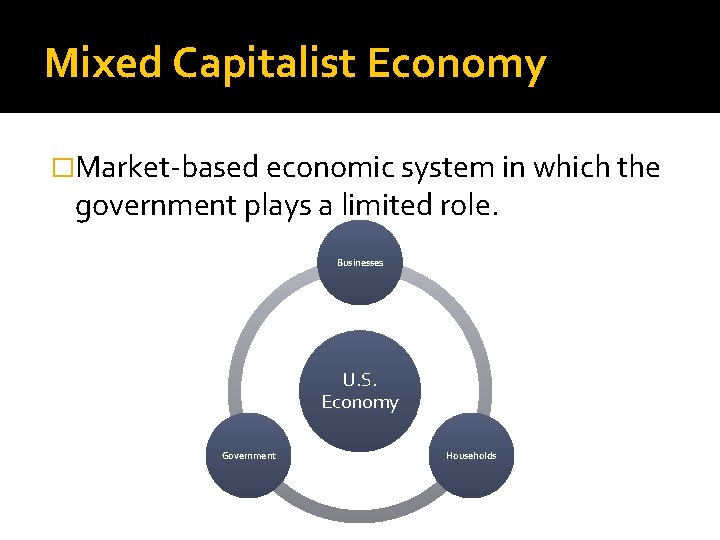
Mixed Capitalist Economy �Market-based economic system in which the government plays a limited role. Businesses U. S. Economy Government Households
Three Key Economic Questions �What to produce with our resources? �How to produce the goods and services? �For whom goods and services are produced? **Individual producers and consumers determine the kinds of goods and services produced AND the prices of those products**
What is a Market?
Our Role �Consumers �Workers �Savers �Investors
CHARACTERISTICS
Laissez-Faire �Idea originated with Adam Smith �Idea that government should generally not intervene in economic/business affairs
Government’s Role �Providing services and goods that the market cannot effectively provide ▪ National Defense ▪ Assistance Programs for Low-Income Families ▪ Interstate highways and airports �Incentives to encourage/discourage production and consumption of products �Safety guidelines that regulate: ▪ Products ▪ Working conditions ▪ Environmental protection
Who is Involved?
People �Vote on public policies and political leaders These leaders set policies that have economic effects
Businesses �Produce and distribute goods and services to consumers.
Labor Unions �Represent some workers in collective bargaining
Cooperatives �Organizations formed by producers or consumers who share resources �Non-profit Organizations: provide services to families or groups.
PILLARS
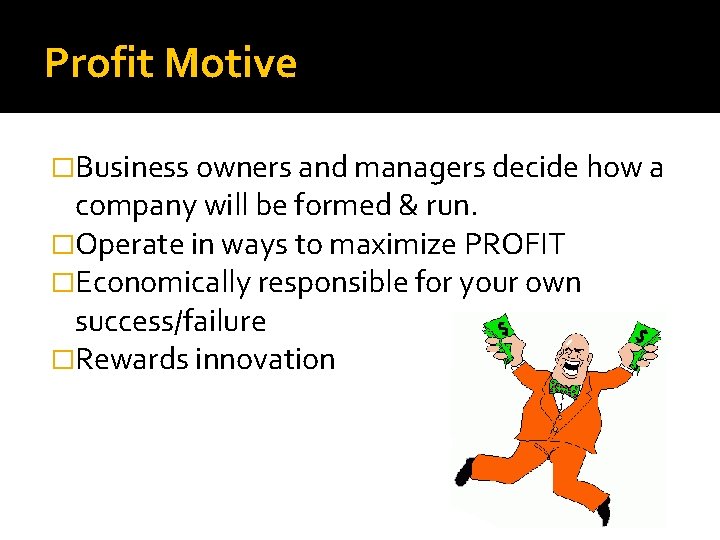
Profit Motive �Business owners and managers decide how a company will be formed & run. �Operate in ways to maximize PROFIT �Economically responsible for your own success/failure �Rewards innovation
Private Property �Property is a protected right under the Fifth Amendment. States included in the 14 th Amendment �Government cannot take land, they have to pay a fair value for it From Individuals AND Corporations
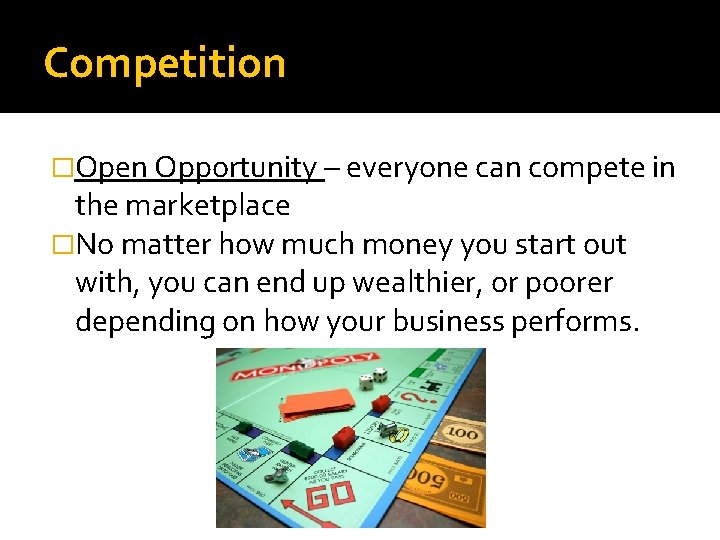
Competition �Open Opportunity – everyone can compete in the marketplace �No matter how much money you start out with, you can end up wealthier, or poorer depending on how your business performs.
Price System �Help move land, labor, and capital into the hands of buyers. �Benefit of a market, sell goods you have and buy things that you want/need.
Factors of Production
Land - Natural Resources �Vast areas of fertile land for crops �Extensive Coastlines/Harbors �Large navigable rivers/lakes to carry products �Moderate Climate
Labor �Only counts those who are working or are actively looking for work �Work for wages OR salaries �Does not include those who perform unpaid labor
Capital �Value of capital goods in the late ‘ 90 s was $11 trillion �Half equipment, half buildings
Entrepreneurship �Thomas Edison �Henry Ford �Bill Gates �Steve Jobs �Sam Walton �Ray Kroc �Harland Sanders �Dave Thomas
Economic Debates Scarcity
Debates UPPER-INCOME FAMILIES LOW-INCOME FAMILIES � Government already takes � Receive more income � Favor higher taxes on too many taxes � Government is taking over too much of the economy upper-income households Because of SCARCITY the market cannot be used to satisfy all wants. Deciding to satisfy one want means paying the cost of not satisfying another.