
The United States Constitution Basic Principles An Outline
The United States Constitution: Basic Principles
An Outline • Written in 1787 and took effect in 1789 • Over 200 years old but still an important & “living” document • Only 7, 000 words, 7 articles, 27 amendments
The Preamble • The introduction to the Constitution • Lists 6 important goals of the new national gov’t “We the People of the United States, in Order to form a more perfect Union, establish Justice, insure domestic Tranquility, provide for the common defense, promote the general Welfare, and secure the Blessings of Liberty to ourselves and our Posterity, do ordain and establish this Constitution for the United States of America. ”
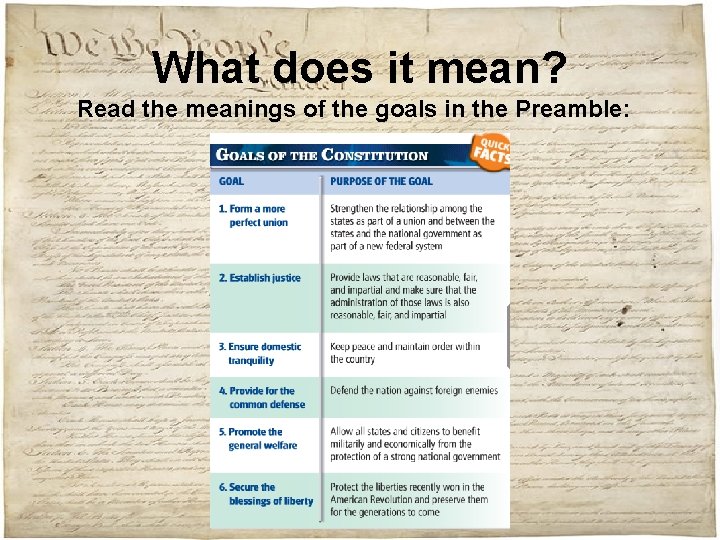
What does it mean? Read the meanings of the goals in the Preamble:
A Stronger Gov’t • When the framers created the Constitution, they were creating a national gov’t with greater powers than under the Articles of Confederation • What was to stop that government from becoming too powerful?
The Basic Principles the Constitution is based upon: 1. 2. 3. 4. 5. 6. 7. Popular Sovereignty Limited Government Separation of Powers Checks and Balances Judicial Review Federalism Rule of Law
1. Popular Sovereignty • All political power resides with the people National government gets its power from people of US, States get their power from people of their states • Popular sovereignty is mentioned in the preamble “We the People…”
2. Limited Government • No government is all powerful • May only do the things the people have given it the power to do • Rule of Law- the government and its officers are always subject to the law • A. k. a. - Constitutionalism: government must be conducted according to the constitution
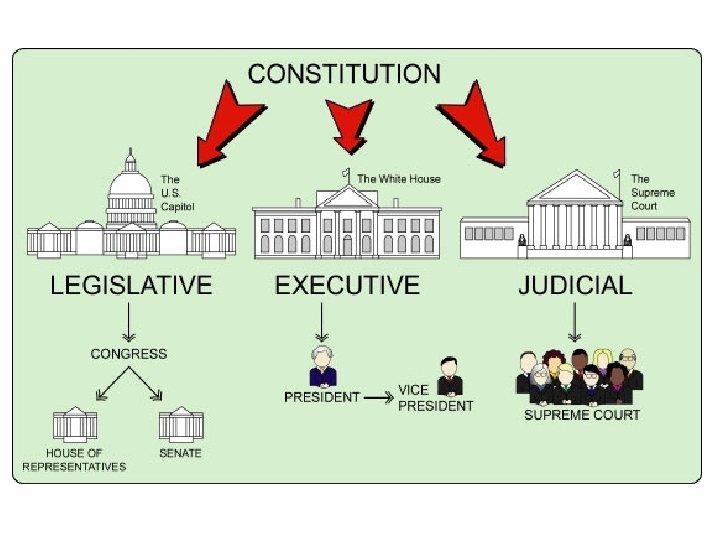
3. Separation of Powers • Basic powers are distributed among three distinct and independent branches of the government • This idea comes from state constitutions • Article 1: Legislative • Article 2: Executive • Article 3: Judicial • Framers intended to create a stronger government but with limited powers
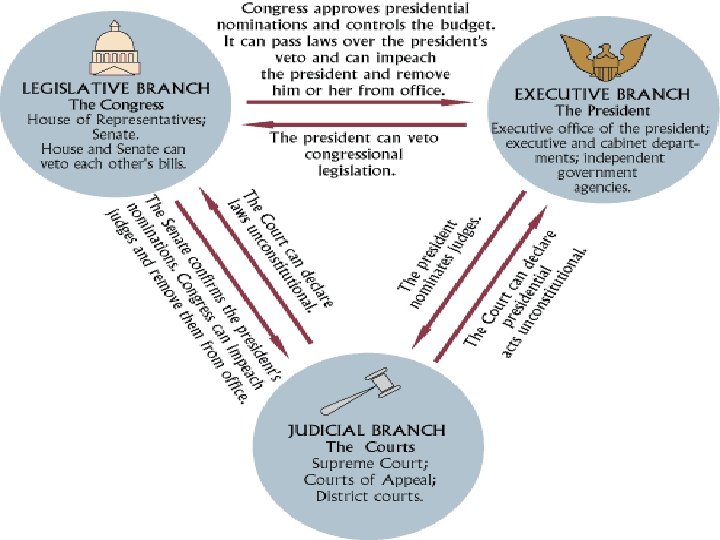
4. Checks and Balances • The 3 branches are tied together by a complex system of checks and balances • Each branch has restraints on it from other branches • Idea is to prevent an “unjust combination of the majority” • Only issues arise when the legislative branch & executive branch are dominated by the same political party
5. Judicial Review • The power of the courts to decide whether what the government does goes along with what the Constitution provides • Power to declare a governmental action unconstitutional • This power is held by all federal courts and most State courts • This is an implied power • Comes from the case Marbury v. Madison (1803)
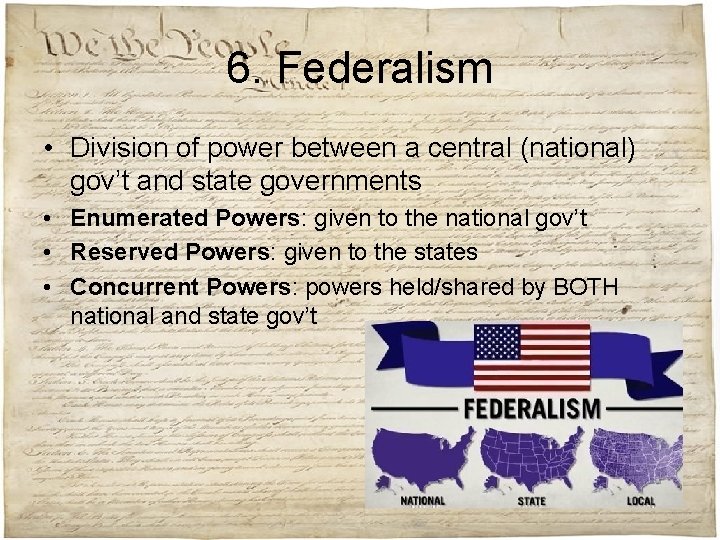
6. Federalism • Division of power between a central (national) gov’t and state governments • Enumerated Powers: given to the national gov’t • Reserved Powers: given to the states • Concurrent Powers: powers held/shared by BOTH national and state gov’t
7. Rule of Law • Everyone is treated equally in the eyes of the law • Nobody is above the law- even the president • Nobody is below the law • The Government must follow the law
- Slides: 15