
The United States Constitution Article III Every Hour

- Slides: 19
The United States Constitution
Article III Every Hour in America there are: n 2 murders n 2 drunk driving deaths n 28 rapes n 58 robberies (with weapon) n 67 attacks on women by someone they know n 103 neglected or abusive acts toward children
Article III Every Hour in America there are: n 157 stalkings n 163 violent attacks on 12 -17 year olds – in school n 349 burglaries (no weapon) n 523 assaults n 1, 540 thefts
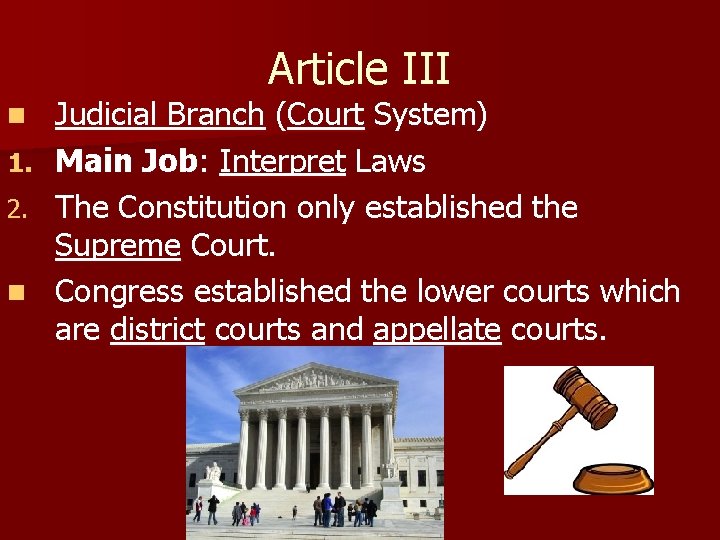
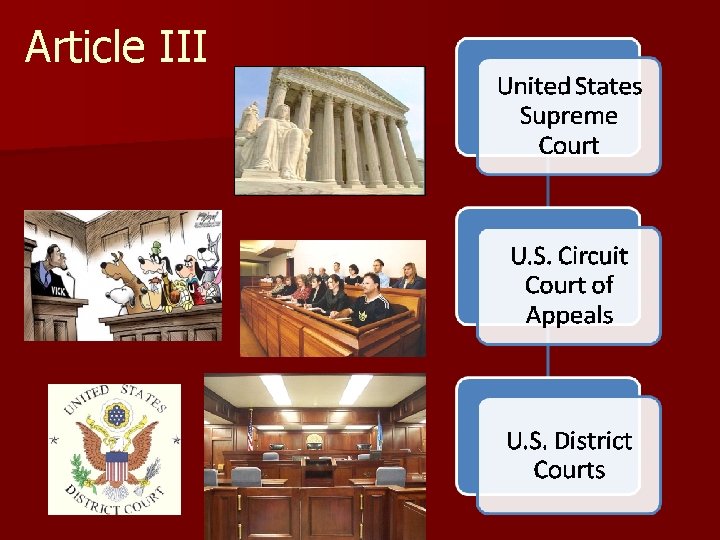
Article III n 1. 2. n Judicial Branch (Court System) Main Job: Interpret Laws The Constitution only established the Supreme Court. Congress established the lower courts which are district courts and appellate courts.
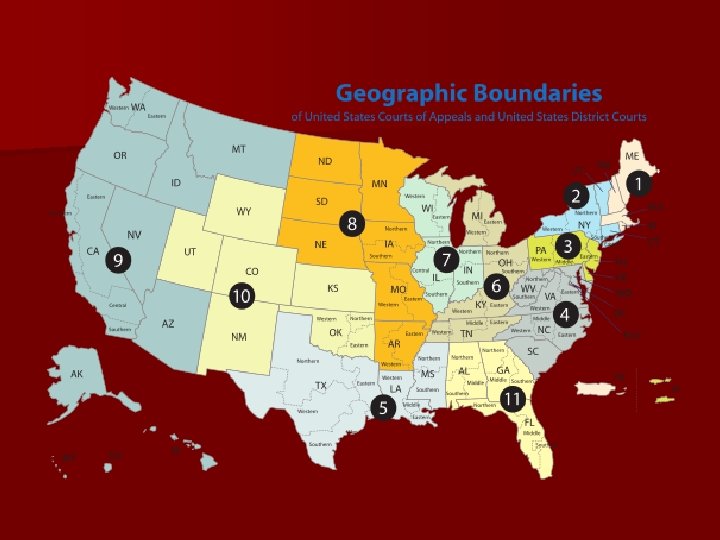
Article III District courts: Most cases begin in district courts. If a party disagrees with the verdict (or decision of the judge and jury), they can appeal it and ask that the decision be reviewed by a higher court. b. Appellate Courts: Also known as the court of appeals. Appellate court judges review decisions of district courts to decide whether they applied the laws correctly. a.
Article III
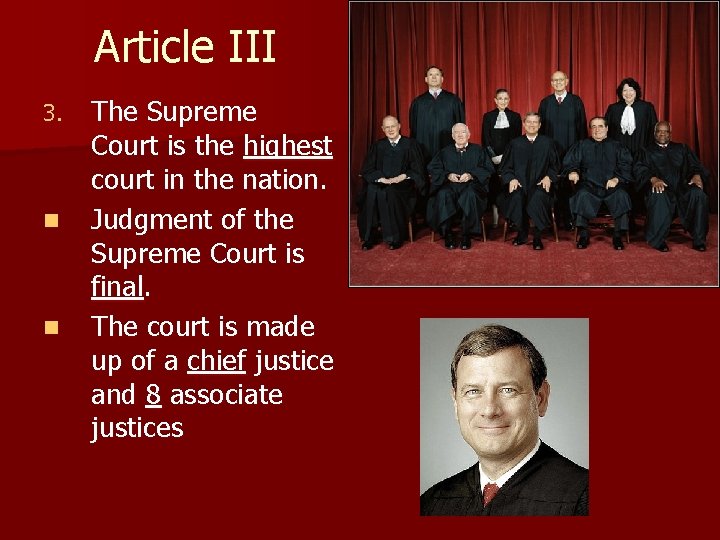
Article III 3. n n The Supreme Court is the highest court in the nation. Judgment of the Supreme Court is final. The court is made up of a chief justice and 8 associate justices
Article III The President appoints justices and they serve for life (until they resign, retire or die). n They can also be impeached and removed from office. 5. The Supreme Court receives and disposes of about 5, 000 cases each year, most by a brief decision that the subject matter is either not proper or not of sufficient importance to warrant review by the full court. n Each year the court decides about 100 cases of great national importance and interest. 4.
Article III The most important power of the Supreme Court is the power to decide what the Constitution means. n It has the right to declare whether acts of the President or laws passed by Congress are unconstitutional, that is, contrary to what is permitted by the US Constitution. 6.
Judicial Process-Answer TRUE or FALSE for each statement. Guess 1. 2. 3. 4. 5. 6.
Judicial Process-Answer TRUE or FALSE for each statement. 1. 2. 3. 4. 5. 6. Criminal laws are intended to prevent people from harming each other or each other’s property. Civil laws cover disputes between people or between the government and its citizens. A judge can impose any punishment he or she feels fits the crime. Felonies are more serious than misdemeanors. A person can plead guilty to a crime and avoid being sent to trial. Convicted persons who believe their case was not handled fairly may appeal to a district court.
Civil Law n Covers disputes between people or between the government and citizens n Usually involve disputes over rights, property or agreements n Examples: – breach of contract (snow plowing) – Family disputes- divorce or child custody n If less than $5000 – handled in small claims court – don’t need a lawyer
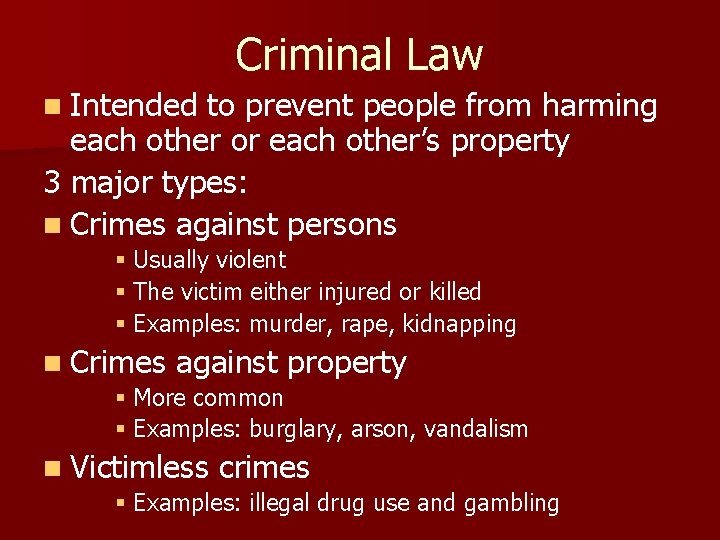
Criminal Law n Intended to prevent people from harming each other or each other’s property 3 major types: n Crimes against persons § Usually violent § The victim either injured or killed § Examples: murder, rape, kidnapping n Crimes against property § More common § Examples: burglary, arson, vandalism n Victimless crimes § Examples: illegal drug use and gambling
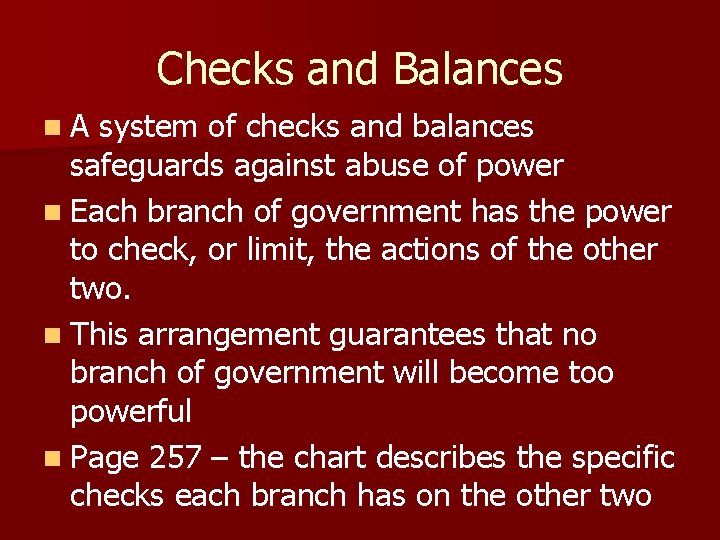
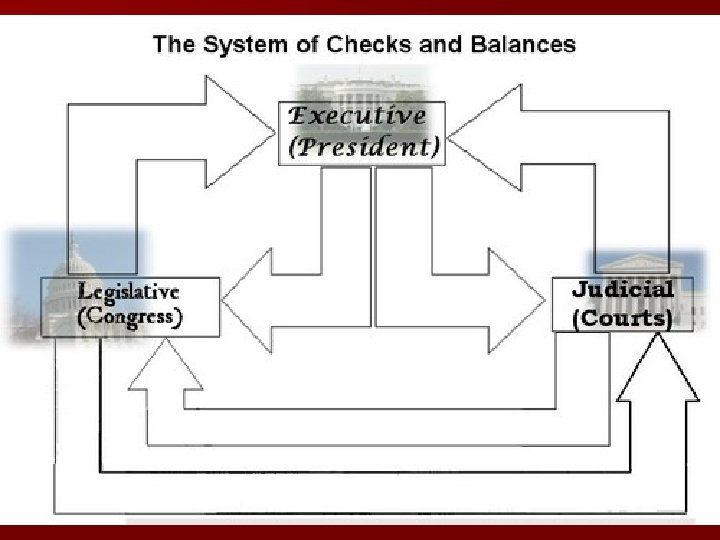
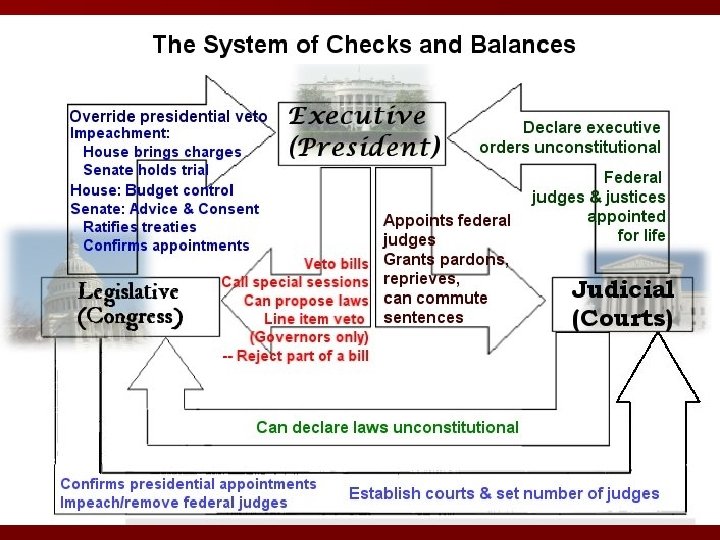
Checks and Balances n. A system of checks and balances safeguards against abuse of power n Each branch of government has the power to check, or limit, the actions of the other two. n This arrangement guarantees that no branch of government will become too powerful n Page 257 – the chart describes the specific checks each branch has on the other two
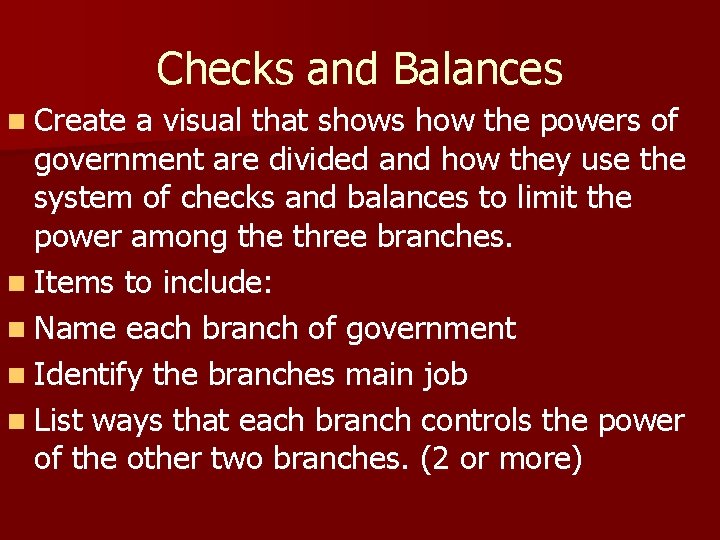
Checks and Balances n Create a visual that shows how the powers of government are divided and how they use the system of checks and balances to limit the power among the three branches. n Items to include: n Name each branch of government n Identify the branches main job n List ways that each branch controls the power of the other two branches. (2 or more)