
The United Fruit Company Suvir C Tarika S
- Slides: 18
“The United Fruit Company” Suvir C. , Tarika S. , Jessica H. , and Gleb S.
Neruda and “The United Fruit Company” ❖ 1950: Neruda was in exile for supporting the Communist Party ❖ Canto General ❖ Political Commentary on the United Fruit Company ❖ Critiques capitalism and unfair division of wealth ❖ emphasizes the plight of the working class
Central America ❖ Guatemala, Honduras, and Costa Rica: economies were based on exporting sugar, coffee, and bananas ❖ Banana republic: a politically unstable country whose economy is largely dependent on exporting a limitedresource product ❖ Exploited by US corporations
What was The United Fruit Company? Trade between American corporation and Central American dictators and upper class Boston-based company - purchased fruit from Central American countries for cheap prices Manipulated Western Hemisphere fruit industry Workers paid extremely low wages and forced to endure terrible working conditions
US Involvement/Corporations ❖ Coca Cola ➢ Used, and still uses South America for manufacturing ➢ Accused of murdering workers who have tried to unionize ❖ Anaconda ➢ Mining conglomerate that supplied few rights to Chilean miners ➢ Supplied money to fund Pinochet’s coup in 1971, overthrowing Allende ■ Government had claimed their mines, but control was restored under
US Involvement/Corporations ❖ United Fruit Company ➢ Grew tropical fruit in banana republics ➢ Sold and traded this fruit in U. S. and Europe ❖ These companies embody capitalism and the American dream. ➢ Influenced more than just trading of resources, also Latin American government
The Banana Massacre ❖ December 6 th, 1928 ❖ Colombian workers on banana plantations went on strike ❖ Demanded better working conditions ❖ US gov’t threatened to invade with the Marine Corps if Colombia didn’t protect United Fruit Company’s interests ❖ President Miguel Méndez sent the Colombian Army to end the strike with a massacre
Dominant Effect: Through his use of allusions, Neruda depicts the United Fruit Company in a negative light and critiques U. S. neocolonialism in Central America.
Color Coding Allusions Tone Metaphor Imagery
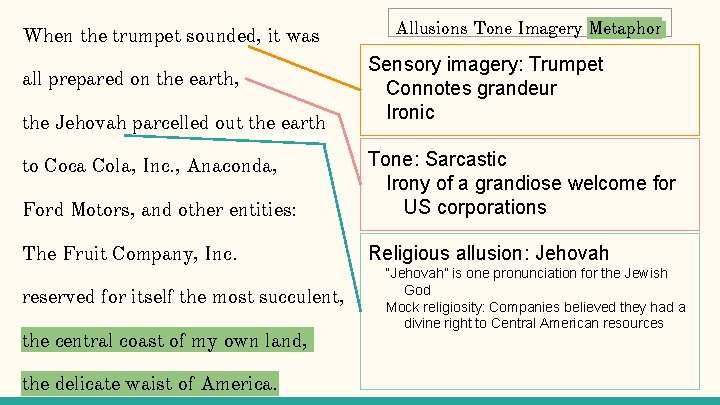
When the trumpet sounded, it was all prepared on the earth, the Jehovah parcelled out the earth Allusions Tone Imagery Metaphor Sensory imagery: Trumpet Connotes grandeur Ironic Ford Motors, and other entities: Tone: Sarcastic Irony of a grandiose welcome for US corporations The Fruit Company, Inc. Religious allusion: Jehovah to Coca Cola, Inc. , Anaconda, reserved for itself the most succulent, the central coast of my own land, the delicate waist of America. “Jehovah” is one pronunciation for the Jewish God Mock religiosity: Companies believed they had a divine right to Central American resources
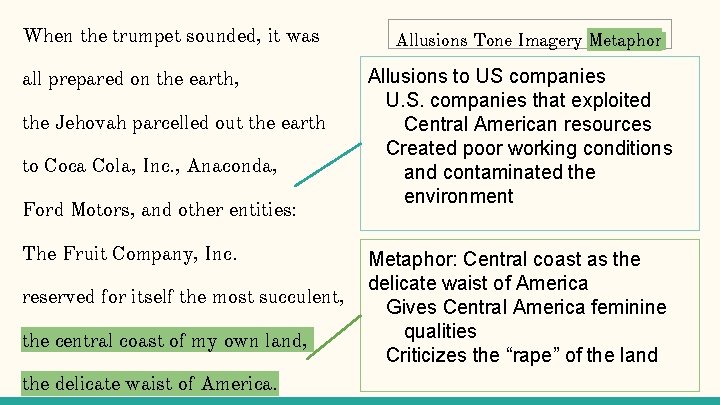
When the trumpet sounded, it was all prepared on the earth, the Jehovah parcelled out the earth to Coca Cola, Inc. , Anaconda, Ford Motors, and other entities: The Fruit Company, Inc. reserved for itself the most succulent, the central coast of my own land, the delicate waist of America. Allusions Tone Imagery Metaphor Allusions to US companies U. S. companies that exploited Central American resources Created poor working conditions and contaminated the environment Metaphor: Central coast as the delicate waist of America Gives Central America feminine qualities Criticizes the “rape” of the land
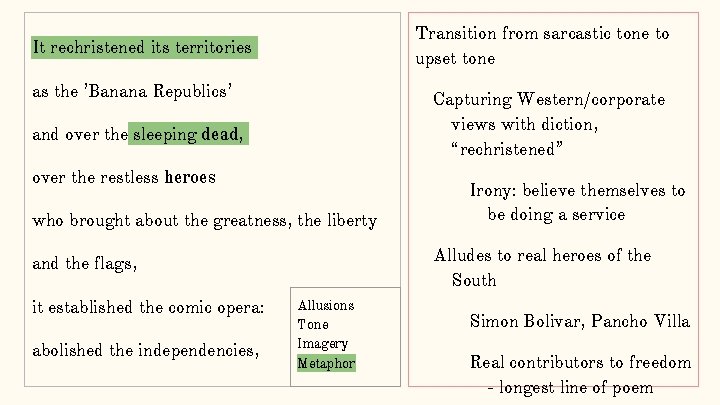
Transition from sarcastic tone to upset tone It rechristened its territories as the ’Banana Republics’ Capturing Western/corporate views with diction, “rechristened” and over the sleeping dead, over the restless heroes who brought about the greatness, the liberty Alludes to real heroes of the South and the flags, it established the comic opera: abolished the independencies, Irony: believe themselves to be doing a service Allusions Tone Imagery Metaphor Simon Bolivar, Pancho Villa Real contributors to freedom - longest line of poem
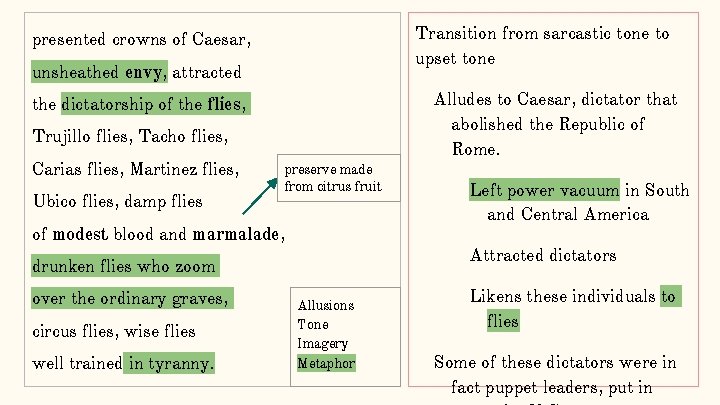
Transition from sarcastic tone to upset tone presented crowns of Caesar, unsheathed envy, attracted Alludes to Caesar, dictator that abolished the Republic of Rome. the dictatorship of the flies, Trujillo flies, Tacho flies, Carias flies, Martinez flies, Ubico flies, damp flies preserve made from citrus fruit of modest blood and marmalade, Attracted dictators drunken flies who zoom over the ordinary graves, circus flies, wise flies well trained in tyranny. Left power vacuum in South and Central America Allusions Tone Imagery Metaphor Likens these individuals to flies Some of these dictators were in fact puppet leaders, put in
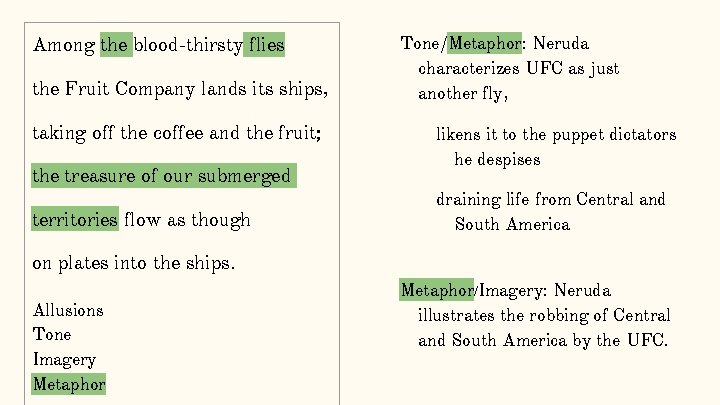
Among the blood-thirsty flies the Fruit Company lands its ships, taking off the coffee and the fruit; the treasure of our submerged territories flow as though Tone/Metaphor: Neruda characterizes UFC as just another fly, likens it to the puppet dictators he despises draining life from Central and South America on plates into the ships. Allusions Tone Imagery Metaphor/Imagery: Neruda illustrates the robbing of Central and South America by the UFC.
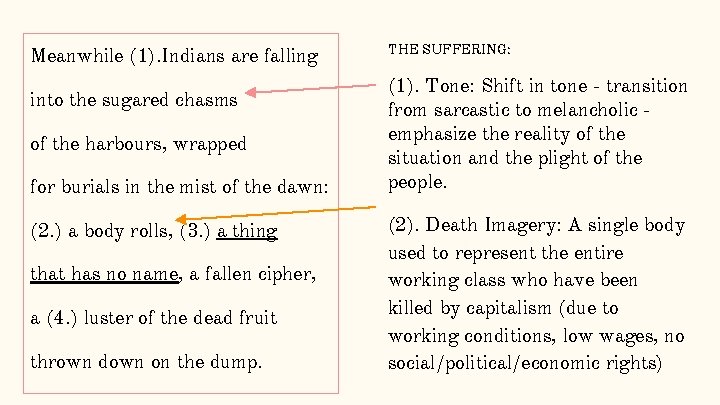
Meanwhile (1). Indians are falling into the sugared chasms of the harbours, wrapped for burials in the mist of the dawn: (2. ) a body rolls, (3. ) a thing that has no name, a fallen cipher, a (4. ) luster of the dead fruit thrown down on the dump. THE SUFFERING: (1). Tone: Shift in tone - transition from sarcastic to melancholic emphasize the reality of the situation and the plight of the people. (2). Death Imagery: A single body used to represent the entire working class who have been killed by capitalism (due to working conditions, low wages, no social/political/economic rights)
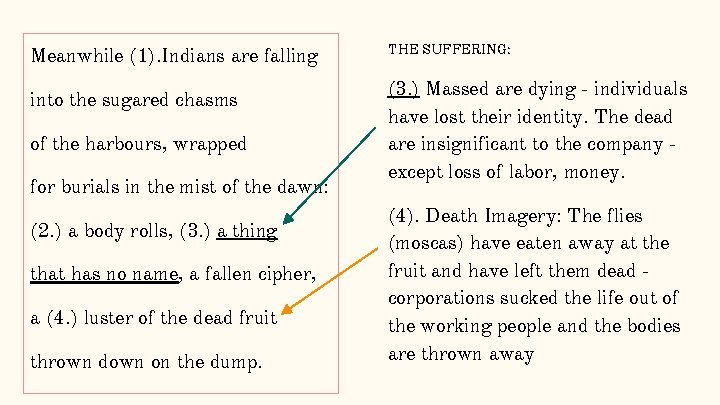
Meanwhile (1). Indians are falling into the sugared chasms of the harbours, wrapped for burials in the mist of the dawn: (2. ) a body rolls, (3. ) a thing that has no name, a fallen cipher, a (4. ) luster of the dead fruit thrown down on the dump. THE SUFFERING: (3. ) Massed are dying - individuals have lost their identity. The dead are insignificant to the company except loss of labor, money. (4). Death Imagery: The flies (moscas) have eaten away at the fruit and have left them dead corporations sucked the life out of the working people and the bodies are thrown away
Conclusion ● Written as a political commentary of the United Fruit Company - critiques the manipulation of the lower class by the USA (capitalism) and the rich political leaders in Central America ● Neruda’s use of: ○ Allusions: Large corporations such as Coca Cola, Ford Motors, Anaconda Mines - symbolism of the capitalism and unfair distribution of wealth ○ Tone: A shift in tone (sarcastic -> upset/melancholic) to emphasize the reality of the situation (death of the innocent workers). ○ Imagery: Death imagery (the flies eating away at the fruit), Central America being torn apart ○ Metaphor: the flies (las moscas) eating away at the fruit -> large corporations eating away at Central America
Today the United Fruit Company is Chiquita Brands International.