
THE UNIQUE WORLD OF WORKERS COMPENSATION THE HANFORD







- Slides: 110
THE UNIQUE WORLD OF WORKERS’ COMPENSATION THE HANFORD EXPERIENCE 2010
RCW & WAC All workers’ compensation claims filed in Washington State are handled utilizing the same guidelines RCW Title 51 - Revised Code of Washington WAC - Washington Administrative Codes
NO FAULT Washington’s industrial insurance program is a “No Fault” system
Course of Employment For an injury claim, the worker does not have to be doing his/her actual job in order to be covered The worker is usually covered: while acting at the employer’s direction furthering the employer’s business
Compensability For both an injury and occupational disease claims, the medical condition diagnosed must be related to the incident and/or job duties on a “more probable then not basis” It is not sufficient that a physician indicate “possibly” or “may” be the cause
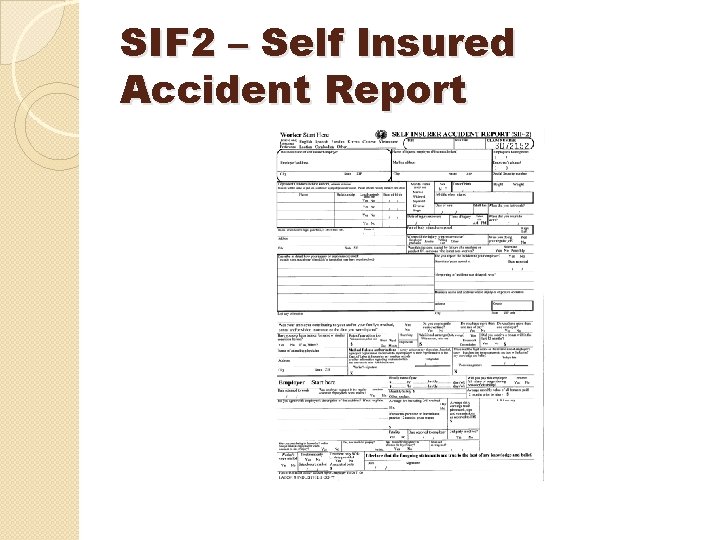
SIF 2 – Self Insured Accident Report
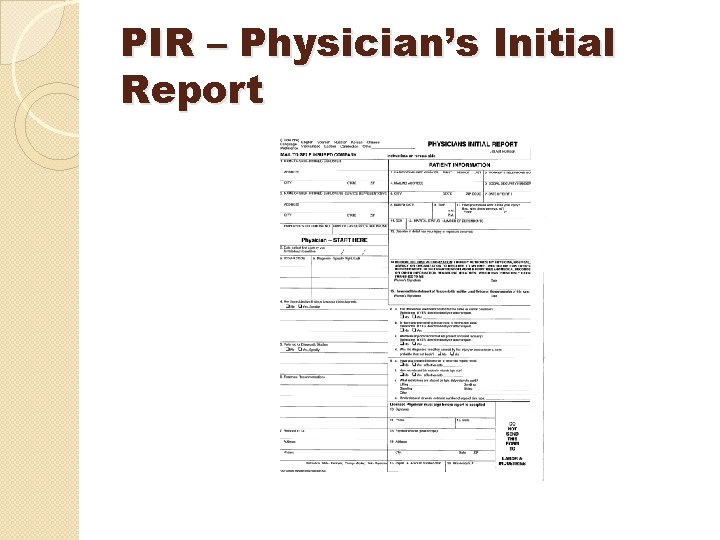
PIR – Physician’s Initial Report
Department of Labor & Industries Order & Notice
SELF – INSURED CLAIM Report the injury to your employer Request a Self Insurer Accident Report (SIF 2) from your Worker’s Compensation Representative (WCR) See a doctor of your choice The doctor will complete the Physician’s Initial Report (PIR) form The doctor mails the completed PIR to the Third Party Administrator (TPA)
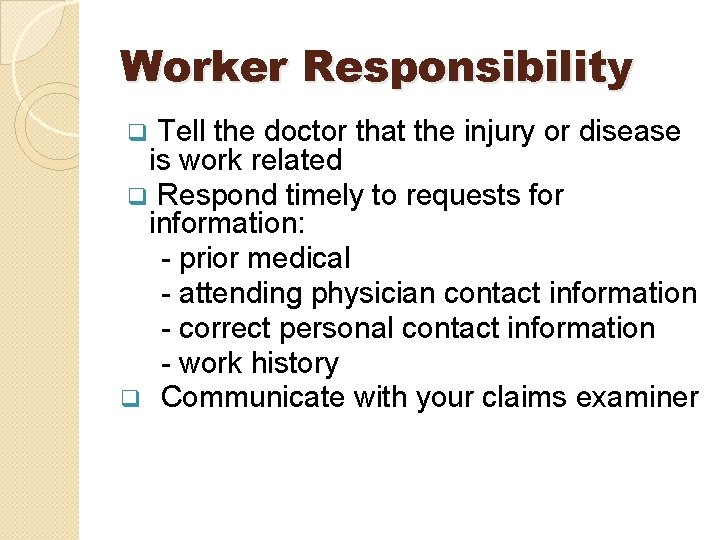
Worker Responsibility Tell the doctor that the injury or disease is work related Respond timely to requests for information: - prior medical - attending physician contact information - correct personal contact information - work history Communicate with your claims examiner
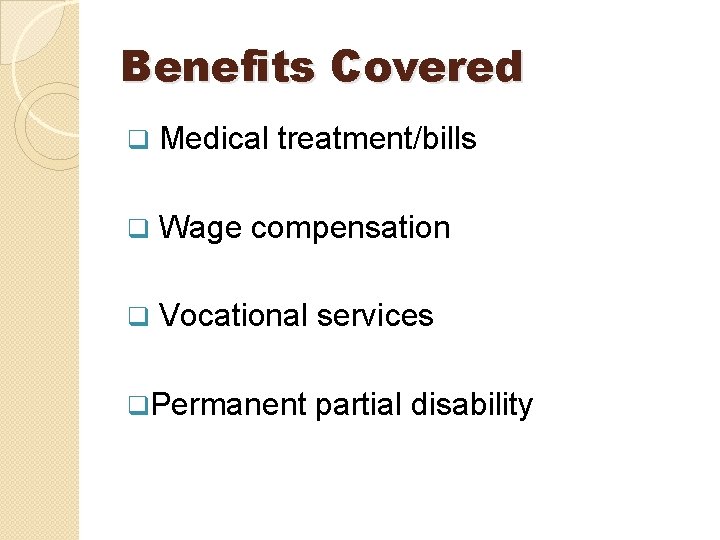
Benefits Covered Medical treatment/bills Wage compensation Vocational services Permanent partial disability
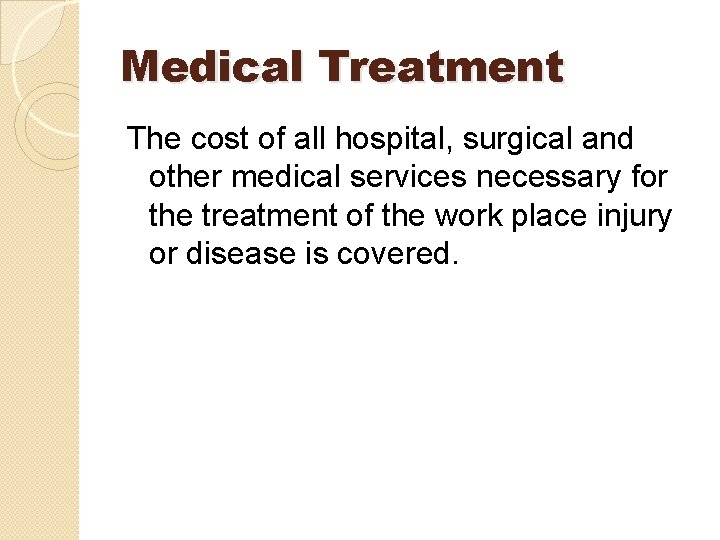
Medical Treatment The cost of all hospital, surgical and other medical services necessary for the treatment of the work place injury or disease is covered.
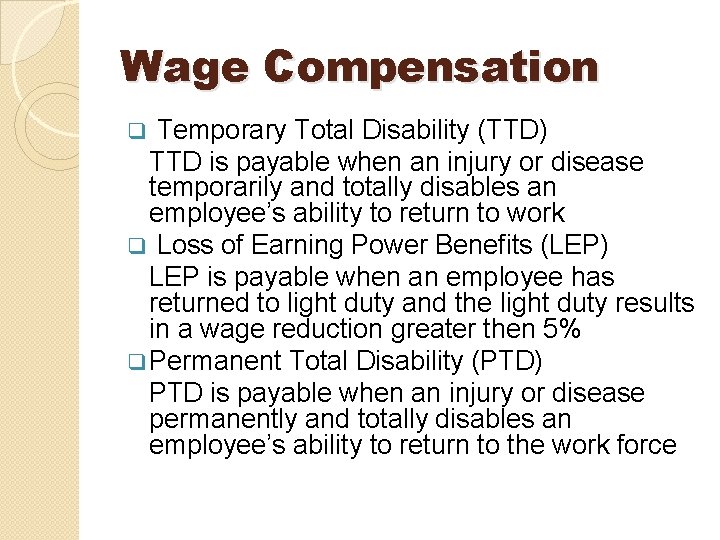
Wage Compensation Temporary Total Disability (TTD) TTD is payable when an injury or disease temporarily and totally disables an employee’s ability to return to work Loss of Earning Power Benefits (LEP) LEP is payable when an employee has returned to light duty and the light duty results in a wage reduction greater then 5% Permanent Total Disability (PTD) PTD is payable when an injury or disease permanently and totally disables an employee’s ability to return to the work force
Permanent Partial Disability When a work place injury or disease results in a permanent physical impairment, a rating evaluation is conducted by either the treating physician or an independent medical examiner. Once the percentage of impairment is determined the Washington State Department of Labor & Industries will issue a closing order that stipulates the impairment award associated with the percentage of loss.
Independent Medical Examinations An injured worker must appear for an independent medical evaluation (IME) scheduled by the self insured employer or the third party administrator.
Purpose of IME To determine if current treatment is appropriate or to determine if further treatment is necessary To determine if a condition is at maximum medical improvement To determine permanent partial disability To resolve disputes in the claim To address reopening of a claim
Office of the Ombudsman For Self Insured Injured Workers
What they do: They can: - advise workers of the rights and responsibilities - investigate complaints - work to ensure workers receive the appropriate benefits under the law They cannot: - issue Department orders - authorize treatment - pay benefits - represent workers at the Board of Industrial Insurance Appeals
Why would a worker contact their office? If a worker has a general questions about workers compensation If a worker has a claim and feels they need assistance with understanding the claims process or to resolve a specific claim issue
Ombudsman Contact Information Mailing address: Office of the Self Insured Ombudsman Department of Labor & Industries PO Box 44001 Olympia WA 98504 -4001 Phone: 1 -888 -317 -0493 Fax: 360 -9024202 Website: Ombudsman. Selfinsured. wa. gov
Other resources for information: Self insurance section of the Washington State Department of Labor & Industries Phone: 360 -92 -6901 http: //www. lni. wa. gov/Main/Worker. Topics. a sp To locate a provider: findadoc@lni. wa. gov
Questions? ? ?
Work Suitability Evaluation (WSE)
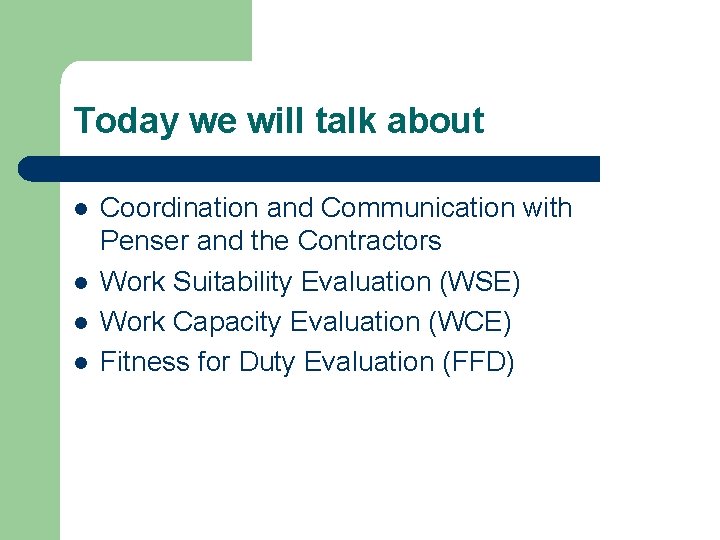
Today we will talk about l l Coordination and Communication with Penser and the Contractors Work Suitability Evaluation (WSE) Work Capacity Evaluation (WCE) Fitness for Duty Evaluation (FFD)
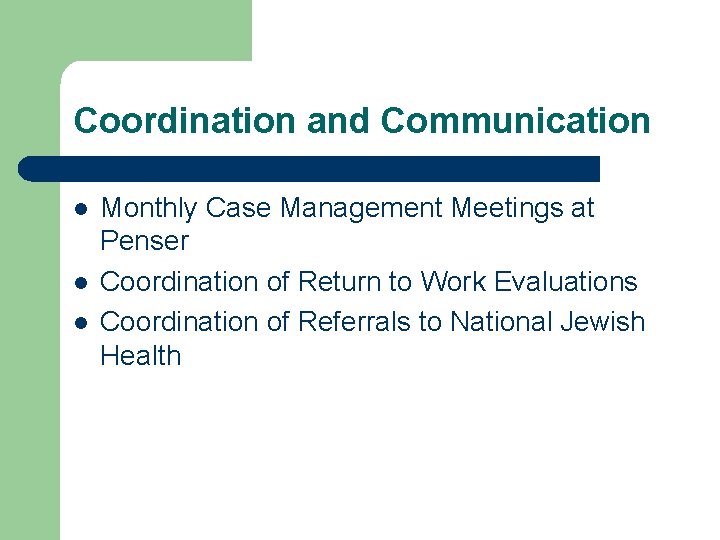
Coordination and Communication l l l Monthly Case Management Meetings at Penser Coordination of Return to Work Evaluations Coordination of Referrals to National Jewish Health
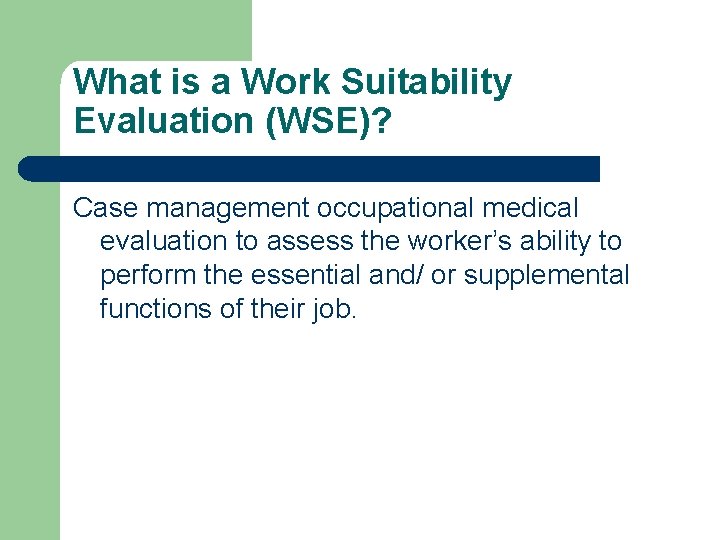
What is a Work Suitability Evaluation (WSE)? Case management occupational medical evaluation to assess the worker’s ability to perform the essential and/ or supplemental functions of their job.
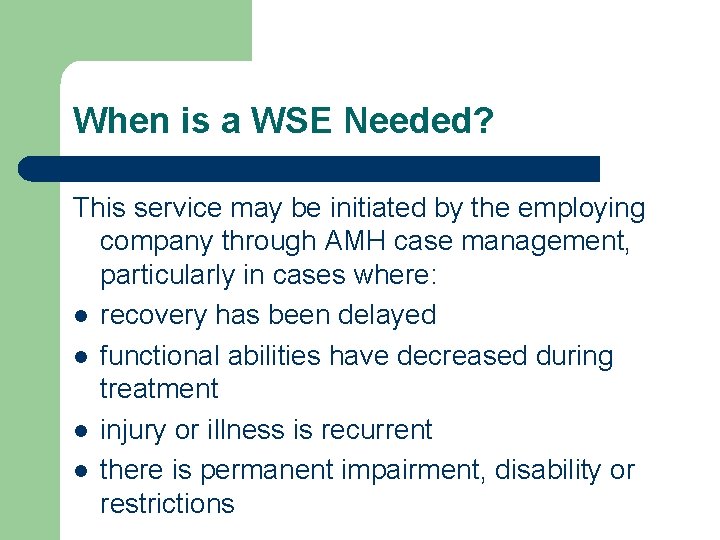
When is a WSE Needed? This service may be initiated by the employing company through AMH case management, particularly in cases where: l recovery has been delayed l functional abilities have decreased during treatment l injury or illness is recurrent l there is permanent impairment, disability or restrictions
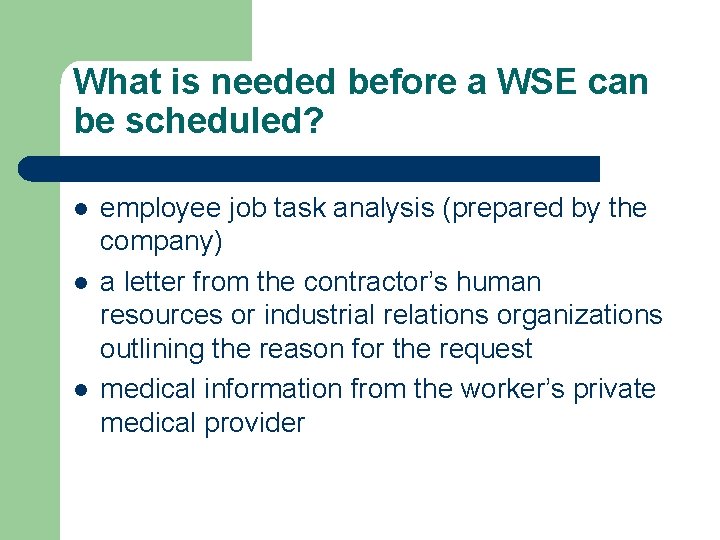
What is needed before a WSE can be scheduled? l l l employee job task analysis (prepared by the company) a letter from the contractor’s human resources or industrial relations organizations outlining the reason for the request medical information from the worker’s private medical provider
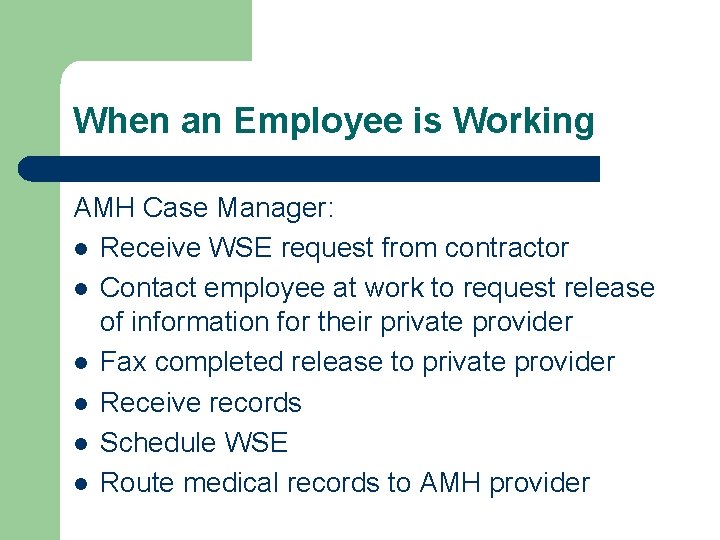
When an Employee is Working AMH Case Manager: l Receive WSE request from contractor l Contact employee at work to request release of information for their private provider l Fax completed release to private provider l Receive records l Schedule WSE l Route medical records to AMH provider
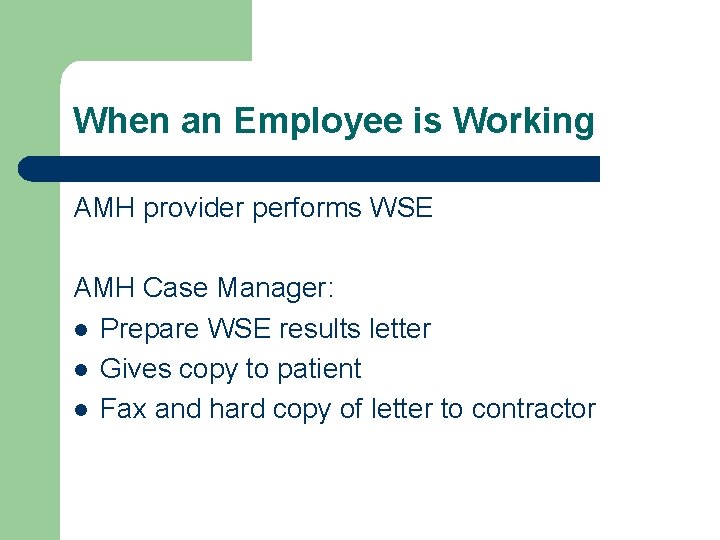
When an Employee is Working AMH provider performs WSE AMH Case Manager: l Prepare WSE results letter l Gives copy to patient l Fax and hard copy of letter to contractor
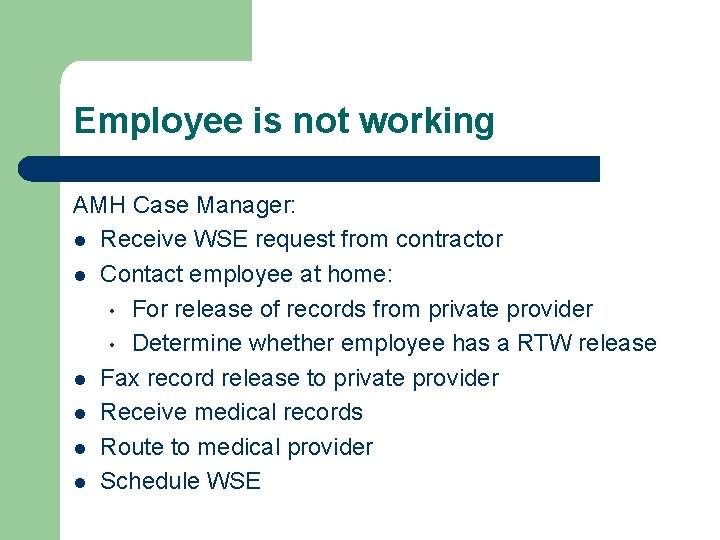
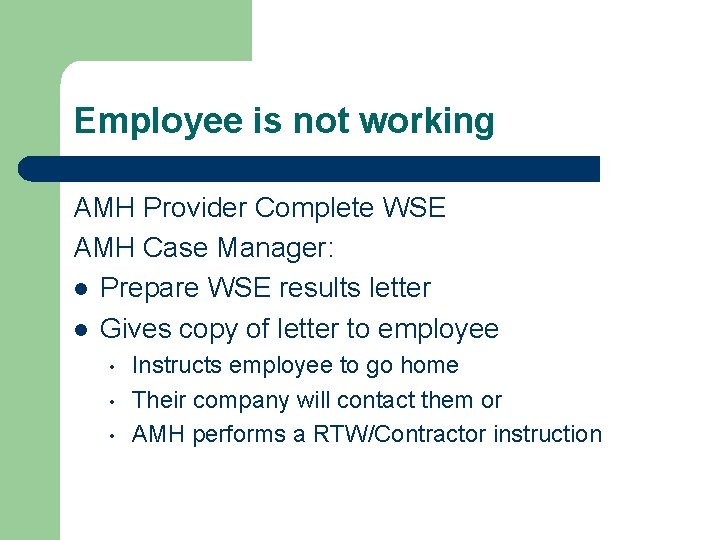
Employee is not working AMH Case Manager: l Receive WSE request from contractor l Contact employee at home: • For release of records from private provider • Determine whether employee has a RTW release l Fax record release to private provider l Receive medical records l Route to medical provider l Schedule WSE
Employee is not working AMH Provider Complete WSE AMH Case Manager: l Prepare WSE results letter l Gives copy of letter to employee • • • Instructs employee to go home Their company will contact them or AMH performs a RTW/Contractor instruction
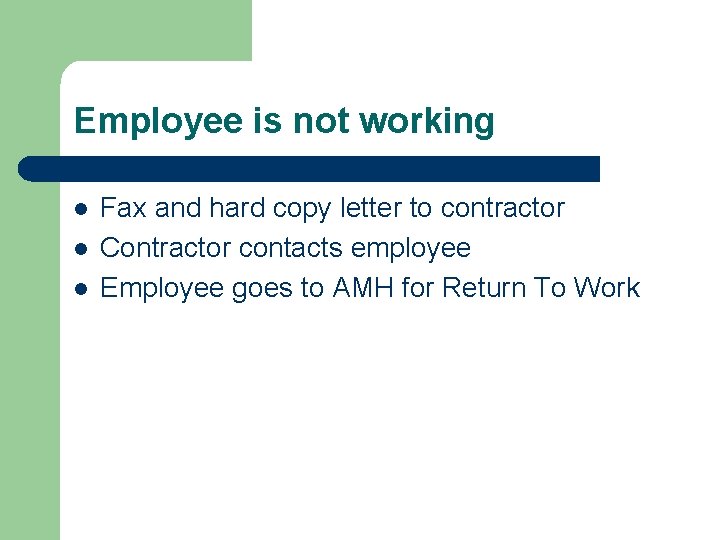
Employee is not working l l l Fax and hard copy letter to contractor Contractor contacts employee Employee goes to AMH for Return To Work
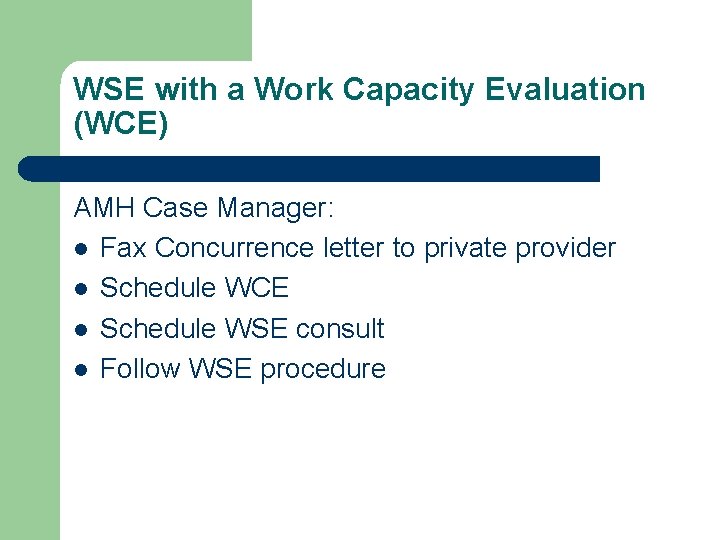
WSE with a Work Capacity Evaluation (WCE) AMH Case Manager: l Fax Concurrence letter to private provider l Schedule WCE l Schedule WSE consult l Follow WSE procedure
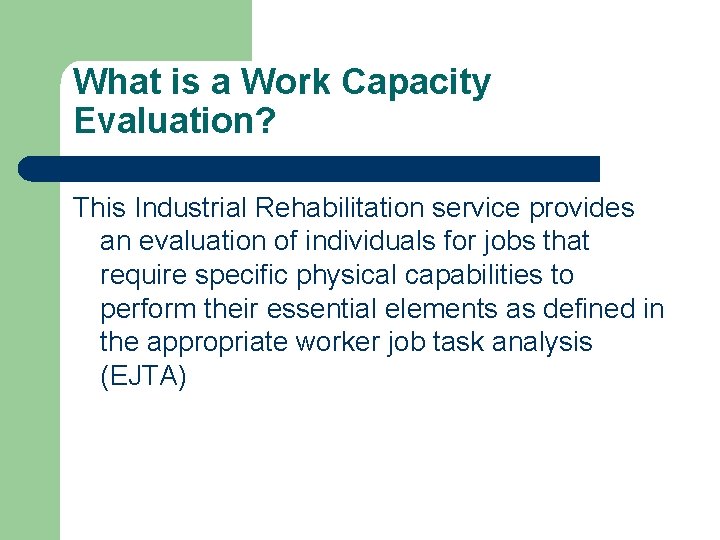
What is a Work Capacity Evaluation? This Industrial Rehabilitation service provides an evaluation of individuals for jobs that require specific physical capabilities to perform their essential elements as defined in the appropriate worker job task analysis (EJTA)
Testing components of the work capacity evaluation (WCE) l l l Analysis of client reliability of pain and disability report Evaluation of marginal effort Intake and vital signs sitting/standing/walking lift and carry capacity range of motion
Components cont. l l l muscular strength and endurance (i. e. climbing, pushing, pulling) functional aerobic capacity musculoskeletal evaluation fine & gross dexterity & hand pinch/grip job simulation and job-task-specific assessment
What is a Fitness for Duty (FFD)Evaluation? This evaluation is a comprehensive, behavioral health assessment as requested by eligible Hanford employers and/or their human resources organizations for performance concerns or for work suitability or reliability.
FFD may include one or all of the following: l l l Psychological assessments Psychological testing Substance abuse assessments Return-to-work assessments Psychological monitoring plans Substance abuse monitoring plans
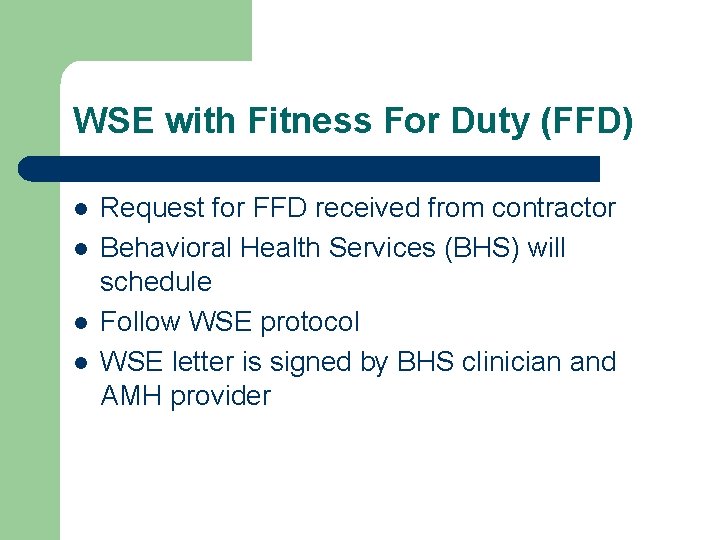
WSE with Fitness For Duty (FFD) l l Request for FFD received from contractor Behavioral Health Services (BHS) will schedule Follow WSE protocol WSE letter is signed by BHS clinician and AMH provider
Questions? ? ?
UNDERSTANDING WASHINGTON WORKERS’ COMPENSATION Lawrence E. Mann
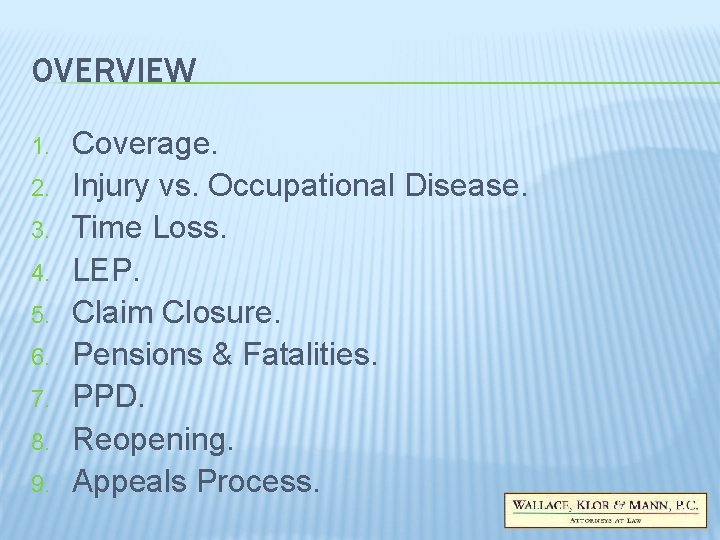
OVERVIEW 1. 2. 3. 4. 5. 6. 7. 8. 9. Coverage. Injury vs. Occupational Disease. Time Loss. LEP. Claim Closure. Pensions & Fatalities. PPD. Reopening. Appeals Process.
1. COVERAGE
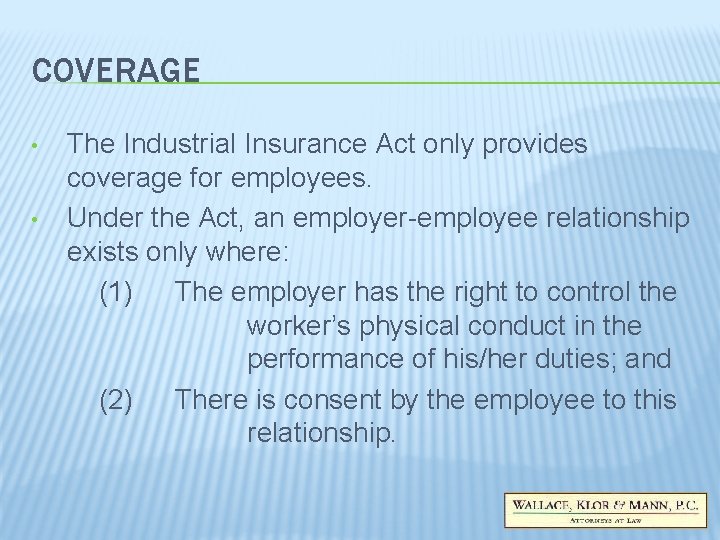
COVERAGE • • The Industrial Insurance Act only provides coverage for employees. Under the Act, an employer-employee relationship exists only where: (1) The employer has the right to control the worker’s physical conduct in the performance of his/her duties; and (2) There is consent by the employee to this relationship.
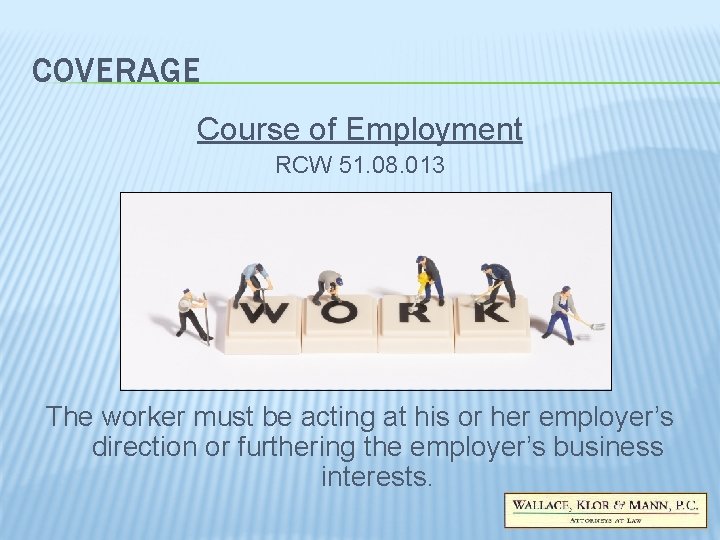
COVERAGE Course of Employment RCW 51. 08. 013 The worker must be acting at his or her employer’s direction or furthering the employer’s business interests.
COVERAGE • Course of Employment Key distinctions between Washington State law and other jurisdictions include: • • No consideration is given to degrees of “fault” by the worker or employer in determining entitlement to benefits. While it is necessary that the injury occur in the course of one’s work, it is not necessary that the injury “arise out of” the particular duties a worker is paid to perform.
COVERAGE Parking Lots (RCW 51. 08. 013) • • Injuries that occur in parking lots are generally not allowable. However, courts have held that the statute allows coverage for parking lot injuries if the job duties require the worker’s presence in the parking lot.
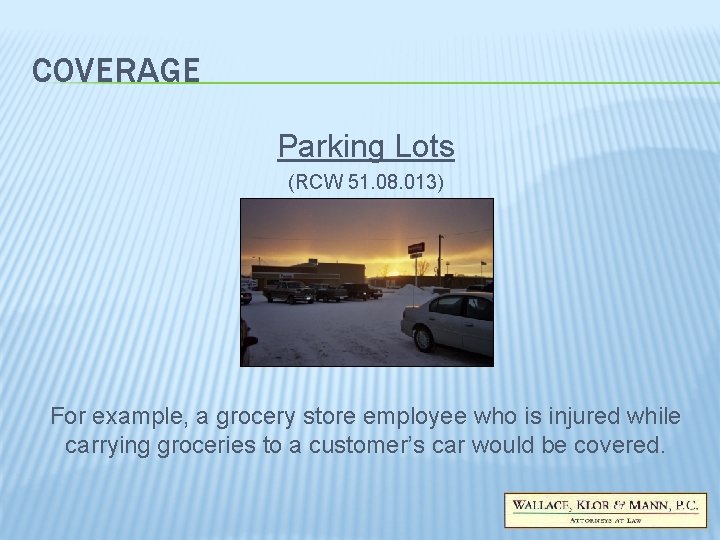
COVERAGE Parking Lots (RCW 51. 08. 013) For example, a grocery store employee who is injured while carrying groceries to a customer’s car would be covered.
COVERAGE Coming & Going (RCW 51. 08. 013) • • A worker injured going to and coming from the workplace in a private vehicle is generally deemed outside the course of employment. However, the worker is covered within a company-controlled area (except a parking lot), while reporting to or leaving work.
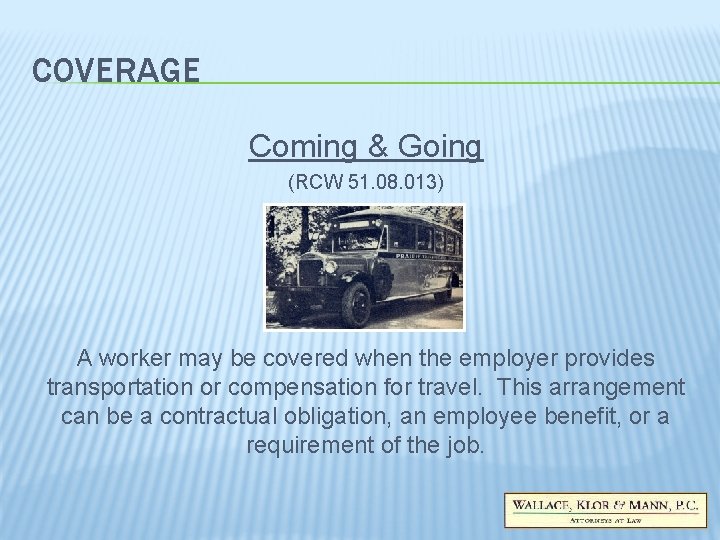
COVERAGE Coming & Going (RCW 51. 08. 013) A worker may be covered when the employer provides transportation or compensation for travel. This arrangement can be a contractual obligation, an employee benefit, or a requirement of the job.
2. INJURY VS. OCCUPATIONAL DISEASE
INJURY VS. OCCUPATIONAL DISEASE • • When a claims manager reviews a claim, he or she begins by determining if the claim is filed for an injury or an occupational disease. This characterization of the claim will dictate further adjudication, including the application of timely filing requirements and requirements for allowance.
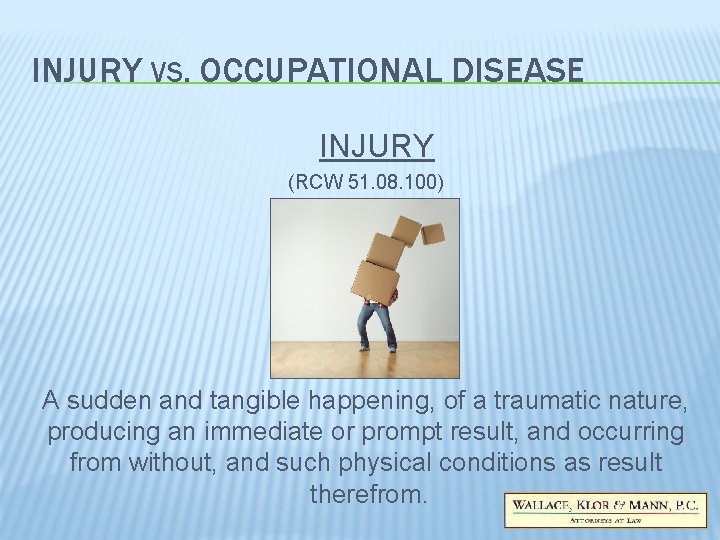
INJURY VS. OCCUPATIONAL DISEASE INJURY (RCW 51. 08. 100) A sudden and tangible happening, of a traumatic nature, producing an immediate or prompt result, and occurring from without, and such physical conditions as result therefrom.
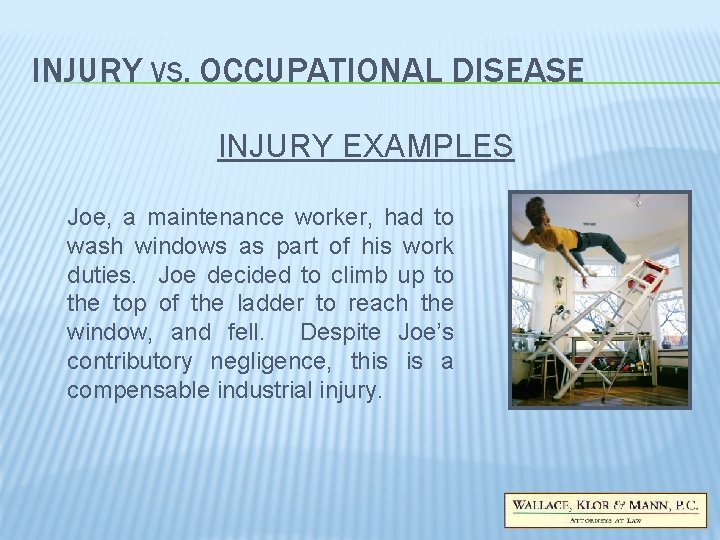
INJURY VS. OCCUPATIONAL DISEASE INJURY EXAMPLES Joe, a maintenance worker, had to wash windows as part of his work duties. Joe decided to climb up to the top of the ladder to reach the window, and fell. Despite Joe’s contributory negligence, this is a compensable industrial injury.
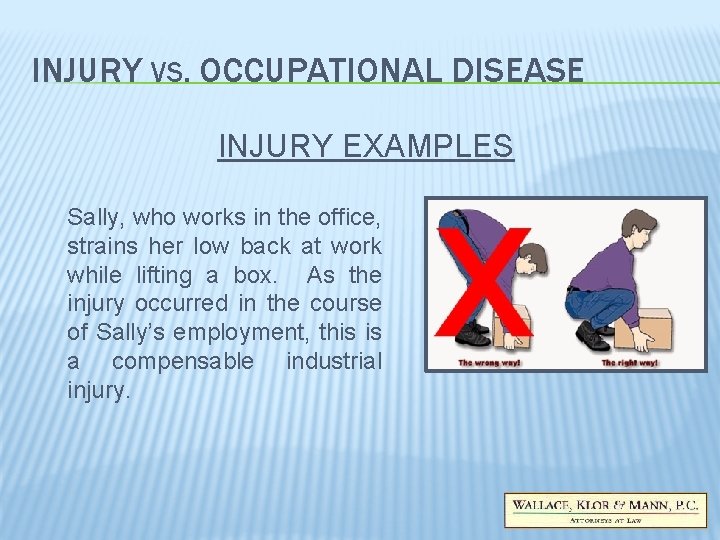
INJURY VS. OCCUPATIONAL DISEASE INJURY EXAMPLES Sally, who works in the office, strains her low back at work while lifting a box. As the injury occurred in the course of Sally’s employment, this is a compensable industrial injury.
INJURY VS. OCCUPATIONAL DISEASE INJURY EXAMPLES HOWEVER… Employee Perry is struck in the face by his supervisor, Beverage, with a ceramic pitcher. Asked how hard he had struck Perry, the supervisor responds: “I struck him with all my might. I don’t know just how hard I did strike him. ” This has been held to not constitute an industrial injury under the “deliberate intention” exception to the Industrial Insurance Act. Perry v. Beverage, 121 Wash. 652 (1922).
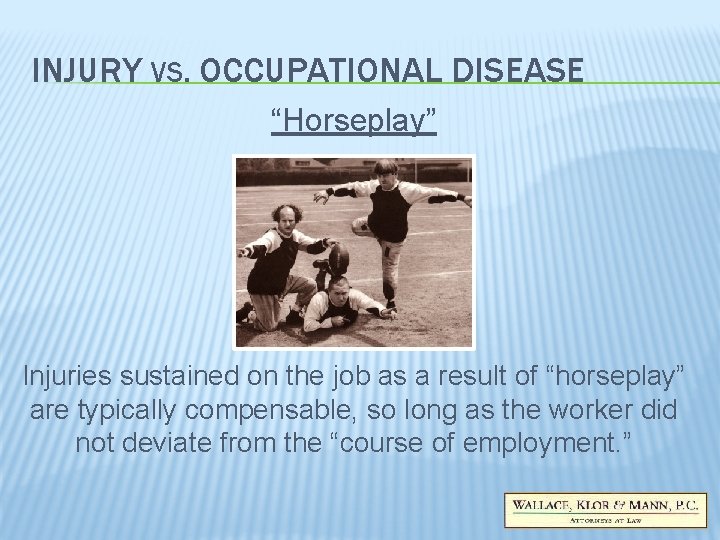
INJURY VS. OCCUPATIONAL DISEASE “Horseplay” Injuries sustained on the job as a result of “horseplay” are typically compensable, so long as the worker did not deviate from the “course of employment. ”
INJURY VS. OCCUPATIONAL DISEASE INJURY EXAMPLES Bill was injured while scuffling with a co-worker during his lunch break on the employer’s premises. His co-workers had been teasing him the entire morning. This is likely a compensable injury because the injuries were received in the lunchroom. In re: Vince Polmanteer, BIIA Dec. , 88 0362 (1989).
INJURY VS. OCCUPATIONAL DISEASE HOWEVER… Frank was injured while lifting his employer’s business associate during a “beer break” near the end of normal working hours. This was deemed to be not compensable because Frank’s participation in the beer break was a deviation from and abandonment of the course of employment. In re: Thomas G. Roe, BIIA Dec. , 43 694 (1974).
INJURY VS. OCCUPATIONAL DISEASE Occupational Disease (RCW 51. 08. 140) A disease or infection that arises naturally and proximately out of employment.
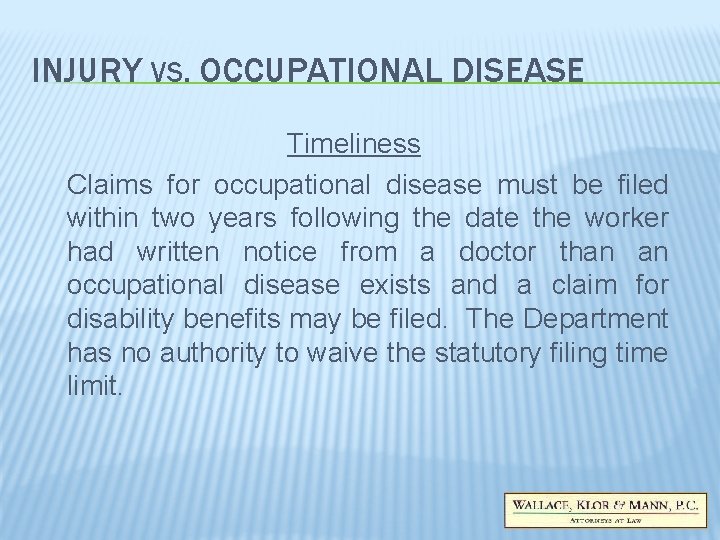
INJURY VS. OCCUPATIONAL DISEASE Timeliness Claims for occupational disease must be filed within two years following the date the worker had written notice from a doctor than an occupational disease exists and a claim for disability benefits may be filed. The Department has no authority to waive the statutory filing time limit.
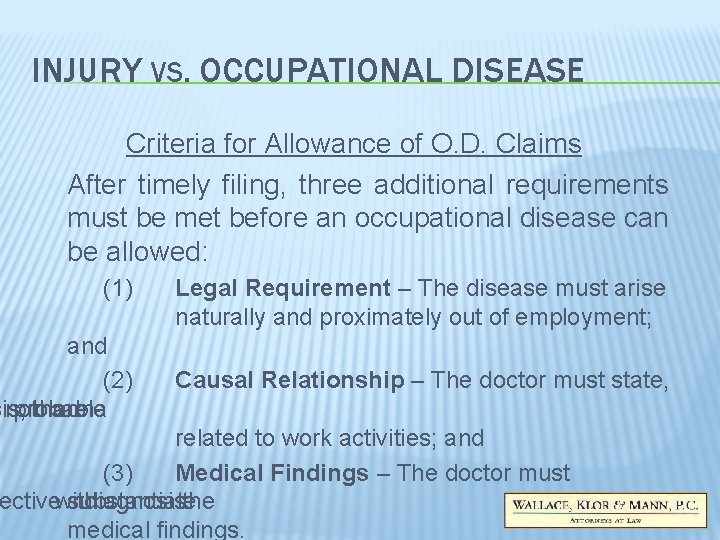
INJURY VS. OCCUPATIONAL DISEASE Criteria for Allowance of O. D. Claims After timely filing, three additional requirements must be met before an occupational disease can be allowed: (1) and (2) sis, not probable than more on a Legal Requirement – The disease must arise naturally and proximately out of employment; Causal Relationship – The doctor must state, related to work activities; and (3) Medical Findings – The doctor must ective with substantiate diagnosis the medical findings.
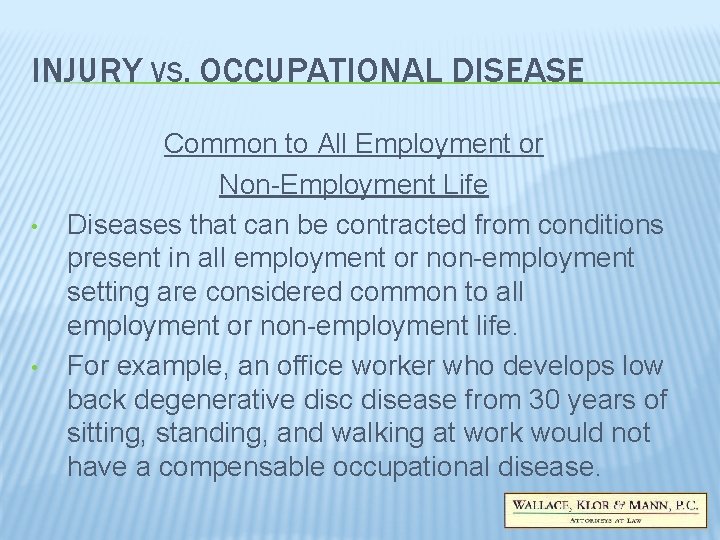
INJURY VS. OCCUPATIONAL DISEASE • • Common to All Employment or Non-Employment Life Diseases that can be contracted from conditions present in all employment or non-employment setting are considered common to all employment or non-employment life. For example, an office worker who develops low back degenerative disc disease from 30 years of sitting, standing, and walking at work would not have a compensable occupational disease.
3. TIME LOSS
TIME LOSS • The Act attempts to reimburse an injured worker for the wages he or she was earning at the time of the injury. • • The term “wages” may also include the reasonable value of board, fuel, housing, or other consideration of like nature received from the employer as part of the contract of hire. Rose v. DLI, 57 Wash. App. 751 (1990). Employer-paid health insurance benefits are a form of compensation that must be included in wages used to calculate an injured worker’s time loss rate. Cockle v. DLI, 142 Wash. 2 d 801 (2001).
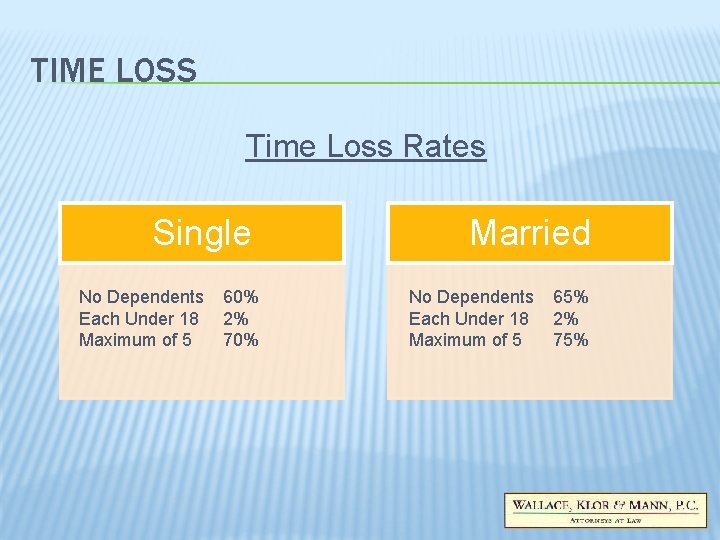
TIME LOSS Time Loss Rates Single No Dependents Each Under 18 Maximum of 5 60% 2% 70% Married No Dependents Each Under 18 Maximum of 5 65% 2% 75%
TIME LOSS Payment of Ongoing Time Loss • • • To be eligible for ongoing time loss, the injured worker must be receiving regular curative treatment. The attending provider must certify the worker’s ongoing inability to work is the result of the accepted medical condition(s). The AP must submit medical reports at approximately 60 -day intervals to support ongoing time loss.
TIME LOSS Provisional Time Loss • • • When a determination regarding claim allowance can’t be made immediately (i. e. because the employer is still investigating validity), Penser is able to make “provisional” payments of time loss when it is otherwise appropriate. Any provisional payments must be paid back if the claim is ultimately denied. Provisional payments are not considered a binding determination on the self-insurer or worker and must be made until a determinative order is issued.
4. LOSS OF EARNING POWER
LOSS OF EARNING POWER (LEP) • • Earning Power is defined as the worker’s ability to earn income as a result of labor. RCW 51. 32. 090 requires the self-insurer to compensate a worker for LEP when the worker’s earning capacity has decreased as a result of the industrial injury or occupational disease.
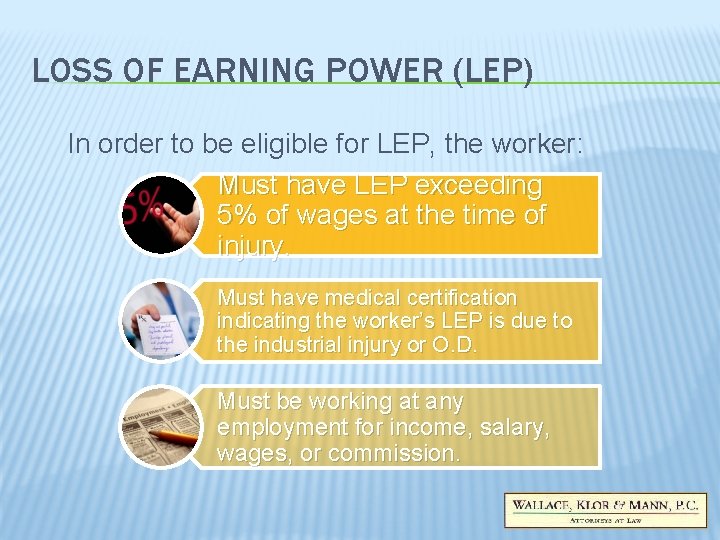
LOSS OF EARNING POWER (LEP) In order to be eligible for LEP, the worker: Must have LEP exceeding 5% of wages at the time of injury. Must have medical certification indicating the worker’s LEP is due to the industrial injury or O. D. Must be working at any employment for income, salary, wages, or commission.
LOSS OF EARNING POWER (LEP) Situations where a Worker May be Entitled to LEP • • The worker returns to work at a lower wage. The worker has more than one job at the time of injury and is restricted from performing one of the jobs even if it is not the job of injury. The worker returns to work but is unable to work at the premium or higher rates he/she normally works. The worker returns but must work less hours.
5. PENSIONS & FATALITIES
PENSIONS & FATALITIES • • • Pensions are a monthly payment made if a worker is permanently and totally disabled from a workplace injury or occupational disease. A Statutory Pension is defined as the loss of both legs or arms, one leg and one arm, total loss of eyesight, or total paralysis. These severe injuries qualify for placement on pension regardless of employability. An Administrative Pension is defined as any condition that permanently incapacitates the worker from performing any work at any gainful occupation.
PENSIONS & FATALITIES Surviving Spouse/Domestic Partner • • The surviving spouse or domestic partner must submit an application for benefits within one year of the worker’s death. If the death is due to the covered injury or occupational disease, pension benefits continue to the spouse or domestic partner’s death and/or eligible dependent children.
PENSIONS & FATALITIES Fatalities • • Fatal claims constitute an umbrella of claims where a worker either dies while on the job, or dies later from a condition contended as related. When a beneficiary’s claim is approved, a one-time immediate payment is made if there is a spouse, domestic partner, child, or dependent. The amount of the immediate payment is 100% of the average monthly wage in the State.
6. CLAIM CLOSURE
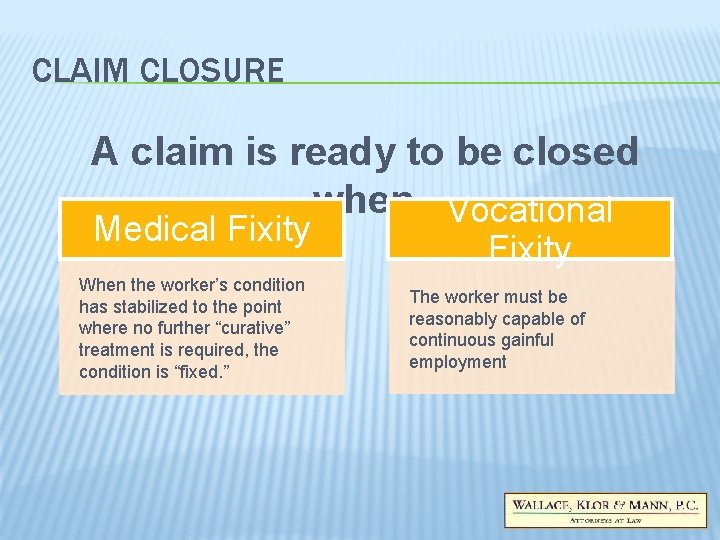
CLAIM CLOSURE A claim is ready to be closed when…Vocational Medical Fixity When the worker’s condition has stabilized to the point where no further “curative” treatment is required, the condition is “fixed. ” Fixity The worker must be reasonably capable of continuous gainful employment
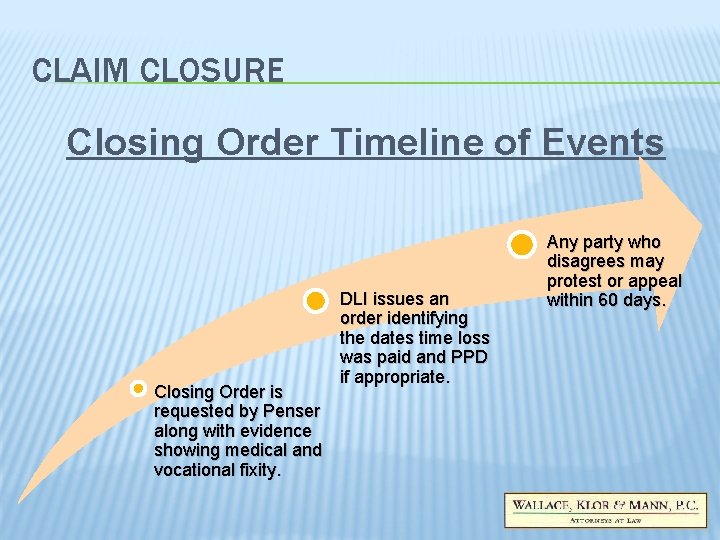
CLAIM CLOSURE Closing Order Timeline of Events Closing Order is requested by Penser along with evidence showing medical and vocational fixity. DLI issues an order identifying the dates time loss was paid and PPD if appropriate. Any party who disagrees may protest or appeal within 60 days.
7. PERMANENT PARTIAL DISABILITY
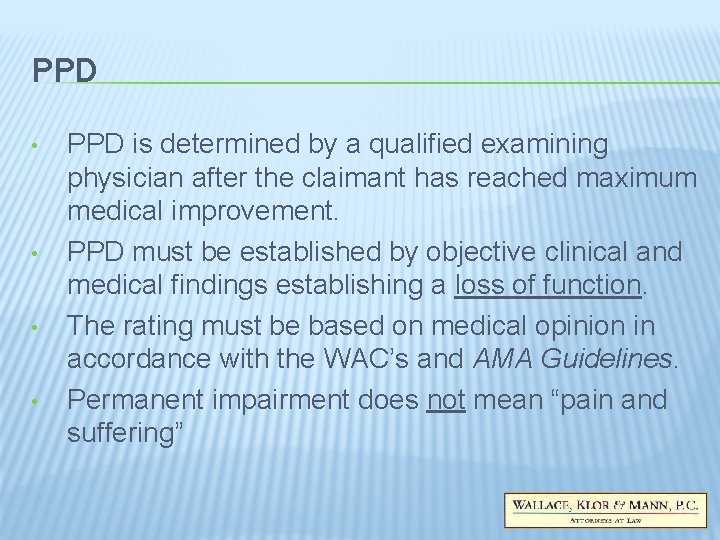
PPD • • PPD is determined by a qualified examining physician after the claimant has reached maximum medical improvement. PPD must be established by objective clinical and medical findings establishing a loss of function. The rating must be based on medical opinion in accordance with the WAC’s and AMA Guidelines. Permanent impairment does not mean “pain and suffering”
PPD Schedule of Benefits The schedule of benefits establishes a monetary award for permanent bodily impairment resulting from an industrial injury or occupational disease. The benefit amount on each schedule is updated every year to account for cost of living and other adjustments. FOR EXAMPLE…
PPD A worker is injured on July 2, 1994, when a machine explodes damaging the left side of his body. Once his conditions are medically fixed and stable, and the worker has returned to work, the IME finds the following: • • • Category II low back impairment $6, 107. 63 25% of left leg above the knee joint with functional stump $16, 490. 60 Loss of hearing in the left ear $9, 772. 20
PPD If that same worker was instead injured on July 2, 2009, he would be entitled to the following: • • • Category II low back impairment $9, 069. 31 25% of left leg above the knee joint with functional stump $24, 487. 13 Loss of hearing in the left ear $14, 510. 83
8. REOPENING
REOPENING Timeliness When an injured worker applies to reopen a claim, the Department has authority to reopen injuries or occupational disease claims within 7 years from the date the first closing order became final.
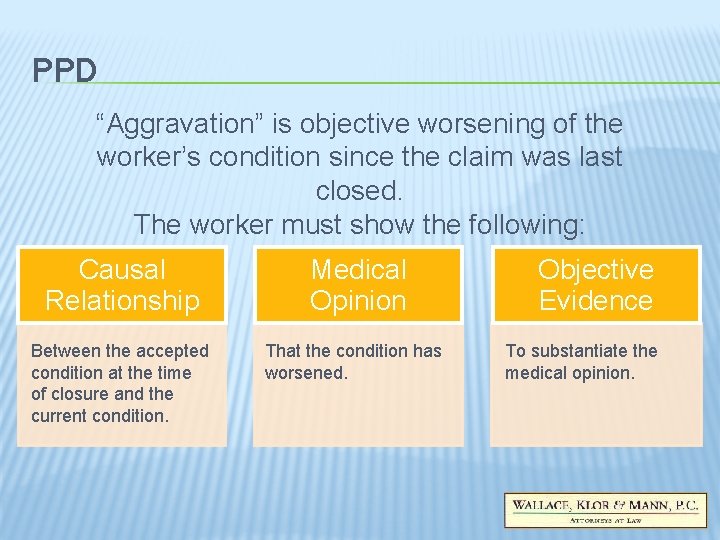
PPD “Aggravation” is objective worsening of the worker’s condition since the claim was last closed. The worker must show the following: Causal Relationship Between the accepted condition at the time of closure and the current condition. Medical Opinion That the condition has worsened. Objective Evidence To substantiate the medical opinion.
9. APPEALS PROCESS
APPEALS PROCESS Appeals. Overview Any aggrieved party has the right to file an appeal of a Department order within 60 days of its issuance.
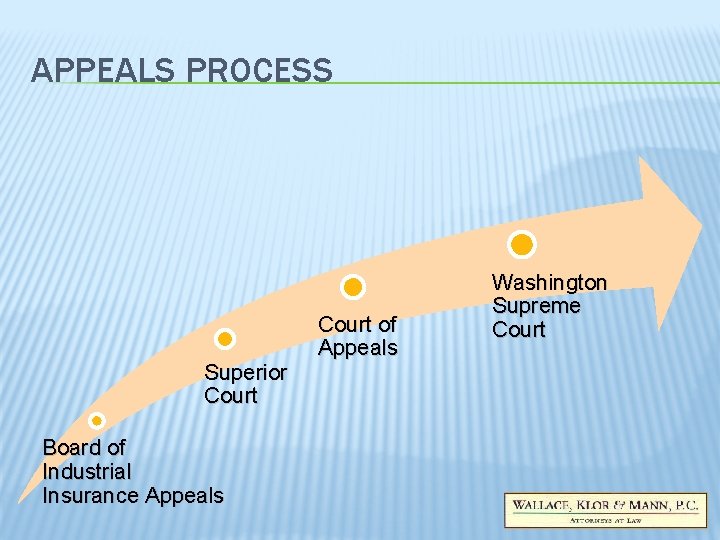
APPEALS PROCESS Superior Court Board of Industrial Insurance Appeals Court of Appeals Washington Supreme Court
APPEALS PROCESS Board of Industrial Insurance Appeals • • A granted appeal begins assigned to a mediation judge, who will facilitate communication between all parties to the appeal, with the goal being resolution. If no resolution is possible, the appeal will be assigned to a hearings judge.
APPEALS PROCESS Board of Industrial Insurance Appeals Hearings before the Board follow the rules of evidence used in Superior Court. Hearings are a formal process, with evidence provided by sworn witness testimony before an industrial appeals judge (IAJ).
APPEALS PROCESS Board of Industrial Insurance Appeals After hearings are conclude, the IAJ will issue a Proposed Decision & Order, containing: 1. Discussion and analysis of issues raised and evidence presented. 2. Findings of fact. 3. Conclusions of law on each contested issue.
APPEALS PROCESS Board of Industrial Insurance Appeals Any party who disagrees with the PD&O may file a Petition for Review within 20 days of communication. The Board must then issue a Decision and Order which may be appealed to Superior Court within 30 days.
APPEALS PROCESS Superior Court The party aggrieved by the Board’s final decision may then appeal to Superior Court.
APPEALS PROCESS Superior Court • • • In Superior Court, one maintains the right to a trial by jury. The parties are limited to the Board’s record. Appeals from a final decision by Superior Court go to the Court of Appeals, and finally the Washington Supreme Court.
QUESTIONS? ? ?
RETURN TO WORK AND VOCATIONAL REHABILIATION IN WASHINGTON STATE Craig Bock, MA, CRC – Bock Consulting June 30, 2010 Bock Consulting
Revised Code of WA (RCW) WA Administrative Code (WAC) • RCW 51. 32. 090 – Time Loss • RCW 51. 32. 095 – RTW • RCW 51. 32. 099 – Vocational Rehab • WAC 296 -19 A-010 – Definitions • WAC 296 -19 A-070 – Ability to Work • WAC 296 -19 A-170 – Job Analyses Bock Consulting
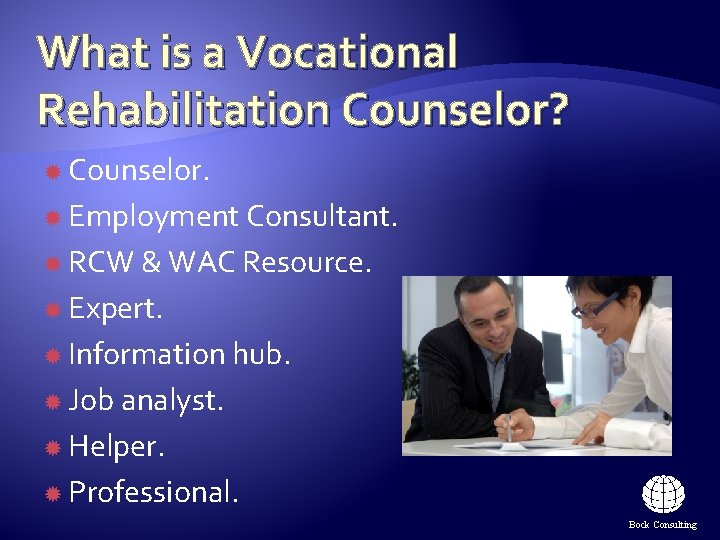
What is a Vocational Rehabilitation Counselor? Counselor. Employment Consultant. RCW & WAC Resource. Expert. Information hub. Job analyst. Helper. Professional. Bock Consulting
What is a CRC, CDMS & ABVE? CRC = Certified Rehabilitation Counselor. CDMS = Certified Disability Management Specialist. ABVE = American Board of Vocational Experts. Bock Consulting
Do You Need A Vocational Rehabilitation Counselor? RCW 51. 32. 090 Temporary total disability — Partial restoration of earning power — Return to available work — When employer continues wages — Limitations. Utilizing the Work Status Activity Report and Job Descriptions prior to VRC involvement. Bock Consulting
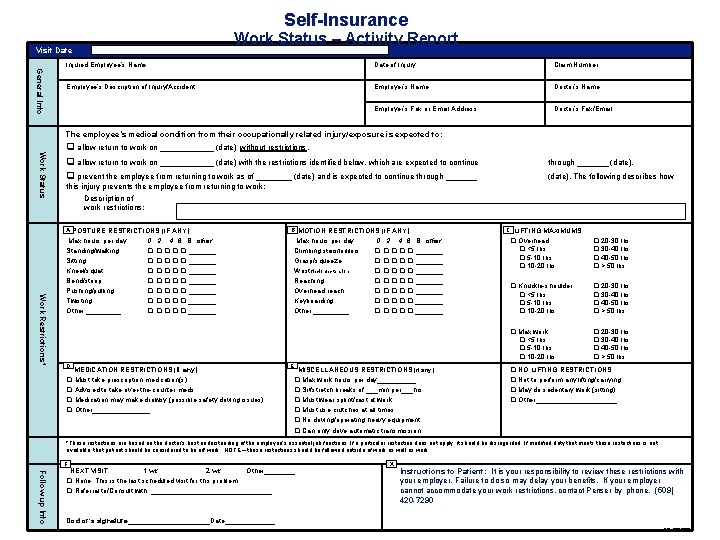
Self-Insurance Visit Date Work Status – Activity Report General Info Injured Employee’s Name: Date of Injury: Claim Number: Employee’s Description of Injury/Accident: Employer’s Name: Doctor’s Name: Employer’s Fax or Email Address: Doctor’s Fax/Email: The employee’s medical condition from their occupationally related injury/exposure is expected to: Work Status allow return to work on ______ (date) without restrictions. allow return to work on ______ (date) with the restrictions identified below, which are expected to continue prevent the employee from returning to work as of ____ (date) and is expected to continue through _______ (date). The following describes how this injury prevents the employee from returning to work: Description of work restrictions: Work Restrictions* A POSTURE RESTRICTIONS (IF ANY): Max hours per day 0 2 4 6 8 other Standing/walking _______ Sitting _______ Kneel/squat _______ Bend/stoop _______ Pushing/pulling _______ Twisting _______ Other _______ D MEDICATION RESTRICTIONS (if any): Must take prescription medication(s) Advised to take over-the-counter meds Medication may make drowsy (possible safety driving issues) Other________ B MOTION RESTRICTIONS (IF ANY): Max hours per day Climbing stairs/ladders Grasp/squeeze Wrist flexion/extension Reaching Overhead reach Keyboarding Other _____ 0 2 4 6 8 other _______ _______ E MISCELLANEOUS RESTRICTIONS (if any): Max work hours per day_____ Sit/stretch breaks of ___min per___hrs Must wear splint/cast at work Must use crutches at all times No driving/operating heavy equipment Can only drive automatic transmission C LIFTING MAXIMUMS: Overhead <5 lbs 5 -10 lbs 10 -20 lbs 20 -30 lbs 30 -40 lbs 40 -50 lbs > 50 lbs Knuckle-shoulder <5 lbs 5 -10 lbs 10 -20 lbs 20 -30 lbs 30 -40 lbs 40 -50 lbs > 50 lbs Max work <5 lbs 5 -10 lbs 10 -20 lbs 20 -30 lbs 30 -40 lbs 40 -50 lbs > 50 lbs NO LIFTING RESTRICTIONS: Not to perform any lifting/carrying May do sedentary work (sitting) Other___________ *These restrictions are based on the doctor’s best understanding of the employee’s essential job functions. If a particular restriction does not apply, it should be disregarded. If modified duty that meets these restrictions is not available, that patient should be considered to be off work. NOTE – these restrictions should be followed outside of work as well as work. F Follow-up Info NEXT VISIT: 1 wk 2 wk Other____ None. This is the last scheduled visit for this problem. Referral to/Consult with: ________________ X Instructions to Patient: It is your responsibility to review these restrictions with your employer. Failure to do so may delay your benefits. If your employer cannot accommodate your work restrictions, contact Penser by phone. (509) 420 -7290 Doctor’s signature___________Date_______ D 0407003
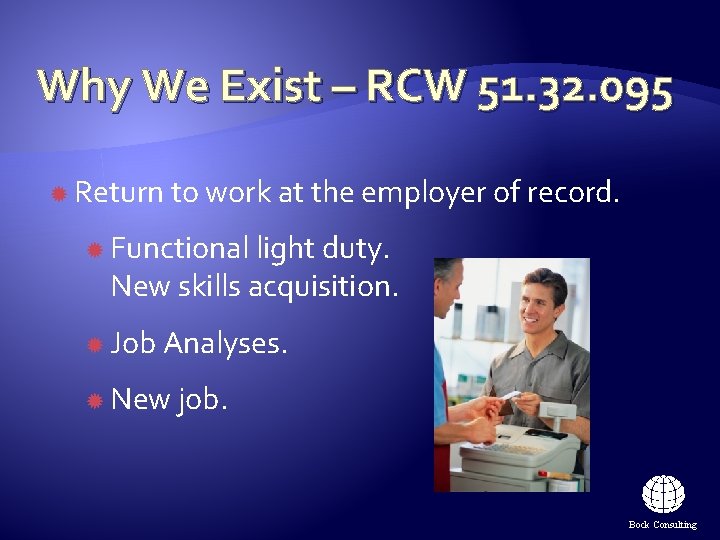
Why We Exist – RCW 51. 32. 095 Return to work at the employer of record. Functional light duty. New skills acquisition. Job Analyses. New job. Bock Consulting
Why We Exist – RCW 51. 32. 095 Employability. (WAC 296 -19 A-070) Work history. Transferability Work Skills worksheet. Residual physical capacities. Job Analyses. WAC 296 -19 A-010 – (6) What is a Job Analysis? WAC 296 -19 A-170 – Required information in JA. Bock Consulting
RCW 51. 32. 099 – Vocational Rehabilitation Plans A Vocational Rehabilitation Counselor must conclude that the worker is eligible for vocational rehab services (retraining). Employer has 15 days from date on retraining approval letter to make a valid job offer. If no job offer, plan development. Bock Consulting
The Vocational Rehabilitation Pilot Project Effective January 1, 2008. Significant amendments to vocational rehabilitation services, applicability of rehabilitation services, benefits, criteria, allowable costs, and performance criteria. Bock Consulting
RCW 51. 32. 099 – Vocational Rehabilitation Plans 90 days to develop plan. 2 years/$14, 000+. Mileage. Plan submission. respond. Worker selects: State has 15 days to Option 1 / Option 2. Bock Consulting
QUESTIONS? Craig Bock, M. A. , CRC Bock Consulting www. bockconsulting. com Bock Consulting