
The Union in Crisis and the American Civil


- Slides: 59
The Union in Crisis and the American Civil War US History Unit #8
Closure Question #1: How did the northern and southern views of slavery differ? Slavery ended early in the North, but slowly. By 1800, there were about 50, 000 enslaved people in the North, compared to nearly one million in the South. In 1860, there were still 18 slaves in New Jersey, but none in the other northern states. Most white northerners limited the rights of free African Americans and discouraged or prevented the migration of more. As a result, many white northerners had little personal experience with African Americans, slave or free, and only a few held strong opinions about slavery. Slavery was an integral part of southern life. Many southerners believed that God intended that black people should provide the labor for white “civilized” society. In a speech before Congress in 1837, planter John Calhoun of South Carolina firmly defended and even praised the virtues of slavery. “I hold it (slavery) to be a good…, ” he said, ”…. and (it) will continue to prove so if not disturbed by the… spirit of abolition. ” Calhoun’s words expressed the feelings of many white southerners.
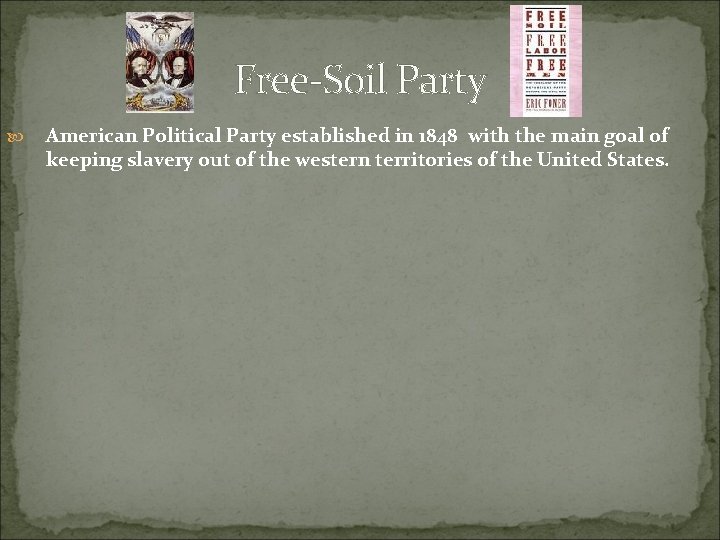
Free-Soil Party American Political Party established in 1848 with the main goal of keeping slavery out of the western territories of the United States.
Closure Question #2: What role did the issue of slavery play in the election of 1848? For decades, the major parties – the Whigs and Democrats – had avoided the slavery issue, thus managing to win support in both the North and the South. In 1848, they hoped once again to attract voters from all sides of the slavery debate. But with the Free-Soilers calling for limits to slavery in the territories, the major parties were forced to take a stand. Both Democrats and Whigs addressed the problem by embracing the idea of popular sovereignty, a policy stating that voters in a territory – not Congress – should decide whether or not to allow slavery there. This idea had wide appeal, since it seemed in keeping with the traditions of American democracy. Furthermore, it allowed Whigs and Democrats once again to focus on the personal exploits and triumphs of their candidates rather than on the issue. The Whigs nominated Zachary Taylor, a general and a hero of the Mexican War. The Democrats put forward Governor Lewis Cass of Michigan. The Free-Soil Party nominated New Yorker Martin Van Buren as their candidate for President. When the votes were counted, Taylor won the election, with slim majorities in both northern and southern states. Van Buren did not carry any state, but he did draw sufficient votes to cause Cass to lose. The Free-Soil Party, which had won 10% of the vote with its antislavery platform, had clearly captured Americans’ attention.
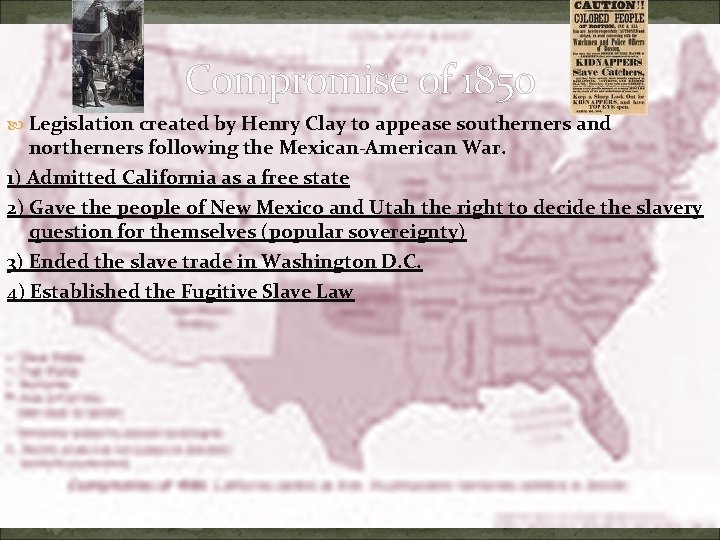
Compromise of 1850 Legislation created by Henry Clay to appease southerners and northerners following the Mexican-American War. 1) Admitted California as a free state 2) Gave the people of New Mexico and Utah the right to decide the slavery question for themselves (popular sovereignty) 3) Ended the slave trade in Washington D. C. 4) Established the Fugitive Slave Law
Fugitive Slave Act / Personal Liberty Laws Fugitive Slave Act – Part of the Compromise of 1850, required private citizens to assist with apprehending runaway slaves and punishment (fines or jail time) for anyone who assisted escaping slaves. Personal Liberty Laws – Laws passed by a few Northern states which nullified the Fugitive Slave Act and allowed the states to arrest slave catchers for kidnapping.
Closure Assignment #1 Answer the following questions based on what you have learned from Chapter 10, Section 1: 1. How did the northern and southern views of slavery differ? 2. What role did the issue of slavery play in the election of 1848? 3. Why did California’s application for statehood cause a crisis?
Closure Question #1: What were the consequences of the Fugitive Slave Act for slaveholders, white northerners, free African Americans, or fugitive slaves? The Compromise of 1850 was meant to calm the fears of Americans. But one provision, the new Fugitive Slave Act, had the opposite effect. The law, which required citizens to catch and return runaway slaves, enraged many northerners. The anger was not restricted to abolitionists; it extended to other northerners who felt forced to support the slave system. Northerners also resented what they saw as increasing federal intervention in the affairs of the independent states. A few northern states struck back, passing personal liberty laws. These statutes nullified the Fugitive Slave Act and allowed the state to arrest slave catchers for kidnapping. Many northerners agreed with abolitionist William Lloyd Garrison when he demanded “nothing less than… a Revolution in the Government of the country. ” Black Americans, of course, despised the law. Some of the captured “fugitive slaves” were really free people who had been kidnapped and sold into slavery. Although the imprisoned African Americans could appeal to a judge for their release, the law awarded $10 to judges who ruled in favor of slave owners but only $5 to those who ruled the captive should be set free. Slaves, fugitives, and free black people plotted and carried out resistance. Through the succeeding decades, tempers flared and violence erupted as far north as Canada, as far west as Kansas, and as far south as Virginia.
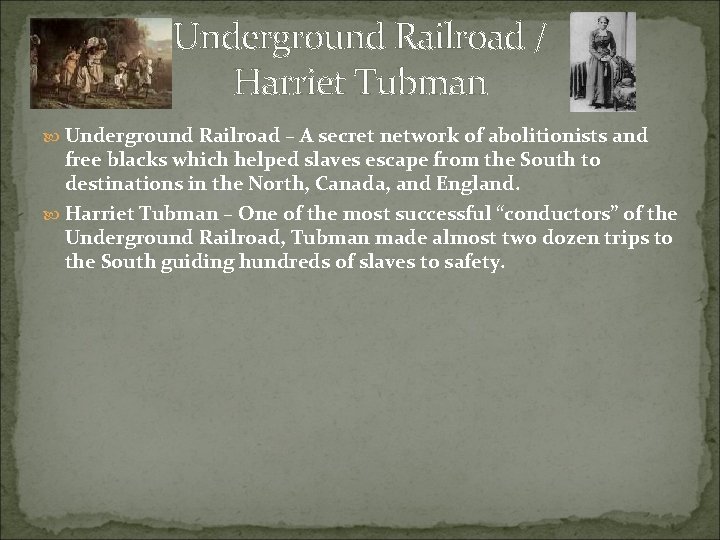
Underground Railroad / Harriet Tubman Underground Railroad – A secret network of abolitionists and free blacks which helped slaves escape from the South to destinations in the North, Canada, and England. Harriet Tubman – One of the most successful “conductors” of the Underground Railroad, Tubman made almost two dozen trips to the South guiding hundreds of slaves to safety.
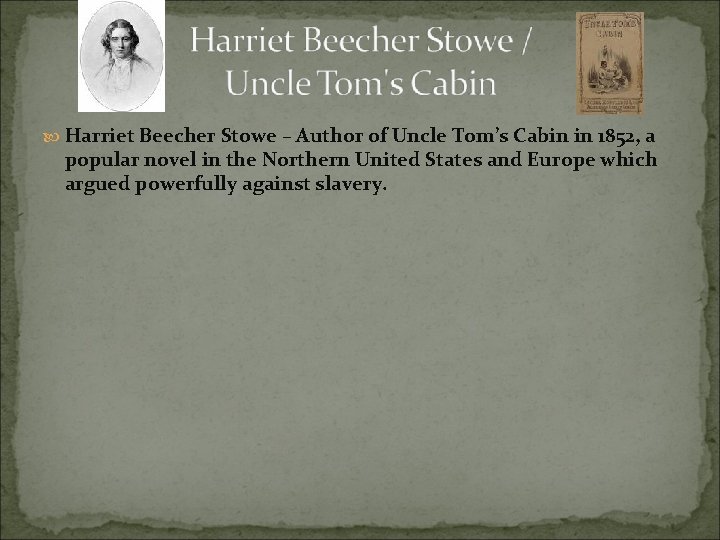
Harriet Beecher Stowe – Author of Uncle Tom’s Cabin in 1852, a popular novel in the Northern United States and Europe which argued powerfully against slavery.
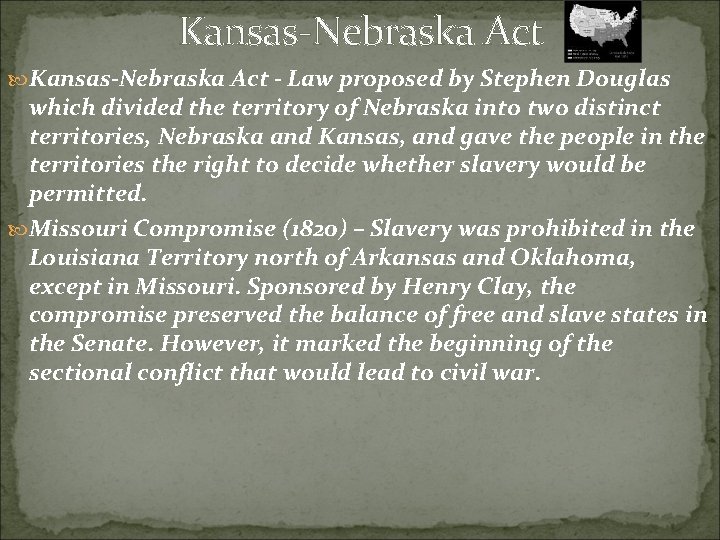
Kansas-Nebraska Act - Law proposed by Stephen Douglas which divided the territory of Nebraska into two distinct territories, Nebraska and Kansas, and gave the people in the territories the right to decide whether slavery would be permitted. Missouri Compromise (1820) – Slavery was prohibited in the Louisiana Territory north of Arkansas and Oklahoma, except in Missouri. Sponsored by Henry Clay, the compromise preserved the balance of free and slave states in the Senate. However, it marked the beginning of the sectional conflict that would lead to civil war.
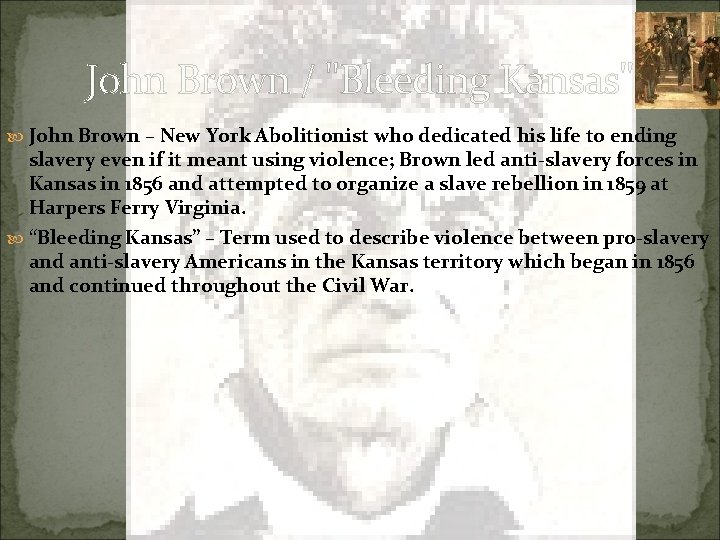
John Brown / "Bleeding Kansas" John Brown – New York Abolitionist who dedicated his life to ending slavery even if it meant using violence; Brown led anti-slavery forces in Kansas in 1856 and attempted to organize a slave rebellion in 1859 at Harpers Ferry Virginia. “Bleeding Kansas” – Term used to describe violence between pro-slavery and anti-slavery Americans in the Kansas territory which began in 1856 and continued throughout the Civil War.
Closure Question #3: How did “Bleeding Kansas” embody the slavery controversy? Most of the people who came to the newly opened territory of Kansas were farmers looking for land. But Kansas also attracted settlers – northern and southern – with political motives. Each group wanted to outnumber the other, so that when it came time to vote, they could control the government. Their competition to settle the territory would have deadly consequences. On May 21 st, 1856, Border Ruffians raided the antislavery town of Lawrence, Kansas. They pillaged homes, burned down the Free State Hotel, and destroyed the presses of The Kansas Free State newspaper. Swift retaliation came from John Brown, a New York abolitionists who had moved his family several times in pursuit of opportunities to confront slavery head-on and who now made his home near Lawrence. With his sons and a few friends, Brown carried out a midnight execution of five proslavery settlers near Pottawatomie Creek, about 20 miles south of Lawrence. Over the next several years, the question of how to admit Kansas to the Union baffled local residents, political parties, the U. S. Congress, and the Supreme Court. Although the Border Ruffians had determined the outcome of the election, President Franklin Pierce urged Congress to admit Kansas as a slave state in 1858. However, Congress, refused and Kansas submitted four constitutions before it finally entered as a free state in 1861, after the Civil War had already begun.
Closure Assignment #2 Answer the following questions based on Chapter 10, Section 2: 1. What were the consequences of the Fugitive Slave Act for slaveholders, white northerners, free African Americans, and fugitive slaves? 2. How did the Kansas-Nebraska Act undo the Missouri Compromise? 3. How did “Bleeding Kansas” embody the slavery controversy?
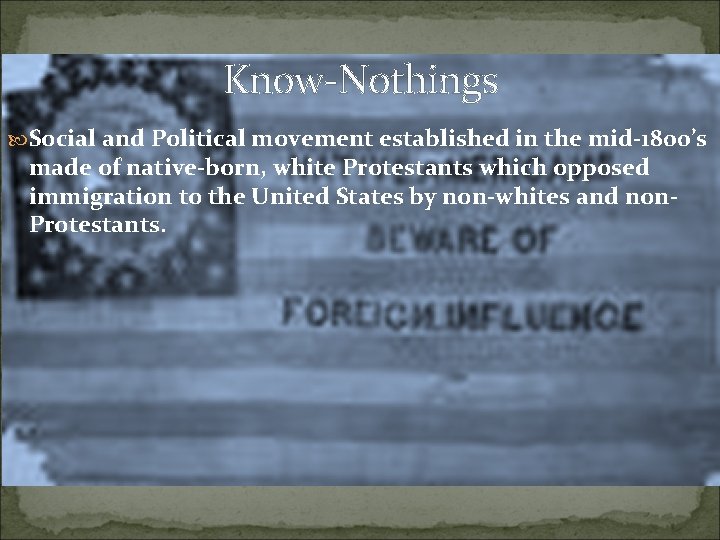
Know-Nothings Social and Political movement established in the mid-1800’s made of native-born, white Protestants which opposed immigration to the United States by non-whites and non. Protestants.
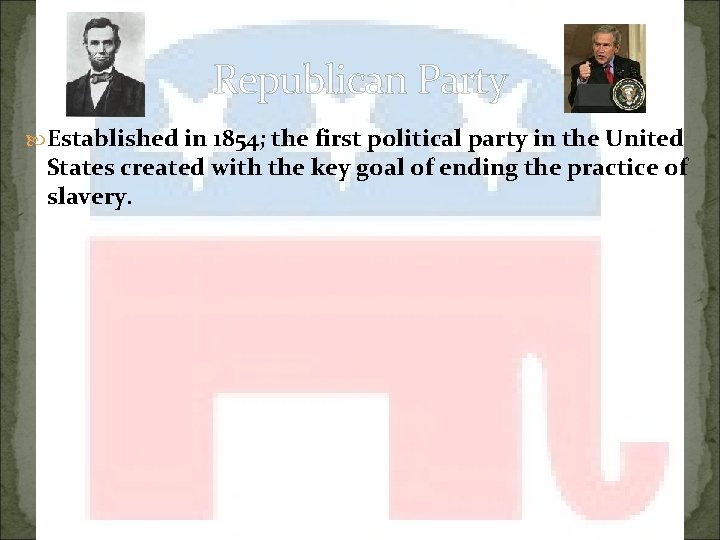
Republican Party Established in 1854; the first political party in the United States created with the key goal of ending the practice of slavery.
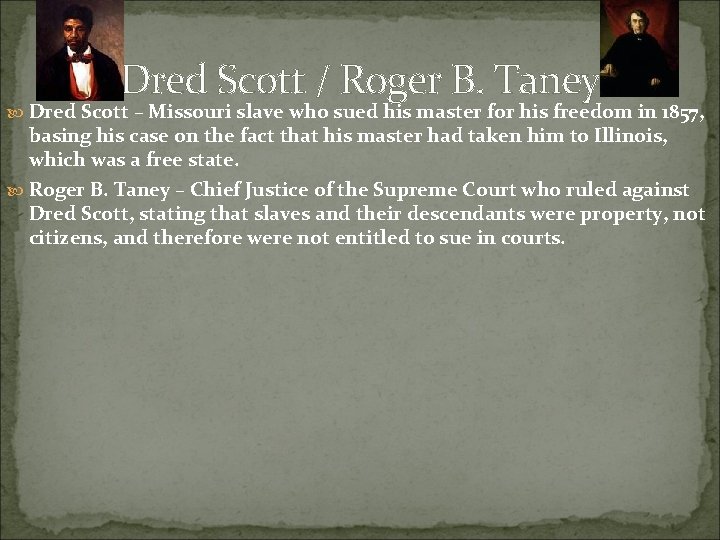
Dred Scott / Roger B. Taney Dred Scott – Missouri slave who sued his master for his freedom in 1857, basing his case on the fact that his master had taken him to Illinois, which was a free state. Roger B. Taney – Chief Justice of the Supreme Court who ruled against Dred Scott, stating that slaves and their descendants were property, not citizens, and therefore were not entitled to sue in courts.
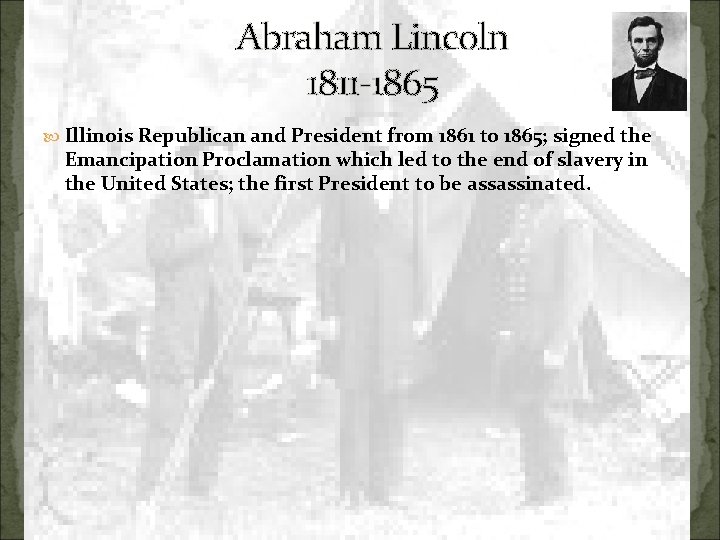
Abraham Lincoln 1811 -1865 Illinois Republican and President from 1861 to 1865; signed the Emancipation Proclamation which led to the end of slavery in the United States; the first President to be assassinated.
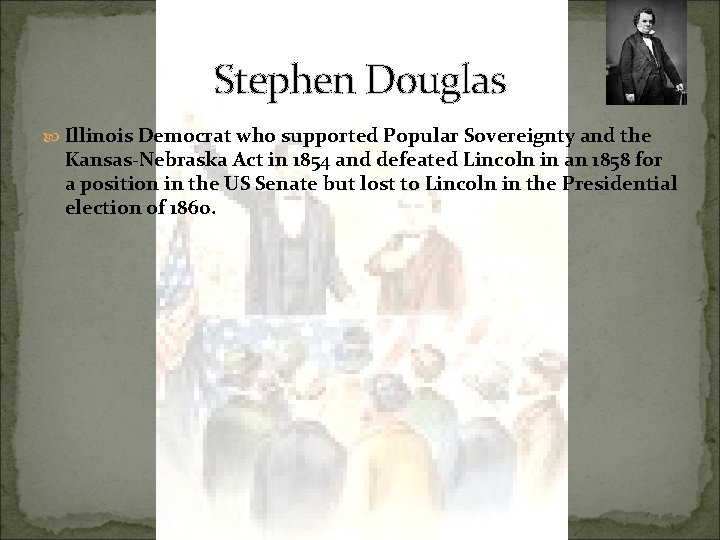
Stephen Douglas Illinois Democrat who supported Popular Sovereignty and the Kansas-Nebraska Act in 1854 and defeated Lincoln in an 1858 for a position in the US Senate but lost to Lincoln in the Presidential election of 1860.
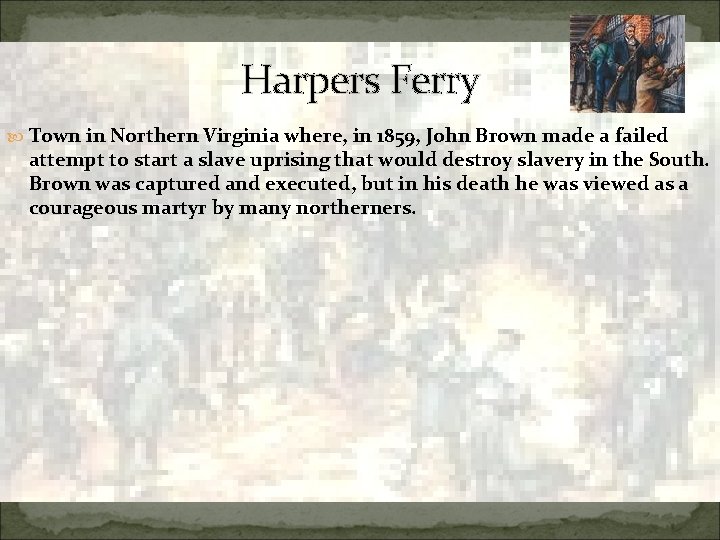
Harpers Ferry Town in Northern Virginia where, in 1859, John Brown made a failed attempt to start a slave uprising that would destroy slavery in the South. Brown was captured and executed, but in his death he was viewed as a courageous martyr by many northerners.
Closure Assignment #3 Answer the following questions based on what you have learned from Chapter 10, Section 3: 1. Why did the Republican Party form? 2. How did the Dred Scott decision increase tensions between North and South? 3. How successful was John Brown’s raid on Harpers Ferry?
Closure Question #1: How did the election of 1860 increase sectional tensions? John Brown’s raid and execution were still fresh in the minds of Americans as the 1860 presidential election approached. Uncertainty about Kansas – would it be a slave state or a free state? – added to the anxiety. In the North, loss of confidence in the Supreme Court resulting from the Dred Scott decision and rage about the Fugitive Slave Act’s intrusion into the states’ independence further aggravated the situation. The issue of states’ rights was on southern minds as well. Would northern radicals conspire to eliminate slavery not only in the territories but also in the original southern states? In the spring of 1860, Mississippi senator Jefferson Davis convinced Congress to adopt resolutions restricting federal control over slavery in the territories. The resolutions also asserted that the Constitution prohibited Congress or any state from interfering with slavery in the states where it already existed. Even southerners who did not own slaves felt that their way of life and their honor were under attack. Benefiting from the fracturing among the other political parties. Lincoln won the election handily with 40% of the popular vote and almost 60% of the electoral vote. In fact, he was not even on the ballot in most southern states. The election of 1860 demonstrated that Americans’ worst fears had come to pass. There were no longer any national political parties. Bell and Breckinridge competed for southern votes, while Douglas and Lincoln competed in the North and West. The North and South were now effectively two political entities, and there seemed no way to bridge the gap.
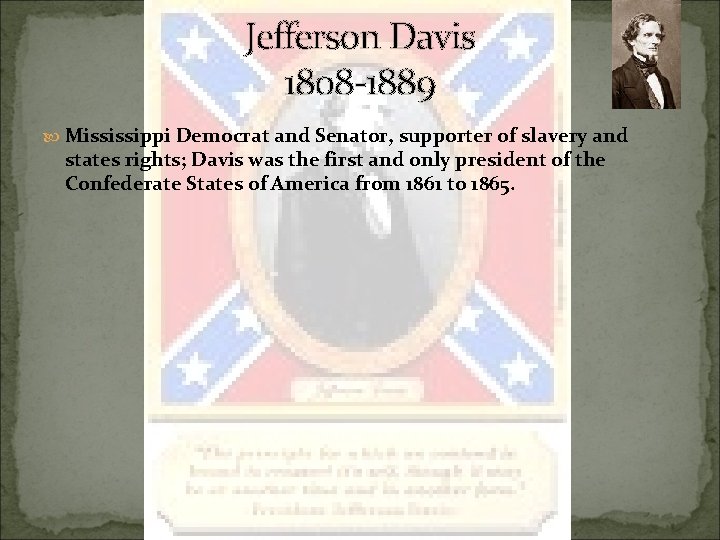
Jefferson Davis 1808 -1889 Mississippi Democrat and Senator, supporter of slavery and states rights; Davis was the first and only president of the Confederate States of America from 1861 to 1865.
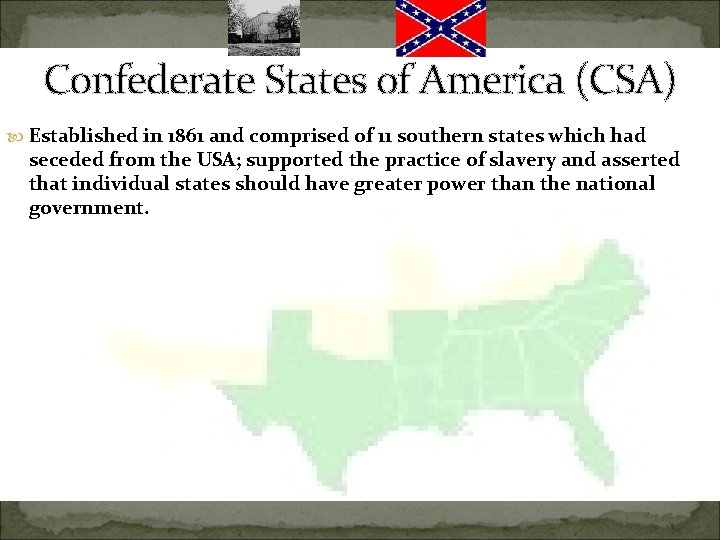
Confederate States of America (CSA) Established in 1861 and comprised of 11 southern states which had seceded from the USA; supported the practice of slavery and asserted that individual states should have greater power than the national government.
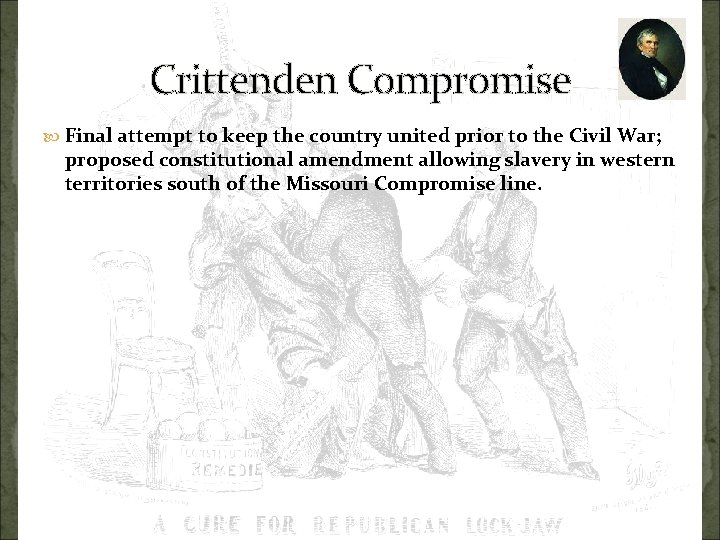
Crittenden Compromise Final attempt to keep the country united prior to the Civil War; proposed constitutional amendment allowing slavery in western territories south of the Missouri Compromise line.
Closure Question #3: How could President Buchanan have prevented war? (Hint: This is an opinion question) Outgoing President James Buchanan condemned South Carolina’s secession from the Union but was unwilling to use force to stop it. Many northerners criticized his weak response to the crisis. In an address to Congress, he seemed almost baffled that the situation had deteriorated so far: “How easy it would be for the American people to settle the slaver question forever and to restore peace and harmony to this distracted country!. . . All that is necessary to accomplish the object, and all for which the slaves States have ever contended, is to be let alone and permitted to manage their domestic institutions in their own way. As sovereign States, they, and they alone, are responsible to God and the world for the slavery existing among them. ” – President James Buchanan, December 3 rd, 1860
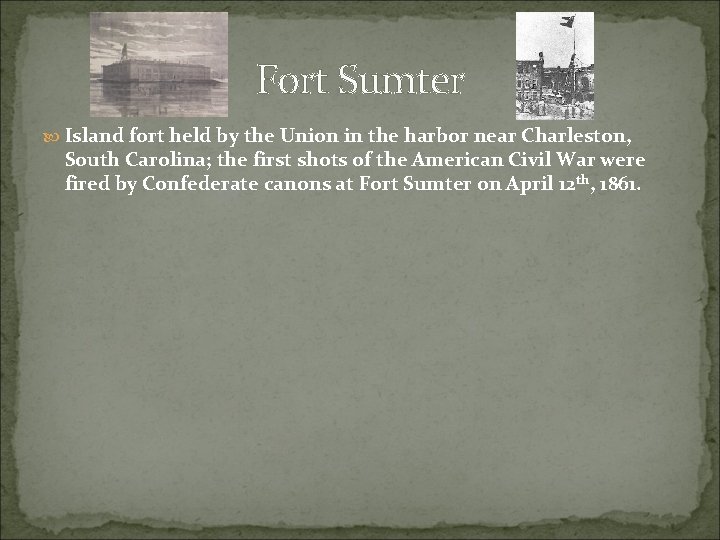
Fort Sumter Island fort held by the Union in the harbor near Charleston, South Carolina; the first shots of the American Civil War were fired by Confederate canons at Fort Sumter on April 12 th, 1861.
Closure Assignment #4 Answer the following questions based on what you have learned from Chapter 10, Section 4: 1. How did the election of 1860 increase sectional tensions? 2. Why did the southern states secede? 3. How could President Buchanan have prevented war?
Closure Question #1: Which side do you think had the best longterm chances for victory at the start of the Civil War? Why? Advantages of the Union • 22 million people lived in the Union. By contrast, the Confederacy had a population of only 9 million, of whom 3. 5 million were slaves. • Most of the nation’s coal and iron came from Union mines, and the vast West was a source of gold, silver, and other resources. • With mechanized factories and a steady flow of European immigrants seeking work, the Union could produce more ammunition, arms, uniforms, medical supplies and railroad cars than the Confederacy could. Advantages of the Confederacy • Although there were pockets of pro. Union feeling in places such as western Virginia, most southern whites believed passionately in the Confederate cause. • The South had a strong military tradition and fine leaders like Virginia’s Robert E. Lee. • The Confederacy did not need to conquer the North; it simply had to avoid defeat, expecting that in time the North would give up the effort. Southern forces would be fighting a defensive war on familiar, friendly ground while northern forces had to fight an offensive war in enemy territory.
Blockade Tactic used by the Union Navy in which Union ships prevented merchant vessels from entering or leaving the South’s ports, crippling southern trade.
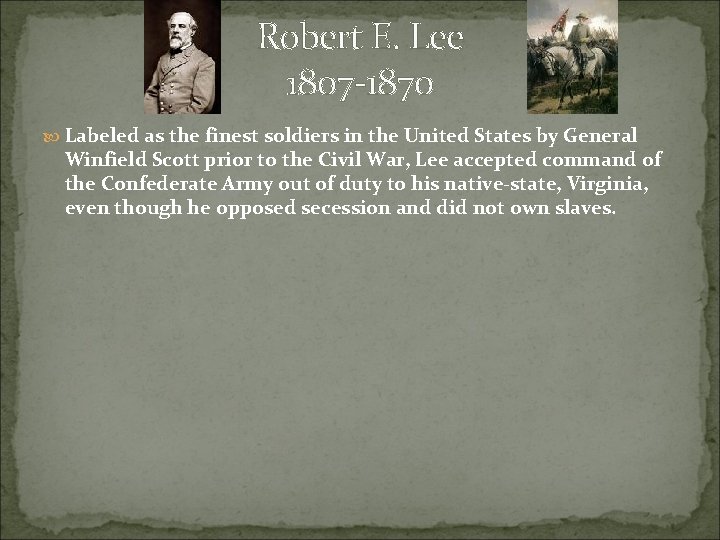
Robert E. Lee 1807 -1870 Labeled as the finest soldiers in the United States by General Winfield Scott prior to the Civil War, Lee accepted command of the Confederate Army out of duty to his native-state, Virginia, even though he opposed secession and did not own slaves.
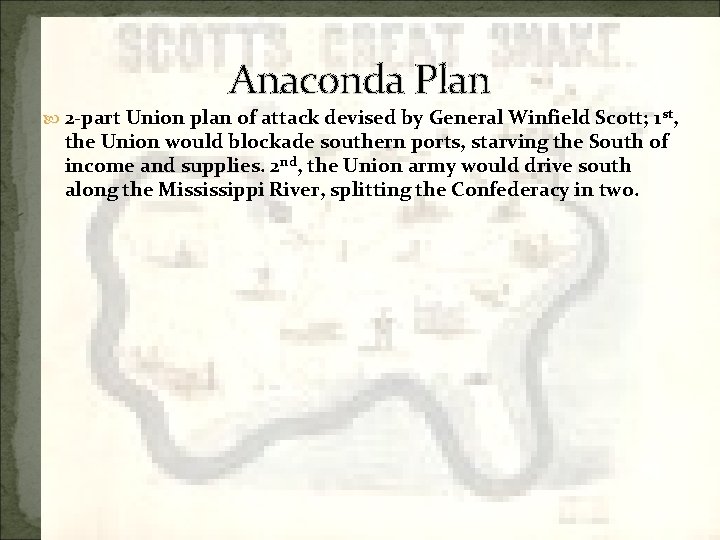
Anaconda Plan 2 -part Union plan of attack devised by General Winfield Scott; 1 st, the Union would blockade southern ports, starving the South of income and supplies. 2 nd, the Union army would drive south along the Mississippi River, splitting the Confederacy in two.
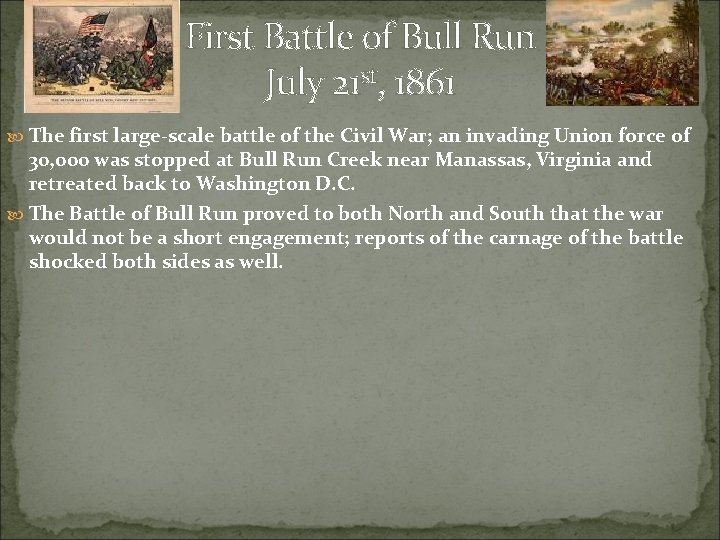
First Battle of Bull Run July 21 st, 1861 The first large-scale battle of the Civil War; an invading Union force of 30, 000 was stopped at Bull Run Creek near Manassas, Virginia and retreated back to Washington D. C. The Battle of Bull Run proved to both North and South that the war would not be a short engagement; reports of the carnage of the battle shocked both sides as well.
Stonewall Jackson Thomas J. Jackson; Confederate general, second-in-command to Robert E. Lee. A Virginia-Native, West Point graduate, and devoutly religious, Jackson is the only General on either side who was never defeated. He was killed by friendly-fire following the Confederate victory at Chancelorsville in 1863.
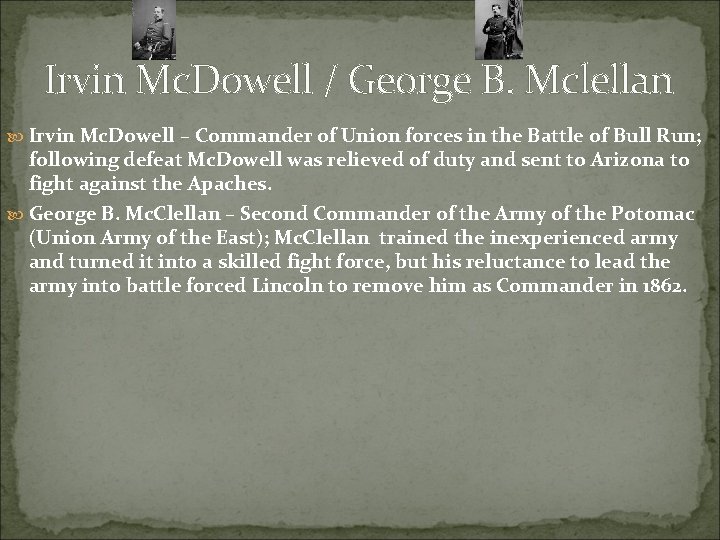
Irvin Mc. Dowell / George B. Mclellan Irvin Mc. Dowell – Commander of Union forces in the Battle of Bull Run; following defeat Mc. Dowell was relieved of duty and sent to Arizona to fight against the Apaches. George B. Mc. Clellan – Second Commander of the Army of the Potomac (Union Army of the East); Mc. Clellan trained the inexperienced army and turned it into a skilled fight force, but his reluctance to lead the army into battle forced Lincoln to remove him as Commander in 1862.
Ulysses S. Grant 1822 -1885 Leader of the Union Army of the West during the Battle of Shiloh; following the Union victory at Vicksburg, Grant became the last General to command the Army of the Potomac, leading the Union to victory over the Confederacy in 1865. He went on to become President of the United States from 1869 to 1877.
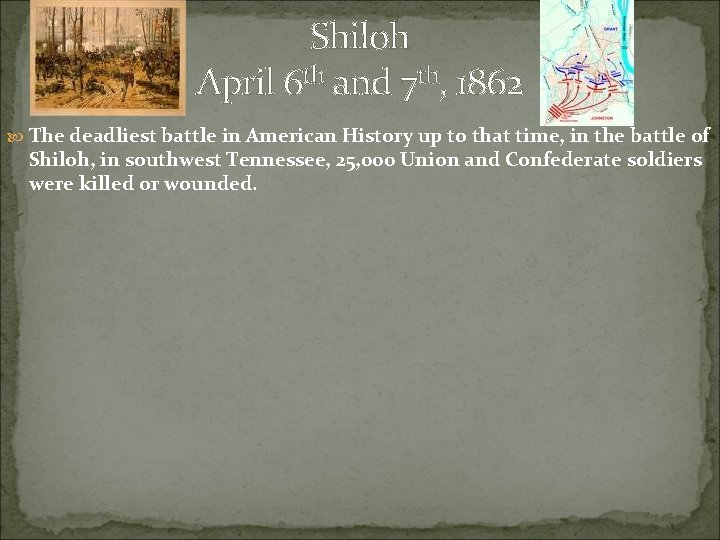
Shiloh April 6 th and 7 th, 1862 The deadliest battle in American History up to that time, in the battle of Shiloh, in southwest Tennessee, 25, 000 Union and Confederate soldiers were killed or wounded.
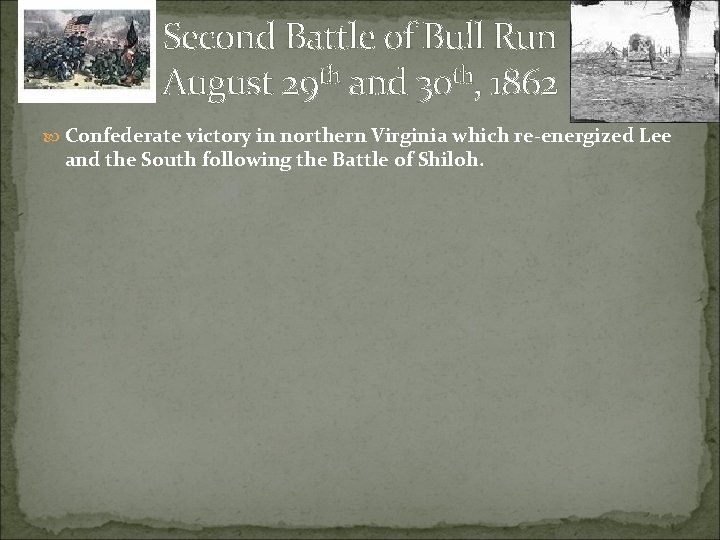
Second Battle of Bull Run August 29 th and 30 th, 1862 Confederate victory in northern Virginia which re-energized Lee and the South following the Battle of Shiloh.
Closure Assignment #5 Answer the following questions based on what you have learned from Chapter 11, Section 1: 1. Which side do you think had the best long-term chances for victory at the start of the Civil War? Why? 2. Choose two battles discussed in this section and describe one effect of each. 3. Based on what you have read, how did Grant and Mc. Clellan differ as military leaders?
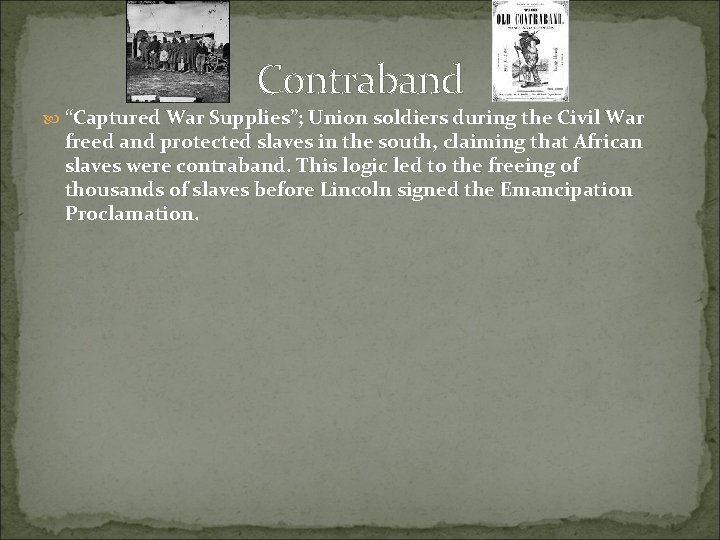
Contraband “Captured War Supplies”; Union soldiers during the Civil War freed and protected slaves in the south, claiming that African slaves were contraband. This logic led to the freeing of thousands of slaves before Lincoln signed the Emancipation Proclamation.
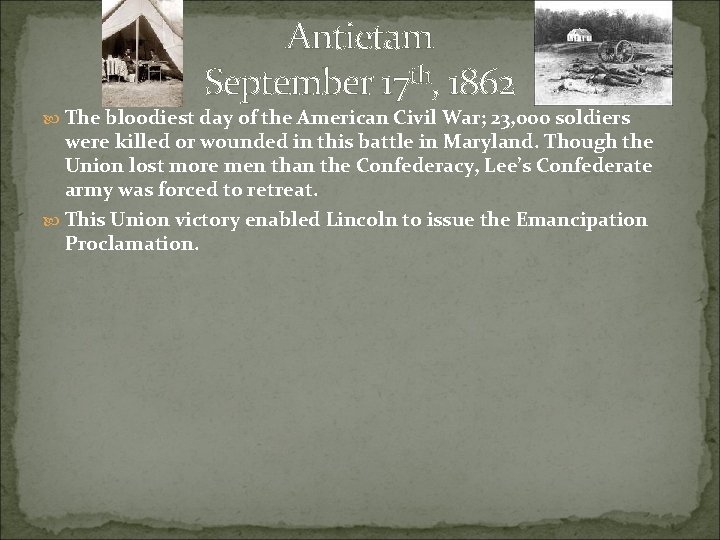
Antietam September 17 th, 1862 The bloodiest day of the American Civil War; 23, 000 soldiers were killed or wounded in this battle in Maryland. Though the Union lost more men than the Confederacy, Lee’s Confederate army was forced to retreat. This Union victory enabled Lincoln to issue the Emancipation Proclamation.
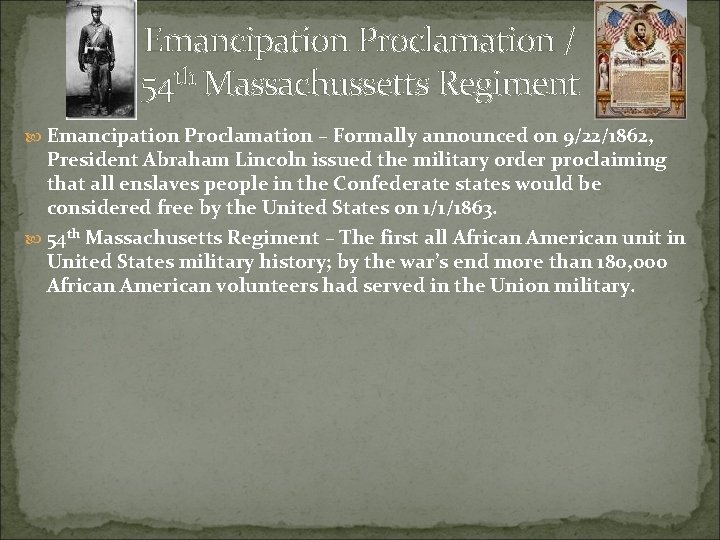
Emancipation Proclamation / 54 th Massachussetts Regiment Emancipation Proclamation – Formally announced on 9/22/1862, President Abraham Lincoln issued the military order proclaiming that all enslaves people in the Confederate states would be considered free by the United States on 1/1/1863. 54 th Massachusetts Regiment – The first all African American unit in United States military history; by the war’s end more than 180, 000 African American volunteers had served in the Union military.
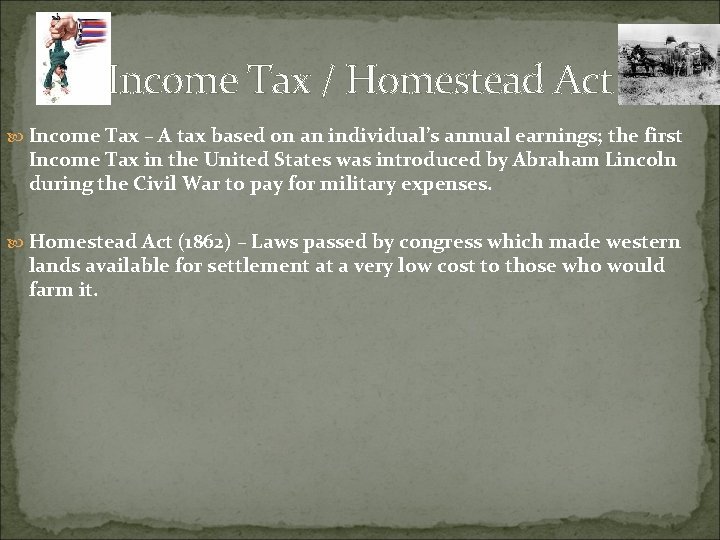
Income Tax / Homestead Act Income Tax – A tax based on an individual’s annual earnings; the first Income Tax in the United States was introduced by Abraham Lincoln during the Civil War to pay for military expenses. Homestead Act (1862) – Laws passed by congress which made western lands available for settlement at a very low cost to those who would farm it.
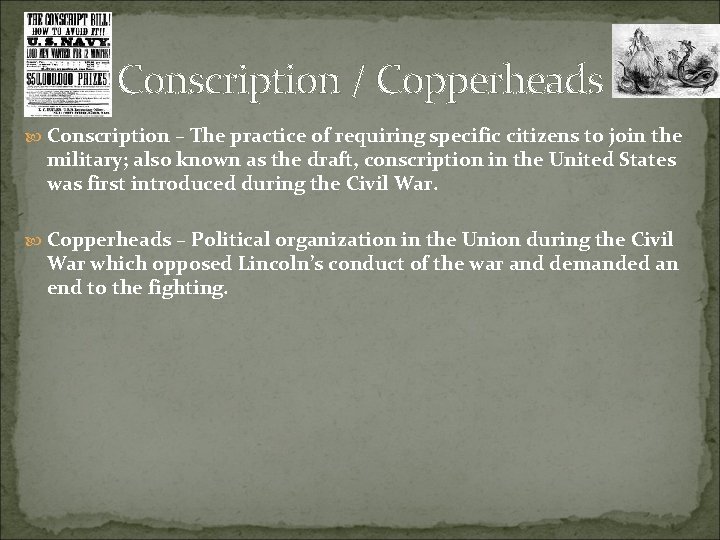
Conscription / Copperheads Conscription – The practice of requiring specific citizens to join the military; also known as the draft, conscription in the United States was first introduced during the Civil War. Copperheads – Political organization in the Union during the Civil War which opposed Lincoln’s conduct of the war and demanded an end to the fighting.
Habeas Corpus Constitutional right which protects a person from being held in jail without being charged for a specific crime; During the Civil War, President Lincoln suspended this right, empowering the military to arrest people suspected of being disloyal to the Union.
Clara Barton 1821 -1912 One of the first professional female nurses; provided medical care to solders during the Civil War. Following the war, Barton founded the American Red Cross.
Closure Assignment #6 Answer the following questions based on what you have learned from Chapter 11, Sections 2 and 3: 1. Do you think Lincoln was right to wait so long before declaring emancipation? Why or why not? 2. How did wartime needs lead to limitations on individual freedom in the North? Do you think such actions were justified? 3. Why do you think nursing came to be a profession dominated by women? Is this still true today?
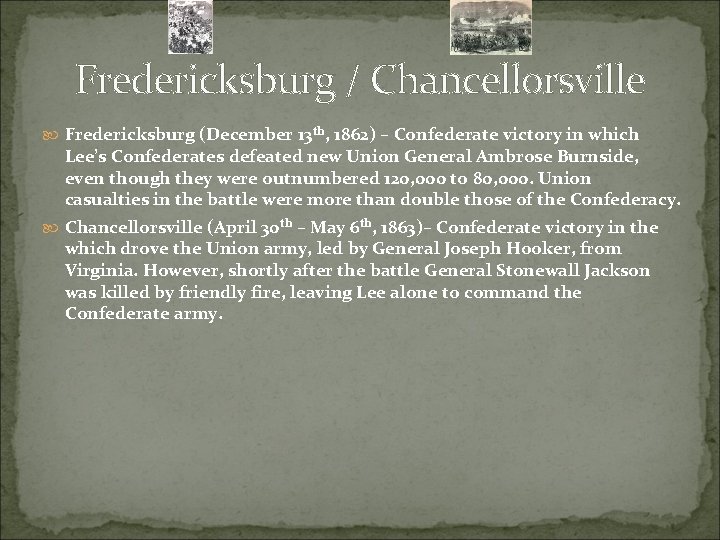
Fredericksburg / Chancellorsville Fredericksburg (December 13 th, 1862) – Confederate victory in which Lee’s Confederates defeated new Union General Ambrose Burnside, even though they were outnumbered 120, 000 to 80, 000. Union casualties in the battle were more than double those of the Confederacy. Chancellorsville (April 30 th – May 6 th, 1863)– Confederate victory in the which drove the Union army, led by General Joseph Hooker, from Virginia. However, shortly after the battle General Stonewall Jackson was killed by friendly fire, leaving Lee alone to command the Confederate army.
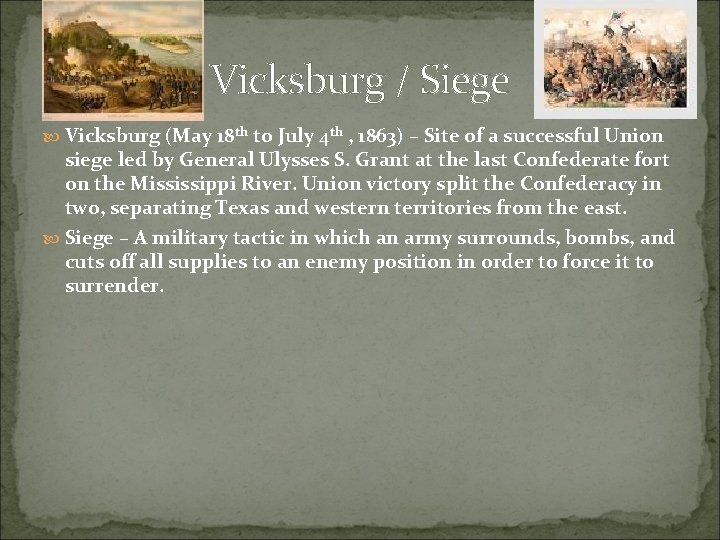
Vicksburg / Siege Vicksburg (May 18 th to July 4 th , 1863) – Site of a successful Union siege led by General Ulysses S. Grant at the last Confederate fort on the Mississippi River. Union victory split the Confederacy in two, separating Texas and western territories from the east. Siege – A military tactic in which an army surrounds, bombs, and cuts off all supplies to an enemy position in order to force it to surrender.
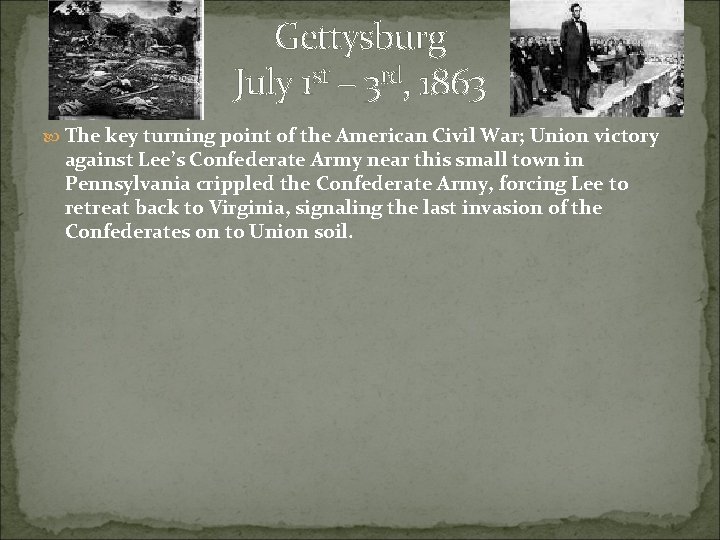
Gettysburg July 1 st – 3 rd, 1863 The key turning point of the American Civil War; Union victory against Lee’s Confederate Army near this small town in Pennsylvania crippled the Confederate Army, forcing Lee to retreat back to Virginia, signaling the last invasion of the Confederates on to Union soil.
Joshua Lawrence Chamberlain / George Pickett Joshua Lawrence Chamberlain – Leader of a Union unit from Maine which successful defended the southern edge of the Union lines at the Battle of Gettysburg. For his bravery, Chamberlain was given the honor of receiving the official Confederate Surrender at Appomattox Court House in 1865. George Pickett – Leader of the final Confederate charge at the Battle of Gettysburg on July 3 rd, 1863; thousands of Confederates were killed by Union rifle and canon fire, ending the battle as a Union victory.
William Tecumseh Sherman / Total War William Tecumseh Sherman – Second-in-command to General Grant, following Grant’s call to serve as commander of the Army of the Potomac Sherman acted as commander of the Union Army of the West, leading 60, 000 troops on a 250 mile march through the hear of the Confederacy in 1864 from Tennessee to Savannah, Georgia. Total War – The practice of attacking civilians as well as soldiers in order to weaken the enemies economy and the will of the people that support the army.
Closure Assignment #7 Answer the following questions based on what you have learned from Chapter 11, Section 4: 1. Using examples from this section, write a general definition of the term turning point. 2. In the Gettysburg Address, Lincoln stated that the purpose of the war was to ensure “that this nation… shall have a new birth of freedom – and that government of the people, by the people, for the people, shall not perish from the earth. ” What do you think he meant? 3. Why do you think General Sherman felt justified in destroying civilian property during his march through Georgia.
Closure Question #1: What alternatives did the South face in February 1865? Do you think they made the right choice? In the summer of 1864, Grant continued his bloody drive toward Richmond. But at Petersburg, about 20 miles south of Richmond, the Confederacy made a desperate stand. Petersburg was a vital railroad center. If Grant captured it, he could cut all supply lines to Richmond. As he had at Vicksburg, Grant turned to siege tactics. Throughout the summer and fall and into the winter, his forces tightened their grip around Petersburg. Both sides dug trenches and threw up fortifications to guard against attack. By March 1865, the two opposing lines of defense stretched for more than 30 miles around Petersburg. Fighting was fierce. Union troops suffered more than 40, 000 casualties. The Confederates lost 28, 000 men. However, unlike Grant, Lee had no replacement troops in reserve. As the siege of Petersburg wore on, Union strength grew in comparison to the Confederate defenders. With the Confederate position truly desperate, southerners began to talk of peace. In February 1865, a party led by Confederate Vice President Alexander Stephens met with Lincoln to discuss a feasible end to the war. However, these discussions produced no results. The Confederate delegation was unwilling to accept a future without slavery.
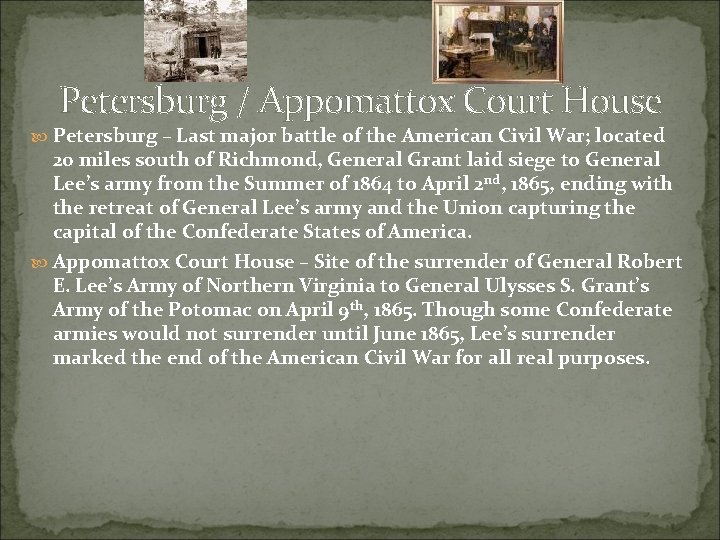
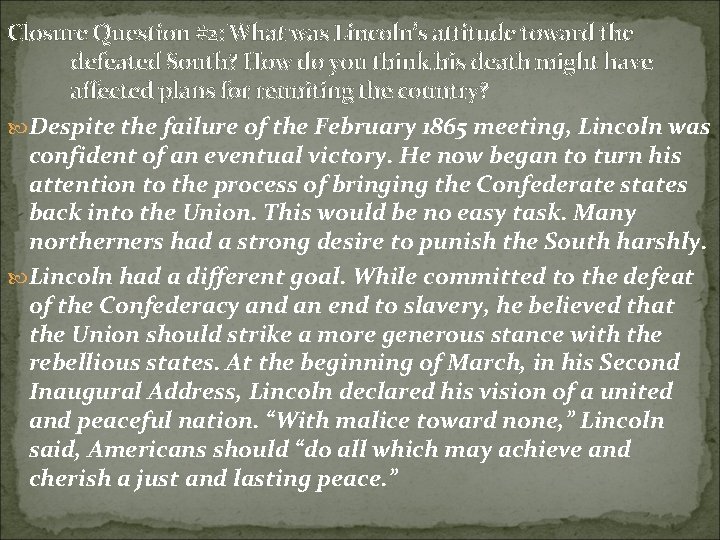
Petersburg / Appomattox Court House Petersburg – Last major battle of the American Civil War; located 20 miles south of Richmond, General Grant laid siege to General Lee’s army from the Summer of 1864 to April 2 nd, 1865, ending with the retreat of General Lee’s army and the Union capturing the capital of the Confederate States of America. Appomattox Court House – Site of the surrender of General Robert E. Lee’s Army of Northern Virginia to General Ulysses S. Grant’s Army of the Potomac on April 9 th, 1865. Though some Confederate armies would not surrender until June 1865, Lee’s surrender marked the end of the American Civil War for all real purposes.
Closure Question #2: What was Lincoln’s attitude toward the defeated South? How do you think his death might have affected plans for reuniting the country? Despite the failure of the February 1865 meeting, Lincoln was confident of an eventual victory. He now began to turn his attention to the process of bringing the Confederate states back into the Union. This would be no easy task. Many northerners had a strong desire to punish the South harshly. Lincoln had a different goal. While committed to the defeat of the Confederacy and an end to slavery, he believed that the Union should strike a more generous stance with the rebellious states. At the beginning of March, in his Second Inaugural Address, Lincoln declared his vision of a united and peaceful nation. “With malice toward none, ” Lincoln said, Americans should “do all which may achieve and cherish a just and lasting peace. ”
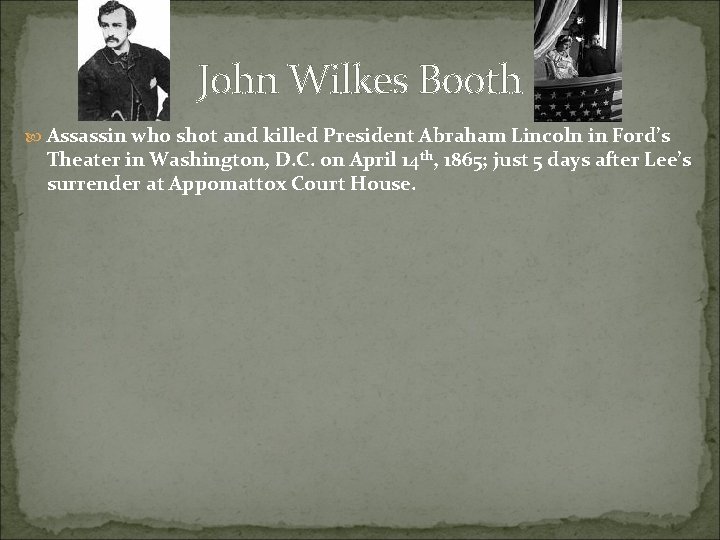
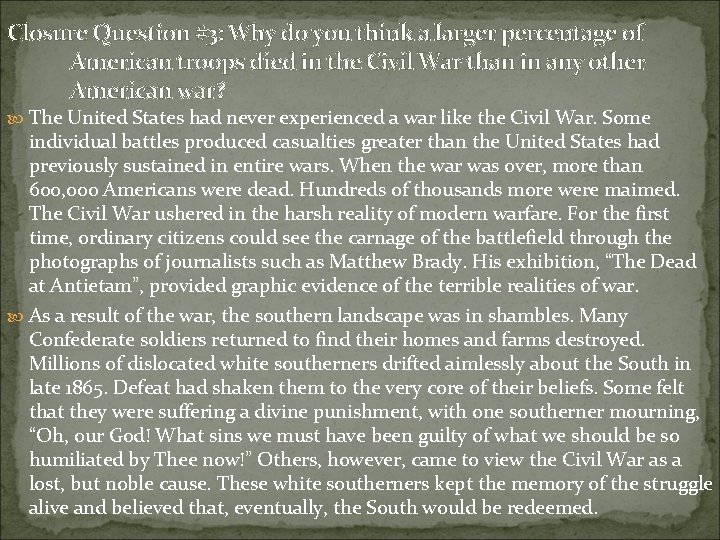
John Wilkes Booth Assassin who shot and killed President Abraham Lincoln in Ford’s Theater in Washington, D. C. on April 14 th, 1865; just 5 days after Lee’s surrender at Appomattox Court House.
Closure Question #3: Why do you think a larger percentage of American troops died in the Civil War than in any other American war? The United States had never experienced a war like the Civil War. Some individual battles produced casualties greater than the United States had previously sustained in entire wars. When the war was over, more than 600, 000 Americans were dead. Hundreds of thousands more were maimed. The Civil War ushered in the harsh reality of modern warfare. For the first time, ordinary citizens could see the carnage of the battlefield through the photographs of journalists such as Matthew Brady. His exhibition, “The Dead at Antietam”, provided graphic evidence of the terrible realities of war. As a result of the war, the southern landscape was in shambles. Many Confederate soldiers returned to find their homes and farms destroyed. Millions of dislocated white southerners drifted aimlessly about the South in late 1865. Defeat had shaken them to the very core of their beliefs. Some felt that they were suffering a divine punishment, with one southerner mourning, “Oh, our God! What sins we must have been guilty of what we should be so humiliated by Thee now!” Others, however, came to view the Civil War as a lost, but noble cause. These white southerners kept the memory of the struggle alive and believed that, eventually, the South would be redeemed.
Closure Assignment #8 Answer the following questions based on Chapter 11, Section 5: 1. What alternatives did the South face in February 1865? Do you think they made the right choice? 2. What was Lincoln’s attitude toward the defeated South? How do you think his death might have affected plans for reuniting the country? 3. Why do you think a larger percentage of American troops died in the Civil War than in any other American war?