
The Unifications of Italy and Germany Consider the

- Slides: 31
The Unifications of Italy and Germany
Consider the following questions. • How far would you go to achieve independence for your country? • Would you be willing to die for the sake of your country? • Willing to kill? • Would you fight back? Or would you strike first. . .
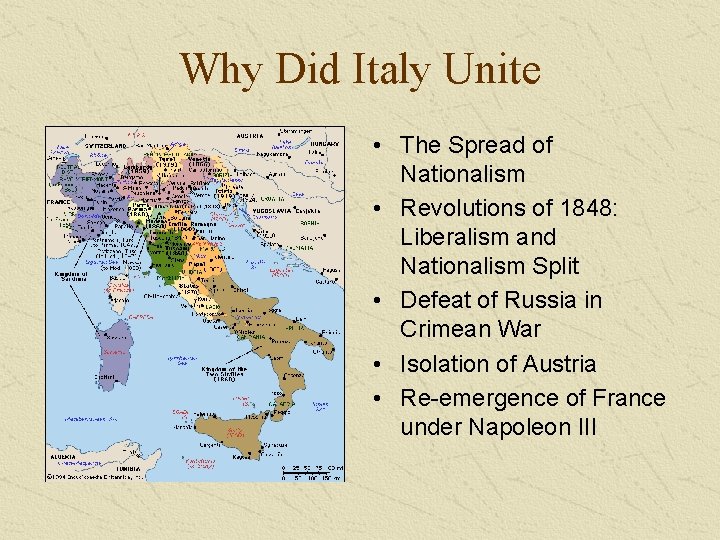
Why Did Italy Unite • The Spread of Nationalism • Revolutions of 1848: Liberalism and Nationalism Split • Defeat of Russia in Crimean War • Isolation of Austria • Re-emergence of France under Napoleon III
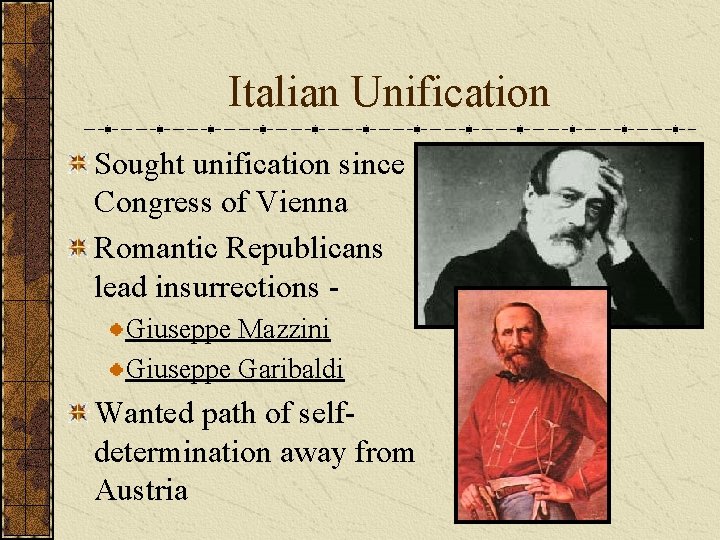
Italian Unification Sought unification since Congress of Vienna Romantic Republicans lead insurrections Giuseppe Mazzini Giuseppe Garibaldi Wanted path of selfdetermination away from Austria
Plans for Italian Unification Plan 1 - unite behind Pope (1848/9) - Austria and France defeat the Roman Republic Plan 2 - unite behind only independent state, Piedmont (Sardinia) - made independent by Congress of Europe as a buffer between France and Austria Piedmont Prime Minister aids France in Crimean War with 10, 000 troops - thrusts Piedmont onto world stage
Nationalist in Italy l Italians were inspired by the French Revolution. • • Congress of Vienna kept Italy separated. Austria controlled portions of northern Italy. Other independent states kept unification hard to do. A group of Italian tried to keep it alive. • This group was called the Risorgimento ”resurgence”. • Secret society.
Giuseppe Mazzini l Formed the Young Italy movement. • Forced Austrian out of Lombardy and Venetia. • Seized control of Rome • A republic was formed by Mazzini and two other leaders. • His victories were not long lived. • Austria gain control of northern states. • Only Sardinia remained independent.
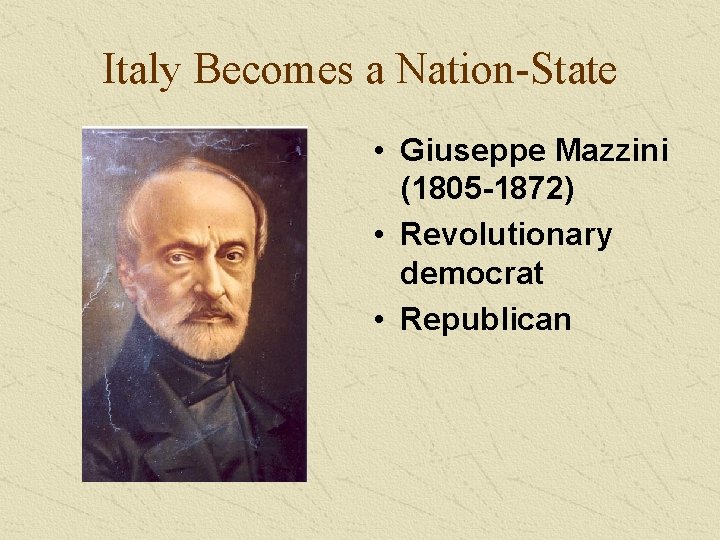
Italy Becomes a Nation-State • Giuseppe Mazzini (1805 -1872) • Revolutionary democrat • Republican
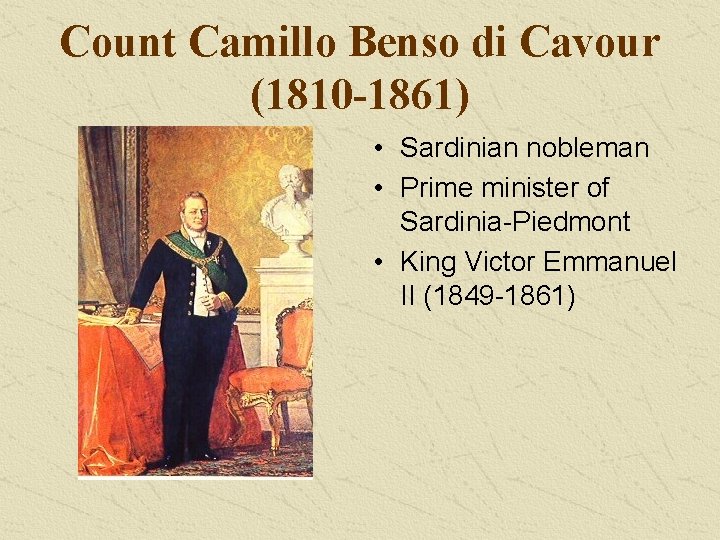
Sardinia l l Was ruled by King Victor Emmanuel II. Chief Minister was Camillo Benso di Cavour. • Was more powerful than King. • Wanted to expand Sardinian territory. • Wanted to lead in uniting Italy. • He strengthened the military and Industry. • Allied with France and England.
Count Camillo Benso di Cavour (1810 -1861) • Sardinian nobleman • Prime minister of Sardinia-Piedmont • King Victor Emmanuel II (1849 -1861)
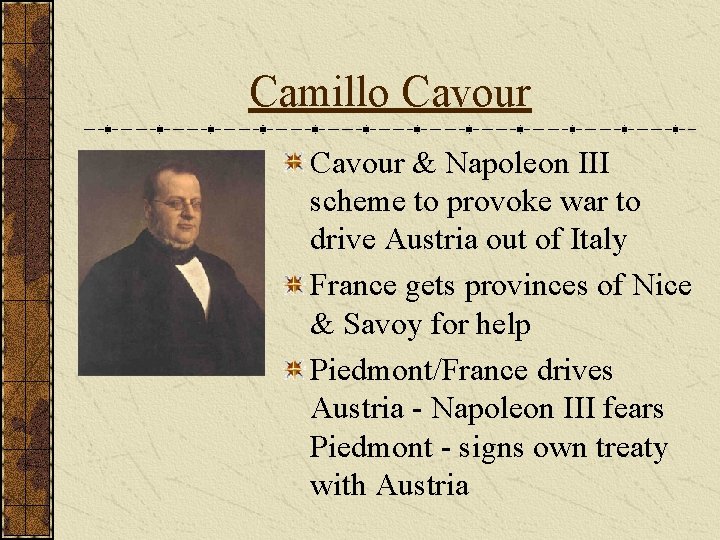
Camillo Cavour & Napoleon III scheme to provoke war to drive Austria out of Italy France gets provinces of Nice & Savoy for help Piedmont/France drives Austria - Napoleon III fears Piedmont - signs own treaty with Austria
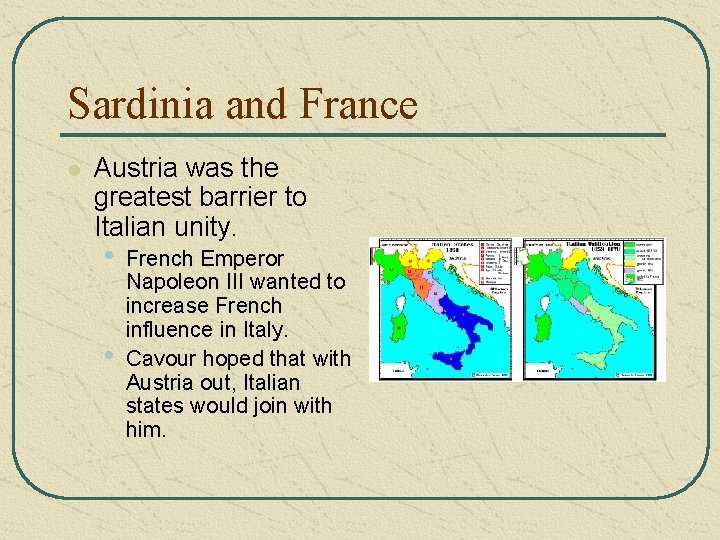
Sardinia and France l Austria was the greatest barrier to Italian unity. • • French Emperor Napoleon III wanted to increase French influence in Italy. Cavour hoped that with Austria out, Italian states would join with him.
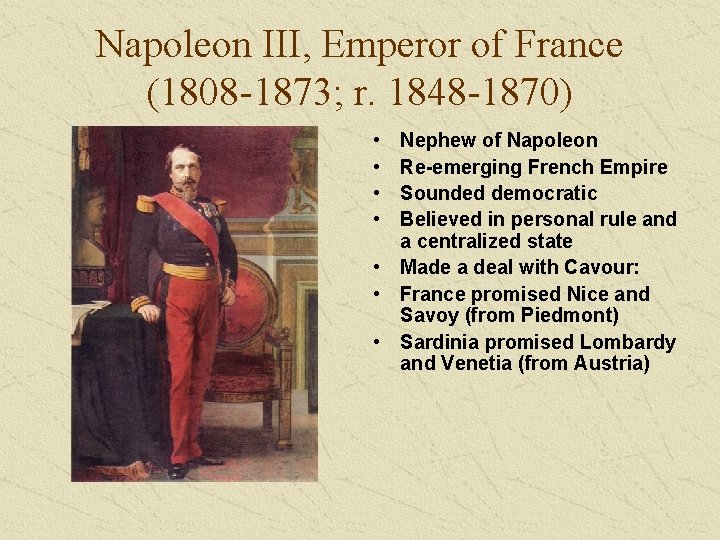
Napoleon III, Emperor of France (1808 -1873; r. 1848 -1870) • • Nephew of Napoleon Re-emerging French Empire Sounded democratic Believed in personal rule and a centralized state • Made a deal with Cavour: • France promised Nice and Savoy (from Piedmont) • Sardinia promised Lombardy and Venetia (from Austria)
War with Austria l l Sardinia provoked Austria to war and France sent troops to help. Austria was quickly defeated in Italy. • States of Lombardy, Venetia, Tuscany, • Modena, and Parma join Sardinia. French signs treaty with Austria. • Austria gets Ventia back. France gets Nice and Savoy. Sardinia gets Lombardy.
Unifying the South l l Southern half of Italy was made up of the Kingdom of the Two Sicilies. Giuseppe Garibaldi was leader of nationalistic movement. • • Formed and army of 1, 000 men and captured Sicily and Naples. Marched to Papal States. • Cavour thought that Garibaldi was becoming to popular • and set up his own republic. Garibaldi stepped aside for Sardinia.
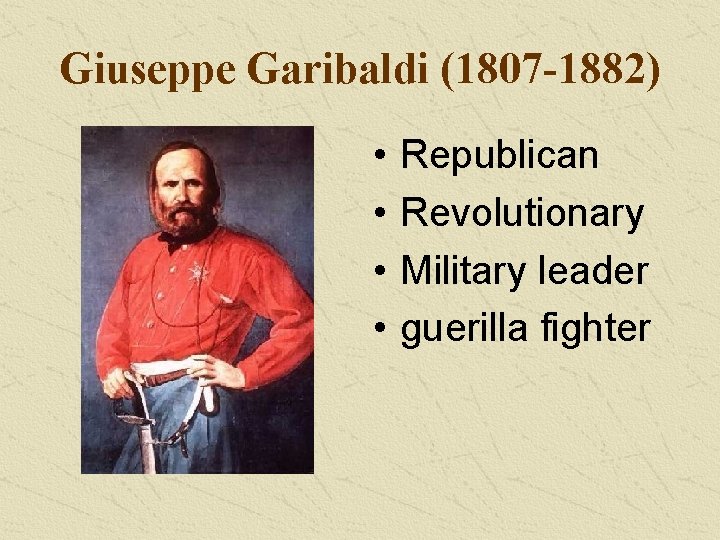
Giuseppe Garibaldi (1807 -1882) • • Republican Revolutionary Military leader guerilla fighter
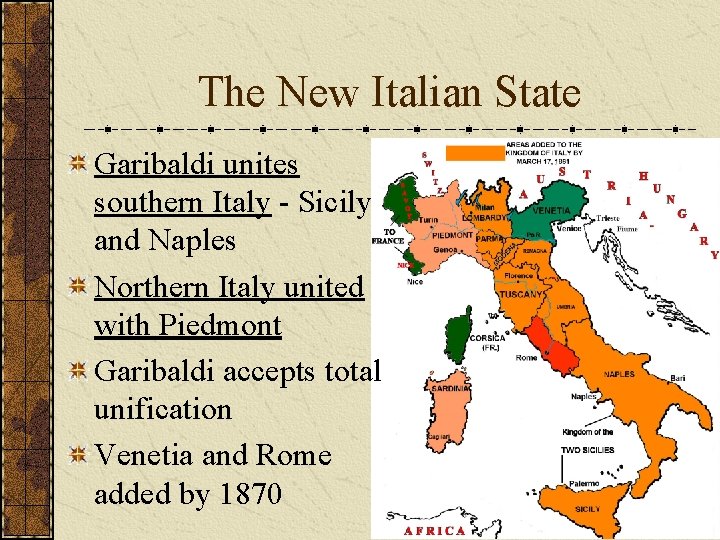
The New Italian State Garibaldi unites southern Italy - Sicily and Naples Northern Italy united with Piedmont Garibaldi accepts total unification Venetia and Rome added by 1870
Italy Gain Venetia in deal with Prussians in war with Austria Gain area around Rome after French lose Franco-Prussian War - city of Rome remains hostile Form of government: monarchy - Victor Emmanuel from Piedmont
Problems of Unification l l l Papal states were added to Italy by 1870 and Austria was ran out of Italy in 1866. Few Italians had experienced selfgovernment. There were cultural differences between the south and north. • North was more industrial and south agricultural.
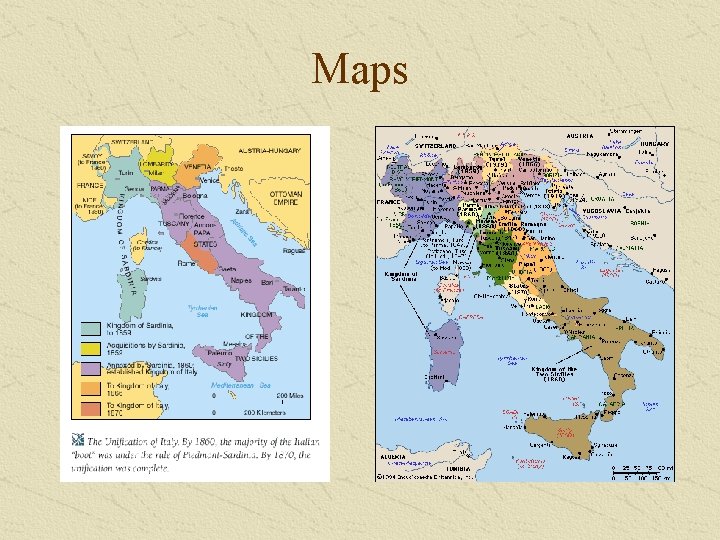
Maps
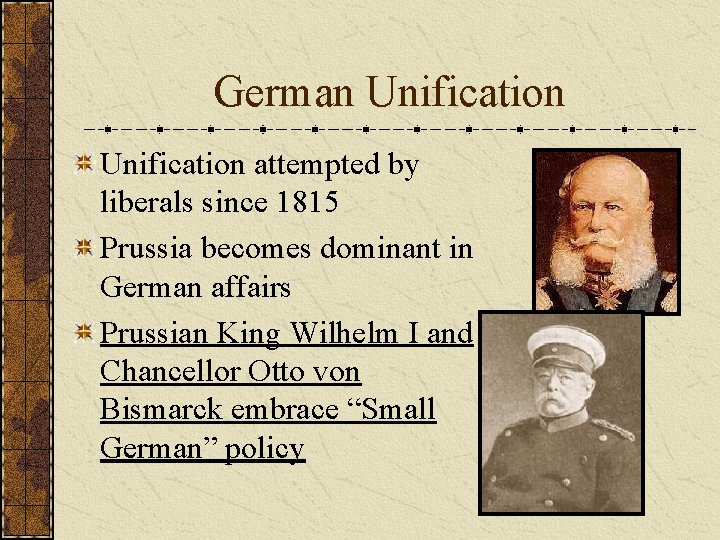
German Unification attempted by liberals since 1815 Prussia becomes dominant in German affairs Prussian King Wilhelm I and Chancellor Otto von Bismarck embrace “Small German” policy
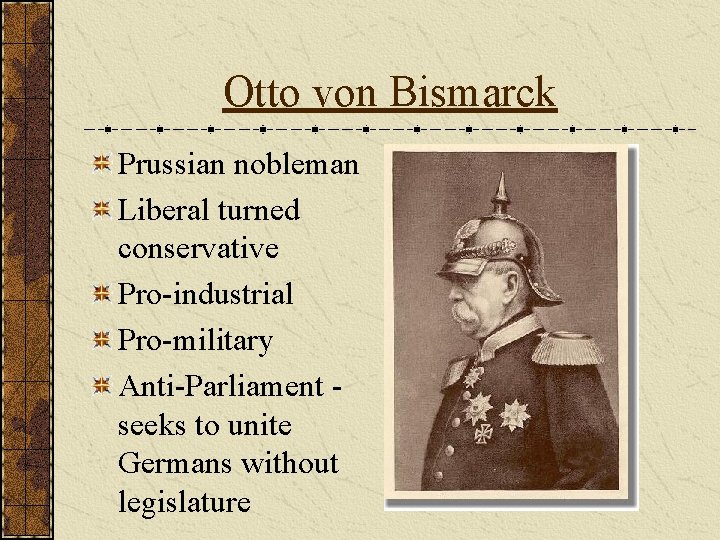
Otto von Bismarck Prussian nobleman Liberal turned conservative Pro-industrial Pro-military Anti-Parliament seeks to unite Germans without legislature
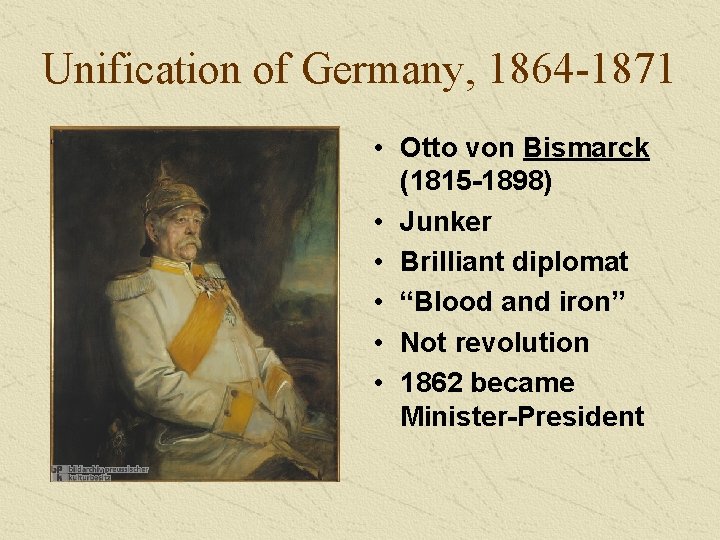
Unification of Germany, 1864 -1871 • Otto von Bismarck (1815 -1898) • Junker • Brilliant diplomat • “Blood and iron” • Not revolution • 1862 became Minister-President
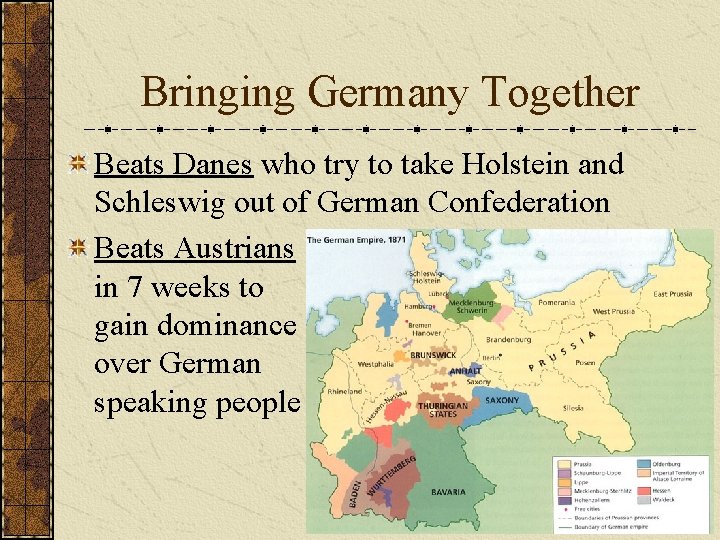
Bringing Germany Together Beats Danes who try to take Holstein and Schleswig out of German Confederation Beats Austrians in 7 weeks to gain dominance over German speaking people
The North German Confederation Bismarck annexes Hesse, Nassau, & Hanover (formerly supported Austria) in new group King of Prussia as leader Bicameral legislature with no real power Bismarck steals thunder of some liberals who wanted unification Bismarck seeks a war to bring southern German states into the Confederation
The Franco-Prussian War Queen Isabella of Spain deposed Spanish pick a Hohenzollern, Leopold (cousin to Wilhelm) France objects, asks Wilhelm for support Bismarck revises The Ems Telegram to look like Wilhelm insulted France declares war on the Northern Confederation
The Franco-Prussian War Southern German states side with Bismarck Germans capture Napoleon III Defeat French in 9 months - forced to give up provinces of Alsace and Lorraine German Empire proclaimed - most important event in Europe in the 19 th century Italy and Germany become new rivals to France and Austria
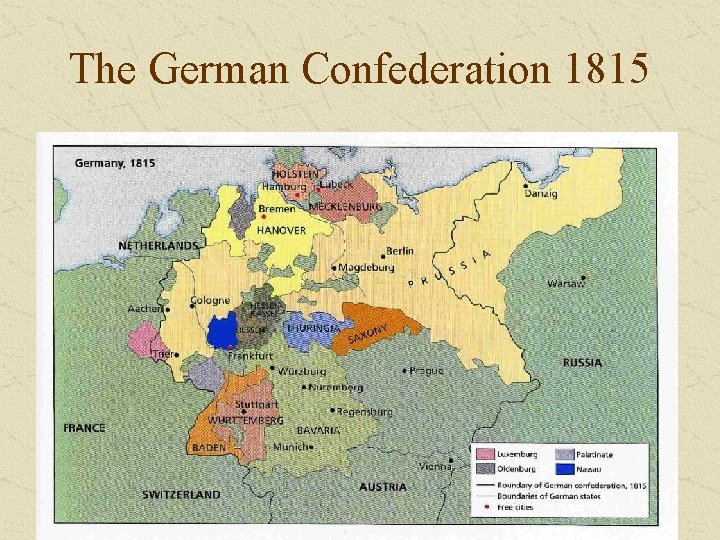
The German Confederation 1815
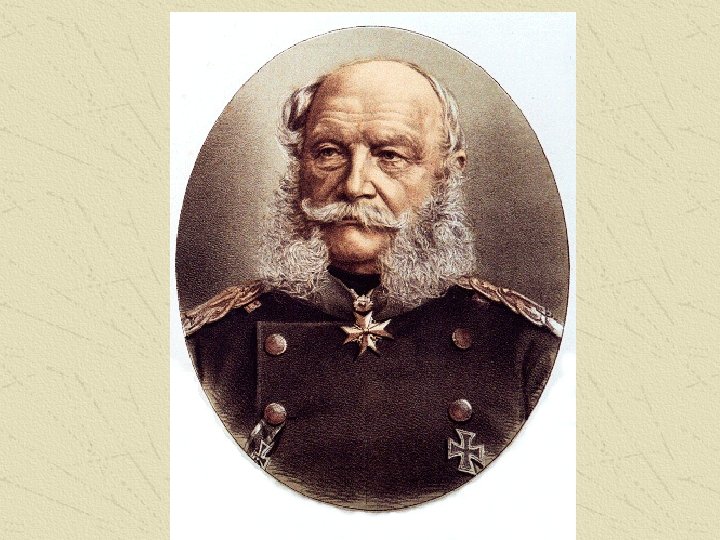
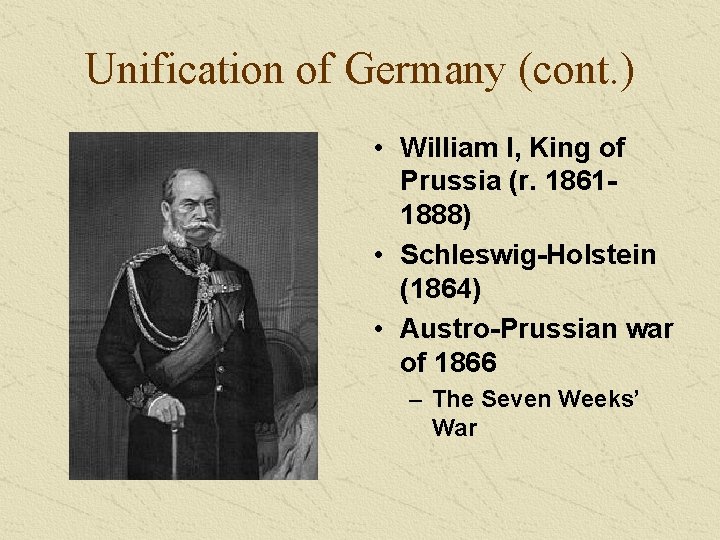
Unification of Germany (cont. ) • William I, King of Prussia (r. 18611888) • Schleswig-Holstein (1864) • Austro-Prussian war of 1866 – The Seven Weeks’ War
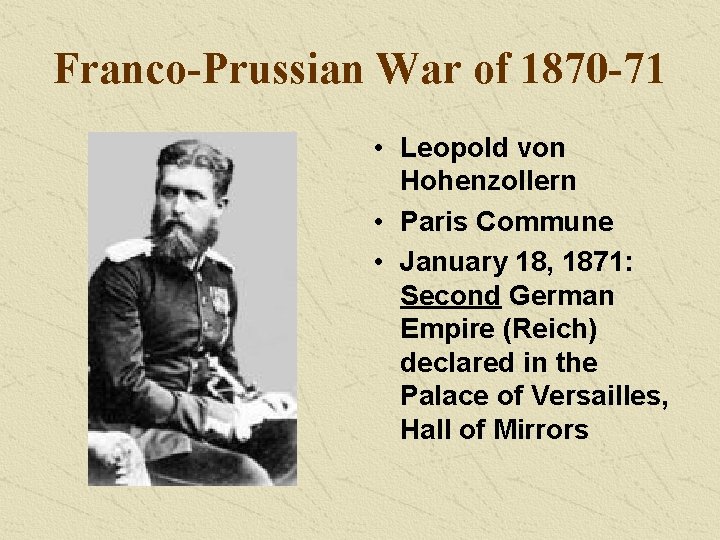
Franco-Prussian War of 1870 -71 • Leopold von Hohenzollern • Paris Commune • January 18, 1871: Second German Empire (Reich) declared in the Palace of Versailles, Hall of Mirrors