
The Unification of Germany 1800 1900 By Samantha
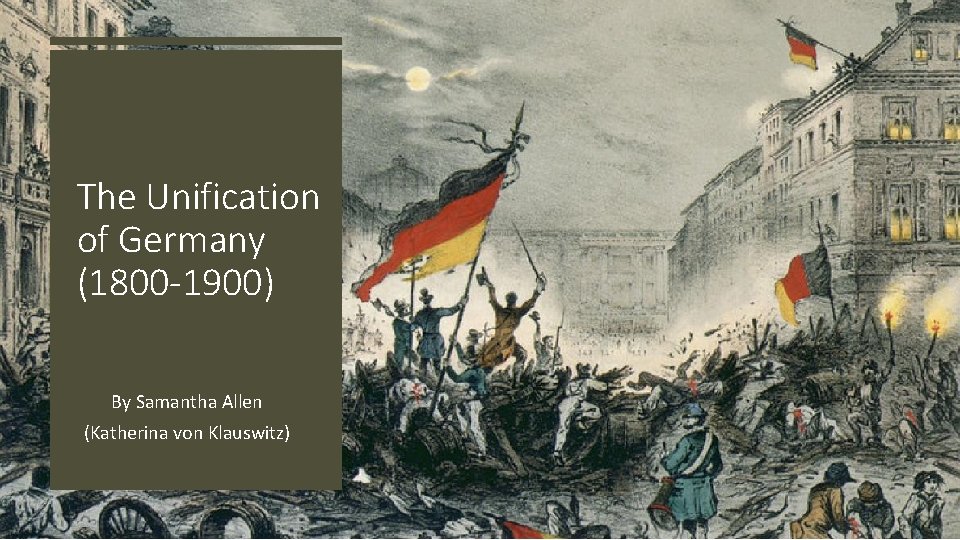
The Unification of Germany (1800 -1900) By Samantha Allen (Katherina von Klauswitz)
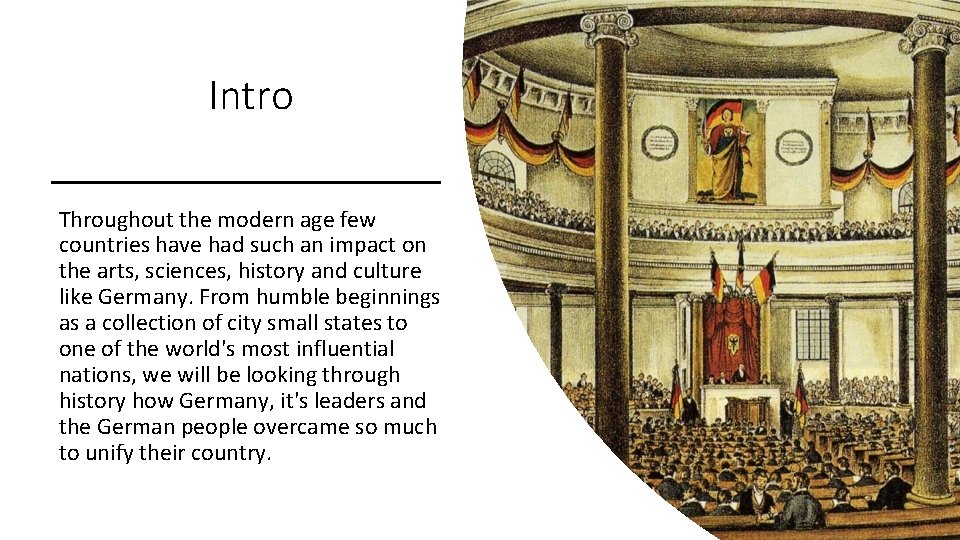
Intro Throughout the modern age few countries have had such an impact on the arts, sciences, history and culture like Germany. From humble beginnings as a collection of city small states to one of the world's most influential nations, we will be looking through history how Germany, it's leaders and the German people overcame so much to unify their country.
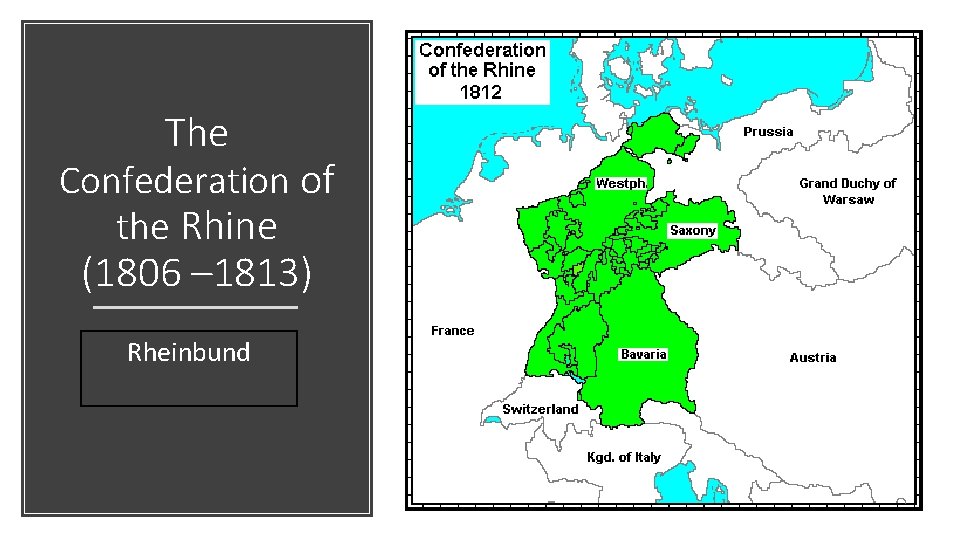
The Confederation of the Rhine (1806 – 1813) Rheinbund
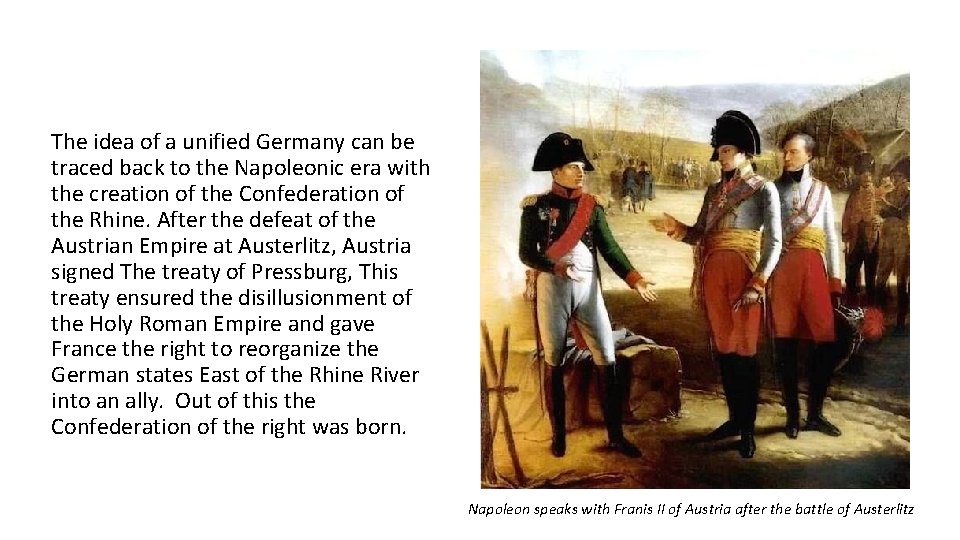
The idea of a unified Germany can be traced back to the Napoleonic era with the creation of the Confederation of the Rhine. After the defeat of the Austrian Empire at Austerlitz, Austria signed The treaty of Pressburg, This treaty ensured the disillusionment of the Holy Roman Empire and gave France the right to reorganize the German states East of the Rhine River into an ally. Out of this the Confederation of the right was born. Napoleon speaks with Franis II of Austria after the battle of Austerlitz
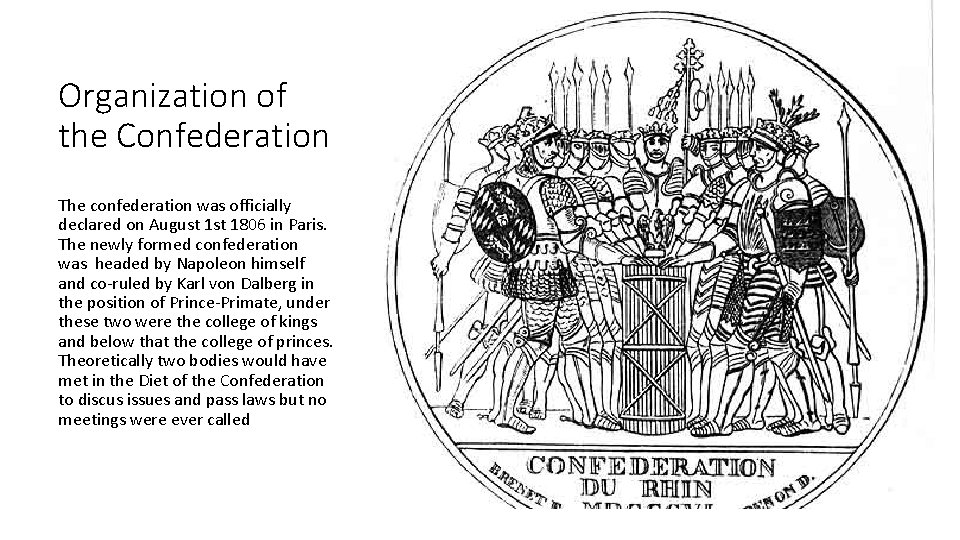
Organization of the Confederation The confederation was officially declared on August 1806 in Paris. The newly formed confederation was headed by Napoleon himself and co-ruled by Karl von Dalberg in the position of Prince-Primate, under these two were the college of kings and below that the college of princes. Theoretically two bodies would have met in the Diet of the Confederation to discus issues and pass laws but no meetings were ever called
Daily Life With the introduction of the Napoleonic code basic rights were granted to the people living in the Confederation such as rights to freedom of speech, press and assembly. Not only that but many old barriers that restricted movement and trade were also removed. Despite the restrictions on daily life being lifted with the introduction of these new rights many were unhappy with the constant warfare and the forced conscription into Napoleon's armies
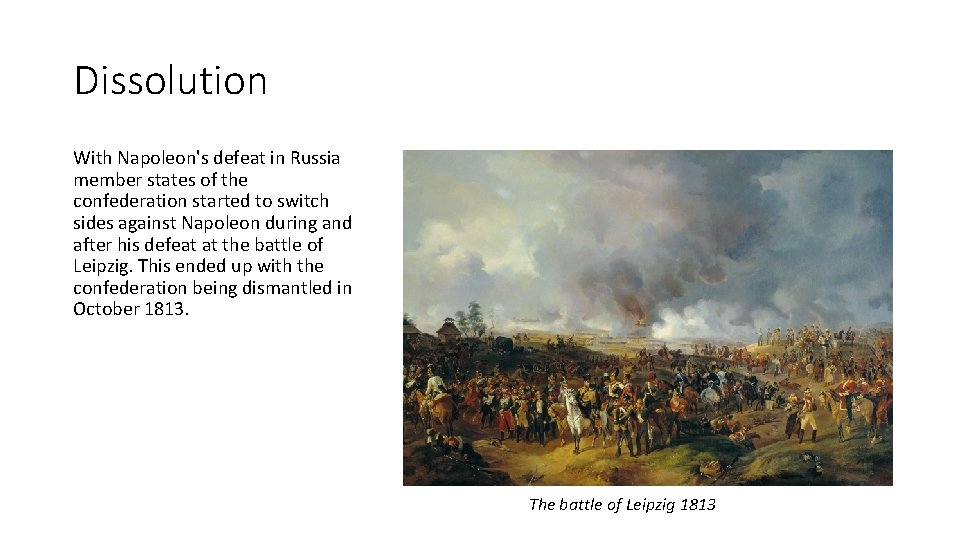
Dissolution With Napoleon's defeat in Russia member states of the confederation started to switch sides against Napoleon during and after his defeat at the battle of Leipzig. This ended up with the confederation being dismantled in October 1813. The battle of Leipzig 1813
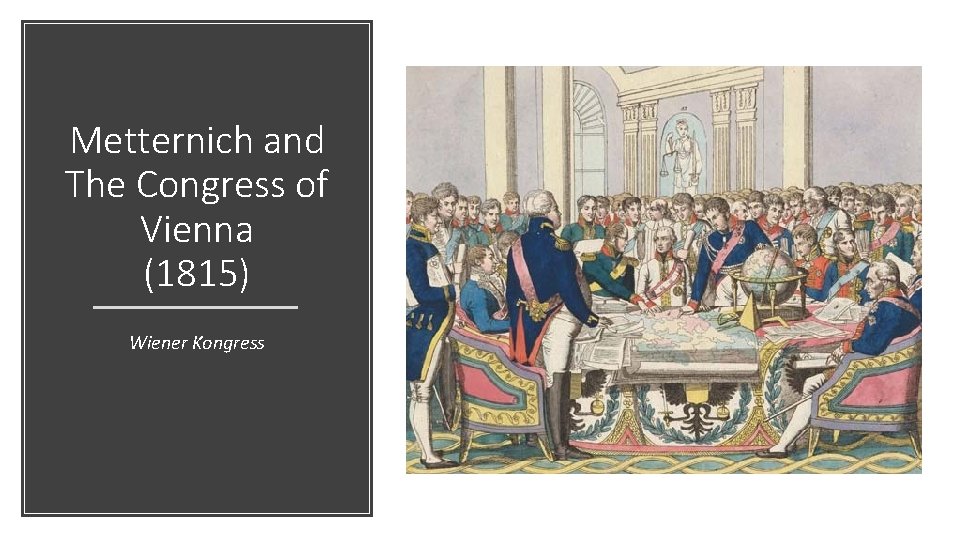
Metternich and The Congress of Vienna (1815) Wiener Kongress
Overview of The Congress Emerging from the ashes of war was the congress of Vienna, A system to keep the balance of power in Europe in check. What this entailed was a system whereas no one nation could ever become too powerful to dominate the entire continent again, after the Napoleonic wars. This system would also try to limit the influence the liberal ideas of The French Revolution. Out of the Congress of Vienna a German confederation was formed to replace the old Holy Roman Empire and keep a balance of power and influence between Austria and Prussia in the German speaking areas of Europe. This system's architect was Klemens von Metternich.
Changes brought about after the congress A number of changes were drawn up for Europe that the congress envisioned, these include: • Major territorial gains by Prussia, Austria and Russia • Many of the old ruling class restored to their former positions • The suppression of Liberalism • A new German Confederation to be Established • Freedom of movement and abolishment of serfdom throughout most of Europe
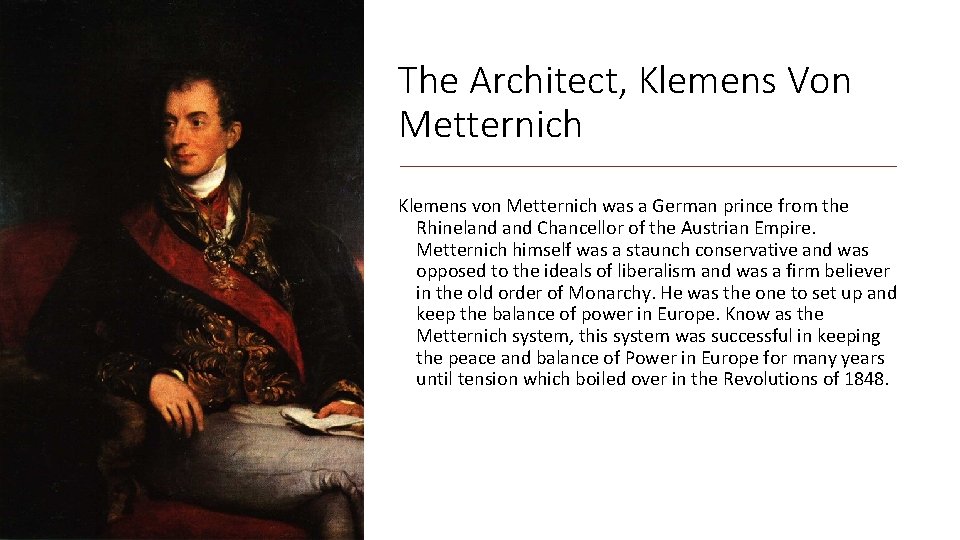
The Architect, Klemens Von Metternich Klemens von Metternich was a German prince from the Rhineland Chancellor of the Austrian Empire. Metternich himself was a staunch conservative and was opposed to the ideals of liberalism and was a firm believer in the old order of Monarchy. He was the one to set up and keep the balance of power in Europe. Know as the Metternich system, this system was successful in keeping the peace and balance of Power in Europe for many years until tension which boiled over in the Revolutions of 1848.
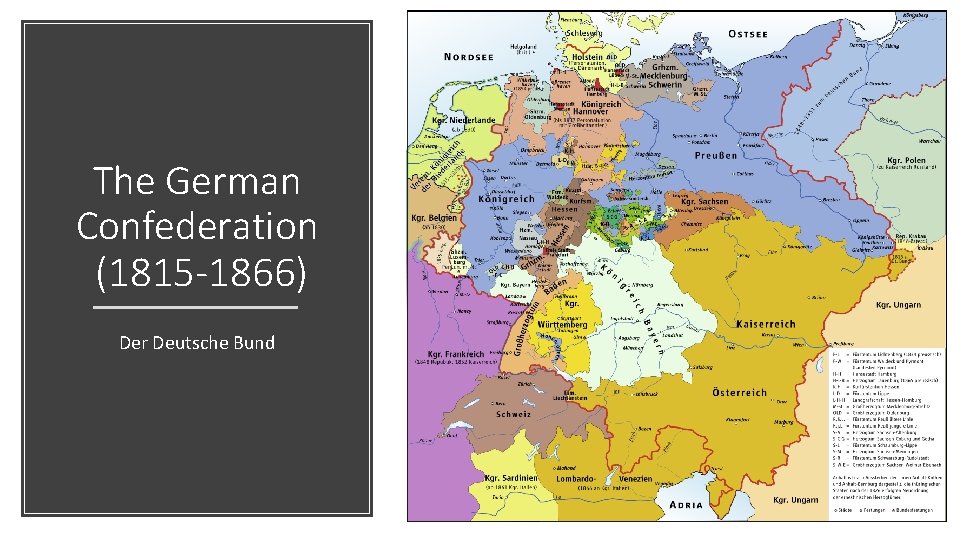
The German Confederation (1815 -1866) Der Deutsche Bund
Overview The early years of the confederation were relatively stable after the Napoleonic wars, Metternich's system of peace stood firm. In this period many artists, philosophers, inventers, scientists, industrialists statesmen would leave their mark as well as the growth in population, rapid industrialization and even revolution would play out in the German confederation.
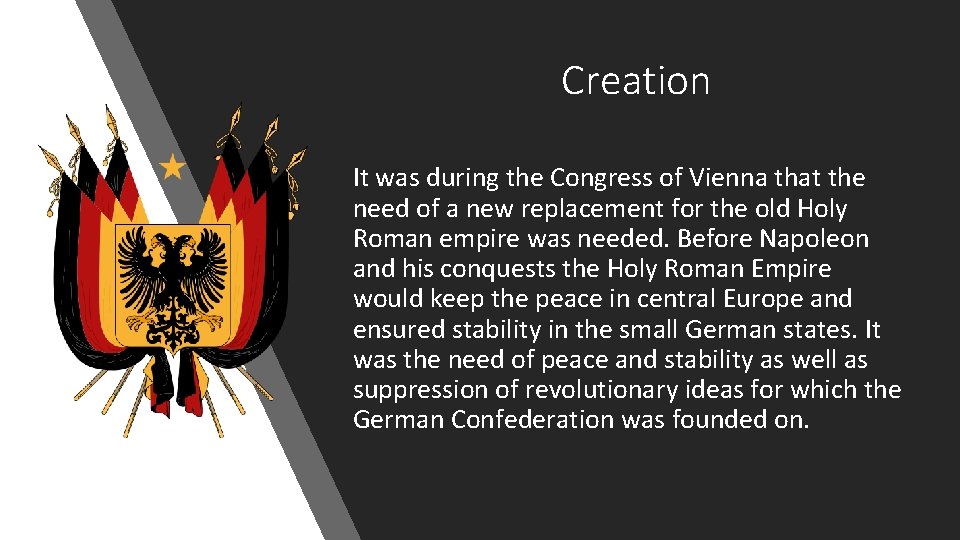
Creation It was during the Congress of Vienna that the need of a new replacement for the old Holy Roman empire was needed. Before Napoleon and his conquests the Holy Roman Empire would keep the peace in central Europe and ensured stability in the small German states. It was the need of peace and stability as well as suppression of revolutionary ideas for which the German Confederation was founded on.
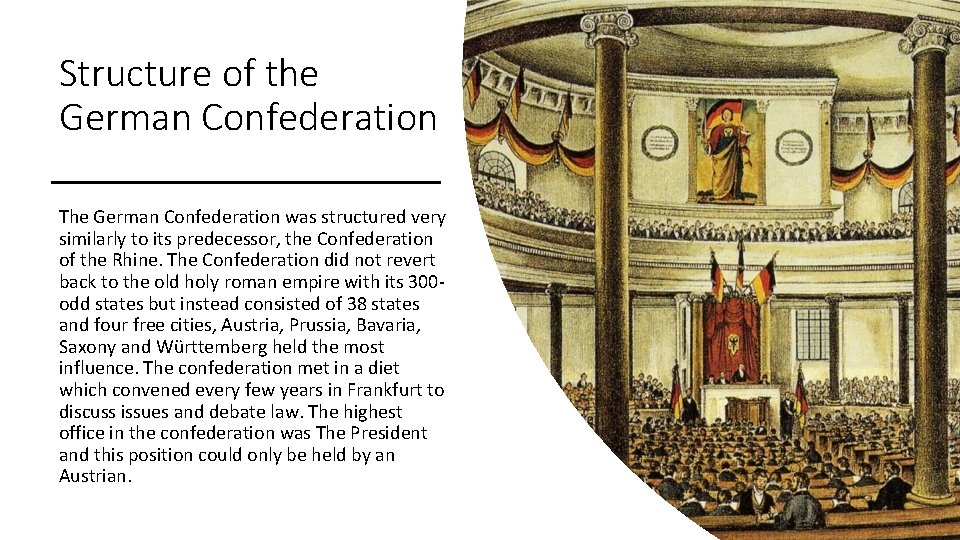
Structure of the German Confederation The German Confederation was structured very similarly to its predecessor, the Confederation of the Rhine. The Confederation did not revert back to the old holy roman empire with its 300 odd states but instead consisted of 38 states and four free cities, Austria, Prussia, Bavaria, Saxony and Württemberg held the most influence. The confederation met in a diet which convened every few years in Frankfurt to discuss issues and debate law. The highest office in the confederation was The President and this position could only be held by an Austrian.
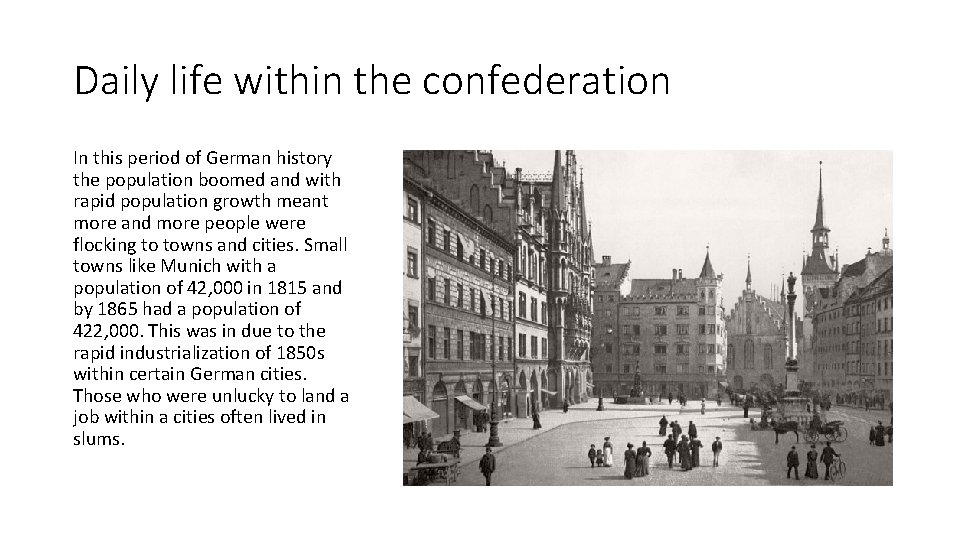
Daily life within the confederation In this period of German history the population boomed and with rapid population growth meant more and more people were flocking to towns and cities. Small towns like Munich with a population of 42, 000 in 1815 and by 1865 had a population of 422, 000. This was in due to the rapid industrialization of 1850 s within certain German cities. Those who were unlucky to land a job within a cities often lived in slums.
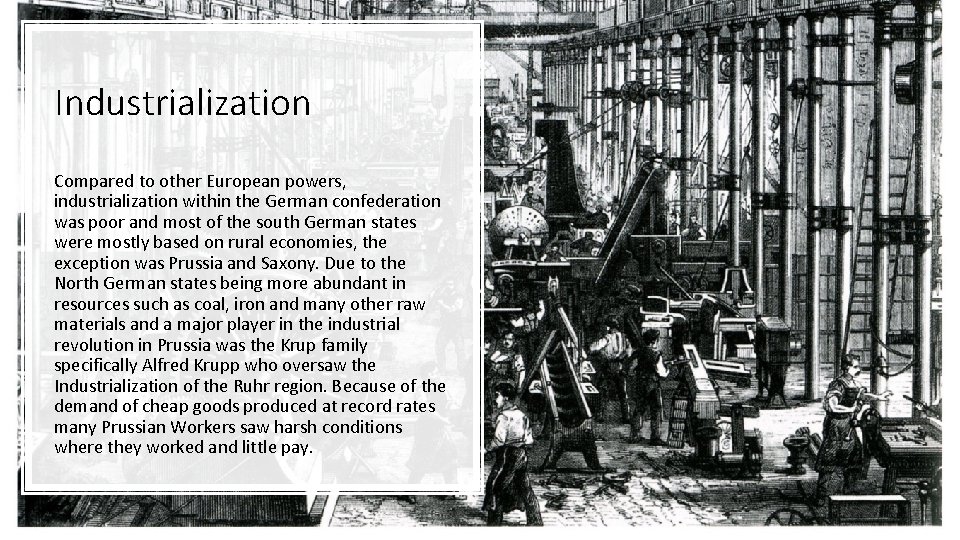
Industrialization Compared to other European powers, industrialization within the German confederation was poor and most of the south German states were mostly based on rural economies, the exception was Prussia and Saxony. Due to the North German states being more abundant in resources such as coal, iron and many other raw materials and a major player in the industrial revolution in Prussia was the Krup family specifically Alfred Krupp who oversaw the Industrialization of the Ruhr region. Because of the demand of cheap goods produced at record rates many Prussian Workers saw harsh conditions where they worked and little pay.
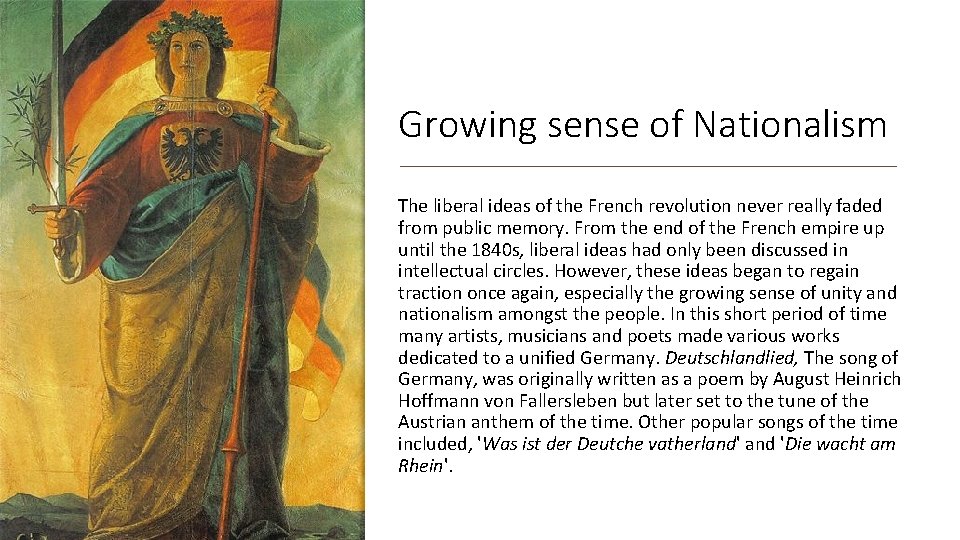
Growing sense of Nationalism The liberal ideas of the French revolution never really faded from public memory. From the end of the French empire up until the 1840 s, liberal ideas had only been discussed in intellectual circles. However, these ideas began to regain traction once again, especially the growing sense of unity and nationalism amongst the people. In this short period of time many artists, musicians and poets made various works dedicated to a unified Germany. Deutschlandlied, The song of Germany, was originally written as a poem by August Heinrich Hoffmann von Fallersleben but later set to the tune of the Austrian anthem of the time. Other popular songs of the time included, 'Was ist der Deutche vatherland' and 'Die wacht am Rhein'.
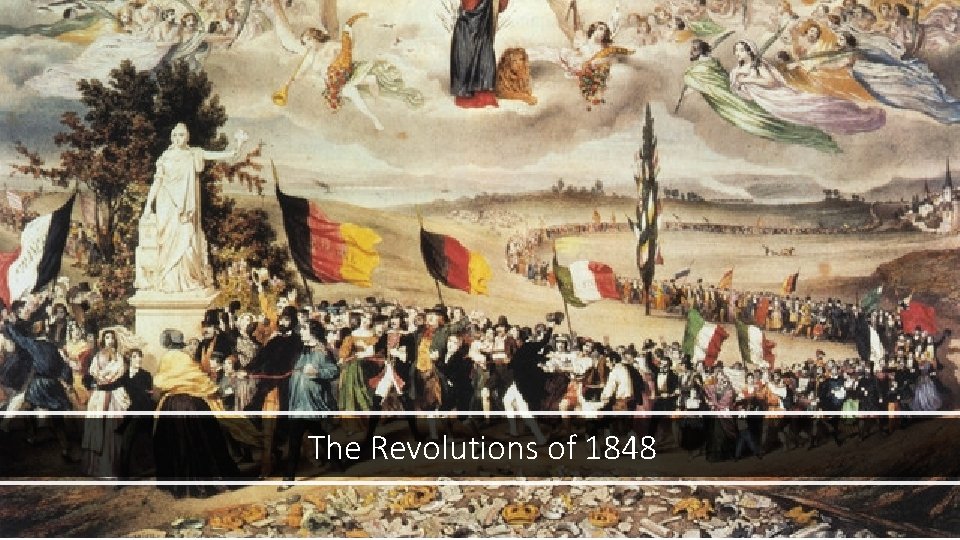
The Revolutions of 1848
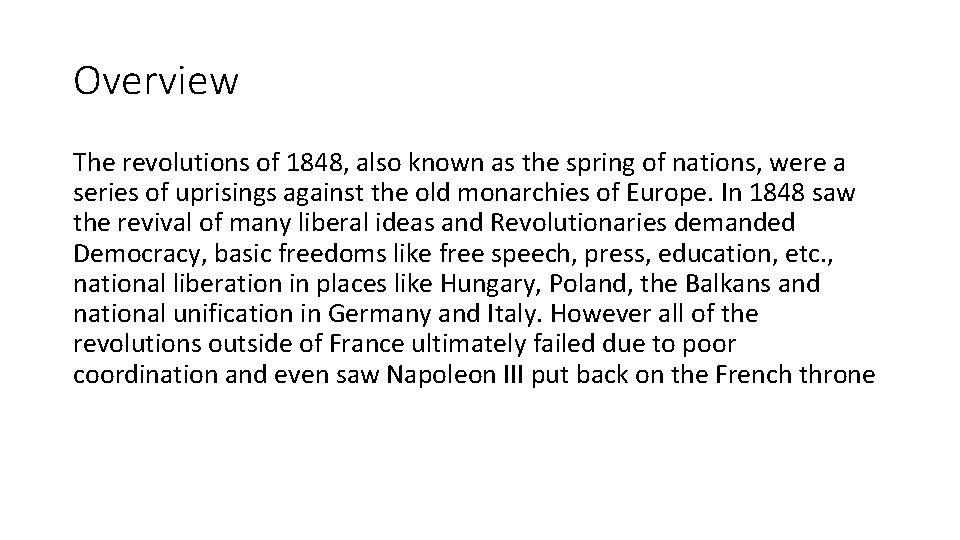
Overview The revolutions of 1848, also known as the spring of nations, were a series of uprisings against the old monarchies of Europe. In 1848 saw the revival of many liberal ideas and Revolutionaries demanded Democracy, basic freedoms like free speech, press, education, etc. , national liberation in places like Hungary, Poland, the Balkans and national unification in Germany and Italy. However all of the revolutions outside of France ultimately failed due to poor coordination and even saw Napoleon III put back on the French throne
Revolution within Germany Within the German confederation revolutionaries created the Frankfort Convention in hopes of Unifying Germany with a constitutional monarchy. At this convention there were two ideas of how Germany should be unified. Gross Deutschland, with Austria as the dominate force or Klein Deutschland which would have Prussia as the dominate force but rule-out any possibility of Austrian inclusion within the new country. This debate was never resolved and the flames of revolution were ultimately extinguished within Germany by 1849
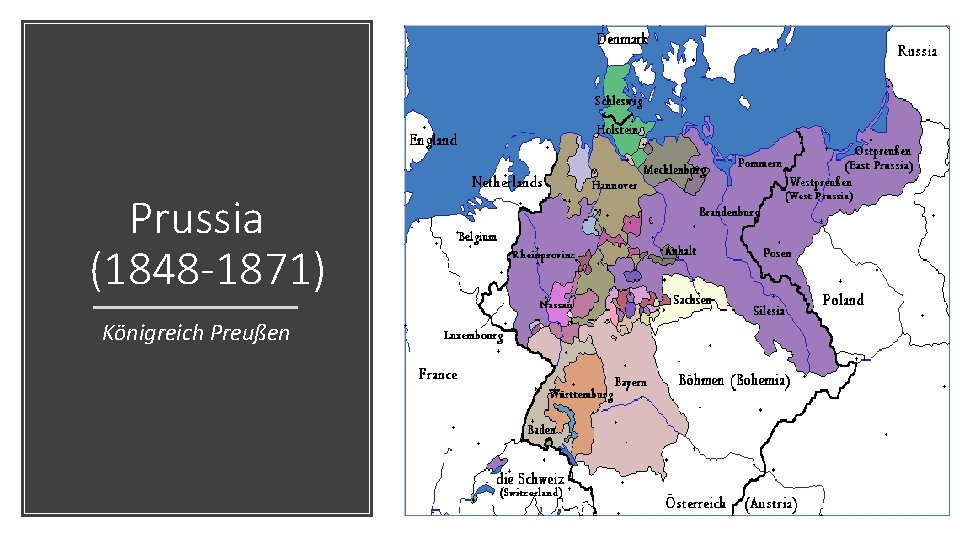
Prussia (1848 -1871) Königreich Preußen
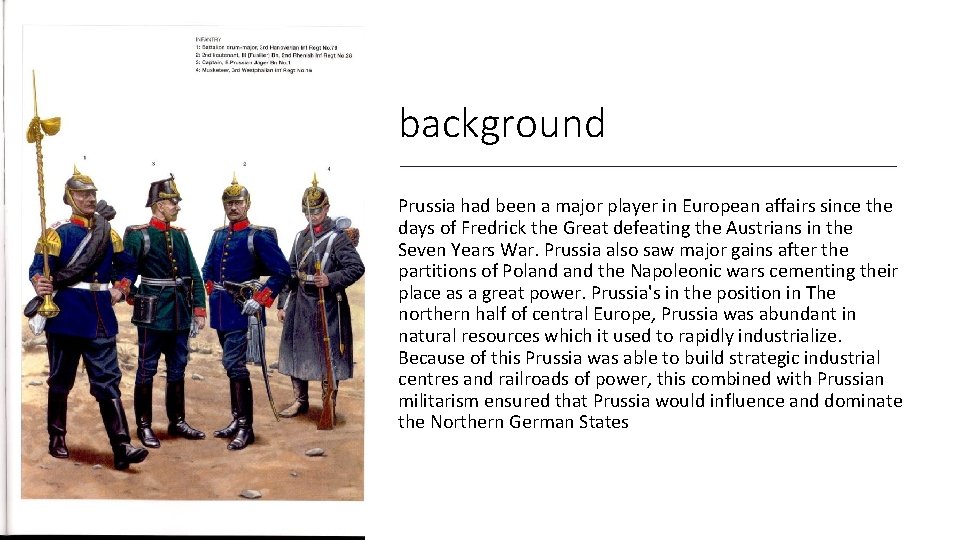
background Prussia had been a major player in European affairs since the days of Fredrick the Great defeating the Austrians in the Seven Years War. Prussia also saw major gains after the partitions of Poland the Napoleonic wars cementing their place as a great power. Prussia's in the position in The northern half of central Europe, Prussia was abundant in natural resources which it used to rapidly industrialize. Because of this Prussia was able to build strategic industrial centres and railroads of power, this combined with Prussian militarism ensured that Prussia would influence and dominate the Northern German States
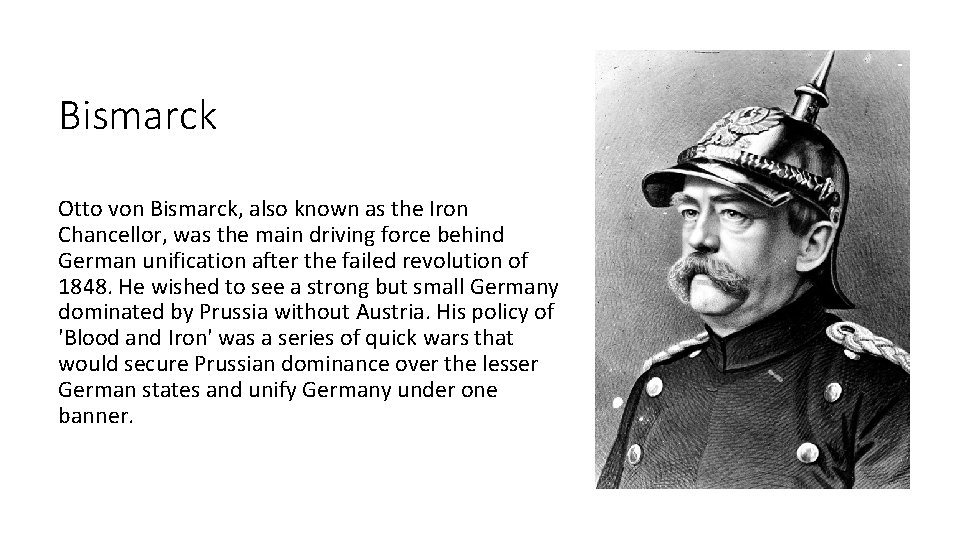
Bismarck Otto von Bismarck, also known as the Iron Chancellor, was the main driving force behind German unification after the failed revolution of 1848. He wished to see a strong but small Germany dominated by Prussia without Austria. His policy of 'Blood and Iron' was a series of quick wars that would secure Prussian dominance over the lesser German states and unify Germany under one banner.
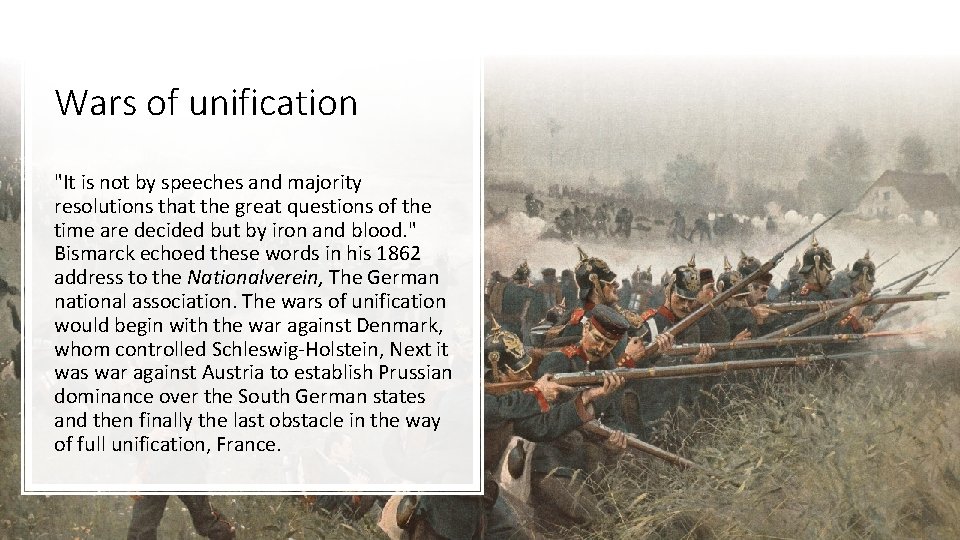
Wars of unification "It is not by speeches and majority resolutions that the great questions of the time are decided but by iron and blood. " Bismarck echoed these words in his 1862 address to the Nationalverein, The German national association. The wars of unification would begin with the war against Denmark, whom controlled Schleswig-Holstein, Next it was war against Austria to establish Prussian dominance over the South German states and then finally the last obstacle in the way of full unification, France.
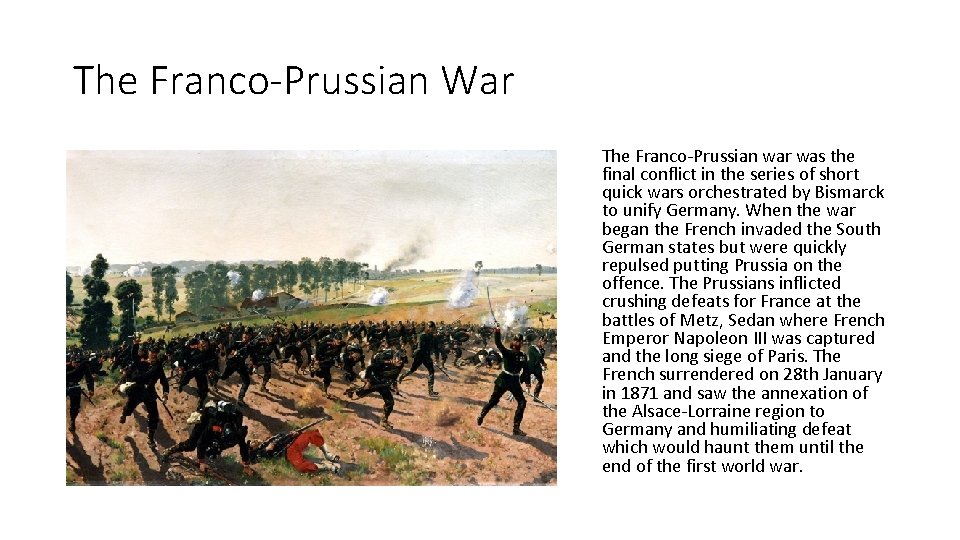
The Franco-Prussian War The Franco-Prussian war was the final conflict in the series of short quick wars orchestrated by Bismarck to unify Germany. When the war began the French invaded the South German states but were quickly repulsed putting Prussia on the offence. The Prussians inflicted crushing defeats for France at the battles of Metz, Sedan where French Emperor Napoleon III was captured and the long siege of Paris. The French surrendered on 28 th January in 1871 and saw the annexation of the Alsace-Lorraine region to Germany and humiliating defeat which would haunt them until the end of the first world war.
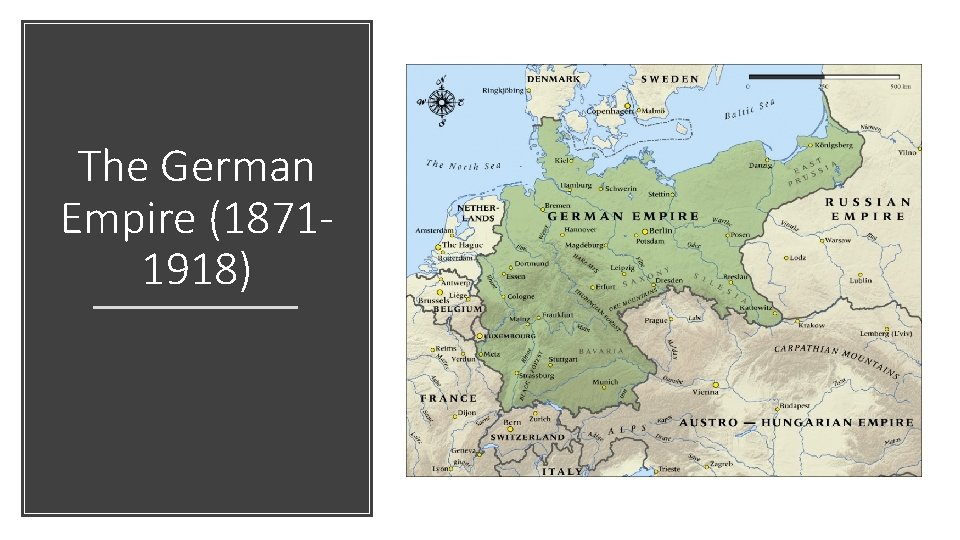
The German Empire (18711918)
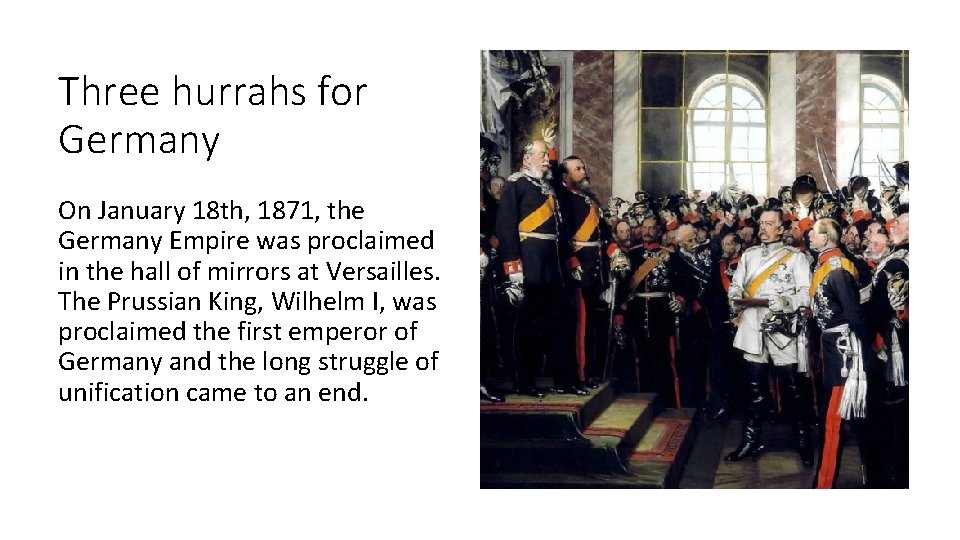
Three hurrahs for Germany On January 18 th, 1871, the Germany Empire was proclaimed in the hall of mirrors at Versailles. The Prussian King, Wilhelm I, was proclaimed the first emperor of Germany and the long struggle of unification came to an end.
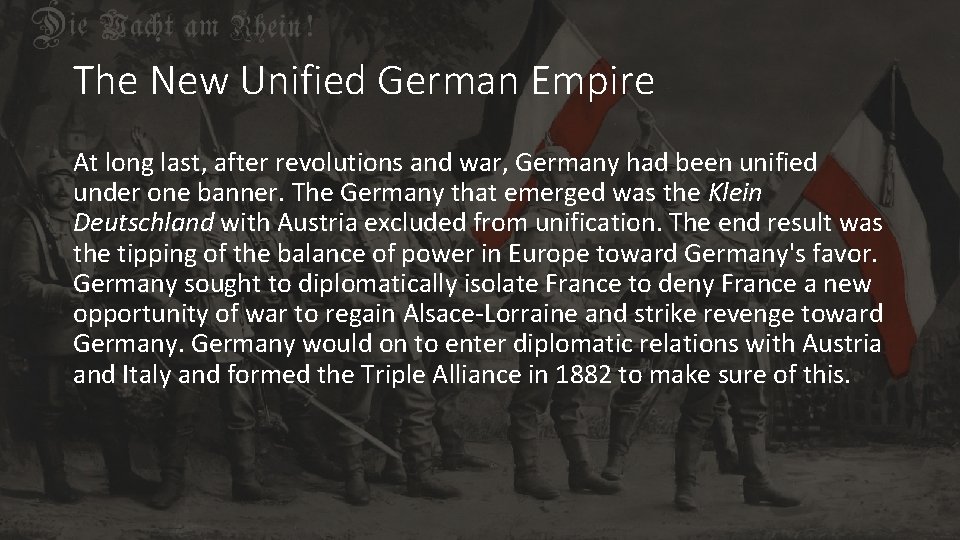
The New Unified German Empire At long last, after revolutions and war, Germany had been unified under one banner. The Germany that emerged was the Klein Deutschland with Austria excluded from unification. The end result was the tipping of the balance of power in Europe toward Germany's favor. Germany sought to diplomatically isolate France to deny France a new opportunity of war to regain Alsace-Lorraine and strike revenge toward Germany would on to enter diplomatic relations with Austria and Italy and formed the Triple Alliance in 1882 to make sure of this.
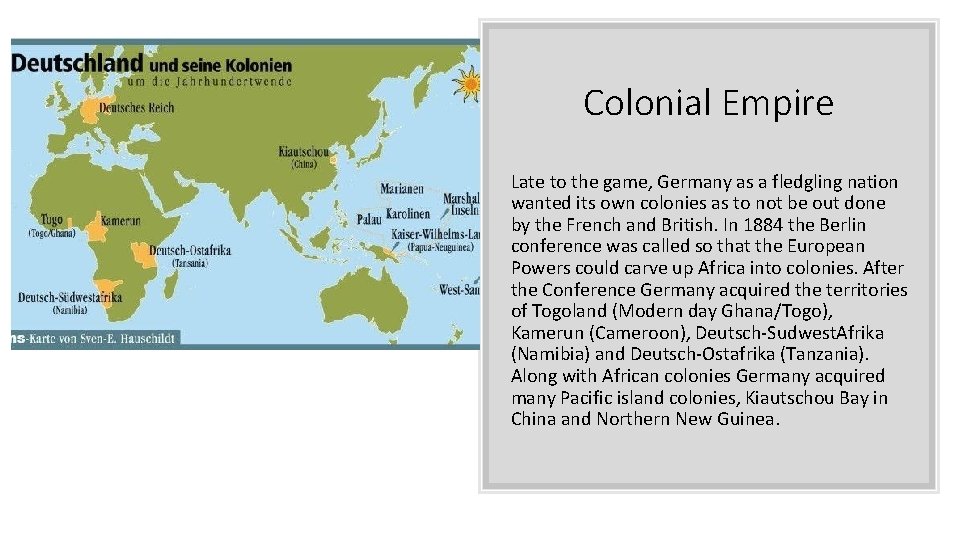
Colonial Empire Late to the game, Germany as a fledgling nation wanted its own colonies as to not be out done by the French and British. In 1884 the Berlin conference was called so that the European Powers could carve up Africa into colonies. After the Conference Germany acquired the territories of Togoland (Modern day Ghana/Togo), Kamerun (Cameroon), Deutsch-Sudwest. Afrika (Namibia) and Deutsch-Ostafrika (Tanzania). Along with African colonies Germany acquired many Pacific island colonies, Kiautschou Bay in China and Northern New Guinea.
In Conclusion Over a century of bloody battles, revolutions, tragedies and triumphs the newly unified Germany would go on leading Europe in science, art and industry up until the first world war. In the future we'd see the down fall of Germany after the first world war, the rise and fall with Nazi Germany and descent of the Iron curtain which split the country in two during the cold war until the fall of the Berlin wall. Despite all of this Germany remains a major economic power, a center of culture and learning and a leader in the arts and sciences.
Works Cited Bismarck, Otto von. "Blood and Iron" Semptember 30 th 1862. http: //www. edb. gov. hk/attachment/en/curriculumdevelopment/kla/pshe/references-and-resources/history/making_of_modern_world_source 10_eng. pdf Date Accessed 10 th Nov. 2017 Brophy, James M. "Rhine, Confederation of the. " Oxford Encyclopedia of the Modern World. : Oxford University Press, 2008. Oxford Reference. 2008. Date Accessed 30 th Oct. 2017 <http: //www. oxfordreference. com/view/10. 1093/acref/9780195176322. 001. 0001/acref-9780195176322 -e-1349>. The Editors of Encyclopaedia Britannica. "Alfred Krupp" Encyclopaedia Britannica. December 09 th, 2016 https: //www. britannica. com/biography/Alfred-Krupp. Date Accessed 06 th Nov. 2017 The Editors of Encyclopaedia Britannica. "Napoleonic Code" Encyclopaedia Britannica. July 19 th, 2016 https: //www. britannica. com/topic/Napoleonic-Code. Date Accessed 30 th Oct. 2017
Works Cited The Editors of Encyclopaedia Britannica. "Confederation of the Rhine" Encyclopaedia Britannica. July 17 th, 2016 https: //www. britannica. com/topic/Confederation-of-the-Rhine. Date Accessed 30 th Oct. 2017 German Embassy Manilia"History of the Deutschlandlied" German Embassy Manila. http: //www. manila. diplo. de/contentblob/876970/Daten/32370/geschichte. pdf Date Accessed 06 th Nov. 2017 Photographic Book "Life in Germany During the 19 th Century" Photographic Book. http: //www. voyagesphotosmanu. com/history_germany. html. Date Accessed 05 th Nov. 2017 Solsten, Eric "Germany: A country Study" Country Studies. 1995. http: //countrystudies. us/germany/23. htm. Date Accessed 05 th Nov. 2017 Udall, Stuart "Industrialisation in Germany 1870 -1914" Cyberdelix. October 17 th, 1988 http: //www. cyberdelix. net/studies/indust 19. htm. Date Accessed 06 th Nov. 2017
- Slides: 33