
The Unification of China AP Exam Tip Understand
- Slides: 54
The Unification of China
AP Exam Tip �Understand the role of legalism in the development of the Chinese bureaucracy. �Be prepared to discuss the political structure of ancient China, but no specific dynastic traditions. �Understand the impact of philosophical systems in the creation of social systems.
In Search of Political and Social Order � Xia, Shang, Zhou Dynasties � Zhou 1122 BCE-256 BCE Used Mandate of Heaven to justify deposition of Shang Late centuries of the Zhou is called “Period of Warring States” 403 BCE- 221 BCE Political Chaos ▪ Forces them to reflect on the nature of society and proper roles of humans Cultural flowering � Philosophies emerge during this time 1. Confucianism 2. Daoism 3. Legalism
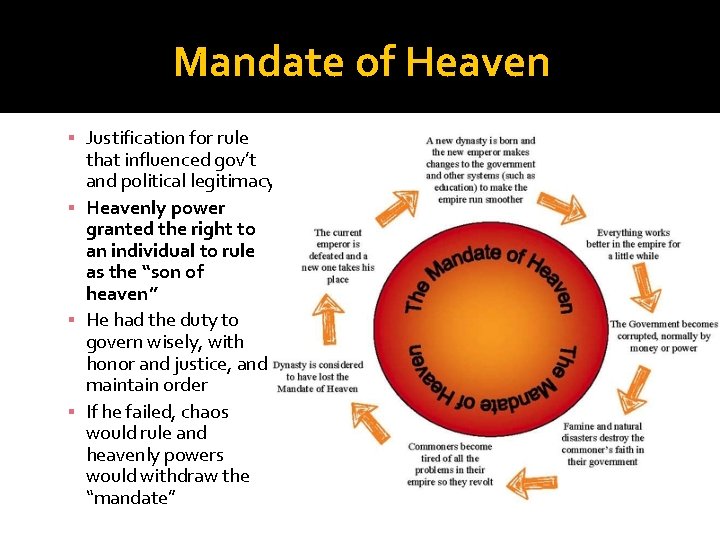
Mandate of Heaven ▪ Justification for rule that influenced gov’t and political legitimacy ▪ Heavenly power granted the right to an individual to rule as the “son of heaven” ▪ He had the duty to govern wisely, with honor and justice, and maintain order ▪ If he failed, chaos would rule and heavenly powers would withdraw the “mandate”
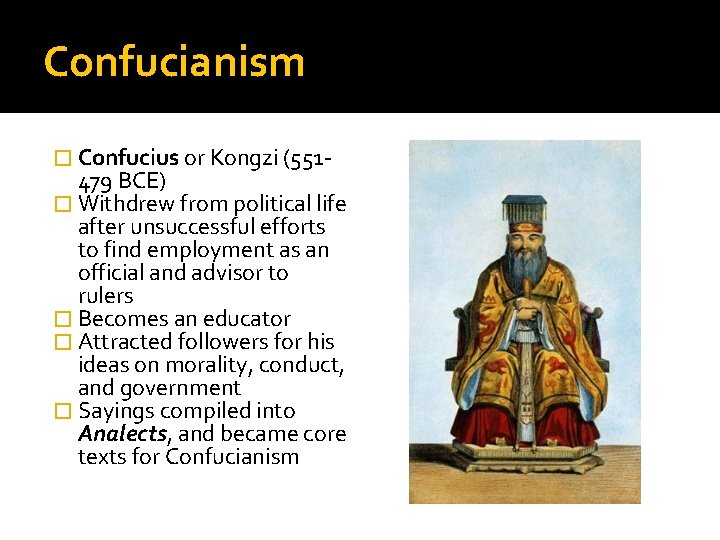
Confucianism � Confucius or Kongzi (551 - 479 BCE) � Withdrew from political life after unsuccessful efforts to find employment as an official and advisor to rulers � Becomes an educator � Attracted followers for his ideas on morality, conduct, and government � Sayings compiled into Analects, and became core texts for Confucianism
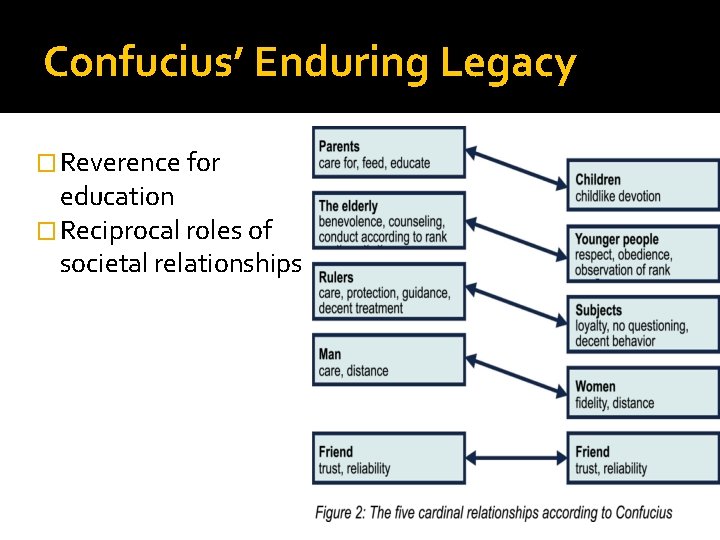
Confucian Belief about Family �Social harmony arose from the proper order of human relationships �Fundamental component of society �Behavior at home prepares them as citizens of the state �Each person has a place & duty in hierarchal order �“Filial piety”(xiao) of children to parents requires obedience, reverence, and love
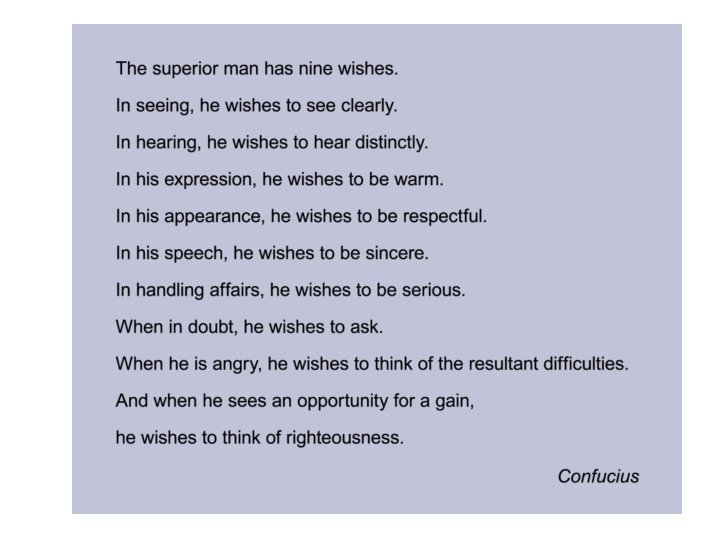
Confucian Values �People should have these qualities 1. “Xiao” or Filial piety 2. “Ren” meant an attitude of kindness and benevolence Someone who is courteous, respectful, diligent, and loyal Needed in gov’t officials 3. “Li” where individuals have a sense of propriety, (behave in appropriate fashion) W/ respect, defer to elders or superiors
Confucius’ Goals for Society �Individuals who possessed these traits would gain influence in society �These people would have the power of leading others by example �This would restore political and social order in China �He wasn’t just interested in just personal morality, but in the creation of junzi or “superior individuals” who would bring order to the state
Confucius’ Enduring Legacy � Reverence for education � Reciprocal roles of societal relationships
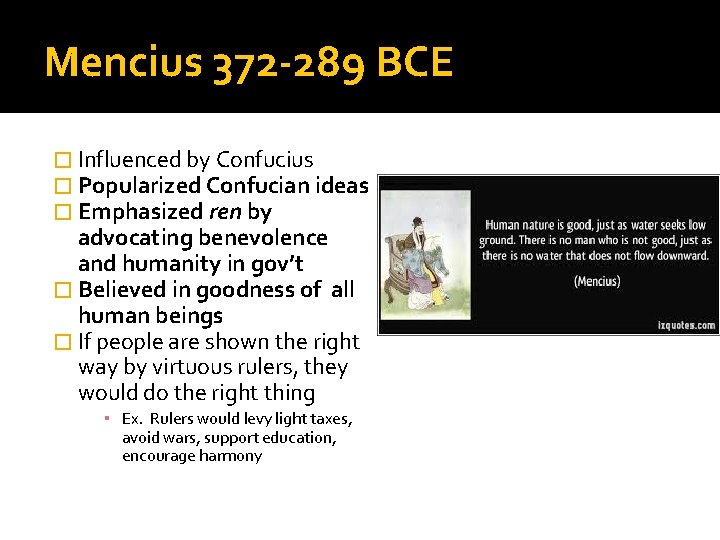
Mencius 372 -289 BCE � Influenced by Confucius � Popularized Confucian ideas � Emphasized ren by advocating benevolence and humanity in gov’t � Believed in goodness of all human beings � If people are shown the right way by virtuous rulers, they would do the right thing ▪ Ex. Rulers would levy light taxes, avoid wars, support education, encourage harmony
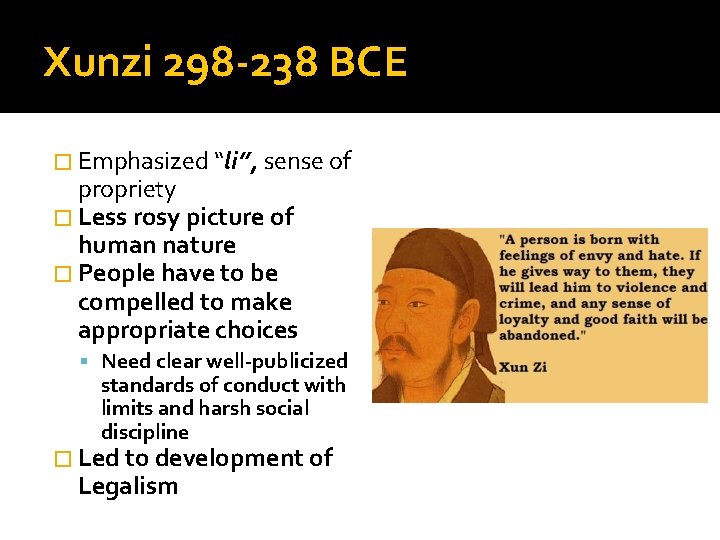
Xunzi 298 -238 BCE � Emphasized “li”, sense of propriety � Less rosy picture of human nature � People have to be compelled to make appropriate choices Need clear well-publicized standards of conduct with limits and harsh social discipline � Led to development of Legalism
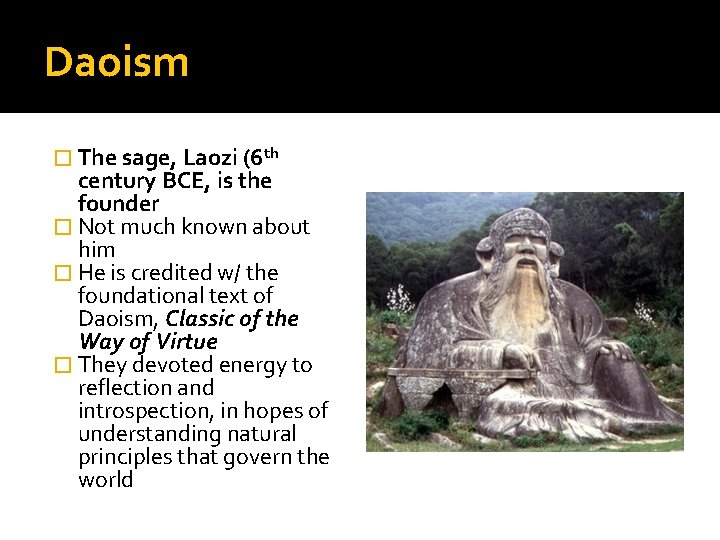
Daoism � The sage, Laozi (6 th century BCE, is the founder � Not much known about him � He is credited w/ the foundational text of Daoism, Classic of the Way of Virtue � They devoted energy to reflection and introspection, in hopes of understanding natural principles that govern the world
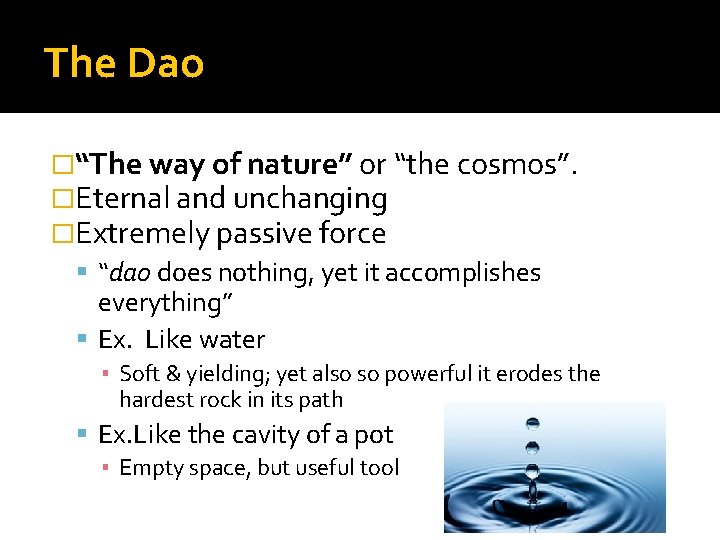
The Dao �“The way of nature” or “the cosmos”. �Eternal and unchanging �Extremely passive force “dao does nothing, yet it accomplishes everything” Ex. Like water ▪ Soft & yielding; yet also so powerful it erodes the hardest rock in its path Ex. Like the cavity of a pot ▪ Empty space, but useful tool
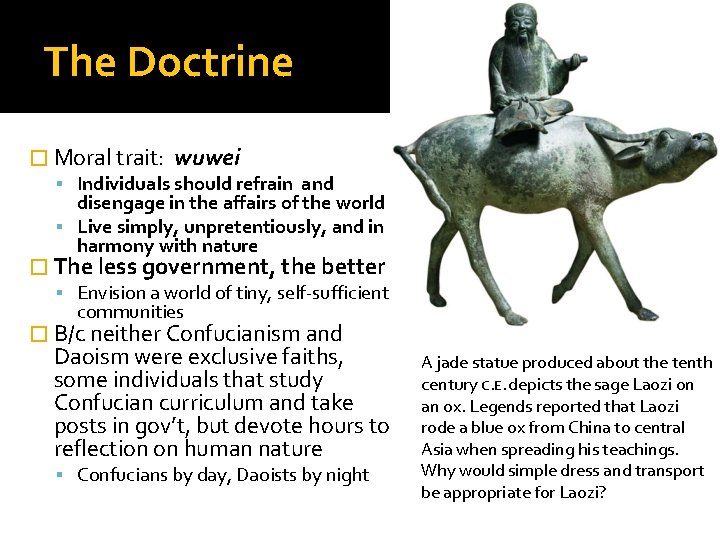
The Doctrine � Moral trait: wuwei Individuals should refrain and disengage in the affairs of the world Live simply, unpretentiously, and in harmony with nature � The less government, the better Envision a world of tiny, self-sufficient communities � B/c neither Confucianism and Daoism were exclusive faiths, some individuals that study Confucian curriculum and take posts in gov’t, but devote hours to reflection on human nature Confucians by day, Daoists by night A jade statue produced about the tenth century C. E. depicts the sage Laozi on an ox. Legends reported that Laozi rode a blue ox from China to central Asia when spreading his teachings. Why would simple dress and transport be appropriate for Laozi?
Legalism � � Shang Yang (ca. 390 -338 BCE) Han Feizi (ca. 280 -233 BCE) establish theory Student of Xunzi and advisor to � the Qin Devoted all attention to the state, which they sought to strengthen and expand at all costs Foundation of a state’s strength were agriculture and armed forces Discourage careers such as merchants, entrepreneurs, scholars, educators, poets, philosophers etc. b/c it did not advance the state
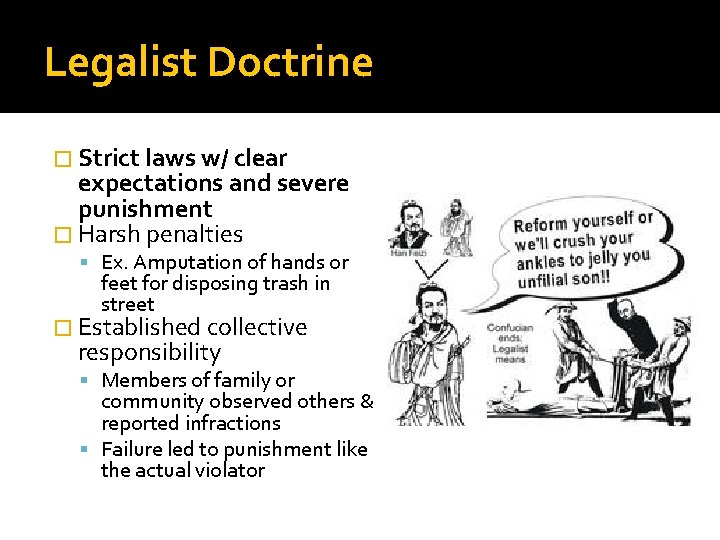
Legalist Doctrine � Strict laws w/ clear expectations and severe punishment � Harsh penalties Ex. Amputation of hands or feet for disposing trash in street � Established collective responsibility Members of family or community observed others & reported infractions Failure led to punishment like the actual violator
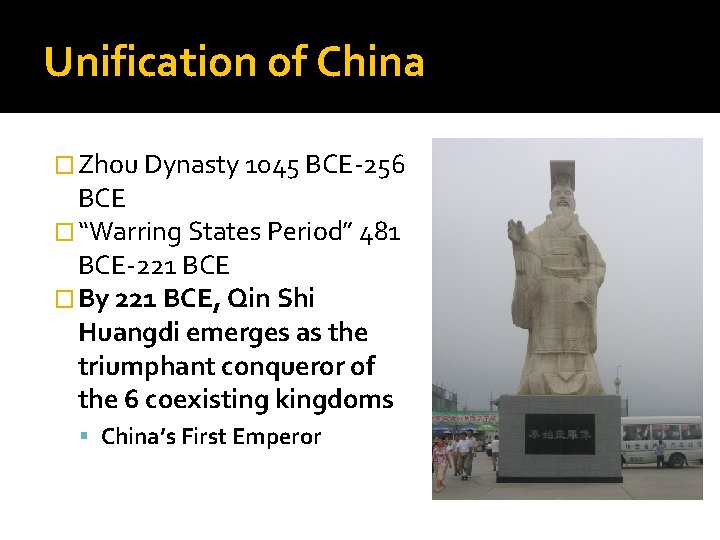
Unification of China � Zhou Dynasty 1045 BCE-256 BCE � “Warring States Period” 481 BCE-221 BCE � By 221 BCE, Qin Shi Huangdi emerges as the triumphant conqueror of the 6 coexisting kingdoms China’s First Emperor
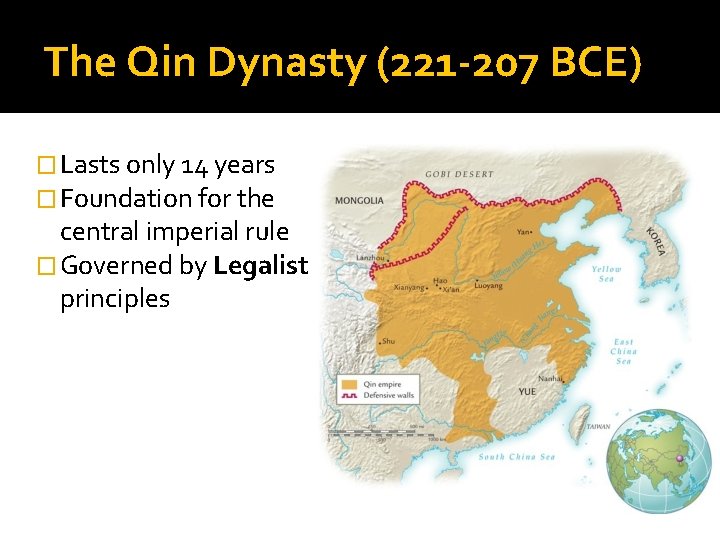
The Qin Dynasty (221 -207 BCE) � Lasts only 14 years � Foundation for the central imperial rule � Governed by Legalist principles
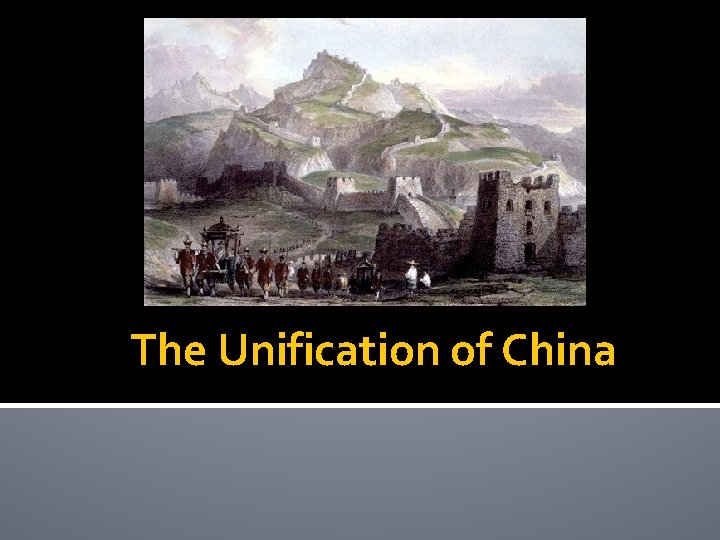
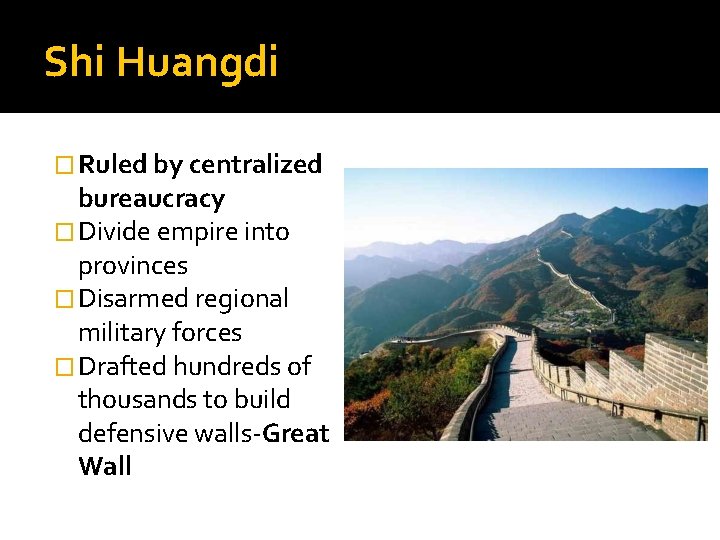
Shi Huangdi � Ruled by centralized bureaucracy � Divide empire into provinces � Disarmed regional military forces � Drafted hundreds of thousands to build defensive walls-Great Wall
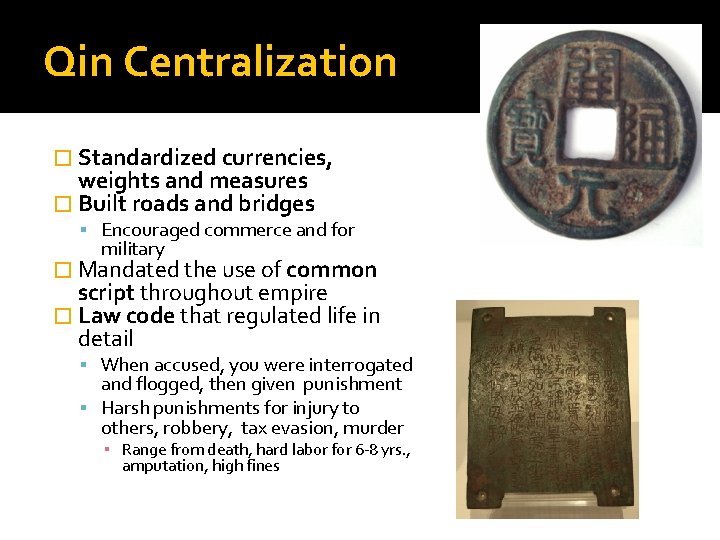
Qin Centralization � Standardized currencies, weights and measures � Built roads and bridges Encouraged commerce and for military � Mandated the use of common script throughout empire � Law code that regulated life in detail When accused, you were interrogated and flogged, then given punishment Harsh punishments for injury to others, robbery, tax evasion, murder ▪ Range from death, hard labor for 6 -8 yrs. , amputation, high fines
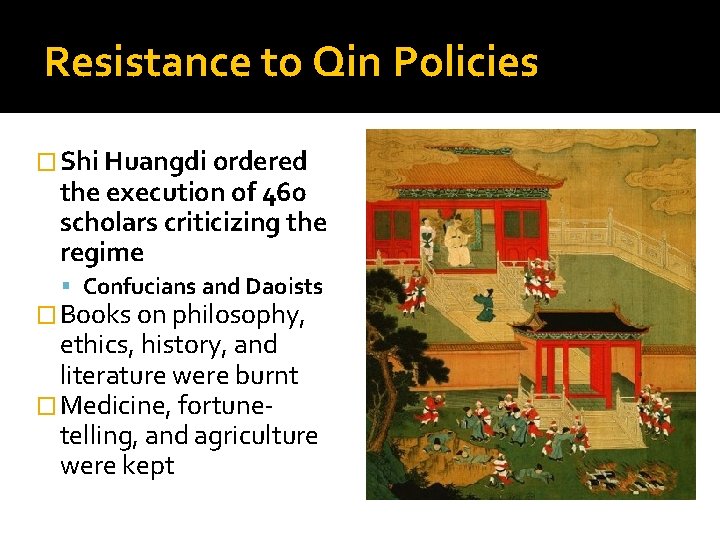
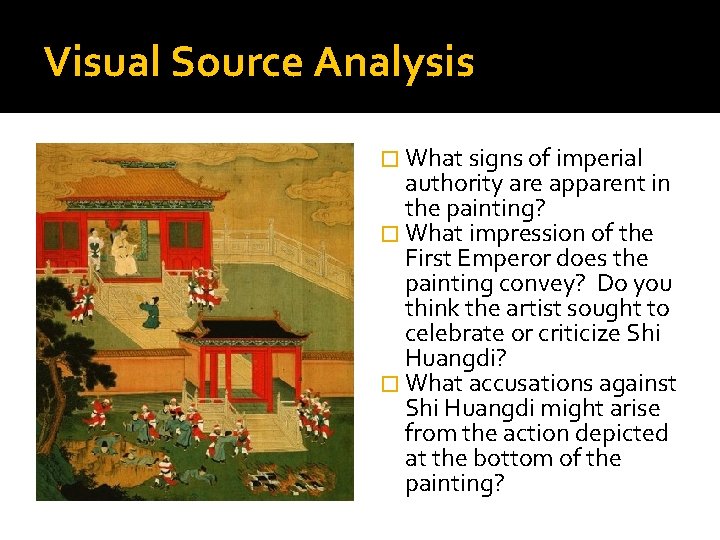
Resistance to Qin Policies � Shi Huangdi ordered the execution of 460 scholars criticizing the regime Confucians and Daoists � Books on philosophy, ethics, history, and literature were burnt � Medicine, fortunetelling, and agriculture were kept
Visual Source Analysis � What signs of imperial authority are apparent in the painting? � What impression of the First Emperor does the painting convey? Do you think the artist sought to celebrate or criticize Shi Huangdi? � What accusations against Shi Huangdi might arise from the action depicted at the bottom of the painting?
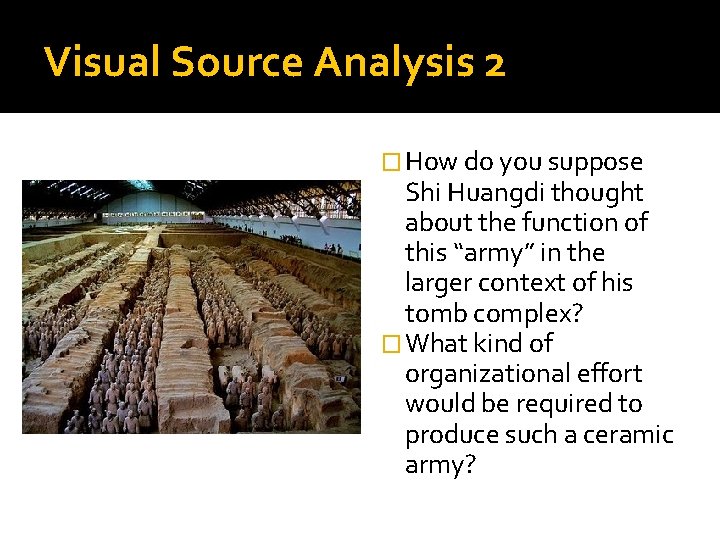
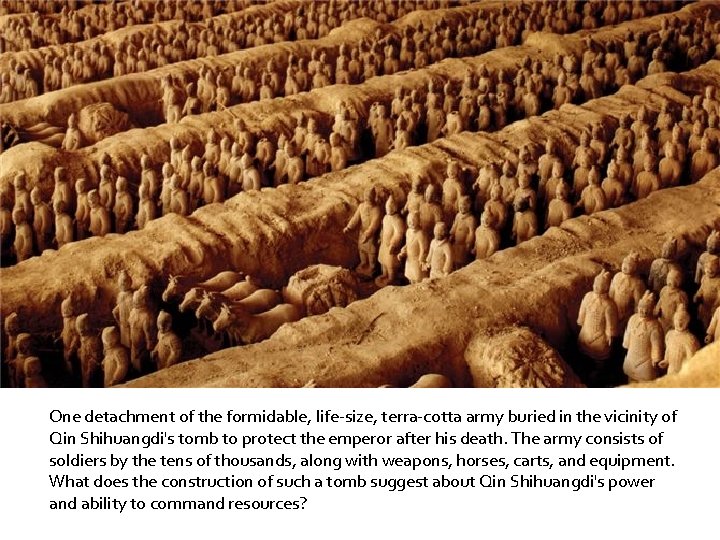
Visual Source Analysis 2 � How do you suppose Shi Huangdi thought about the function of this “army” in the larger context of his tomb complex? � What kind of organizational effort would be required to produce such a ceramic army?
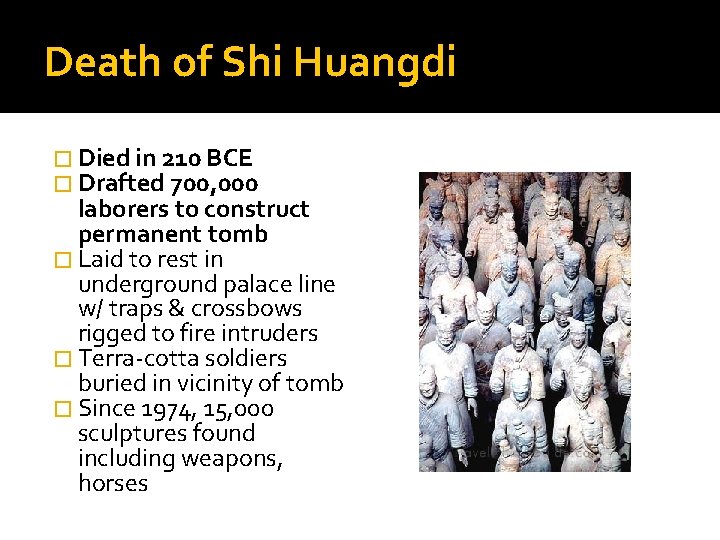
Death of Shi Huangdi � Died in 210 BCE � Drafted 700, 000 laborers to construct permanent tomb � Laid to rest in underground palace line w/ traps & crossbows rigged to fire intruders � Terra-cotta soldiers buried in vicinity of tomb � Since 1974, 15, 000 sculptures found including weapons, horses
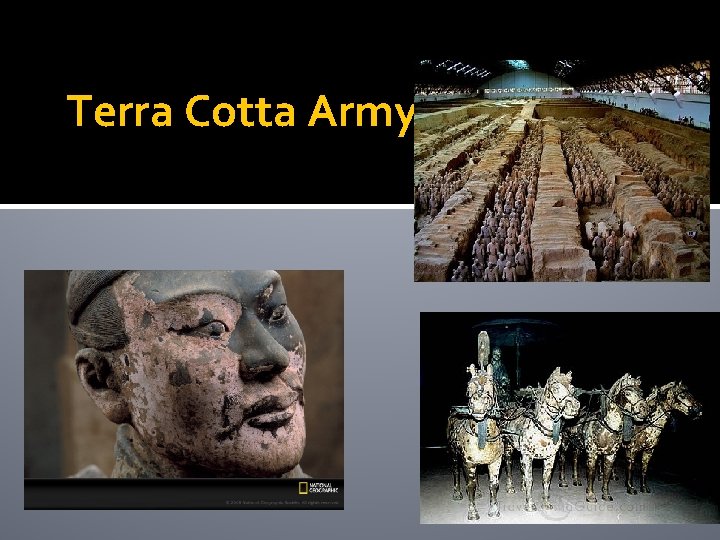
Terra Cotta Army
Collapse of Qin dynasty �After death of Shi Huangdi, revolts began �In 207 BCE, waves of rebels overwhelm the Qin court, slaughter gov’t officials, burn state bldgs. �Dissolves in chaos
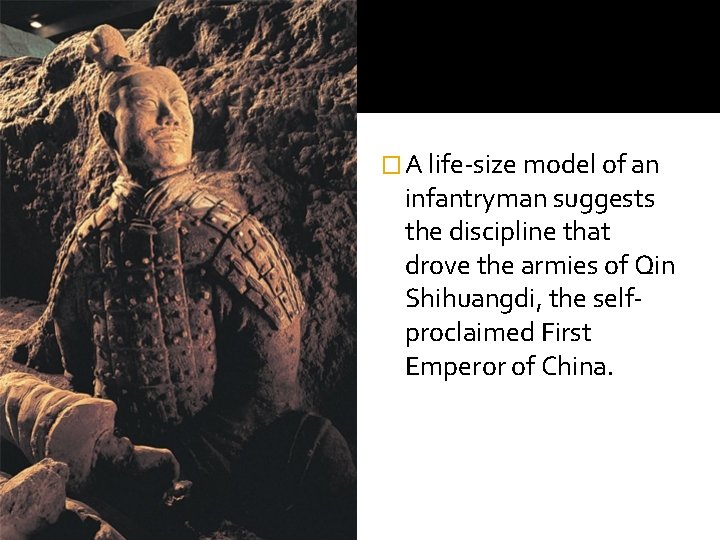
� A life-size model of an infantryman suggests the discipline that drove the armies of Qin Shihuangdi, the selfproclaimed First Emperor of China.
One detachment of the formidable, life-size, terra-cotta army buried in the vicinity of Qin Shihuangdi's tomb to protect the emperor after his death. The army consists of soldiers by the tens of thousands, along with weapons, horses, carts, and equipment. What does the construction of such a tomb suggest about Qin Shihuangdi's power and ability to command resources?
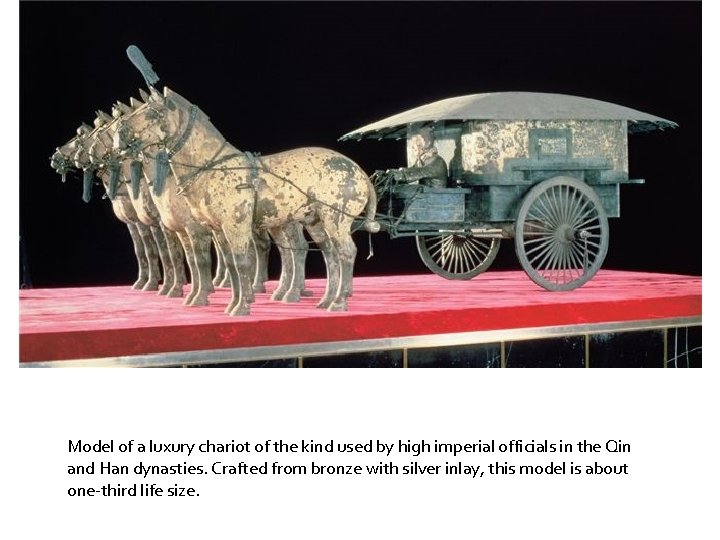
Model of a luxury chariot of the kind used by high imperial officials in the Qin and Han dynasties. Crafted from bronze with silver inlay, this model is about one-third life size.
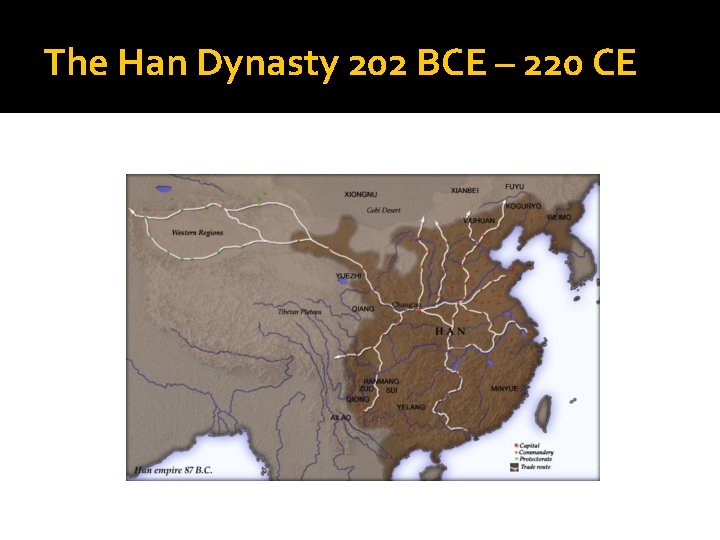
The Han Dynasty 202 BCE – 220 CE
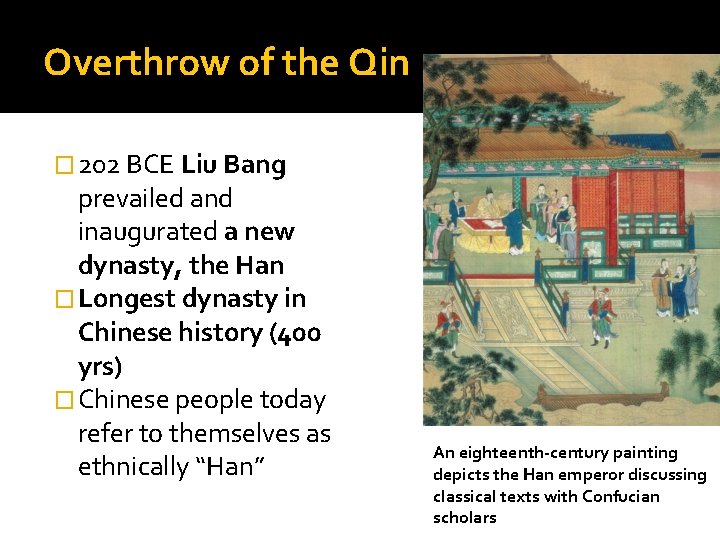
Overthrow of the Qin � 202 BCE Liu Bang prevailed and inaugurated a new dynasty, the Han � Longest dynasty in Chinese history (400 yrs) � Chinese people today refer to themselves as ethnically “Han” An eighteenth-century painting depicts the Han emperor discussing classical texts with Confucian scholars
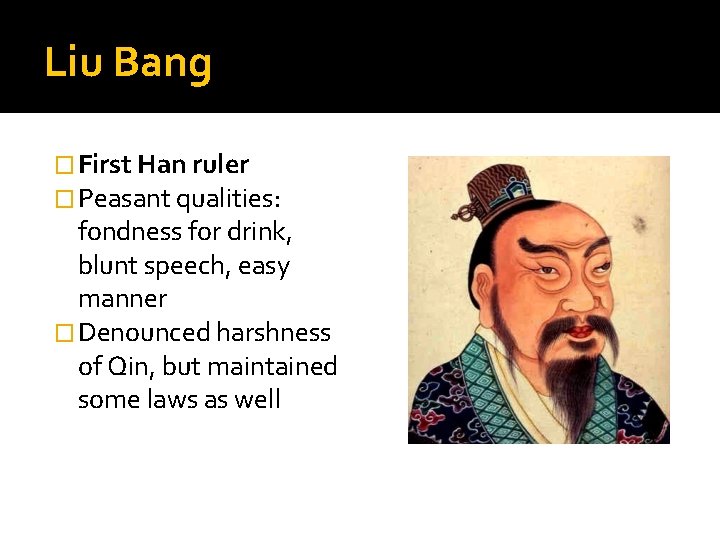
Liu Bang � First Han ruler � Peasant qualities: fondness for drink, blunt speech, easy manner � Denounced harshness of Qin, but maintained some laws as well
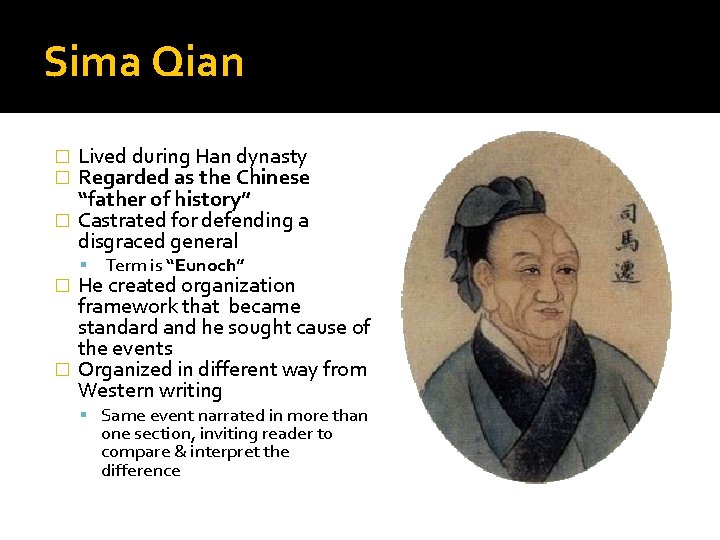
Sima Qian Lived during Han dynasty Regarded as the Chinese “father of history” � Castrated for defending a disgraced general � � Term is “Eunoch” He created organization framework that became standard and he sought cause of the events � Organized in different way from Western writing � Same event narrated in more than one section, inviting reader to compare & interpret the difference
Han Dynasty �Adopt Confucianism as the official ideology of the imperial system �Confucian Educational System Emerged from the Need to recruit 1, 000’s of intelligent, educated individuals to run bureaucracy Opened university in Chang’an ▪ Local officials ordered to send promising students from their districts to university ▪ Prepared them for government service Confucianism was the basis for its curriculum By the end of the Han dynasty, 30, 000 students
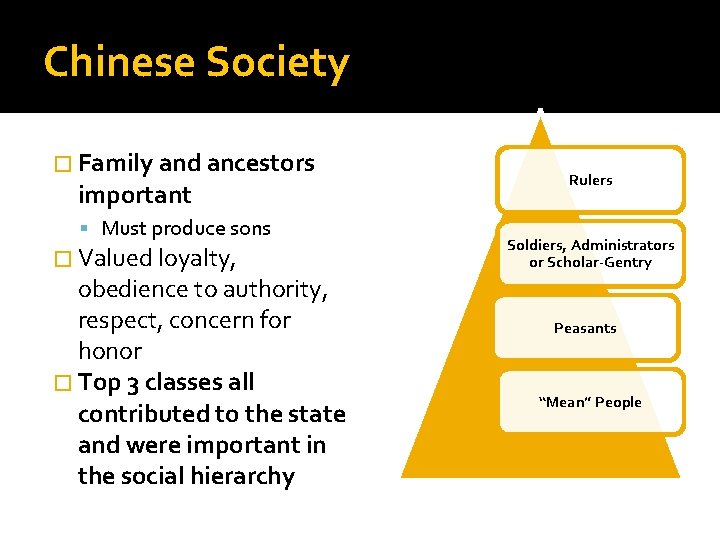
Chinese Society � Family and ancestors important Must produce sons � Valued loyalty, obedience to authority, respect, concern for honor � Top 3 classes all contributed to the state and were important in the social hierarchy Rulers Soldiers, Administrators or Scholar-Gentry Peasants “Mean” People
“Mean” People �Meaningless skills �Anyone who lacked skills or direct production of goods Actors, artists, poets, etc.
Merchants devoted to moneymaking instead of learning and political service (Confucianism) Viewed with suspicion ▪ Low status endures
Women �Patriarchal Social Order �Women’s status depended on her “location” within society Ex. Women in royal families could be influential �Mother’s in law had authority over son’s wife �“Lessons for Women”, 1 st c. CE, instructs daughters to conform to traditional expectations Ex. Obey males, maintain husband’s household, perform domestic chores, raise children Book was one of most popular and widely read about role of women until 20 th century
Scholar-gentry �They were educated, privileged group who were prepared for governmental service Made gov’t run more efficiently �Gov’t jobs depended on the performance on exams �Han depended on these local officials for day-to-day administration to far off territories
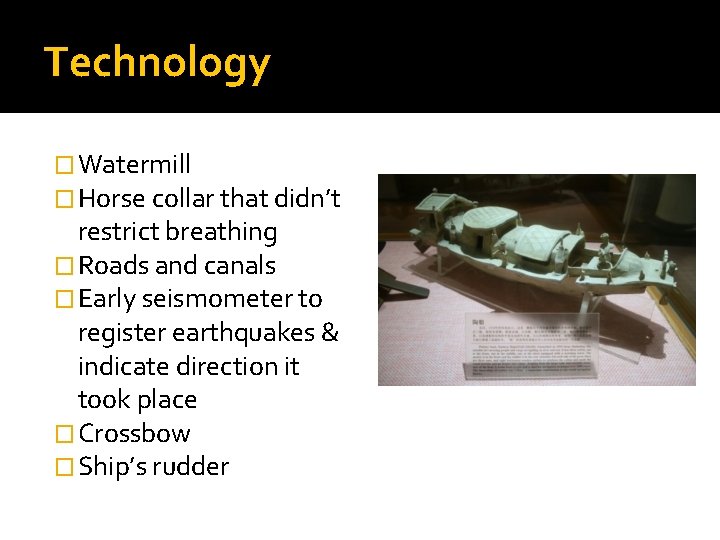
Technology � Watermill � Horse collar that didn’t restrict breathing � Roads and canals � Early seismometer to register earthquakes & indicate direction it took place � Crossbow � Ship’s rudder
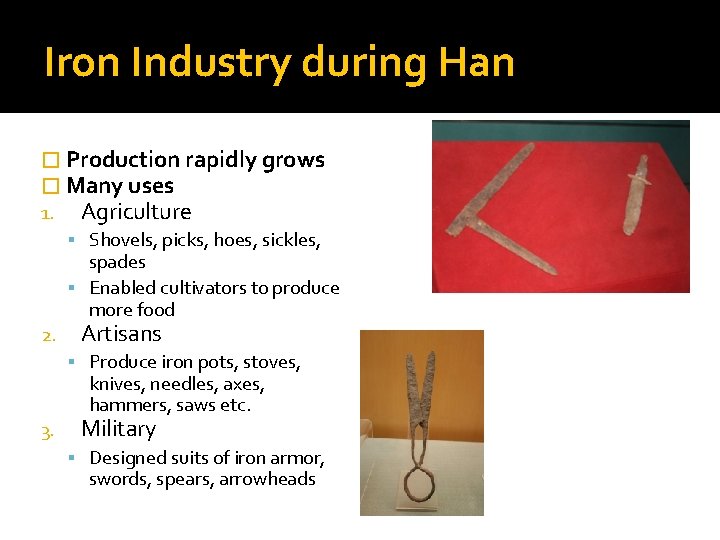
Iron Industry during Han � Production rapidly grows � Many uses 1. Agriculture Shovels, picks, hoes, sickles, spades Enabled cultivators to produce more food 2. Artisans Produce iron pots, stoves, knives, needles, axes, hammers, saws etc. 3. Military Designed suits of iron armor, swords, spears, arrowheads
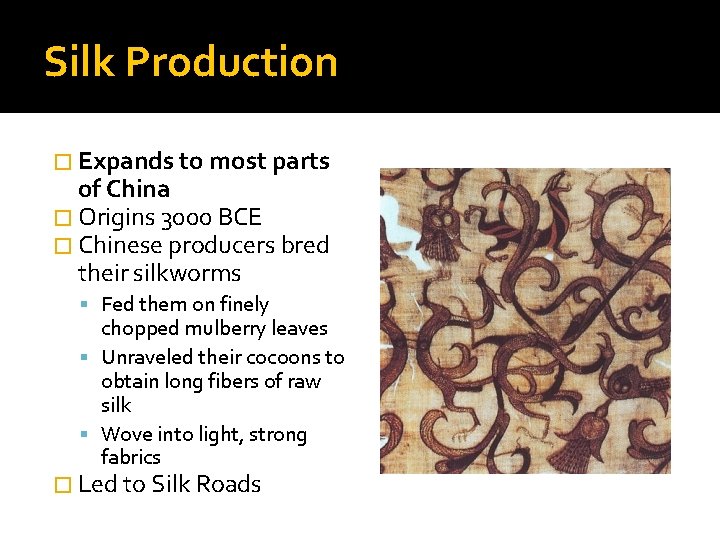
Silk Production � Expands to most parts of China � Origins 3000 BCE � Chinese producers bred their silkworms Fed them on finely chopped mulberry leaves Unraveled their cocoons to obtain long fibers of raw silk Wove into light, strong fabrics � Led to Silk Roads
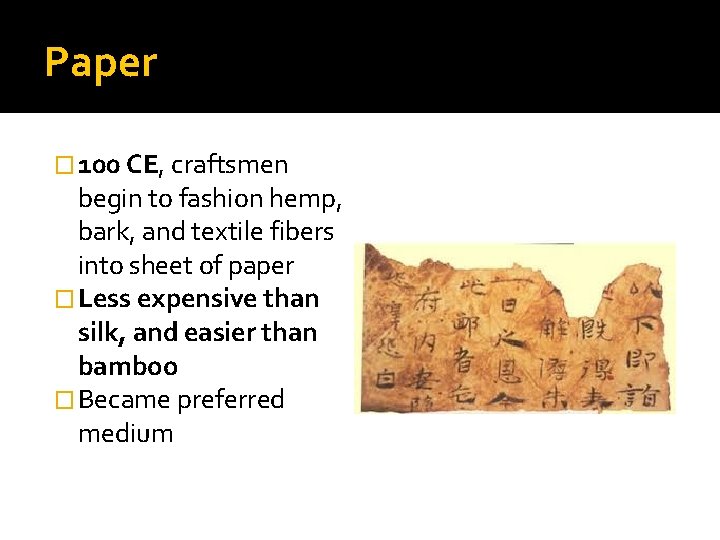
Paper � 100 CE, craftsmen begin to fashion hemp, bark, and textile fibers into sheet of paper � Less expensive than silk, and easier than bamboo � Became preferred medium
Population Growth �Early part of Han dynasty see rapid population growth � 20 million in 220 BCE � 60 million by 9 CE
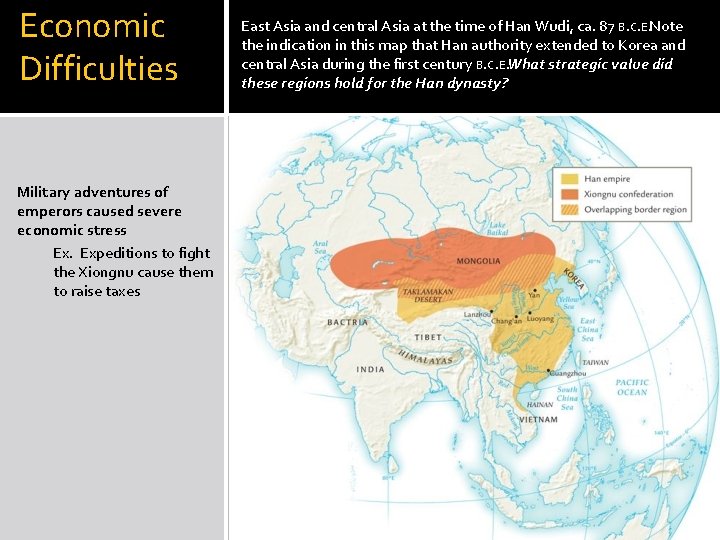
Economic Difficulties Military adventures of emperors caused severe economic stress Ex. Expeditions to fight the Xiongnu cause them to raise taxes East Asia and central Asia at the time of Han Wudi, ca. 87 B. C. E. Note the indication in this map that Han authority extended to Korea and central Asia during the first century B. C. E. What strategic value did these regions hold for the Han dynasty?
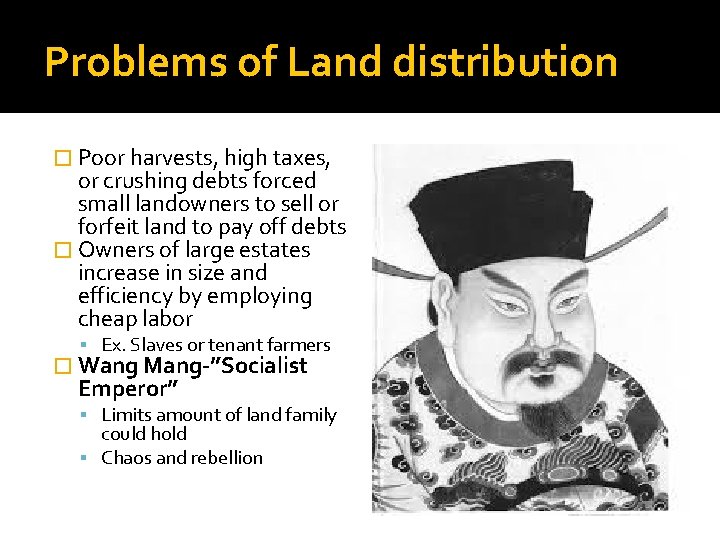
Problems of Land distribution � Poor harvests, high taxes, or crushing debts forced small landowners to sell or forfeit land to pay off debts � Owners of large estates increase in size and efficiency by employing cheap labor Ex. Slaves or tenant farmers � Wang Mang-”Socialist Emperor” Limits amount of land family could hold Chaos and rebellion
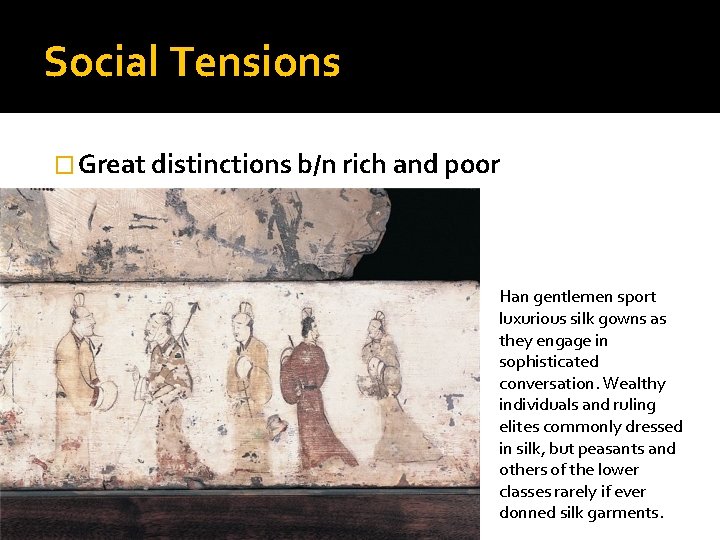
Social Tensions � Great distinctions b/n rich and poor Han gentlemen sport luxurious silk gowns as they engage in sophisticated conversation. Wealthy individuals and ruling elites commonly dressed in silk, but peasants and others of the lower classes rarely if ever donned silk garments.
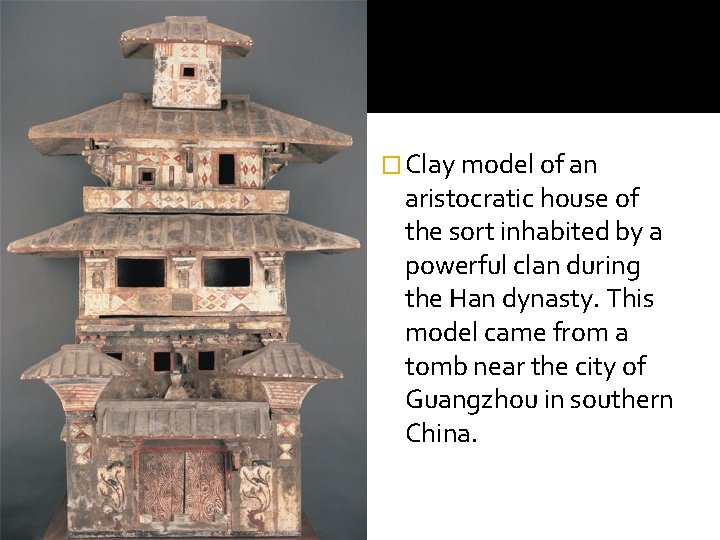
� Clay model of an aristocratic house of the sort inhabited by a powerful clan during the Han dynasty. This model came from a tomb near the city of Guangzhou in southern China.
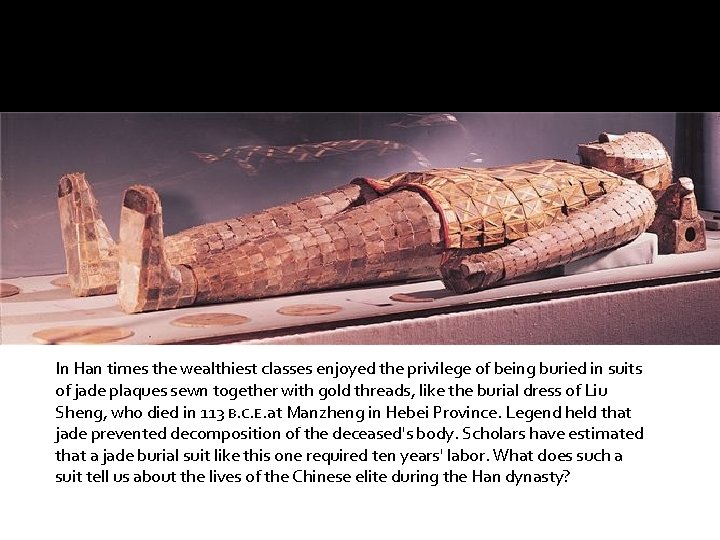
In Han times the wealthiest classes enjoyed the privilege of being buried in suits of jade plaques sewn together with gold threads, like the burial dress of Liu Sheng, who died in 113 B. C. E. at Manzheng in Hebei Province. Legend held that jade prevented decomposition of the deceased's body. Scholars have estimated that a jade burial suit like this one required ten years' labor. What does such a suit tell us about the lives of the Chinese elite during the Han dynasty?
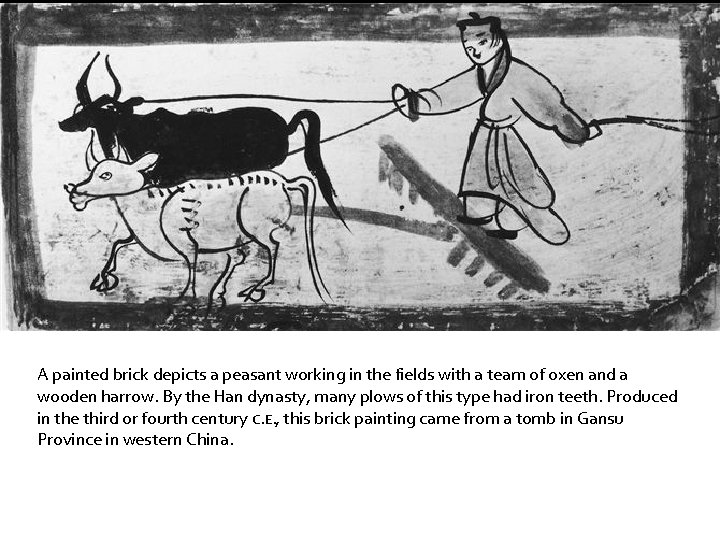
A painted brick depicts a peasant working in the fields with a team of oxen and a wooden harrow. By the Han dynasty, many plows of this type had iron teeth. Produced in the third or fourth century C. E. , this brick painting came from a tomb in Gansu Province in western China.
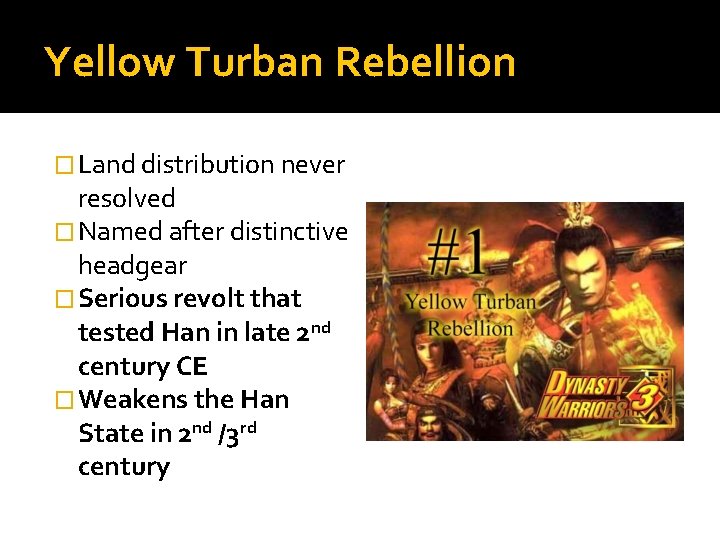
Yellow Turban Rebellion � Land distribution never resolved � Named after distinctive headgear � Serious revolt that tested Han in late 2 nd century CE � Weakens the Han State in 2 nd /3 rd century
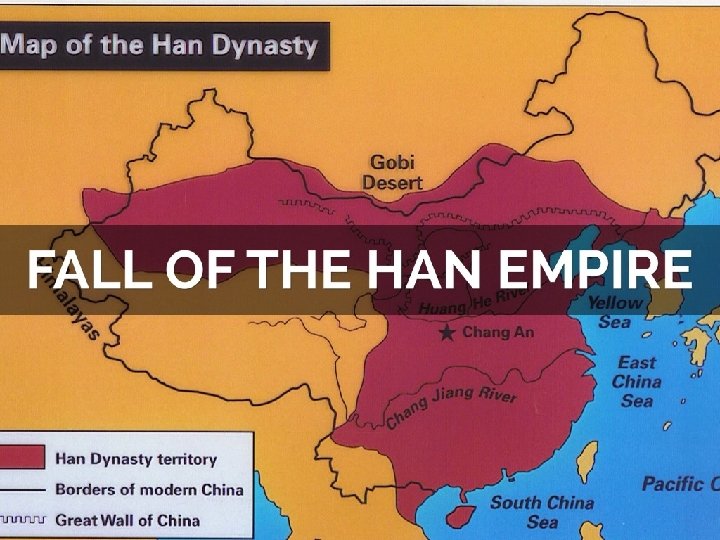
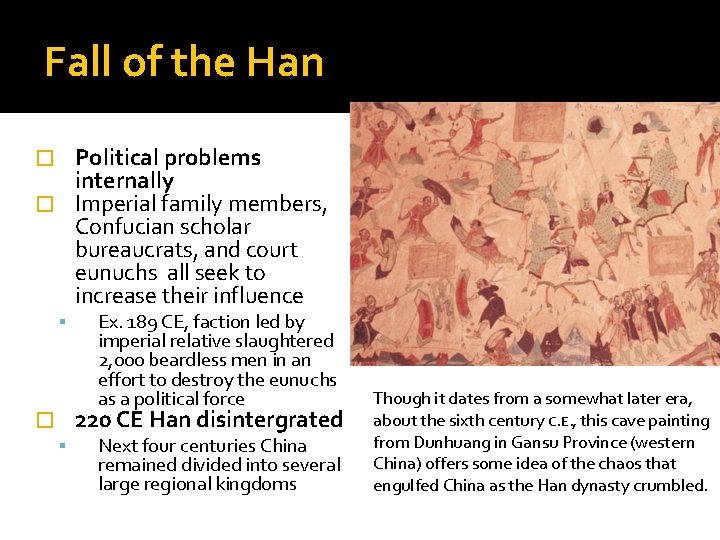
Fall of the Han Political problems internally � Imperial family members, Confucian scholar bureaucrats, and court eunuchs all seek to increase their influence � Ex. 189 CE, faction led by imperial relative slaughtered 2, 000 beardless men in an effort to destroy the eunuchs as a political force 220 CE Han disintergrated � Next four centuries China remained divided into several large regional kingdoms Though it dates from a somewhat later era, about the sixth century C. E. , this cave painting from Dunhuang in Gansu Province (western China) offers some idea of the chaos that engulfed China as the Han dynasty crumbled.