
The Uncontrolled Cooking Test Measuring ThreeStone Fire Performance
- Slides: 12
The Uncontrolled Cooking Test: Measuring Three-Stone Fire Performance in Northern Mozambique J. Robinson 1, 2, M. Ibraimo 2, 3, C Pemberton-Pigott 1 1. Se. TAR Centre, University of Johannesburg 2. Department of Geography, Environmental Management and Energy Studies, University of Johannesburg 3. Department of Physics, Eduardo Mondlane University, Maputo, Mozambique DUE 2011 April 2011 13 th
Background • Importance of domestic biomass use in Mozambique • 80% energy consumed is biomass • 71% live in rural areas • Characterize energy baseline of rural villages • 2010 field research programme • • 2008 socio-economic study by M. Ibraimo Muculuone village, Nampula Province, northern Mozambique Rural, poor, off-grid, subsistence farming Heavy reliance (92%) on firewood and three-stone fire • Aims • Measure baseline cooking energy patterns • Provide data and experience for testing methodology devt.
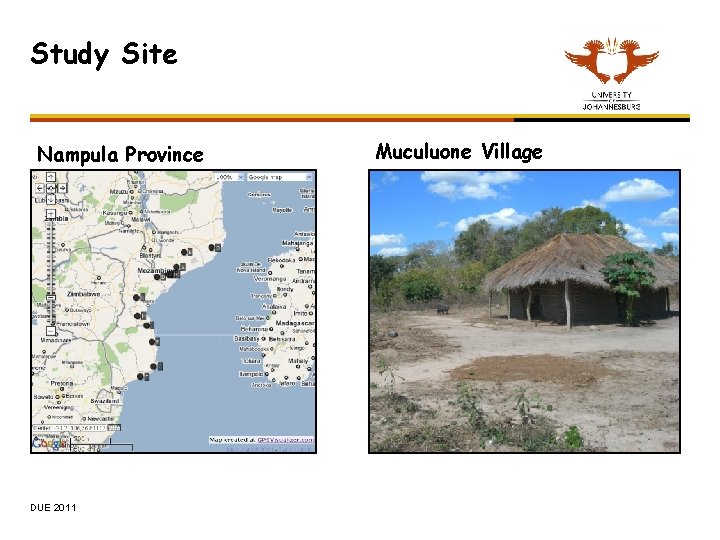
Study Site Nampula Province DUE 2011 Muculuone Village
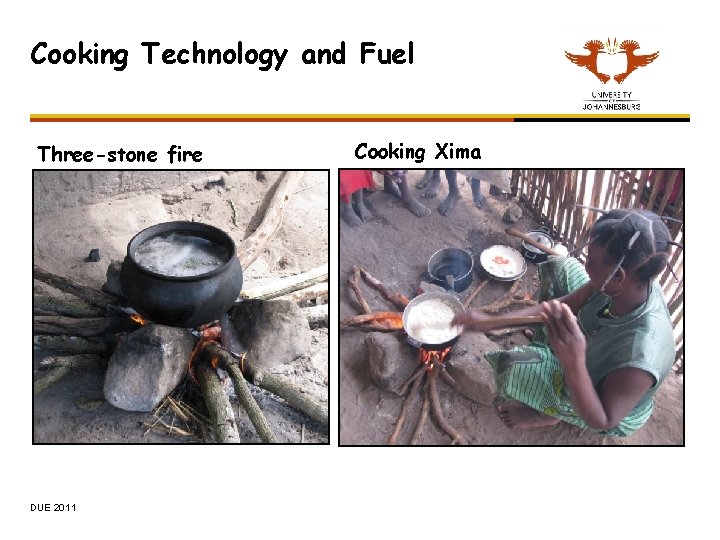
Cooking Technology and Fuel Three-stone fire DUE 2011 Cooking Xima
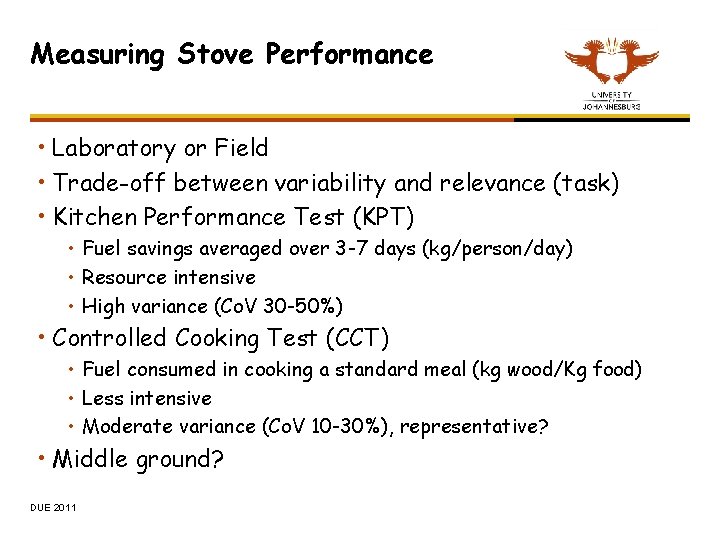
Measuring Stove Performance • Laboratory or Field • Trade-off between variability and relevance (task) • Kitchen Performance Test (KPT) • Fuel savings averaged over 3 -7 days (kg/person/day) • Resource intensive • High variance (Co. V 30 -50%) • Controlled Cooking Test (CCT) • Fuel consumed in cooking a standard meal (kg wood/Kg food) • Less intensive • Moderate variance (Co. V 10 -30%), representative? • Middle ground? DUE 2011
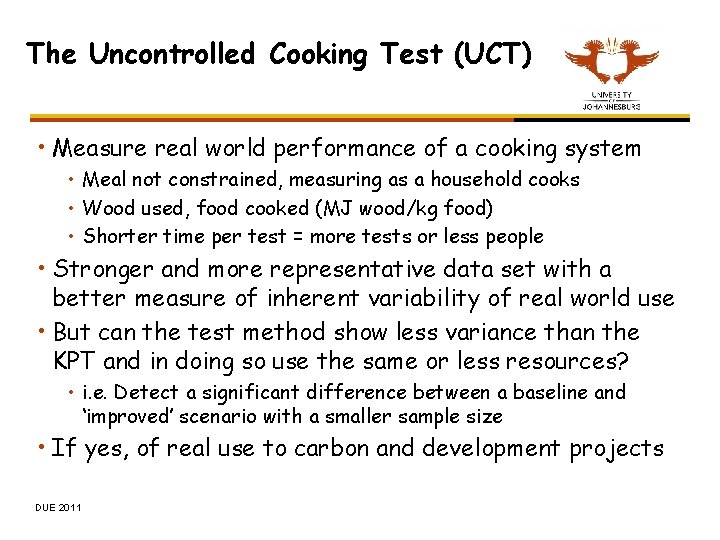
The Uncontrolled Cooking Test (UCT) • Measure real world performance of a cooking system • Meal not constrained, measuring as a household cooks • Wood used, food cooked (MJ wood/kg food) • Shorter time per test = more tests or less people • Stronger and more representative data set with a better measure of inherent variability of real world use • But can the test method show less variance than the KPT and in doing so use the same or less resources? • i. e. Detect a significant difference between a baseline and ‘improved’ scenario with a smaller sample size • If yes, of real use to carbon and development projects DUE 2011
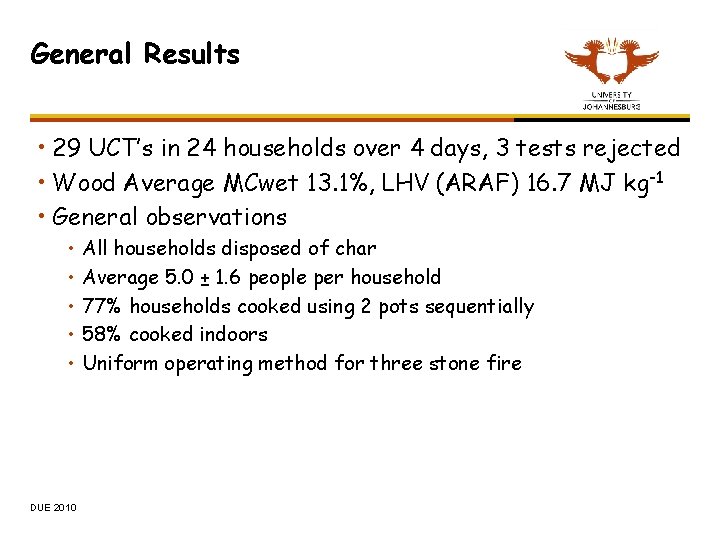
General Results • 29 UCT’s in 24 households over 4 days, 3 tests rejected • Wood Average MCwet 13. 1%, LHV (ARAF) 16. 7 MJ kg-1 • General observations • • • DUE 2010 All households disposed of char Average 5. 0 ± 1. 6 people per household 77% households cooked using 2 pots sequentially 58% cooked indoors Uniform operating method for three stone fire
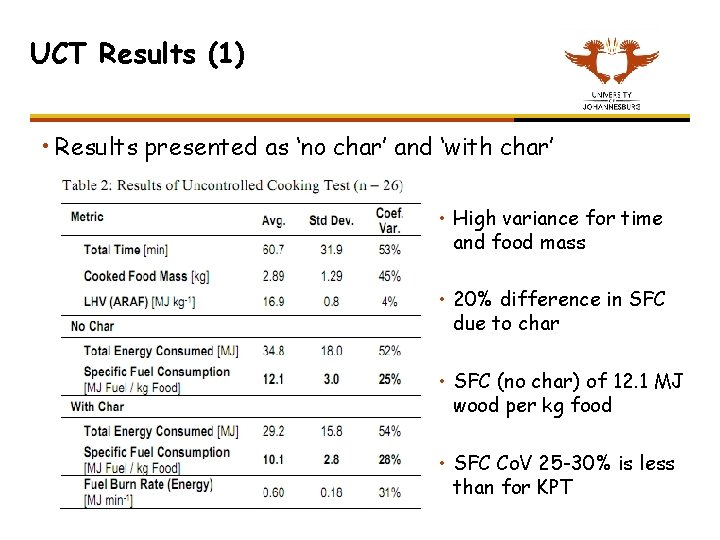
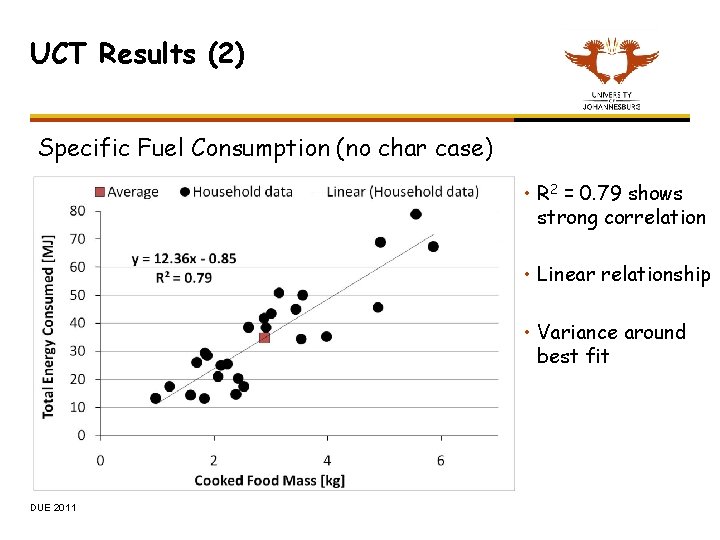
UCT Results (1) • Results presented as ‘no char’ and ‘with char’ • High variance for time and food mass • 20% difference in SFC due to char • SFC (no char) of 12. 1 MJ wood per kg food • SFC Co. V 25 -30% is less than for KPT
UCT Results (2) Specific Fuel Consumption (no char case) • R 2 = 0. 79 shows strong correlation • Linear relationship • Variance around best fit DUE 2011
Conclusions and Recommendations • UCT proved a capable and viable method • Captured key user behaviour • Less variation than typically reported by KPT (one case) • Offers potential to detect a statistically significantly difference between baseline and ‘improved’ stove by using less resources • Future work • Variability, error and sample size • Statistical treatments (non linear) • Correlate laboratory and field performance
Acknowledgements • Vincent Molapo (UJ Se. TAR) and Fabiano Simao (UEM) • Village elders and households in Muculuone • NRF/ NRI funded SAMOZ programme - Prof H. Winkler (UJ) and Prof M. Falcão (UEM) • UJ Quick Wins Programme, Volkswagen Stiftung Biomodels project through the IER, Uni. of Stuttgart • GTZ BECCAP/Pro. BEC for funding of UJ Se. TAR centre and loan of vehicle.
Questions? jamesrobinson 77@gmail. com 011 559 1901