
The uncertainty principle virtual particles and real forces


- Slides: 20
The uncertainty principle, virtual particles and real forces. (http: //teachers. web. cern. ch/teachers/archiv/HST 2005/bubble_chambers/BCwebsite/articles. htm) (An introduction to quantum fluctuations) Goronwy Tudor Jones University of Birmingham CERN HST 2012
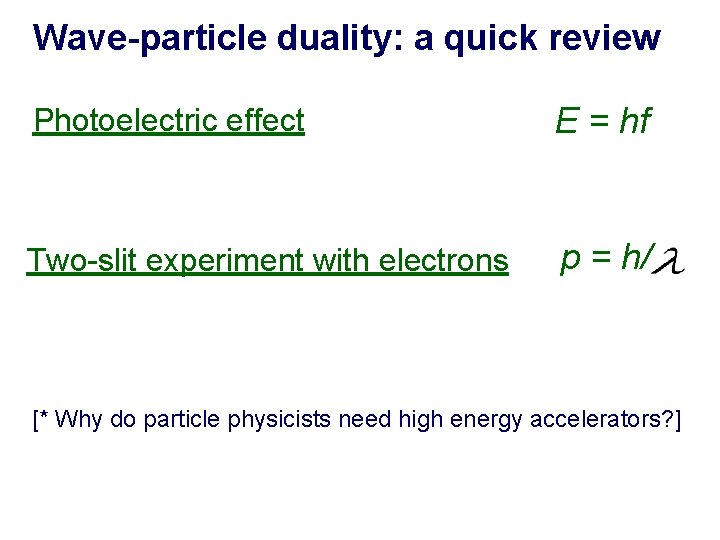
Wave-particle duality: a quick review Photoelectric effect E = hf Two-slit experiment with electrons p = h/ [* Why do particle physicists need high energy accelerators? ]
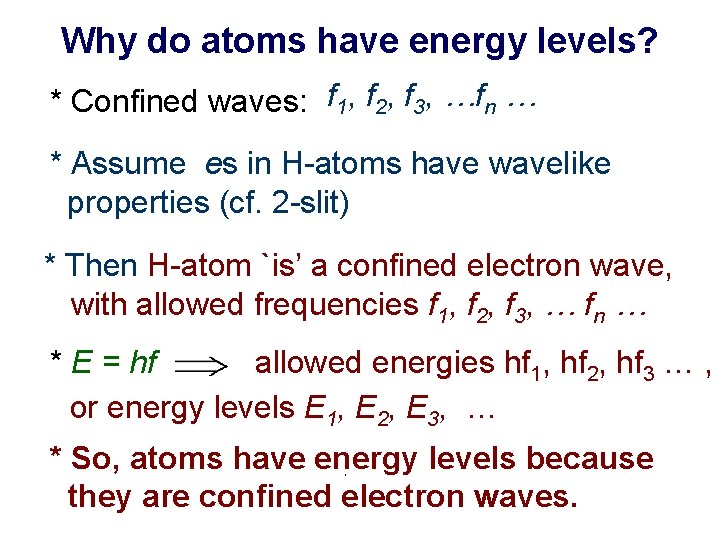
Why do atoms have energy levels? * Confined waves: f 1, f 2, f 3, …fn … * Assume es in H-atoms have wavelike properties (cf. 2 -slit) * Then H-atom `is’ a confined electron wave, with allowed frequencies f 1, f 2, f 3, … fn … * E = hf allowed energies hf 1, hf 2, hf 3 … , or energy levels E 1, E 2, E 3, … * So, atoms have energy levels because they are confined electron waves. •
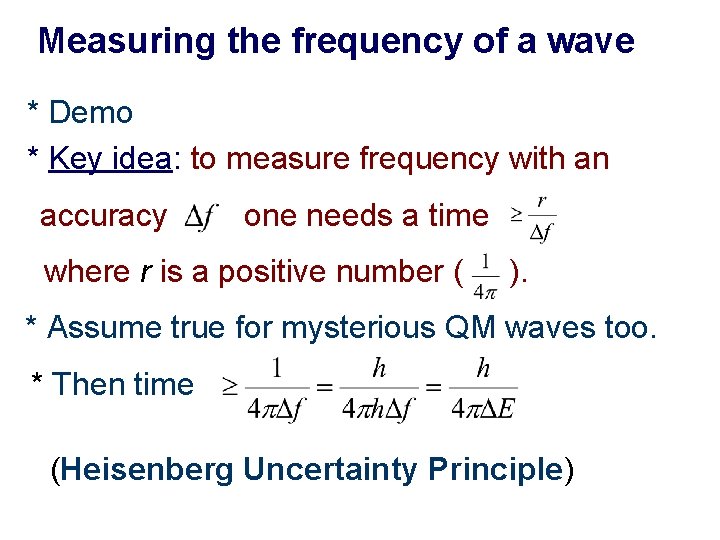
Measuring the frequency of a wave * Demo * Key idea: to measure frequency with an accuracy one needs a time where r is a positive number ( ). * Assume true for mysterious QM waves too. * Then time (Heisenberg Uncertainty Principle)
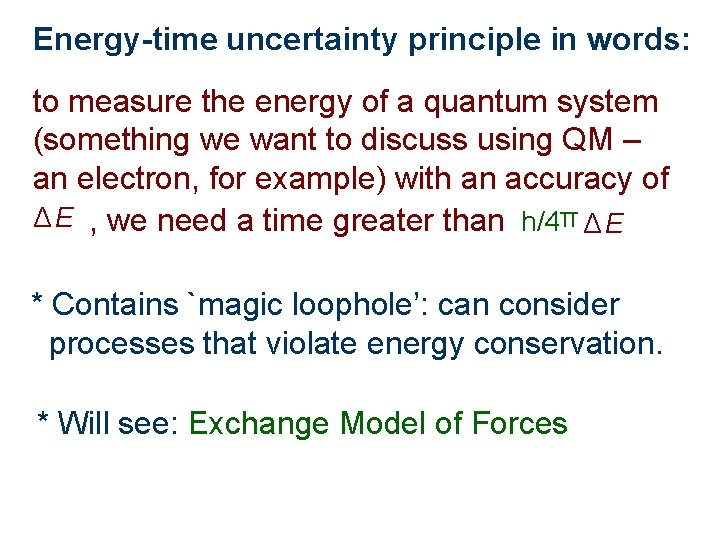
Energy-time uncertainty principle in words: to measure the energy of a quantum system (something we want to discuss using QM – an electron, for example) with an accuracy of Δ E , we need a time greater than h/4π Δ E * Contains `magic loophole’: can consider processes that violate energy conservation. * Will see: Exchange Model of Forces
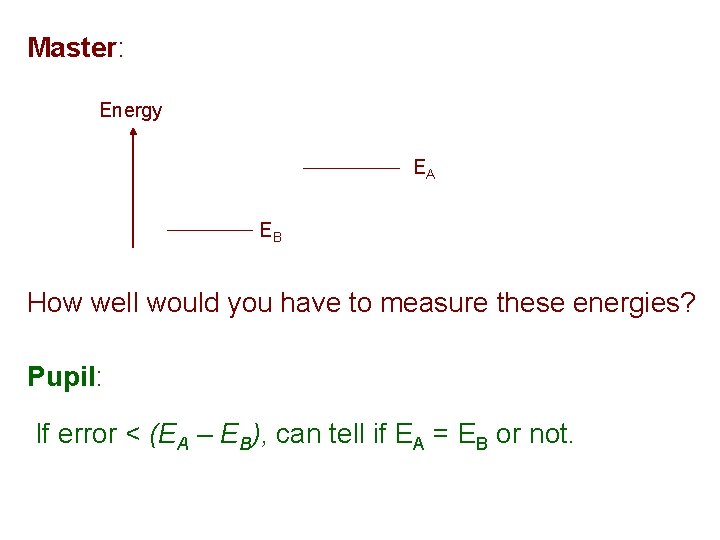
Master: Energy EA EB How well would you have to measure these energies? Pupil: If error < (EA – EB), can tell if EA = EB or not.
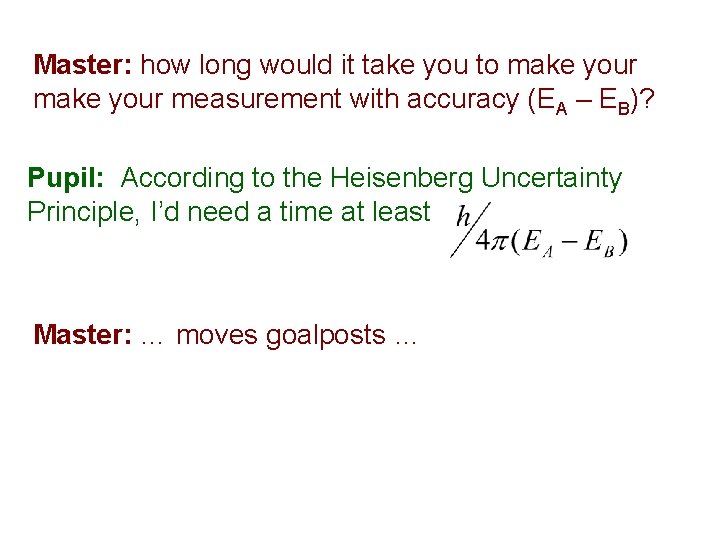
Master: how long would it take you to make your measurement with accuracy (EA – EB)? Pupil: According to the Heisenberg Uncertainty Principle, I’d need a time at least Master: … moves goalposts …
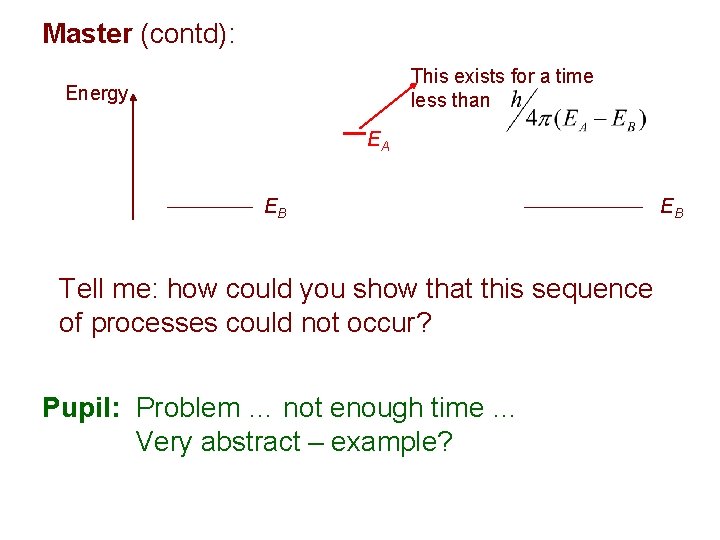
Master (contd): This exists for a time less than Energy EA EB Tell me: how could you show that this sequence of processes could not occur? Pupil: Problem … not enough time … Very abstract – example? EB
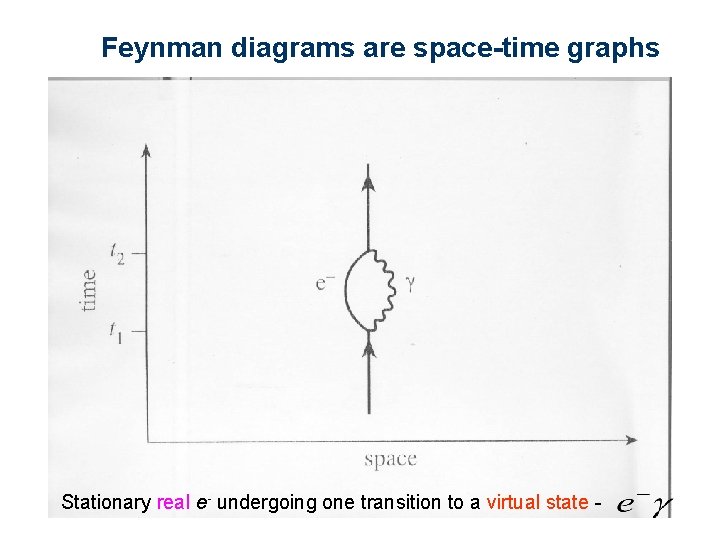
Feynman diagrams are space-time graphs Stationary real e- undergoing one transition to a virtual state -
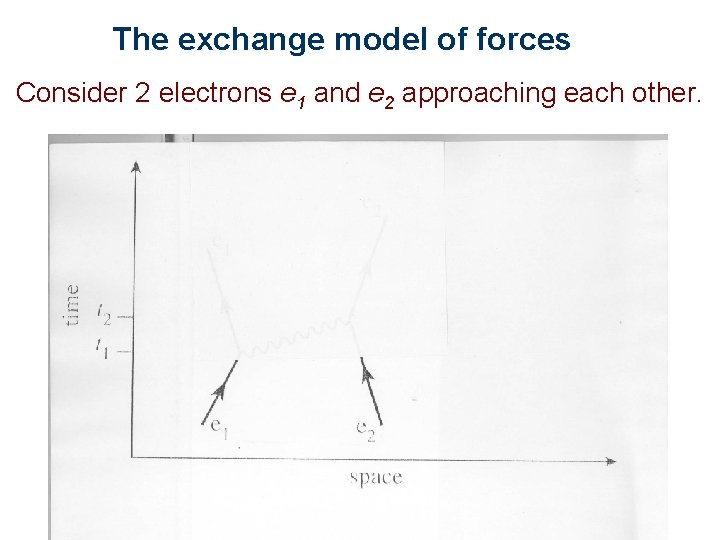
The exchange model of forces Consider 2 electrons e 1 and e 2 approaching each other.
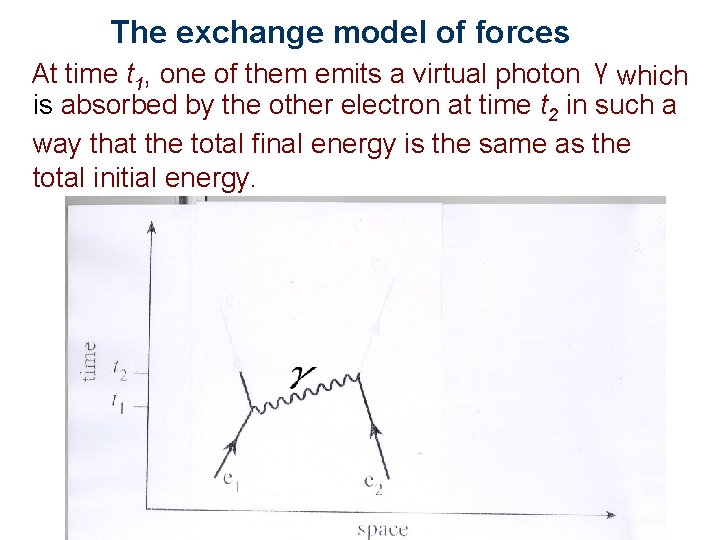
The exchange model of forces At time t 1, one of them emits a virtual photon γ which is absorbed by the other electron at time t 2 in such a way that the total final energy is the same as the total initial energy.
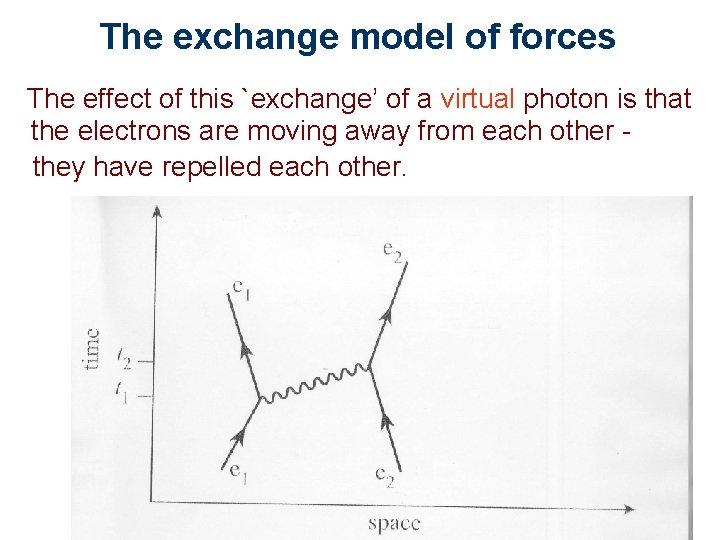
The exchange model of forces The effect of this `exchange’ of a virtual photon is that the electrons are moving away from each other they have repelled each other.
Discussion
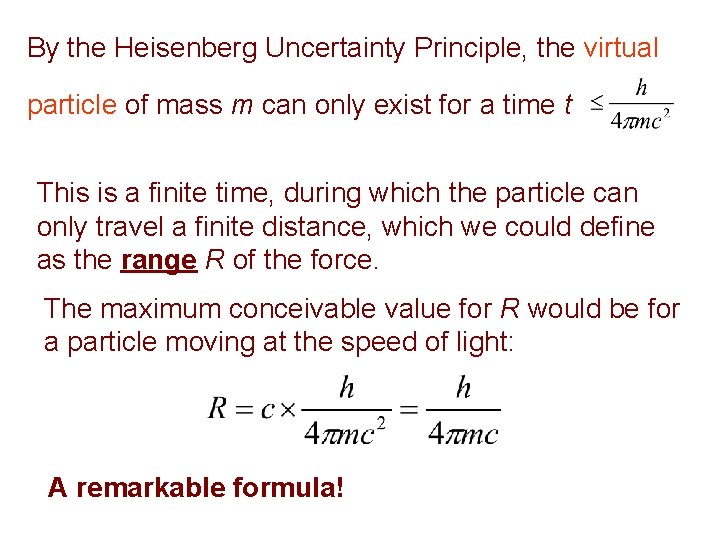
By the Heisenberg Uncertainty Principle, the virtual particle of mass m can only exist for a time t This is a finite time, during which the particle can only travel a finite distance, which we could define as the range R of the force. The maximum conceivable value for R would be for a particle moving at the speed of light: A remarkable formula!
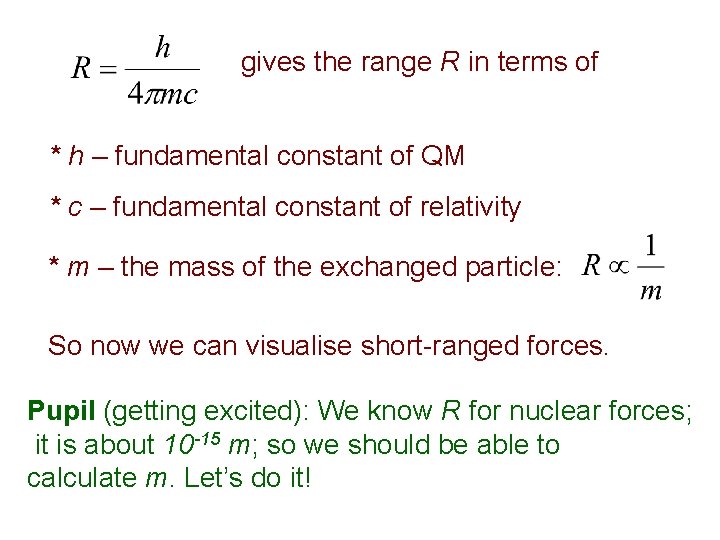
gives the range R in terms of * h – fundamental constant of QM * c – fundamental constant of relativity * m – the mass of the exchanged particle: So now we can visualise short-ranged forces. Pupil (getting excited): We know R for nuclear forces; it is about 10 -15 m; so we should be able to calculate m. Let’s do it!
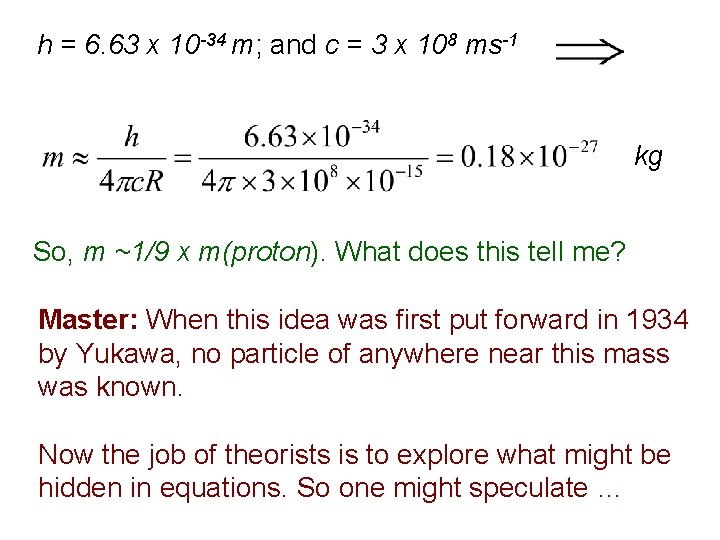
h = 6. 63 x 10 -34 m; and c = 3 x 10⁸ ms-1 kg So, m ~1/9 x m(proton). What does this tell me? Master: When this idea was first put forward in 1934 by Yukawa, no particle of anywhere near this mass was known. Now the job of theorists is to explore what might be hidden in equations. So one might speculate …
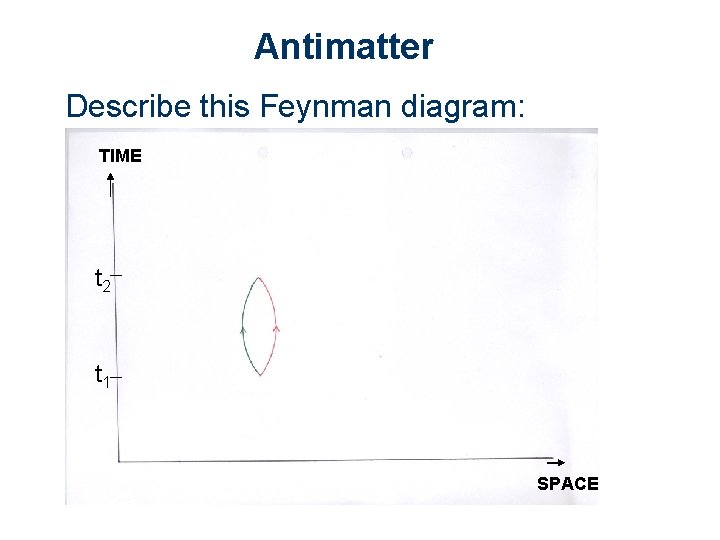
Antimatter Describe this Feynman diagram: TIME t 2 t 1 SPACE
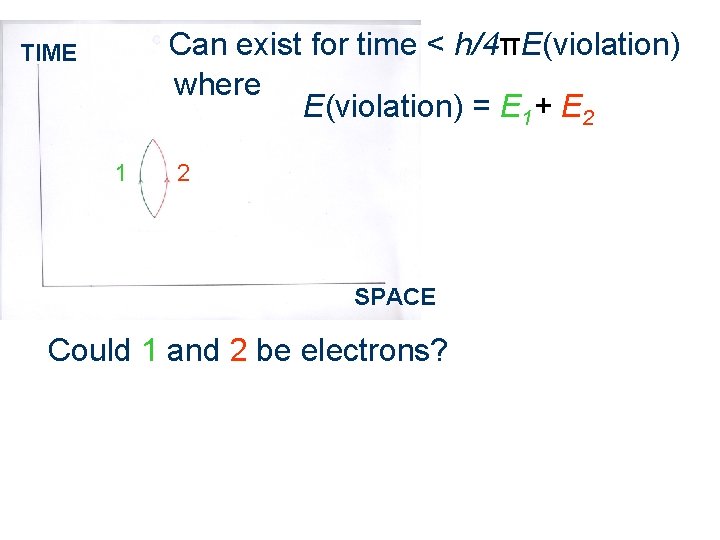
Can exist for time < h/4πE(violation) where E(violation) = E 1+ E 2 TIME 1 2 SPACE Could 1 and 2 be electrons?
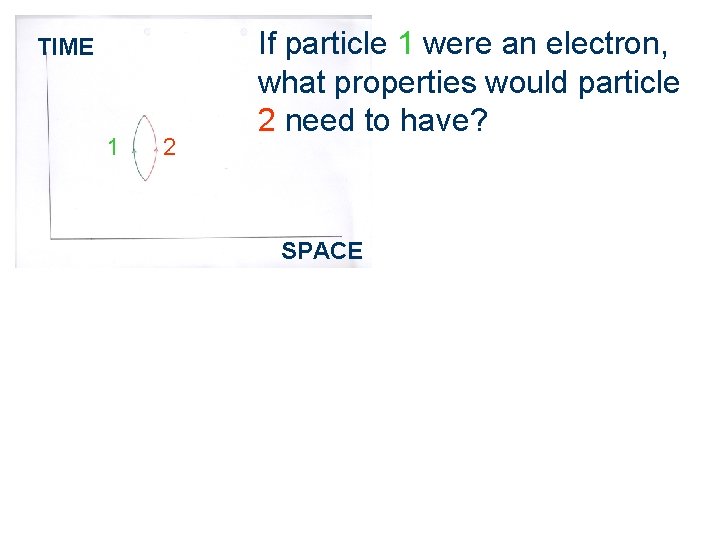
TIME 1 2 If particle 1 were an electron, what properties would particle 2 need to have? SPACE
What is empty space?