
The Uncertainty of Outcome and Scoring Effects on
- Slides: 18
The Uncertainty of Outcome and Scoring Effects on Nielson Ratings for Monday Night Football Authors: Rodney J. Paul and Andrew P. Weinbach
Purpose of the Study • Looks to test fan preferences • Uses Nielsen Television Ratings • Measures most recent information on teams involved • Within-game changes in viewers can be captured • Determinants of Changes can be analyzed • Studies the ratings for Monday Night Football • Played during prime time hours • Data is available at half-hour intervals • Only football game played at that time
Understanding the Competitive Balance • Past studies found that game attendance is positively influenced by competitive balance, measured by team win percentage • Current article looks to test the hypothesis that games between high quality teams with a high uncertainty of outcome leads to more fans • Fan preference of competitive balance is evident in television ratings, which are chosen by a statistical sampling procedure to represent all U. S. households
Key Variables • Use regression models for the beginning of the game and halftime ratings, which are at 9 pm and 10: 30 pm respectively. • Variables of Interest for Start of Game: • Expected Uncertainty of Outcome (difference in win percentages) • Overall quality of teams (sum of win percentages) • Expected level of Scoring (Las Vegas total) • Variables of Interest for Change in Ratings • Halftime score differential • Halftime total points scored
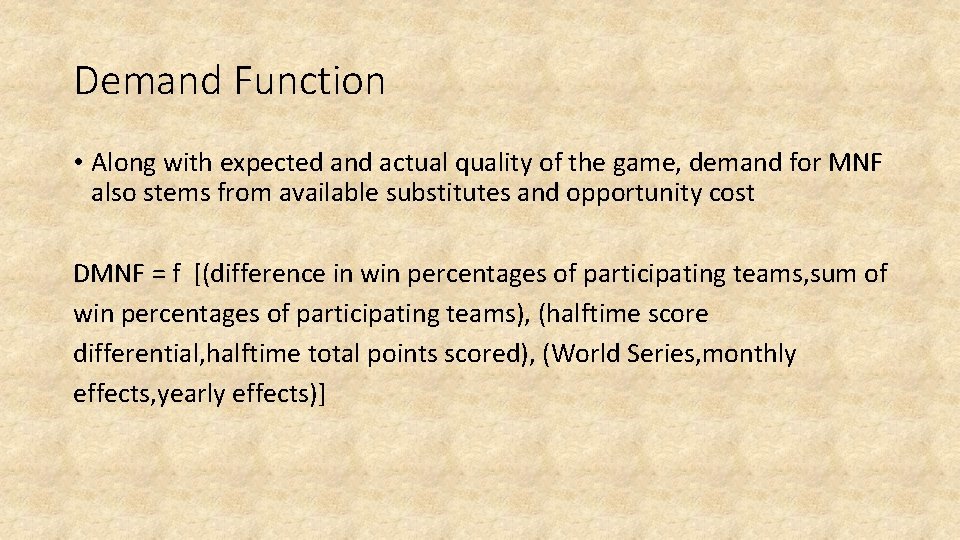
Demand Function • Along with expected and actual quality of the game, demand for MNF also stems from available substitutes and opportunity cost DMNF = f [(difference in win percentages of participating teams, sum of win percentages of participating teams), (halftime score differential, halftime total points scored), (World Series, monthly effects, yearly effects)]
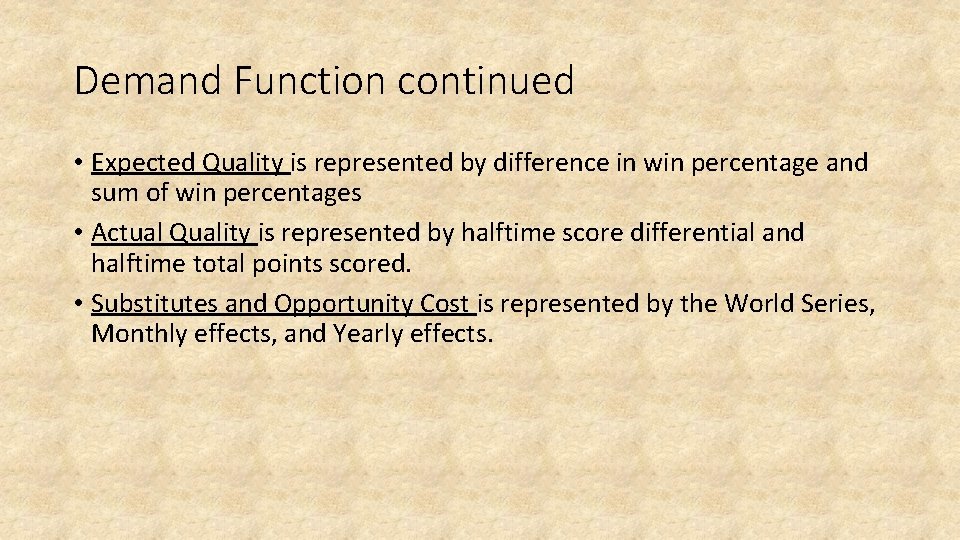
Demand Function continued • Expected Quality is represented by difference in win percentage and sum of win percentages • Actual Quality is represented by halftime score differential and halftime total points scored. • Substitutes and Opportunity Cost is represented by the World Series, Monthly effects, and Yearly effects.
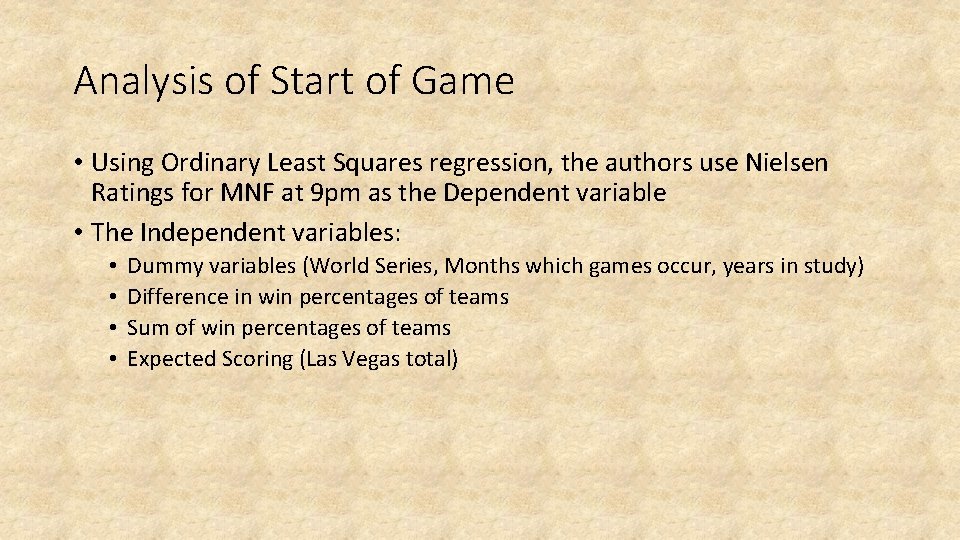
Analysis of Start of Game • Using Ordinary Least Squares regression, the authors use Nielsen Ratings for MNF at 9 pm as the Dependent variable • The Independent variables: • • Dummy variables (World Series, Months which games occur, years in study) Difference in win percentages of teams Sum of win percentages of teams Expected Scoring (Las Vegas total)
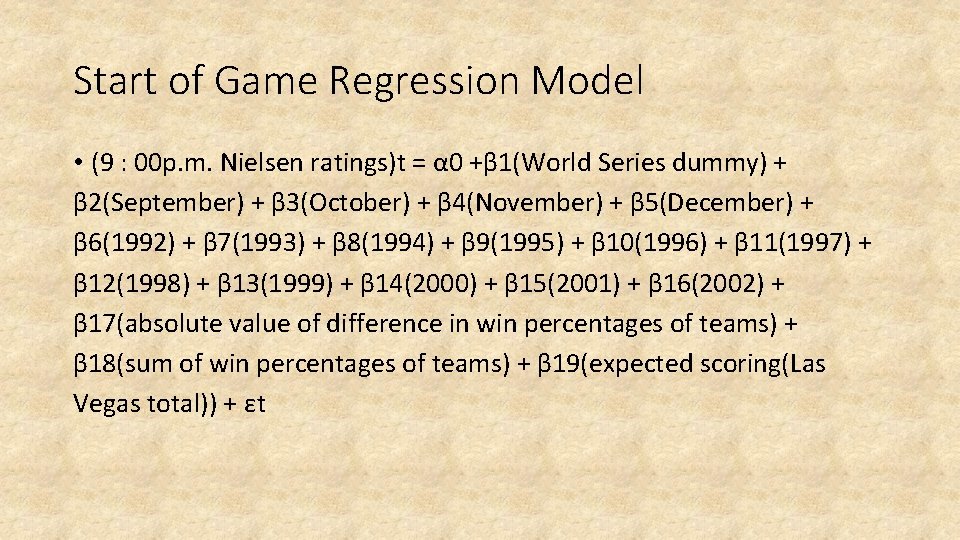
Start of Game Regression Model • (9 : 00 p. m. Nielsen ratings)t = α 0 +β 1(World Series dummy) + β 2(September) + β 3(October) + β 4(November) + β 5(December) + β 6(1992) + β 7(1993) + β 8(1994) + β 9(1995) + β 10(1996) + β 11(1997) + β 12(1998) + β 13(1999) + β 14(2000) + β 15(2001) + β 16(2002) + β 17(absolute value of difference in win percentages of teams) + β 18(sum of win percentages of teams) + β 19(expected scoring(Las Vegas total)) + εt
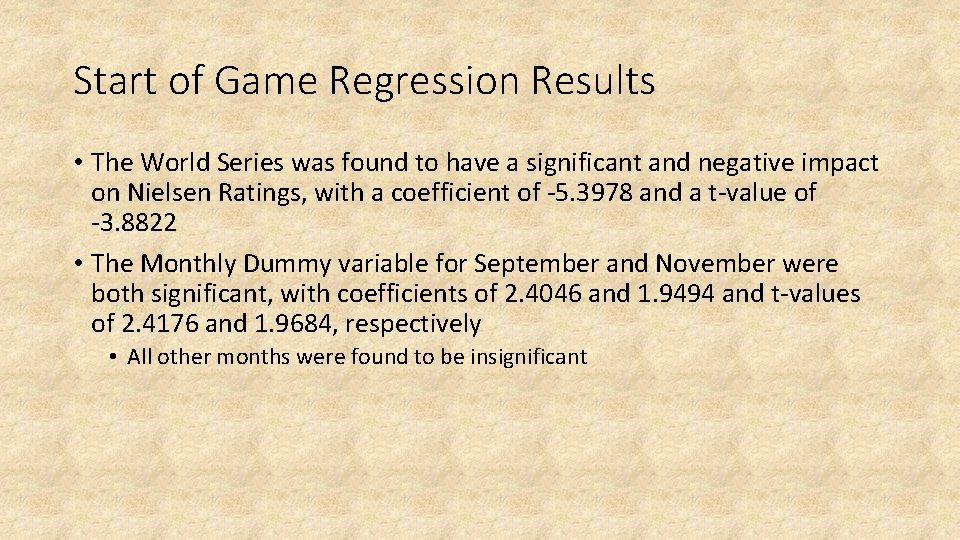
Start of Game Regression Results • The World Series was found to have a significant and negative impact on Nielsen Ratings, with a coefficient of -5. 3978 and a t-value of -3. 8822 • The Monthly Dummy variable for September and November were both significant, with coefficients of 2. 4046 and 1. 9494 and t-values of 2. 4176 and 1. 9684, respectively • All other months were found to be insignificant
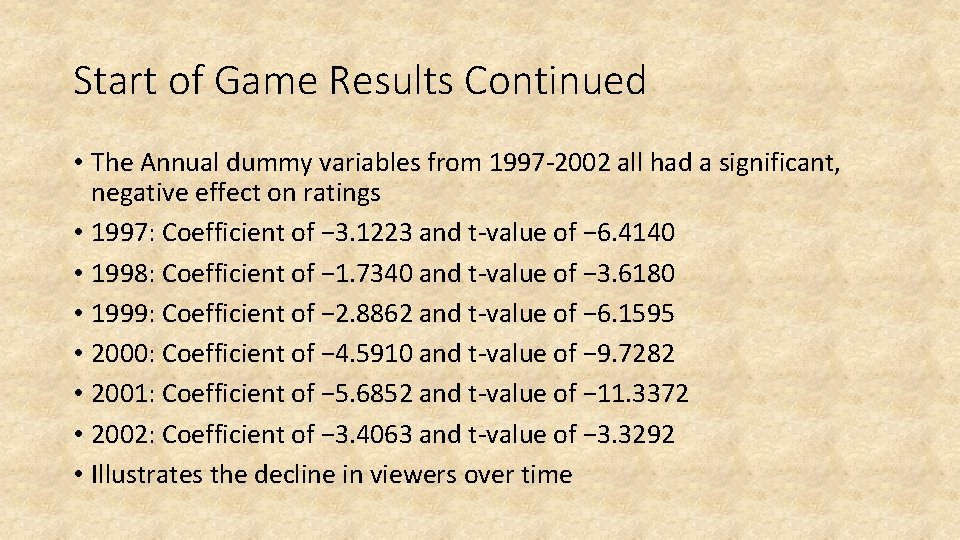
Start of Game Results Continued • The Annual dummy variables from 1997 -2002 all had a significant, negative effect on ratings • 1997: Coefficient of − 3. 1223 and t-value of − 6. 4140 • 1998: Coefficient of − 1. 7340 and t-value of − 3. 6180 • 1999: Coefficient of − 2. 8862 and t-value of − 6. 1595 • 2000: Coefficient of − 4. 5910 and t-value of − 9. 7282 • 2001: Coefficient of − 5. 6852 and t-value of − 11. 3372 • 2002: Coefficient of − 3. 4063 and t-value of − 3. 3292 • Illustrates the decline in viewers over time
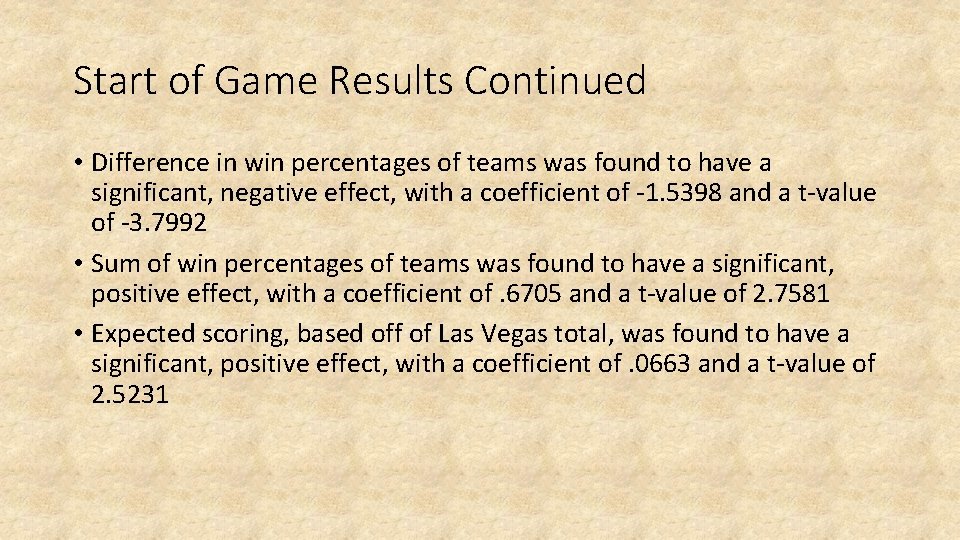
Start of Game Results Continued • Difference in win percentages of teams was found to have a significant, negative effect, with a coefficient of -1. 5398 and a t-value of -3. 7992 • Sum of win percentages of teams was found to have a significant, positive effect, with a coefficient of. 6705 and a t-value of 2. 7581 • Expected scoring, based off of Las Vegas total, was found to have a significant, positive effect, with a coefficient of. 0663 and a t-value of 2. 5231
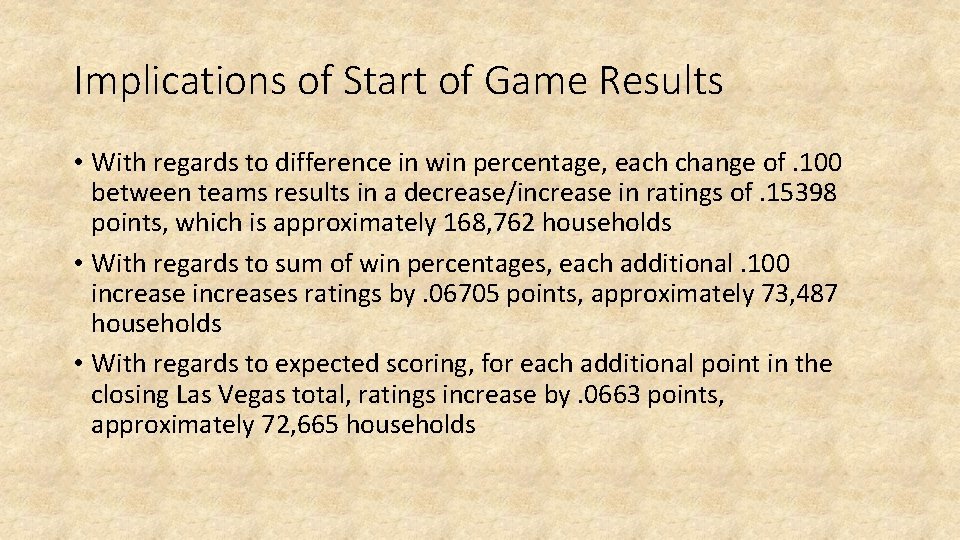
Implications of Start of Game Results • With regards to difference in win percentage, each change of. 100 between teams results in a decrease/increase in ratings of. 15398 points, which is approximately 168, 762 households • With regards to sum of win percentages, each additional. 100 increases ratings by. 06705 points, approximately 73, 487 households • With regards to expected scoring, for each additional point in the closing Las Vegas total, ratings increase by. 0663 points, approximately 72, 665 households
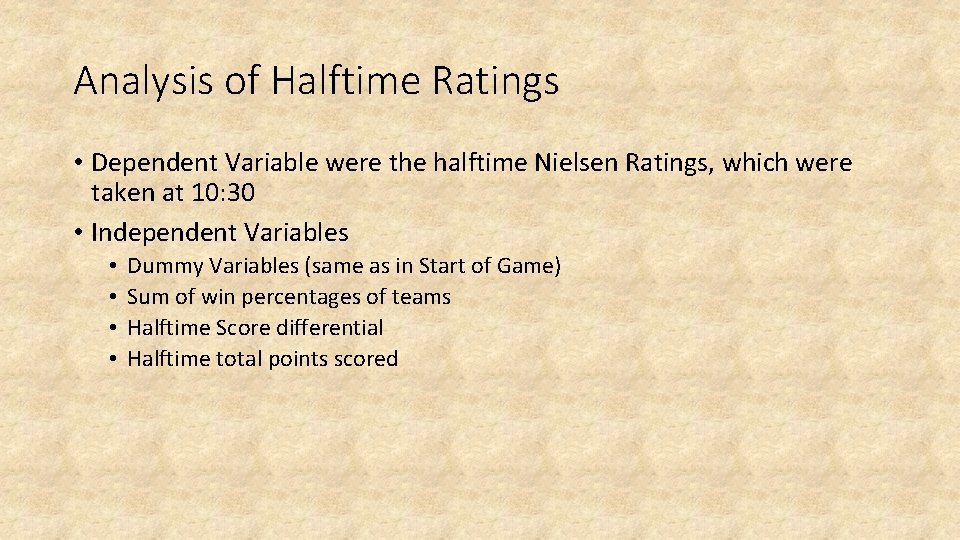
Analysis of Halftime Ratings • Dependent Variable were the halftime Nielsen Ratings, which were taken at 10: 30 • Independent Variables • • Dummy Variables (same as in Start of Game) Sum of win percentages of teams Halftime Score differential Halftime total points scored
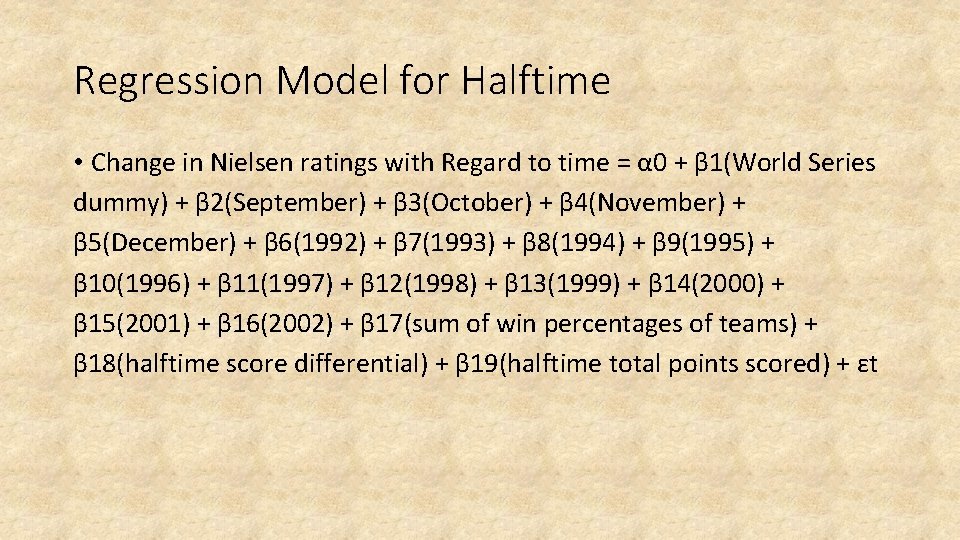
Regression Model for Halftime • Change in Nielsen ratings with Regard to time = α 0 + β 1(World Series dummy) + β 2(September) + β 3(October) + β 4(November) + β 5(December) + β 6(1992) + β 7(1993) + β 8(1994) + β 9(1995) + β 10(1996) + β 11(1997) + β 12(1998) + β 13(1999) + β 14(2000) + β 15(2001) + β 16(2002) + β 17(sum of win percentages of teams) + β 18(halftime score differential) + β 19(halftime total points scored) + εt
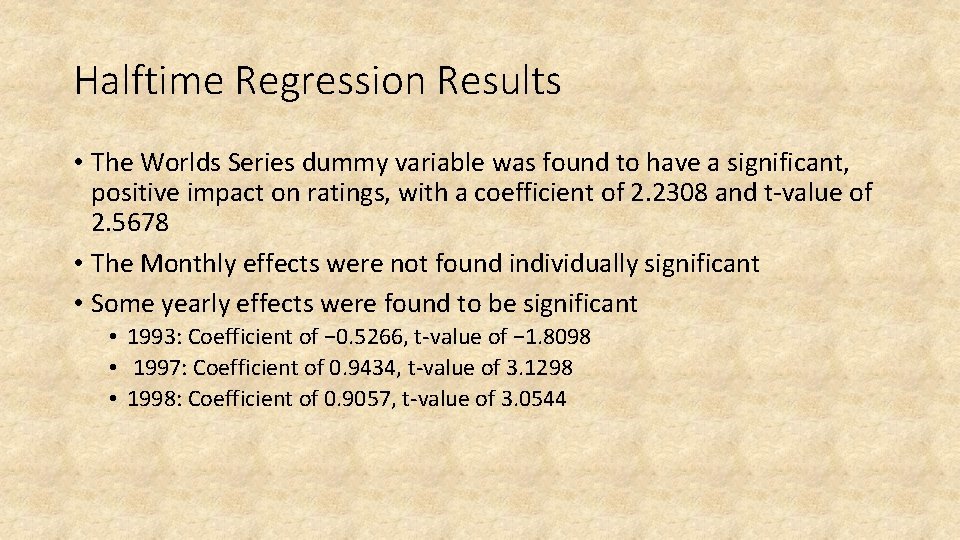
Halftime Regression Results • The Worlds Series dummy variable was found to have a significant, positive impact on ratings, with a coefficient of 2. 2308 and t-value of 2. 5678 • The Monthly effects were not found individually significant • Some yearly effects were found to be significant • 1993: Coefficient of − 0. 5266, t-value of − 1. 8098 • 1997: Coefficient of 0. 9434, t-value of 3. 1298 • 1998: Coefficient of 0. 9057, t-value of 3. 0544
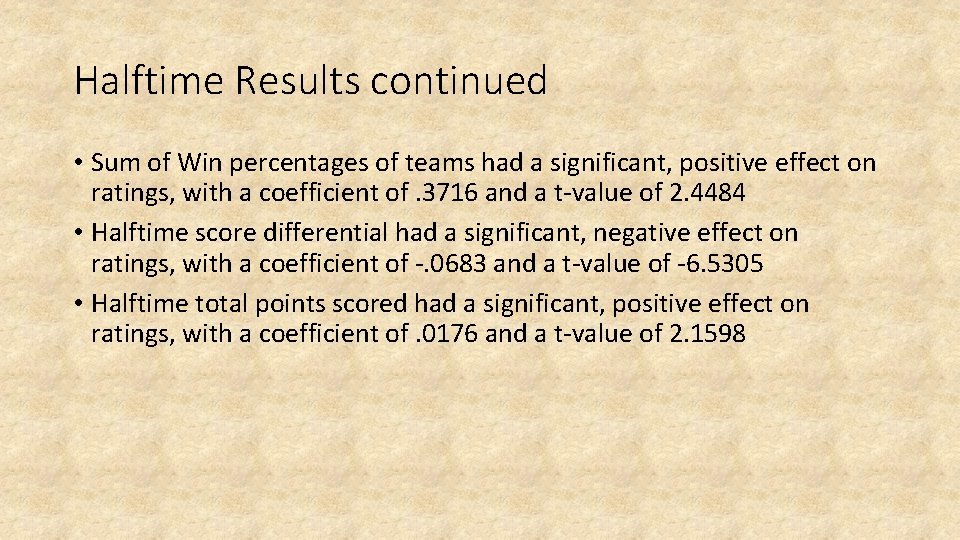
Halftime Results continued • Sum of Win percentages of teams had a significant, positive effect on ratings, with a coefficient of. 3716 and a t-value of 2. 4484 • Halftime score differential had a significant, negative effect on ratings, with a coefficient of -. 0683 and a t-value of -6. 5305 • Halftime total points scored had a significant, positive effect on ratings, with a coefficient of. 0176 and a t-value of 2. 1598
Implications of Halftime Results • With regards to point differential, for each additional touchdown and extra point lead, ratings drop by half a point. • Given that one rating point is approximately 1, 096, 000 households, this means an extra touchdown leads to about half a million households turning off the game • With regards to total points scored, for each additional point scored by halftime, ratings rise by. 02 points • For each additional touchdown scored by halftime, viewers increase by more than 150, 000 • When combined, the impact of scoring is more important to viewers than score differential • If the score is 10 -0, ABC will lose about. 5 points. However, if the score is 2717, the impact of scoring will dominate the differential.
Conclusion • Networks can retain viewers through not only close games, but close games between high-scoring teams • If choosing between two game with same expected closeness, network should choose game with higher expected scoring • Based off of the results, fans seem to prefer close games between quality teams • Holds true for start of game and halftime results • Quality of games and high scoring attract viewers, retain them throughout the game, and attract new viewers as game progresses