
THE UKS POINTS BASED IMMIGRATION SYSTEM AN INTRODUCTION
THE UK'S POINTS -BASED IMMIGRATION SYSTEM: AN INTRODUCTION FOR EMPLOYERS
GOVERNMENT POLICY PAPER FEB 2020 Commitments: End Free Movement (Dec 2020) Points Based Scheme (Jan 2021) Continuation (June 2021) of the EU Settlement Scheme
TIMELINES FOR EMPLOYERS WITH EU WORKERS Current EU workers (EU Settlement Scheme) EU Workers arriving after 31 st December 2020 are subject to new immigration regime No Right to Work checks until then
EU CITIZENS ALREADY LIVING IN THE UK The new system will not apply to EU citizens living in the UK by 31 December 2020. They and their family members are eligible to apply to the EU Settlement Scheme and have until 30 June 2021 to make an application. As a transition measure, employers can continue to accept the passports and national identity cards of EU citizens as evidence of their right to work up until 30 June 2021.
SKILLED WORKERS From 1 January 2021, anyone coming to the UK to work will need to demonstrate that: they have a job offer from a Home Office approved sponsor the job offer is at the required skill level – RQF 3 or above (A Level and equivalent) they speak English In addition to this: if they earn more than the required minimum salary threshold they are eligible to make an application if they earn less than the required minimum salary threshold, but no less than £ 20, 480, they may still be eligible if they can demonstrate that they have a job offer in a specific shortage occupation or a Ph. D relevant to the job Anyone coming to work in the UK will need to be paid the higher of the specific salary threshold for their occupation – the ‘going rate’ – and the general salary threshold. However, some applicants will be able to trade characteristics, such as their qualifications, against a lower salary. The general minimum salary threshold will be £ 25, 600.
SHORTAGE OCCUPATION LIST Manufacturing NI has been lobbying The Migration Advisory Committee to lower the salary threshold. The initial salary threshold has been lowered from £ 30, 000 to £ 25, 600. Ø Manufacturing NI has also provided extensive evidence to the Migration Advisory Committee (MAC) on the Shortage Occupation List highlighting those occupation(s) to be in shortage in Northern Ireland compared to other regions of the UK.
IDENTIFYING WHETHER A JOB MEETS THE REQUIRED SKILL LEVEL All jobs have a corresponding Standard Occupational Classifcation (SOC) code. You can use the ONS Occupation Coding Tool to identify the relevant SOC code for your job. Current skill levels for SOC codes are set out in Appendix J of the Immigration Rules. The Immigration Rules will be updated in order to expand the list of occupations that will be eligible for the Skilled Work route. This will be based on the advice already published by the Migration Advisory Committee.

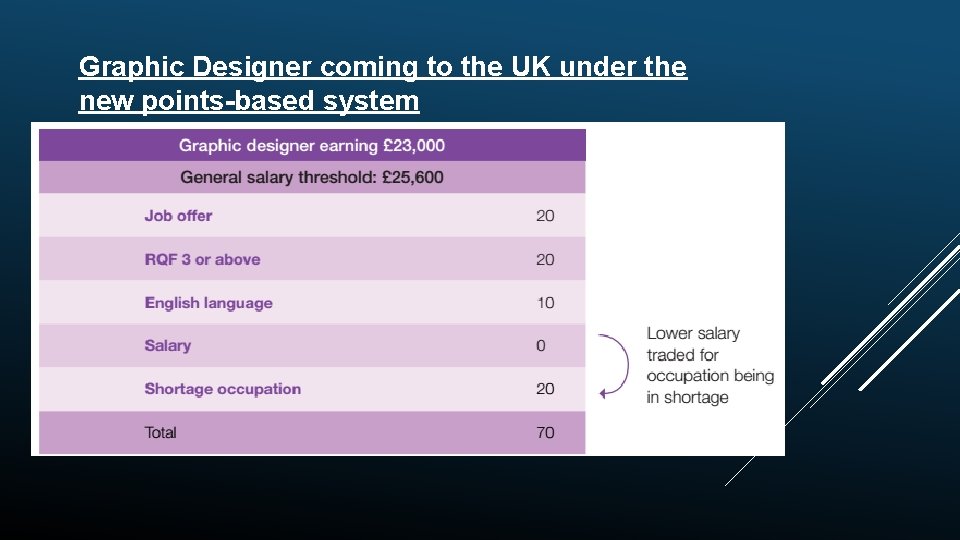
Graphic Designer coming to the UK under the new points-based system SKILLED WORKER CASE STUDIES

HIGH VALUE UK Points Based System Investor Entrepreneur Exceptional talent Business and study routes for non EU migrants Graduate entrepreneur SKILLED | General | Intra company transfer | Sportsperson | Minister of Religion UNSKILLED Not in use STUDENTS General | Students TEMPORARY | Creative and sporting | Charity workers | Religious workers | Government authorised exchange | International agreement | youth mobility scheme
HIGHLY SKILLED WORKERS From January 2021, the current Global Talent route will open to EU citizens on the same basis as non-EU citizens. This means the most highly skilled, who can achieve the required level of points, will be able to enter the UK without a job offer if they are endorsed by the relevant competent body. In the longer term, an unsponsored route for highly skilled workers will be introduced. This would allow a small number of the most highly skilled workers to come to the UK without a job offer.
LOWER-SKILLED WORKERS There will not be an immigration route specifically for those who do not meet the skills or salary threshold for the skilled worker route. The new immigration system provides greater flexibility for employers with changes to salary and skills thresholds. Employers can also benefit from the youth mobility scheme. The UK has arrangements in place with eight countries and territories to enable around 20, 000 young people to come to the UK each year. Other routes Initiatives are also being brought forward for scientists, graduates and NHS workers, which will provide businesses with additional flexibility. A new Graduate Immigration Route will be available to international students who have completed a degree in the UK from summer 2021. This will enable international students to remain in the UK and work at any skill level for two years after they have completed their studies.
BECOMING AN APPROVED SPONSOR You need to apply to be a sponsor if you want to recruit workers from outside the resident labour market from 1 January 2021. Until then current immigration rules will apply. The standard processing time for an application is usually 8 weeks and will start when we receive your application. You do not need to be a sponsor to employ someone from the resident labour market with an existing right to work in the UK. This includes EU citizens with settled or pre-settled status, and non-EU citizens with indefinite leave to remain in the UK.
YOU WILL NEED TO: 1. Check your business is eligible. To get a licence, you cannot have unspent criminal convictions for immigration offences or certain other crimes, such as fraud or money laundering. 2. Choose the type of licence you want to apply for. This will depend on what type of worker you want to sponsor: Tier 2 – skilled workers with long-term job offers Tier 5 – skilled temporary workers You can apply for a licence covering either tier or both
3. Decide who will manage sponsorship within your business. You need to appoint people within your business to manage the sponsorship process when you apply for a licence. The main tool they’ll use is the sponsorship management system (SMS). The roles are: authorising officer – a senior and competent person responsible for the actions of staff and representatives who use the SMS key contact – your main point of contact with UK Visas and Immigration (UKVI) level 1 user – responsible for all day-to-day management of your licence using the SMS These roles can be filled by the same person or different people
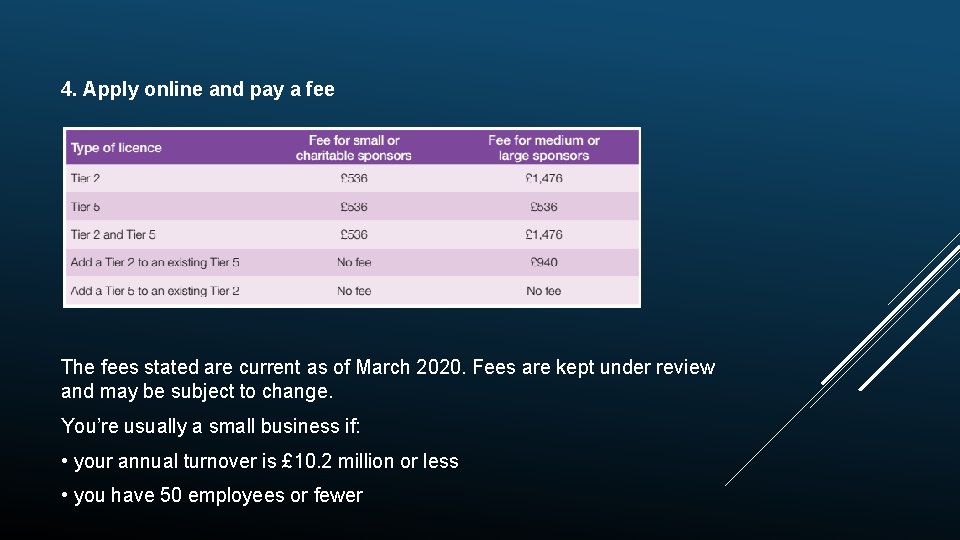
4. Apply online and pay a fee The fees stated are current as of March 2020. Fees are kept under review and may be subject to change. You’re usually a small business if: • your annual turnover is £ 10. 2 million or less • you have 50 employees or fewer
COSTS FOR EMPLOYERS Sponsor Licence Costs £ 536 - £ 1476 Typical Tier 2 - £ 610 -£ 1220 Health Surcharge (£ 400 per year) COS (£ 199) Approx. - £ 4, 000 - £ 5, 000 per visa holder Family members? – up to £ 10, 000
THE VISA PROCESS New immigration routes, such as the skilled worker route, will open from autumn 2020 for applications from those who wish to work in the UK from 1 January 2021. Applicants will apply and pay for their visa online. Anyone who comes to the UK as a visitor will not be able to apply for a visa to work once in the country. Planning to come EU citizens and non-visa nationals will not require a visa to enter the country when visiting. All migrants looking to enter the UK to work will need to apply for permission in advance. Getting permission Most EU citizens will complete their application online. Non-EU citizens will continue to go to a Visa Application Centre to enrol their biometrics.
Crossing the UK border Citizens of Australia, Canada, Japan, New Zealand, Singapore, South Korea and the USA, who possess biometric passports, will continue to be able to use e-gates to pass through the UK border either as a visitor or with prior permission. EU citizens will continue to use e-gates but this policy will be kept under review. Others will need to see a Border Force officer. Living in the UK EU citizens can use the online checking service to demonstrate their immigration status and their right to work in the UK. As a transition measure, employers, landlords and public service providers will continue to accept the passports and national identity cards of EU citizens as evidence of permission up until 30 June 2021. Non-EU citizens will continue to use their physical documentation. Leaving the UK after leave has expired, or not leaving at all when required to, will impact a migrant’s immigration status and affect future interactions with UK immigration.
RECOMMENDATIONS FOR EMPLOYERS Get a Sponsor Licence Consider your EU workers – audit and inform Consider Manage Be budgetary concerns timescales compliant
- Slides: 20