
The UKs European university So what exactly are

- Slides: 37
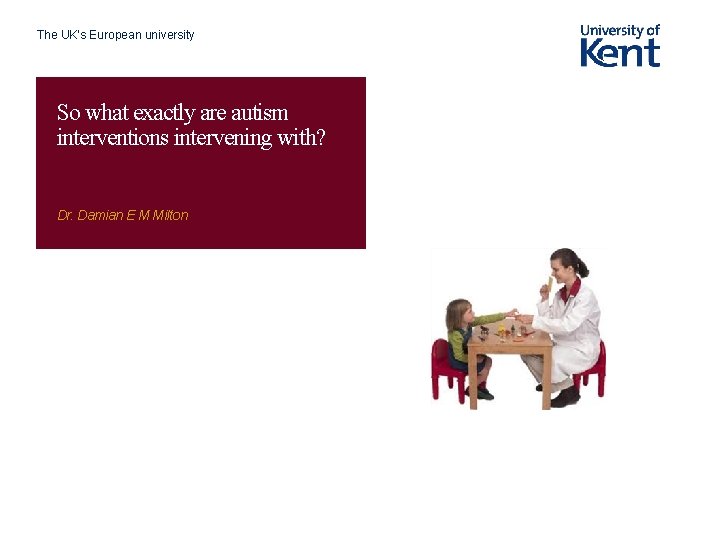
The UK’s European university So what exactly are autism interventions intervening with? Dr. Damian E M Milton
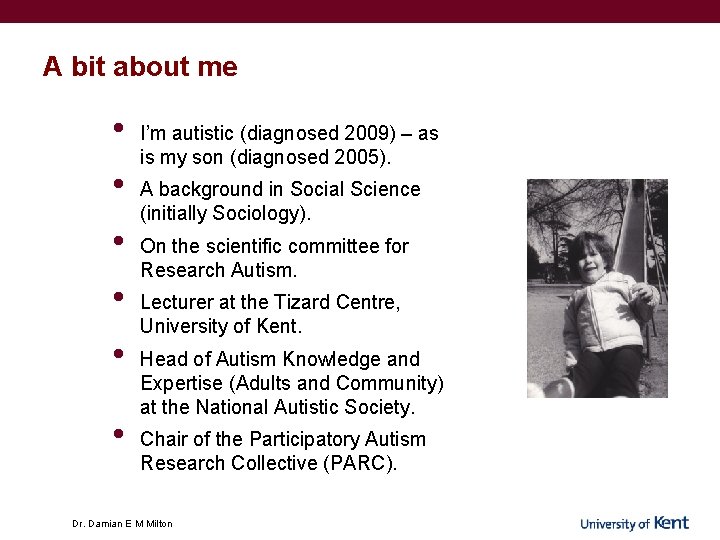
A bit about me • • • I’m autistic (diagnosed 2009) – as is my son (diagnosed 2005). A background in Social Science (initially Sociology). On the scientific committee for Research Autism. Lecturer at the Tizard Centre, University of Kent. Head of Autism Knowledge and Expertise (Adults and Community) at the National Autistic Society. Chair of the Participatory Autism Research Collective (PARC). Dr. Damian E M Milton
• “I had virtually no socially-shared nor consciously, intentionally expressed, personhood beyond this performance of a nonautistic ‘normality’ with which I had neither comprehension, connection, nor identification. This disconnected constructed facade was accepted by the world around me when my true and connected self was not. Each spoonful of its acceptance was a shovel full of dirt on the coffin in which my real self was being buried alive. . . ” (Williams, 1996: 243). Dr. Damian E M Milton
Introduction • • Exploring the narrative of ‘early intervention’ in regard to autistic people. Research Autism website lists of 1, 000 named interventions. What is the goal of these interventions? Are there ethical issues regarding these purposes, or the means by which one tries to achieve them? An overview of the spectrum of ideology regarding educational approaches for autistic children – using examples (ABA, RDI, Intensive Interaction). Tensions between views and why they exist. My own positionality. . . Dr. Damian E M Milton
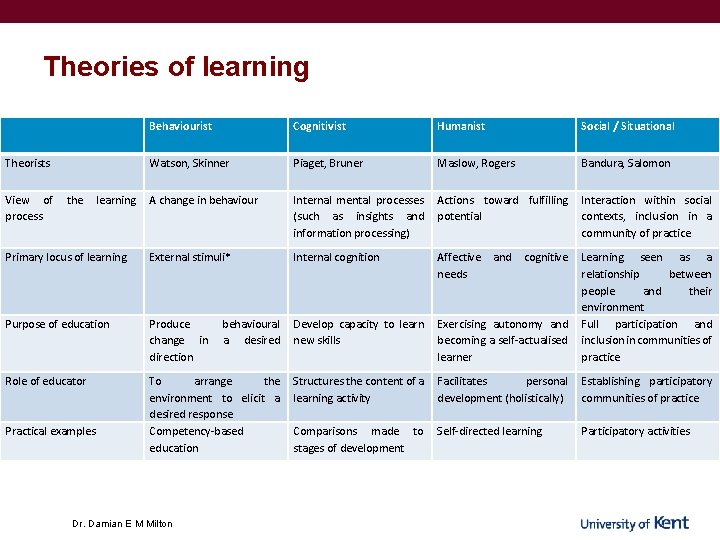
Theories of learning Behaviourist Cognitivist Humanist Social / Situational Watson, Skinner Piaget, Bruner Maslow, Rogers Bandura, Salomon A change in behaviour Internal mental processes (such as insights and information processing) Actions toward fulfilling potential Interaction within social contexts, inclusion in a community of practice Primary locus of learning External stimuli* Internal cognition Affective needs Purpose of education Produce change in direction behavioural a desired Develop capacity to learn new skills Exercising autonomy and becoming a self-actualised learner Learning seen as a relationship between people and their environment Full participation and inclusion in communities of practice Role of educator To arrange the environment to elicit a desired response Competency-based education Structures the content of a learning activity Facilitates personal development (holistically) Establishing participatory communities of practice Comparisons made to stages of development Self-directed learning Participatory activities Theorists View of process the Practical examples learning Dr. Damian E M Milton and cognitive
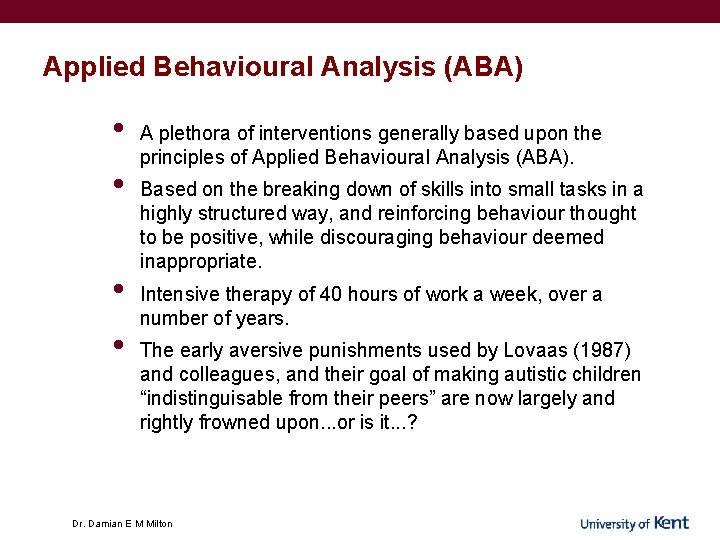
Applied Behavioural Analysis (ABA) • • A plethora of interventions generally based upon the principles of Applied Behavioural Analysis (ABA). Based on the breaking down of skills into small tasks in a highly structured way, and reinforcing behaviour thought to be positive, while discouraging behaviour deemed inappropriate. Intensive therapy of 40 hours of work a week, over a number of years. The early aversive punishments used by Lovaas (1987) and colleagues, and their goal of making autistic children “indistinguisable from their peers” are now largely and rightly frowned upon. . . or is it. . . ? Dr. Damian E M Milton
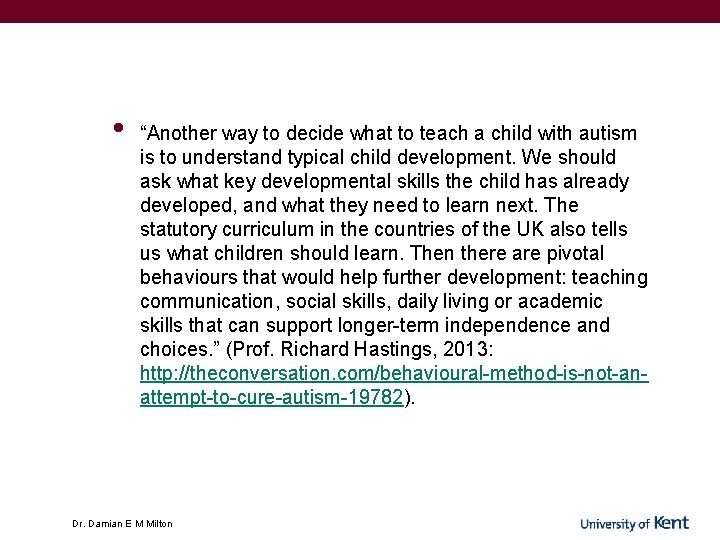
• “Another way to decide what to teach a child with autism is to understand typical child development. We should ask what key developmental skills the child has already developed, and what they need to learn next. The statutory curriculum in the countries of the UK also tells us what children should learn. Then there are pivotal behaviours that would help further development: teaching communication, social skills, daily living or academic skills that can support longer-term independence and choices. ” (Prof. Richard Hastings, 2013: http: //theconversation. com/behavioural-method-is-not-anattempt-to-cure-autism-19782). Dr. Damian E M Milton
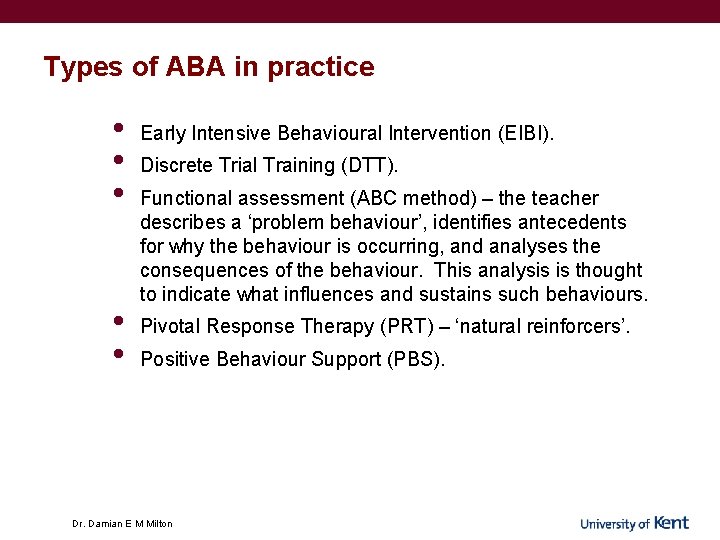
Types of ABA in practice • • • Early Intensive Behavioural Intervention (EIBI). Discrete Trial Training (DTT). Functional assessment (ABC method) – the teacher describes a ‘problem behaviour’, identifies antecedents for why the behaviour is occurring, and analyses the consequences of the behaviour. This analysis is thought to indicate what influences and sustains such behaviours. Pivotal Response Therapy (PRT) – ‘natural reinforcers’. Positive Behaviour Support (PBS). Dr. Damian E M Milton
Searching for a miracle • • • Maurice (1994) claims that ABA had saved her children’s lives, likening it to chemotherapy as a treatment for cancer. Often sold as if it is a ‘miracle treatment’, and if not, as the only recognised approach to be ‘scientifically proven’, and needed as quickly as possible in order not to miss the ‘window of opportunity’. Exploitation of vulnerable parents? Dr. Damian E M Milton
Criticisms • • The Loud Hands Project (2014) Who decides which behaviours are to be deemed as either positive or negative? How much does this take into account autistic subjectivity and learning styles? PBS still open to this criticism. Intensity leads to overload, particularly when staged in a face-to-face manner, and distress can be ignored when viewed as inappropriate behaviour. Some of the nuances of the different forms of ABA and criticisms made, are lost on many people practising ABA in the hope of some kind of miracle transformation. Dr. Damian E M Milton
Hogsbro (2011) • • • Found that on average, ABA provision had a negative impact on a number of standardised measures. Parents had the highest expectations for their children, and professionals and parents using this model subjectively rated improvements higher than all other groups. Such evidence raises questions as to the validity of anecdotal accounts of change, yet also with accounts that suggest the ABA is a ‘proven’ method or indeed a ‘medical treatment’. Dr. Damian E M Milton
• “Because most of us are not ill at all, but have injuries or genetic conditions of a permanent nature, the goal of ‘getting better’ is impossible to achieve, but changing the way we are treated as disabled people is possible. Therefore the social model is full of hope for us. ” (Mason, 2000: 57). Dr. Damian E M Milton
Relationship and developmental approaches • • • Alternatives to Behavioural approaches are often categorised as Relationship-based or Developmental approaches. This is a very broad category however which encompasses a number of differing approaches. Most with a strong cognitivist or functionalist basis (looking at levels of psychological and social functioning, often compared to normative averages). Yet some, also utilising Humanist and/or Social or Situational ideas. One can also see elements of a functionalist perspective in some Behaviourist narratives, particularly PBS. Dr. Damian E M Milton
Cognitive-functionalist perspectives • • • One firmly established cognitivist approach is that of TEACCH or Structured Teaching. This approach places emphasis on the structure and predictable sequencing of activities, as well as visual schedules and prompts. More recently the SCERTS (Social Communication, Emotional Regulation and Transactional Support) approach has been formulated that looks to be a familycentred approach, and highlights the development of ‘Functional’ social communication, regulating emotions, and mutual transactional support. Dr. Damian E M Milton
Intensive Interaction • • A relationship-based model which seeks to make functional gains in communication. However, the focus here is primarily building trust and rapport on the child’s own terms. Following a child’s interests and learning their ‘language’. Phoebe Caldwell (2014) – moving beyond initial model in her practice. Dr. Damian E M Milton
Evidence-base? • • • There is certainly not enough evidence to suggest a one-size-fits-all approach. Common factors between approaches? Beneficial factors within them? Influential factors such as maturation which have little to do with what educational approach one takes. For me, none can claim to have a scientific evidence base of effectiveness. For me, this has not been demonstrated, and unlikely ever to be. Dr. Damian E M Milton
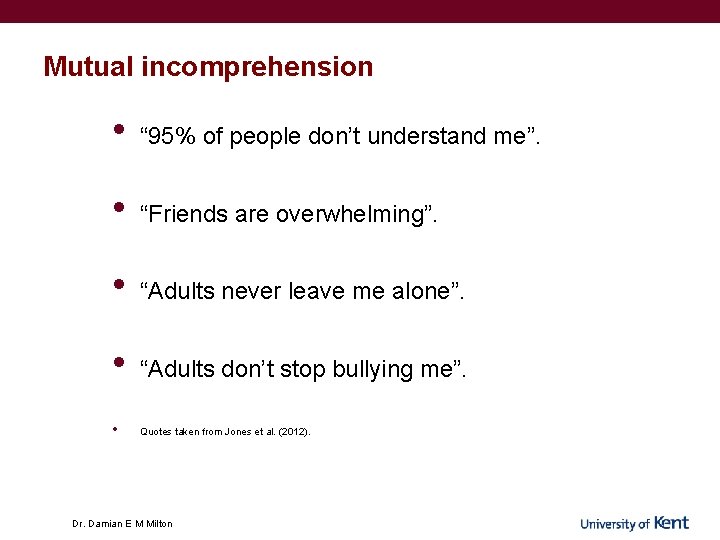
Mutual incomprehension • “ 95% of people don’t understand me”. • “Friends are overwhelming”. • “Adults never leave me alone”. • “Adults don’t stop bullying me”. • Quotes taken from Jones et al. (2012). Dr. Damian E M Milton
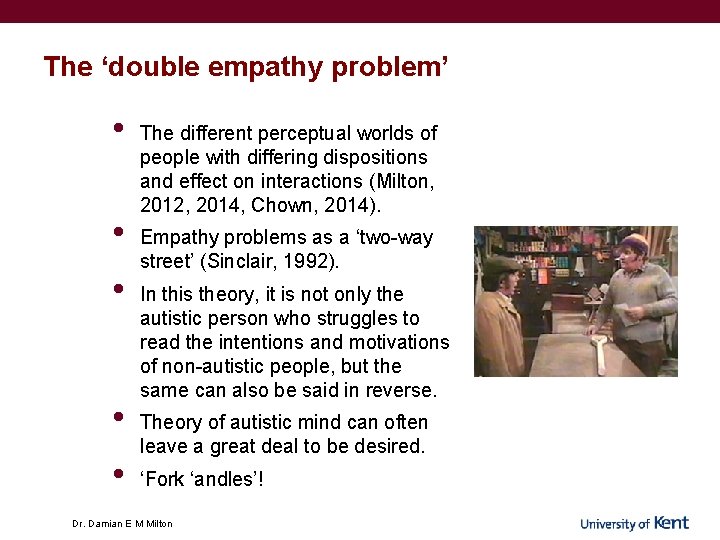
The ‘double empathy problem’ • • • The different perceptual worlds of people with differing dispositions and effect on interactions (Milton, 2012, 2014, Chown, 2014). Empathy problems as a ‘two-way street’ (Sinclair, 1992). In this theory, it is not only the autistic person who struggles to read the intentions and motivations of non-autistic people, but the same can also be said in reverse. Theory of autistic mind can often leave a great deal to be desired. ‘Fork ‘andles’! Dr. Damian E M Milton
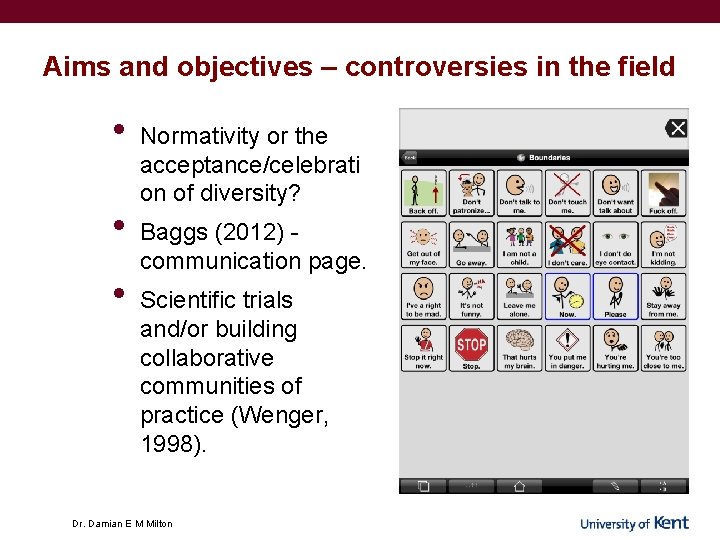
Aims and objectives – controversies in the field • • • Normativity or the acceptance/celebrati on of diversity? Baggs (2012) communication page. Scientific trials and/or building collaborative communities of practice (Wenger, 1998). Dr. Damian E M Milton
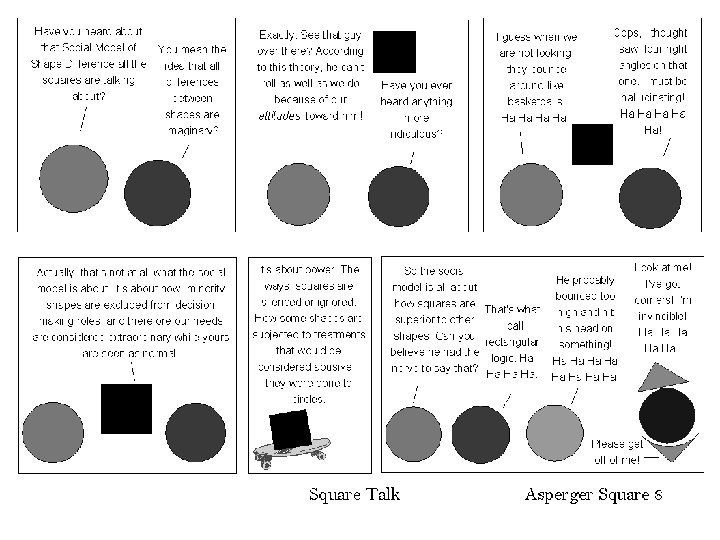
Dr. Damian E M Milton
The autistic voice • “. . . right from the start, from the time someone came up with the word ‘autism’, the condition has been judged from the outside, by its appearances, and not from the inside according to how it is experienced. ” (Williams, 1996: 14). Dr. Damian E M Milton
The concept of neurodiversity • • Variations in neurological development as part of natural diversity, rather than something to be pathologised using a purely medical model of disability, defined by one’s deviation from statistical or idealised norms of embodiment or observed behaviour. This is not to say that those who identify as autistic people or other forms of neuro-identity do not find life challenging. Autistic people are significantly disadvantaged in many aspects of life. Dr. Damian E M Milton
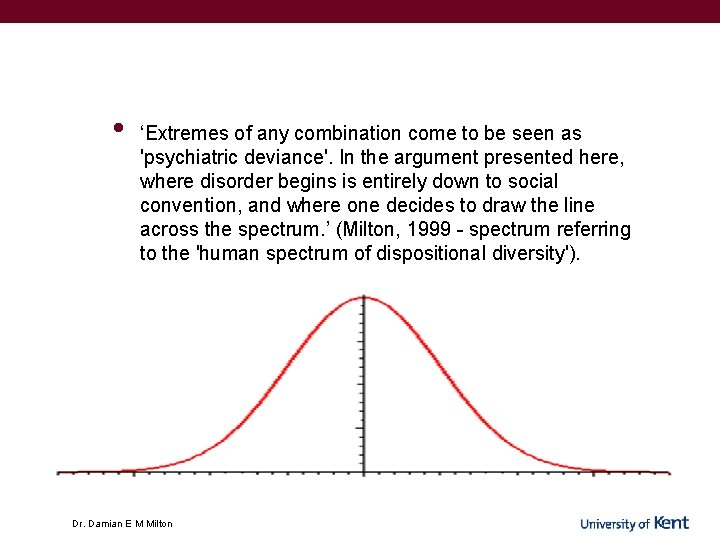
• ‘Extremes of any combination come to be seen as 'psychiatric deviance'. In the argument presented here, where disorder begins is entirely down to social convention, and where one decides to draw the line across the spectrum. ’ (Milton, 1999 - spectrum referring to the 'human spectrum of dispositional diversity'). Dr. Damian E M Milton
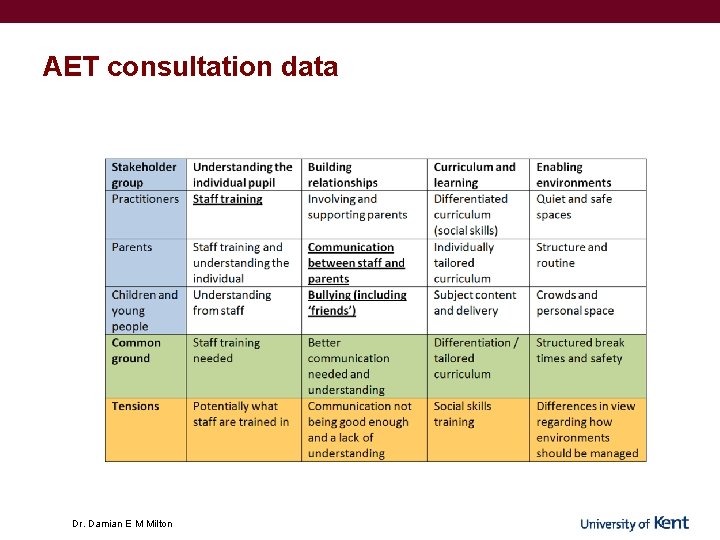
AET consultation data Dr. Damian E M Milton
Stakeholder perceptions • • Findings from Ph. D research. Significant tensions over a number of issues: Celebrating the diversity of learners and not trying to ‘normalise’ them. Radical change in society. Pupil-led vs. teacher-led activities. Social skills training and the appropriateness of behaviour. The ‘three-way dispositional problem’! Dr. Damian E M Milton
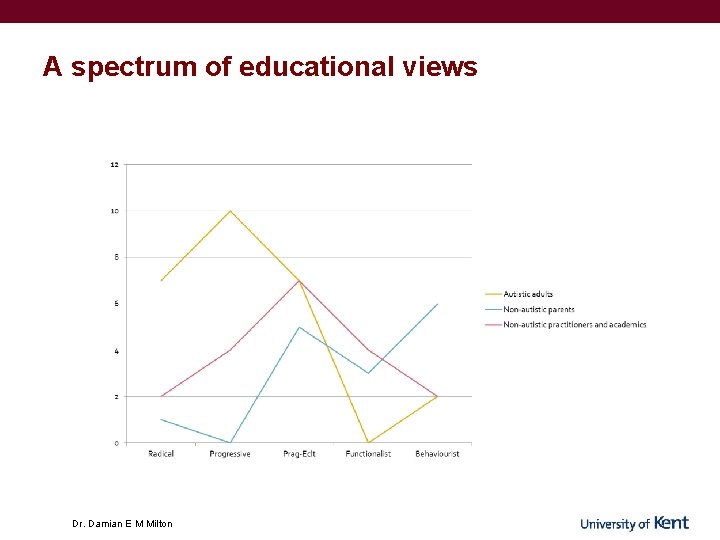
A spectrum of educational views Dr. Damian E M Milton
Common ground? • • Not a great deal! Against extreme normalisation? Enabling environments? Building relationships, communication and mutual understanding. Dr. Damian E M Milton
A better way forward • • Understanding of differing dispositions, a building of relationships in a respectful manner, engaging with an individual’s abilities and interests and not just what they find difficult. Is this not how many people, whatever their disposition would like to be treated within educational settings? Dr. Damian E M Milton
• • Consensus in this field is about as likely as having a sustained political consensus between all political interest groups. The reason such a consensus is not possible, is because the debates are largely theoretical and ideological. Thus, there will not be any agreement regarding how to measure progress, or even if one can. The most important message here for parents and practitioners working with autistic children, is that there are no easy answers! Dr. Damian E M Milton
Concluding remarks • • • What is a parent or practitioner working with autistic children to do? The answer to this befuddling question is never an easy one. Due to the diversity of dispositions and learning styles of people on the autism spectrum, asking “what works? ” in an educational setting, is like asking the same question about people who are not autistic. Dr. Damian E M Milton
• • • Thus, the common sense answer is: it depends on the child, what you are trying to teach and why, and the environment one is in. One thing that does not work though, speaking as an autistic person, is trying to ‘cure’ someone of being autistic. How about asking autistic people? Dr. Damian E M Milton
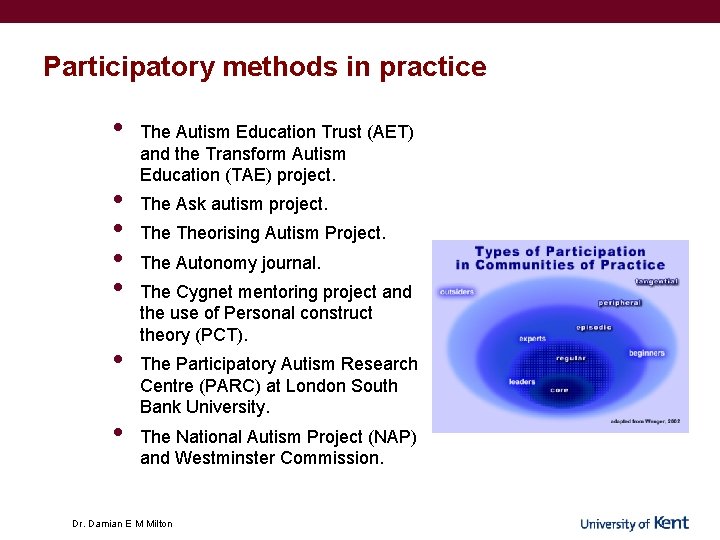
Participatory methods in practice • • The Autism Education Trust (AET) and the Transform Autism Education (TAE) project. The Ask autism project. Theorising Autism Project. The Autonomy journal. The Cygnet mentoring project and the use of Personal construct theory (PCT). The Participatory Autism Research Centre (PARC) at London South Bank University. The National Autism Project (NAP) and Westminster Commission. Dr. Damian E M Milton
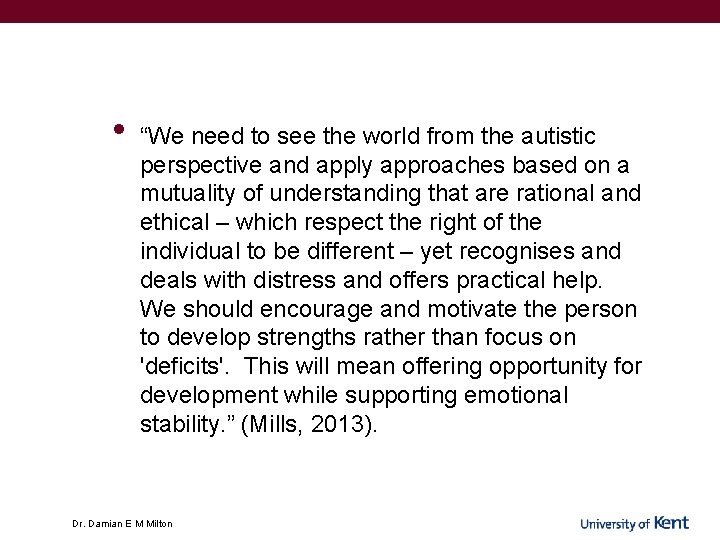
• “We need to see the world from the autistic perspective and apply approaches based on a mutuality of understanding that are rational and ethical – which respect the right of the individual to be different – yet recognises and deals with distress and offers practical help. We should encourage and motivate the person to develop strengths rather than focus on 'deficits'. This will mean offering opportunity for development while supporting emotional stability. ” (Mills, 2013). Dr. Damian E M Milton
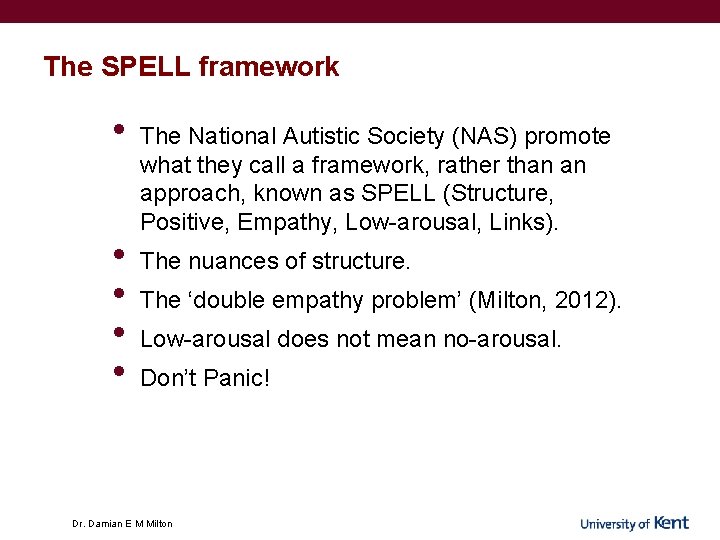
The SPELL framework • • • The National Autistic Society (NAS) promote what they call a framework, rather than an approach, known as SPELL (Structure, Positive, Empathy, Low-arousal, Links). The nuances of structure. The ‘double empathy problem’ (Milton, 2012). Low-arousal does not mean no-arousal. Don’t Panic! Dr. Damian E M Milton
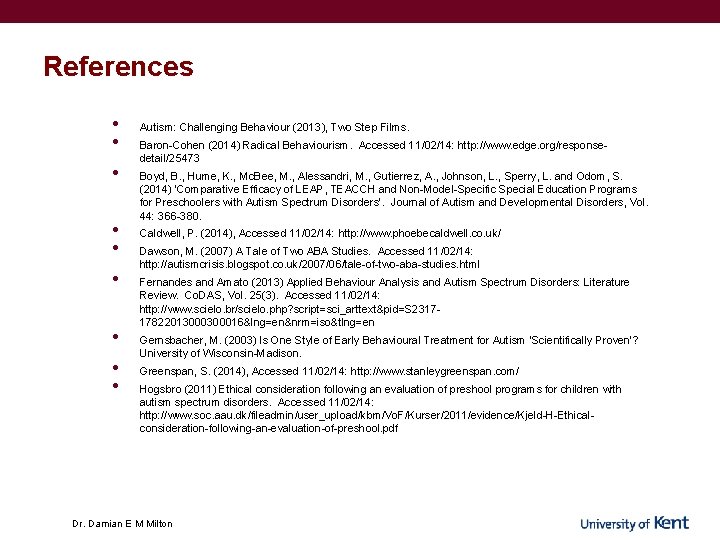
References • • • Autism: Challenging Behaviour (2013), Two Step Films. Baron-Cohen (2014) Radical Behaviourism. Accessed 11/02/14: http: //www. edge. org/responsedetail/25473 Boyd, B. , Hume, K. , Mc. Bee, M. , Alessandri, M. , Gutierrez, A. , Johnson, L. , Sperry, L. and Odom, S. (2014) ‘Comparative Efficacy of LEAP, TEACCH and Non-Model-Specific Special Education Programs for Preschoolers with Autism Spectrum Disorders’. Journal of Autism and Developmental Disorders, Vol. 44: 366 -380. Caldwell, P. (2014), Accessed 11/02/14: http: //www. phoebecaldwell. co. uk/ Dawson, M. (2007) A Tale of Two ABA Studies. Accessed 11/02/14: http: //autismcrisis. blogspot. co. uk/2007/06/tale-of-two-aba-studies. html Fernandes and Amato (2013) Applied Behaviour Analysis and Autism Spectrum Disorders: Literature Review. Co. DAS, Vol. 25(3). Accessed 11/02/14: http: //www. scielo. br/scielo. php? script=sci_arttext&pid=S 23171782201300016&lng=en&nrm=iso&tlng=en Gernsbacher, M. (2003) Is One Style of Early Behavioural Treatment for Autism ‘Scientifically Proven’? University of Wisconsin-Madison. Greenspan, S. (2014), Accessed 11/02/14: http: //www. stanleygreenspan. com/ Hogsbro (2011) Ethical consideration following an evaluation of preshool programs for children with autism spectrum disorders. Accessed 11/02/14: http: //www. soc. aau. dk/fileadmin/user_upload/kbm/Vo. F/Kurser/2011/evidence/Kjeld-H-Ethicalconsideration-following-an-evaluation-of-preshool. pdf Dr. Damian E M Milton
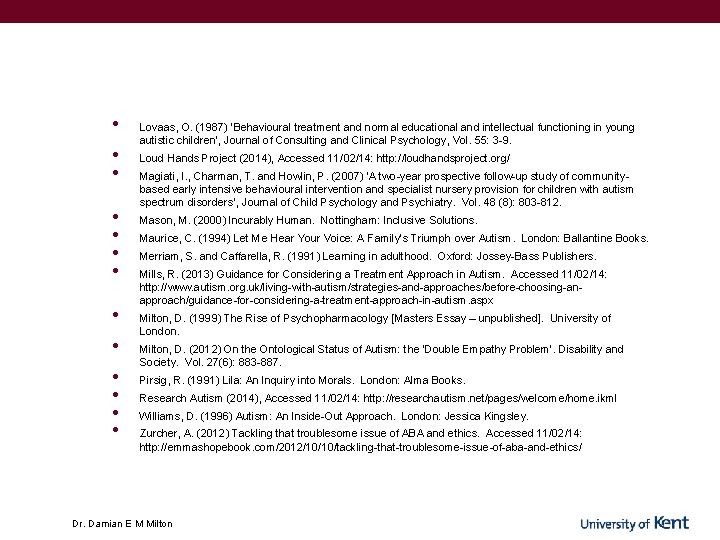
• • • • Lovaas, O. (1987) ‘Behavioural treatment and normal educational and intellectual functioning in young autistic children’, Journal of Consulting and Clinical Psychology, Vol. 55: 3 -9. Loud Hands Project (2014), Accessed 11/02/14: http: //loudhandsproject. org/ Magiati, I. , Charman, T. and Howlin, P. (2007) ‘A two-year prospective follow-up study of communitybased early intensive behavioural intervention and specialist nursery provision for children with autism spectrum disorders’, Journal of Child Psychology and Psychiatry. Vol. 48 (8): 803 -812. Mason, M. (2000) Incurably Human. Nottingham: Inclusive Solutions. Maurice, C. (1994) Let Me Hear Your Voice: A Family’s Triumph over Autism. London: Ballantine Books. Merriam, S. and Caffarella, R. (1991) Learning in adulthood. Oxford: Jossey-Bass Publishers. Mills, R. (2013) Guidance for Considering a Treatment Approach in Autism. Accessed 11/02/14: http: //www. autism. org. uk/living-with-autism/strategies-and-approaches/before-choosing-anapproach/guidance-for-considering-a-treatment-approach-in-autism. aspx Milton, D. (1999) The Rise of Psychopharmacology [Masters Essay – unpublished]. University of London. Milton, D. (2012) On the Ontological Status of Autism: the ‘Double Empathy Problem’. Disability and Society. Vol. 27(6): 883 -887. Pirsig, R. (1991) Lila: An Inquiry into Morals. London: Alma Books. Research Autism (2014), Accessed 11/02/14: http: //researchautism. net/pages/welcome/home. ikml Williams, D. (1996) Autism: An Inside-Out Approach. London: Jessica Kingsley. Zurcher, A. (2012) Tackling that troublesome issue of ABA and ethics. Accessed 11/02/14: http: //emmashopebook. com/2012/10/10/tackling-that-troublesome-issue-of-aba-and-ethics/ Dr. Damian E M Milton
THE UK’S EUROPEAN UNIVERSITY www. kent. ac. uk