
The UK publics views on the dog overpopulation

The UK public's views on the dog overpopulation problem and people's willingness to pay for a humane management Christina Siettou, University of Kent This study is funded by the School of Economics (Prof. A. Carruth, Prof. I. Fraser and Prof. R. Fraser) 2 nd International Dog Population Management Conference
Background Each year Local Authorities are expected to deal with over 100, 000 stray dogs. In 2013 more than 111, 000 dogs were handled across the UK (Dogs Trust, 2013). Once these dogs are apprehended, they enter into contracted holding kennels for their statutory seven day period. These dogs fate is threefold: -some dogs are reconnected with their owners, -some are adopted out or transferred to private animal welfare organizations -and the rest are put to sleep.
Background The estimated total number of dogs that were put to sleep by all Local Authorities across the UK, in 2012, was approximately 8, 903 dogs (Dogs Trust, 2012). Of these, 5, 337 dogs were put to sleep without an official reason reported with a high chance of them all being healthy adoptable pets. Houpt et al. (2007) reported that about 20, 000 dogs are put to sleep by animal welfare organizations in the UK on an annual basis.
Material and Methods An online survey was conducted with 500 individuals – a representative UK sample. Quota was on gender, age and dog ownership. The Choice Experiment Method analysed through the econometric model of the Multinomial Logit was employed to elicit people's willingness to pay to prolong the current seven day statutory period. Two payment methods were investigated : -Voluntary Contribution -Mandatory Council Tax charge
Material and Methods A Choice Experiment is a stated preference technique based on the combination of Lancaster’s theory of consumer demand random utility theory (Hanley et al. , 1998). According to Lancaster (1966) the utility gained from a good can be described as the utility derived from the bundle of its characteristics. Each bundle will yield a different level of utility. Given consumers are assumed rational each will choose the set of characteristics that maximizes their utility.
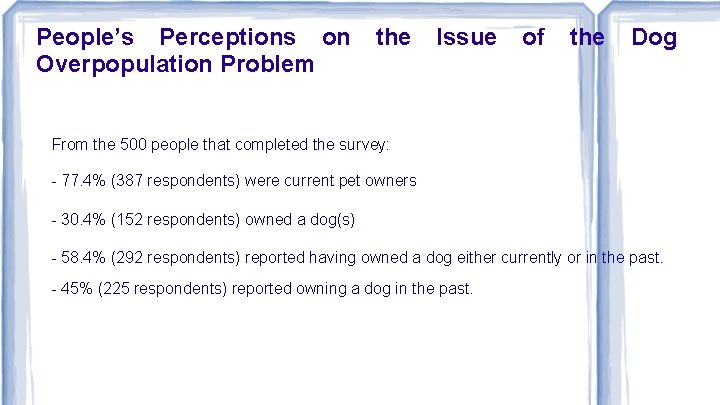
People’s Perceptions on Overpopulation Problem the Issue of the Dog From the 500 people that completed the survey: - 77. 4% (387 respondents) were current pet owners - 30. 4% (152 respondents) owned a dog(s) - 58. 4% (292 respondents) reported having owned a dog either currently or in the past. - 45% (225 respondents) reported owning a dog in the past.
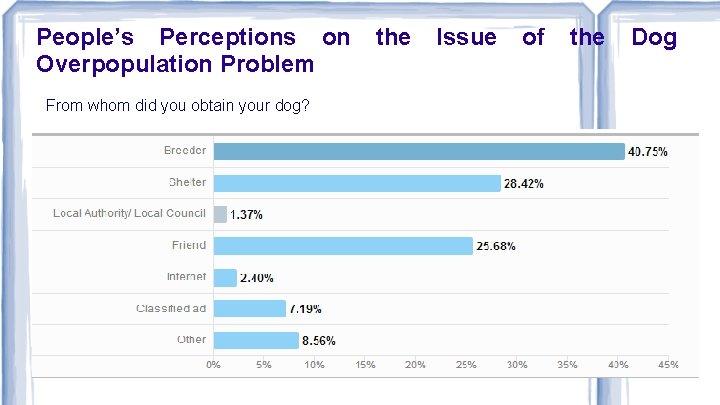
People’s Perceptions on Overpopulation Problem From whom did you obtain your dog? the Issue of the Dog

People’s Perceptions on Overpopulation Problem Were you aware that healthy dogs that are not re-homed are being put to sleep? the Issue of the Dog At least 7000 dogs are put down each year in the UK. Do you think this number is of:
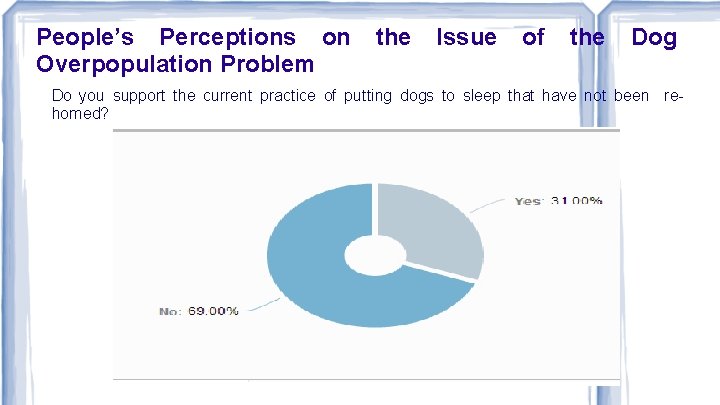
People’s Perceptions on Overpopulation Problem the Issue of the Dog Do you support the current practice of putting dogs to sleep that have not been rehomed?
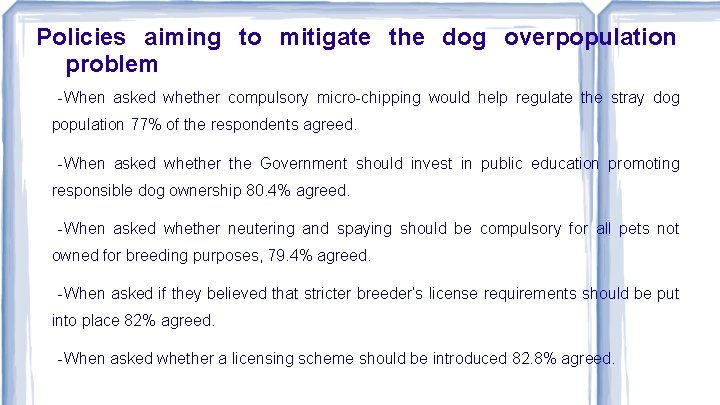
Policies aiming to mitigate the dog overpopulation problem -When asked whether compulsory micro-chipping would help regulate the stray dog population 77% of the respondents agreed. -When asked whether the Government should invest in public education promoting responsible dog ownership 80. 4% agreed. -When asked whether neutering and spaying should be compulsory for all pets not owned for breeding purposes, 79. 4% agreed. -When asked if they believed that stricter breeder’s license requirements should be put into place 82% agreed. -When asked whether a licensing scheme should be introduced 82. 8% agreed.
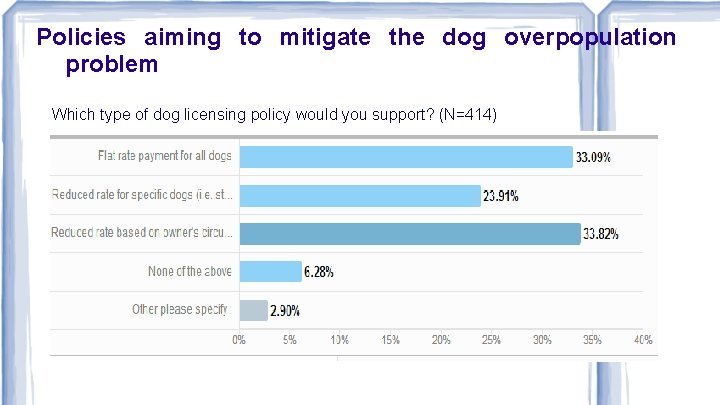
Policies aiming to mitigate the dog overpopulation problem Which type of dog licensing policy would you support? (N=414)
People's willingness to pay to prolong the 7 day statutory period The hypothetical scenario: To reduce the number of healthy adoptable dogs that are being put to sleep each year, Local Authorities would need to raise the necessary funds for their upkeep. These funds would be asked to be contributed by you (the public). You would be, hypothetically, asked to make a payment on a monthly basis that would be used to prolong the kennel stay of a stray dog of your choice. The dog would remain in the kennels until it is rehomed and there would be no other commitment in terms of time, etc. required from your end. In the case of the supported dog being subsequently adopted, the payment would be transferred to another dog of your choice.
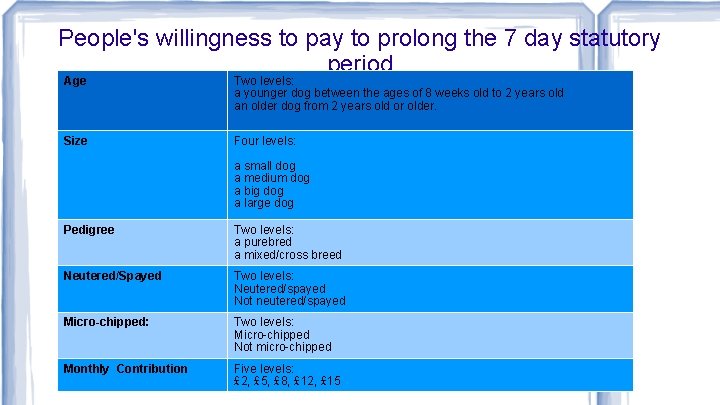
People's willingness to pay to prolong the 7 day statutory period Age Two levels: a younger dog between the ages of 8 weeks old to 2 years old an older dog from 2 years old or older. Size Four levels: a small dog a medium dog a big dog a large dog Pedigree Two levels: a purebred a mixed/cross breed Neutered/Spayed Two levels: Neutered/spayed Not neutered/spayed Micro-chipped: Two levels: Micro-chipped Not micro-chipped Monthly Contribution Five levels: £ 2, £ 5, £ 8, £ 12, £ 15
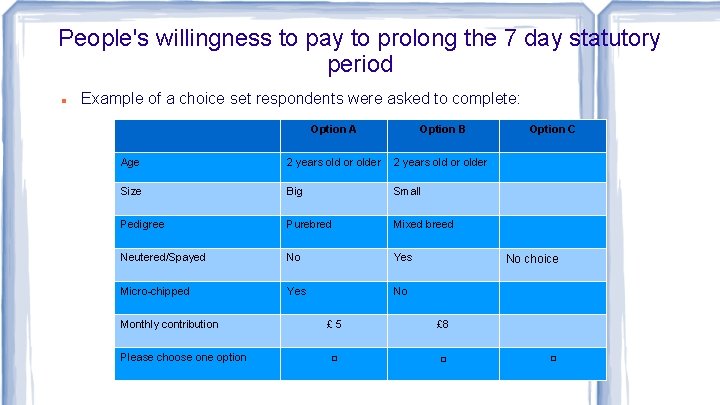
People's willingness to pay to prolong the 7 day statutory period Example of a choice set respondents were asked to complete: Option A Option B Age 2 years old or older Size Big Small Pedigree Purebred Mixed breed Neutered/Spayed No Yes Micro-chipped Yes No Monthly contribution Please choose one option Option C No choice £ 5 £ 8 □ □ □
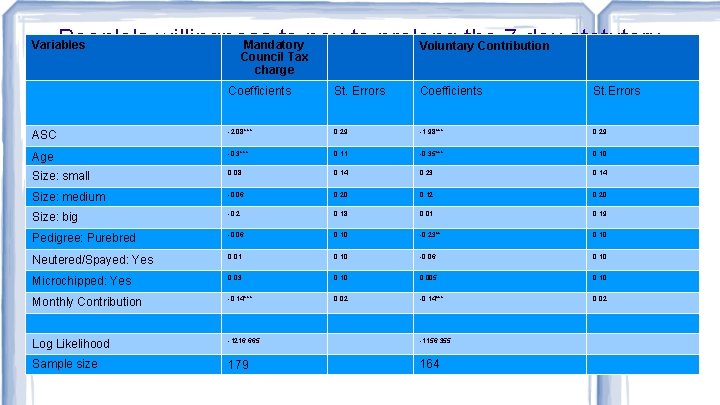
People's willingness to pay to prolong the 7 day statutory Mandatory Voluntary Contribution Council Tax period charge Variables Coefficients St. Errors ASC -2. 08*** 0. 29 -1. 98*** 0. 29 Age -0. 3*** 0. 11 -0. 35*** 0. 10 Size: small 0. 08 0. 14 0. 23 0. 14 Size: medium -0. 06 0. 20 0. 12 0. 20 Size: big -0. 2 0. 18 0. 01 0. 19 Pedigree: Purebred -0. 06 0. 10 -0. 23** 0. 10 Neutered/Spayed: Yes 0. 01 0. 10 -0. 06 0. 10 Microchipped: Yes 0. 03 0. 10 0. 005 0. 10 Monthly Contribution -0. 14*** 0. 02 Log Likelihood -1216. 665 -1156. 355 Sample size 179 164
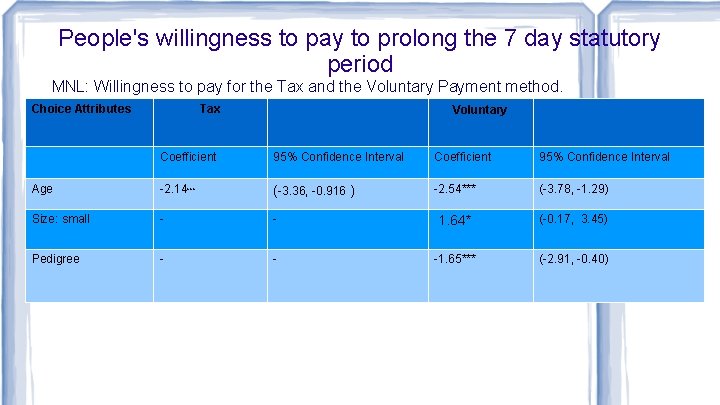
People's willingness to pay to prolong the 7 day statutory period MNL: Willingness to pay for the Tax and the Voluntary Payment method. Choice Attributes Tax Voluntary Coefficient 95% Confidence Interval Age -2. 14*** (-3. 36, -0. 916 ) -2. 54*** (-3. 78, -1. 29) Size: small - - 1. 64* (-0. 17, 3. 45) Pedigree - - -1. 65*** (-2. 91, -0. 40)
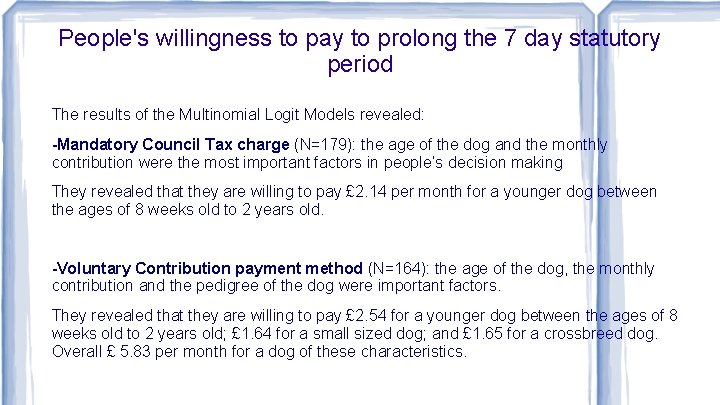
People's willingness to pay to prolong the 7 day statutory period The results of the Multinomial Logit Models revealed: -Mandatory Council Tax charge (N=179): the age of the dog and the monthly contribution were the most important factors in people’s decision making They revealed that they are willing to pay £ 2. 14 per month for a younger dog between the ages of 8 weeks old to 2 years old. -Voluntary Contribution payment method (N=164): the age of the dog, the monthly contribution and the pedigree of the dog were important factors. They revealed that they are willing to pay £ 2. 54 for a younger dog between the ages of 8 weeks old to 2 years old; £ 1. 64 for a small sized dog; and £ 1. 65 for a crossbreed dog. Overall £ 5. 83 per month for a dog of these characteristics.
Conclusions This study reveals that the UK public is concerned about the pet dog overpopulation problem. The general findings reveal that policies for mitigating the pet dog overpopulation problem would be supported by the UK public. Additionally, people would be willing to pay on a monthly basis, both under a Voluntary Contribution regime (£ 5. 83 per month) and under a Mandatory Council Tax charge (£ 2. 14) in order to prolong the 7 day statutory period.
- Slides: 18