
The UK Prospective Diabetes Study ukpds UK Prospective
The UK Prospective Diabetes Study ukpds
UK Prospective Diabetes Study multi-centre randomised controlled trial of different therapies of Type 2 diabetes ukpds
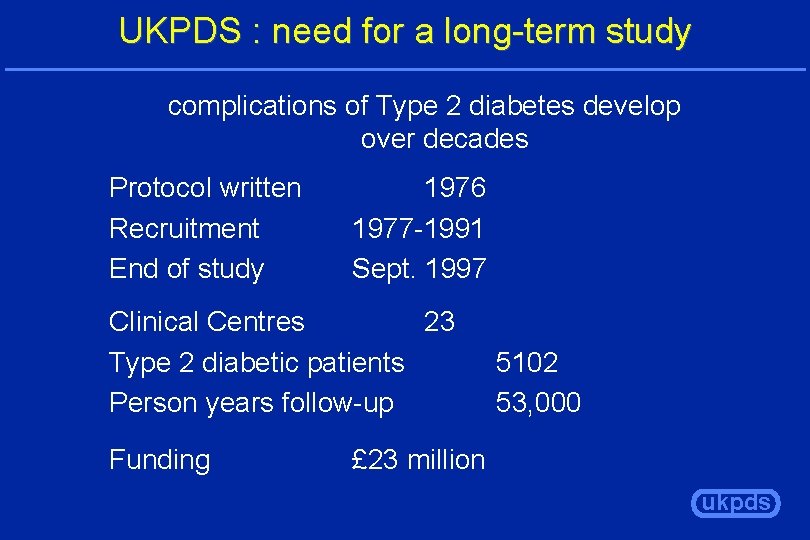
UKPDS : need for a long-term study complications of Type 2 diabetes develop over decades Protocol written Recruitment End of study 1976 1977 -1991 Sept. 1997 Clinical Centres 23 Type 2 diabetic patients Person years follow-up Funding 5102 53, 000 £ 23 million ukpds
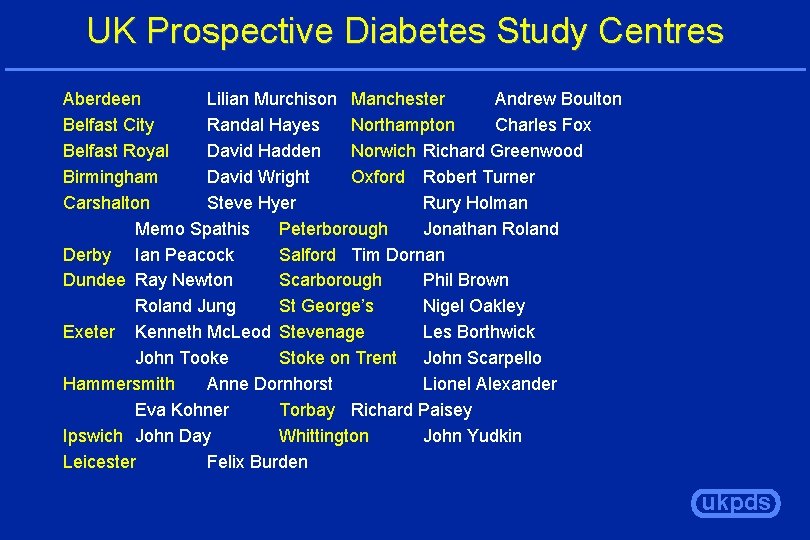
UK Prospective Diabetes Study Centres Aberdeen Lilian Murchison Manchester Andrew Boulton Belfast City Randal Hayes Northampton Charles Fox Belfast Royal David Hadden Norwich Richard Greenwood Birmingham David Wright Oxford Robert Turner Carshalton Steve Hyer Rury Holman Memo Spathis Peterborough Jonathan Roland Derby Ian Peacock Salford Tim Dornan Dundee Ray Newton Scarborough Phil Brown Roland Jung St George’s Nigel Oakley Exeter Kenneth Mc. Leod Stevenage Les Borthwick John Tooke Stoke on Trent John Scarpello Hammersmith Anne Dornhorst Lionel Alexander Eva Kohner Torbay Richard Paisey Ipswich John Day Whittington John Yudkin Leicester Felix Burden ukpds

Co-ordinating Staff Chief Investigators : Robert Turner, Rury Holman Statisticians : Irene Stratton, Carole Cull Ziyah Mehta, Heather Mc. Elroy Modeller : Richard Stevens Epidemiologists : Andrew Neil, Amanda Adler Diabetologists : David Matthews, Valeria Frighi Biochemists : Susan Manley, Iain Ross Administrators : Philip Bassett, Suzy Oakes Retinopathy Grading Centre : Eva Kohner, Steve Aldington Health Economics : Alastair Gray, Maria Raikou Grant Applications : Ivy Samuel, Caroline Wood Computing Support : Ian Kennedy, John Veness And many others ukpds
Acknowledgements • • • patients physicians nurses dietitians retinal photographers • Retinopathy Grading : Hammersmith Hospital • Biochemistry : Diabetes Research Laboratories • ECG Grading : Guy’s Hospital ukpds
Major Funding Bodies UK Medical Research Council British Diabetic Association UK Department of Health USA National Institutes of Health (NEI, NIDDK) British Heart Foundation Wellcome Trust Novo Nordisk Bayer Bristol Myers Squibb Lipha Farmitalia Carlo Erba Lilly Hoechst ukpds
UK Prospective Diabetes Study Glucose Control Study ukpds
Blood Glucose Control Study : Aims to determine whether • improved glucose control of Type 2 diabetes will prevent clinical complications • therapy with sulphonylurea - first or second generation insulin metformin has any specific advantage or disadvantage ukpds
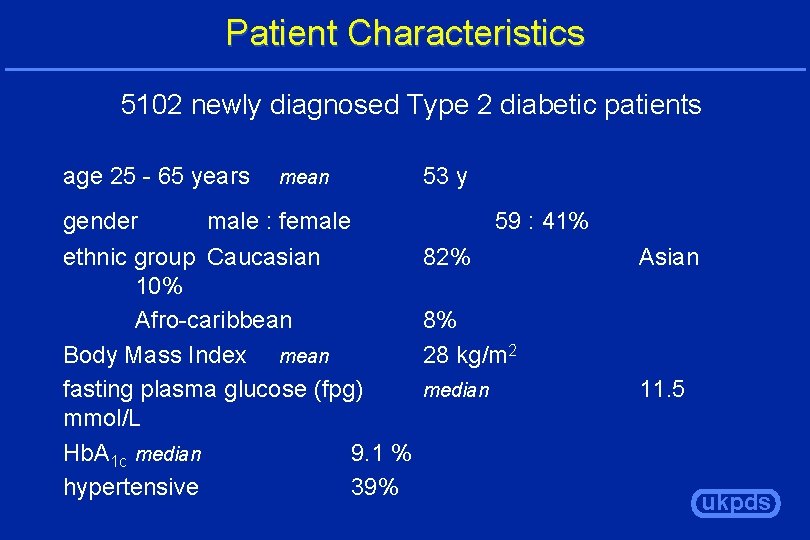
Patient Characteristics 5102 newly diagnosed Type 2 diabetic patients age 25 - 65 years gender mean 53 y male : female ethnic group Caucasian 10% Afro-caribbean Body Mass Index mean fasting plasma glucose (fpg) mmol/L Hb. A 1 c median 9. 1 % hypertensive 39% 59 : 41% 82% Asian 8% 28 kg/m 2 median 11. 5 ukpds
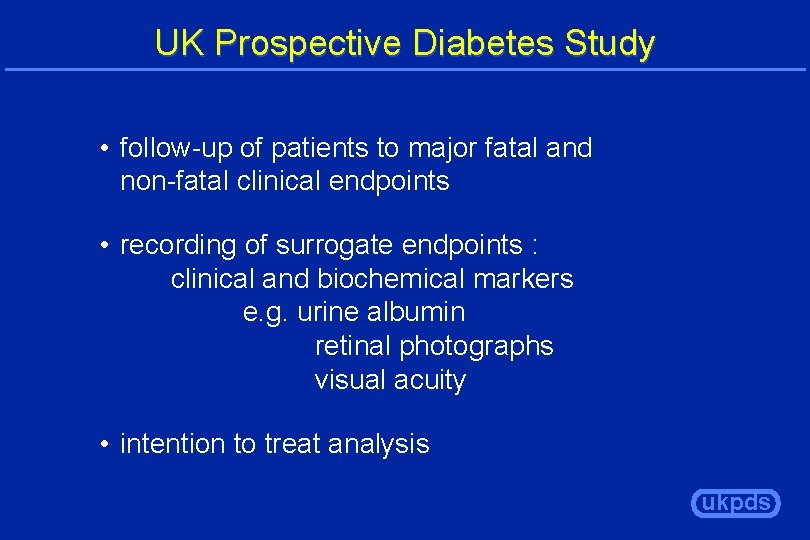
UK Prospective Diabetes Study • follow-up of patients to major fatal and non-fatal clinical endpoints • recording of surrogate endpoints : clinical and biochemical markers e. g. urine albumin retinal photographs visual acuity • intention to treat analysis ukpds
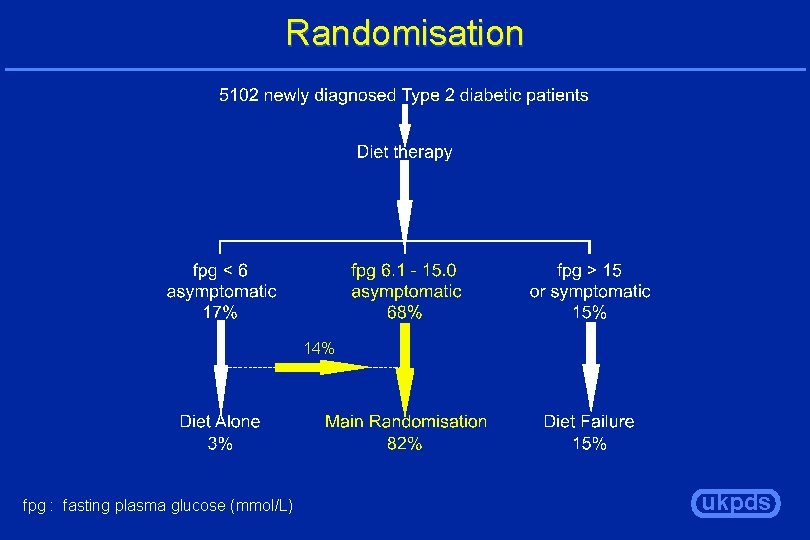
Randomisation 14% fpg : fasting plasma glucose (mmol/L) ukpds
UK Prospective Diabetes Study Does an intensive glucose control policy reduce the risk of complications of diabetes? ukpds
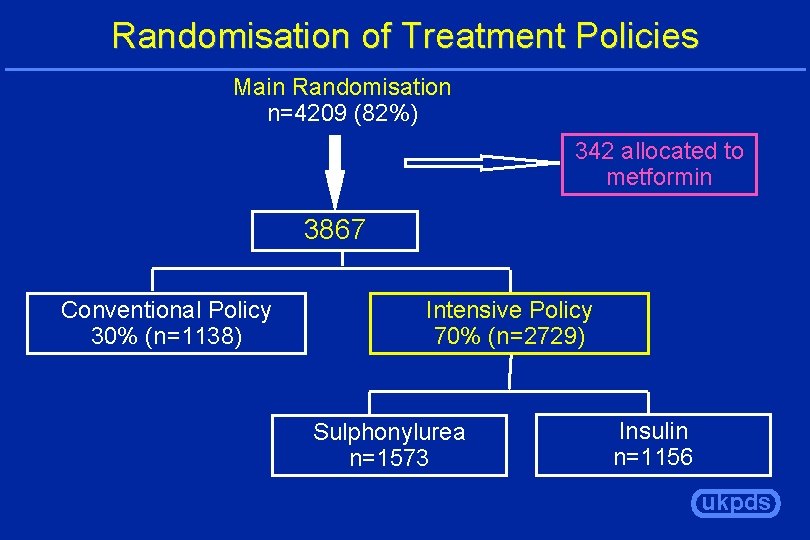
Randomisation of Treatment Policies Main Randomisation n=4209 (82%) 342 allocated to metformin 3867 Conventional Policy 30% (n=1138) Intensive Policy 70% (n=2729) Sulphonylurea n=1573 Insulin n=1156 ukpds
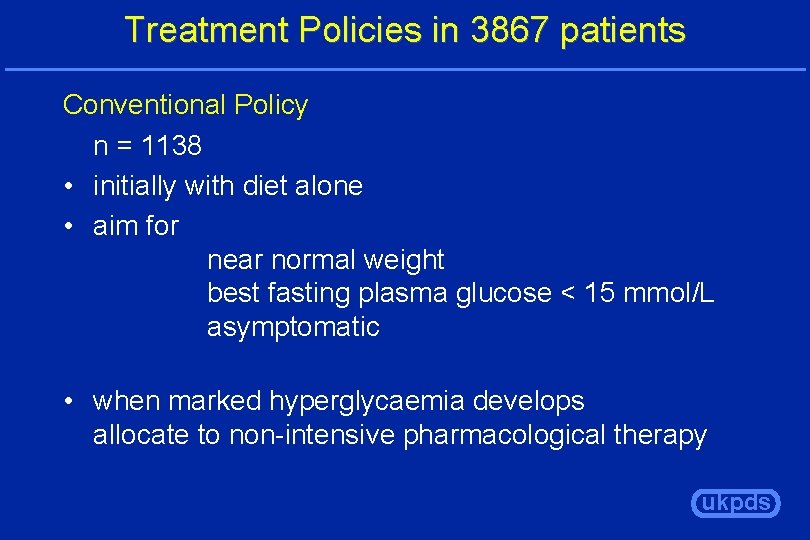
Treatment Policies in 3867 patients Conventional Policy n = 1138 • initially with diet alone • aim for near normal weight best fasting plasma glucose < 15 mmol/L asymptomatic • when marked hyperglycaemia develops allocate to non-intensive pharmacological therapy ukpds
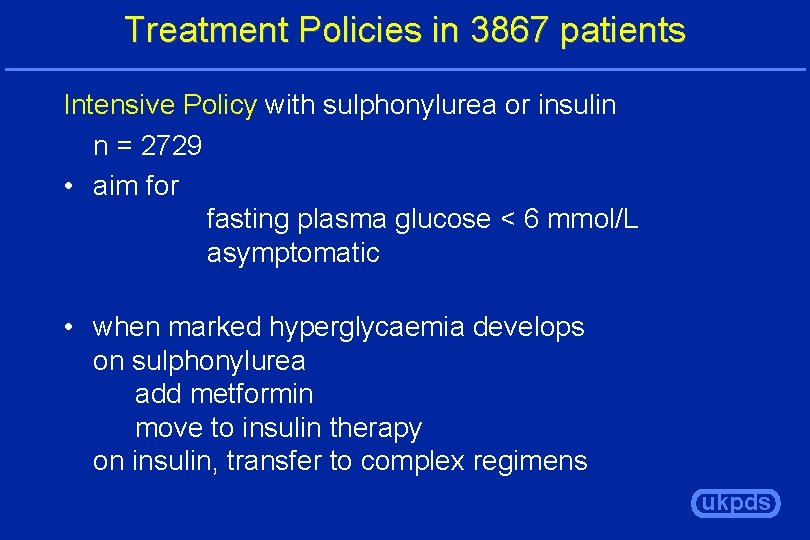
Treatment Policies in 3867 patients Intensive Policy with sulphonylurea or insulin n = 2729 • aim for fasting plasma glucose < 6 mmol/L asymptomatic • when marked hyperglycaemia develops on sulphonylurea add metformin move to insulin therapy on insulin, transfer to complex regimens ukpds
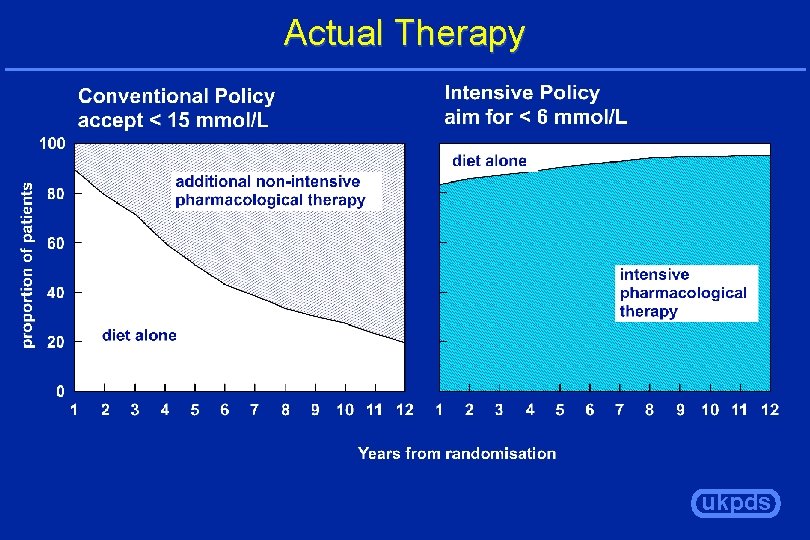
Actual Therapy ukpds
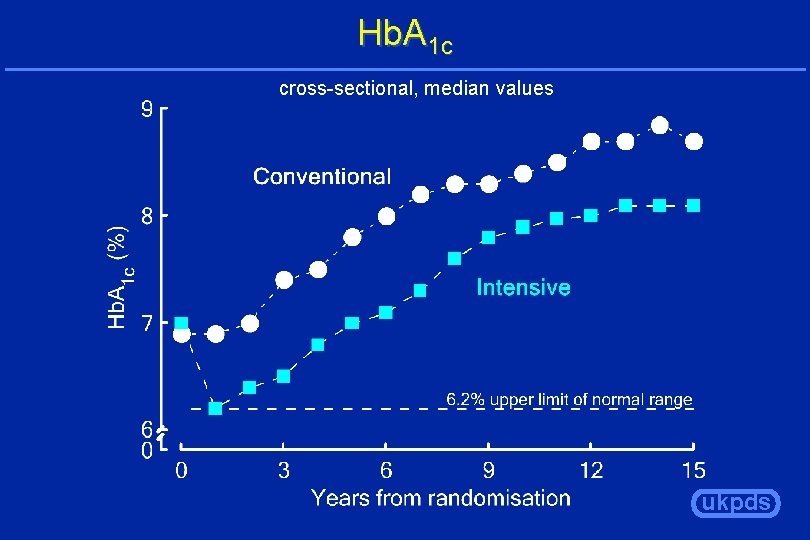
Hb. A 1 c cross-sectional, median values ukpds
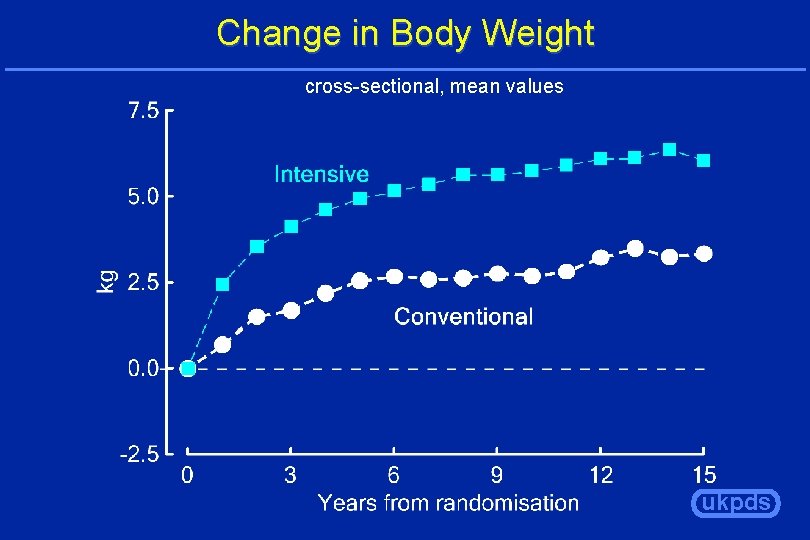
Change in Body Weight cross-sectional, mean values ukpds
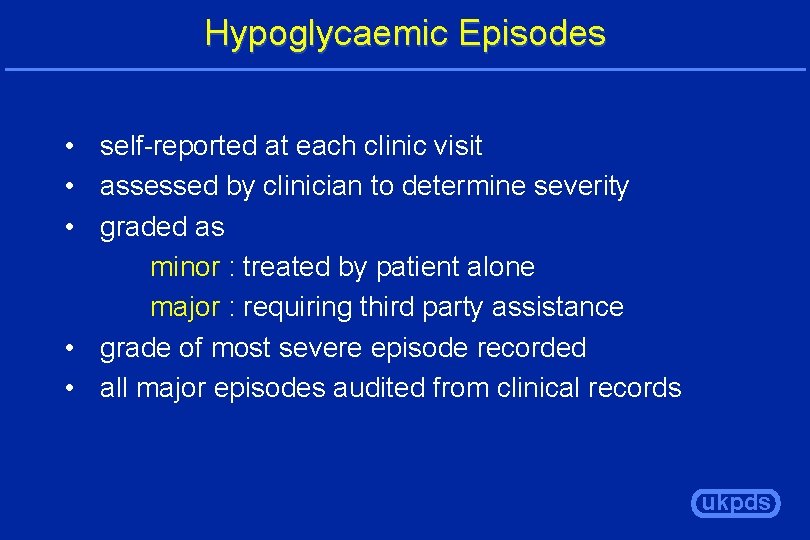
Hypoglycaemic Episodes • self-reported at each clinic visit • assessed by clinician to determine severity • graded as minor : treated by patient alone major : requiring third party assistance • grade of most severe episode recorded • all major episodes audited from clinical records ukpds
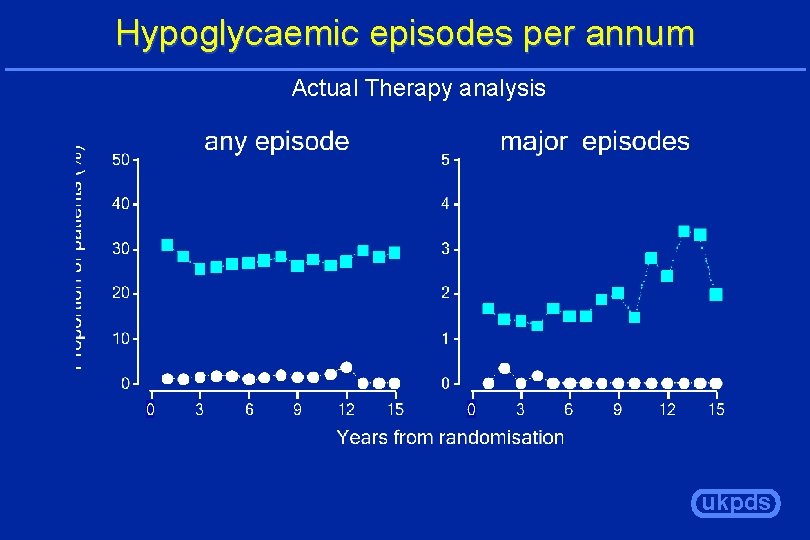
Hypoglycaemic episodes per annum Actual Therapy analysis ukpds
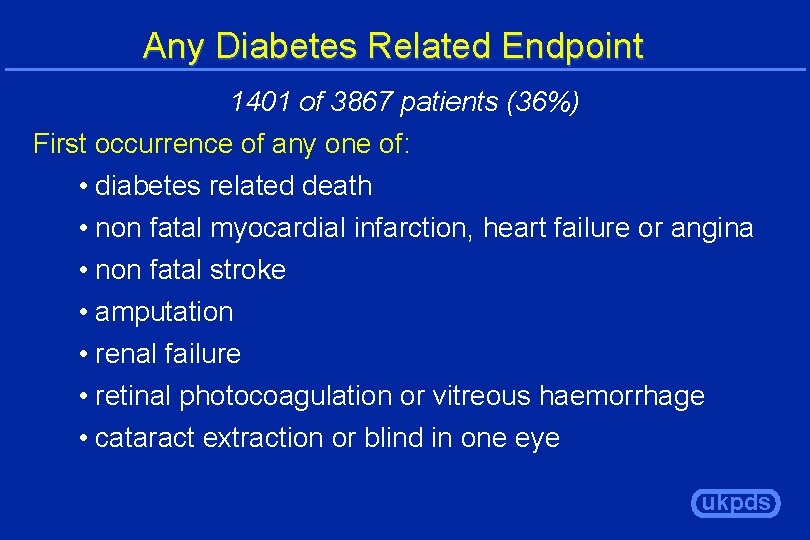
Any Diabetes Related Endpoint 1401 of 3867 patients (36%) First occurrence of any one of: • diabetes related death • non fatal myocardial infarction, heart failure or angina • non fatal stroke • amputation • renal failure • retinal photocoagulation or vitreous haemorrhage • cataract extraction or blind in one eye ukpds
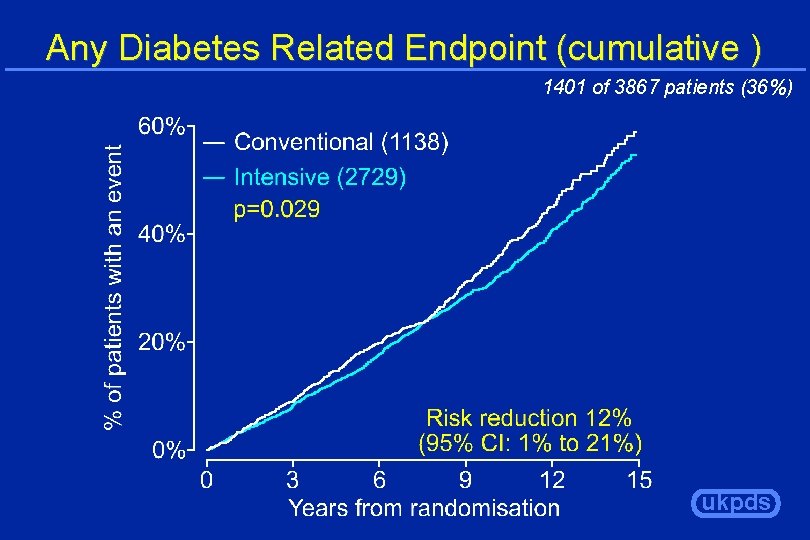
Any Diabetes Related Endpoint (cumulative ) 1401 of 3867 patients (36%) ukpds
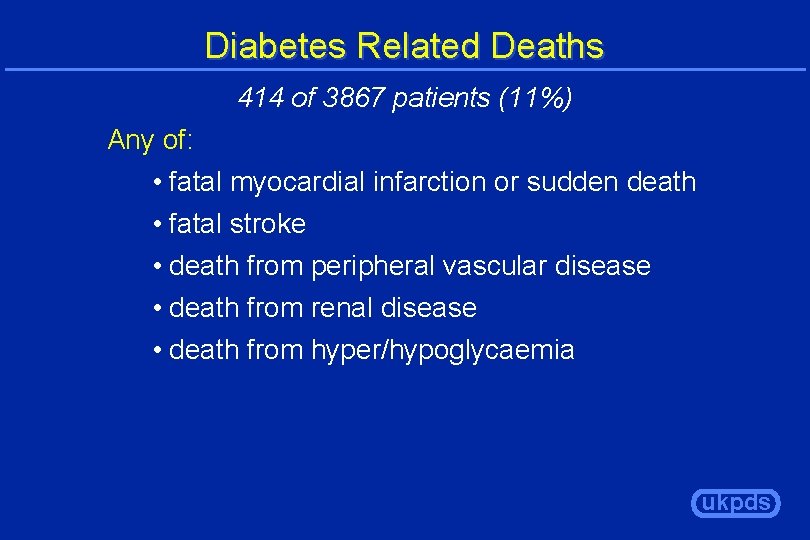
Diabetes Related Deaths 414 of 3867 patients (11%) Any of: • fatal myocardial infarction or sudden death • fatal stroke • death from peripheral vascular disease • death from renal disease • death from hyper/hypoglycaemia ukpds
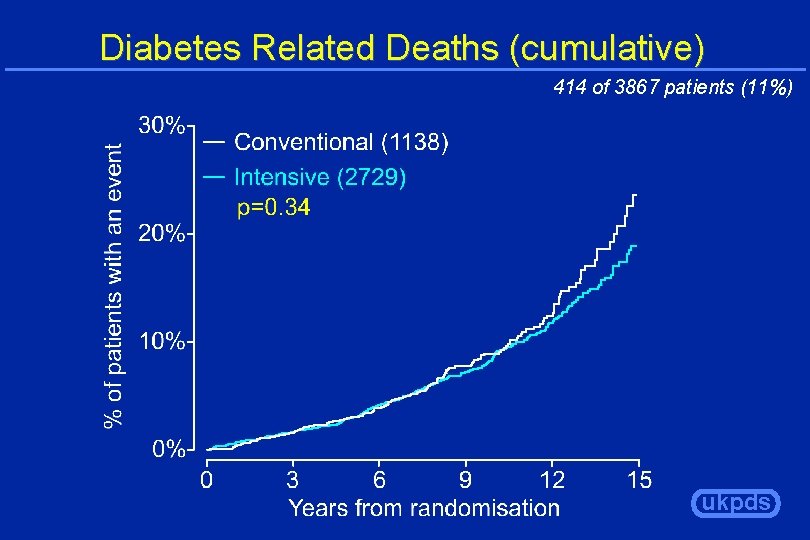
Diabetes Related Deaths (cumulative) 414 of 3867 patients (11%) ukpds
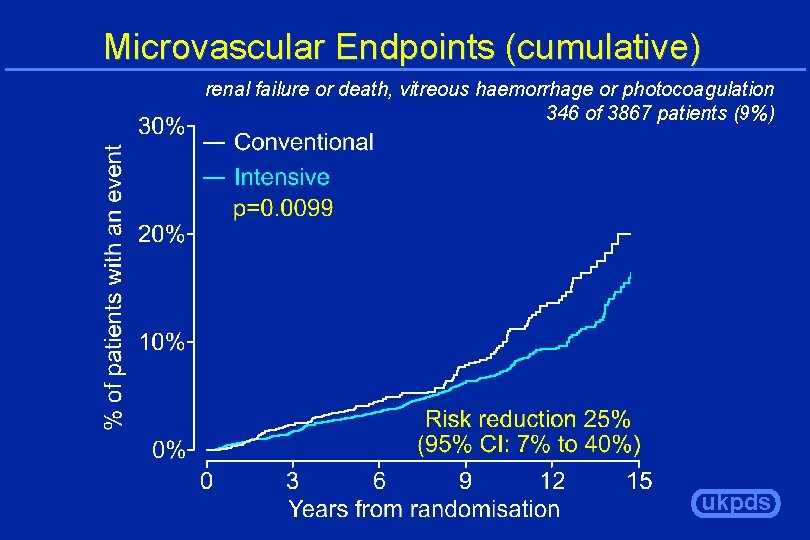
Microvascular Endpoints (cumulative) renal failure or death, vitreous haemorrhage or photocoagulation 346 of 3867 patients (9%) ukpds
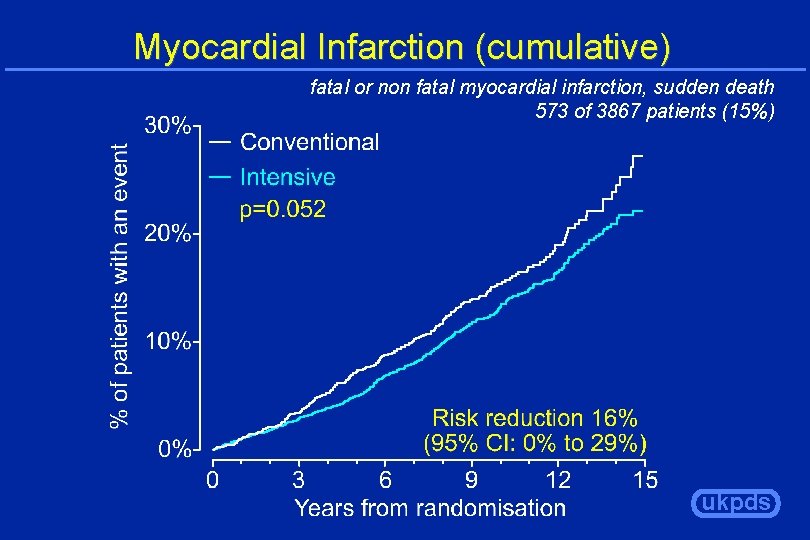
Myocardial Infarction (cumulative) fatal or non fatal myocardial infarction, sudden death 573 of 3867 patients (15%) ukpds
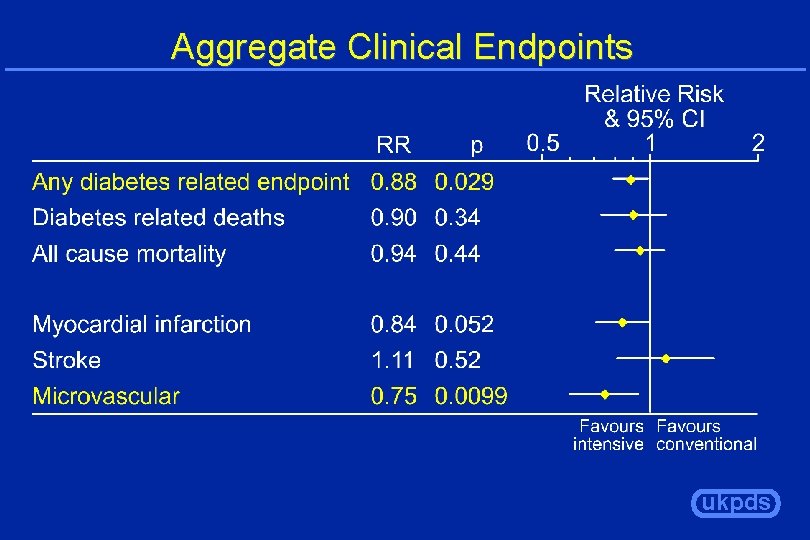
Aggregate Clinical Endpoints ukpds
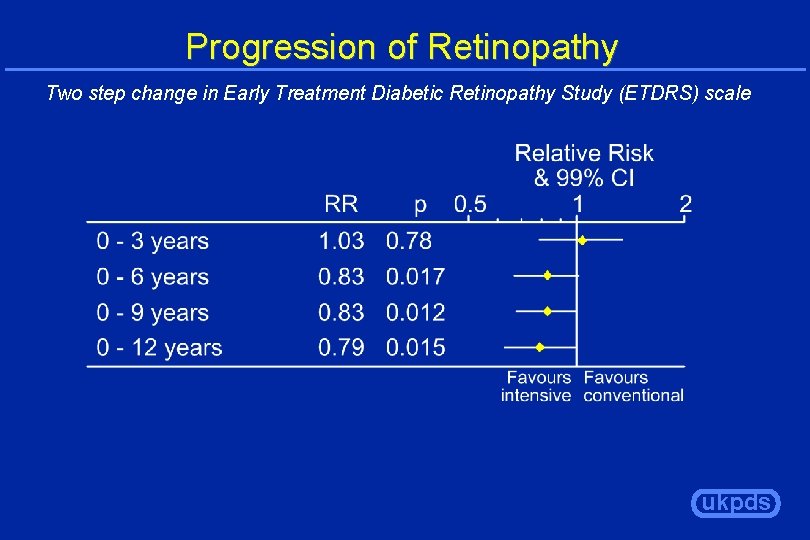
Progression of Retinopathy Two step change in Early Treatment Diabetic Retinopathy Study (ETDRS) scale ukpds
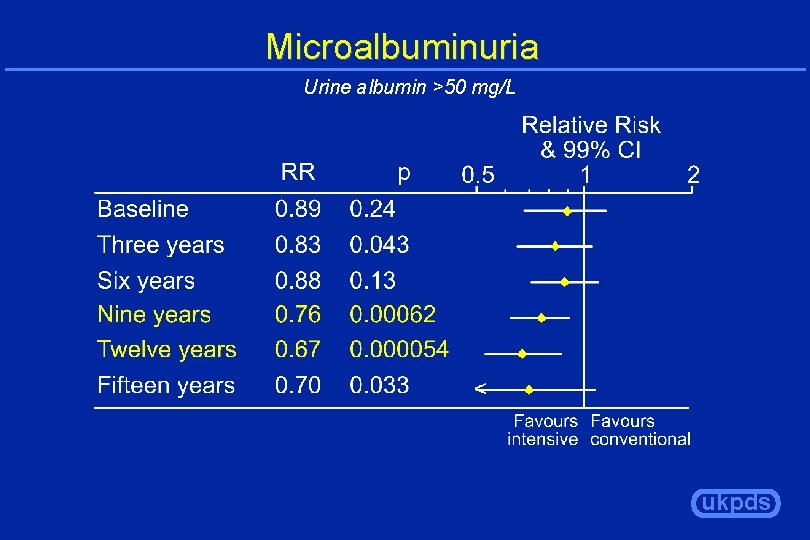
Microalbuminuria Urine albumin >50 mg/L ukpds
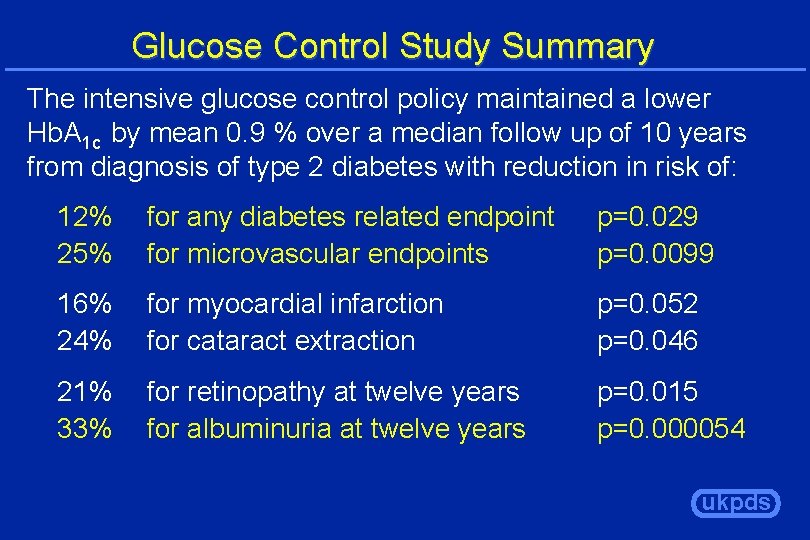
Glucose Control Study Summary The intensive glucose control policy maintained a lower Hb. A 1 c by mean 0. 9 % over a median follow up of 10 years from diagnosis of type 2 diabetes with reduction in risk of: 12% 25% for any diabetes related endpoint for microvascular endpoints p=0. 029 p=0. 0099 16% 24% for myocardial infarction for cataract extraction p=0. 052 p=0. 046 21% 33% for retinopathy at twelve years for albuminuria at twelve years p=0. 015 p=0. 000054 ukpds
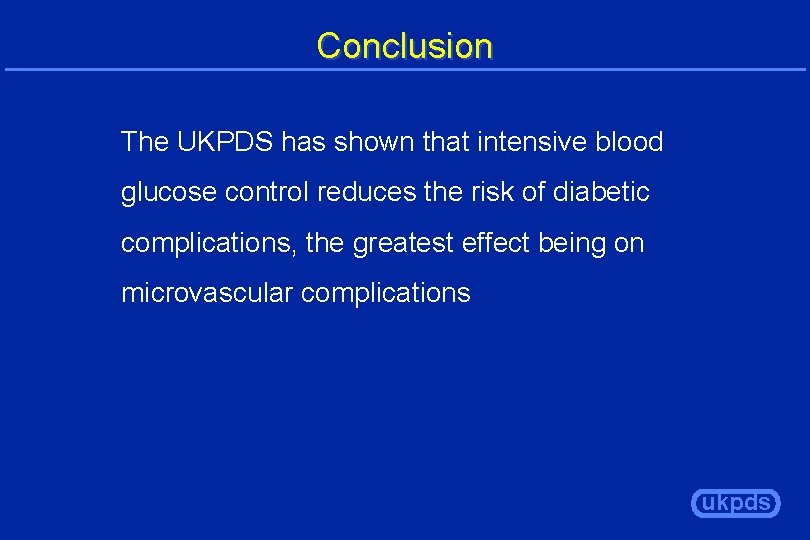
Conclusion The UKPDS has shown that intensive blood glucose control reduces the risk of diabetic complications, the greatest effect being on microvascular complications ukpds
UK Prospective Diabetes Study Does insulin or sulphonylurea therapy have specific advantages or disadvantages? ukpds
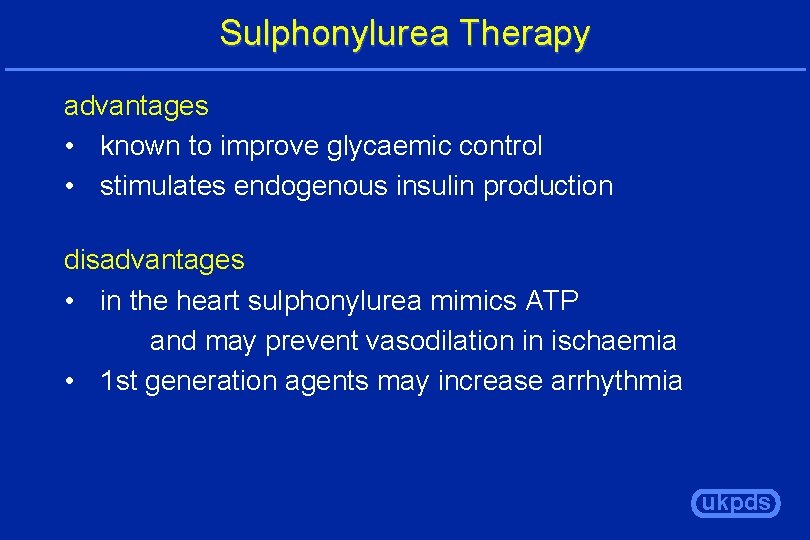
Sulphonylurea Therapy advantages • known to improve glycaemic control • stimulates endogenous insulin production disadvantages • in the heart sulphonylurea mimics ATP and may prevent vasodilation in ischaemia • 1 st generation agents may increase arrhythmia ukpds
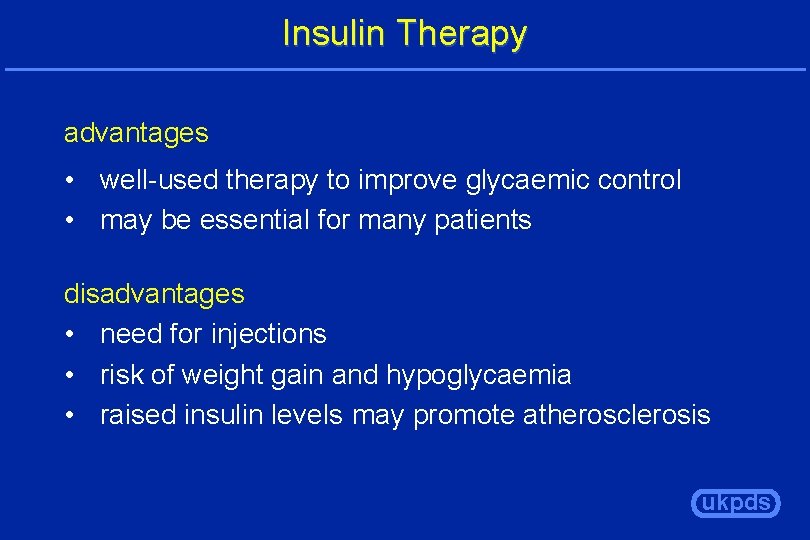
Insulin Therapy advantages • well-used therapy to improve glycaemic control • may be essential for many patients disadvantages • need for injections • risk of weight gain and hypoglycaemia • raised insulin levels may promote atherosclerosis ukpds
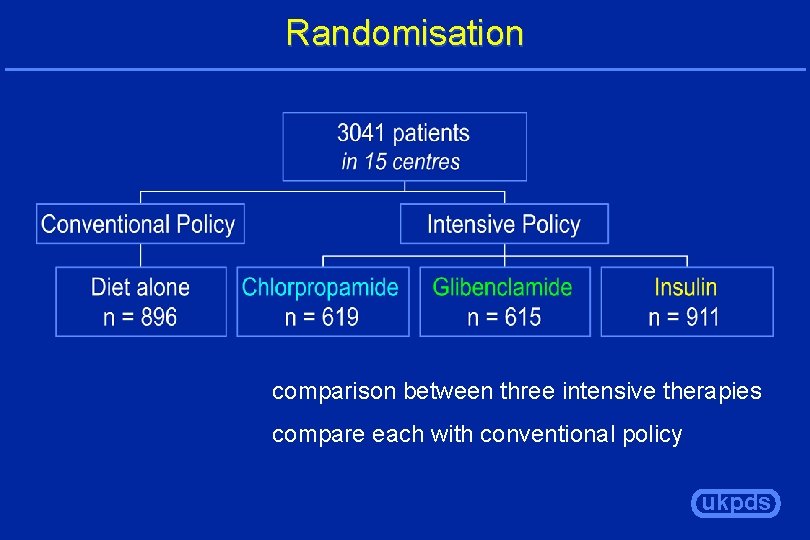
Randomisation comparison between three intensive therapies compare each with conventional policy ukpds
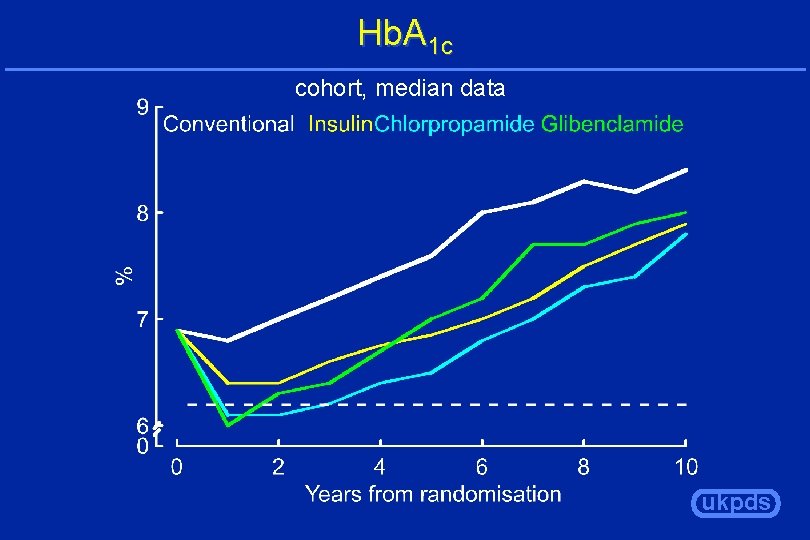
Hb. A 1 c cohort, median data ukpds
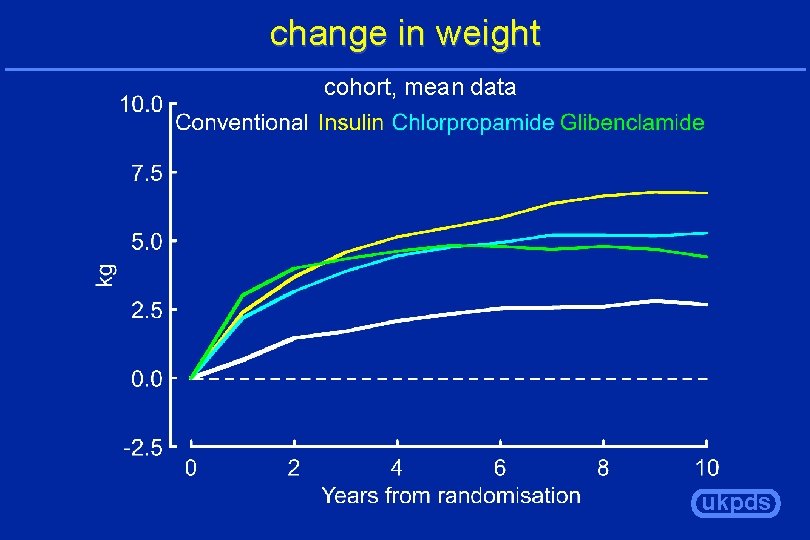
change in weight cohort, mean data ukpds
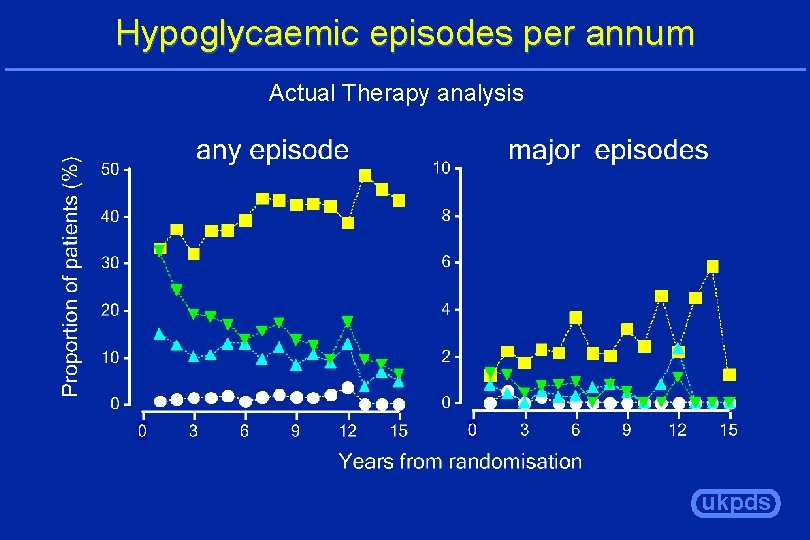
Hypoglycaemic episodes per annum Actual Therapy analysis ukpds
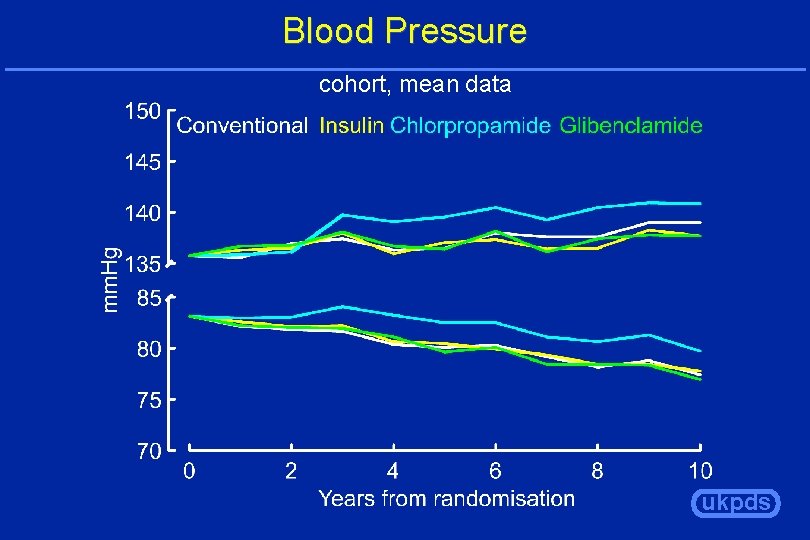
Blood Pressure cohort, mean data ukpds
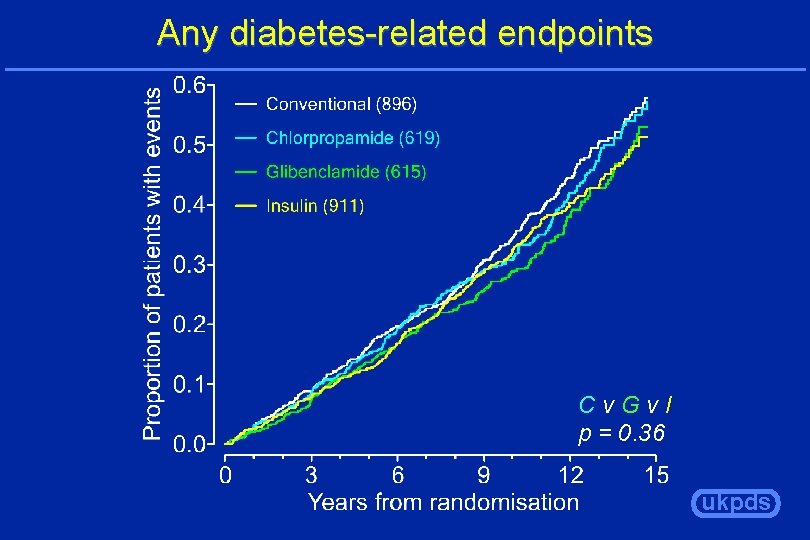
Any diabetes-related endpoints Cv. Gv. I p = 0. 36 ukpds
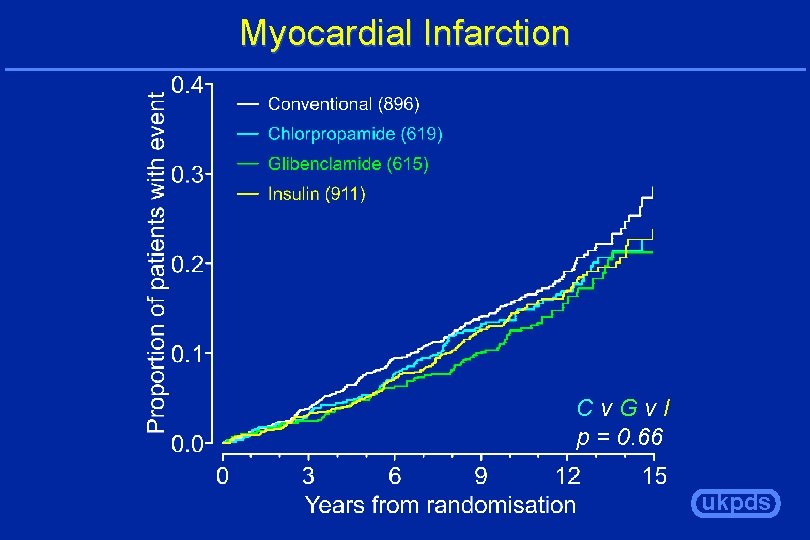
Myocardial Infarction Cv. Gv. I p = 0. 66 ukpds
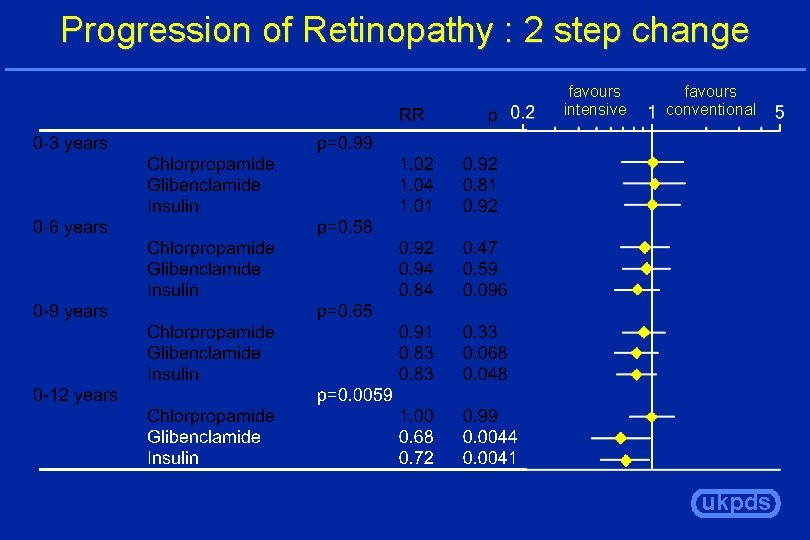
Progression of Retinopathy : 2 step change favours intensive favours conventional ukpds
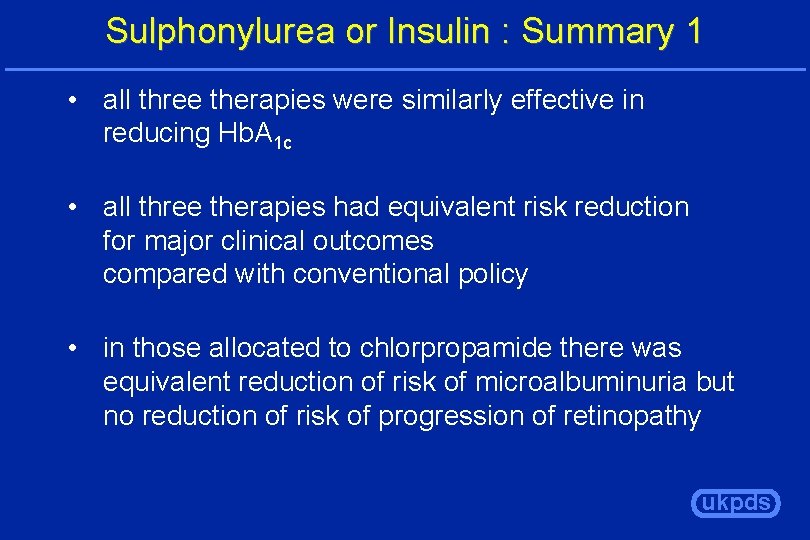
Sulphonylurea or Insulin : Summary 1 • all three therapies were similarly effective in reducing Hb. A 1 c • all three therapies had equivalent risk reduction for major clinical outcomes compared with conventional policy • in those allocated to chlorpropamide there was equivalent reduction of risk of microalbuminuria but no reduction of risk of progression of retinopathy ukpds
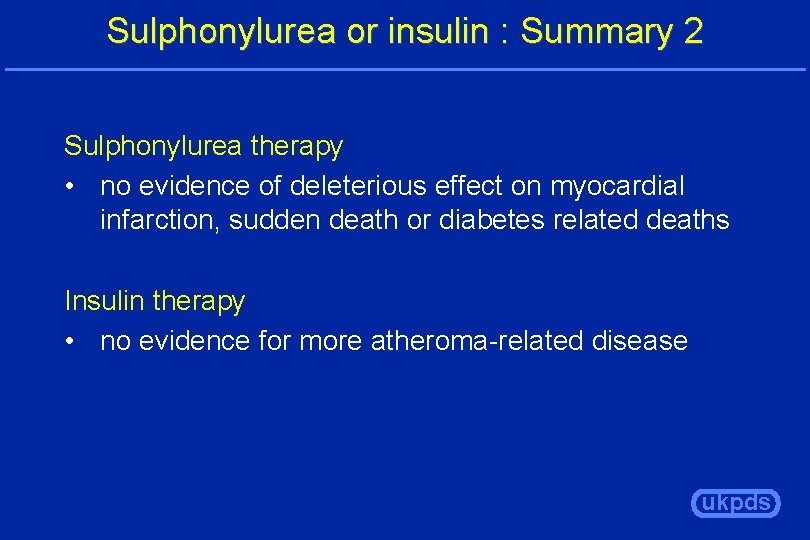
Sulphonylurea or insulin : Summary 2 Sulphonylurea therapy • no evidence of deleterious effect on myocardial infarction, sudden death or diabetes related deaths Insulin therapy • no evidence for more atheroma-related disease ukpds
UK Prospective Diabetes Study Does metformin in overweight diabetic patients have any advantages or disadvantages? ukpds
Introduction • the UKPDS has shown that an intensive glucose control policy using sulphonylurea or insulin therapy is effective in reducing the risk of complications in both overweight and normal weight patients • overweight (>120% Ideal Body Weight) UKPDS patients could be randomised to an intensive glucose control policy with metformin instead of diet, sulphonylurea or insulin ukpds
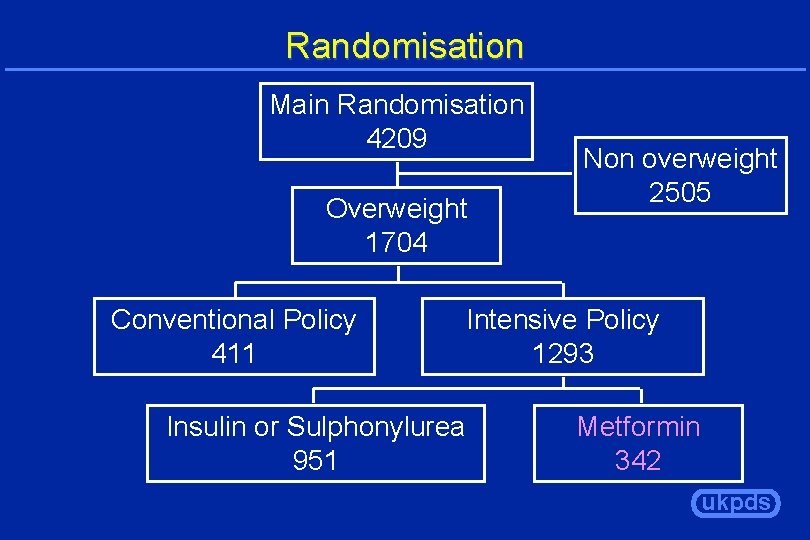
Randomisation Main Randomisation 4209 Overweight 1704 Conventional Policy 411 Non overweight 2505 Intensive Policy 1293 Insulin or Sulphonylurea 951 Metformin 342 ukpds
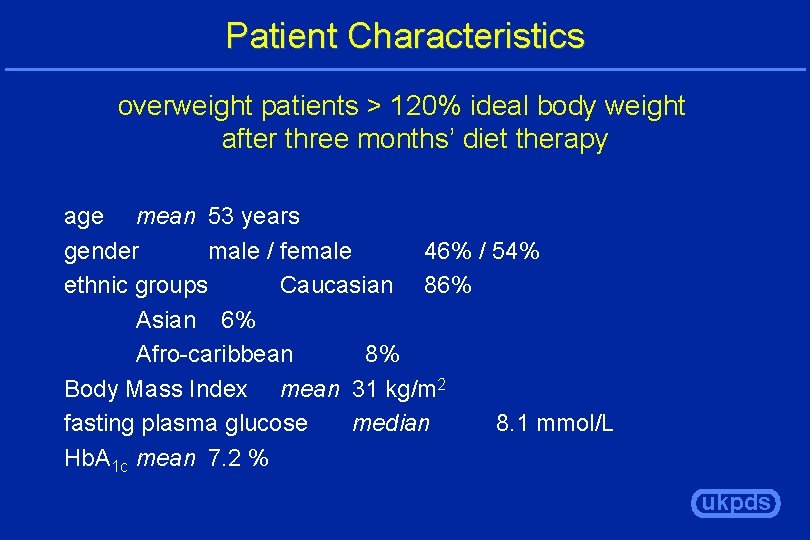
Patient Characteristics overweight patients > 120% ideal body weight after three months’ diet therapy age mean 53 years gender male / female 46% / 54% ethnic groups Caucasian 86% Asian 6% Afro-caribbean 8% Body Mass Index mean 31 kg/m 2 fasting plasma glucose median 8. 1 mmol/L Hb. A 1 c mean 7. 2 % ukpds
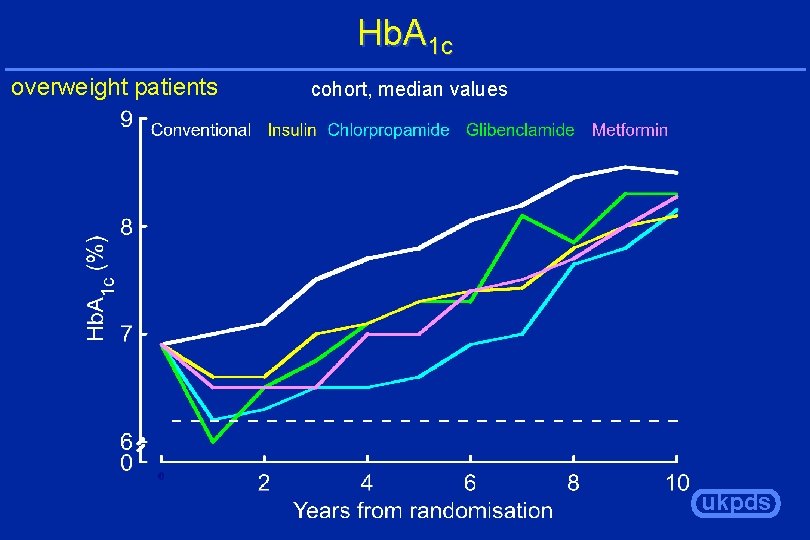
Hb. A 1 c overweight patients cohort, median values ukpds
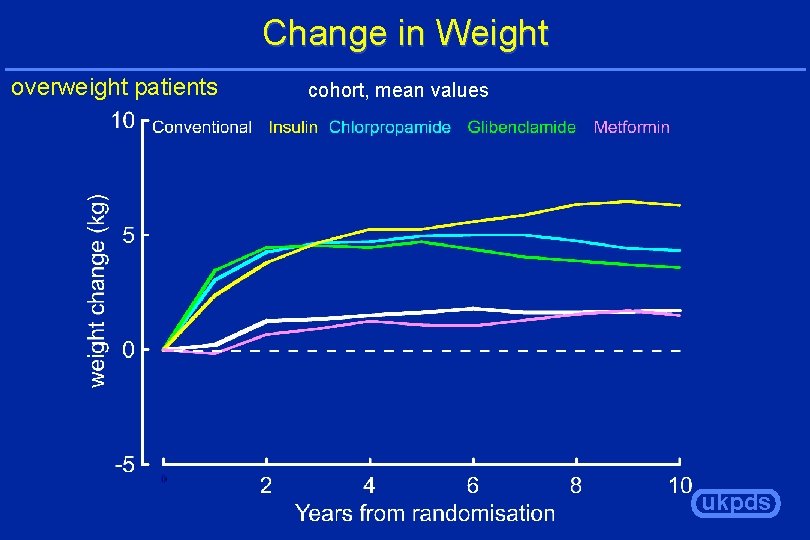
Change in Weight overweight patients cohort, mean values ukpds
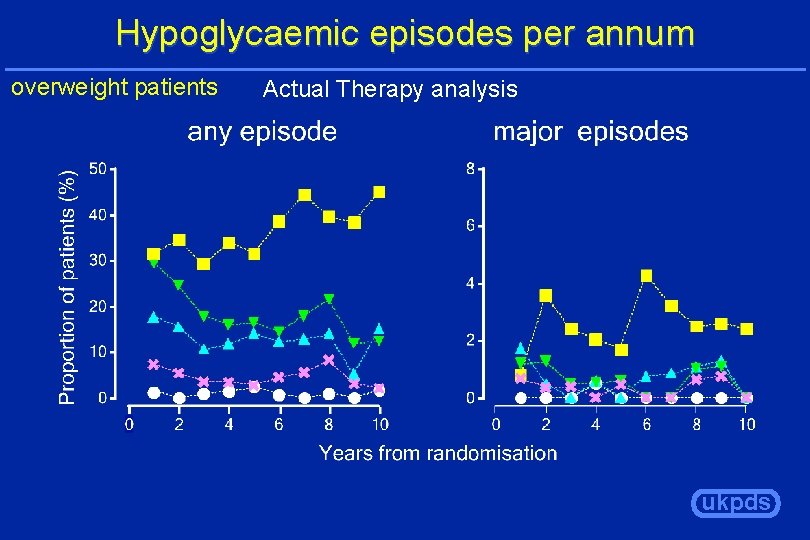
Hypoglycaemic episodes per annum overweight patients Actual Therapy analysis ukpds
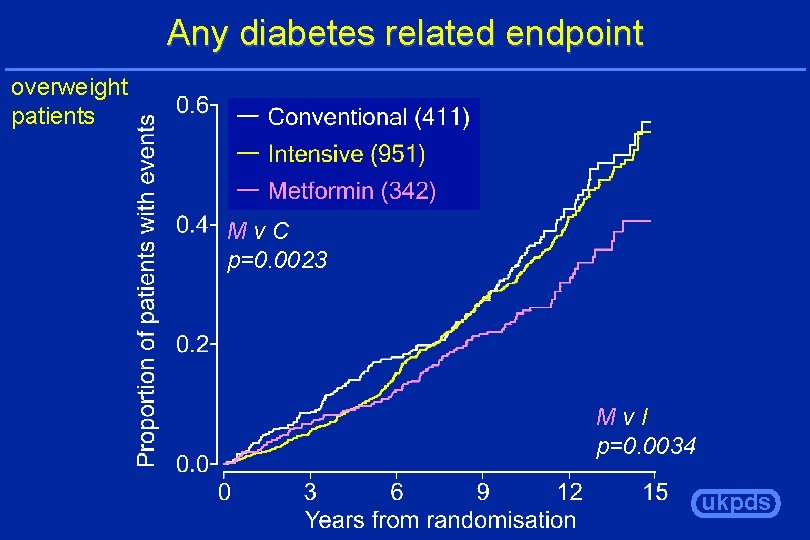
Any diabetes related endpoint overweight patients Mv. C p=0. 0023 Mv. I p=0. 0034 ukpds
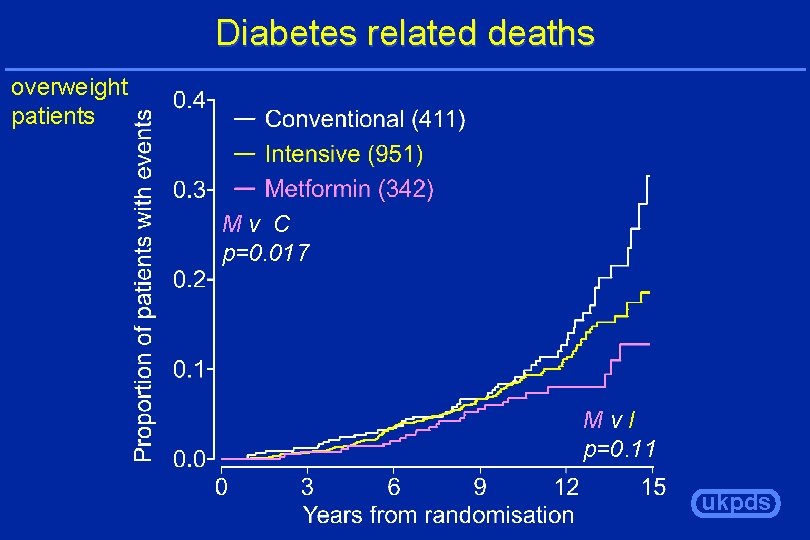
Diabetes related deaths overweight patients Mv C p=0. 017 Mv. I p=0. 11 ukpds
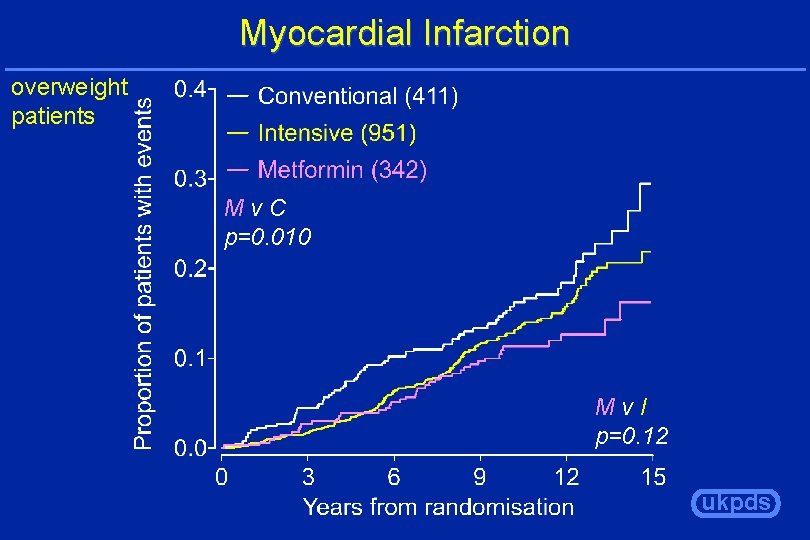
Myocardial Infarction overweight patients Mv. C p=0. 010 Mv. I p=0. 12 ukpds
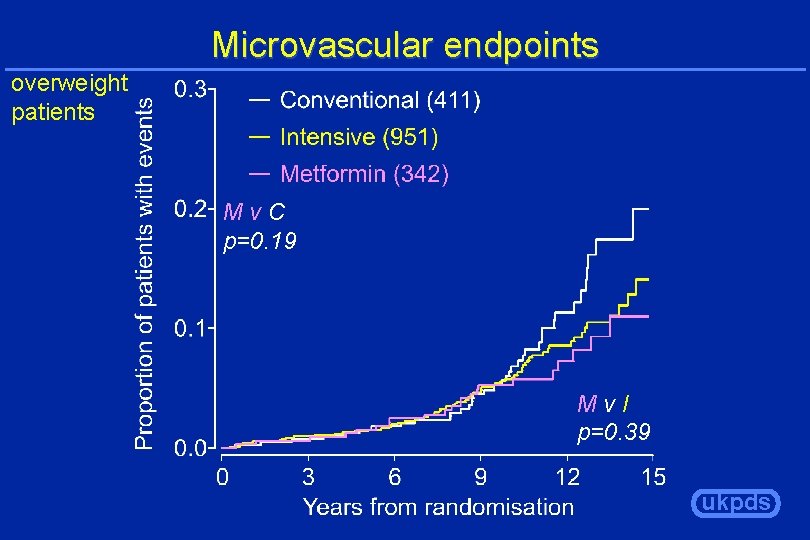
Microvascular endpoints overweight patients Mv. C p=0. 19 Mv. I p=0. 39 ukpds
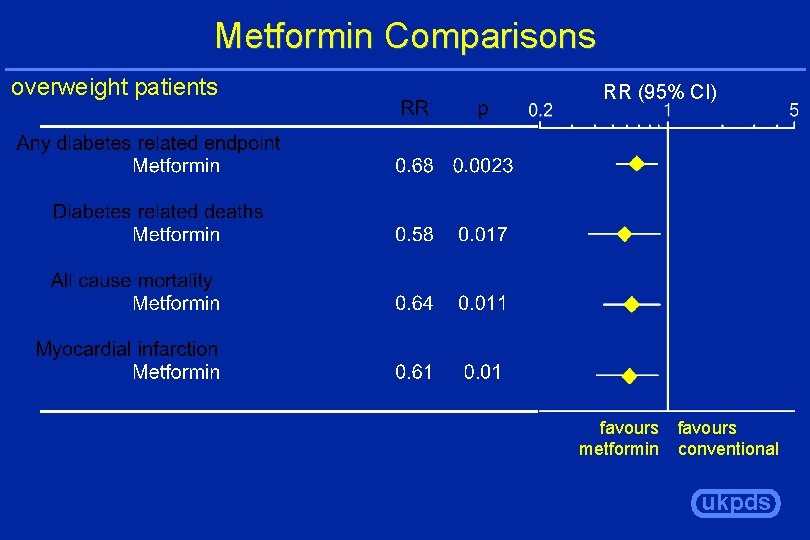
Metformin Comparisons overweight patients RR (95% CI) favours metformin favours conventional ukpds
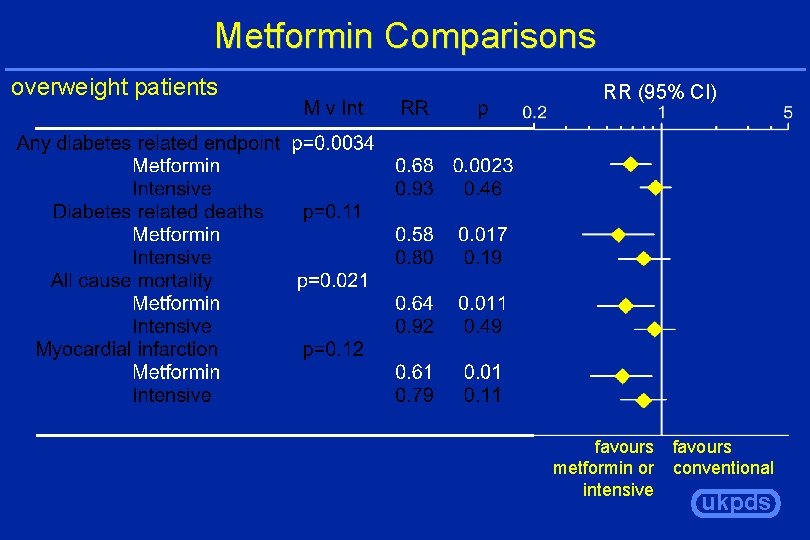
Metformin Comparisons overweight patients RR (95% CI) favours metformin or intensive favours conventional ukpds
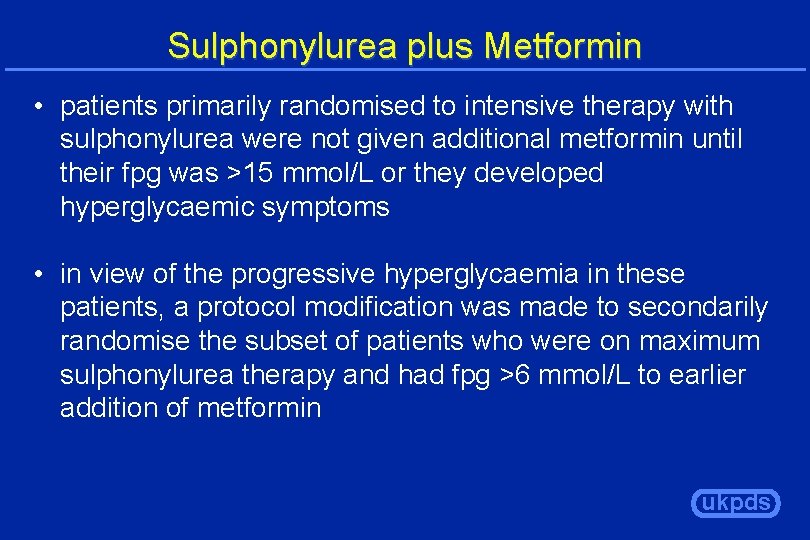
Sulphonylurea plus Metformin • patients primarily randomised to intensive therapy with sulphonylurea were not given additional metformin until their fpg was >15 mmol/L or they developed hyperglycaemic symptoms • in view of the progressive hyperglycaemia in these patients, a protocol modification was made to secondarily randomise the subset of patients who were on maximum sulphonylurea therapy and had fpg >6 mmol/L to earlier addition of metformin ukpds
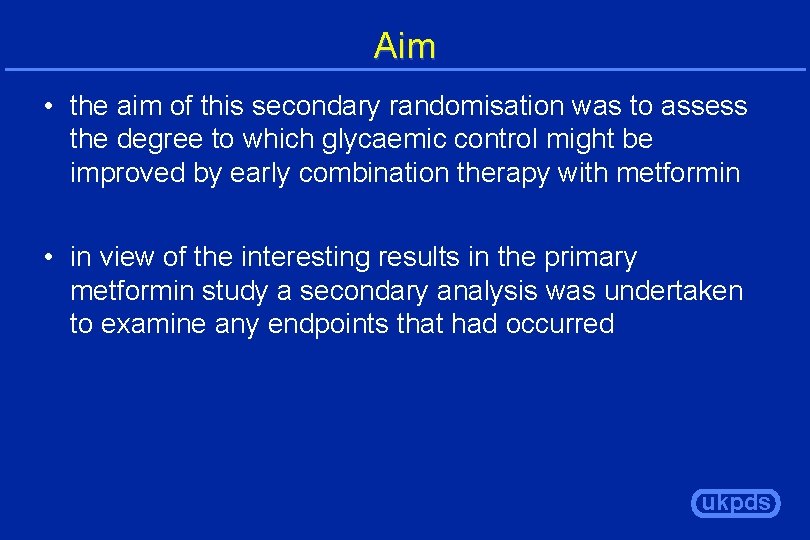
Aim • the aim of this secondary randomisation was to assess the degree to which glycaemic control might be improved by early combination therapy with metformin • in view of the interesting results in the primary metformin study a secondary analysis was undertaken to examine any endpoints that had occurred ukpds
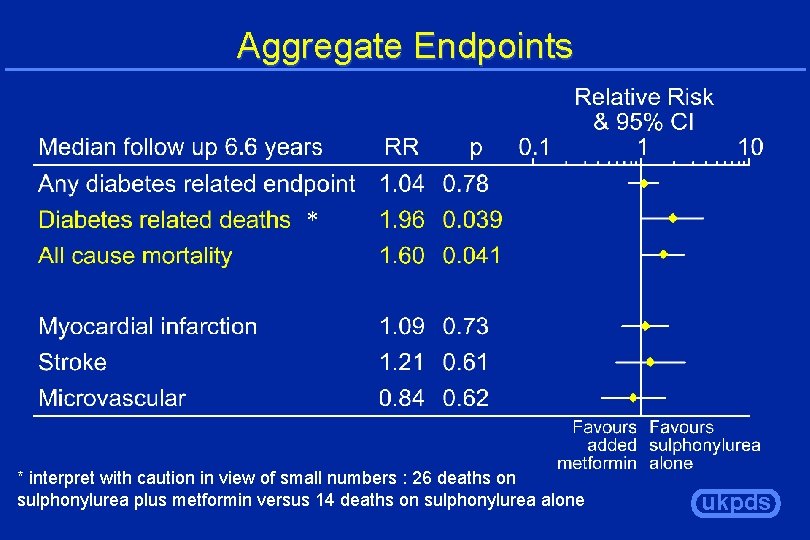
Aggregate Endpoints * * interpret with caution in view of small numbers : 26 deaths on sulphonylurea plus metformin versus 14 deaths on sulphonylurea alone ukpds
Metformin in Overweight Patients • compared with conventional policy 32% risk reduction in any diabetes-related endpoints p=0. 0023 42% risk reduction in diabetes-related deaths p=0. 017 36% risk reduction in all cause mortality p=0. 011 39% risk reduction in myocardial infarction p=0. 01 ukpds
Metformin : Summary • the addition of metformin in patients already treated with sulphonylurea requires further study • on balance, metformin treatment would appear to be advantageous as primary pharmacological therapy in diet-treated overweight patients ukpds
UK Prospective Diabetes Study Blood Pressure Control Study ukpds
Blood Pressure Control Study : Aims to determine whether • tight blood pressure control policy can reduce morbidity and mortality in Type 2 diabetic patients • ACE inhibitor (captopril) or Beta blocker (atenolol) is advantageous in reducing the risk of development of clinical complications ukpds
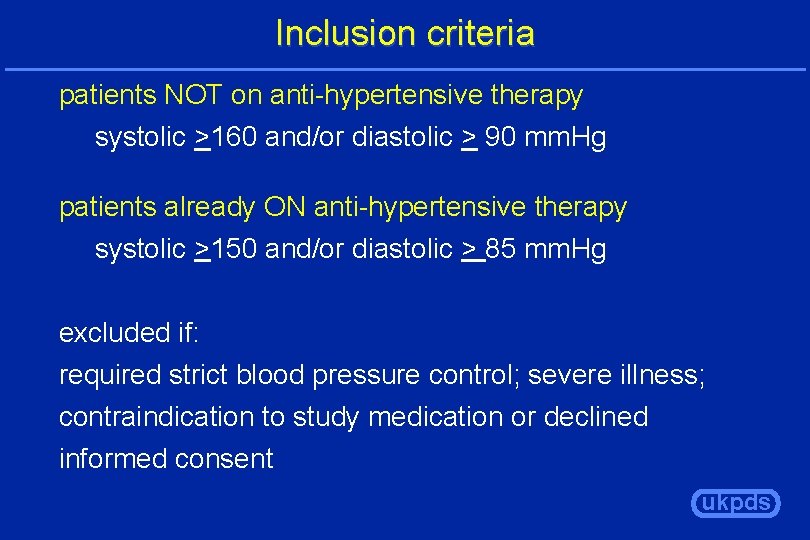
Inclusion criteria patients NOT on anti-hypertensive therapy systolic >160 and/or diastolic > 90 mm. Hg patients already ON anti-hypertensive therapy systolic >150 and/or diastolic > 85 mm. Hg excluded if: required strict blood pressure control; severe illness; contraindication to study medication or declined informed consent ukpds
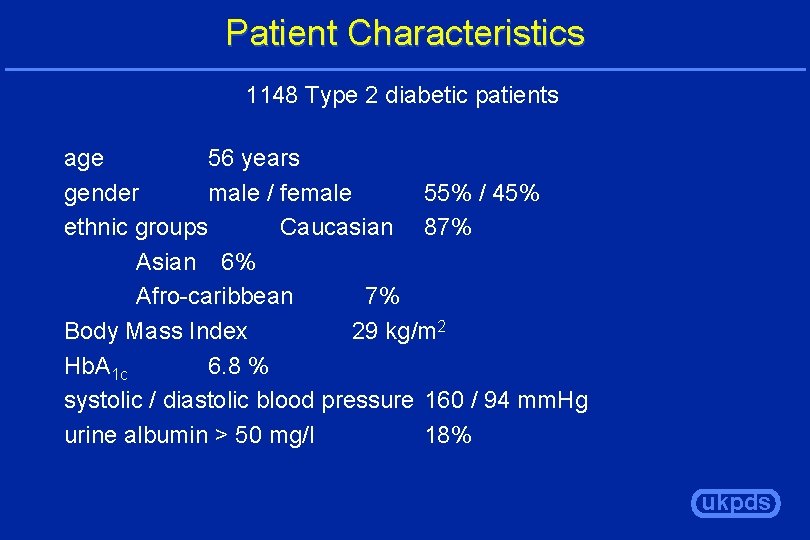
Patient Characteristics 1148 Type 2 diabetic patients age 56 years gender male / female 55% / 45% ethnic groups Caucasian 87% Asian 6% Afro-caribbean 7% Body Mass Index 29 kg/m 2 Hb. A 1 c 6. 8 % systolic / diastolic blood pressure 160 / 94 mm. Hg urine albumin > 50 mg/l 18% ukpds
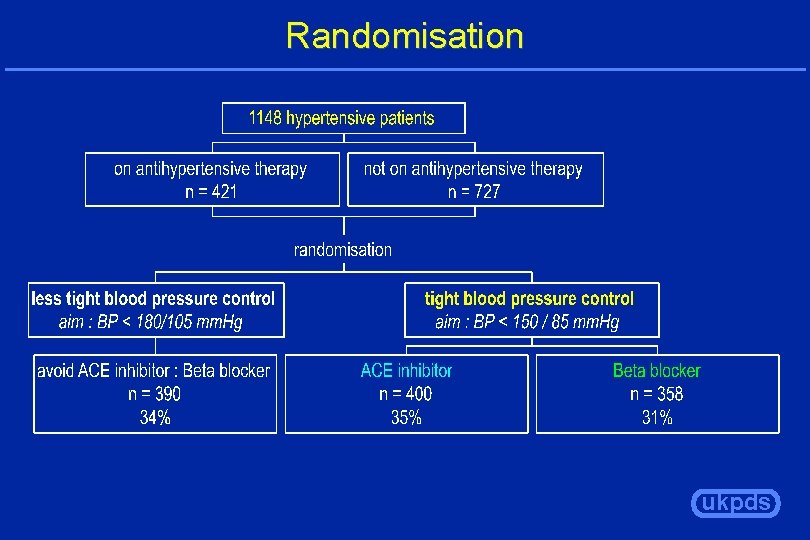
Randomisation ukpds
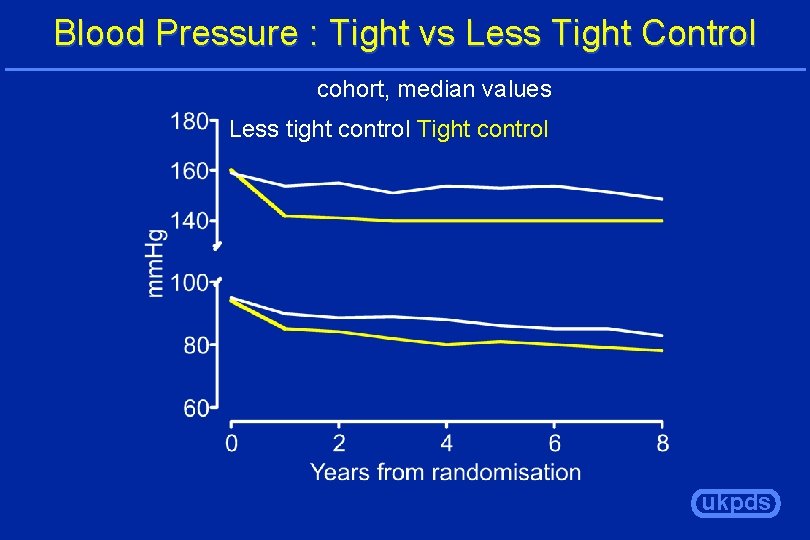
Blood Pressure : Tight vs Less Tight Control cohort, median values Less tight control Tight control ukpds
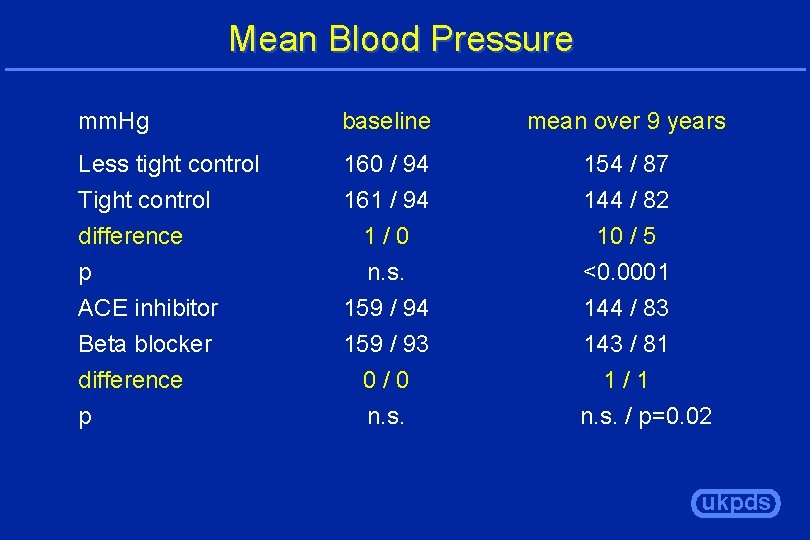
Mean Blood Pressure mm. Hg baseline mean over 9 years Less tight control Tight control difference p ACE inhibitor Beta blocker 160 / 94 161 / 94 1/0 n. s. 159 / 94 159 / 93 154 / 87 144 / 82 10 / 5 <0. 0001 144 / 83 143 / 81 difference 0/0 1/1 p n. s. / p=0. 02 ukpds
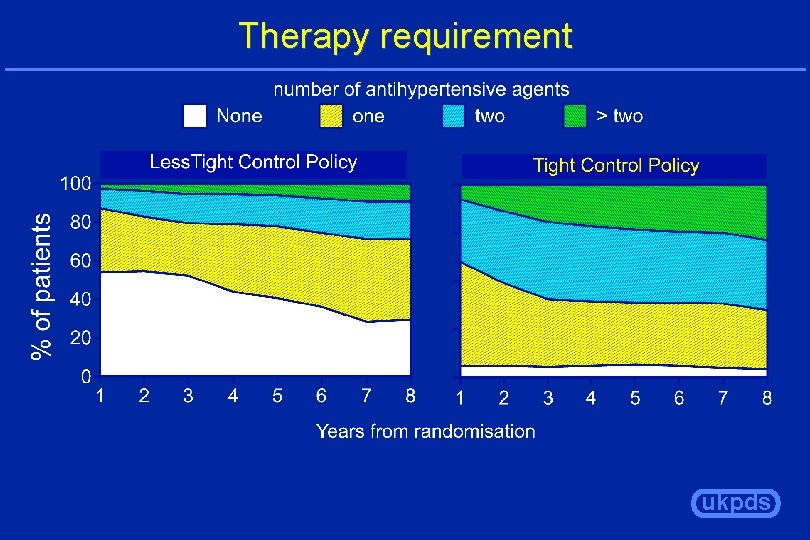
Therapy requirement ukpds
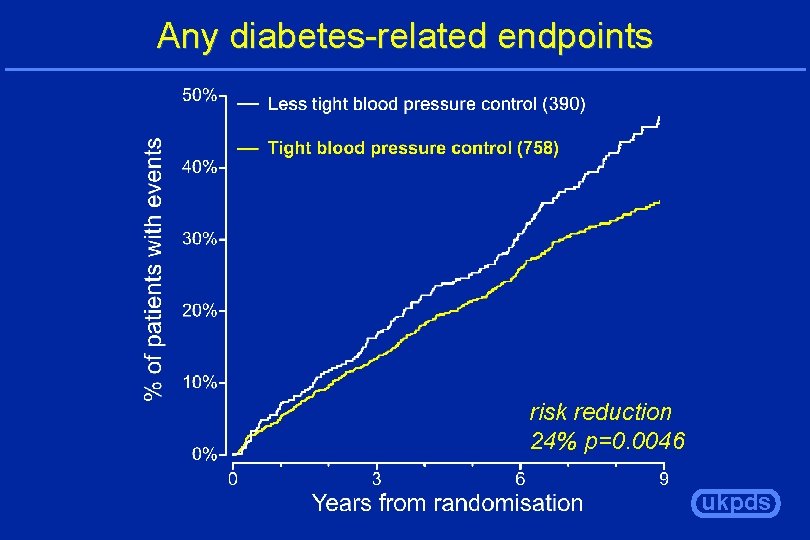
Any diabetes-related endpoints risk reduction 24% p=0. 0046 ukpds
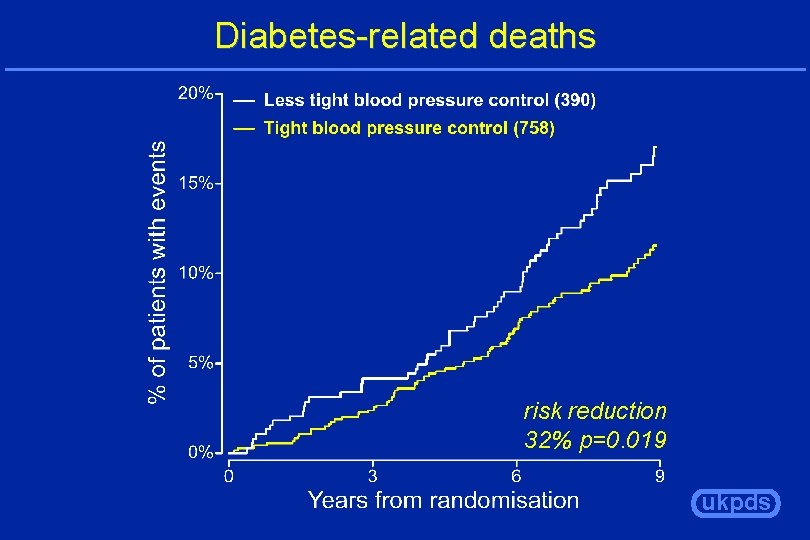
Diabetes-related deaths risk reduction 32% p=0. 019 ukpds
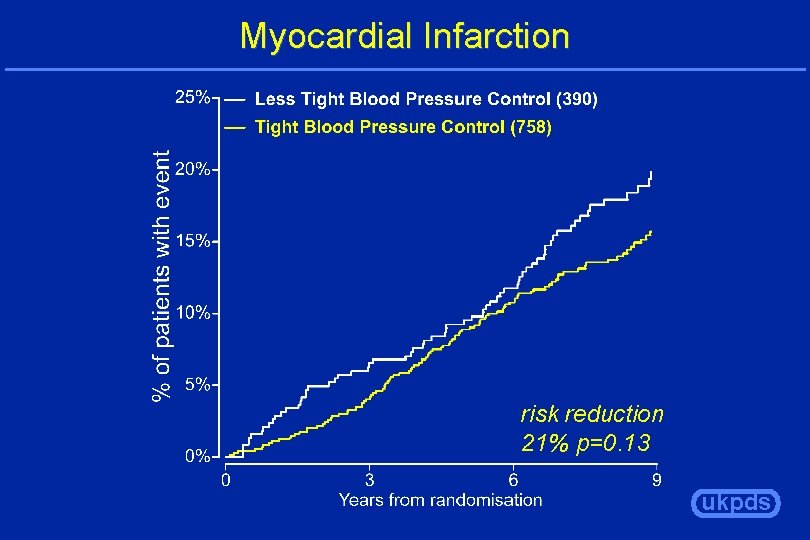
Myocardial Infarction risk reduction 21% p=0. 13 ukpds
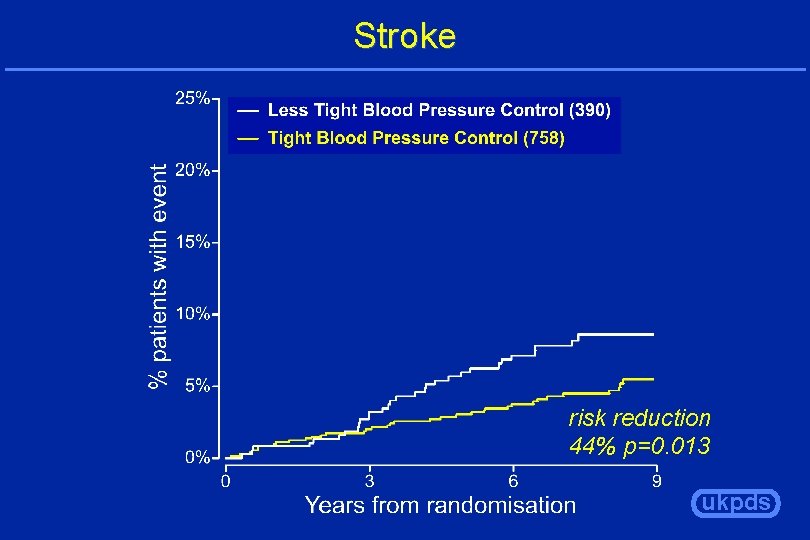
Stroke risk reduction 44% p=0. 013 ukpds
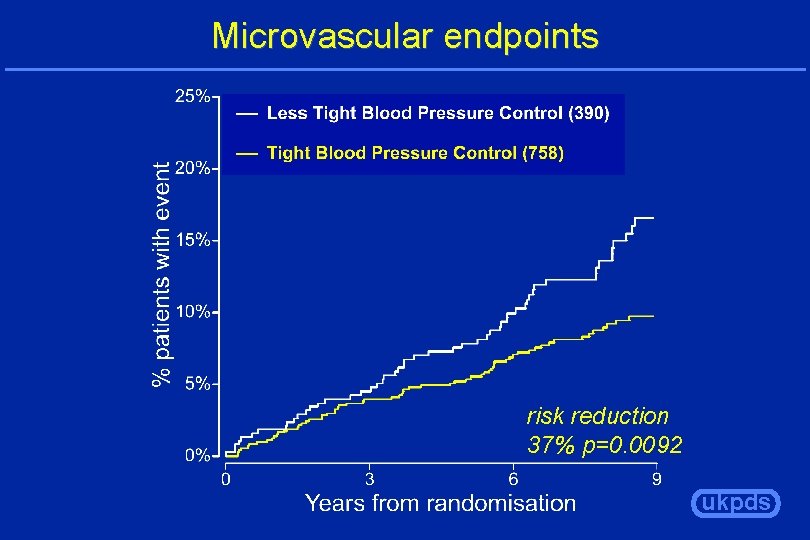
Microvascular endpoints risk reduction 37% p=0. 0092 ukpds
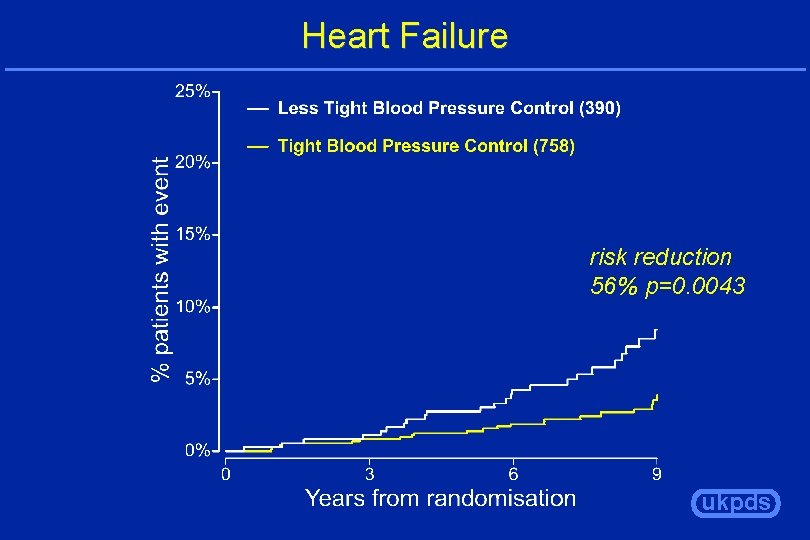
Heart Failure risk reduction 56% p=0. 0043 ukpds
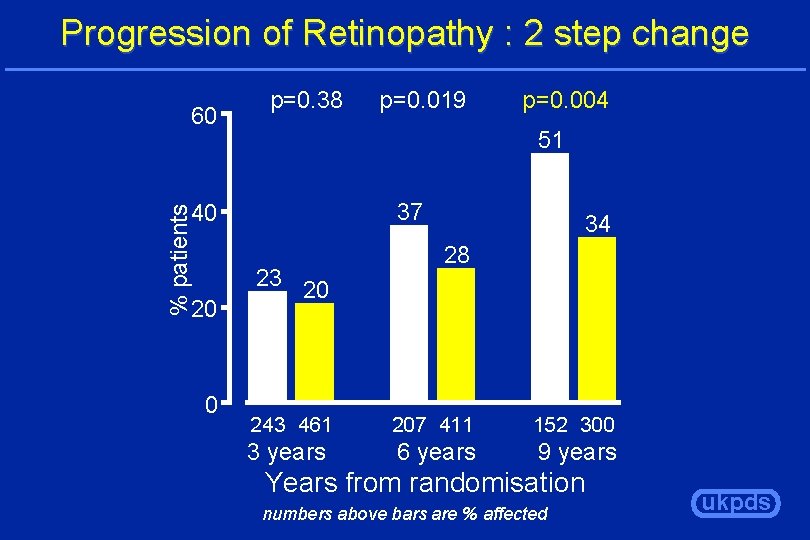
Progression of Retinopathy : 2 step change 60 p=0. 38 37 % patients 23 0 p=0. 004 51 40 20 p=0. 019 34 28 20 243 461 207 411 152 300 3 years 6 years 9 years Years from randomisation numbers above bars are % affected ukpds
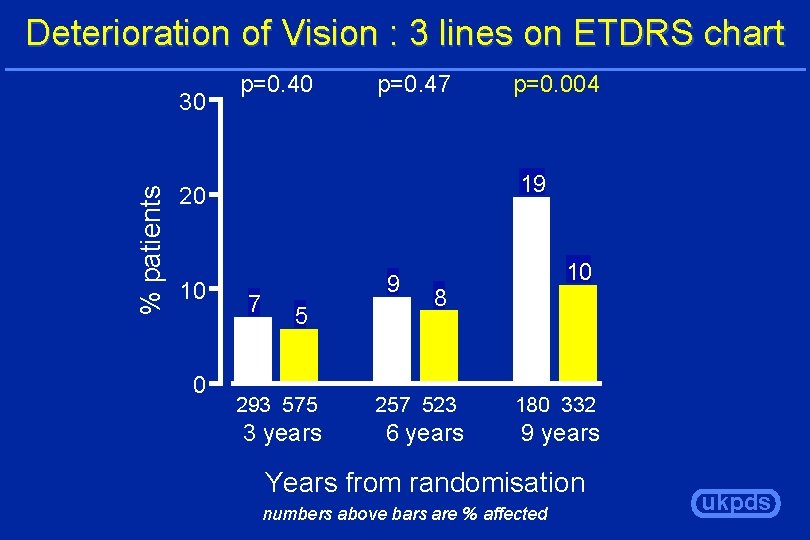
Deterioration of Vision : 3 lines on ETDRS chart % patients 30 p=0. 47 19 20 10 0 p=0. 004 7 9 5 293 575 3 years 10 8 257 523 6 years 180 332 9 years Years from randomisation numbers above bars are % affected ukpds
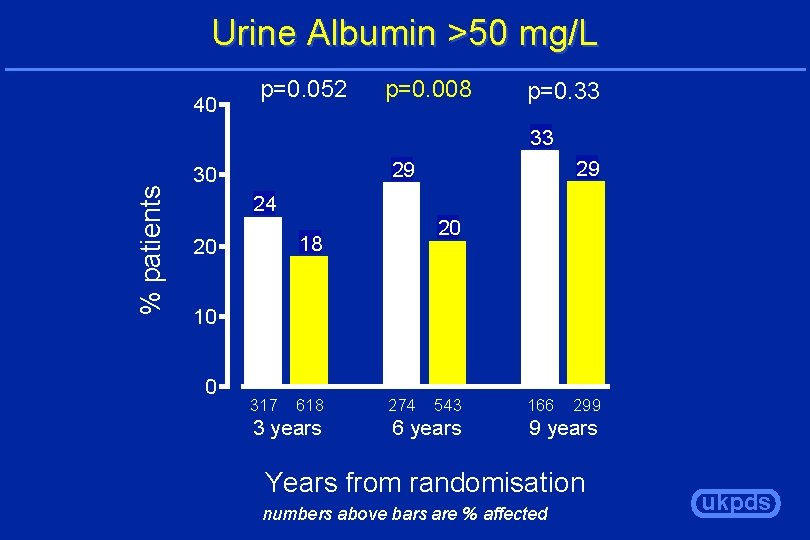
Urine Albumin >50 mg/L 40 p=0. 052 p=0. 008 p=0. 33 % patients 33 29 29 30 24 20 18 20 10 0 317 618 3 years 274 543 6 years 166 299 9 years Years from randomisation numbers above bars are % affected ukpds
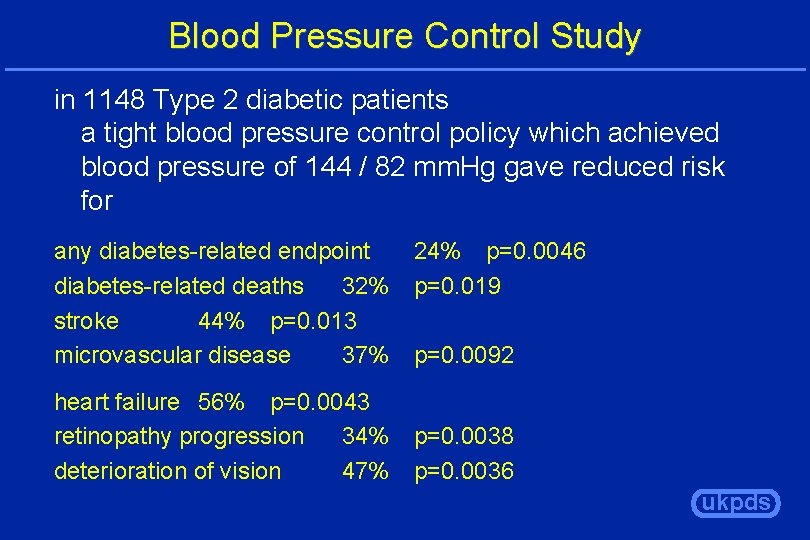
Blood Pressure Control Study in 1148 Type 2 diabetic patients a tight blood pressure control policy which achieved blood pressure of 144 / 82 mm. Hg gave reduced risk for any diabetes-related endpoint 24% p=0. 0046 diabetes-related deaths 32% p=0. 019 stroke 44% p=0. 013 microvascular disease 37% p=0. 0092 heart failure 56% p=0. 0043 retinopathy progression 34% p=0. 0038 deterioration of vision 47% p=0. 0036 ukpds
UK Prospective Diabetes Study Do ACE inhibitors or Beta Blockers have any specific advantages or disadvantages? ukpds
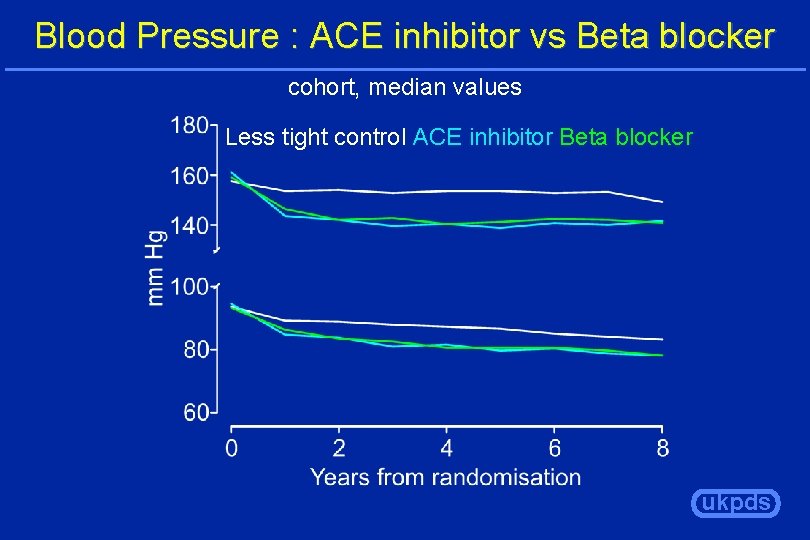
Blood Pressure : ACE inhibitor vs Beta blocker cohort, median values Less tight control ACE inhibitor Beta blocker ukpds
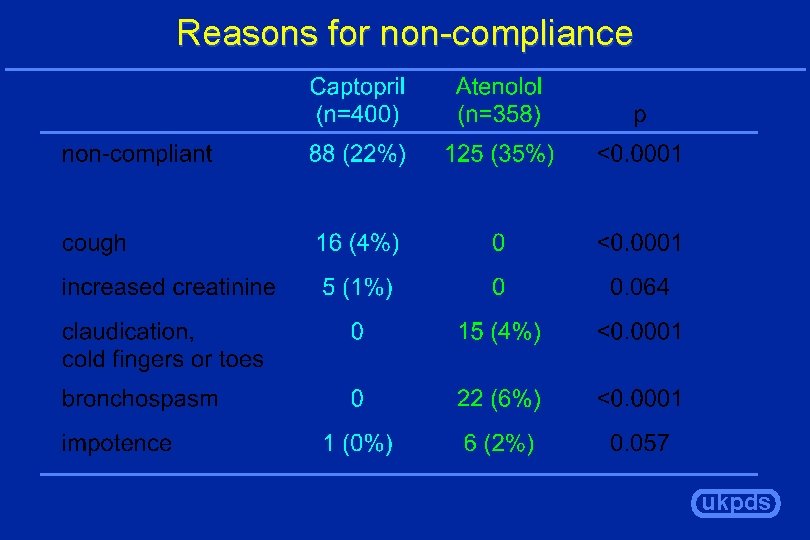
Reasons for non-compliance ukpds
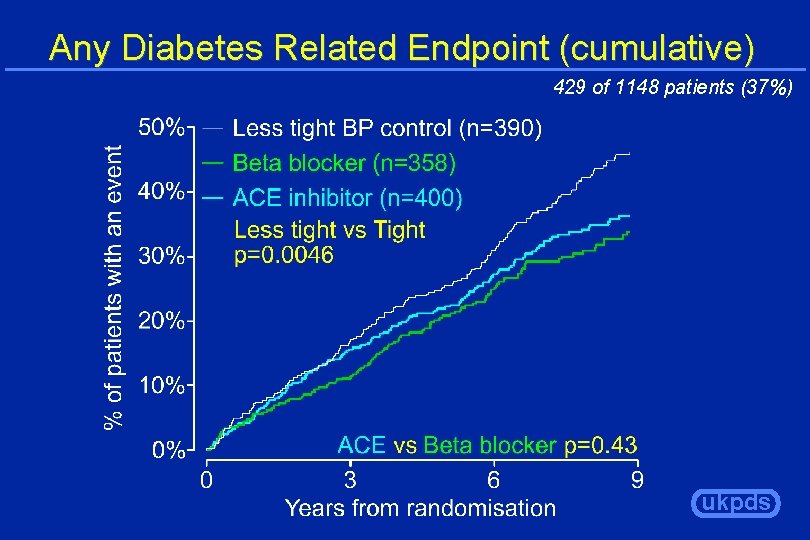
Any Diabetes Related Endpoint (cumulative) 429 of 1148 patients (37%) ukpds
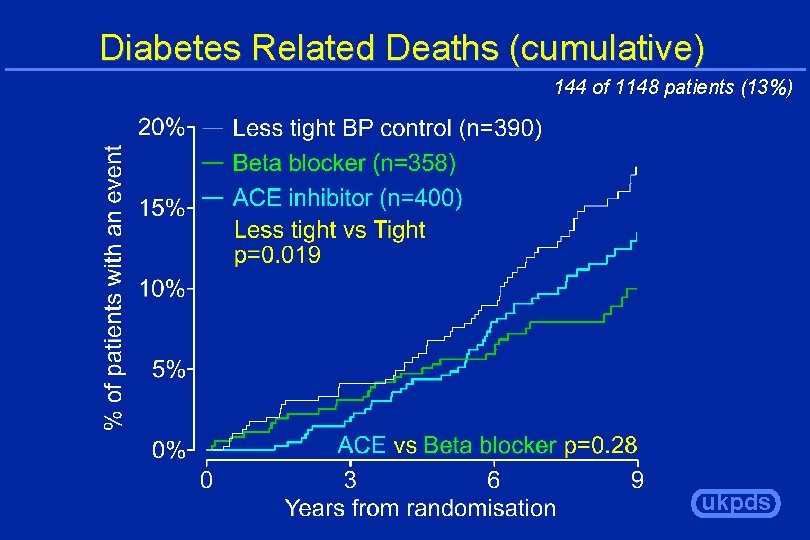
Diabetes Related Deaths (cumulative) 144 of 1148 patients (13%) ukpds
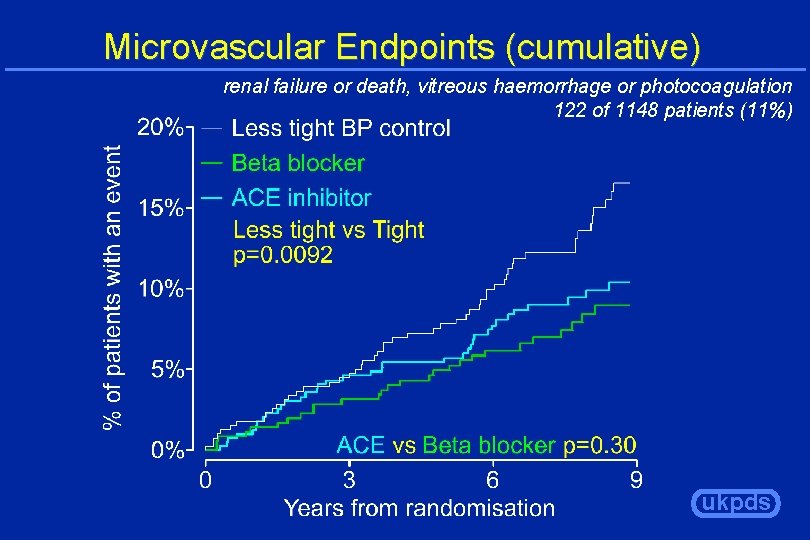
Microvascular Endpoints (cumulative) renal failure or death, vitreous haemorrhage or photocoagulation 122 of 1148 patients (11%) ukpds
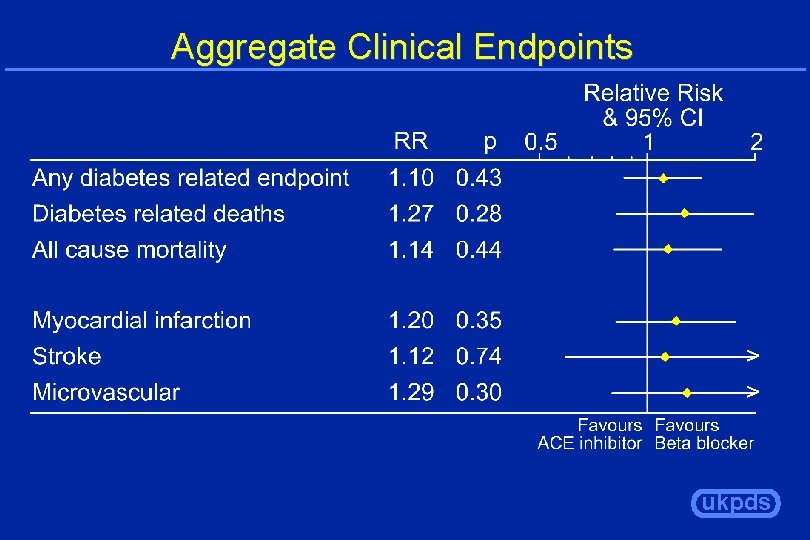
Aggregate Clinical Endpoints ukpds
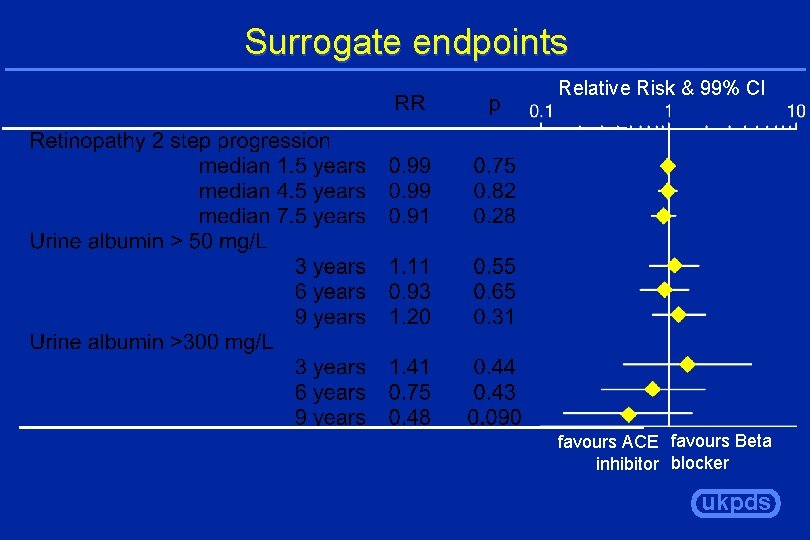
Surrogate endpoints Relative Risk & 99% CI favours ACE favours Beta inhibitor blocker ukpds
Conclusion ACE inhibitors and Beta blockers were equally effective in lowering mean blood pressure in hypertensive patients with type 2 diabetes and in reducing the risk of: • • • any diabetes related endpoint diabetes related deaths microvascular endpoints ukpds
UK Prospective Diabetes Study Potential implications for clinical care of diabetic patients ukpds
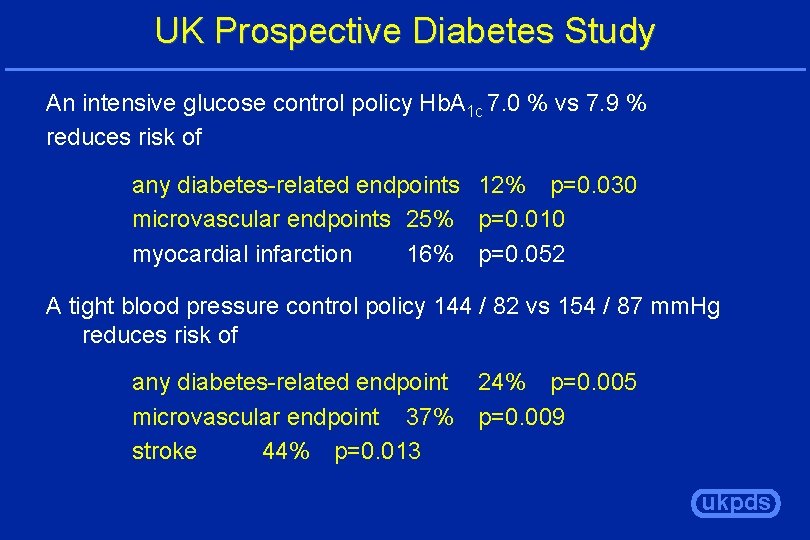
UK Prospective Diabetes Study An intensive glucose control policy Hb. A 1 c 7. 0 % vs 7. 9 % reduces risk of any diabetes-related endpoints 12% p=0. 030 microvascular endpoints 25% p=0. 010 myocardial infarction 16% p=0. 052 A tight blood pressure control policy 144 / 82 vs 154 / 87 mm. Hg reduces risk of any diabetes-related endpoint 24% p=0. 005 microvascular endpoint 37% p=0. 009 stroke 44% p=0. 013 ukpds
Choice of Therapies diabetes : • each of the available therapies studied can be used • in overweight, diet-treated patients, metformin may be advantageous hypertension : • Beta blockers and ACE inhibitors each provide protection ukpds
Which goals of therapy? • current guidelines suggest Hb. A 1 c <7% • the risk of diabetic complications was reduced in the UKPDS trial which achieved a median Hb. A 1 c 7. 0% in the intensive glucose control group • this Hb. A 1 c level is in accord with current guidelines but is difficult to accomplish in some patients • epidemiological analysis suggests that any reduction of hyperglycaemia would be advantageous ukpds
Which goals of therapy? • current guidelines suggest blood pressure <140 / 85 mm. Hg or <130 / 85 mm. Hg • the risk of diabetic complications was reduced in the UKPDS blood pressure control trial which achieved a mean blood pressure 144 / 82 mm. Hg in the tight control group • this result is in accord with current guidelines, which are also supported by the epidemiological analysis ukpds
Polypharmacy • glycaemia combinations of agents with different actions will be needed more patients will require insulin • blood pressure many patients will need 3 or more different types of agents ukpds
Differences between Therapies • sulphonylurea, insulin and metformin are each effective in reducing the risk of any diabetes related endpoints and microvascular endpoints • no evidence of increased risk of complications for any single therapy • ACE inhibitors and Beta blockers are each effective in reducing the risk of macrovascular and microvascular endpoints • no evidence that either is specifically advantageous ukpds
UK Prospective Diabetes Study The UKPDS has shown conclusively that : • intensive therapy to reduce glycaemia is worthwhile as it reduces risk of complications • tight blood pressure control is worthwhile as it reduces risk of complications • there are no major differences between therapies tested • reduction in risk of complications of diabetes is a realisable goal ukpds
Beneficial Effects of Intensive Therapy The UKPDS has shown that more intensive monitoring more intensive use of existing therapies which improves blood glucose control blood pressure control can reduce the risk of diabetic complications ukpds
UK Prospective Diabetes Study papers presenting major results of the study UKPDS 33: Lancet (1998) 352, 837 -853 UKPDS 34: Lancet (1998) 352, 854 -865 UKPDS 38: BMJ (1998) 317, 703 -713 UKPDS 39: BMJ (1998) 317, 713 -720 ukpds
- Slides: 100