
The UK Power Networks interpretation of the five

- Slides: 5
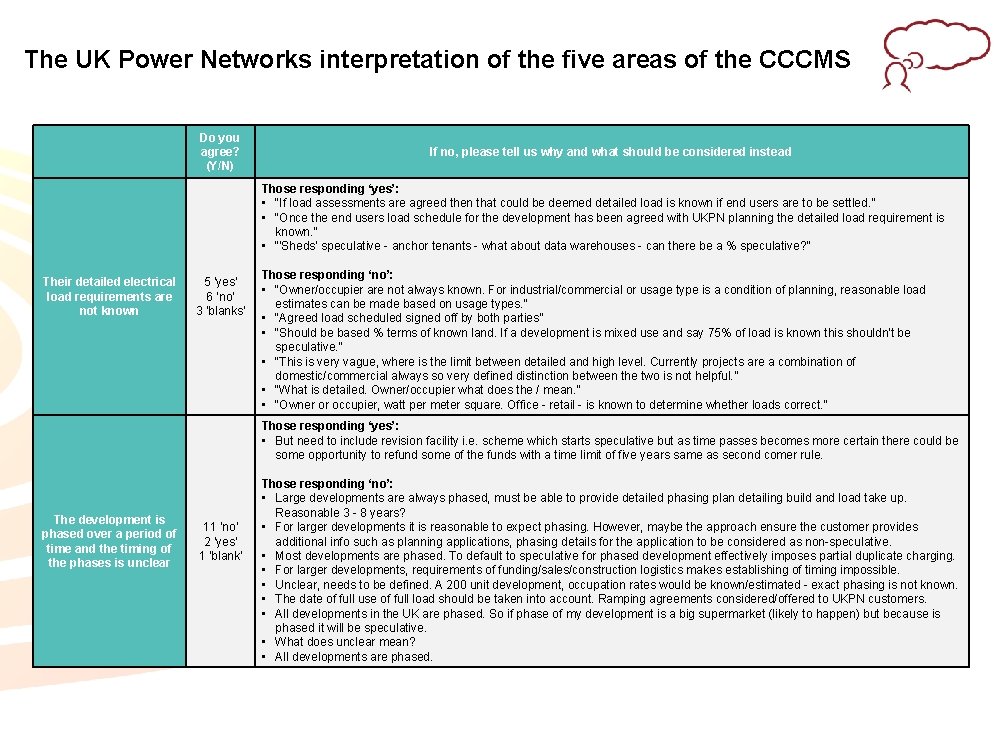
The UK Power Networks interpretation of the five areas of the CCCMS Do you agree? (Y/N) If no, please tell us why and what should be considered instead Those responding ‘yes’: • “If load assessments are agreed then that could be deemed detailed load is known if end users are to be settled. ” • “Once the end users load schedule for the development has been agreed with UKPN planning the detailed load requirement is known. ” • “'Sheds' speculative - anchor tenants - what about data warehouses - can there be a % speculative? ” Their detailed electrical load requirements are not known 5 ‘yes’ 6 ‘no’ 3 ‘blanks’ Those responding ‘no’: • “Owner/occupier are not always known. For industrial/commercial or usage type is a condition of planning, reasonable load estimates can be made based on usage types. ” • “Agreed load scheduled signed off by both parties” • “Should be based % terms of known land. If a development is mixed use and say 75% of load is known this shouldn't be speculative. “ • “This is very vague, where is the limit between detailed and high level. Currently projects are a combination of domestic/commercial always so very defined distinction between the two is not helpful. ” • “What is detailed. Owner/occupier what does the / mean. ” • “Owner or occupier, watt per meter square. Office - retail - is known to determine whether loads correct. ” Those responding ‘yes’: • But need to include revision facility i. e. scheme which starts speculative but as time passes becomes more certain there could be some opportunity to refund some of the funds with a time limit of five years same as second comer rule. The development is phased over a period of time and the timing of the phases is unclear 11 ‘no’ 2 ‘yes’ 1 ‘blank’ Those responding ‘no’: • Large developments are always phased, must be able to provide detailed phasing plan detailing build and load take up. Reasonable 3 - 8 years? • For larger developments it is reasonable to expect phasing. However, maybe the approach ensure the customer provides additional info such as planning applications, phasing details for the application to be considered as non-speculative. • Most developments are phased. To default to speculative for phased development effectively imposes partial duplicate charging. • For larger developments, requirements of funding/sales/construction logistics makes establishing of timing impossible. • Unclear, needs to be defined. A 200 unit development, occupation rates would be known/estimated - exact phasing is not known. • The date of full use of full load should be taken into account. Ramping agreements considered/offered to UKPN customers. • All developments in the UK are phased. So if phase of my development is a big supermarket (likely to happen) but because is phased it will be speculative. • What does unclear mean? • All developments are phased.
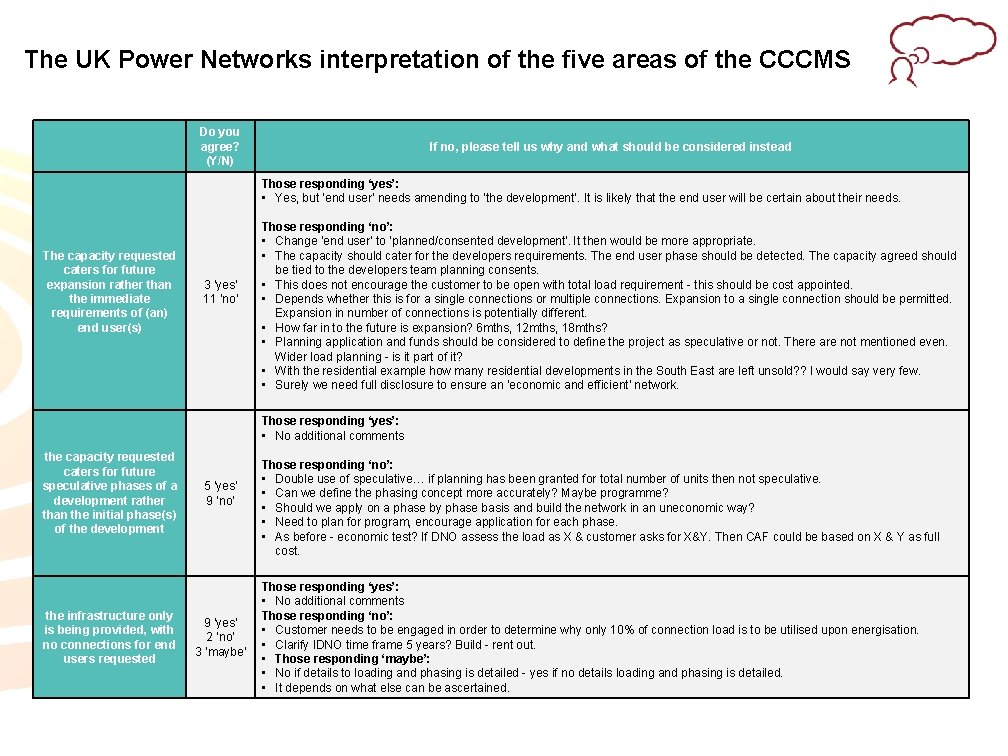
The UK Power Networks interpretation of the five areas of the CCCMS Do you agree? (Y/N) If no, please tell us why and what should be considered instead Those responding ‘yes’: • Yes, but ‘end user’ needs amending to ‘the development’. It is likely that the end user will be certain about their needs. The capacity requested caters for future expansion rather than the immediate requirements of (an) end user(s) 3 ‘yes’ 11 ‘no’ Those responding ‘no’: • Change ‘end user’ to ‘planned/consented development’. It then would be more appropriate. • The capacity should cater for the developers requirements. The end user phase should be detected. The capacity agreed should be tied to the developers team planning consents. • This does not encourage the customer to be open with total load requirement - this should be cost appointed. • Depends whether this is for a single connections or multiple connections. Expansion to a single connection should be permitted. Expansion in number of connections is potentially different. • How far in to the future is expansion? 6 mths, 12 mths, 18 mths? • Planning application and funds should be considered to define the project as speculative or not. There are not mentioned even. Wider load planning - is it part of it? • With the residential example how many residential developments in the South East are left unsold? ? I would say very few. • Surely we need full disclosure to ensure an 'economic and efficient' network. Those responding ‘yes’: • No additional comments the capacity requested caters for future speculative phases of a development rather than the initial phase(s) of the development the infrastructure only is being provided, with no connections for end users requested 5 ‘yes’ 9 ‘no’ 9 ‘yes’ 2 ‘no’ 3 ‘maybe’ Those responding ‘no’: • Double use of speculative… if planning has been granted for total number of units then not speculative. • Can we define the phasing concept more accurately? Maybe programme? • Should we apply on a phase by phase basis and build the network in an uneconomic way? • Need to plan for program, encourage application for each phase. • As before - economic test? If DNO assess the load as X & customer asks for X&Y. Then CAF could be based on X & Y as full cost. Those responding ‘yes’: • No additional comments Those responding ‘no’: • Customer needs to be engaged in order to determine why only 10% of connection load is to be utilised upon energisation. • Clarify IDNO time frame 5 years? Build - rent out. • Those responding ‘maybe’: • No if details to loading and phasing is detailed - yes if no details loading and phasing is detailed. • It depends on what else can be ascertained.
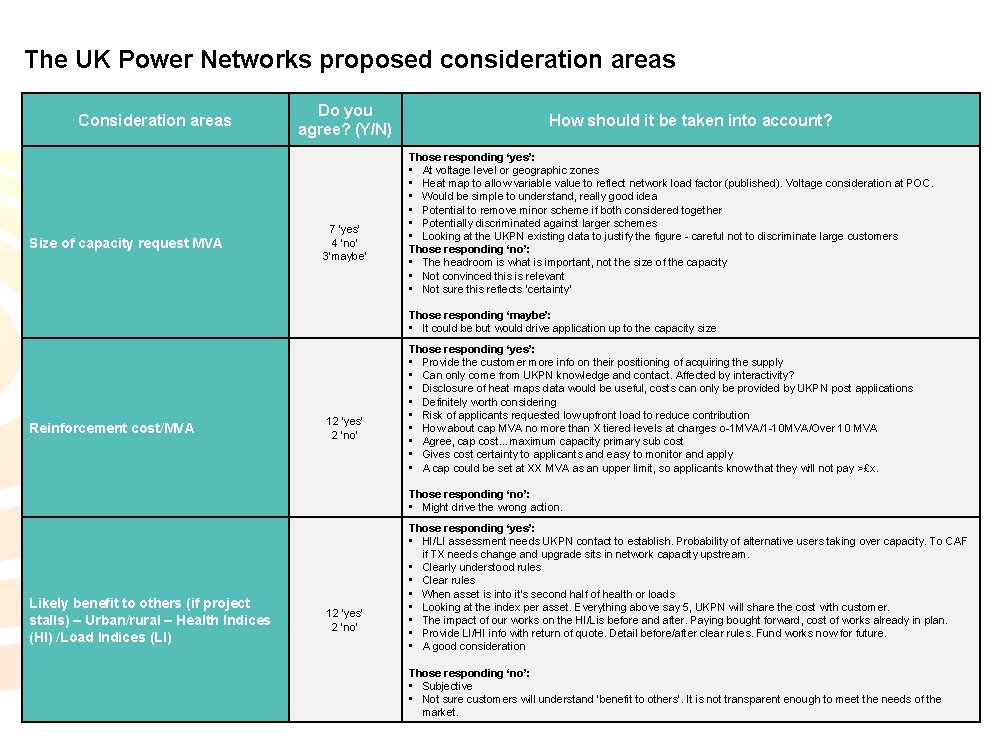
The UK Power Networks proposed consideration areas Consideration areas Size of capacity request MVA Do you agree? (Y/N) 7 ‘yes’ 4 ‘no’ 3’maybe’ How should it be taken into account? Those responding ‘yes’: • At voltage level or geographic zones • Heat map to allow variable value to reflect network load factor (published). Voltage consideration at POC. • Would be simple to understand, really good idea • Potential to remove minor scheme if both considered together • Potentially discriminated against larger schemes • Looking at the UKPN existing data to justify the figure - careful not to discriminate large customers Those responding ‘no’: • The headroom is what is important, not the size of the capacity • Not convinced this is relevant • Not sure this reflects ‘certainty’ Those responding ‘maybe’: • It could be but would drive application up to the capacity size Reinforcement cost/MVA 12 ‘yes’ 2 ‘no’ Those responding ‘yes’: • Provide the customer more info on their positioning of acquiring the supply • Can only come from UKPN knowledge and contact. Affected by interactivity? • Disclosure of heat maps data would be useful, costs can only be provided by UKPN post applications • Definitely worth considering • Risk of applicants requested low upfront load to reduce contribution • How about cap MVA no more than X tiered levels at charges o-1 MVA/1 -10 MVA/Over 10 MVA • Agree, cap cost…maximum capacity primary sub cost • Gives cost certainty to applicants and easy to monitor and apply • A cap could be set at XX MVA as an upper limit, so applicants know that they will not pay >£x. Those responding ‘no’: • Might drive the wrong action. Likely benefit to others (if project stalls) – Urban/rural – Health Indices (HI) /Load Indices (LI) 12 ‘yes’ 2 ‘no’ Those responding ‘yes’: • HI/LI assessment needs UKPN contact to establish. Probability of alternative users taking over capacity. To CAF if TX needs change and upgrade sits in network capacity upstream. • Clearly understood rules • Clear rules • When asset is into it's second half of health or loads • Looking at the index per asset. Everything above say 5, UKPN will share the cost with customer. • The impact of our works on the HI/Lis before and after. Paying bought forward, cost of works already in plan. • Provide LI/HI info with return of quote. Detail before/after clear rules. Fund works now for future. • A good consideration Those responding ‘no’: • Subjective • Not sure customers will understand ‘benefit to others’. It is not transparent enough to meet the needs of the market.
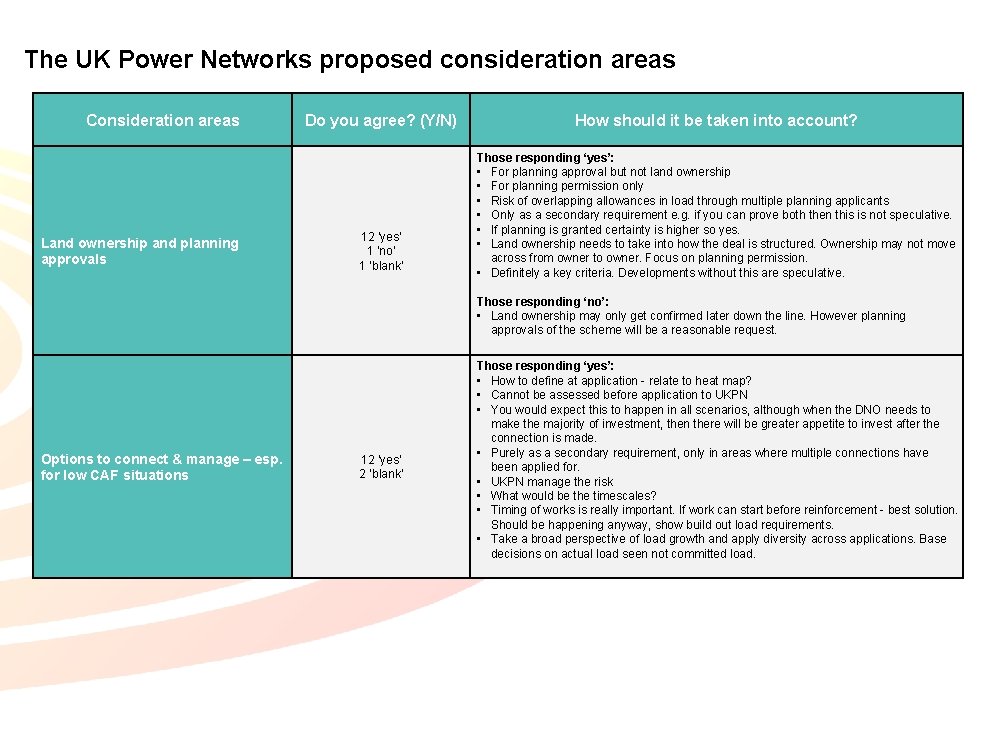
The UK Power Networks proposed consideration areas Consideration areas Land ownership and planning approvals Do you agree? (Y/N) 12 ‘yes’ 1 ‘no’ 1 ‘blank’ How should it be taken into account? Those responding ‘yes’: • For planning approval but not land ownership • For planning permission only • Risk of overlapping allowances in load through multiple planning applicants • Only as a secondary requirement e. g. if you can prove both then this is not speculative. • If planning is granted certainty is higher so yes. • Land ownership needs to take into how the deal is structured. Ownership may not move across from owner to owner. Focus on planning permission. • Definitely a key criteria. Developments without this are speculative. Those responding ‘no’: • Land ownership may only get confirmed later down the line. However planning approvals of the scheme will be a reasonable request. Options to connect & manage – esp. for low CAF situations 12 ‘yes’ 2 ‘blank’ Those responding ‘yes’: • How to define at application - relate to heat map? • Cannot be assessed before application to UKPN • You would expect this to happen in all scenarios, although when the DNO needs to make the majority of investment, then there will be greater appetite to invest after the connection is made. • Purely as a secondary requirement, only in areas where multiple connections have been applied for. • UKPN manage the risk • What would be the timescales? • Timing of works is really important. If work can start before reinforcement - best solution. Should be happening anyway, show build out load requirements. • Take a broad perspective of load growth and apply diversity across applications. Base decisions on actual load seen not committed load.
The UK Power Networks proposed consideration areas Consideration areas Overall site connections strategy – spare capacity – interim works – review points Do you agree? (Y/N) 9 ‘yes’ 1 ‘no’ 1 ‘maybe’ 3 ‘blank’ How should it be taken into account? Those responding ‘yes’: • Would need clear simple milestones and a legal agreement through supply contract. Link to planning. • Good idea, would be tied to the planning applications and developers strategic programme • Must be provided at application stage • To be utilised alongside UKPNs consortium connections offering. • Revising/reviewing the scheme over time is a great idea to be realistic about the project status and requirements. • What would be the timescales? • Need to show build out plan and structure build out programme. Need to work out how this is transparent. Those responding ‘no’: • Maybe too many unknowns in this approach. Some interim works may result in stranded costs. • Those responding ‘maybe’: • Very difficult to assess because this is something which needs to be reviewed on a project but project basis. Those responding ‘yes’: • Very good idea but cannot see anyway of making it work. • With set time limits • Yes, but the focus for the developers is often the upfront cost. Any money back will be good but not extremely important • Per MVA % of reinforcement paid, going back to TSA's Rebatable contribution as physical development progresses, down to the CAF 8 ‘yes’ 5 ‘no’ 1 ‘maybe’ Those responding ‘no’: • Implementation hurdles - too many variables. • For the benefit of the developer, this is not an attractive offer. • Rebate is unlikely to get back to the owner/occupier • Prefer something that mitigates upfront capital cosy rather than money back Those responding ‘maybe’: • Could be hard to administer, timescale for rebate based on 2 nd comer. Does the DNO provide updates or does the customer have to apply/monitor?