
The UK Low Carbon Transition Plan An introduction
The UK Low Carbon Transition Plan An introduction to our national strategy for climate and energy July 2009
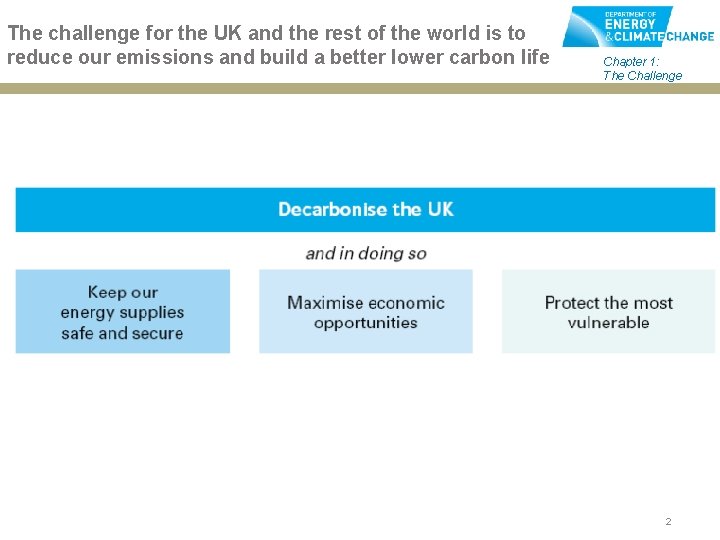
The challenge for the UK and the rest of the world is to reduce our emissions and build a better lower carbon life Chapter 1: The Challenge 2
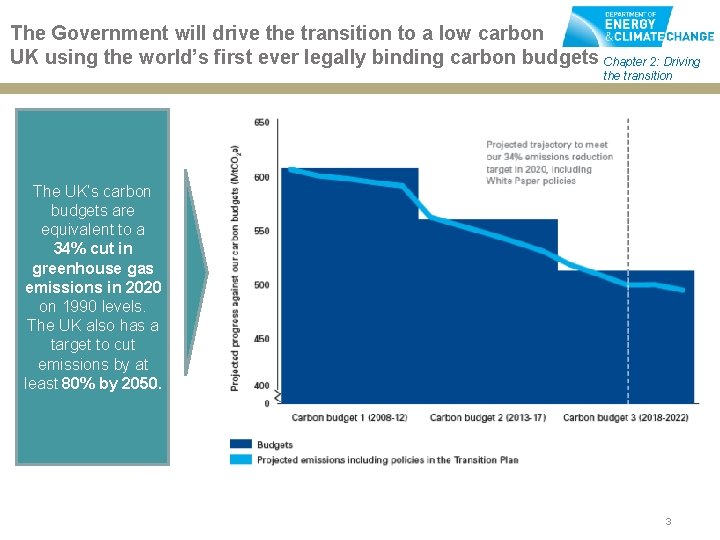
The Government will drive the transition to a low carbon UK using the world’s first ever legally binding carbon budgets Chapter 2: Driving the transition The UK’s carbon budgets are equivalent to a 34% cut in greenhouse gas emissions in 2020 on 1990 levels. The UK also has a target to cut emissions by at least 80% by 2050. 3

This Transition Plan for the first time sets out how these budgets will be met All sectors will contribute emission savings Chapter 2: Driving the transition • The plan will ensure the UK meets its 15% renewable energy target in 2020. • For the first time, Government departments have been allocated their own carbon budgets. • Role for dynamic, competitive markets, a strategic role for Government, and active communities. • The plan will help ensure secure energy supplies. 4
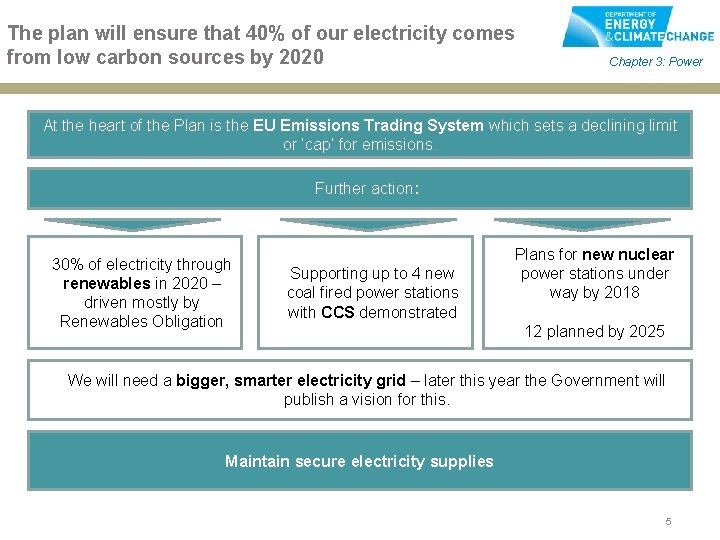
The plan will ensure that 40% of our electricity comes from low carbon sources by 2020 Chapter 3: Power At the heart of the Plan is the EU Emissions Trading System which sets a declining limit or ‘cap’ for emissions. Further action: 30% of electricity through renewables in 2020 – driven mostly by Renewables Obligation Supporting up to 4 new coal fired power stations with CCS demonstrated Plans for new nuclear power stations under way by 2018 12 planned by 2025 We will need a bigger, smarter electricity grid – later this year the Government will publish a vision for this. Maintain secure electricity supplies 5
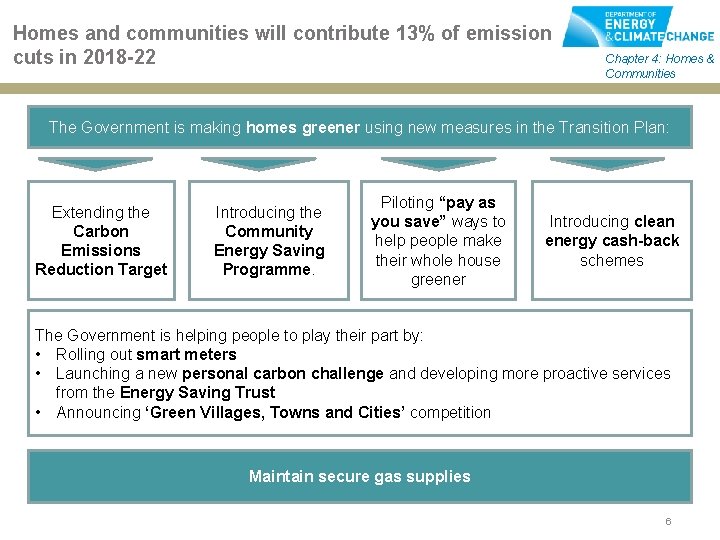
Homes and communities will contribute 13% of emission cuts in 2018 -22 Chapter 4: Homes & Communities The Government is making homes greener using new measures in the Transition Plan: Extending the Carbon Emissions Reduction Target Introducing the Community Energy Saving Programme. Piloting “pay as you save” ways to help people make their whole house greener Introducing clean energy cash-back schemes The Government is helping people to play their part by: • Rolling out smart meters • Launching a new personal carbon challenge and developing more proactive services from the Energy Saving Trust • Announcing ‘Green Villages, Towns and Cities’ competition Maintain secure gas supplies 6
The transition to low carbon will come at a cost to households in the form of more expensive energy Chapter 4: Homes & Communities The additional impact in 2020 of policies in this Transition Plan, relative to today, is £ 76 on annual bills, which is equivalent to approximately a 6% increase from current energy bills. When previously announced climate policies are included, this figure is 8%. 7
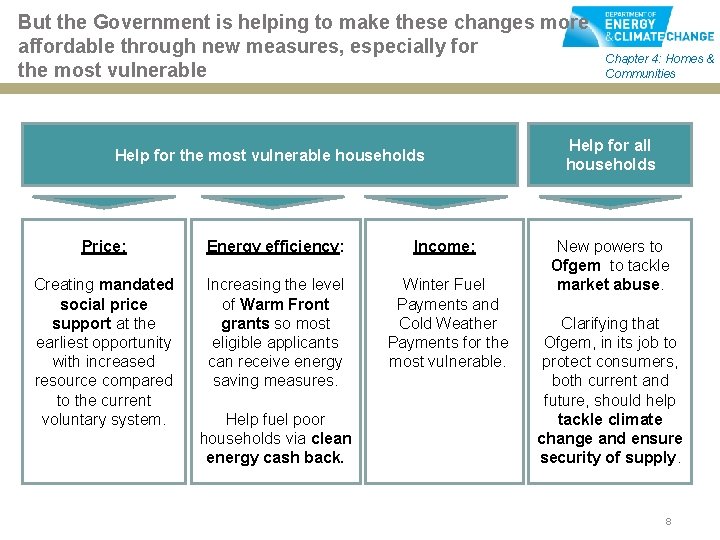
But the Government is helping to make these changes more affordable through new measures, especially for the most vulnerable Help for the most vulnerable households Price: Energy efficiency: Income: Creating mandated social price support at the earliest opportunity with increased resource compared to the current voluntary system. Increasing the level of Warm Front grants so most eligible applicants can receive energy saving measures. Winter Fuel Payments and Cold Weather Payments for the most vulnerable. Help fuel poor households via clean energy cash back. Chapter 4: Homes & Communities Help for all households New powers to Ofgem to tackle market abuse. Clarifying that Ofgem, in its job to protect consumers, both current and future, should help tackle climate change and ensure security of supply. 8
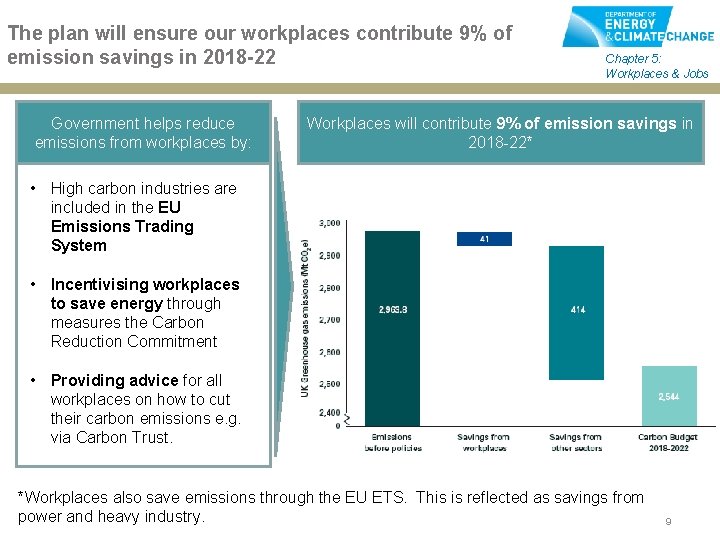
The plan will ensure our workplaces contribute 9% of emission savings in 2018 -22 Government helps reduce emissions from workplaces by: Chapter 5: Workplaces & Jobs Workplaces will contribute 9% of emission savings in 2018 -22* • High carbon industries are included in the EU Emissions Trading System • Incentivising workplaces to save energy through measures the Carbon Reduction Commitment • Providing advice for all workplaces on how to cut their carbon emissions e. g. via Carbon Trust. *Workplaces also save emissions through the EU ETS. This is reflected as savings from power and heavy industry. 9
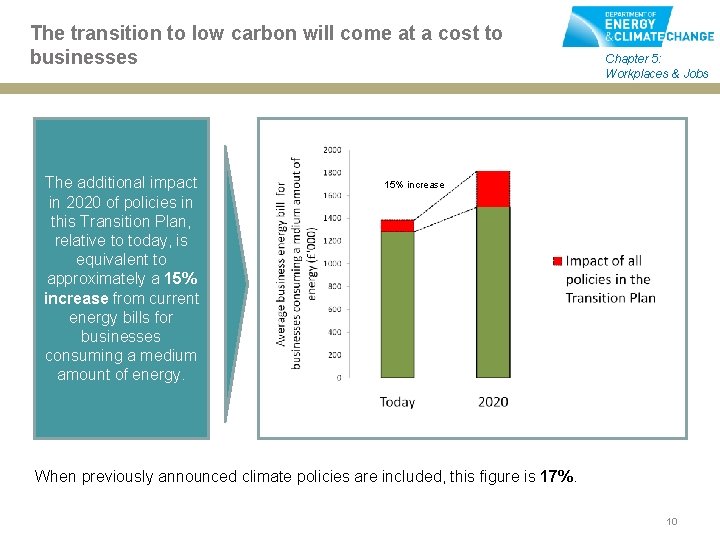
The transition to low carbon will come at a cost to businesses The additional impact in 2020 of policies in this Transition Plan, relative to today, is equivalent to approximately a 15% increase from current energy bills for businesses consuming a medium amount of energy. Chapter 5: Workplaces & Jobs 15% increase When previously announced climate policies are included, this figure is 17%. 10
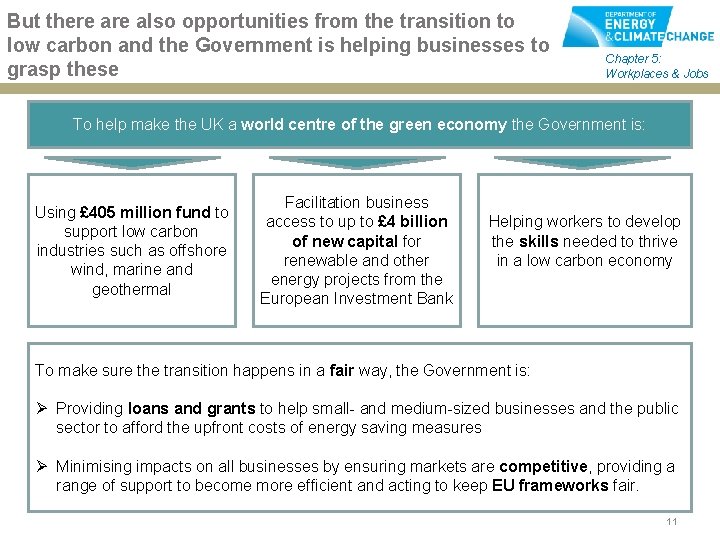
But there also opportunities from the transition to low carbon and the Government is helping businesses to grasp these Chapter 5: Workplaces & Jobs To help make the UK a world centre of the green economy the Government is: Using £ 405 million fund to support low carbon industries such as offshore wind, marine and geothermal Facilitation business access to up to £ 4 billion of new capital for renewable and other energy projects from the European Investment Bank Helping workers to develop the skills needed to thrive in a low carbon economy To make sure the transition happens in a fair way, the Government is: Ø Providing loans and grants to help small- and medium-sized businesses and the public sector to afford the upfront costs of energy saving measures Ø Minimising impacts on all businesses by ensuring markets are competitive, providing a range of support to become more efficient and acting to keep EU frameworks fair. 11
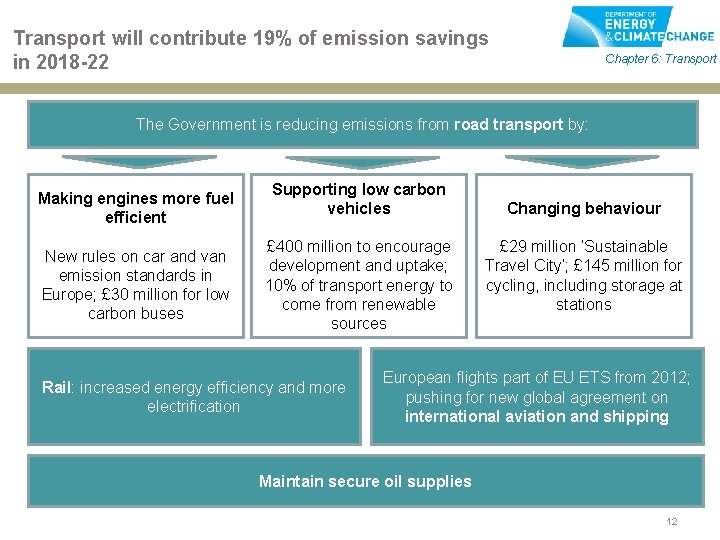
Transport will contribute 19% of emission savings in 2018 -22 Chapter 6: Transport The Government is reducing emissions from road transport by: Making engines more fuel efficient New rules on car and van emission standards in Europe; £ 30 million for low carbon buses Supporting low carbon vehicles £ 400 million to encourage development and uptake; 10% of transport energy to come from renewable sources Rail: increased energy efficiency and more electrification Changing behaviour £ 29 million ‘Sustainable Travel City’; £ 145 million for cycling, including storage at stations European flights part of EU ETS from 2012; pushing for new global agreement on international aviation and shipping Maintain secure oil supplies 12
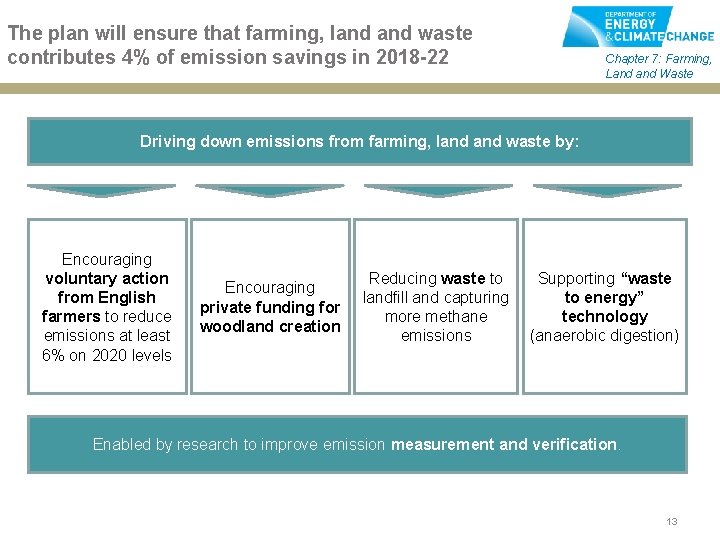
The plan will ensure that farming, land waste contributes 4% of emission savings in 2018 -22 Chapter 7: Farming, Land Waste Driving down emissions from farming, land waste by: Encouraging voluntary action from English farmers to reduce emissions at least 6% on 2020 levels Encouraging private funding for woodland creation Reducing waste to landfill and capturing more methane emissions Supporting “waste to energy” technology (anaerobic digestion) Enabled by research to improve emission measurement and verification. 13
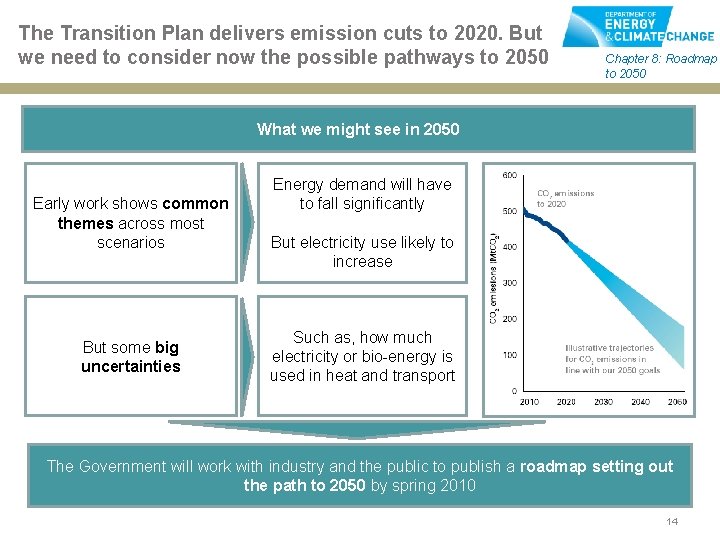
The Transition Plan delivers emission cuts to 2020. But we need to consider now the possible pathways to 2050 Chapter 8: Roadmap to 2050 What we might see in 2050 Early work shows common themes across most scenarios But some big uncertainties Energy demand will have to fall significantly But electricity use likely to increase Such as, how much electricity or bio-energy is used in heat and transport The Government will work with industry and the public to publish a roadmap setting out the path to 2050 by spring 2010 14
- Slides: 14