
The UK Housing Market A barometer of the
The UK Housing Market A barometer of the economy?
UK house price inflation (annual percentage rates, adjusted quarterly) Source: based on Halifax House Price Index (HBOS)
Who benefit from rising house prices? • The losers – The first-time buyer – Those upscaling • The gainers – Downsizers – Elderly going into homes – Emigrants • Those largely unaffected – Those not moving – Those moving to another area where house prices are similar
Who benefit from falling house prices? • The losers – Those with negative equity wanting to move – Downsizers – People exiting the housing market • Emigrants • Elderly going into homes • The gainers – The first-time buyer – Those upscaling • Those largely unaffected – Those not moving – Those moving to similar priced houses
Determination of house prices • Equilibrium in the housing market – Where supply of houses equals demand • Many different segments of the market – Price changes caused by shifts in D and/or S • D and/or S P • Problem of inelasticity of supply
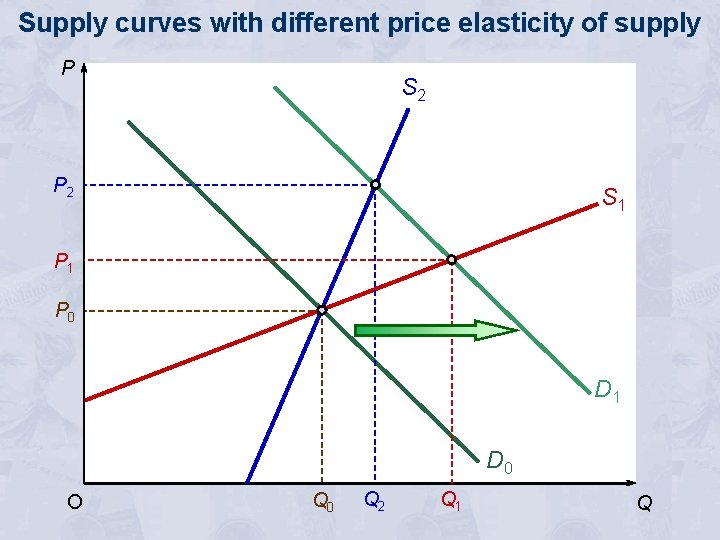
Supply curves with different price elasticity of supply P S 2 P 2 S 1 P 0 D 1 D 0 O Q 0 Q 2 Q 1 Q
Determination of house prices • Equilibrium in the housing market – Where supply of houses equals demand • Many different segments of the market – Price changes caused by shifts in D and/or S • D and/or S P • Problem of inelasticity of supply – Some lags in price adjustment • Especially when markets are turning • Currently there is a glut of properties, especially flats, because sellers are reluctant to reduce prices
Causes of rising house prices • Shifts in demand: short-term causes – Incomes • Current and expected – Interest rates • Current and expected
Halifax variable mortgage rate
Causes of rising house prices • Shifts in demand: short-term causes – Incomes • Current and expected – Interest rates • Current and expected – Availability of mortgages • • Credit rating of applicants Multiple of income Required deposit as % of value of property Problem of the credit crunch
Ratio of average house prices to average earnings £ 000 s Source: based on Halifax House Price Index (HBOS)
Causes of rising house prices • Shifts in demand: short-term causes – Incomes – Interest rates – Availability of mortgages – Rents (rental property is a substitute good) – Taxation: stamp duty – Speculation about future house prices
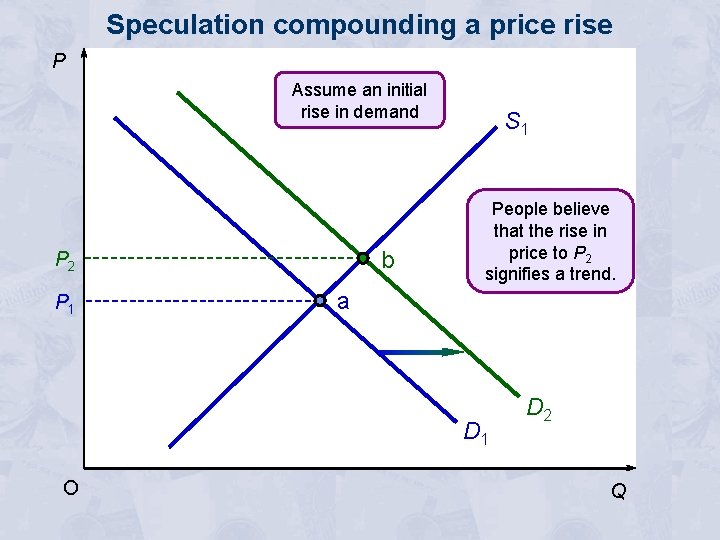
Speculation compounding a price rise P Assume an initial rise in demand b P 2 P 1 S 1 People believe that the rise in price to P 2 signifies a trend. a D 1 O D 2 Q
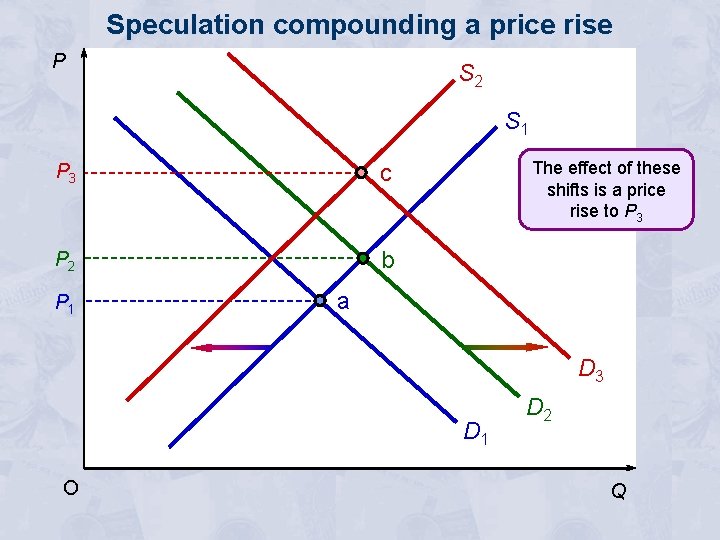
Speculation compounding a price rise P S 2 S 1 P 3 c P 2 b P 1 riserush inof price to The effect these Sellers hold back, Buyers to buy P is before compounded isfor a prices price waiting now prices 2 shifts by rise speculation tofurther. P 3 to rise any a D 3 D 1 O D 2 Q
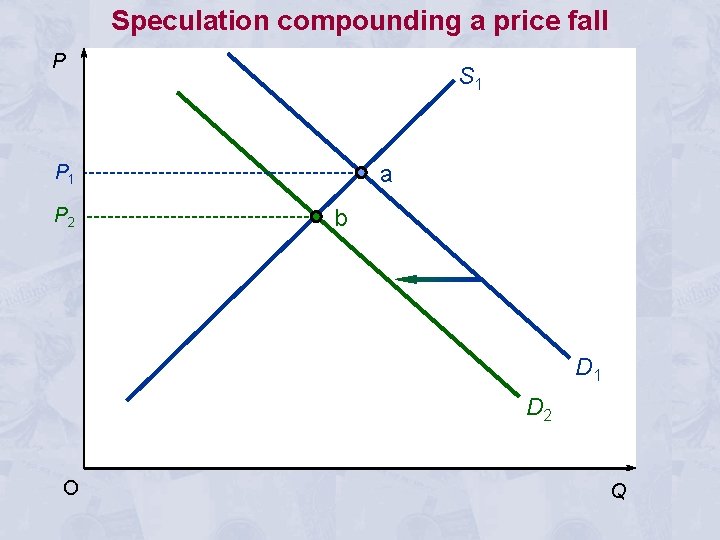
Speculation compounding a price fall P S 1 a P 1 P 2 b D 1 D 2 O Q
? Complete the diagram by adding a new demand curve (D 3) and a new supply curve (S 2) to illustrate the effect of speculation.
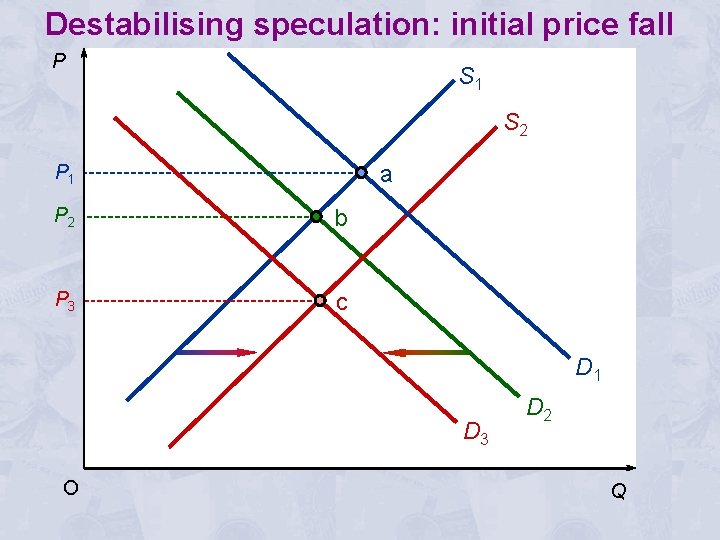
Destabilising speculation: initial price fall P S 1 S 2 a P 1 P 2 b P 3 c D 1 D 3 O D 2 Q
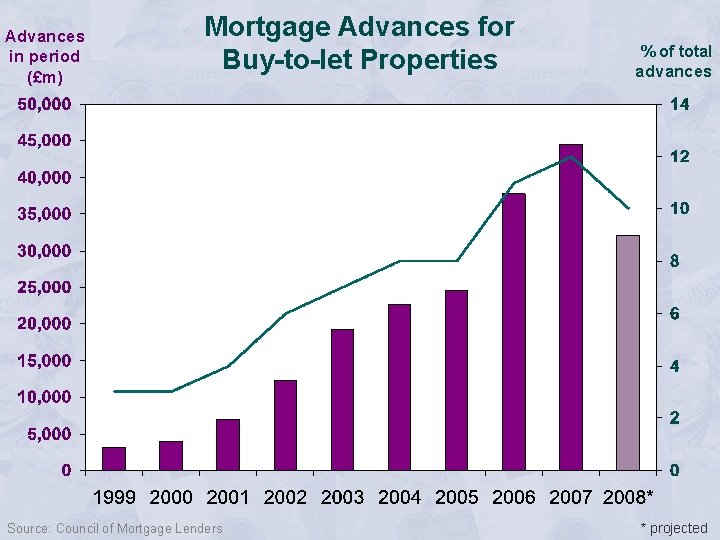
Advances in period (£m) Mortgage Advances for Buy-to-let Properties Source: Council of Mortgage Lenders % of total advances * projected
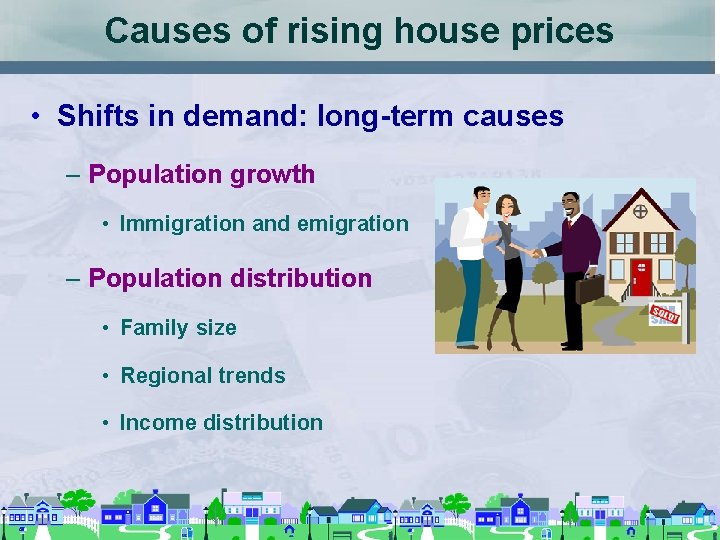
Causes of rising house prices • Shifts in demand: long-term causes – Population growth • Immigration and emigration – Population distribution • Family size • Regional trends • Income distribution
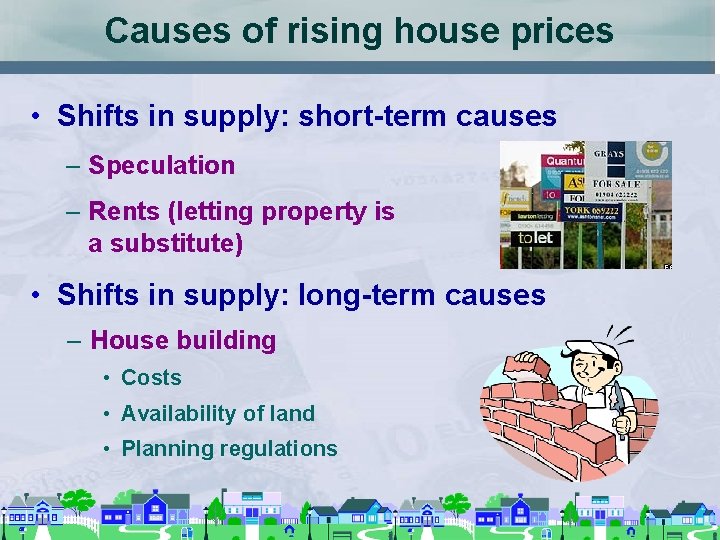
Causes of rising house prices • Shifts in supply: short-term causes – Speculation – Rents (letting property is a substitute) • Shifts in supply: long-term causes – House building • Costs • Availability of land • Planning regulations
What will happen to House Prices? Is there going to be a crash?
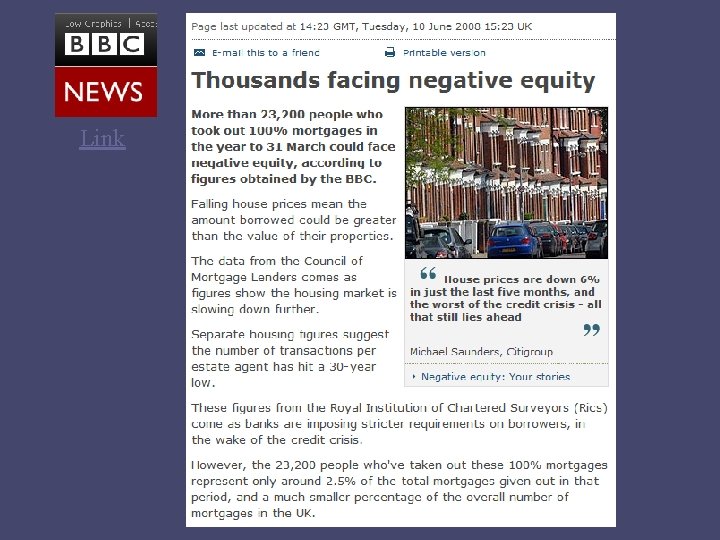
Link
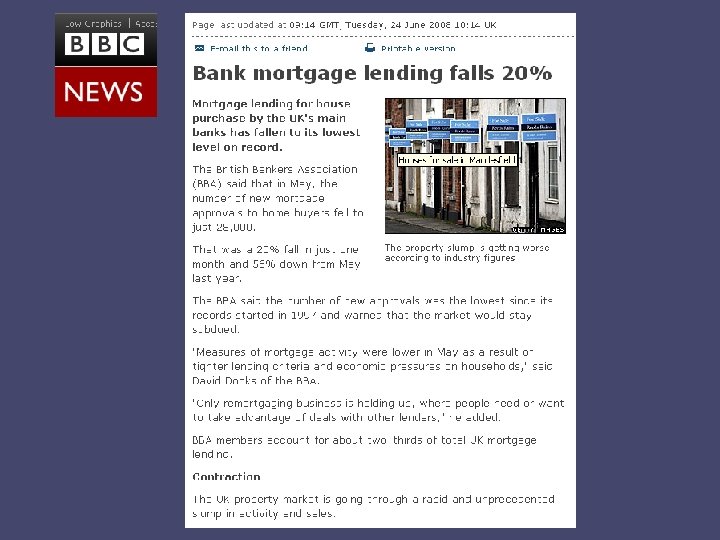
What will happen to house prices? • Short-term: probably fall sharply – Credit crunch – Buy-to-let is now much less profitable • In many cases rents do not cover the mortgage interest – Renting is now relatively more affordable – Speculation – Interest rates: actual and expected • Problem of inflation: B of E reluctant to reduce rate – Flats fall more than houses
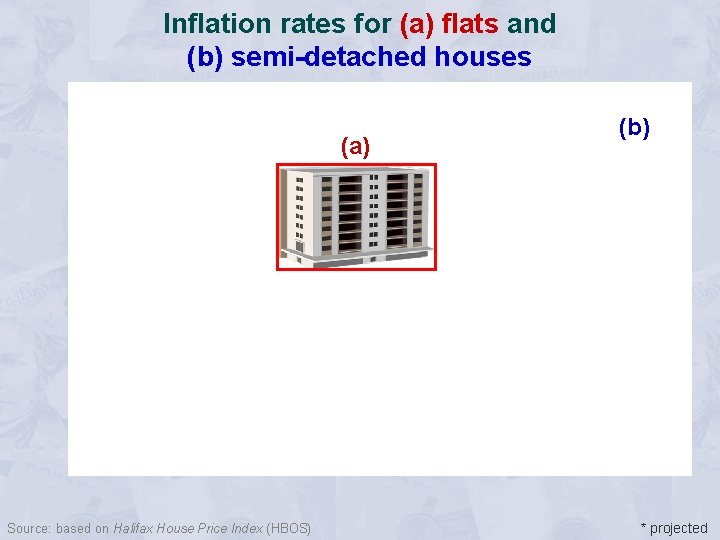
Inflation rates for (a) flats and (b) semi-detached houses (a) Source: based on Halifax House Price Index (HBOS) (b) * projected
What will happen to house prices? • Short-term: probably fall – Credit crunch – Buy-to-let is now much less profitable – Renting is now relatively more affordable – Speculation – Interest rates: actual and expected – Flats fall more than houses – North fall more than the south
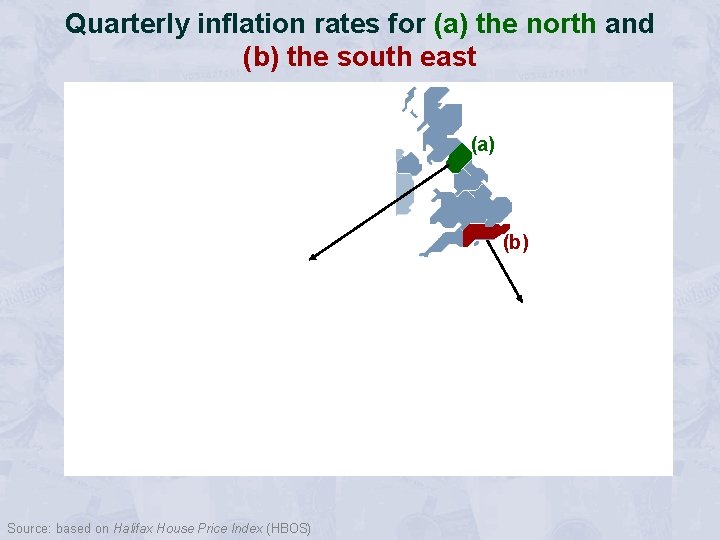
Quarterly inflation rates for (a) the north and (b) the south east (a) (b) Source: based on Halifax House Price Index (HBOS)
What will happen to house prices? • Short-term: probably fall – Credit crunch – Buy-to-let is now much less profitable – Renting is now relatively more affordable – Speculation – Interest rates: actual and expected – Flats fall more than houses – North fall more than the south • Long-term: probably rise – Demand will probably outstrip supply
What can the government do? • Demand – Making house ownership more affordable • Tax relief • Schemes for mortgage sharing – But ultimately increases demand • Supply
What can the government do? • Demand – Making house ownership more affordable • Tax relief • Schemes for mortgage sharing – But ultimately increases demand • Supply – Relaxing planning regulations – Public housing
Housing as a barometer of the economy • Demand reflects incomes – Recession causes lack of demand • People cannot afford to move • People less likely to move to other locations – Exaggerated effect • Interest rates – Depend on inflation – Reflect credit conditions – Affect the housing market • Housing market reflects confidence – Demand – House building • Housing market affects other markets – DIY, furniture, repairs, etc.
- Slides: 31