
The U S Political Spectrum Where do YOU
- Slides: 18
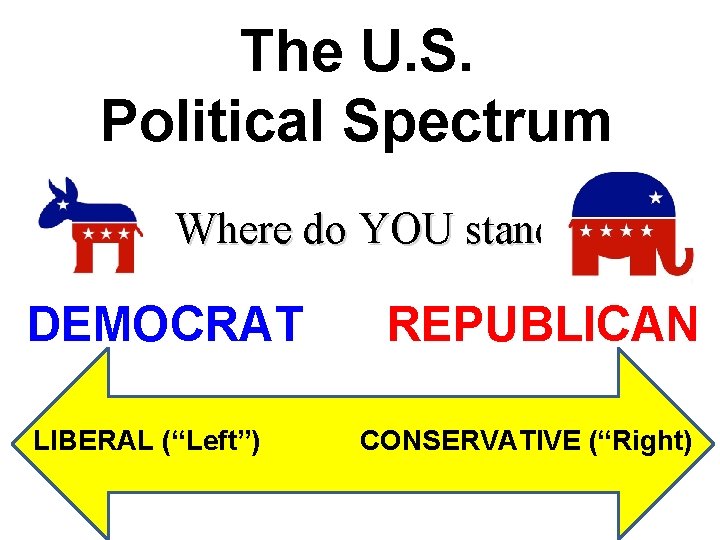
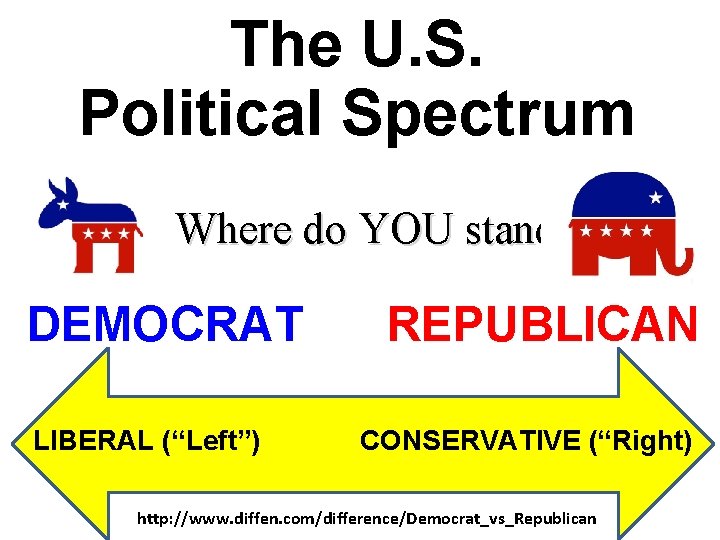
The U. S. Political Spectrum Where do YOU stand? DEMOCRAT LIBERAL (“Left”) REPUBLICAN CONSERVATIVE (“Right)
Origins of the 2 Parties Ø The Democratic Party traces its origins & heritage back to Party Thomas Jefferson & James Madison's Democratic. Republican Party. § The modern-day Democratic Party was founded around 1828 by supporters of Andrew Jackson, making it the world's oldest political party. Ø The Republican Party is the younger of the two parties. Party Founded in 1854 by anti-slavery expansion activists and modernizers, the Republican Party rose to prominence with the election of Abraham Lincoln, the first Republican president.
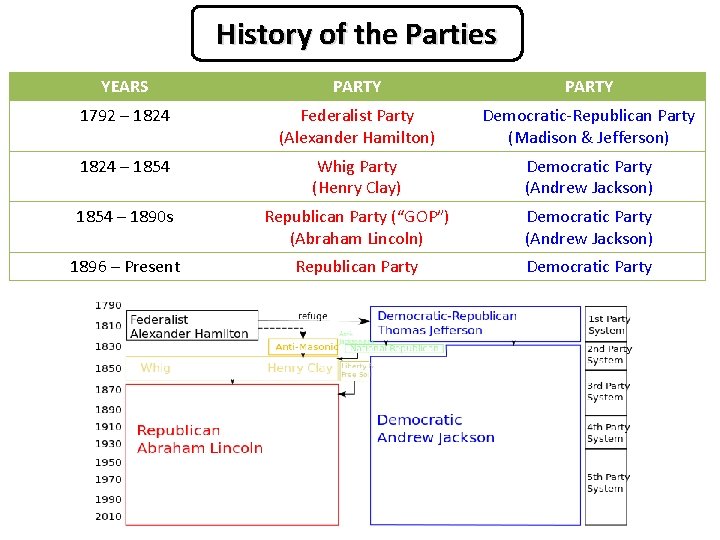
History of the Parties YEARS PARTY 1792 – 1824 Federalist Party (Alexander Hamilton) Democratic-Republican Party (Madison & Jefferson) 1824 – 1854 Whig Party (Henry Clay) Democratic Party (Andrew Jackson) 1854 – 1890 s Republican Party (“GOP”) (Abraham Lincoln) Democratic Party (Andrew Jackson) 1896 – Present Republican Party Democratic Party
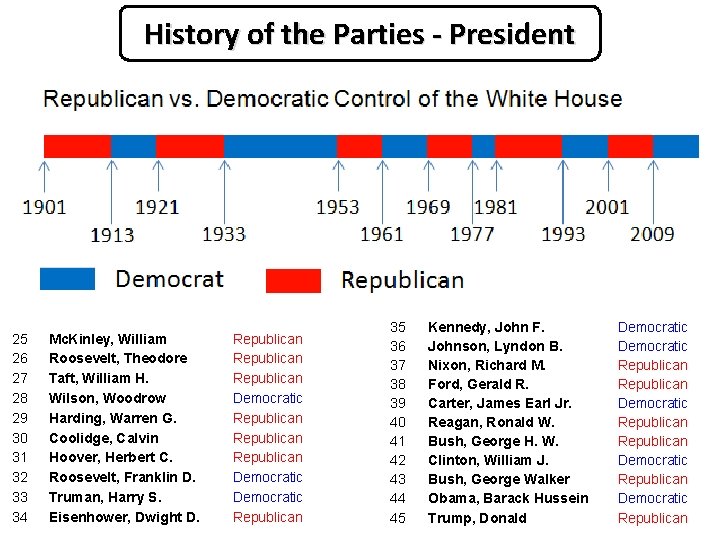
History of the Parties - President 25 26 27 28 29 30 31 32 33 34 Mc. Kinley, William Roosevelt, Theodore Taft, William H. Wilson, Woodrow Harding, Warren G. Coolidge, Calvin Hoover, Herbert C. Roosevelt, Franklin D. Truman, Harry S. Eisenhower, Dwight D. Republican Republican Democratic Republican 35 36 37 38 39 40 41 42 43 44 45 Kennedy, John F. Johnson, Lyndon B. Nixon, Richard M. Ford, Gerald R. Carter, James Earl Jr. Reagan, Ronald W. Bush, George H. W. Clinton, William J. Bush, George Walker Obama, Barack Hussein Trump, Donald Democratic Republican Democratic Republican
Comparisons of Ideologies or the Issues Where do YOU stand? DEMOCRAT LIBERAL (“Left”) REPUBLICAN CONSERVATIVE (“Right)
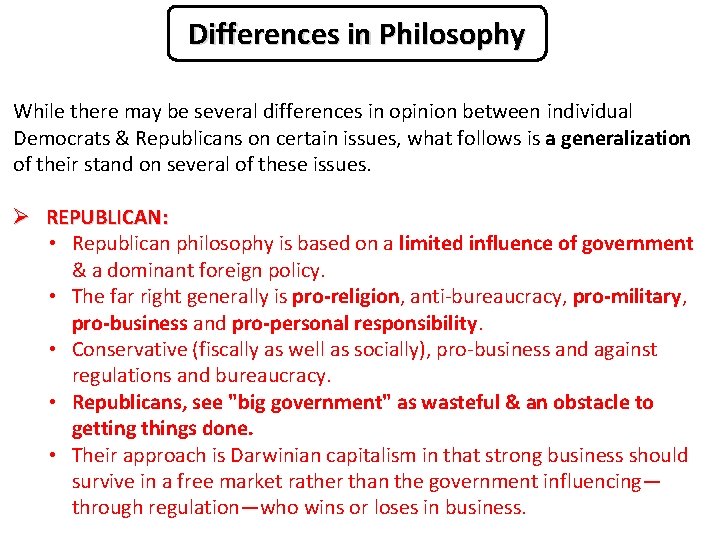
Differences in Philosophy While there may be several differences in opinion between individual Democrats & Republicans on certain issues, what follows is a generalization of their stand on several of these issues. Ø REPUBLICAN: • Republican philosophy is based on a limited influence of government & a dominant foreign policy. • The far right generally is pro-religion, anti-bureaucracy, pro-military, pro-business and pro-personal responsibility. • Conservative (fiscally as well as socially), pro-business and against regulations and bureaucracy. • Republicans, see "big government" as wasteful & an obstacle to getting things done. • Their approach is Darwinian capitalism in that strong business should survive in a free market rather than the government influencing— through regulation—who wins or loses in business.
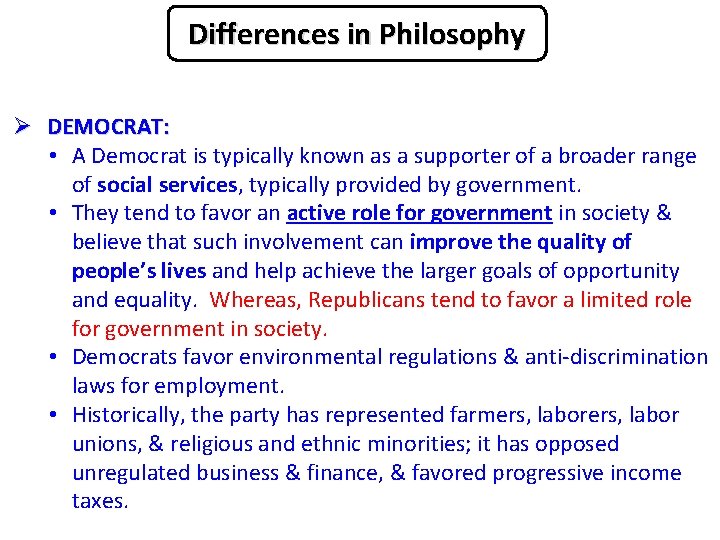
Differences in Philosophy Ø DEMOCRAT: • A Democrat is typically known as a supporter of a broader range of social services, typically provided by government. • They tend to favor an active role for government in society & believe that such involvement can improve the quality of people’s lives and help achieve the larger goals of opportunity and equality. Whereas, Republicans tend to favor a limited role for government in society. • Democrats favor environmental regulations & anti-discrimination laws for employment. • Historically, the party has represented farmers, labor unions, & religious and ethnic minorities; it has opposed unregulated business & finance, & favored progressive income taxes.
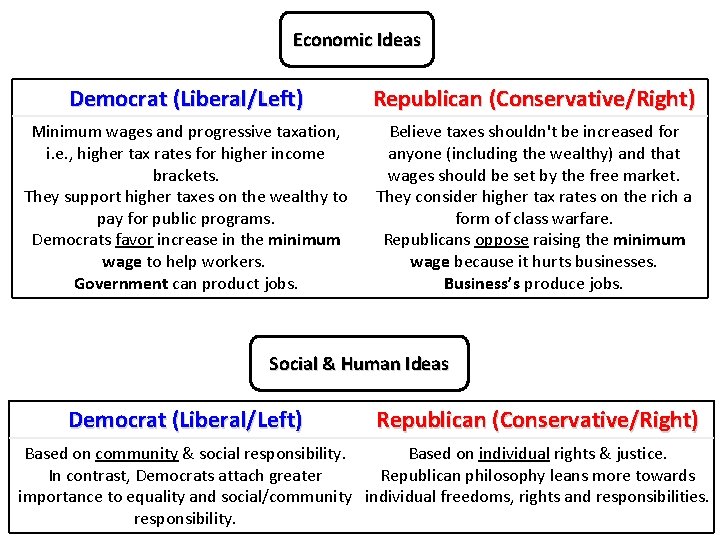
Economic Ideas Democrat (Liberal/Left) Republican (Conservative/Right) Minimum wages and progressive taxation, i. e. , higher tax rates for higher income brackets. They support higher taxes on the wealthy to pay for public programs. Democrats favor increase in the minimum wage to help workers. Government can product jobs. Believe taxes shouldn't be increased for anyone (including the wealthy) and that wages should be set by the free market. They consider higher tax rates on the rich a form of class warfare. Republicans oppose raising the minimum wage because it hurts businesses. Business’s produce jobs. Social & Human Ideas Democrat (Liberal/Left) Republican (Conservative/Right) Based on community & social responsibility. Based on individual rights & justice. In contrast, Democrats attach greater Republican philosophy leans more towards importance to equality and social/community individual freedoms, rights and responsibilities. responsibility.
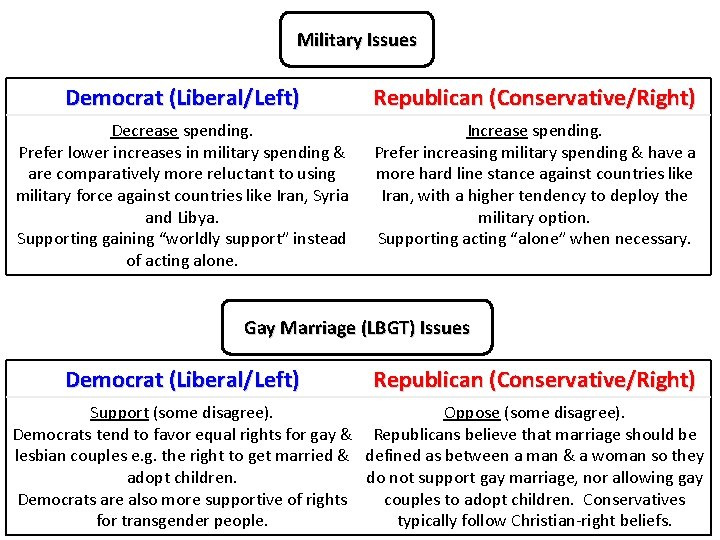
Military Issues Democrat (Liberal/Left) Republican (Conservative/Right) Decrease spending. Prefer lower increases in military spending & are comparatively more reluctant to using military force against countries like Iran, Syria and Libya. Supporting gaining “worldly support” instead of acting alone. Increase spending. Prefer increasing military spending & have a more hard line stance against countries like Iran, with a higher tendency to deploy the military option. Supporting acting “alone” when necessary. Gay Marriage (LBGT) Issues Democrat (Liberal/Left) Republican (Conservative/Right) Support (some disagree). Oppose (some disagree). Democrats tend to favor equal rights for gay & Republicans believe that marriage should be lesbian couples e. g. the right to get married & defined as between a man & a woman so they adopt children. do not support gay marriage, nor allowing gay Democrats are also more supportive of rights couples to adopt children. Conservatives for transgender people. typically follow Christian-right beliefs.
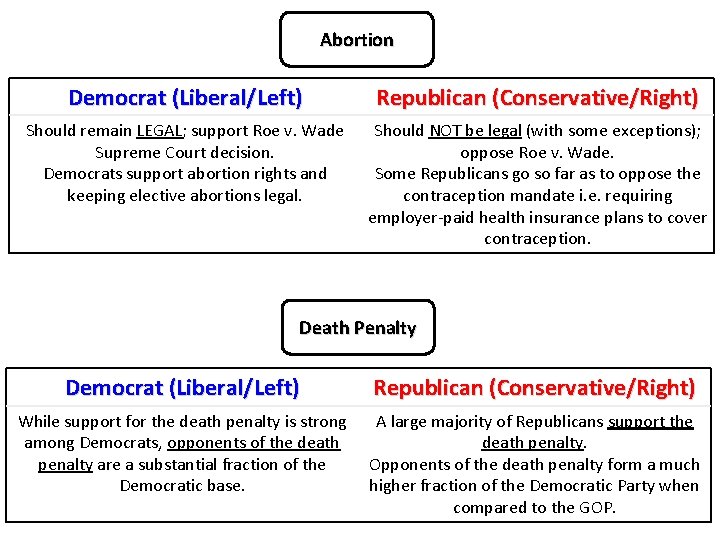
Abortion Democrat (Liberal/Left) Republican (Conservative/Right) Should remain LEGAL; support Roe v. Wade Supreme Court decision. Democrats support abortion rights and keeping elective abortions legal. Should NOT be legal (with some exceptions); oppose Roe v. Wade. Some Republicans go so far as to oppose the contraception mandate i. e. requiring employer-paid health insurance plans to cover contraception. Death Penalty Democrat (Liberal/Left) Republican (Conservative/Right) While support for the death penalty is strong among Democrats, opponents of the death penalty are a substantial fraction of the Democratic base. A large majority of Republicans support the death penalty. Opponents of the death penalty form a much higher fraction of the Democratic Party when compared to the GOP.
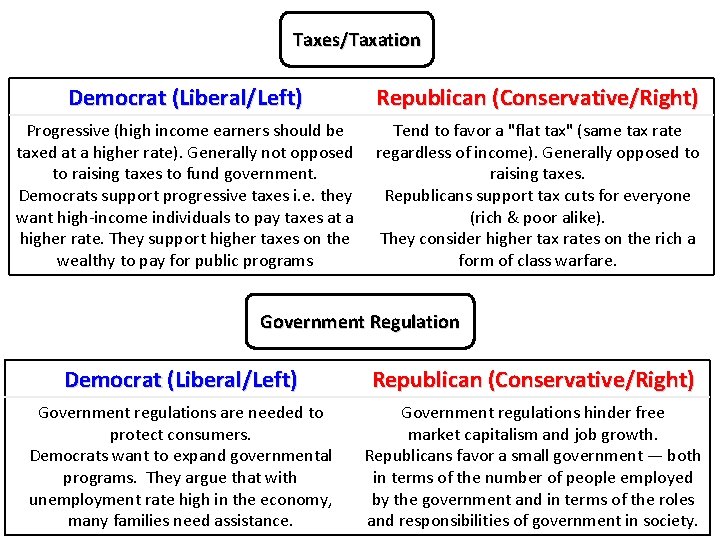
Taxes/Taxation Democrat (Liberal/Left) Republican (Conservative/Right) Progressive (high income earners should be Tend to favor a "flat tax" (same tax rate taxed at a higher rate). Generally not opposed regardless of income). Generally opposed to to raising taxes to fund government. raising taxes. Democrats support progressive taxes i. e. they Republicans support tax cuts for everyone want high-income individuals to pay taxes at a (rich & poor alike). higher rate. They support higher taxes on the They consider higher tax rates on the rich a wealthy to pay for public programs form of class warfare. Government Regulation Democrat (Liberal/Left) Republican (Conservative/Right) Government regulations are needed to protect consumers. Democrats want to expand governmental programs. They argue that with unemployment rate high in the economy, many families need assistance. Government regulations hinder free market capitalism and job growth. Republicans favor a small government — both in terms of the number of people employed by the government and in terms of the roles and responsibilities of government in society.
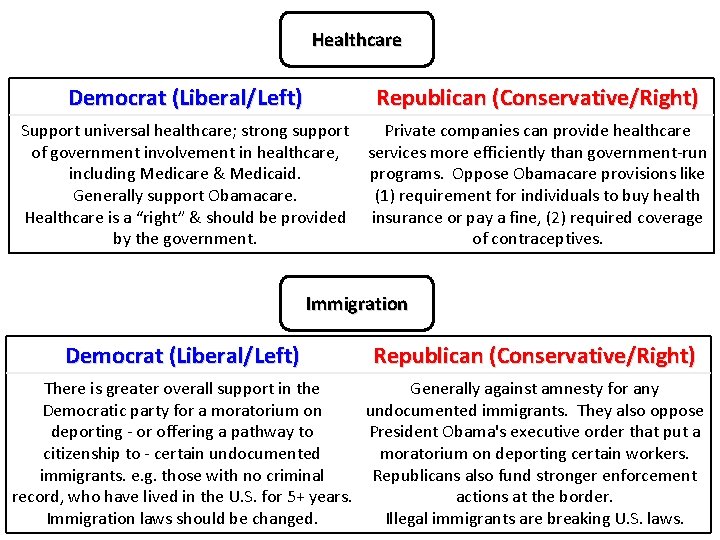
Healthcare Democrat (Liberal/Left) Republican (Conservative/Right) Support universal healthcare; strong support Private companies can provide healthcare of government involvement in healthcare, services more efficiently than government-run including Medicare & Medicaid. programs. Oppose Obamacare provisions like Generally support Obamacare. (1) requirement for individuals to buy health Healthcare is a “right” & should be provided insurance or pay a fine, (2) required coverage by the government. of contraceptives. Immigration Democrat (Liberal/Left) Republican (Conservative/Right) There is greater overall support in the Generally against amnesty for any Democratic party for a moratorium on undocumented immigrants. They also oppose deporting - or offering a pathway to President Obama's executive order that put a citizenship to - certain undocumented moratorium on deporting certain workers. immigrants. e. g. those with no criminal Republicans also fund stronger enforcement record, who have lived in the U. S. for 5+ years. actions at the border. Immigration laws should be changed. Illegal immigrants are breaking U. S. laws.
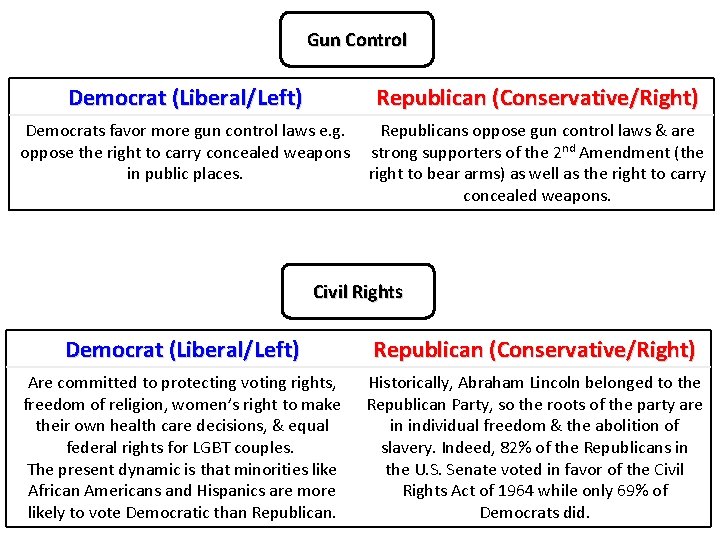
Gun Control Democrat (Liberal/Left) Republican (Conservative/Right) Democrats favor more gun control laws e. g. Republicans oppose gun control laws & are oppose the right to carry concealed weapons strong supporters of the 2 nd Amendment (the in public places. right to bear arms) as well as the right to carry concealed weapons. Civil Rights Democrat (Liberal/Left) Republican (Conservative/Right) Are committed to protecting voting rights, freedom of religion, women’s right to make their own health care decisions, & equal federal rights for LGBT couples. The present dynamic is that minorities like African Americans and Hispanics are more likely to vote Democratic than Republican. Historically, Abraham Lincoln belonged to the Republican Party, so the roots of the party are in individual freedom & the abolition of slavery. Indeed, 82% of the Republicans in the U. S. Senate voted in favor of the Civil Rights Act of 1964 while only 69% of Democrats did.
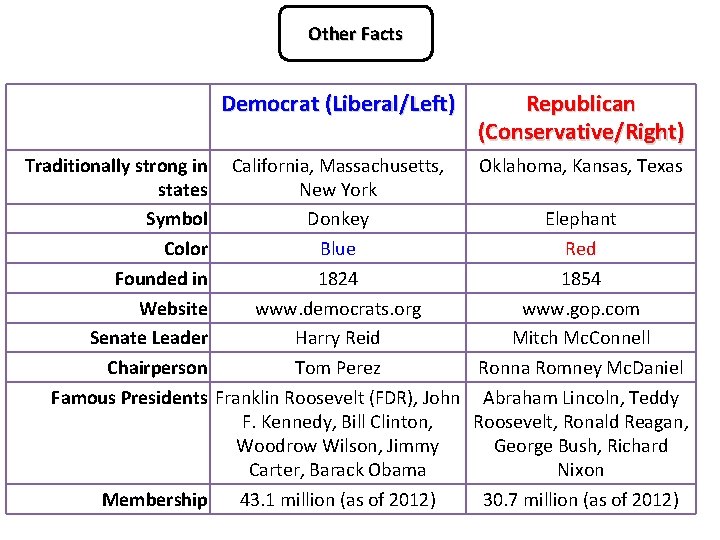
Other Facts Democrat (Liberal/Left) Traditionally strong in California, Massachusetts, states New York Symbol Donkey Color Blue Founded in 1824 Website www. democrats. org Senate Leader Harry Reid Chairperson Tom Perez Famous Presidents Franklin Roosevelt (FDR), John F. Kennedy, Bill Clinton, Woodrow Wilson, Jimmy Carter, Barack Obama Membership 43. 1 million (as of 2012) Republican (Conservative/Right) Oklahoma, Kansas, Texas Elephant Red 1854 www. gop. com Mitch Mc. Connell Ronna Romney Mc. Daniel Abraham Lincoln, Teddy Roosevelt, Ronald Reagan, George Bush, Richard Nixon 30. 7 million (as of 2012)
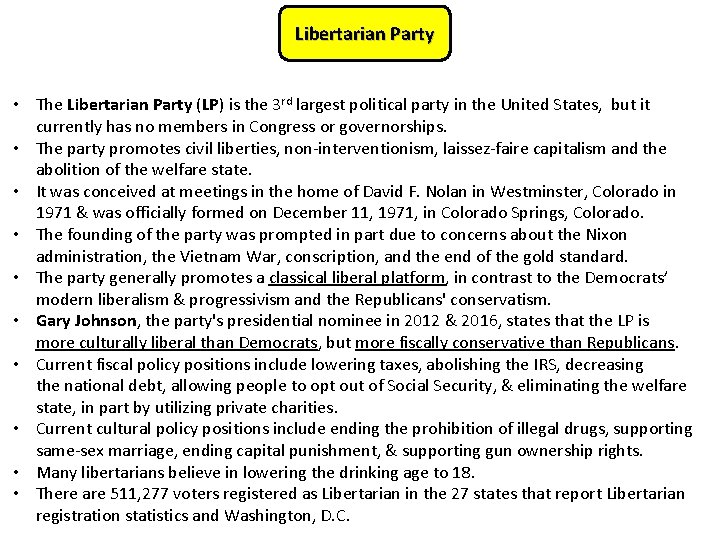
Libertarian Party • The Libertarian Party (LP) is the 3 rd largest political party in the United States, but it currently has no members in Congress or governorships. • The party promotes civil liberties, non-interventionism, laissez-faire capitalism and the abolition of the welfare state. • It was conceived at meetings in the home of David F. Nolan in Westminster, Colorado in 1971 & was officially formed on December 11, 1971, in Colorado Springs, Colorado. • The founding of the party was prompted in part due to concerns about the Nixon administration, the Vietnam War, conscription, and the end of the gold standard. • The party generally promotes a classical liberal platform, in contrast to the Democrats’ modern liberalism & progressivism and the Republicans' conservatism. • Gary Johnson, the party's presidential nominee in 2012 & 2016, states that the LP is more culturally liberal than Democrats, but more fiscally conservative than Republicans. • Current fiscal policy positions include lowering taxes, abolishing the IRS, decreasing the national debt, allowing people to opt out of Social Security, & eliminating the welfare state, in part by utilizing private charities. • Current cultural policy positions include ending the prohibition of illegal drugs, supporting same-sex marriage, ending capital punishment, & supporting gun ownership rights. • Many libertarians believe in lowering the drinking age to 18. • There are 511, 277 voters registered as Libertarian in the 27 states that report Libertarian registration statistics and Washington, D. C.
Green Party • The Green Party of the United States (GPUS or Greens) is the 4 th largest political party in the United States. • The party, promotes environmentalism, nonviolence, social justice, participatory grassroots democracy, gender equality, LGBT rights, anti-war & anti-racism. • On the political spectrum the party is generally seen as left-wing. • The GPUS was founded in 2001 as the evolution of the Association of State Green Parties (ASGP), which was formed in 1996. After its founding, the GPUS soon became the primary national green organization in the country, eclipsing the Greens/Green Party USA (G/GPUSA), which formed in 1991 out of the Green Committees of Correspondence (Co. C), a collection of local green groups active since 1984. • The Greens gained widespread public attention during the 2000 presidential election, when the ticket composed of Ralph Nader and Winona La. Duke won 2. 7% of the popular vote. Nader was vilified by many Democrats & even some Greens, who accused him of spoiling the election for Al Gore, the Democratic candidate. The degree of Nader's impact on the 2000 election remains controversial. • The GPUS has had several members elected into state legislatures, including in California, Maine & Arkansas. • In September 2017, independent Ralph Chapman, member of the Maine House of Representatives, switched his affiliation to the Green Party. • A number of Greens around the United States hold positions on the municipal level, including on school boards, city councils and as mayors.
The U. S. Political Spectrum Where do YOU stand? DEMOCRAT LIBERAL (“Left”) REPUBLICAN CONSERVATIVE (“Right) http: //www. diffen. com/difference/Democrat_vs_Republican