
The U S Disability Belt A Spatial Analysis
The U. S. Disability Belt: A Spatial Analysis of Geographic Variation in Disability Amanda Botticello, Ph. D, MPH Andrew Houtenville, Ph. D John O’Neill, Ph. D *This research is funded by the National Institute for Disability and Rehabilitation Research (NIDILRR), grant H 133 B 130015.
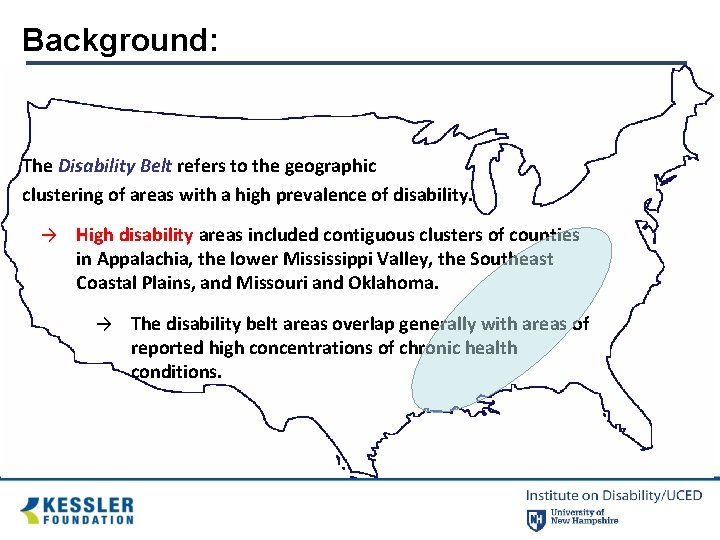
Background: The Disability Belt refers to the geographic clustering of areas with a high prevalence of disability. → High disability areas included contiguous clusters of counties in Appalachia, the lower Mississippi Valley, the Southeast Coastal Plains, and Missouri and Oklahoma. → The disability belt areas overlap generally with areas of reported high concentrations of chronic health conditions.
Background: Ø Understanding geographic variation is important for understanding how area characteristics—demographic, social, physical, and institutional—affect disability prevalence. Ø Evidence of clustering can be used by state and local health agencies to target policy and interventions to high -risk areas.
Background Limitations of prior research § Prior analyses have been largely descriptive and visual. § More recently, work on geographic variation in health conditions has moved to identifying “high risk” clusters with spatial statistics. § Information based on singular data sources. § Labor market participation data. § Survey data that offers a broader perspective on the experience of disability and disability type. § Focus on high prevalence areas. § Areas with low prevalence disability are similarly important for understanding the contextual influences of disability.
Research Questions I. How does the geographic distribution of disability compare across different data and disability types? II. Is the spatial clustering of disability significant and where are these clusters located? III. What contextual factors are associated with geographic variation in the distribution of disability? § Socioeconomic. § Disability types.
Analytic Approach I. Mapping: To visualize and compare the distribution of disability prevalence and program participation. II. Spatial clustering: To detect areas with significant concentrations of reported disability. a. Spatial auto-correlation statistics were calculated to assess global spatial clustering (Moran’s I). b. Univariate LISA analysis used to identify statistically significant “hot” and “cold” spots (p < 0. 01). III. Contextualizing: Lagged spatial regression models were estimated to assess the relationship between county-level SES and disability.
Sources of Data Disability data: § American Community Survey (ACS) pooled five-year sample (US Census Bureau). § Old-Age, Survivors, and Disability Insurance (OASDI) program participants (Social Security Administration). Spatial data: § US Census TIGERLINE files. Attribute data: § ACS pooled five-year sample. § Median household income ($10, 000), % unemployed, % households receiving public assistance, % persons with high school diploma. All data: § 2010. § County-level (N = 3, 109) in the 48 contiguous United States. All analyses were conducted in Geo. Da version 1. 8. 14.

Disability Prevalence American Community Survey (ACS) data. § Six self-reported questions assessing functioning difficulties. § Hearing, vision, cognition, ambulation, self care, or independent living. § Percent disabled = (1+ disability/Total working age population)*100% Social Security Administration (SSA) data. § Social Security Disability Insurance (SSDI) recipients. § Persons no longer able to work due to disability. § Percent disabled = (Total disabled workers /Total working age population)*100%. *Working-Age Population: Total county population 18 -64 years.
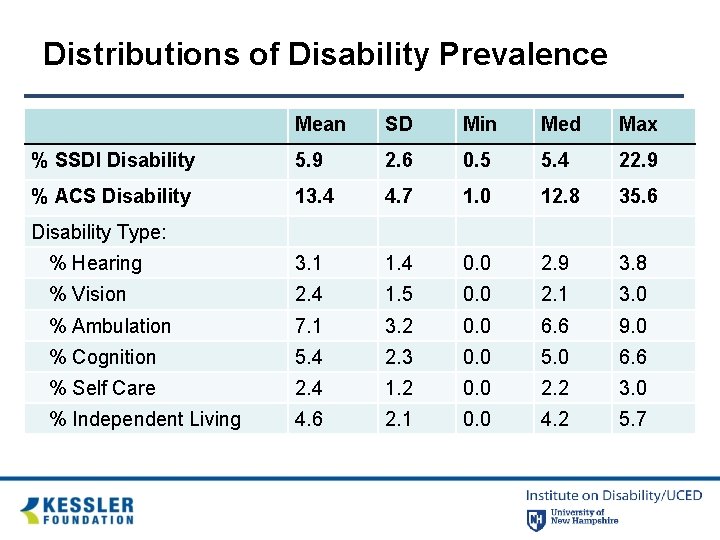
Distributions of Disability Prevalence Mean SD Min Med Max % SSDI Disability 5. 9 2. 6 0. 5 5. 4 22. 9 % ACS Disability 13. 4 4. 7 1. 0 12. 8 35. 6 % Hearing 3. 1 1. 4 0. 0 2. 9 3. 8 % Vision 2. 4 1. 5 0. 0 2. 1 3. 0 % Ambulation 7. 1 3. 2 0. 0 6. 6 9. 0 % Cognition 5. 4 2. 3 0. 0 5. 0 6. 6 % Self Care 2. 4 1. 2 0. 0 2. 2 3. 0 % Independent Living 4. 6 2. 1 0. 0 4. 2 5. 7 Disability Type:
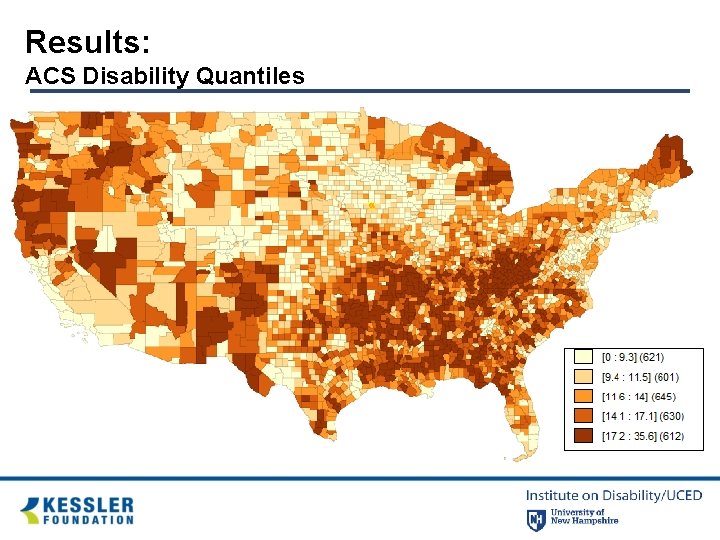
Results: ACS Disability Quantiles
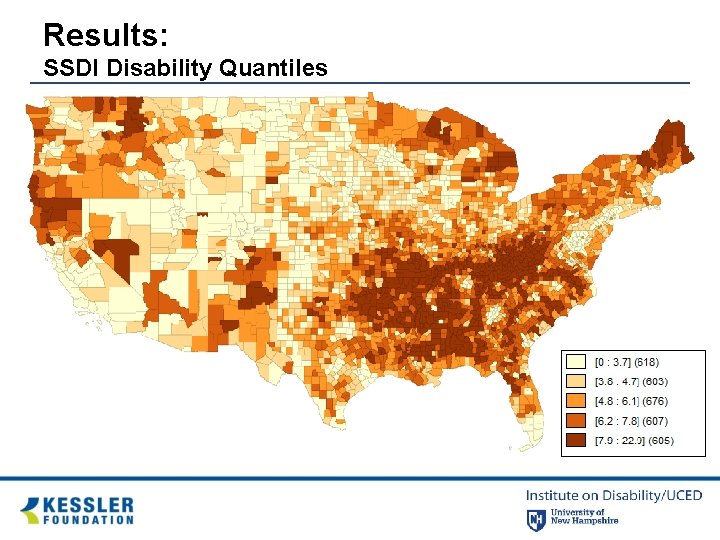
Results: SSDI Disability Quantiles
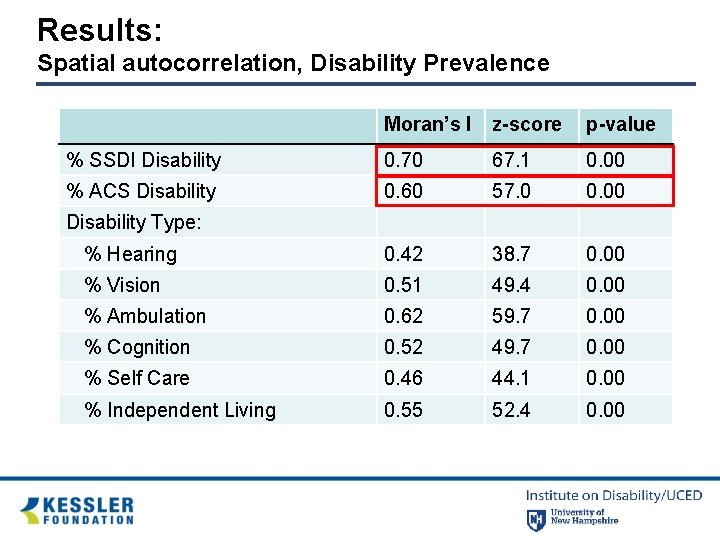
Results: Spatial autocorrelation, Disability Prevalence Moran’s I z-score p-value % SSDI Disability 0. 70 67. 1 0. 00 % ACS Disability 0. 60 57. 0 0. 00 % Hearing 0. 42 38. 7 0. 00 % Vision 0. 51 49. 4 0. 00 % Ambulation 0. 62 59. 7 0. 00 % Cognition 0. 52 49. 7 0. 00 % Self Care 0. 46 44. 1 0. 00 % Independent Living 0. 55 52. 4 0. 00 Disability Type:
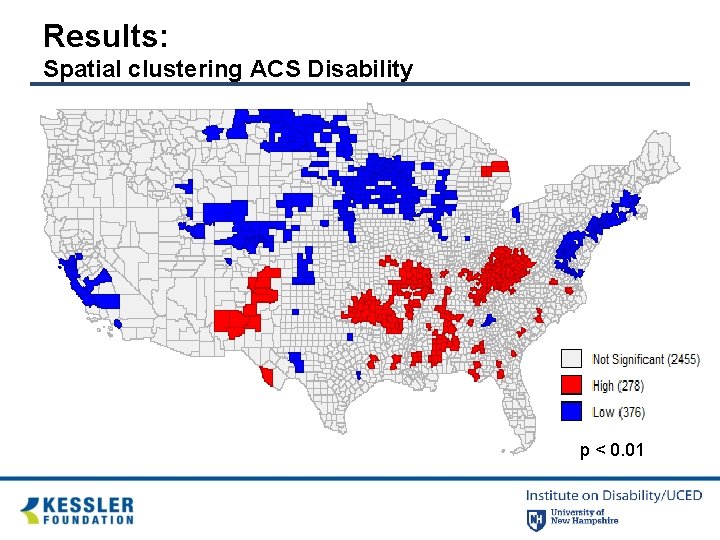
Results: Spatial clustering ACS Disability p < 0. 01
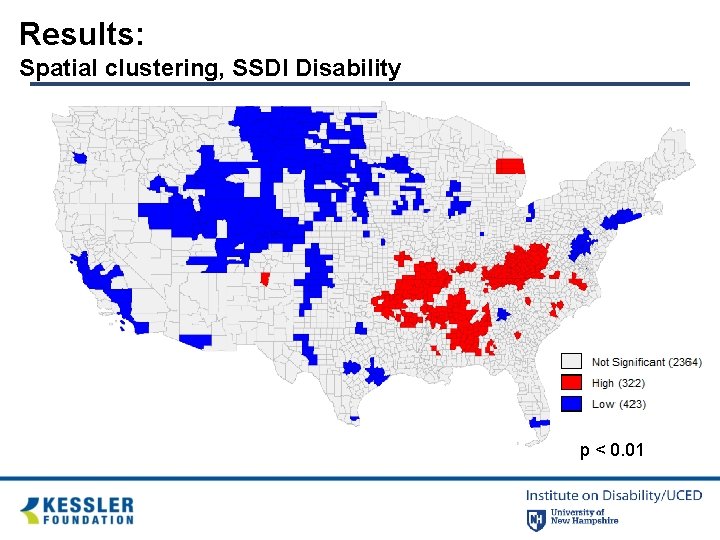
Results: Spatial clustering, SSDI Disability p < 0. 01
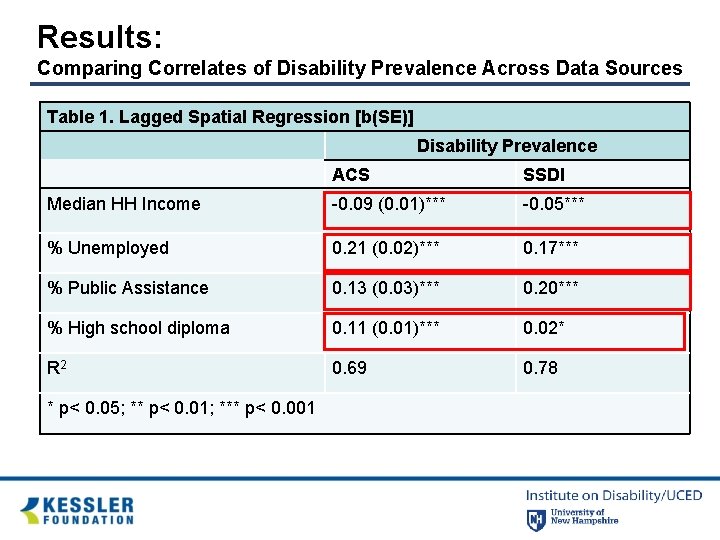
Results: Comparing Correlates of Disability Prevalence Across Data Sources Table 1. Lagged Spatial Regression [b(SE)] Disability Prevalence ACS SSDI Median HH Income -0. 09 (0. 01)*** -0. 05*** % Unemployed 0. 21 (0. 02)*** 0. 17*** % Public Assistance 0. 13 (0. 03)*** 0. 20*** % High school diploma 0. 11 (0. 01)*** 0. 02* R 2 0. 69 0. 78 * p< 0. 05; ** p< 0. 01; *** p< 0. 001
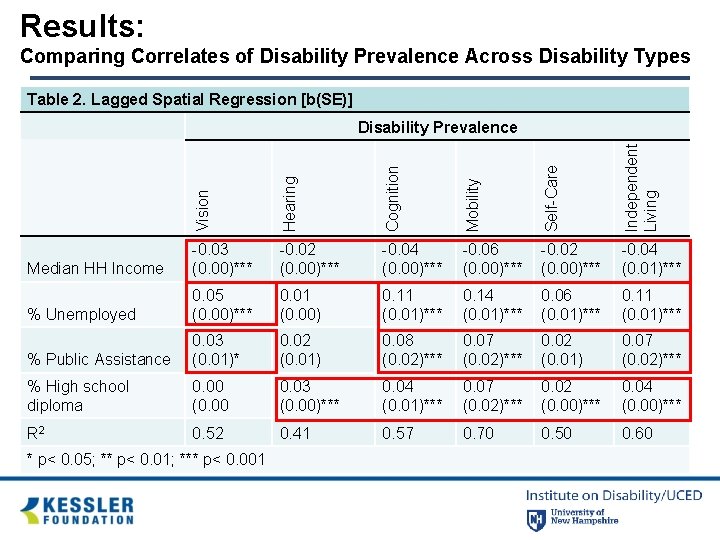
Results: Comparing Correlates of Disability Prevalence Across Disability Types Table 2. Lagged Spatial Regression [b(SE)] Vision Hearing Cognition Mobility Self-Care Independent Living Disability Prevalence Median HH Income -0. 03 (0. 00)*** -0. 02 (0. 00)*** -0. 04 (0. 00)*** -0. 06 (0. 00)*** -0. 02 (0. 00)*** -0. 04 (0. 01)*** % Unemployed 0. 05 (0. 00)*** 0. 01 (0. 00) 0. 11 (0. 01)*** 0. 14 (0. 01)*** 0. 06 (0. 01)*** 0. 11 (0. 01)*** % Public Assistance 0. 03 (0. 01)* 0. 02 (0. 01) 0. 08 (0. 02)*** 0. 07 (0. 02)*** 0. 02 (0. 01) 0. 07 (0. 02)*** % High school diploma 0. 00 (0. 00 0. 03 (0. 00)*** 0. 04 (0. 01)*** 0. 07 (0. 02)*** 0. 02 (0. 00)*** 0. 04 (0. 00)*** R 2 0. 52 0. 41 0. 57 0. 70 0. 50 0. 60 * p< 0. 05; ** p< 0. 01; *** p< 0. 001
![Results: Association between Disability Types and SSDI Disability Table 3. Lagged Spatial Regression [b(SE)]](http://slidetodoc.com/presentation_image_h2/2cd035b302d47e26b51c74f6accc2412/image-17.jpg "Results: Association between Disability Types and SSDI Disability Table 3. Lagged Spatial Regression [b(SE)]")
Results: Association between Disability Types and SSDI Disability Table 3. Lagged Spatial Regression [b(SE)] SSDI Disability Prevalence I II IV V VI VII % Any ACS disability 0. 21(0. 00)*** -- -- -- % Vision -- 0. 25(0. 02)*** -- -- -- % Hearing -- -- 0. 26(0. 02)*** -- -- % Cognitive -- -- -- 0. 32(0. 01)*** -- -- -- % Mobility -- -- 0. 32(0. 01)*** -- -- % Self-care -- -- -- 0. 48(0. 02)*** -- % Independent living -- -- -- 0. 41(0. 01)*** R 2 0. 82 0. 78 0. 80 0. 82 0. 80 0. 81 * p< 0. 05; ** p< 0. 01; *** p< 0. 001 Adjusted for median household income, unemployment, public assistance, high school graduates
Summary § Maps of disability prevalence showed similar geographic variation in ACS and SSDI disability prevalence. § Spatial statistics demonstrated significant geographic clustering by both data sources and by disability type. § Both SSDI and ACS showed significantly high disability clusters in Appalachia as well as parts of Missouri, Oklahoma, and Michigan. § ACS showed additional high prevalence in parts of New Mexico. § Low prevalence was significant in the New York metro-area, the California coast, and the Midwest and Mountain states. § Indicators of low county level socioeconomic status were associated with higher disability prevalence across data sources and types.
Future Considerations § Determine additional factors related to spatial variation in disability and disability types. § Demographic & social § Industrial mix § Examine differences in spatial variation by region.

Questions? abotticello@kesslerfoundation. org Thank You!
- Slides: 20