
The U S Constitution History Declaration of Independence
- Slides: 43
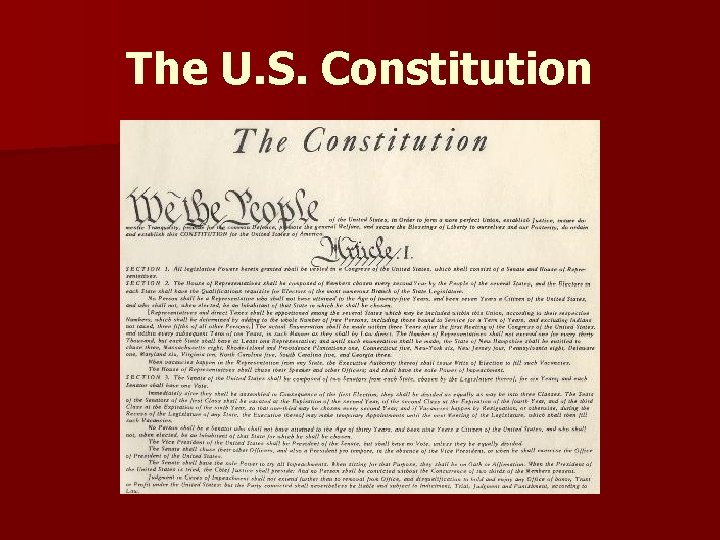
The U. S. Constitution
History Declaration of Independence n The Declaration of Independence was signed on July 4, 1776, in Philadelphia, PA. n It separated the colonies from England during the Revolutionary War.
Articles of Confederation n The Articles of Confederation were the country’s form of government from 1781 -1787. n The Articles had many weaknesses, such as no executive branch and the inability to collect taxes. n They were eventually replaced by the U. S. Constitution.
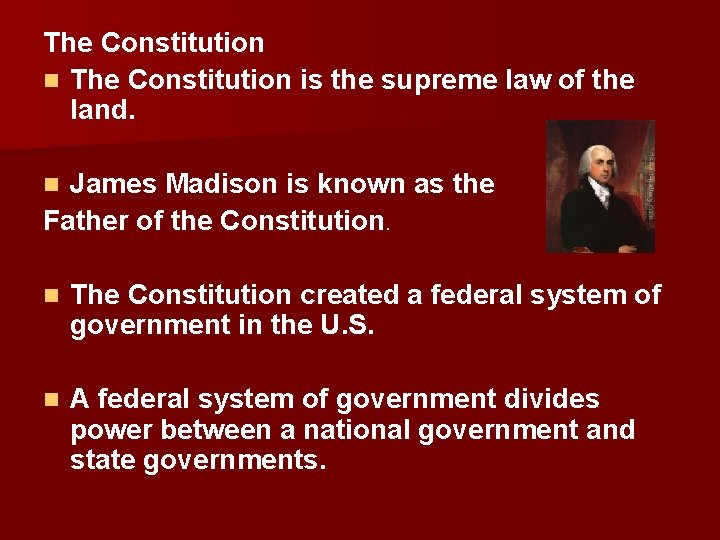
The Constitution n The Constitution is the supreme law of the land. James Madison is known as the Father of the Constitution. n n The Constitution created a federal system of government in the U. S. n A federal system of government divides power between a national government and state governments.
n Before the Constitution could be ratified, a Great Compromise had to be reached between the 13 colonies. n Large states wanted representation in Congress to be based on a state’s population (Virginia Plan). n Small states wanted representation in Congress to be based on every state having just one vote (New Jersey Plan).
n A committee eventually agreed on a two house Congress. One house would be based on a state’s population, and the other house would have two representatives from each state. n There is a basic principle that can be found in both the Declaration of Independence and the Constitution. It is known as popular sovereignty. This means that a government gets its power from its people. n Powers in the Constitution are both expressed and implied. Expressed give rights to individual people. Implied allow the government to expand its own power. This is known as the elastic clause.
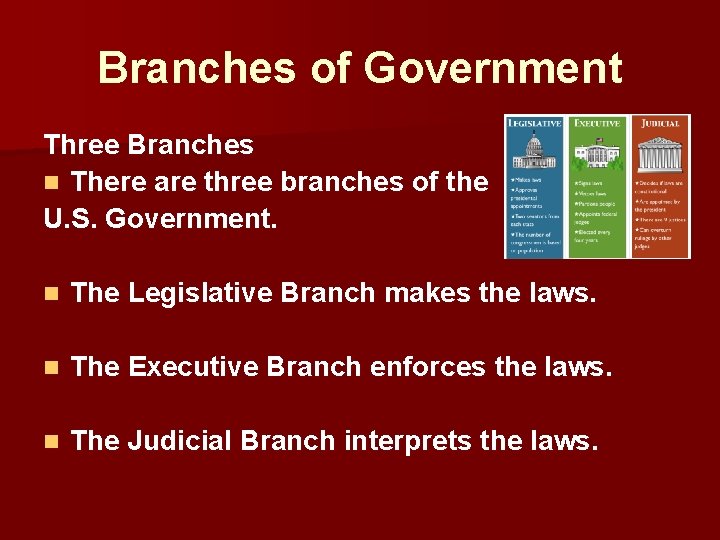
Branches of Government Three Branches n There are three branches of the U. S. Government. n The Legislative Branch makes the laws. n The Executive Branch enforces the laws. n The Judicial Branch interprets the laws.
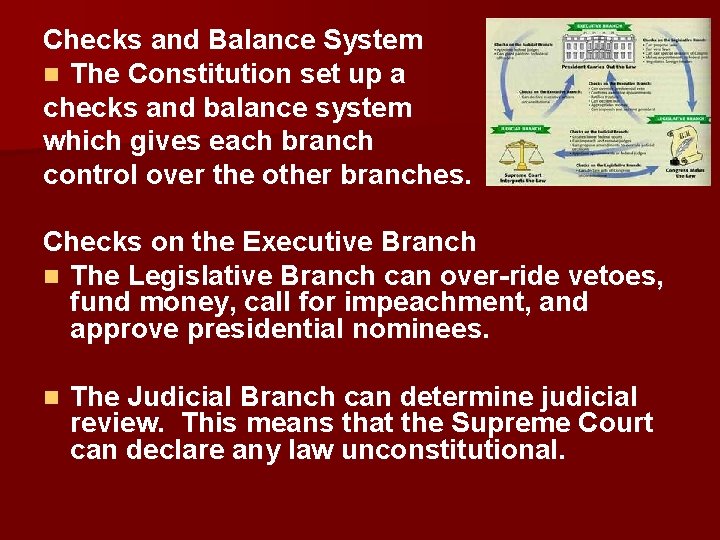
Checks and Balance System n The Constitution set up a checks and balance system which gives each branch control over the other branches. Checks on the Executive Branch n The Legislative Branch can over-ride vetoes, fund money, call for impeachment, and approve presidential nominees. n The Judicial Branch can determine judicial review. This means that the Supreme Court can declare any law unconstitutional.
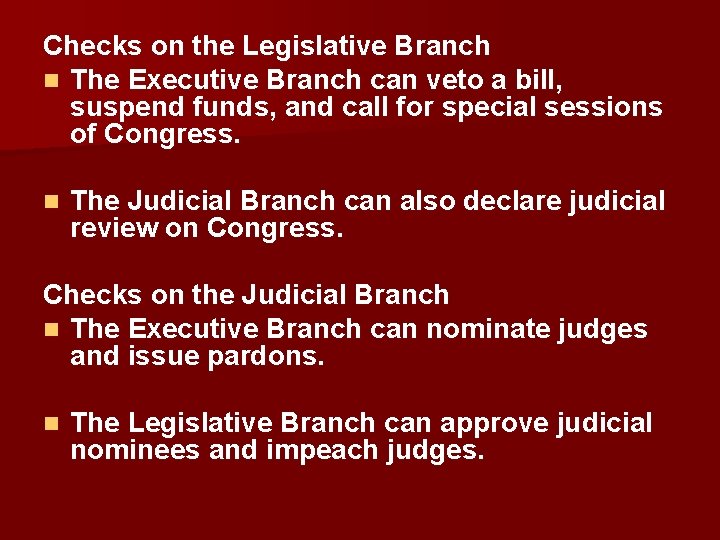
Checks on the Legislative Branch n The Executive Branch can veto a bill, suspend funds, and call for special sessions of Congress. n The Judicial Branch can also declare judicial review on Congress. Checks on the Judicial Branch n The Executive Branch can nominate judges and issue pardons. n The Legislative Branch can approve judicial nominees and impeach judges.
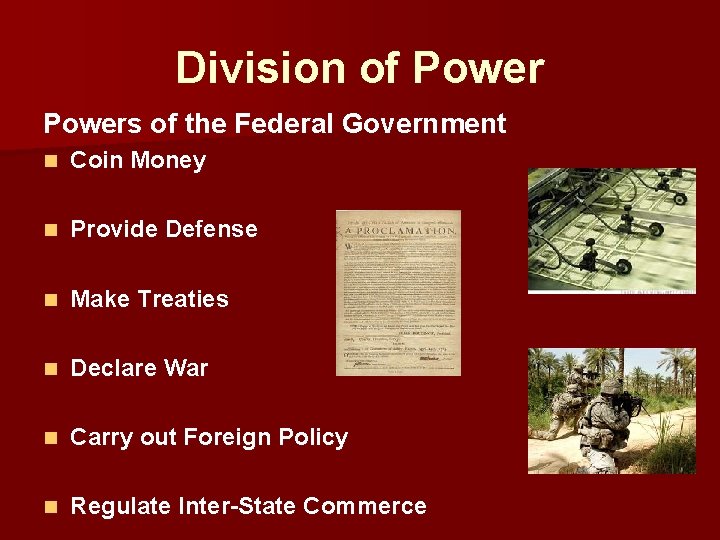
Division of Powers of the Federal Government n Coin Money n Provide Defense n Make Treaties n Declare War n Carry out Foreign Policy n Regulate Inter-State Commerce
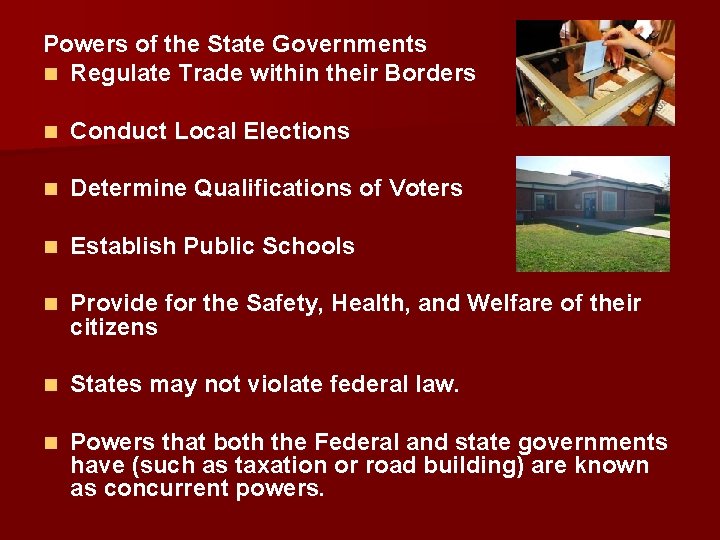
Powers of the State Governments n Regulate Trade within their Borders n Conduct Local Elections n Determine Qualifications of Voters n Establish Public Schools n Provide for the Safety, Health, and Welfare of their citizens n States may not violate federal law. n Powers that both the Federal and state governments have (such as taxation or road building) are known as concurrent powers.
The Preamble n The Preamble provides for a basis of the U. S. Government and states a purpose for the Constitution. n The Preamble states six goals for the U. S. government: - To “form a more perfect Union” - To “establish Justice” - To “insure domestic Tranquility” - To “provide for the common defense” - To “promote the general Welfare” - To “secure the Blessings of Liberty to ourselves and our Posterity”
The Articles n There are 7 articles set forth by the Constitution. n Articles I, II, and III divide the power of the federal government into three branches. This principle is called Separation of Powers. Article I (1) – Legislative Branch n 2 Houses (Senate & House of Representatives)
House of Representatives n 435 members n Based on population of state n Elected every 2 years n Must be 25 years old n Must be a 7 year U. S. citizen n Your U. S. House of Representative is Mike Bost. n The person who presides over the U. S. House of Representatives is the Speaker of the House. n The Speaker chooses heads of committees. n The Speaker of the House is Nancy Pelosi.
Senate n 100 members n 2 Senators from each state n Serve 6 year terms n 1/3 of the Senate is elected every 2 years n Must be 30 years old n Must be a 9 year U. S. citizen n Your U. S. Senators are Richard Durbin and Tammy Duckworth. n The Vice President is the person who presides over the Senate. n When the Vice President is not present, the person who presides over the Senate is the President Pro Tempore. n The President Pro Tempore of the Senate is Chuck Grassley.
Powers of the Legislative Branch n In order for a bill to become law, it must be passed by both houses and signed by the President. n After a bill has been sent to the President, it becomes a law if the President does not send it back within 10 days. n In order for a bill to become a law after the President vetoes it, 2/3 of each house must approve the bill. n All revenue (tax) bills originate in the House of Representatives.
n Declare War n Coining of money n Carrying out foreign policy, the Senate approves treaties. n Habeas Corpus - a law official must have cause for holding a prisoner. This protects a person from unjust imprisonment. n Bills of attainder - punishes a person without a jury trial. n Passage of ex post facto laws - makes an action a crime even though it was not a crime when it was committed. n The debates, laws, and other information about what goes on in the Legislative Branch are reported in the Congressional Record. n A census occurs every 10 years to determine how many House of Representative members each state receives.
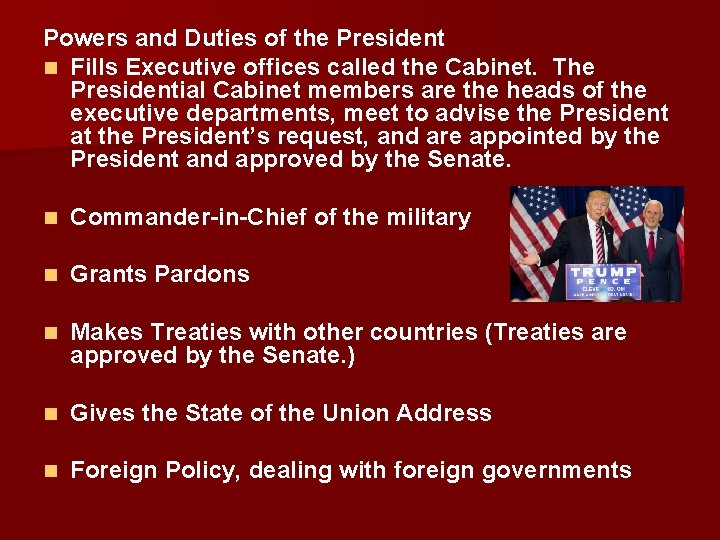
Article II (2) – Executive Branch n President and Vice President n The President of the United States is Donald Trump. n The Vice President of the United States is Mike Pence.
The President n Serves 4 year terms n Can only be elected twice n Must be 35 years old n Natural born citizen of the U. S. n Reside in U. S. for 14 years
Presidential Elections n Election Day is the 1 st Tuesday after the 1 st Monday in November every 4 years. n The President is elected by the Electoral College, not directly by the people. n The Electoral College votes of each state go to the candidate who received the most popular votes. n There are 538 Electoral College votes. In order to become President, a majority 270 votes are needed. n If no one running for President receives a majority of Electoral College votes, then the House of Representatives selects the President from the 3 candidates who received the most Electoral College votes.
Powers and Duties of the President n Fills Executive offices called the Cabinet. The Presidential Cabinet members are the heads of the executive departments, meet to advise the President at the President’s request, and are appointed by the President and approved by the Senate. n Commander-in-Chief of the military n Grants Pardons n Makes Treaties with other countries (Treaties are approved by the Senate. ) n Gives the State of the Union Address n Foreign Policy, dealing with foreign governments
n If the President dies, resigns, is impeached from office, or is unable to carry out the duties of the office, then the Vice President becomes President. n According to the Constitution, the only duty that the Vice President has is to cast the deciding vote in the event of a tie in the Senate. Impeachment n Impeachment means to accuse a government official of a crime and can lead to the removal from office. n Congress can take the President to court for irresponsible behavior or breaking a law. n When the President is impeached, the Senate serves as a court with the Chief Justice acting as a judge and the Senate acting as a Jury. Andrew Johnson and Bill Clinton are the only two Presidents to be impeached, but both remained in office. n
Article III (3) – Judicial Branch n Supreme Court and Federal Courts Federal Court System n There is one U. S. Supreme Court. n There are 12 Appellate Courts. n There are 94 District Courts.
Jurisdiction n There are two types of jurisdiction, original and appellate. n Original jurisdiction means that the court has the authority to be the first court to hear a case. n Appellate jurisdiction hears cases that have been appealed from lower courts.
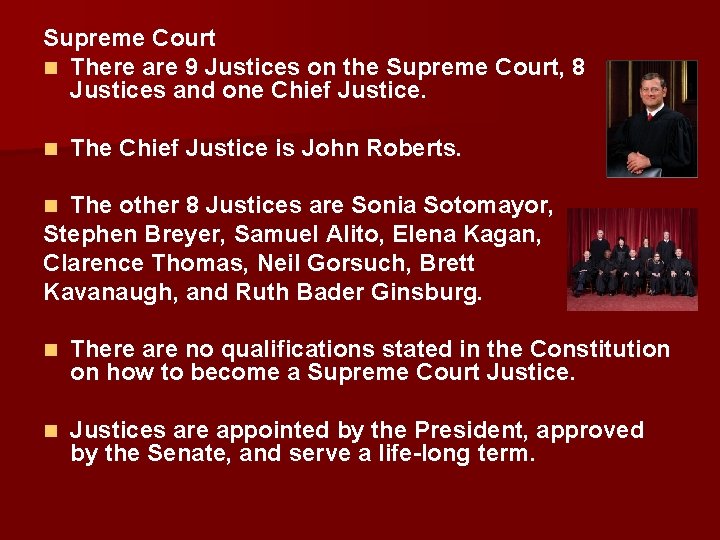
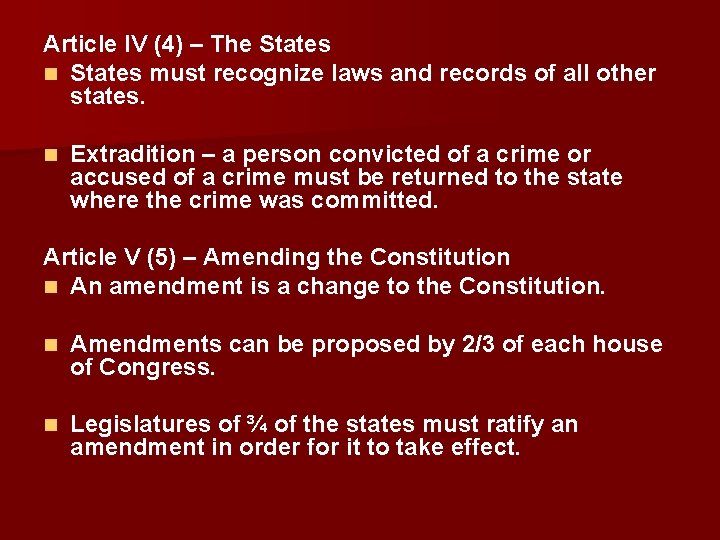
Supreme Court n There are 9 Justices on the Supreme Court, 8 Justices and one Chief Justice. n The Chief Justice is John Roberts. The other 8 Justices are Sonia Sotomayor, Stephen Breyer, Samuel Alito, Elena Kagan, Clarence Thomas, Neil Gorsuch, Brett Kavanaugh, and Ruth Bader Ginsburg. n n There are no qualifications stated in the Constitution on how to become a Supreme Court Justice. n Justices are appointed by the President, approved by the Senate, and serve a life-long term.
Article IV (4) – The States n States must recognize laws and records of all other states. n Extradition – a person convicted of a crime or accused of a crime must be returned to the state where the crime was committed. Article V (5) – Amending the Constitution n An amendment is a change to the Constitution. n Amendments can be proposed by 2/3 of each house of Congress. n Legislatures of ¾ of the states must ratify an amendment in order for it to take effect.
Article VI (6) – National Supremacy n The U. S. Constitution and Federal Laws are supreme when in conflict with State Laws. Article VII (7) – Ratification of the Constitution n The Constitution needed 9 of the original 13 colonies to ratify and approve it into law. It went into effect in June 1788.
The Amendments n There are 27 amendments to the U. S. Constitution. n The first ten amendments are known as the Bill of Rights. n The Bill of Rights was written as a way to limit government power.
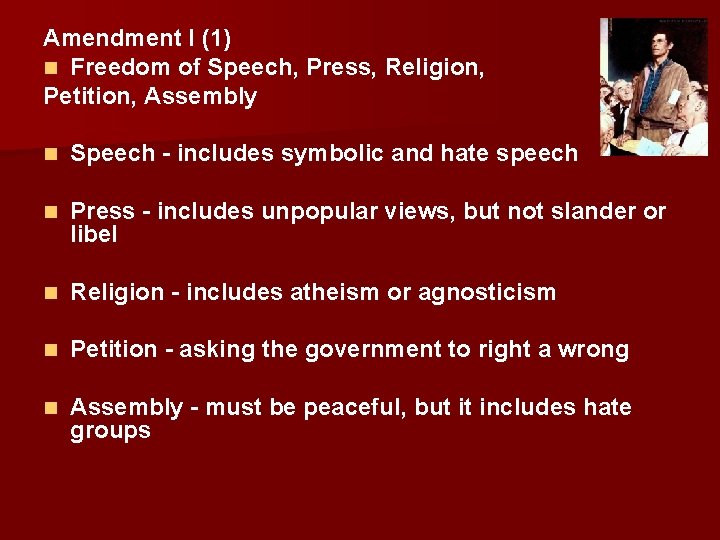
Amendment I (1) n Freedom of Speech, Press, Religion, Petition, Assembly n Speech - includes symbolic and hate speech n Press - includes unpopular views, but not slander or libel n Religion - includes atheism or agnosticism n Petition - asking the government to right a wrong n Assembly - must be peaceful, but it includes hate groups
Amendment II (2) n Right to Bear Arms - right to a militia Amendment III (3) n Quartering of Soldiers - quartering means housing of troops Amendment IV (4) n Search and Seizures - law enforcement must have a search warrant and reasonable cause before they search your house and take you to court.
Amendment V (5) n Rights of the Accused Person n Grand Jury - is there a reason to hold a trial n Double Jeopardy - can not be tried twice for the same crime n Pleading the “Fifth” - do not have to incriminate (testify) against yourself n Eminent Domain - can’t have property taken without being compensated
Amendment VI (6) n Right to a Speedy, Fair Trial n Fair trial - to have a jury of your peers n Speedy trial n Right to a lawyer
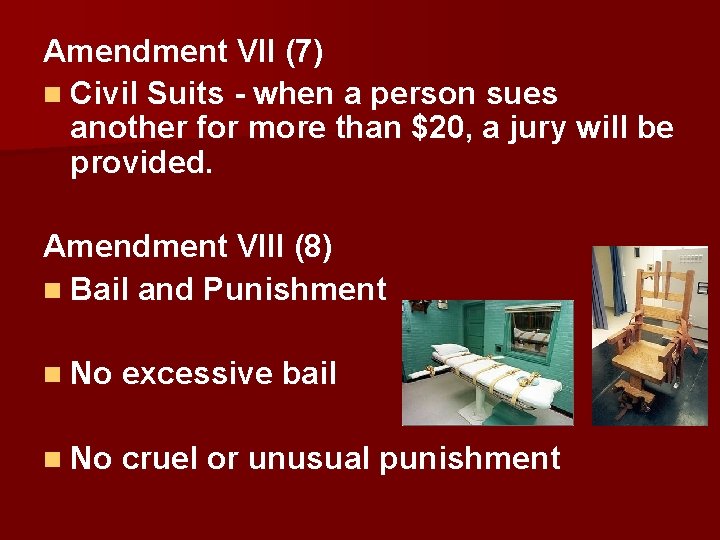
Amendment VII (7) n Civil Suits - when a person sues another for more than $20, a jury will be provided. Amendment VIII (8) n Bail and Punishment n No excessive bail n No cruel or unusual punishment
Amendment IX (9) n Powers Reserved to the People Amendment X (10) n Powers Reserved to the States n Reserved powers are powers that state governments may use if the powers are not given to the national government and are not forbidden to the states.
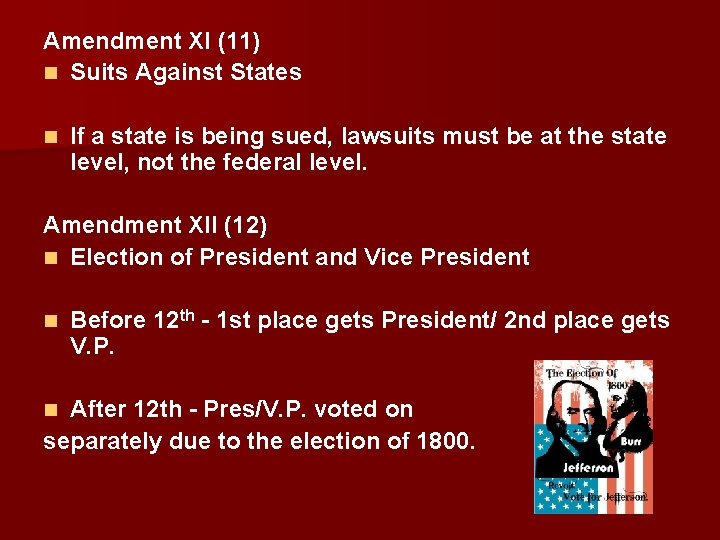
Amendment XI (11) n Suits Against States n If a state is being sued, lawsuits must be at the state level, not the federal level. Amendment XII (12) n Election of President and Vice President n Before 12 th - 1 st place gets President/ 2 nd place gets V. P. After 12 th - Pres/V. P. voted on separately due to the election of 1800. n
Amendment XIII (13) n Abolition of Slavery - made slavery illegal in the U. S. Amendment XIV (14) n Rights of Citizens n Citizenship cannot be denied based on race. n All people born in the United States are U. S. citizens. n Naturalization is the procedure by which a citizen of a foreign nation becomes a citizen of the United States. n A naturalized citizen cannot become President.
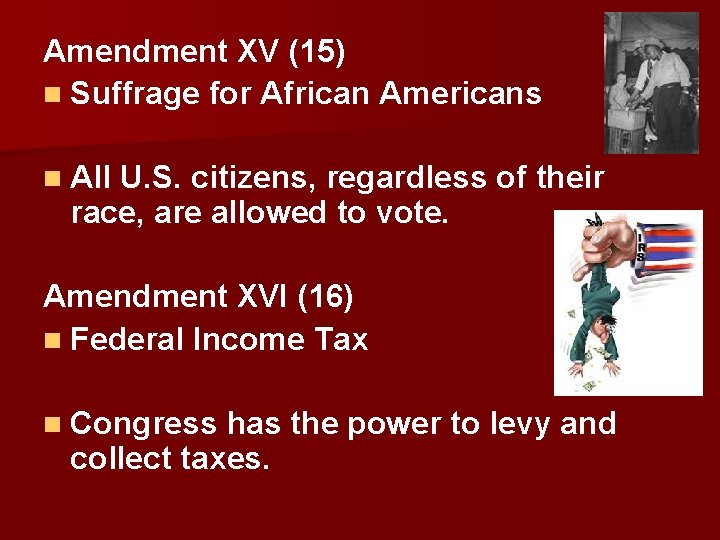
Amendment XV (15) n Suffrage for African Americans n All U. S. citizens, regardless of their race, are allowed to vote. Amendment XVI (16) n Federal Income Tax n Congress has the power to levy and collect taxes.
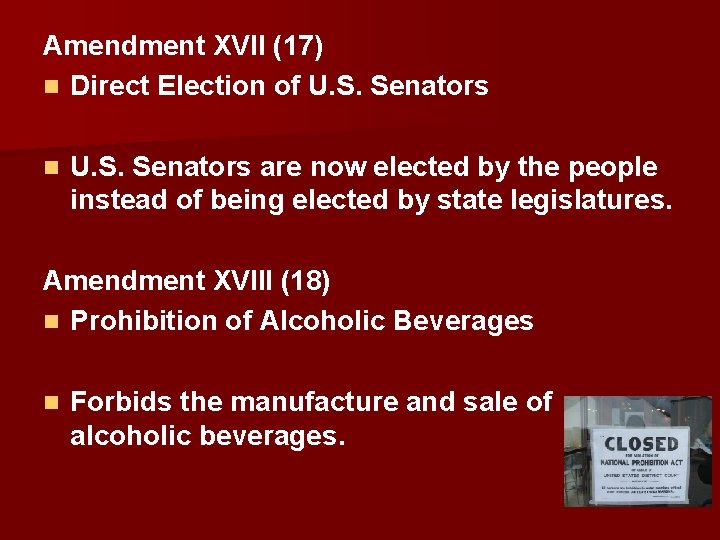
Amendment XVII (17) n Direct Election of U. S. Senators n U. S. Senators are now elected by the people instead of being elected by state legislatures. Amendment XVIII (18) n Prohibition of Alcoholic Beverages n Forbids the manufacture and sale of alcoholic beverages.
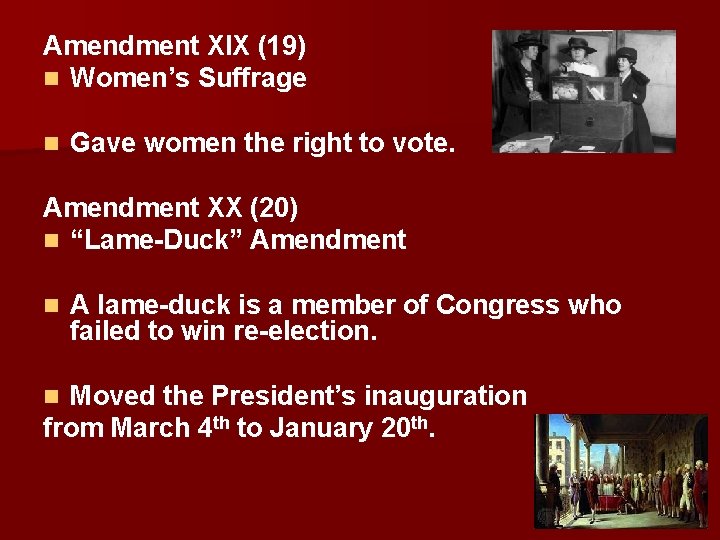
Amendment XIX (19) n Women’s Suffrage n Gave women the right to vote. Amendment XX (20) n “Lame-Duck” Amendment n A lame-duck is a member of Congress who failed to win re-election. Moved the President’s inauguration from March 4 th to January 20 th. n
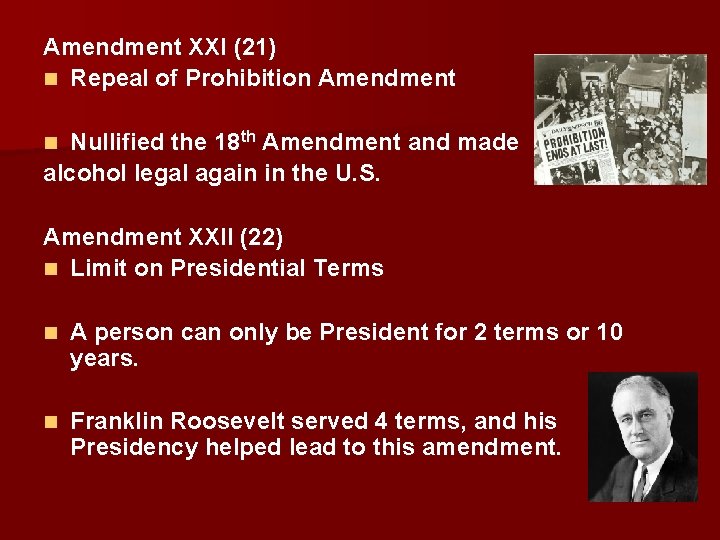
Amendment XXI (21) n Repeal of Prohibition Amendment Nullified the 18 th Amendment and made alcohol legal again in the U. S. n Amendment XXII (22) n Limit on Presidential Terms n A person can only be President for 2 terms or 10 years. n Franklin Roosevelt served 4 terms, and his Presidency helped lead to this amendment.
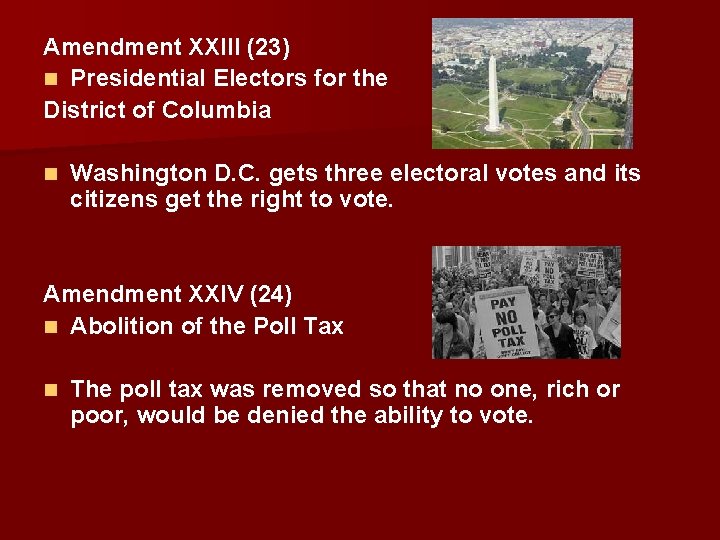
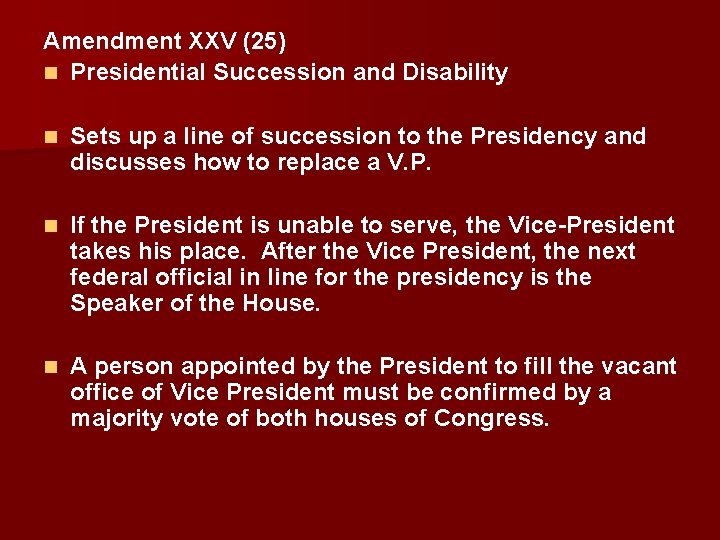
Amendment XXIII (23) n Presidential Electors for the District of Columbia n Washington D. C. gets three electoral votes and its citizens get the right to vote. Amendment XXIV (24) n Abolition of the Poll Tax n The poll tax was removed so that no one, rich or poor, would be denied the ability to vote.
Amendment XXV (25) n Presidential Succession and Disability n Sets up a line of succession to the Presidency and discusses how to replace a V. P. n If the President is unable to serve, the Vice-President takes his place. After the Vice President, the next federal official in line for the presidency is the Speaker of the House. n A person appointed by the President to fill the vacant office of Vice President must be confirmed by a majority vote of both houses of Congress.
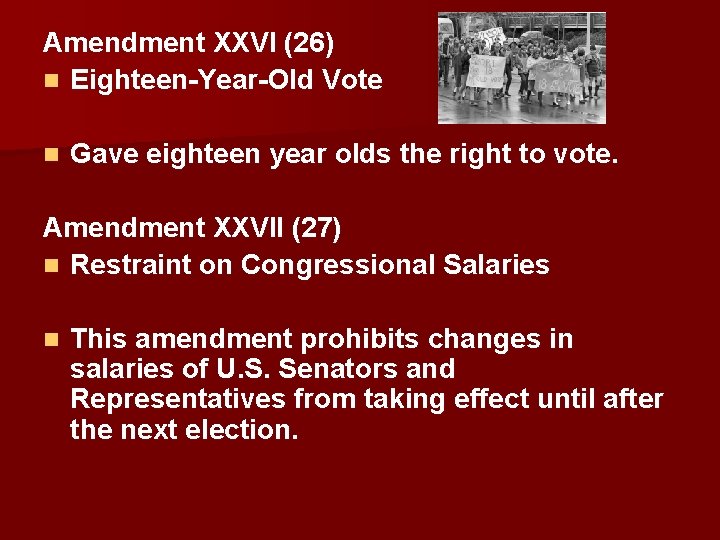
Amendment XXVI (26) n Eighteen-Year-Old Vote n Gave eighteen year olds the right to vote. Amendment XXVII (27) n Restraint on Congressional Salaries n This amendment prohibits changes in salaries of U. S. Senators and Representatives from taking effect until after the next election.