
The U S Constitution Chapter 3 Basic Principles
The U. S. Constitution Chapter 3
Basic Principles – Section 1 l A. The Constitution is the fundamental law of the nation; it is the highest form of law in the United States. The Constitution of the United States of America is the foundation of all law and government in the United States. It provides the framework for the organization of the United States Government and enumerates the powers of the Congress as well as those reserved to the states and to the people, those reserved to the President of the United States with the advice and consent of the Senate and to the Judiciary which are tasked to preserve, protect and defend the Constitution of the United States and to enforce the laws passed by the Congress.
Basic principles con’t 1. 2. The Constitution consists of a preamble, seven original articles, twenty-seven amendments, and a paragraph certifying its enactment by the constitutional convention. The concept of republicanism strongly influenced the framers of the constitution. Republicanism is the belief that the citizens of a state have political authority, they are bound by a social contract to obey laws, and their rights are guaranteed by a constitution.
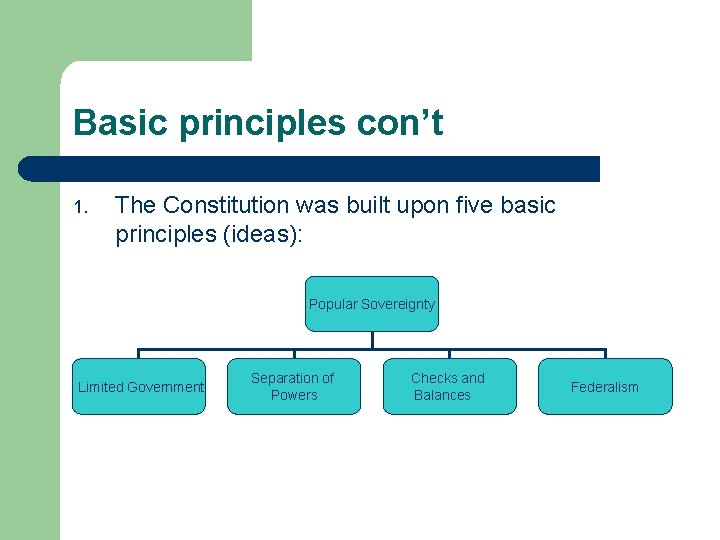
Basic principles con’t 1. The Constitution was built upon five basic principles (ideas): Popular Sovereignty Limited Government Separation of Powers Checks and Balances Federalism

Basic Principles Con’t Principle Description 1. Federalism A. Federal system divides power between a federal government and smaller state governments. B. This separation of power is intended to make sure that the central government is powerful enough to be effective, but not too big as to overwhelm the states. C. Under this system, individual states are allowed to deal with their own problems; the way the states deal with problems however, the power of the national government is superior to that of the state governments. 2. Popular A. For a government to truly serve the people, it must be based on Popular sovereignty means that the government’s authority comes from the people. Sovereignty 3. Separation of Powers A. The separation of Powers makes sure that no one branch has too much power. B. The Constitution assigns the three branches of government specific powers. C. A separation of powers is intended to prevent abuse of power by one branch of government. 4. Limited Government A. The government is limited by the will of the people. B. The Constitution actually puts limitations on what the government is allowed to do. C. Limited government also means that no individual or government official is above the law; they too are bound by the Constitution. 5. Checks and Balances A. Each branch of government has built-in checks and balances to restrain the power of the other two branches. B. This system or checks and balances divides power within the government.
Amending the Constitution – Section 2 l l Amendments are changes in the written words of the Constitution. There are 4 possible methods formal amendments:
Amending the Constitution l l B. There are two methods for Proposing Amendments: First Method—two thirds vote of both houses of Congress must be met in order to propose an amendment. Second Method— An amendment may also be proposed by a national convention that is called by Congress at the request of at least two thirds of the States. No convention has ever been called to propose an amendment, however.
Amending the Constitution C. There are two methods for ratifying amendments l First Method—Legislatures in at least three fourths (38) of the states must approve an amendment before it becomes part of the Constitution. l Second Method— Requires the approval of special conventions in at least three fourths of the states.
The Bill of Rights – Section 3 l l l A. The first 10 Amendments are known as the Bill of Rights. They list the basic rights held by people. They were proposed in 1789 and ratified in 1791. The first 10 amendments, the Bill of Rights, were designed as a protection for individual freedoms. The Bill of Rights protects citizens’ freedom of speech, religion, and assembly, and it guarantees a free press and the rights of people accused of crimes. In addition to protecting individual freedoms, the Bill of Rights also acknowledges the rights and powers of the states and the people.
- Slides: 9