
THE TWOSIDED HUMAN NATURE Week 12 PART 1
- Slides: 48
THE TWO-SIDED HUMAN NATURE Week 12
PART 1: PROSOCIALITY
Before we begin… Think about a time when you help another person • How is this person related to you? • What was the situation like? • Why did you help?
Which of the following is a prosocial behavior? • Coming to class on • Tipping the waiter time • Not talking back to your parents • Helping a granny cross the road • Not littering • Thanking the taxi driver • Holding the lift door open • Donating money to charity • Marrying your sweetheart • Marrying someone you don’t love
What is prosocial behavior? • Any act performed with the goal of benefitting another person • Whether or not it benefits the self is another question • Note: the definition focuses on action, not resisting action (e. g. , not talking back)
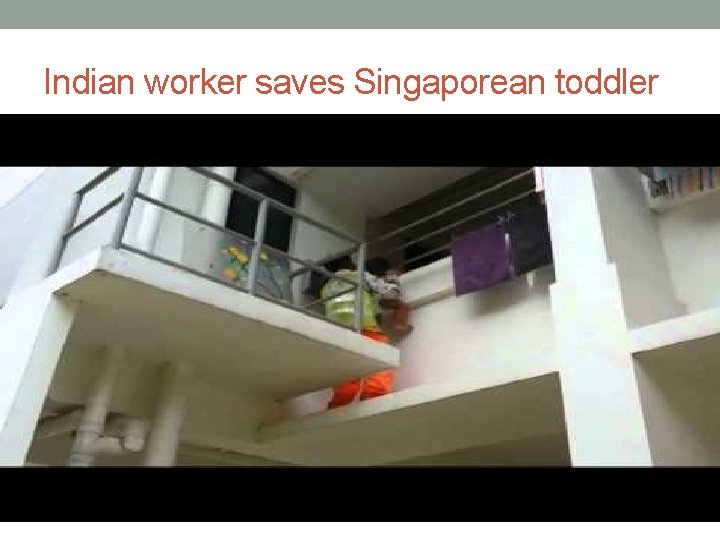
Indian worker saves Singaporean toddler
Altruism is a strange behavior.
Altruism poses a problem for behaviorism People seek to maximize gains for the self (positive reinforcement) and avoid losses (pain, punishment etc). But prosocial behavior is costly. Yet people still do it!
Prosocial behavior poses a problem to evolutionary theory • Basic principle of evolutionary psychology • Genes that maximize survival (“fitness”) survive • Genes that don’t, die out. • Again, prosocial behavior is costly. • Hence, there shouldn’t be prosociality, right?
How can we explain altruism? • Preferably, the explanation should be… • parsimonious • generalizable
Theoretical approaches 1. Evolutionary mechanisms 2. Socialization 3. Kin selection 4. Reciprocal altruism 5. Social exchange theory 6. Empathy-altruism hypothesis
#1: Altruism is, in fact, selfish behavior after all • The “I couldn’t live with myself in the morning” theory • Not helping feels bad. • People help to relieve their own negative affect.
#2: Socialization • We help because we have learnt that is the right thing to do
#3: The selfish gene view (sometimes called “kin selection”) • Revision of Darwinian theory • Old view: survival of the fittest organism • New view survival of the fittest GENE • Genes, not organisms, are the unit of analysis • ANT ATTACK!!! • https: //www. youtube. com/watch? v=W 8 v. FFM_k 1 FI
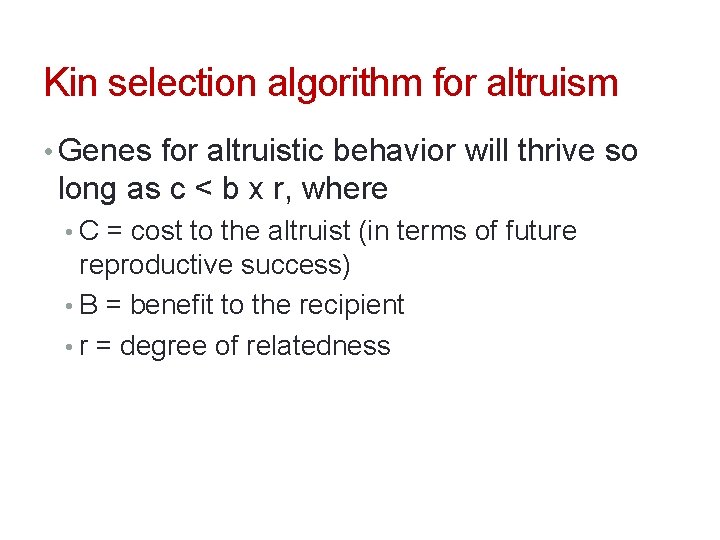
Kin selection algorithm for altruism • Genes for altruistic behavior will thrive so long as c < b x r, where • C = cost to the altruist (in terms of future reproductive success) • B = benefit to the recipient • r = degree of relatedness
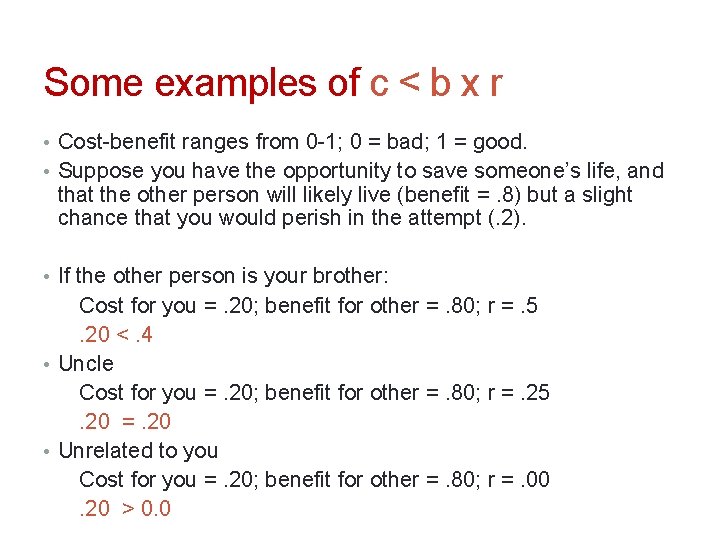
Some examples of c < b x r • Cost-benefit ranges from 0 -1; 0 = bad; 1 = good. • Suppose you have the opportunity to save someone’s life, and that the other person will likely live (benefit =. 8) but a slight chance that you would perish in the attempt (. 2). • If the other person is your brother: Cost for you =. 20; benefit for other =. 80; r =. 5. 20 <. 4 • Uncle Cost for you =. 20; benefit for other =. 80; r =. 25. 20 =. 20 • Unrelated to you Cost for you =. 20; benefit for other =. 80; r =. 00. 20 > 0. 0
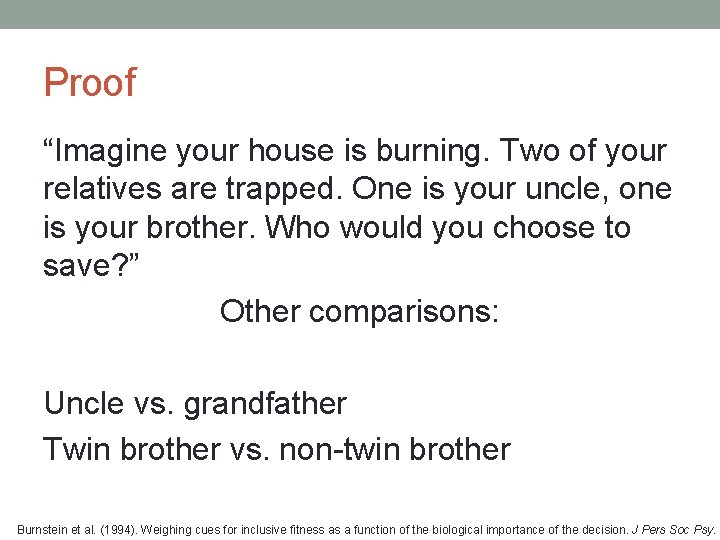
Proof “Imagine your house is burning. Two of your relatives are trapped. One is your uncle, one is your brother. Who would you choose to save? ” Other comparisons: Uncle vs. grandfather Twin brother vs. non-twin brother Burnstein et al. (1994). Weighing cues for inclusive fitness as a function of the biological importance of the decision. J Pers Soc Psy.
#4: Reciprocity norm • Altruism sometimes does occur between unrelated organisms • Reciprocity norm (“I scratch your back now, you scratch my back next time”) • Has survival value and hence can become genetically based
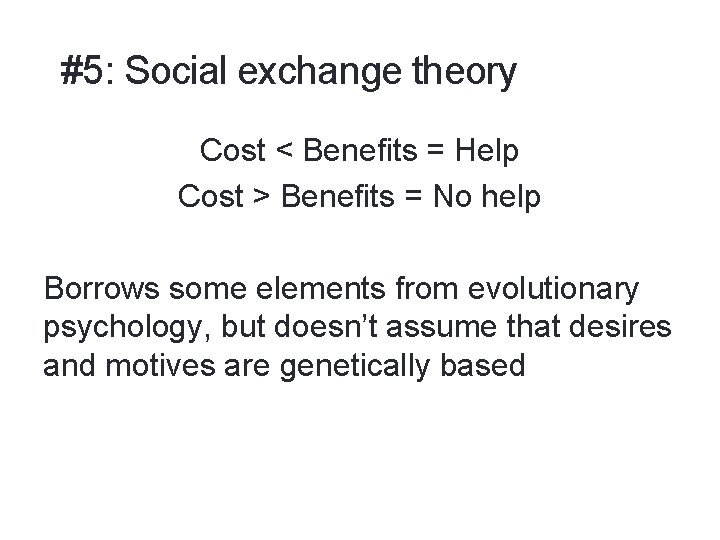
#5: Social exchange theory Cost < Benefits = Help Cost > Benefits = No help Borrows some elements from evolutionary psychology, but doesn’t assume that desires and motives are genetically based
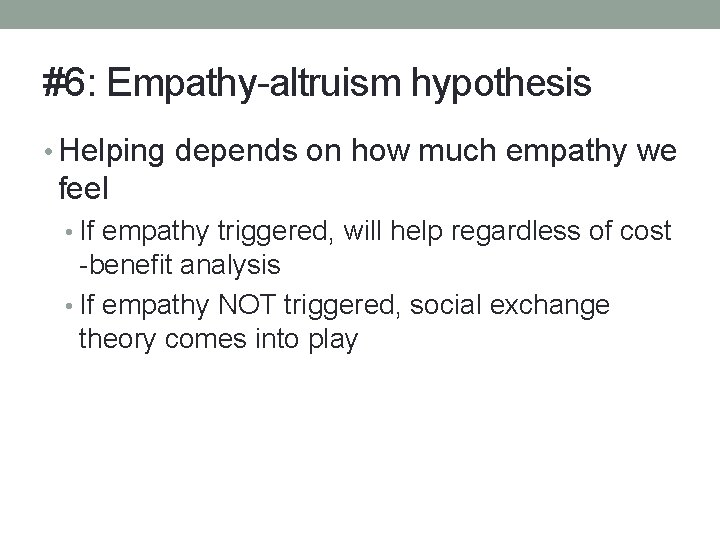
#6: Empathy-altruism hypothesis • Helping depends on how much empathy we feel • If empathy triggered, will help regardless of cost -benefit analysis • If empathy NOT triggered, social exchange theory comes into play
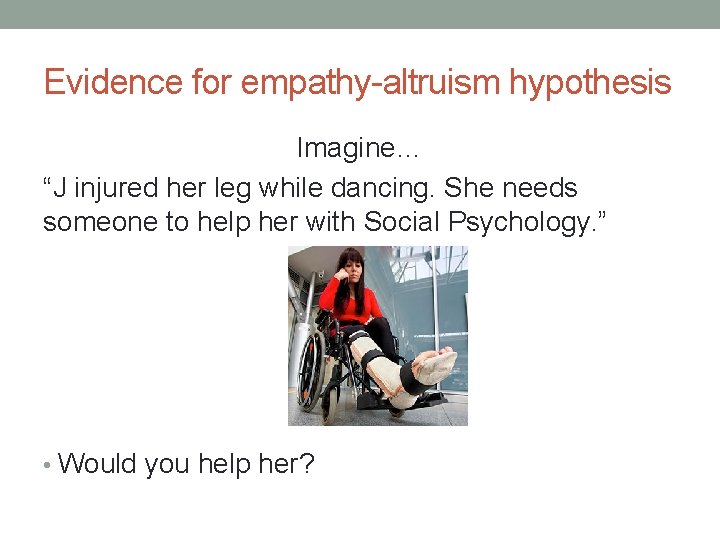
Evidence for empathy-altruism hypothesis Imagine… “J injured her leg while dancing. She needs someone to help her with Social Psychology. ” • Would you help her?
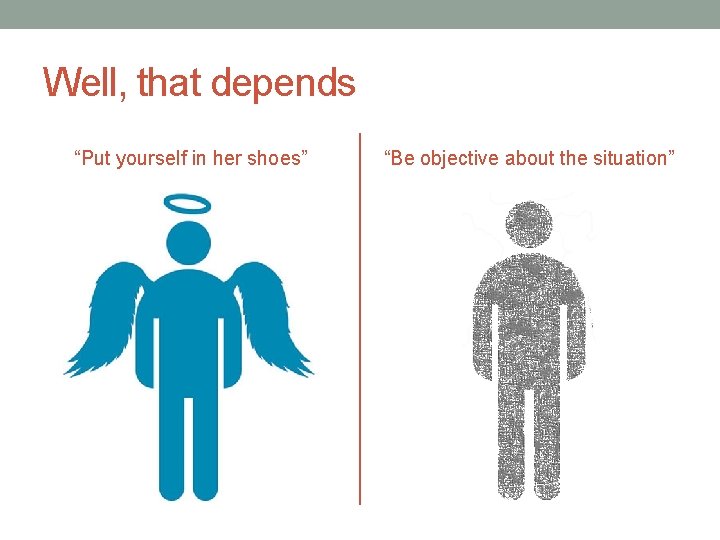
Well, that depends “Put yourself in her shoes” “Be objective about the situation”
Is altruism unique in humans? • Interspecies helping • Animals help humans too https: //www. youtube. com/watch? v=ao. O 4 IQw. Yw 54
How to increase helping behavior? • Your textbook has lots of examples 1. Be religious 2. Be in a good mood 3. Be the only one who can help • But I want to describe one cool study
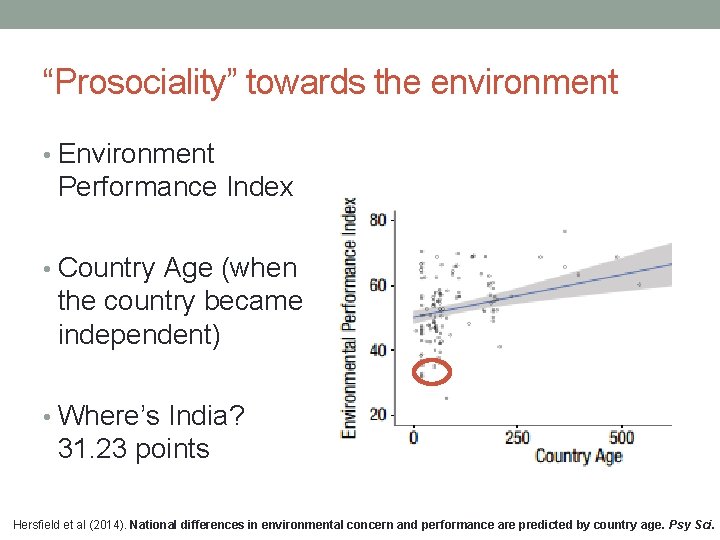
“Prosociality” towards the environment • Environment Performance Index • Country Age (when the country became independent) • Where’s India? 31. 23 points Hersfield et al (2014). National differences in environmental concern and performance are predicted by country age. Psy Sci.
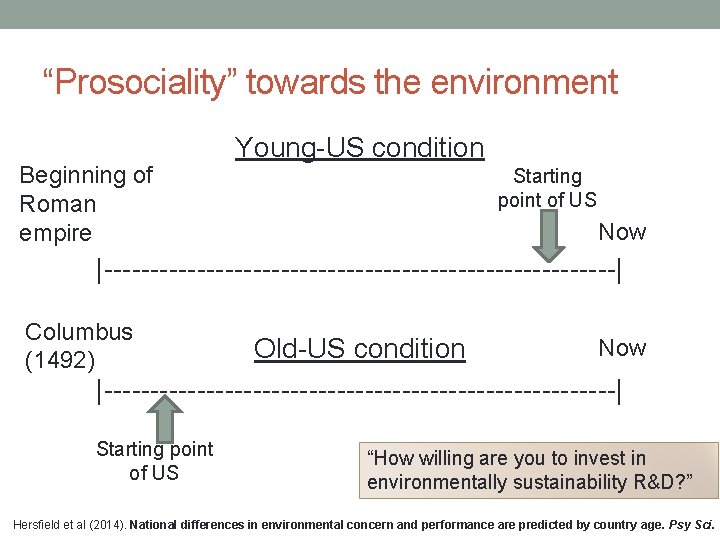
“Prosociality” towards the environment Beginning of Roman empire Young-US condition Starting point of US Now |----------------------------| Columbus (1492) Now Old-US condition |----------------------------| Starting point of US “How willing are you to invest in environmentally sustainability R&D? ” Hersfield et al (2014). National differences in environmental concern and performance are predicted by country age. Psy Sci.
PART 2: AGGRESSION
Which of the following is an aggressive act? • Spreading rumors • Gossiping • Staring • Hitting a table • Shouting to vent frustration in a place where no one can hear you • Manipulating someone to do things s/he doesn’t like • Honking…especially on Delhi’s roads
Important distinctions • Intentionality is important • What do you want to achieve with [Act X]? • Hostile vs. instrumental aggression • Nature vs. Nurture
The “kitten and rat” study • Suppose you raise a kitten from birth with a rat. • Would the cat refrain from attacking the rat? • No, it will refuse to chase or kill other rats. • Evidence for nurture?
Why do people act aggressively? • Nature • Genetics • Testosterone • Gender? • Nurture (aka. environment) • Mere presence of guns • Alcohol • A creepy cultural reason…
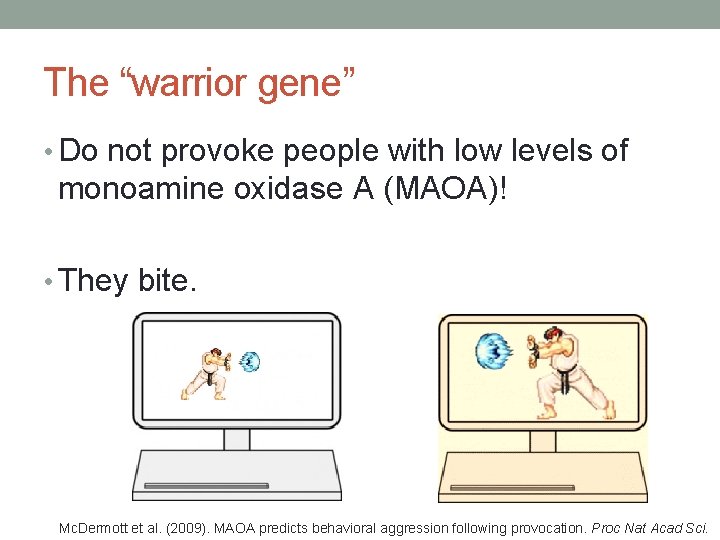
The “warrior gene” • Do not provoke people with low levels of monoamine oxidase A (MAOA)! • They bite. Mc. Dermott et al. (2009). MAOA predicts behavioral aggression following provocation. Proc Nat Acad Sci.
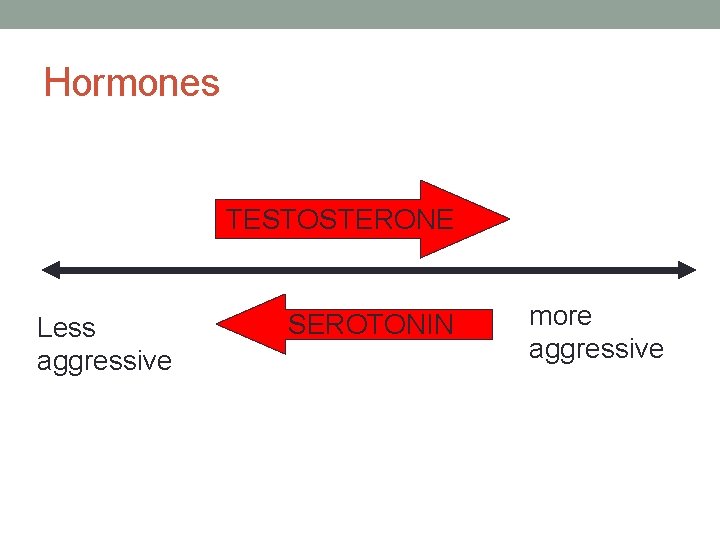
Hormones TESTOSTERONE Less aggressive SEROTONIN more aggressive
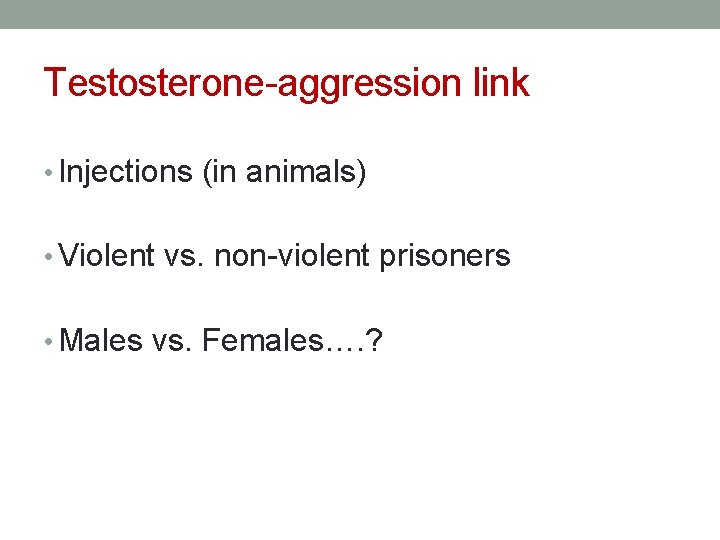
Testosterone-aggression link • Injections (in animals) • Violent vs. non-violent prisoners • Males vs. Females…. ?
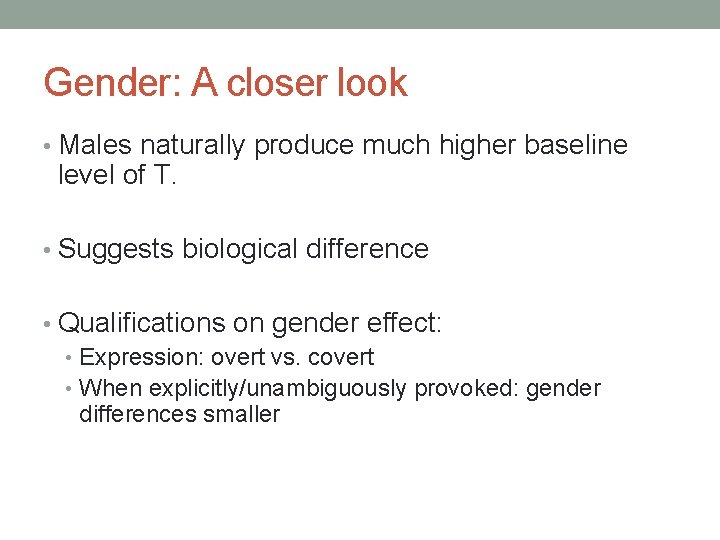
Gender: A closer look • Males naturally produce much higher baseline level of T. • Suggests biological difference • Qualifications on gender effect: • Expression: overt vs. covert • When explicitly/unambiguously provoked: gender differences smaller
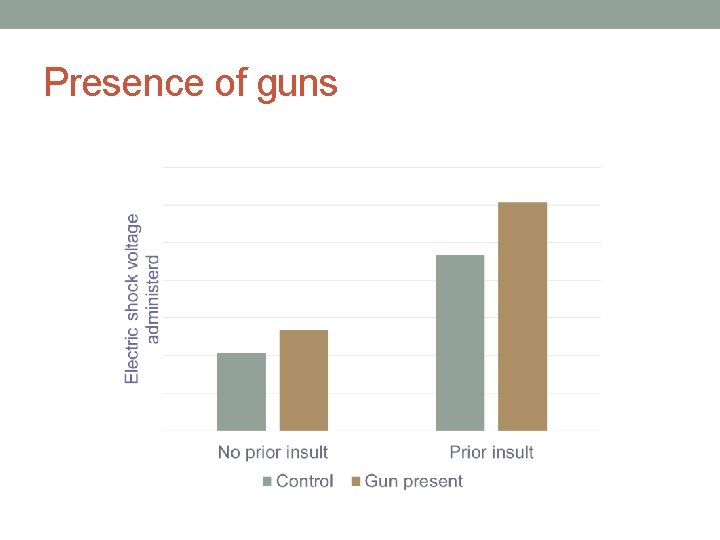
Presence of guns
Alcohol • Does not make people more aggressive per se • Alcohol acts as a disinhibitor in the prefrontal cortex • Also explains link to sexual misconduct
Creepy cultural justification Violent people often claim that God sanctions their actions. Afghanistan US ISIS Pakistan Palestinian territories Philippines Bushman et al. (2007). When God sanctions killing. Psy Sci.
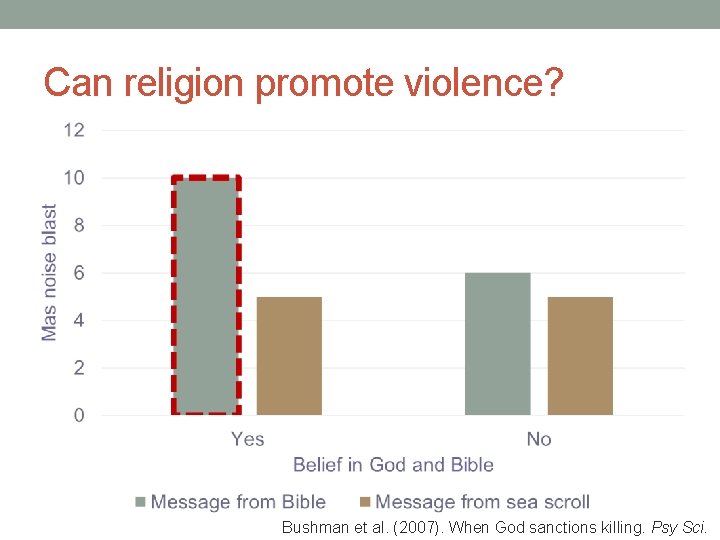
Can religion promote violence? Participants read a passage, presumably from the Bible (or sea scroll), about a tribe violating another tribe. Then half of them read: “The assembly fasted and prayed before the LORD and asked ‘‘What shall be done about the sins of our brothers in Benjamin? ’’; and the LORD answered them, saying that no such abomination could stand among his people. The LORD commanded Israel to take arms against their brothers and chasten them before the LORD. ” Bushman et al. (2007). When God sanctions killing. Psy Sci.
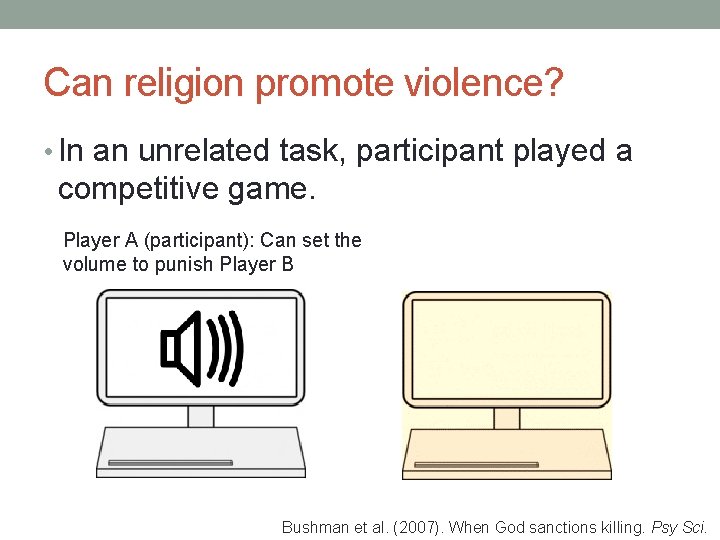
Can religion promote violence? • In an unrelated task, participant played a competitive game. Player A (participant): Can set the volume to punish Player B Bushman et al. (2007). When God sanctions killing. Psy Sci.
Can religion promote violence? Bushman et al. (2007). When God sanctions killing. Psy Sci.
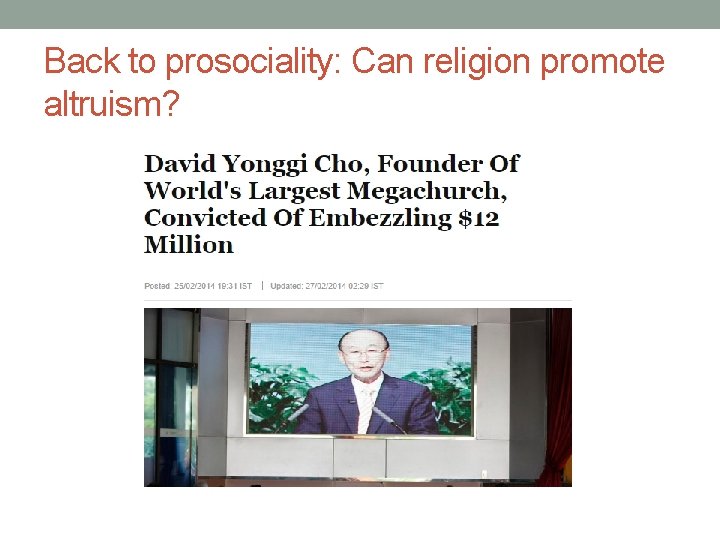
Back to prosociality: Can religion promote altruism?
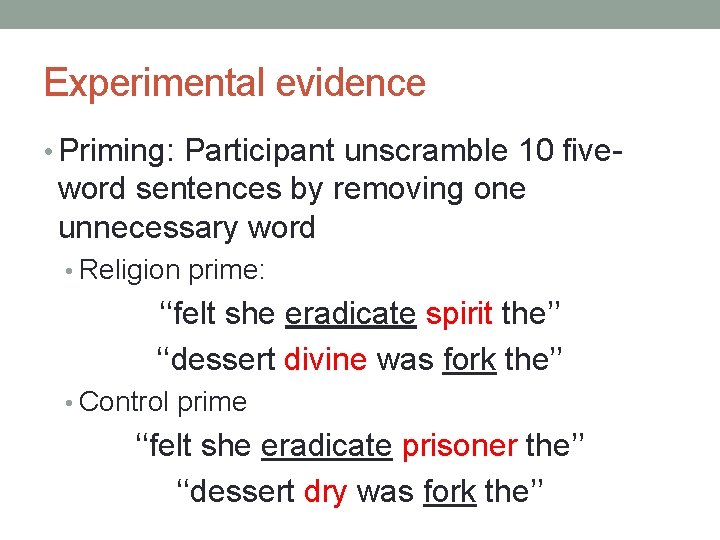
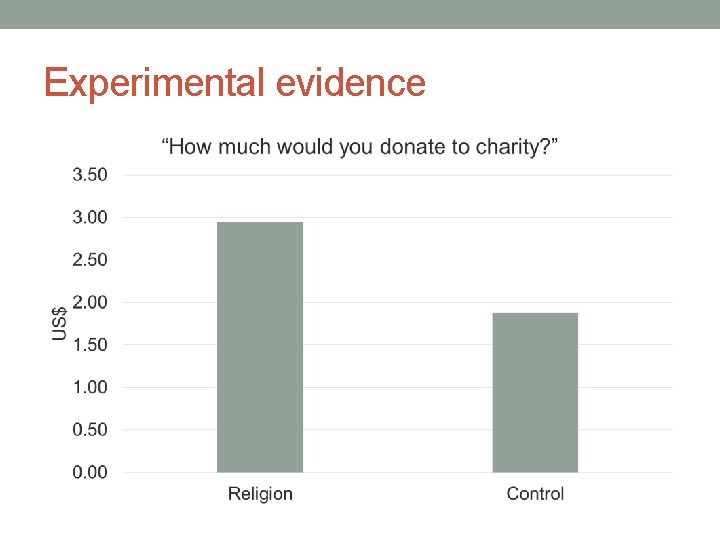
Experimental evidence • Priming: Participant unscramble 10 five- word sentences by removing one unnecessary word • Religion prime: ‘‘felt she eradicate spirit the’’ ‘‘dessert divine was fork the’’ • Control prime ‘‘felt she eradicate prisoner the’’ ‘‘dessert dry was fork the’’
Experimental evidence
Reducing violent aggression
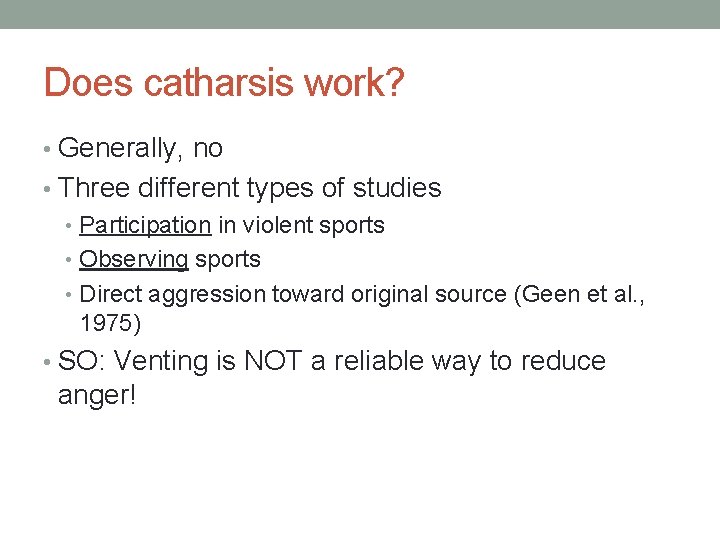
Does catharsis work? • Generally, no • Three different types of studies • Participation in violent sports • Observing sports • Direct aggression toward original source (Geen et al. , 1975) • SO: Venting is NOT a reliable way to reduce anger!
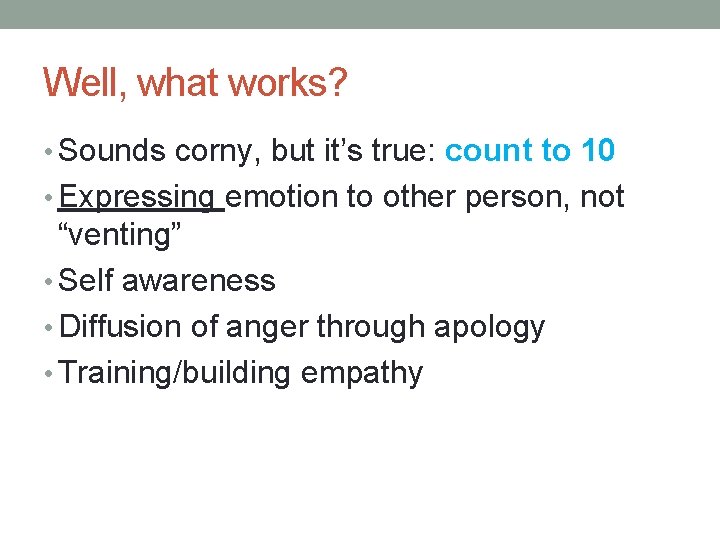
Well, what works? • Sounds corny, but it’s true: count to 10 • Expressing emotion to other person, not “venting” • Self awareness • Diffusion of anger through apology • Training/building empathy
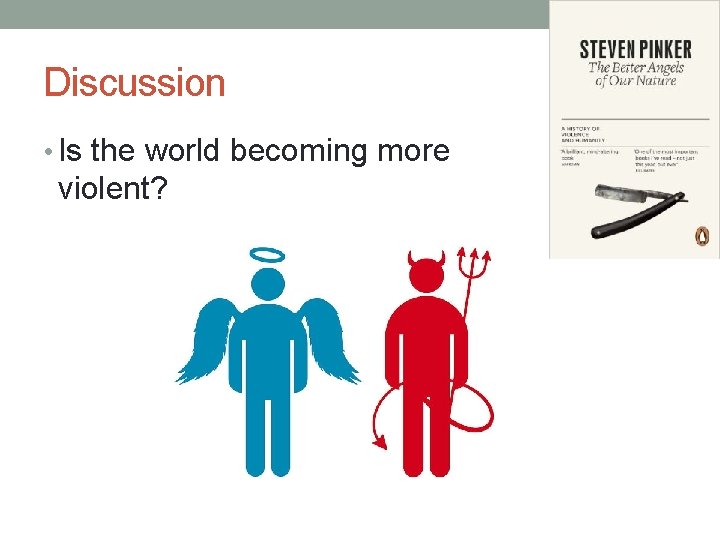
Discussion • Is the world becoming more violent?