
The Tutoring Cycle from Ross Mac Donalds The

- Slides: 8
The Tutoring Cycle from Ross Mac. Donald’s The Master Tutor: A Guidebook for More Effective Tutoring Providing Academic Support, Promoting Independent Learning
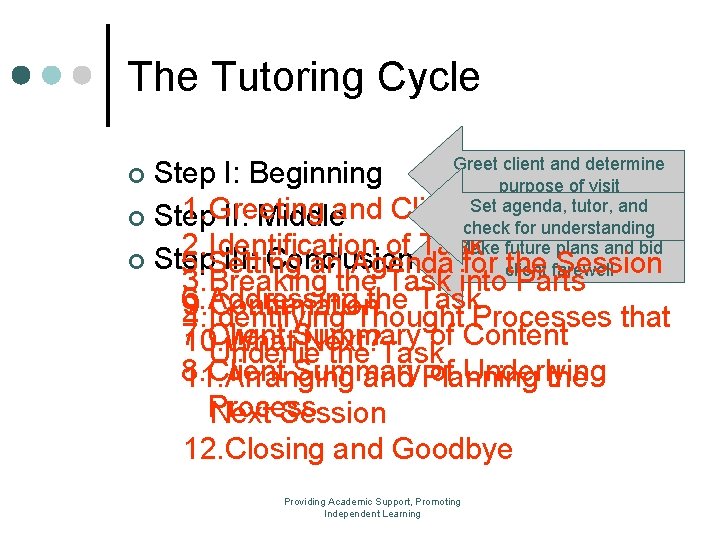
The Tutoring Cycle Greet client and determine Step I: Beginning purpose of visit Setting agenda, tutor, and 1. Greeting and Climate ¢ Step II: Middle check for understanding Make future plans and bid 2. Identification of Task ¢ Step III: Conclusion 5. Setting an Agenda for client the farewell Session 3. Breaking the Task into Parts 6. Addressing the Task 9. Confirmation 4. Identifying Thought Processes that 7. Client Summary of Content 10. What Next? Underlie the Task 8. Client Summary of Underlying 11. Arranging and Planning the Process Next Session 12. Closing and Goodbye ¢ Providing Academic Support, Promoting Independent Learning
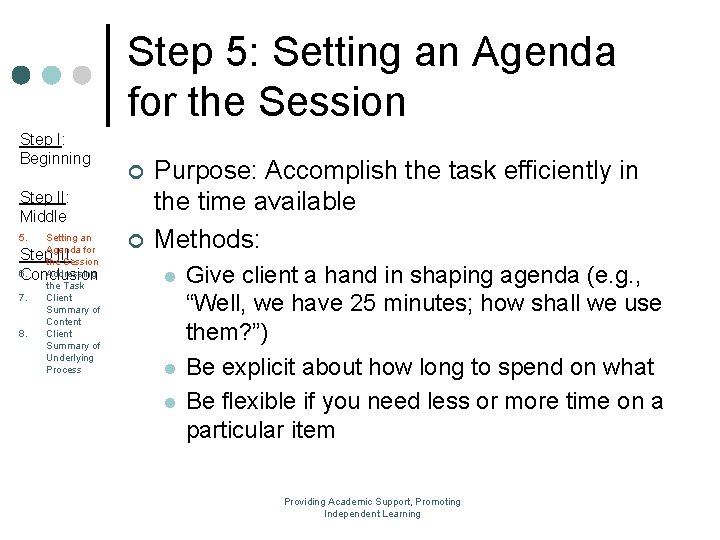
Step 5: Setting an Agenda for the Session Step I: Beginning ¢ Step II: Middle 5. Setting an Agenda for the Session Addressing the Task Client Summary of Content Client Summary of Underlying Process Step III: 6. Conclusion 7. 8. ¢ Purpose: Accomplish the task efficiently in the time available Methods: l l l Give client a hand in shaping agenda (e. g. , “Well, we have 25 minutes; how shall we use them? ”) Be explicit about how long to spend on what Be flexible if you need less or more time on a particular item Providing Academic Support, Promoting Independent Learning
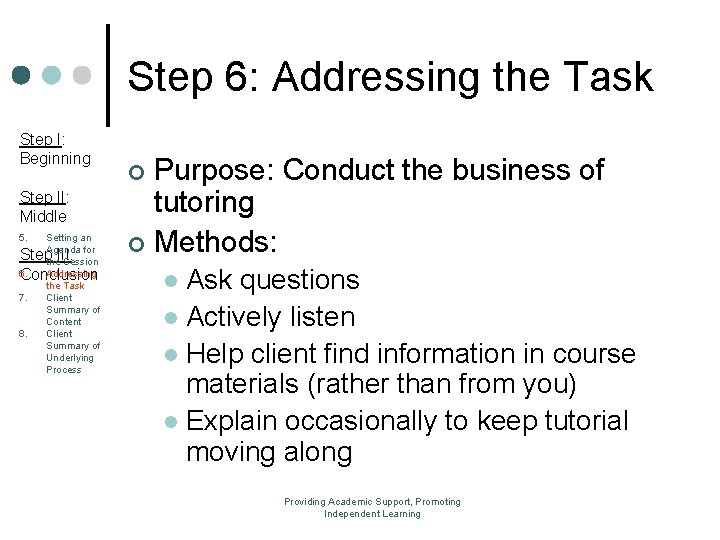
Step 6: Addressing the Task Step I: Beginning Step II: Middle 5. Setting an Agenda for the Session Addressing the Task Client Summary of Content Client Summary of Underlying Process Step III: 6. Conclusion 7. 8. Purpose: Conduct the business of tutoring ¢ Methods: ¢ Ask questions l Actively listen l Help client find information in course materials (rather than from you) l Explain occasionally to keep tutorial moving along l Providing Academic Support, Promoting Independent Learning
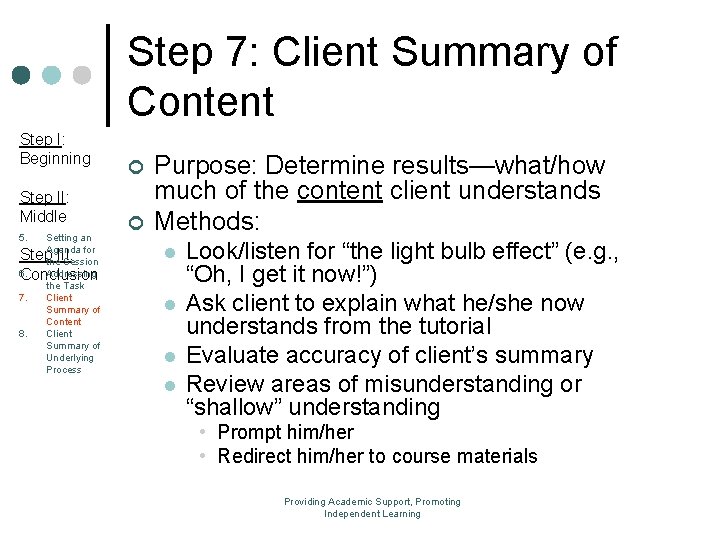
Step 7: Client Summary of Content Step I: Beginning Step II: Middle 5. Setting an Agenda for the Session Addressing the Task Client Summary of Content Client Summary of Underlying Process ¢ ¢ Purpose: Determine results—what/how much of the content client understands Methods: Step III: 6. Conclusion l 7. l 8. l l Look/listen for “the light bulb effect” (e. g. , “Oh, I get it now!”) Ask client to explain what he/she now understands from the tutorial Evaluate accuracy of client’s summary Review areas of misunderstanding or “shallow” understanding • Prompt him/her • Redirect him/her to course materials Providing Academic Support, Promoting Independent Learning
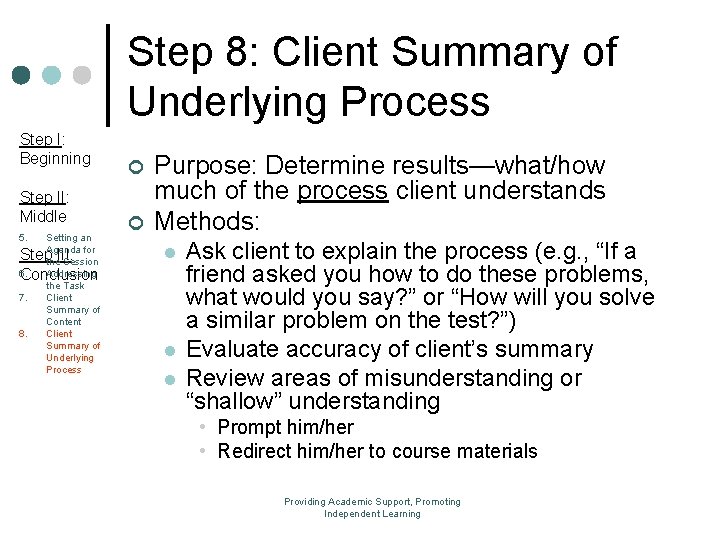
Step 8: Client Summary of Underlying Process Step I: Beginning Step II: Middle 5. Setting an Agenda for the Session Addressing the Task Client Summary of Content Client Summary of Underlying Process Step III: 6. Conclusion 7. 8. ¢ ¢ Purpose: Determine results—what/how much of the process client understands Methods: l l l Ask client to explain the process (e. g. , “If a friend asked you how to do these problems, what would you say? ” or “How will you solve a similar problem on the test? ”) Evaluate accuracy of client’s summary Review areas of misunderstanding or “shallow” understanding • Prompt him/her • Redirect him/her to course materials Providing Academic Support, Promoting Independent Learning
Steps 5 -8: Summary Step I: Beginning Step II: Middle 5. Setting an Agenda for the Session Addressing the Task Client Summary of Content Client Summary of Underlying Process Step III: 6. Conclusion 7. 8. Why is “Do you understand? ” not a good way to determine what/how much the client now understands? ¢ Why is Step 8 (Client Summary of Underlying Process) so important? [Consider the message in the footer of each slide. ] ¢ Providing Academic Support, Promoting Independent Learning
Steps 5 -8: Summary Step I: Beginning ¢ Step II: Middle 5. Setting an Agenda for the Session Addressing the Task Client Summary of Content Client Summary of Underlying Process 1. 2. 3. 4. Step III: 6. Conclusion 7. 8. How do these steps rely upon your having done Steps 1 -4 well? ¢ Greeting and Climate Setting Identification of Task Breaking the Task into Parts Identifying Thought Processes that Underlie the Task Keep in mind how these steps (5 -8) set you up for success with the next steps in the tutoring cycle. . . Providing Academic Support, Promoting Independent Learning