
The Tropical Rainforest Ecosystem What are the characteristics


- Slides: 8
The Tropical Rainforest Ecosystem What are the characteristics and relationships of the tropical rainforest biome?
Biomes Recap D: Downloadsbiomes. swf
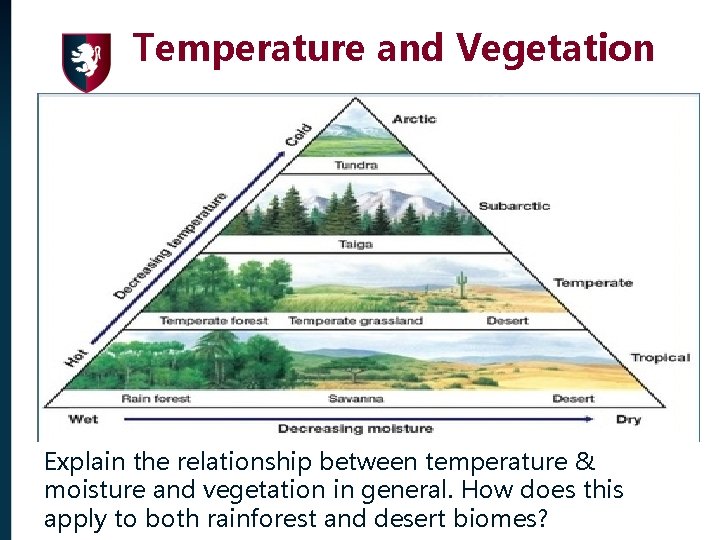
Temperature and Vegetation Explain the relationship between temperature & moisture and vegetation in general. How does this apply to both rainforest and desert biomes?
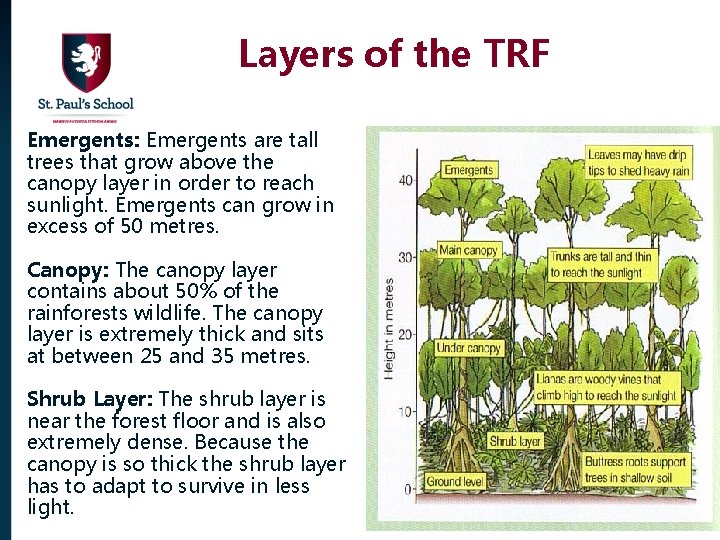
Layers of the TRF Emergents: Emergents are tall trees that grow above the canopy layer in order to reach sunlight. Emergents can grow in excess of 50 metres. Canopy: The canopy layer contains about 50% of the rainforests wildlife. The canopy layer is extremely thick and sits at between 25 and 35 metres. Shrub Layer: The shrub layer is near the forest floor and is also extremely dense. Because the canopy is so thick the shrub layer has to adapt to survive in less light.
How do plants adapt? Lianas: These are woody vines that climb up other trees to try and get into the canopy and capture sunlight. Buttress Roots: Very long roots that are designed to support tall trees and to suck up the maximum amount of nutrients in fairly nutrient poor soil. Fan Palms: Huge wide leaved plants that aim to capture as much sunlight and rainfall as possible. Evergreen: Most vegetation in rainforests does shed its leaves once a year. However, because the climate of rainforests is similar all year, they shed their leaves at different times providing a constant source of biological matter and keeping the rainforest green. Drip tip leaves: A lot of vegetation have leaves designed for rainfall to travel over them and drip to the ground. This is because the vegetation does not wanted to be damaged by large quantities of water.
How do animals adapt? Because there are so many animals competing for food, many animals have adapted by learning to eat a particular food eaten by no other animal Toucans have adapted by developing long, large bill. This adaptation allows this bird to reach fruit on branches that are too small to support the bird's weight. The bill also is used to cut the fruit from the tree The sloth uses a behavioural adaptation and camouflage to survive in the rainforest. It moves very, very slowly and spends most of its time hanging upside down from trees. Blue-green algae grows on its fur giving the sloth a greenish colour and making it more difficult for predators to spot Rain forest animals and insects often use bright colouring and distinctive markings to scare predators. Some of these creatures, such as certain species of poison dart frogs, actually are dangerous, but some aren't. They merely assume the appearances of dangerous animals When the sun goes down, some animals bed down. Others – including the flying fox bat are bright-eyed and on the lookout for a meal. The adaptation to night hunting gives nocturnal animals the benefit of reduced competition for food. At night, there are no birds to compete for the fruit and blossoms that form the diet for flying fox bats.
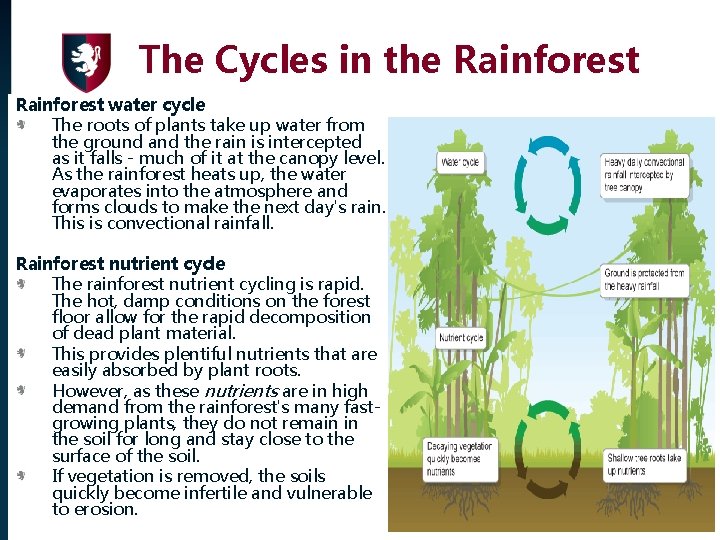
The Cycles in the Rainforest water cycle The roots of plants take up water from the ground and the rain is intercepted as it falls - much of it at the canopy level. As the rainforest heats up, the water evaporates into the atmosphere and forms clouds to make the next day's rain. This is convectional rainfall. Rainforest nutrient cycle The rainforest nutrient cycling is rapid. The hot, damp conditions on the forest floor allow for the rapid decomposition of dead plant material. This provides plentiful nutrients that are easily absorbed by plant roots. However, as these nutrients are in high demand from the rainforest's many fastgrowing plants, they do not remain in the soil for long and stay close to the surface of the soil. If vegetation is removed, the soils quickly become infertile and vulnerable to erosion.