
The Tropical Cyclone Boundary Layer 4 Thermodynamics www
The Tropical Cyclone Boundary Layer 4: Thermodynamics www. cawcr. gov. au Jeff Kepert Head, High Impact Weather Research Oct 2013 The Centre for Australian Weather and Climate Research A partnership between CSIRO and the Bureau of Meteorology
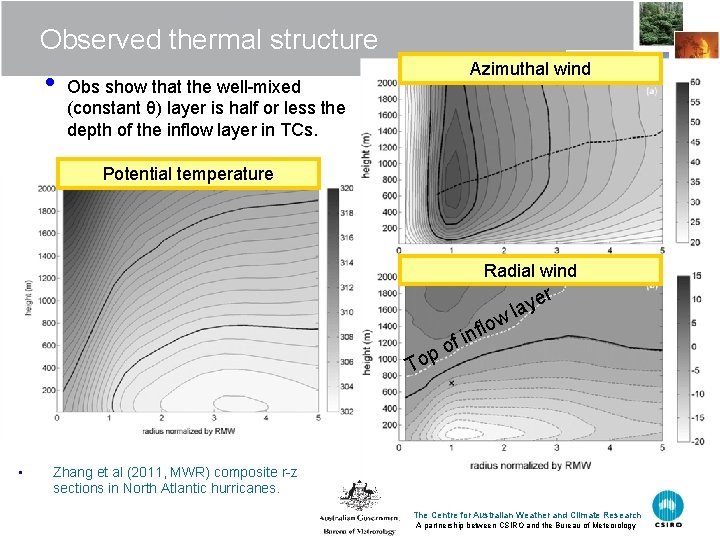
Observed thermal structure • Azimuthal wind Obs show that the well-mixed (constant θ) layer is half or less the depth of the inflow layer in TCs. Potential temperature Radial wind w o l f f in er y a l po o T • Zhang et al (2011, MWR) composite r-z sections in North Atlantic hurricanes. The Centre for Australian Weather and Climate Research A partnership between CSIRO and the Bureau of Meteorology
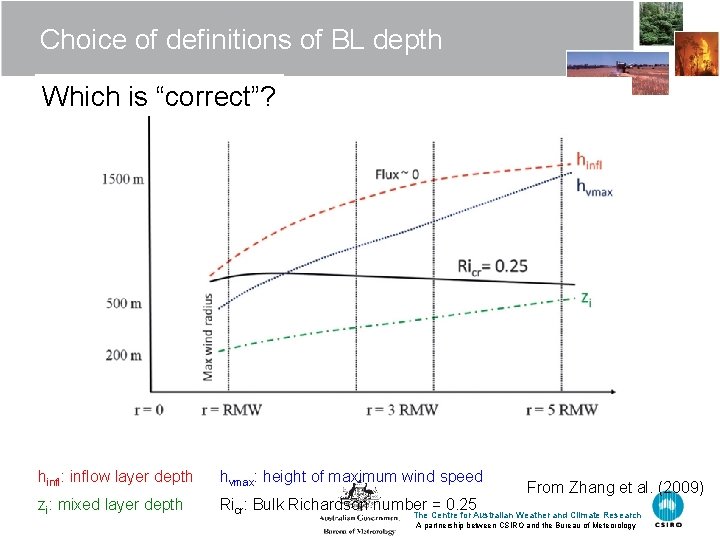
Choice of definitions of BL depth Which is “correct”? hinfl: inflow layer depth hvmax: height of maximum wind speed zi: mixed layer depth Ricr: Bulk Richardson number = 0. 25 The Centre for Australian Weather and Climate Research From Zhang et al. (2009) A partnership between CSIRO and the Bureau of Meteorology
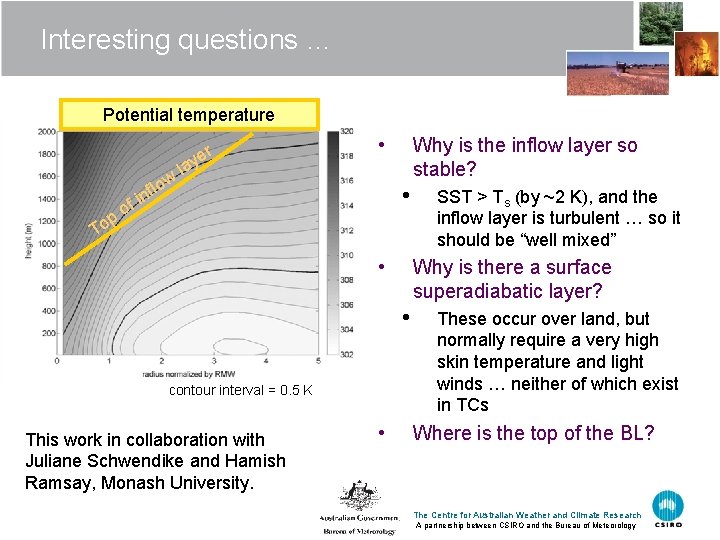
Interesting questions … Potential temperature r p To of lo f n i w e lay • Why is the inflow layer so stable? • • Why is there a surface superadiabatic layer? • contour interval = 0. 5 K This work in collaboration with Juliane Schwendike and Hamish Ramsay, Monash University. • SST > Ts (by ~2 K), and the inflow layer is turbulent … so it should be “well mixed” These occur over land, but normally require a very high skin temperature and light winds … neither of which exist in TCs Where is the top of the BL? The Centre for Australian Weather and Climate Research A partnership between CSIRO and the Bureau of Meteorology
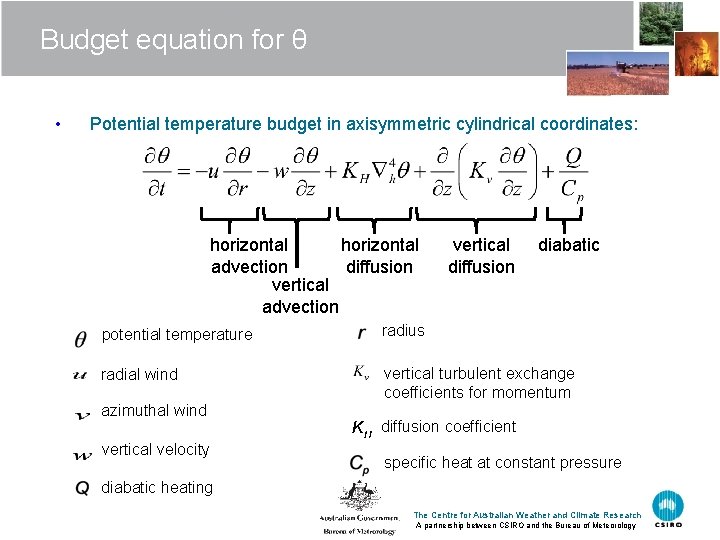
Budget equation for θ • Potential temperature budget in axisymmetric cylindrical coordinates: horizontal advection diffusion vertical advection vertical diffusion diabatic potential temperature radius radial wind vertical turbulent exchange coefficients for momentum azimuthal wind vertical velocity diffusion coefficient specific heat at constant pressure diabatic heating The Centre for Australian Weather and Climate Research A partnership between CSIRO and the Bureau of Meteorology
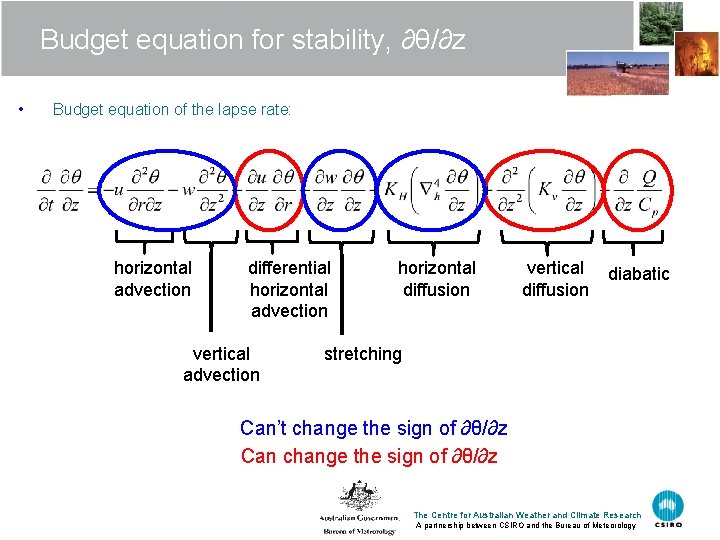
Budget equation for stability, ∂θ/∂z • Budget equation of the lapse rate: horizontal advection differential horizontal advection vertical advection horizontal diffusion vertical diffusion diabatic stretching Can’t change the sign of ∂θ/∂z Can change the sign of ∂θ/∂z The Centre for Australian Weather and Climate Research A partnership between CSIRO and the Bureau of Meteorology
The model CM 1: Axisymmetric TC model of Bryan and Rotunno (2009) • • • Non-hydrostatic Axisymmetric “full-physics” tropical cyclone model Simulations are time-mean of a quasi-steady state storm at potential intensity (PI) The Centre for Australian Weather and Climate Research A partnership between CSIRO and the Bureau of Meteorology
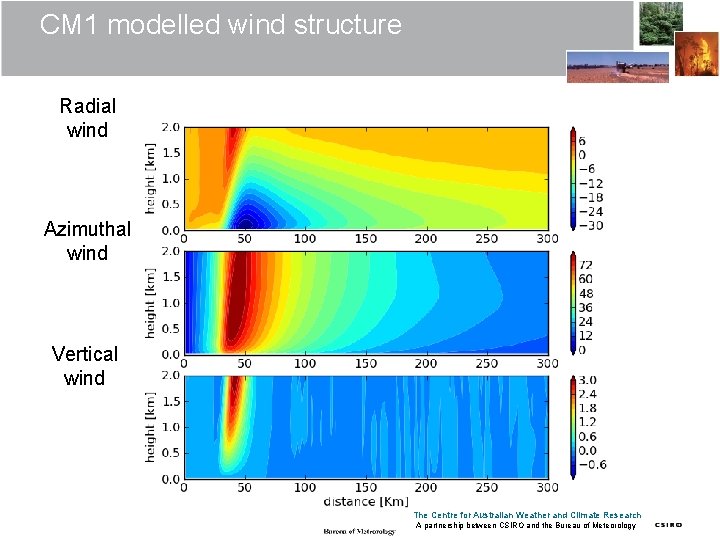
CM 1 modelled wind structure Radial wind Azimuthal wind Vertical wind The Centre for Australian Weather and Climate Research A partnership between CSIRO and the Bureau of Meteorology
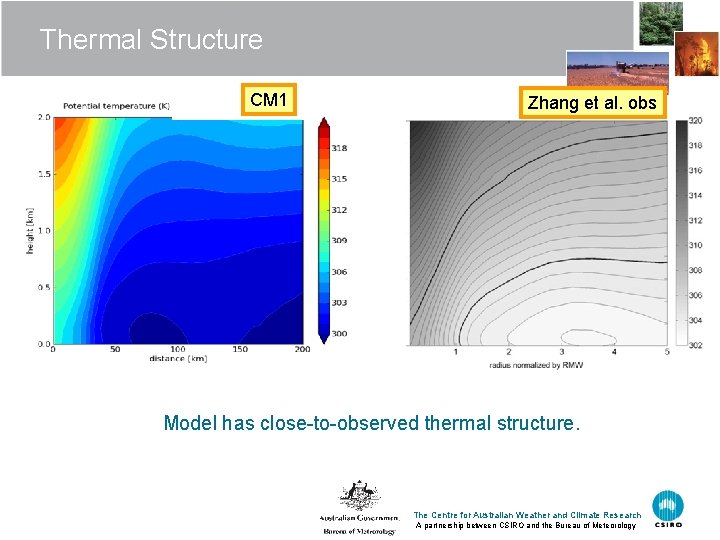
Thermal Structure CM 1 Zhang et al. obs Model has close-to-observed thermal structure. The Centre for Australian Weather and Climate Research A partnership between CSIRO and the Bureau of Meteorology
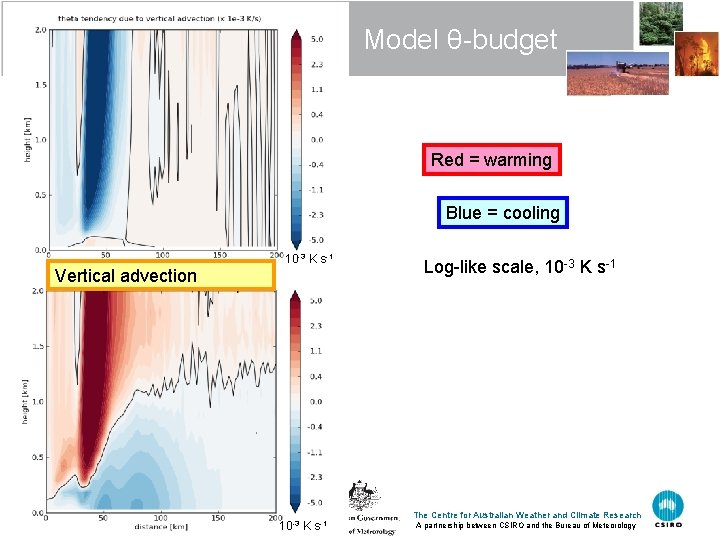
Model θ-budget Red = warming Blue = cooling 10 -3 K s-1 Diabaticadvection Vertical term 10 -3 K s-1 Log-like scale, 10 -3 K s-1 The Centre for Australian Weather and Climate Research A partnership between CSIRO and the Bureau of Meteorology
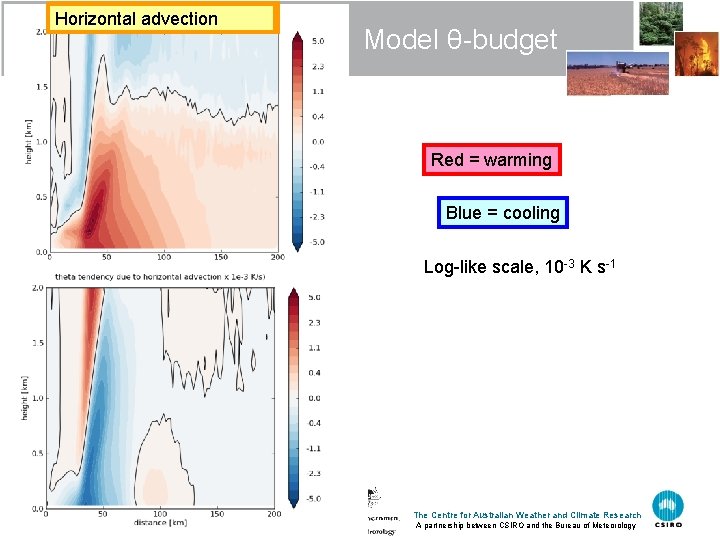
Vertical diffusion Horizontal advection Model θ-budget Red = warming Blue = cooling Log-like scale, 10 -3 K s-1 The Centre for Australian Weather and Climate Research A partnership between CSIRO and the Bureau of Meteorology
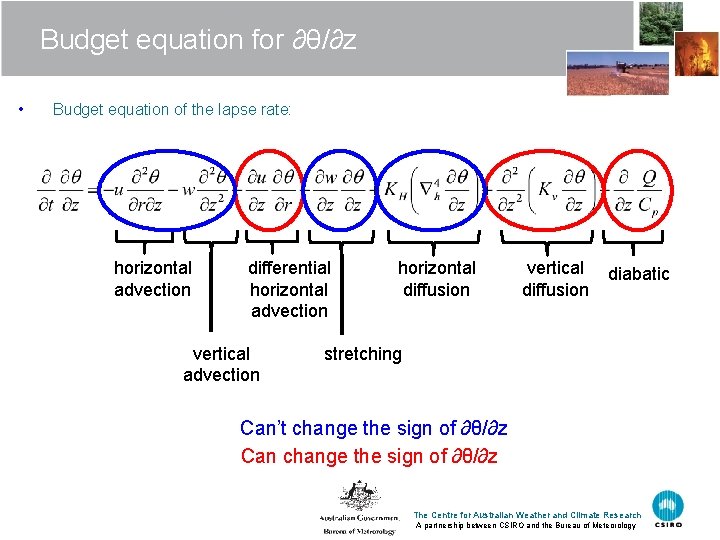
Budget equation for ∂θ/∂z • Budget equation of the lapse rate: horizontal advection differential horizontal advection vertical advection horizontal diffusion vertical diffusion diabatic stretching Can’t change the sign of ∂θ/∂z Can change the sign of ∂θ/∂z The Centre for Australian Weather and Climate Research A partnership between CSIRO and the Bureau of Meteorology
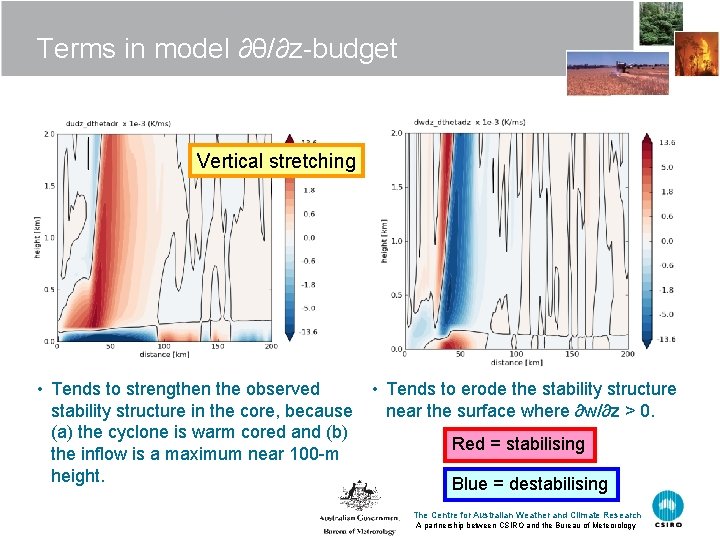
Terms in model ∂θ/∂z-budget Differential Vertical stretching horizontal advection • Tends to strengthen the observed • Tends to erode the stability structure in the core, because near the surface where ∂w/∂z > 0. (a) the cyclone is warm cored and (b) Red = stabilising the inflow is a maximum near 100 -m height. Blue = destabilising The Centre for Australian Weather and Climate Research A partnership between CSIRO and the Bureau of Meteorology
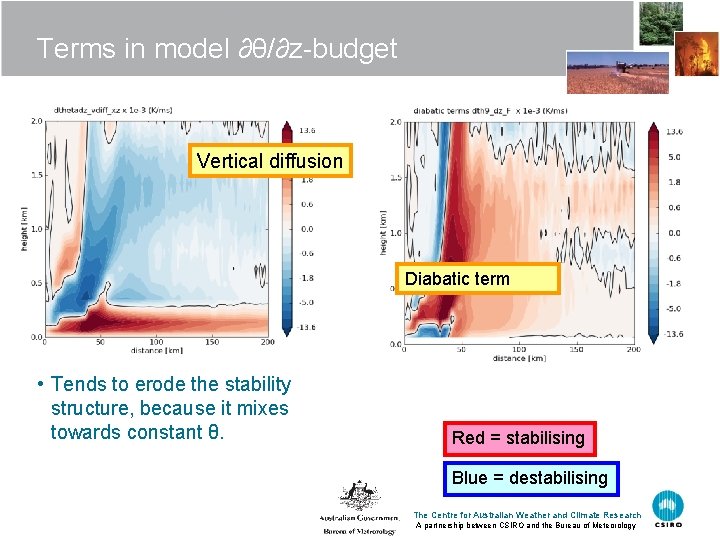
Terms in model ∂θ/∂z-budget Vertical diffusion Diabatic term • Tends to erode the stability structure, because it mixes towards constant θ. Red = stabilising Blue = destabilising The Centre for Australian Weather and Climate Research A partnership between CSIRO and the Bureau of Meteorology
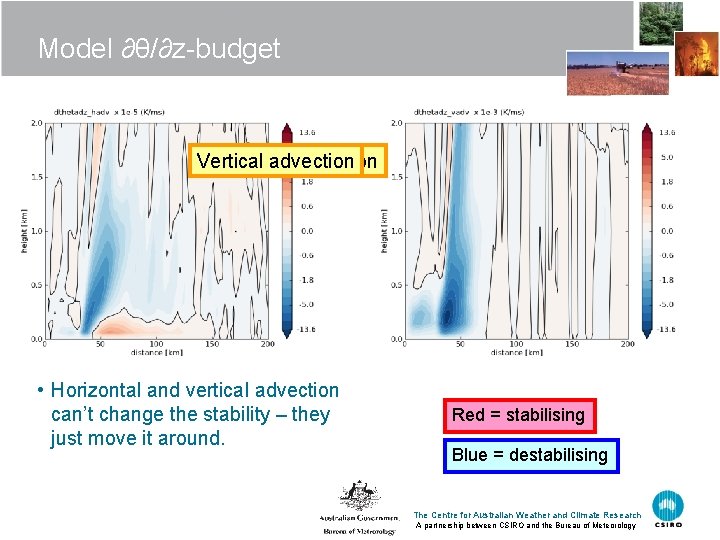
Model ∂θ/∂z-budget Vertical Horizontal advection • Horizontal and vertical advection can’t change the stability – they just move it around. Red = stabilising Blue = destabilising The Centre for Australian Weather and Climate Research A partnership between CSIRO and the Bureau of Meteorology
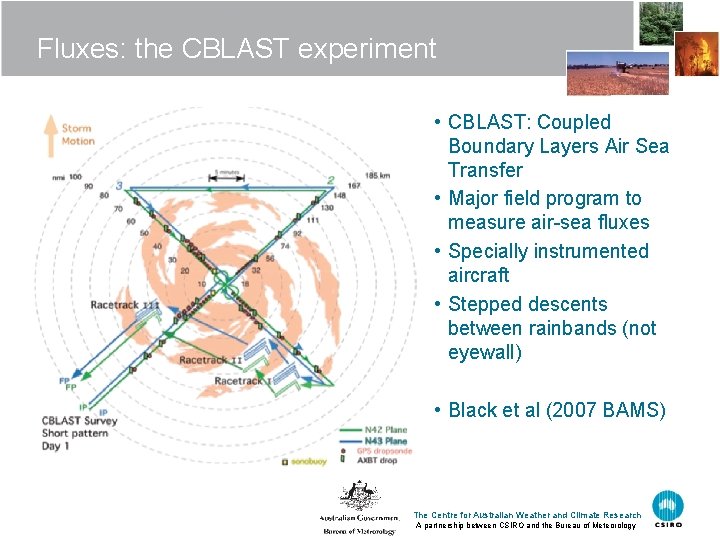
Fluxes: the CBLAST experiment • CBLAST: Coupled Boundary Layers Air Sea Transfer • Major field program to measure air-sea fluxes • Specially instrumented aircraft • Stepped descents between rainbands (not eyewall) • Black et al (2007 BAMS) The Centre for Australian Weather and Climate Research A partnership between CSIRO and the Bureau of Meteorology
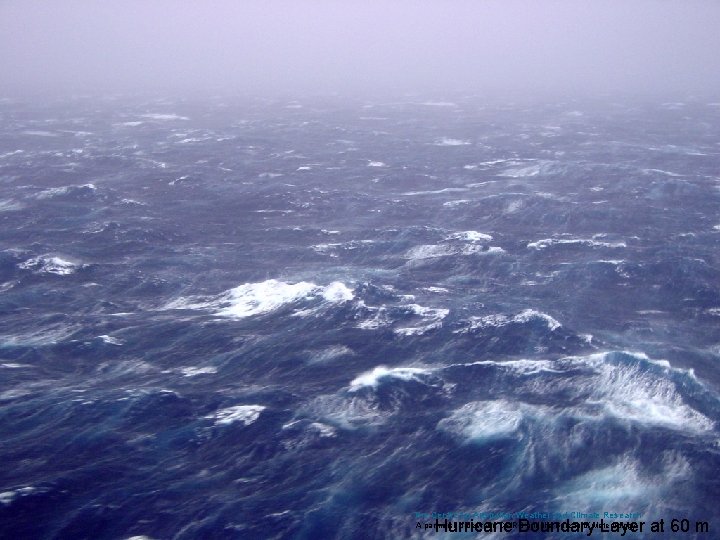
The Centre for Australian Weather and Climate Research Hurricane Boundary Layer at 60 m A partnership between CSIRO and the Bureau of Meteorology
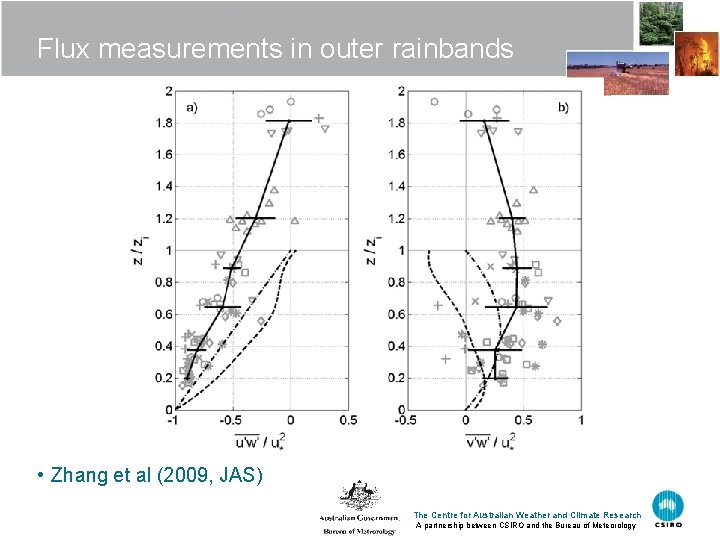
Flux measurements in outer rainbands • Zhang et al (2009, JAS) The Centre for Australian Weather and Climate Research A partnership between CSIRO and the Bureau of Meteorology
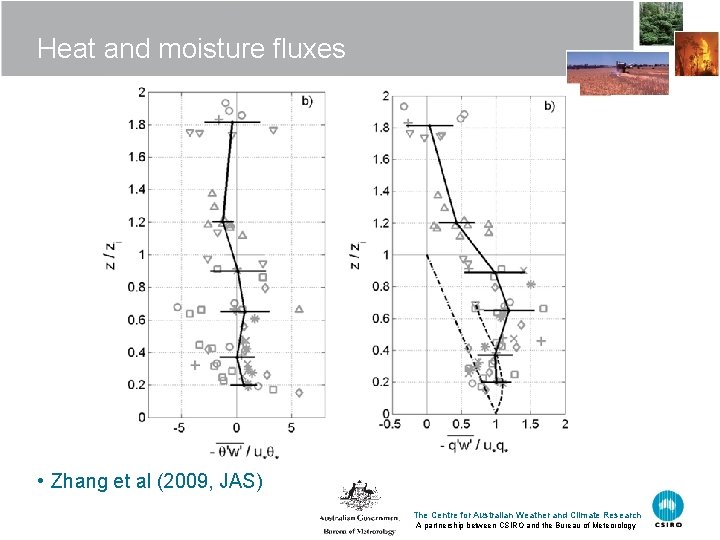
Heat and moisture fluxes • Zhang et al (2009, JAS) The Centre for Australian Weather and Climate Research A partnership between CSIRO and the Bureau of Meteorology
Vertical structure • Fluxes extend to well above the inversion (stable layer) • Flux becomes zero (~top of boundary layer) at about 2 zi • Suggests that the stable layer is not the top of the boundary layer • Momentum flux is similar to that in textbooks, except deeper The Centre for Australian Weather and Climate Research A partnership between CSIRO and the Bureau of Meteorology
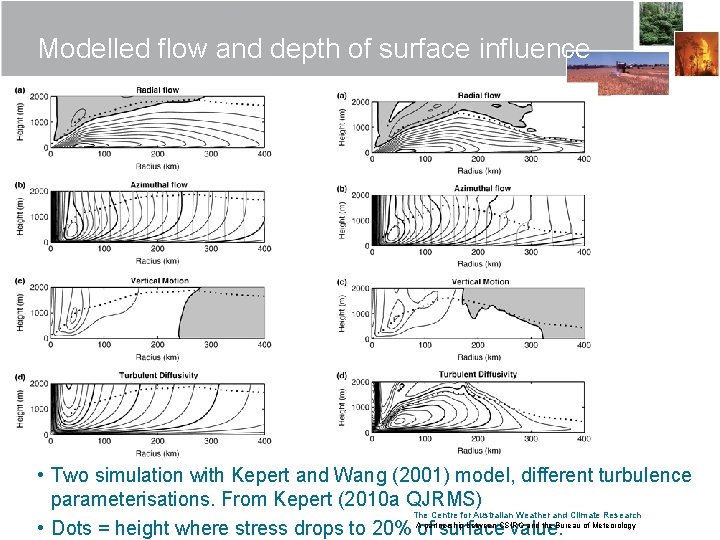
Modelled flow and depth of surface influence • Two simulation with Kepert and Wang (2001) model, different turbulence parameterisations. From Kepert (2010 a QJRMS) The Centre for Australian Weather and Climate Research • Dots = height where stress drops to 20% of surface value. A partnership between CSIRO and the Bureau of Meteorology
Thermal structure conclusions • The main stabilising term is differential advection. • The inflow decreases with height, and advects cold (low θ) air inwards. So the cooling is strongest in the lower BL. • This term reverses (destabilises) right next to the surface because the inflow max is at about 100 -m height … so the differential advection is reversed right near the surface. • Main destabilising terms are: • Vertical diffusion – due to heating from below. • Differential advection below ~100 m causes the “surface super”. • One-dimensional thinking is no good for TCBL thermodynamics. • Constant-θ is not a good definition of the TCBL. • Mixing is much deeper than constant-θ layer. • Boundary layer depth a little greater than inflow layer depth • In axisymmetric storms • Motion asymmetry is a difficulty The Centre for Australian Weather and Climate Research A partnership between CSIRO and the Bureau of Meteorology
- Slides: 22