
The Tree of Life Introduction to Biological Diversity
The Tree of Life: Introduction to Biological Diversity Ch. 26 Lesson 8. 1
Overview • “We will begin this chapter by discussing the origin of life. That discussion is the most speculative in the entire unit, for no fossil evidence of that seminal episode exists. ”
Early Earth Conditions • Simple cells were produced through a sequence of 4 main stages: – Abiotic synthesis of small organic molecules (amino acids/nucleotides) – Joining of these small molecules into polymers (proteins/nucleic acids) – Packaging of these molecules into “protobionts” (droplets that maintain an internal chemistry different than the outside environment) – Origin of self-replicating molecules that eventually made inheritance possible
Early Earth Conditions? ? ? • Previous 4 stages are mere predictions, but it leads to some predictions that can be tested in the laboratory – Synthesis of organic compounds – Abiotic synthesis of polymers – Protobionts – The RNA World
Synthesis of Organic Compounds • Earth formed about 4. 6 billion years ago from condensing of a vast cloud of dust and rocks • Not much could exist for the first few hundred million years because of huge chunks of ice and rock hitting earth. – Originated enough heat to vaporize all available water and prevent seas from forming • Early earth atmosphere was a thick water vapor that condensed to form the seas
Synthesis of Organic Compounds • Russian chemist Oparin theorized that life could come from simple molecules – energized by lightning and intense UV radiation • These “simple molecules” are what we refer to as “primordial soup” • Though experiments have been done to show that the atmosphere could have been conducive to forming life, no one has yet been able to create organic compounds from such a primordial soup • Still the idea of “life from nonlife”
Abiotic Synthesis of Polymers • Amino acids dropped on hot sand, clay or rock formed polymers spontaneously without the help of enzymes. • Then what?
Protobionts • In order for their to be life, there must be accurate replication and metabolism (among other things) • DNA replication requires elaborate enzymatic machinery • Protobionts – aggregates of abiotically produced molecules (life from nonlife) surrounded by a membrane • If membrane was semi-permeable, it could have taken up organic compounds
First Prokaryotes • Protobionts would have had to make some of their own molecules for survival, but then they were replaced by organisms who could gain all they need from their environment – Some of these autotrophs could use light energy • Diversification of autotrophs lead to hetertrophs • These prokaryotes were earth’s only inhabitants from at least 3. 5 to 2 billion years ago
Electron Transport Systems • Formation of these would have been very important in formation of first cells • Many believe rudimentary forms existed before oxygen was present, relying on hydrogen and methane
Photosynthesis and Oxygen • Most oxygen in our atmosphere today is formed from the splitting of water in photosynthesis • In a pre-oxygen world, only cyanobacteria could produce oxygen. – Eventually this saturated the oceans, then finally made it to the atmosphere • Addition of oxygen to atmosphere probably killed many prokaryotes used to being anaerobic
First Eukaryotes • Oldest eukaryotic fossils are 2. 1 billion years old – Most postulate the actual first eukaryotes were 2. 7 billion years ago – This would have been around the time of oxygen’s introduction to the atmosphere
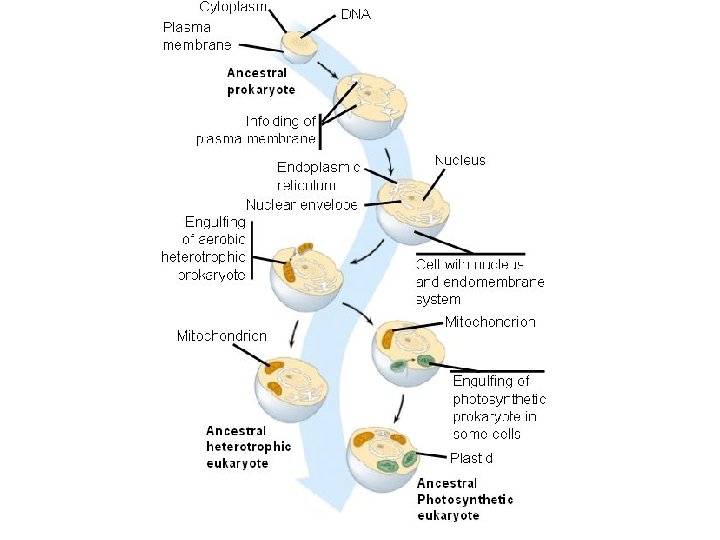
Eukaryotic Evolution • Eukaryotes have nuclear envelopes, Golgi apparati, ER and cytoskeletons, which prokaryotes did not – Cytoskeletons give eukaryotes ability to move and possibly engulf other organisms – First eukaryotes may have been predators • Big Question: How did complexity arise? – Endosymbiosis – mitochondria and plastids were formerly small prokaryotes living within larger cells
Endosymbiosis • Prokaryotes found their way into host cells and lived there until they adapted to living their and became useful – mitochondria and plastids • Because all eukaryotes have mitochondria, but not all eukaryotes have plastids, serial endosymbiosis (a sequence of endosymbiotic events) probably led to mitochondria evolving before plastids
Eukaryotic Cells = Chimeras • Chimera – Greek mythological figure that was part goat, part lion and part serpent • The parts of a eukaryotic cell come from different prokaryotes – “Clues to other aspects of the origin of eukaryotic cells are far more numerous and confusing” • Maximum parsimony and likelihood? ?
Evolution of Multicellularity • First multicellular organisms were colonies (collections of autonomously replicating cells) – Some of these cells became specialized, were able to exist on their own, then start replicating and differentiating
Cambrian Explosion & Land Colonization • Most of the major phyla of animals appear suddenly in the first 20 million years of the Cambrian period • Explosion in diversity is for “reasons unknown at this time” • Colonization of land was possible because of adaptations to prevent dehydration (wax coating on leaves of plants to prevent water loss)
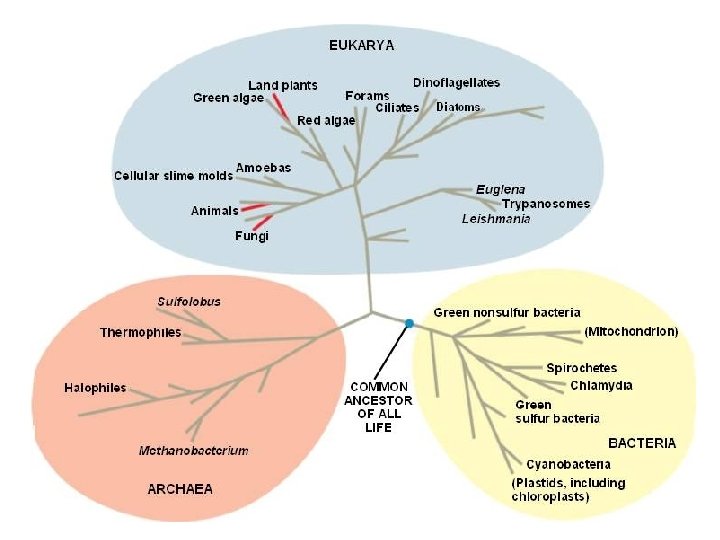
Taxonomic Changes • Used to be two: Plants and Animals • 1969 it changed to 5: Monera, Protista, Plantae, Fungi, Animalia • Now biologists favor 3 -Domain System – Bacteria, Archaea and Eukarya

- Slides: 21