
THE TREATMENT OF PROLONGED GRIEF DISORDER USING COGNITIVE





- Slides: 42
THE TREATMENT OF PROLONGED GRIEF DISORDER USING COGNITIVE BEHAVIORAL THERAPY By Kyle Linnemann, LPCC
What is Cognitive Behavioral Therapy? A Brief Overview
The Origin of Cognitive Behavioral Therapy � � � The main idea upon which CBT is based can be traced as far back as to Greek philosopher Epictetus (AD 55 - AD 135) who said, “Men are disturbed not by things, but by the views which we take of them. ” In 1957 psychologist Albert Ellis formally set forth the first cognitive behavioral therapy by proposing that therapist help people adjust their thinking and behavior as the treatment of emotional and behavioral problems. In the early 1960’s, psychiatrist Aaron Beck began helping depressed patients evaluate their thoughts and think more realistically, and by doing so, they began to feel better.
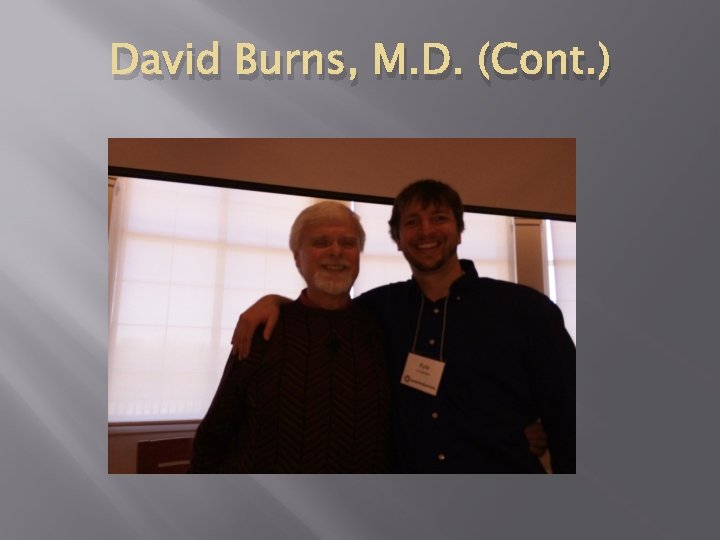
David Burns, M. D. � � CBT was popularized by Dr. David Burns, M. D. Wrote ground breaking books: Feeling Good: The New Mood Therapy (1980) and When Panic Attacks (2006). Big NBA fan (especially the Warriors). Close, personal friend of Kyle Linnemann.
David Burns, M. D. (Cont. )
How Does CBT Work? � � � The therapist and client work together to help the client identify unhealthy thoughts contributing to the unwanted feelings. The therapist uses a variety of techniques to help the client challenge unhealthy thoughts. The client uses what is learned in therapy and outside of session to help change unhealthy thoughts and decrease unwanted feelings.
Examples of CBT Techniques
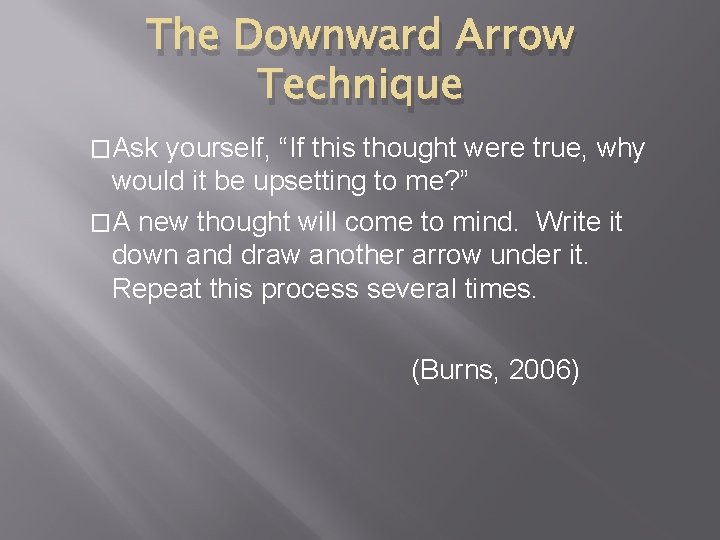
The Downward Arrow Technique �Ask yourself, “If this thought were true, why would it be upsetting to me? ” �A new thought will come to mind. Write it down and draw another arrow under it. Repeat this process several times. (Burns, 2006)
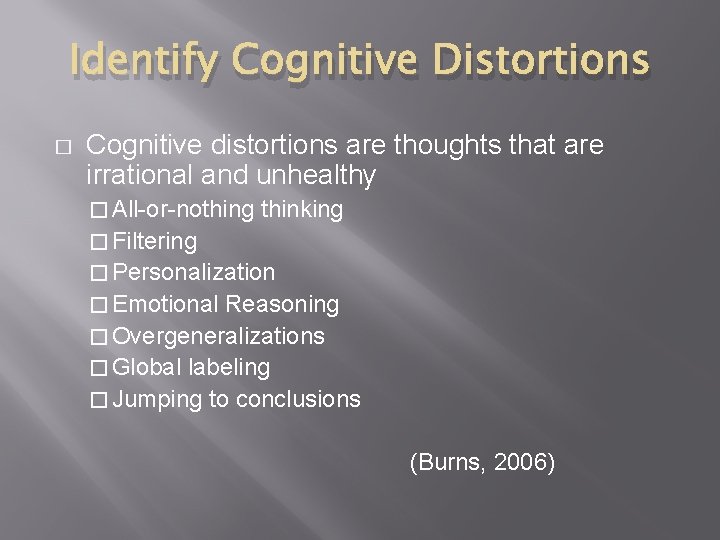
Identify Cognitive Distortions � Cognitive distortions are thoughts that are irrational and unhealthy � All-or-nothing thinking � Filtering � Personalization � Emotional Reasoning � Overgeneralizations � Global labeling � Jumping to conclusions (Burns, 2006)
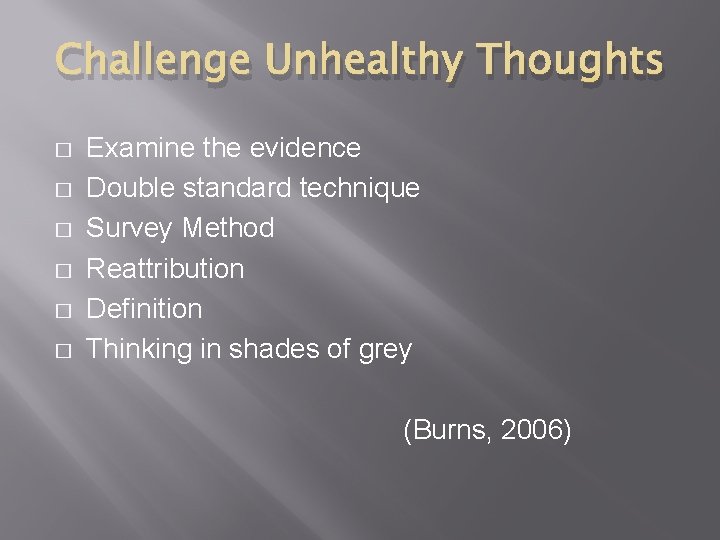
Challenge Unhealthy Thoughts � � � Examine the evidence Double standard technique Survey Method Reattribution Definition Thinking in shades of grey (Burns, 2006)
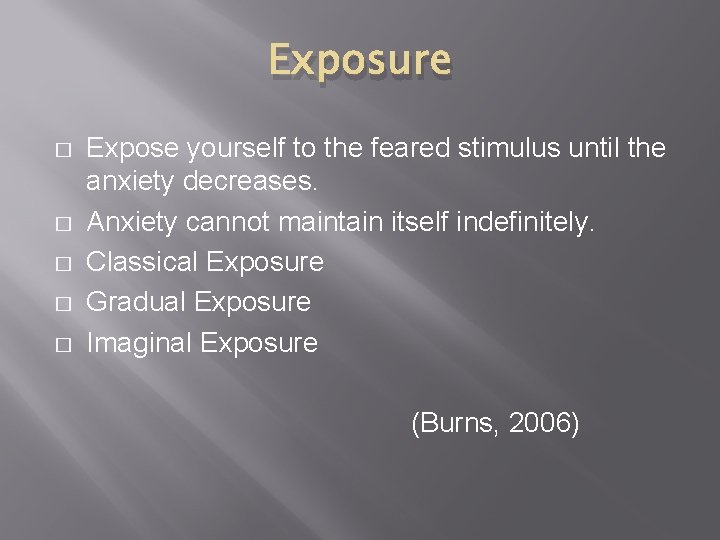
Exposure � � � Expose yourself to the feared stimulus until the anxiety decreases. Anxiety cannot maintain itself indefinitely. Classical Exposure Gradual Exposure Imaginal Exposure (Burns, 2006)
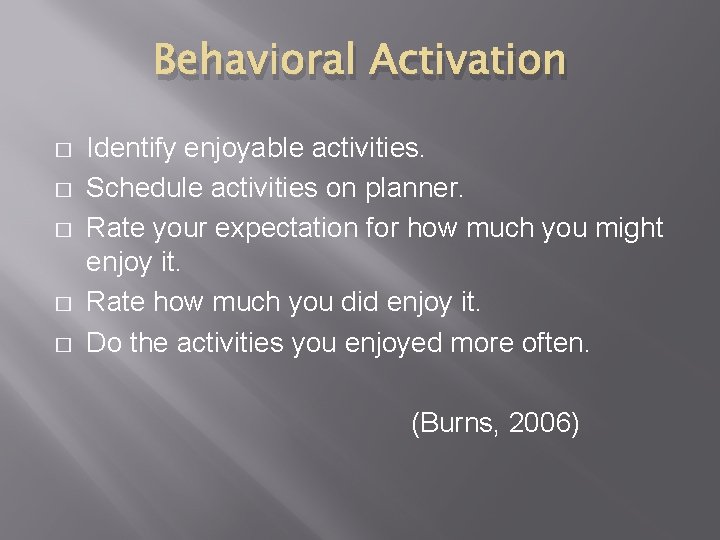
Behavioral Activation � � � Identify enjoyable activities. Schedule activities on planner. Rate your expectation for how much you might enjoy it. Rate how much you did enjoy it. Do the activities you enjoyed more often. (Burns, 2006)
CBT and Prolonged Grief Disorder The what, who, why, and how.
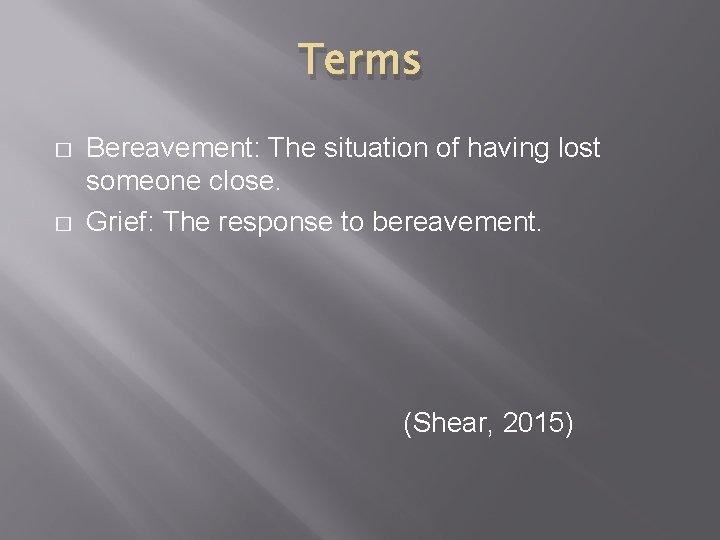
Terms � � Bereavement: The situation of having lost someone close. Grief: The response to bereavement. (Shear, 2015)
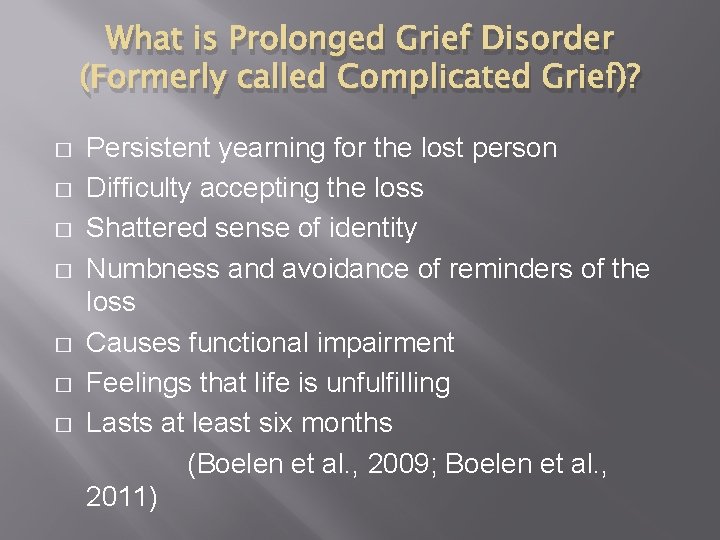
What is Prolonged Grief Disorder (Formerly called Complicated Grief)? � � � � Persistent yearning for the lost person Difficulty accepting the loss Shattered sense of identity Numbness and avoidance of reminders of the loss Causes functional impairment Feelings that life is unfulfilling Lasts at least six months (Boelen et al. , 2009; Boelen et al. , 2011)
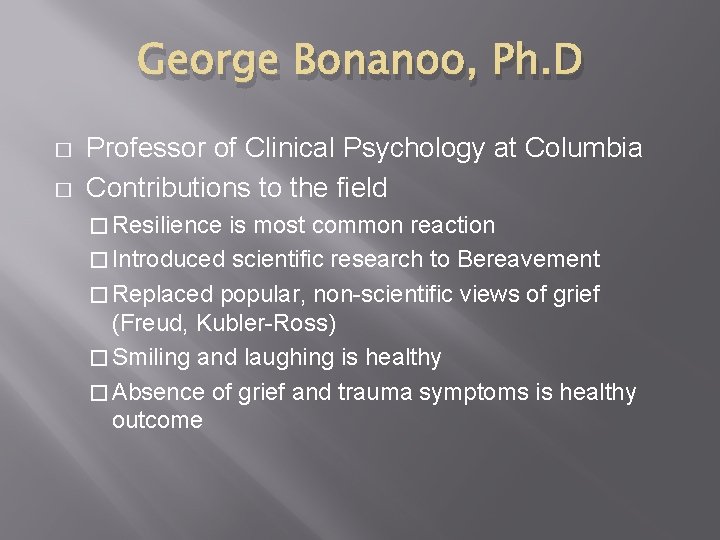
George Bonanoo, Ph. D � � Professor of Clinical Psychology at Columbia Contributions to the field � Resilience is most common reaction � Introduced scientific research to Bereavement � Replaced popular, non-scientific views of grief (Freud, Kubler-Ross) � Smiling and laughing is healthy � Absence of grief and trauma symptoms is healthy outcome
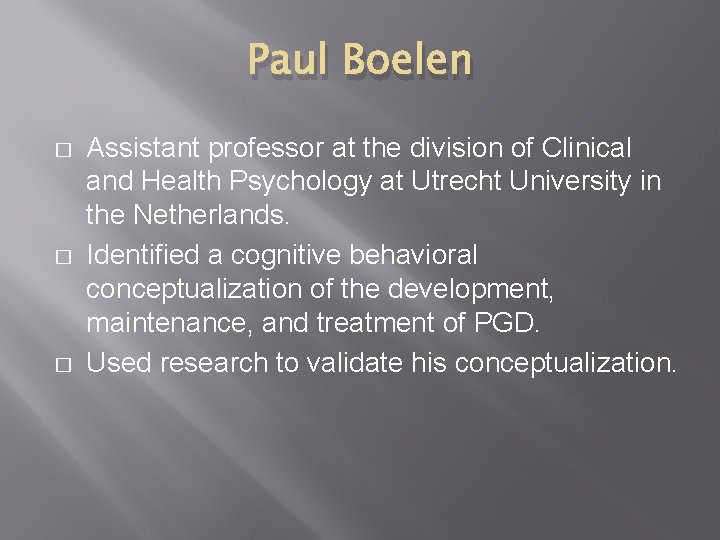
Paul Boelen � � � Assistant professor at the division of Clinical and Health Psychology at Utrecht University in the Netherlands. Identified a cognitive behavioral conceptualization of the development, maintenance, and treatment of PGD. Used research to validate his conceptualization.
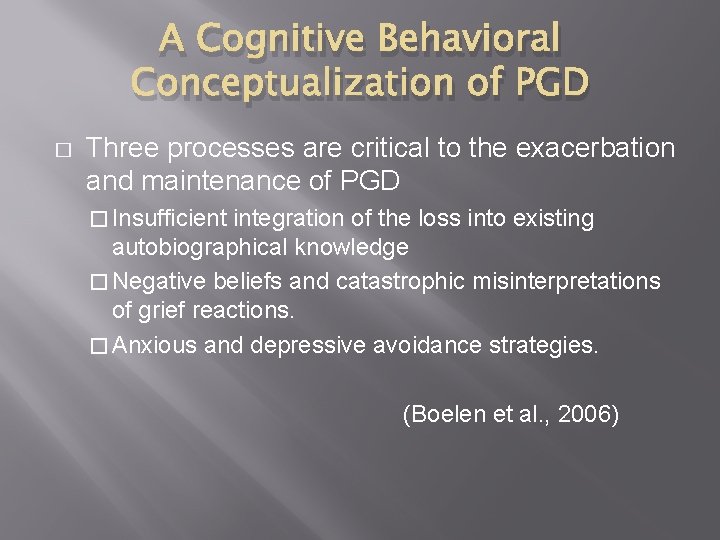
A Cognitive Behavioral Conceptualization of PGD � Three processes are critical to the exacerbation and maintenance of PGD � Insufficient integration of the loss into existing autobiographical knowledge � Negative beliefs and catastrophic misinterpretations of grief reactions. � Anxious and depressive avoidance strategies. (Boelen et al. , 2006)
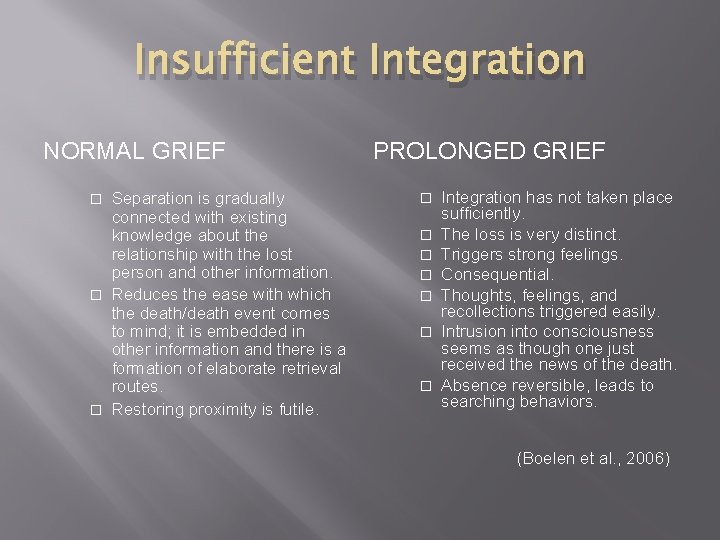
Insufficient Integration NORMAL GRIEF Separation is gradually connected with existing knowledge about the relationship with the lost person and other information. � Reduces the ease with which the death/death event comes to mind; it is embedded in other information and there is a formation of elaborate retrieval routes. � Restoring proximity is futile. � PROLONGED GRIEF � � � � Integration has not taken place sufficiently. The loss is very distinct. Triggers strong feelings. Consequential. Thoughts, feelings, and recollections triggered easily. Intrusion into consciousness seems as though one just received the news of the death. Absence reversible, leads to searching behaviors. (Boelen et al. , 2006)
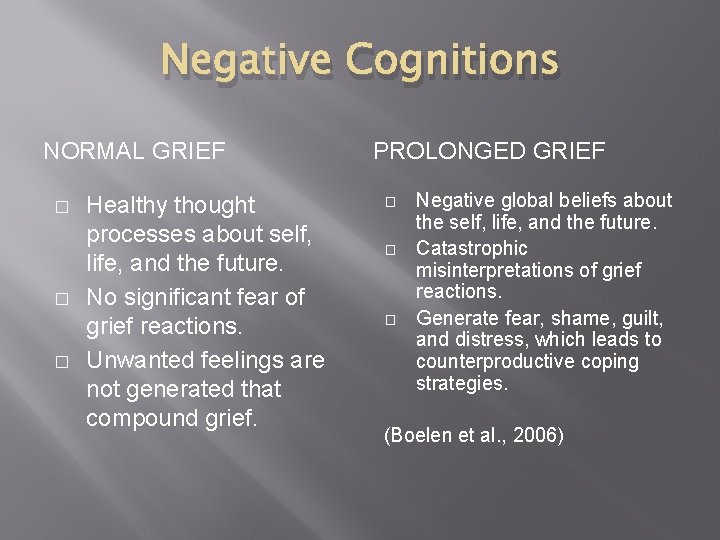
Negative Cognitions NORMAL GRIEF � � � Healthy thought processes about self, life, and the future. No significant fear of grief reactions. Unwanted feelings are not generated that compound grief. PROLONGED GRIEF � � � Negative global beliefs about the self, life, and the future. Catastrophic misinterpretations of grief reactions. Generate fear, shame, guilt, and distress, which leads to counterproductive coping strategies. (Boelen et al. , 2006)
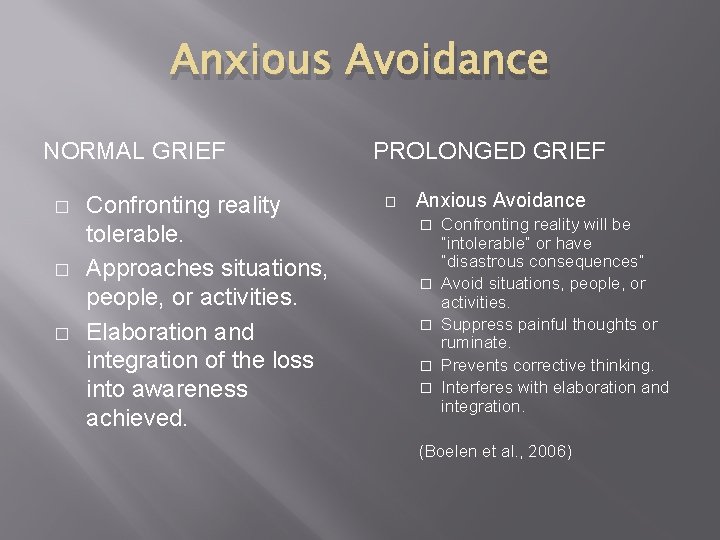
Anxious Avoidance NORMAL GRIEF � � � Confronting reality tolerable. Approaches situations, people, or activities. Elaboration and integration of the loss into awareness achieved. PROLONGED GRIEF � Anxious Avoidance � � � Confronting reality will be “intolerable” or have “disastrous consequences” Avoid situations, people, or activities. Suppress painful thoughts or ruminate. Prevents corrective thinking. Interferes with elaboration and integration. (Boelen et al. , 2006)
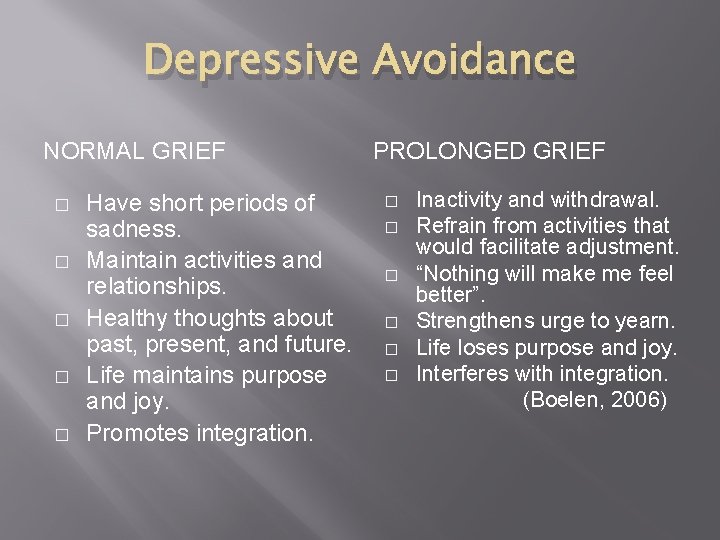
Depressive Avoidance NORMAL GRIEF � � � Have short periods of sadness. Maintain activities and relationships. Healthy thoughts about past, present, and future. Life maintains purpose and joy. Promotes integration. PROLONGED GRIEF � � � Inactivity and withdrawal. Refrain from activities that would facilitate adjustment. “Nothing will make me feel better”. Strengthens urge to yearn. Life loses purpose and joy. Interferes with integration. (Boelen, 2006)
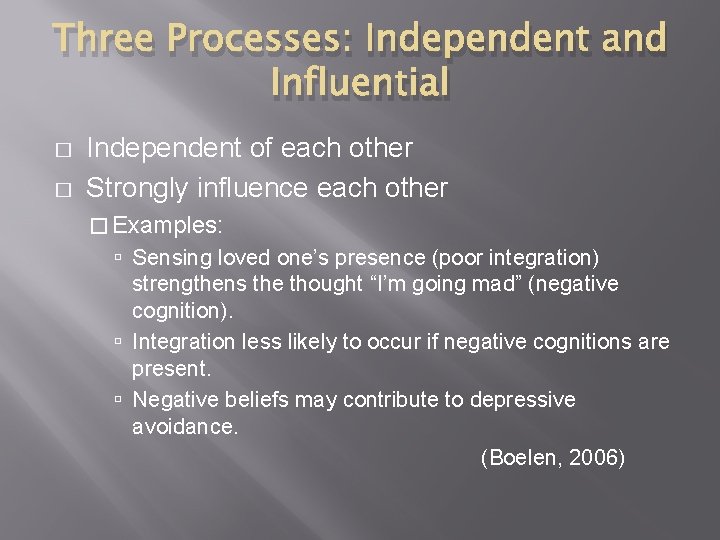
Three Processes: Independent and Influential � � Independent of each other Strongly influence each other � Examples: Sensing loved one’s presence (poor integration) strengthens the thought “I’m going mad” (negative cognition). Integration less likely to occur if negative cognitions are present. Negative beliefs may contribute to depressive avoidance. (Boelen, 2006)
CBT for PGD
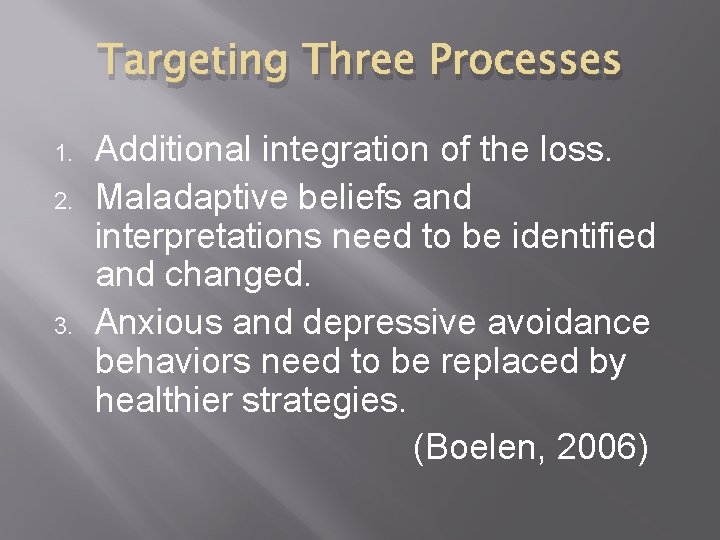
Targeting Three Processes 1. 2. 3. Additional integration of the loss. Maladaptive beliefs and interpretations need to be identified and changed. Anxious and depressive avoidance behaviors need to be replaced by healthier strategies. (Boelen, 2006)
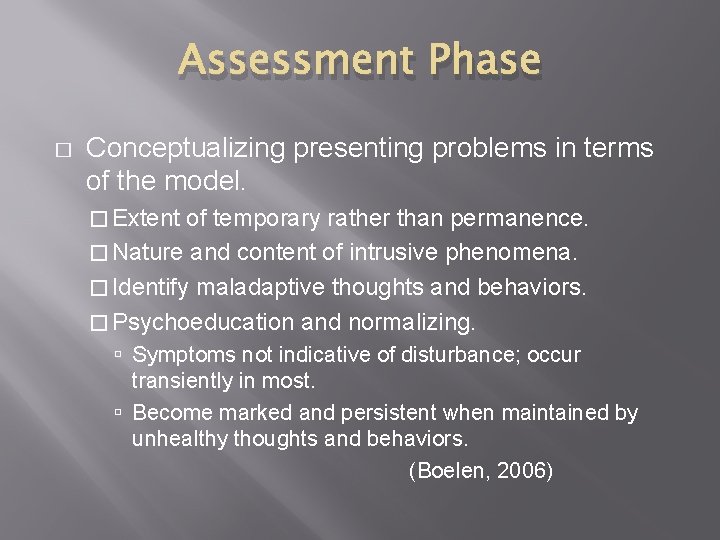
Assessment Phase � Conceptualizing presenting problems in terms of the model. � Extent of temporary rather than permanence. � Nature and content of intrusive phenomena. � Identify maladaptive thoughts and behaviors. � Psychoeducation and normalizing. Symptoms not indicative of disturbance; occur transiently in most. Become marked and persistent when maintained by unhealthy thoughts and behaviors. (Boelen, 2006)
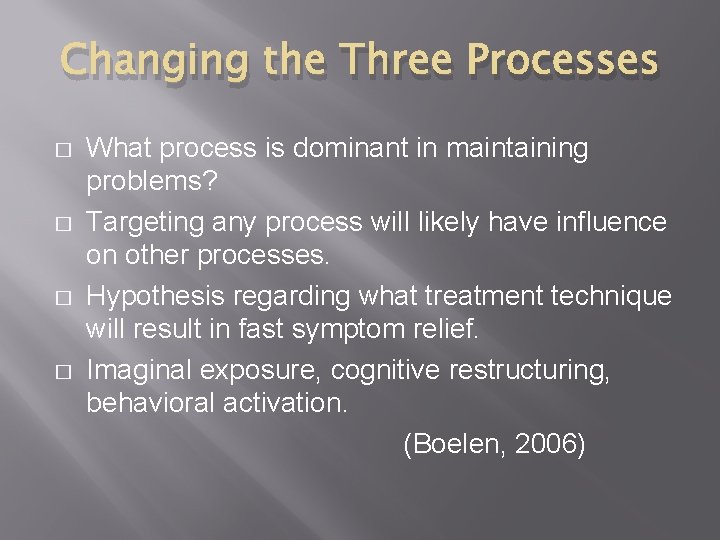
Changing the Three Processes � � What process is dominant in maintaining problems? Targeting any process will likely have influence on other processes. Hypothesis regarding what treatment technique will result in fast symptom relief. Imaginal exposure, cognitive restructuring, behavioral activation. (Boelen, 2006)
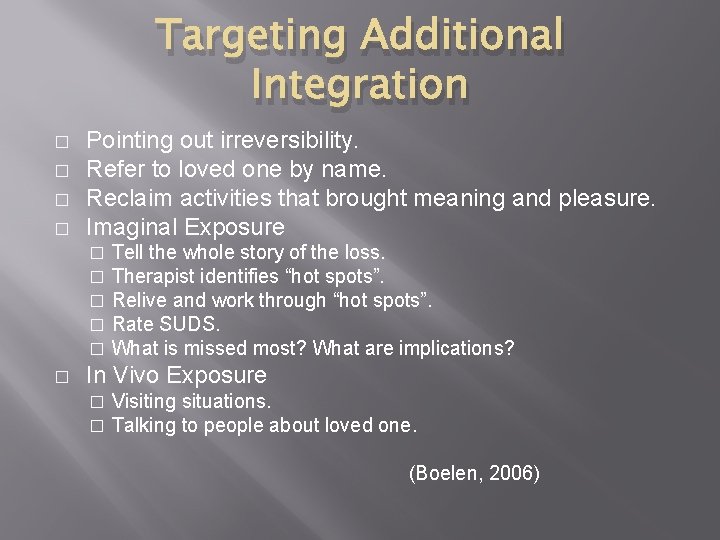
Targeting Additional Integration � � Pointing out irreversibility. Refer to loved one by name. Reclaim activities that brought meaning and pleasure. Imaginal Exposure � � � Tell the whole story of the loss. Therapist identifies “hot spots”. Relive and work through “hot spots”. Rate SUDS. What is missed most? What are implications? In Vivo Exposure � � Visiting situations. Talking to people about loved one. (Boelen, 2006)
Targeting Negative Beliefs � � Cognitive restructuring. Explain rationale. Mood logs between sessions. Put behavioral interventions in cognitive contexts. � Exposure. � Behavioral activation. (Boelen, 2006)
Targeting Anxious and Depressive Avoidance � Anxious Avoidance � Exposure � Response Prevention Continuing bonds Preoccupied responses � Depressive Avoidance � Cognitive restructuring � Behavioral activation � Formulating goals and steps towards attaining them (Boelen, 2006)
Kathy Shear, M. D. � Columbia University � Professor of Psychiatry at Columbia University � Director of Bereavement and Grief Program � Director of the Complicated Grief Research and Treatment Program at New York State Psychiatric Institute
Attachment Theory (Bowlby) and CGT (Shear) � � � � Biologically motivated to seek, form, and maintain relationships with others. Proximity to others is rewarding. Closest bond between parent and child and romantic relationships. Attachment security contributes to physiological and psychological regulatory processes. Disruption of secure attachment leads to emotional and physiological disregulation. Successful mourning occurs when the person adjusts to the loss. Complicated grief occurs when assimilation is impeded by thoughts, feelings, and behaviors.
Self-Determination Theory and PGD � � � Loss of a loved disrupts relatedness, autonomy, and competence. Adjustment to loss facilitated by reestablishing avenues for fulfilling basic needs. Prolonged acute grief takes place when this adjustment does not occur. (Shear, 2015).
How to do CGT The Four Phases
Getting Started (Sessions 1 -3) � Pretreatment Assessment � Identify PGD using 19 -item Inventory for Complicated Grief (ICG). � Therapist gains psychiatric, medical, and personal history. � Client provided with general description of treatment and goals. � Emotionally activating components; success hinges on willingness to engage. � Building rapport.
Getting Started (Cont. ) � � Rate grief intensity daily. Restoration Focus: Rewarding activities, aspirational goals, and rebuilding close relationships. � Core values and interests � Build in simple activities that generated satisfaction. � Family Member, Close Friend
Core Revisiting Sequence (sessions 4 -9). � Situational revisiting and memories work. � Close eyes and visualize the moment they learned of death. � Tell what happened after for 10 minutes. � Check SUDS regularly. � Record session and listen daily. � Repeated 3 -5 times during next five sessions. � Clients report believing their loved ones are gone. � Each session includes: � Restoration work. � Feedback and summary from the client.
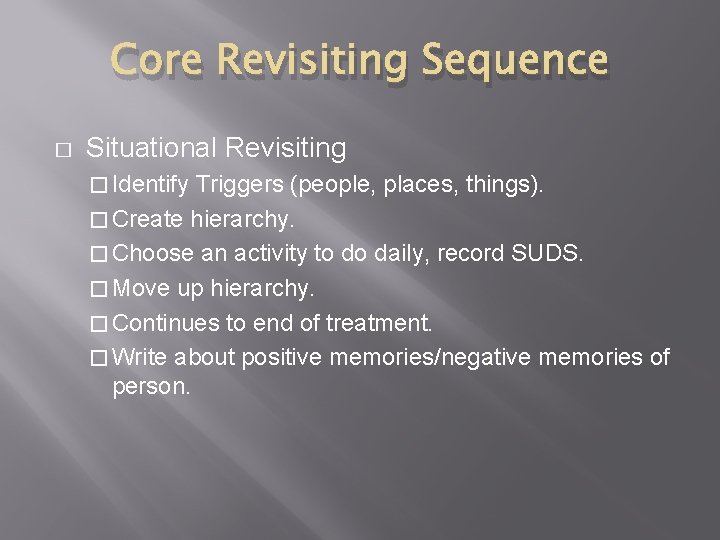
Core Revisiting Sequence � Situational Revisiting � Identify Triggers (people, places, things). � Create hierarchy. � Choose an activity to do daily, record SUDS. � Move up hierarchy. � Continues to end of treatment. � Write about positive memories/negative memories of person.
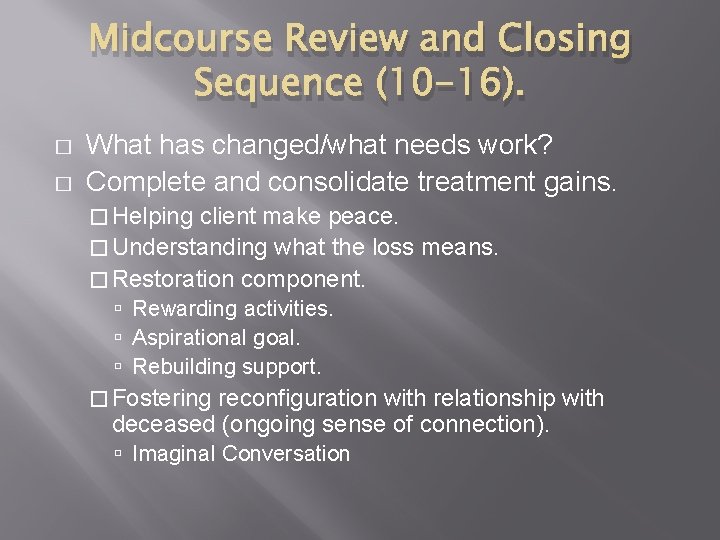
Midcourse Review and Closing Sequence (10 -16). � � What has changed/what needs work? Complete and consolidate treatment gains. � Helping client make peace. � Understanding what the loss means. � Restoration component. Rewarding activities. Aspirational goal. Rebuilding support. � Fostering reconfiguration with relationship with deceased (ongoing sense of connection). Imaginal Conversation
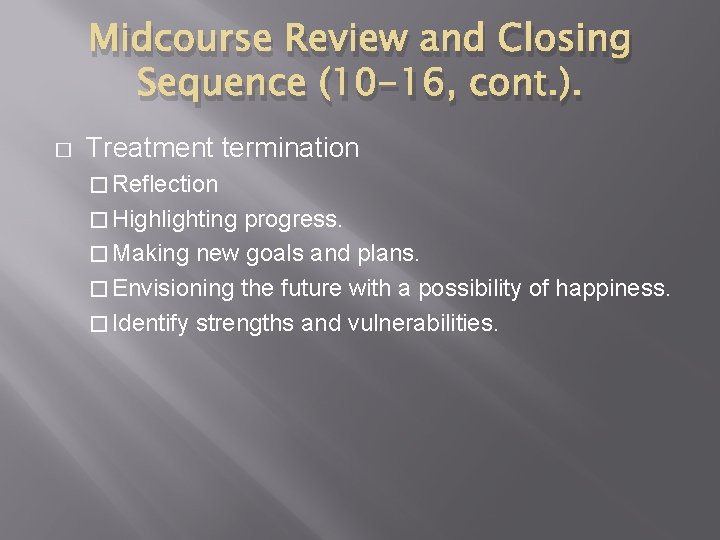
Midcourse Review and Closing Sequence (10 -16, cont. ). � Treatment termination � Reflection � Highlighting progress. � Making new goals and plans. � Envisioning the future with a possibility of happiness. � Identify strengths and vulnerabilities.
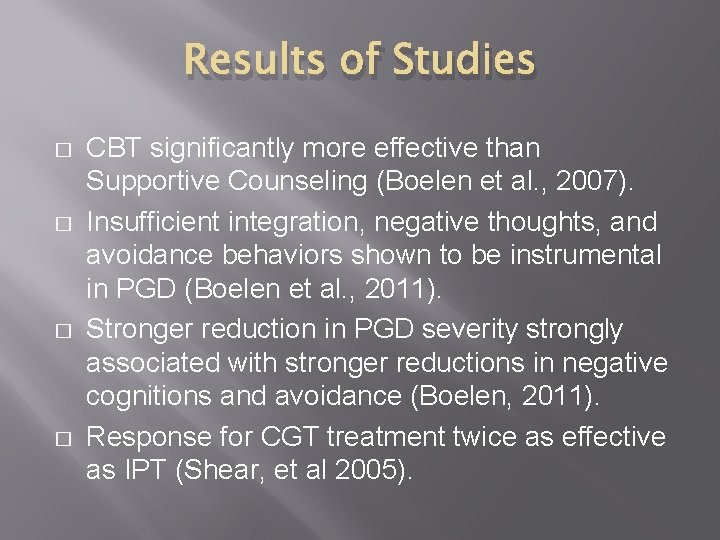
Results of Studies � � CBT significantly more effective than Supportive Counseling (Boelen et al. , 2007). Insufficient integration, negative thoughts, and avoidance behaviors shown to be instrumental in PGD (Boelen et al. , 2011). Stronger reduction in PGD severity strongly associated with stronger reductions in negative cognitions and avoidance (Boelen, 2011). Response for CGT treatment twice as effective as IPT (Shear, et al 2005).
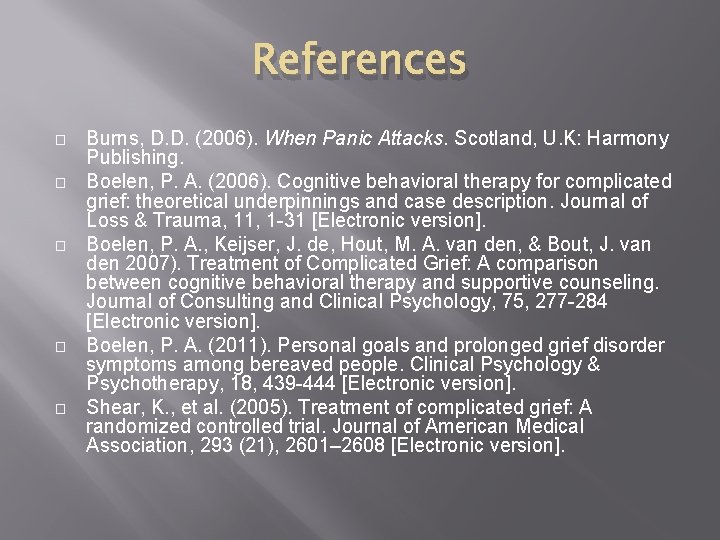
References � � � Burns, D. D. (2006). When Panic Attacks. Scotland, U. K: Harmony Publishing. Boelen, P. A. (2006). Cognitive behavioral therapy for complicated grief: theoretical underpinnings and case description. Journal of Loss & Trauma, 11, 1 -31 [Electronic version]. Boelen, P. A. , Keijser, J. de, Hout, M. A. van den, & Bout, J. van den 2007). Treatment of Complicated Grief: A comparison between cognitive behavioral therapy and supportive counseling. Journal of Consulting and Clinical Psychology, 75, 277 -284 [Electronic version]. Boelen, P. A. (2011). Personal goals and prolonged grief disorder symptoms among bereaved people. Clinical Psychology & Psychotherapy, 18, 439 -444 [Electronic version]. Shear, K. , et al. (2005). Treatment of complicated grief: A randomized controlled trial. Journal of American Medical Association, 293 (21), 2601– 2608 [Electronic version].