
The transverse structure of the nucleon resolving the




- Slides: 60
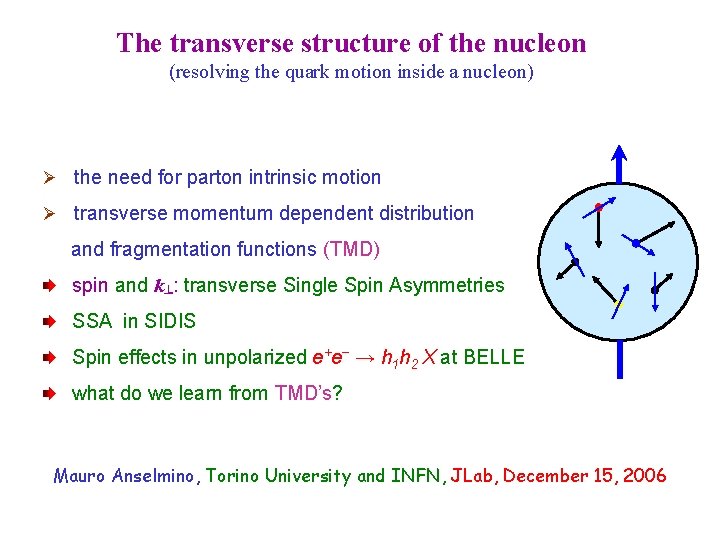
The transverse structure of the nucleon (resolving the quark motion inside a nucleon) Ø the need for parton intrinsic motion Ø transverse momentum dependent distribution and fragmentation functions (TMD) spin and k┴: transverse Single Spin Asymmetries SSA in SIDIS Spin effects in unpolarized e+e– → h 1 h 2 X at BELLE what do we learn from TMD’s? Mauro Anselmino, Torino University and INFN, JLab, December 15, 2006
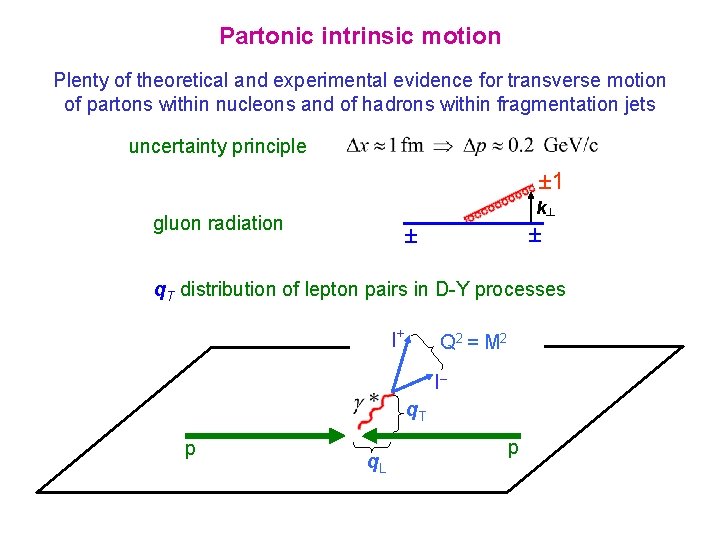
Partonic intrinsic motion Plenty of theoretical and experimental evidence for transverse motion of partons within nucleons and of hadrons within fragmentation jets uncertainty principle ± 1 gluon radiation k┴ ± ± q. T distribution of lepton pairs in D-Y processes l+ Q 2 = M 2 l– q. T p q. L p
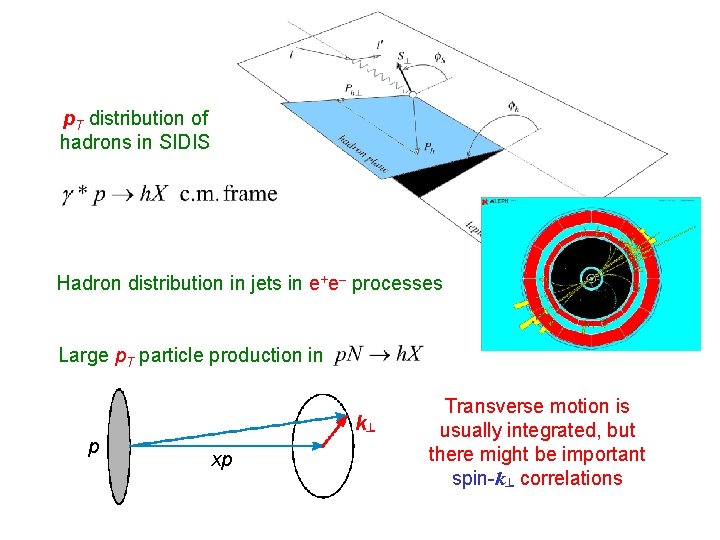
p. T distribution of hadrons in SIDIS Hadron distribution in jets in e+e– processes Large p. T particle production in p k┴ xp Transverse motion is usually integrated, but there might be important spin-k┴ correlations
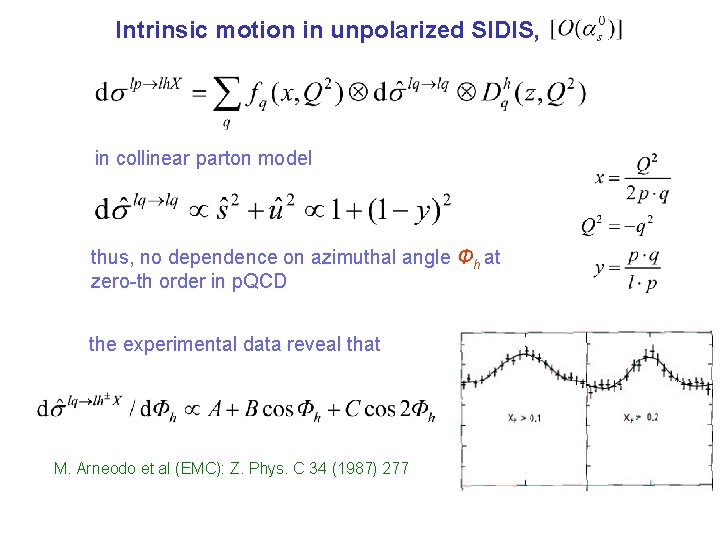
Intrinsic motion in unpolarized SIDIS, in collinear parton model thus, no dependence on azimuthal angle Фh at zero-th order in p. QCD the experimental data reveal that M. Arneodo et al (EMC): Z. Phys. C 34 (1987) 277
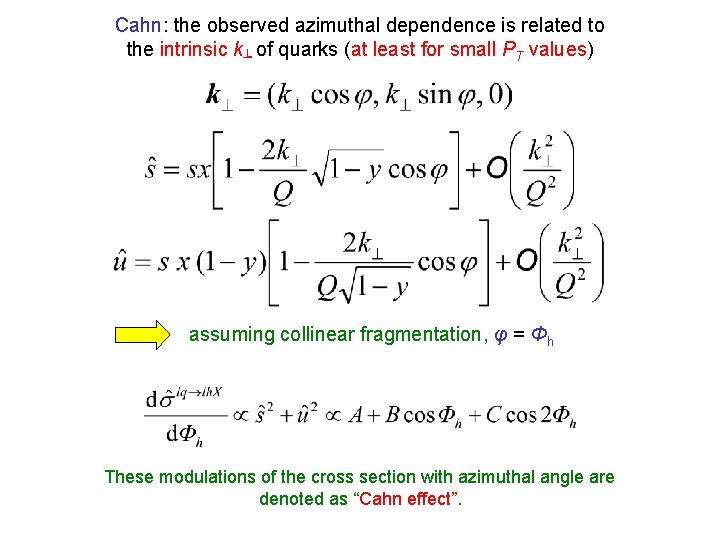
Cahn: the observed azimuthal dependence is related to the intrinsic k┴ of quarks (at least for small PT values) assuming collinear fragmentation, φ = Φh These modulations of the cross section with azimuthal angle are denoted as “Cahn effect”.
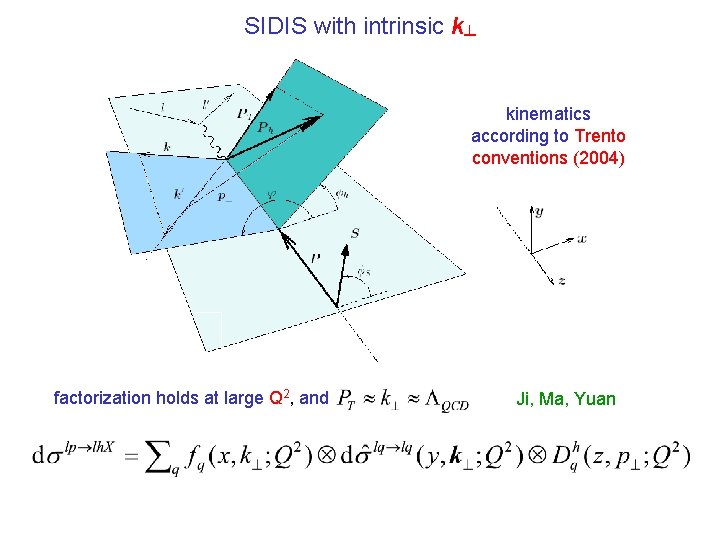
SIDIS with intrinsic k┴ kinematics according to Trento conventions (2004) factorization holds at large Q 2, and Ji, Ma, Yuan
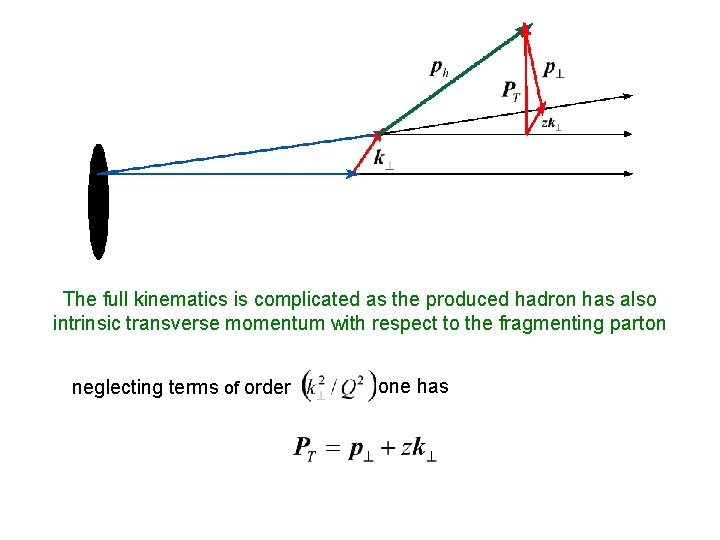
The full kinematics is complicated as the produced hadron has also intrinsic transverse momentum with respect to the fragmenting parton neglecting terms of order one has
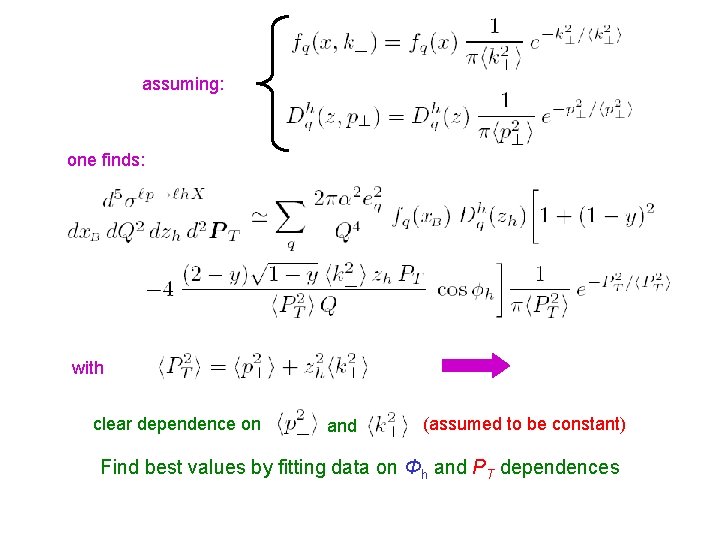
assuming: one finds: with clear dependence on and (assumed to be constant) Find best values by fitting data on Φh and PT dependences
EMC data, µp and µd, E between 100 and 280 Ge. V M. A. , M. Boglione, U. D’Alesio, A. Kotzinian, F. Murgia and A. Prokudin
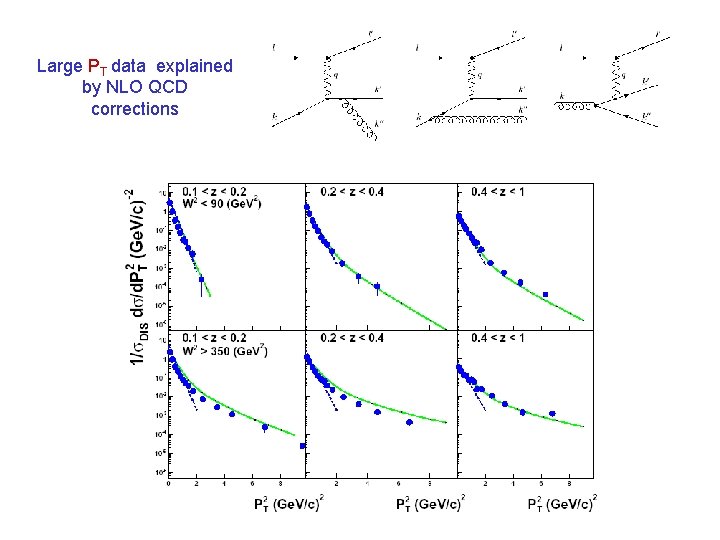
Large PT data explained by NLO QCD corrections
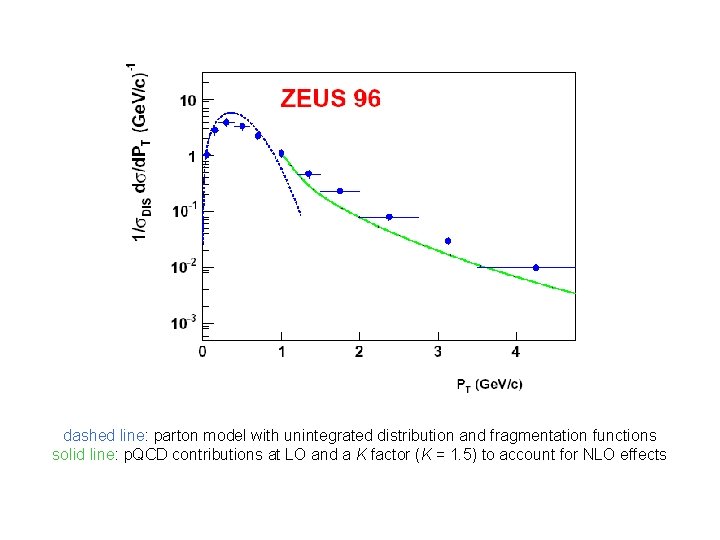
dashed line: parton model with unintegrated distribution and fragmentation functions solid line: p. QCD contributions at LO and a K factor (K = 1. 5) to account for NLO effects
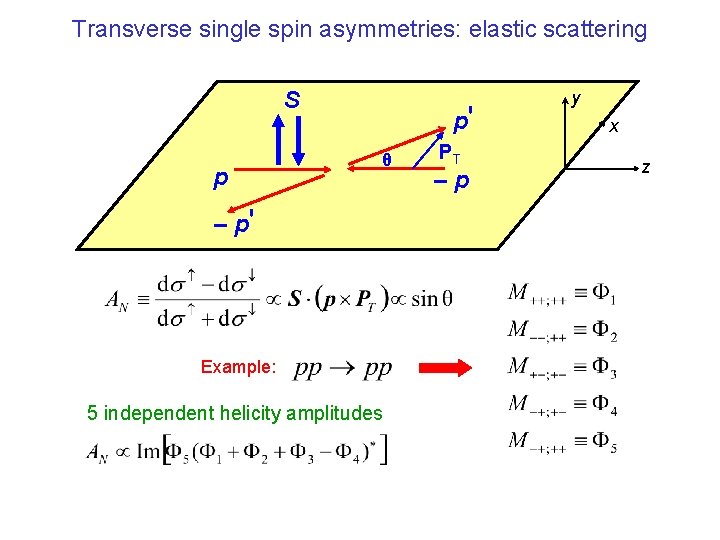
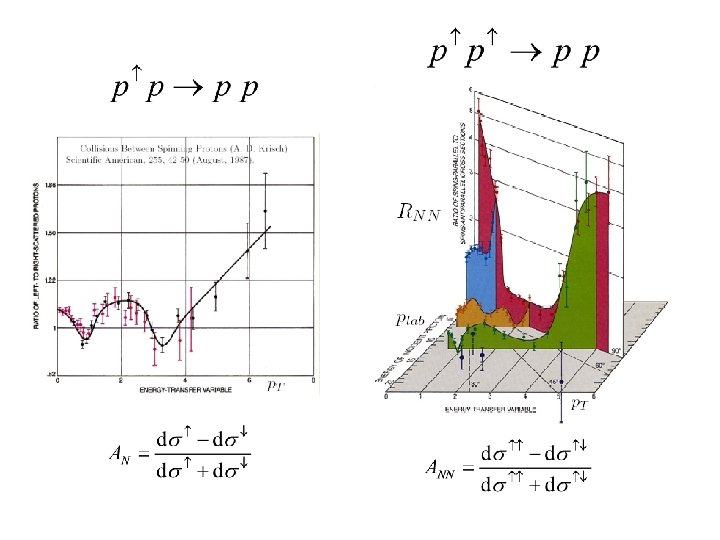
Transverse single spin asymmetries: elastic scattering S p p' θ – p' Example: 5 independent helicity amplitudes PT –p y x z
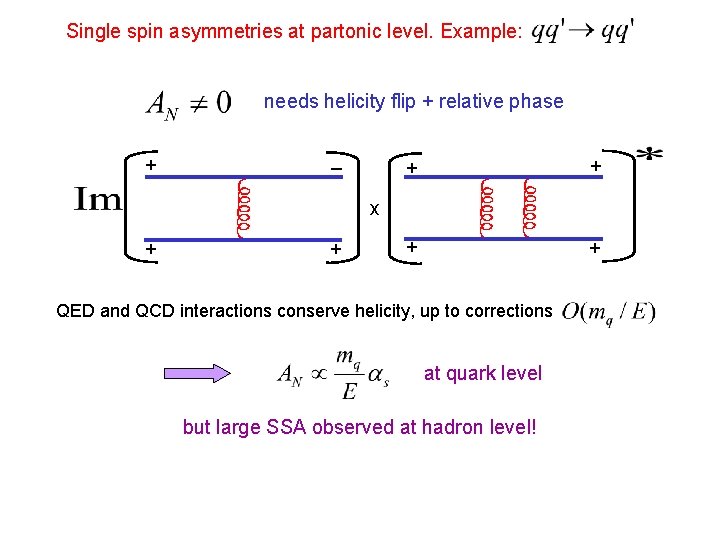
Single spin asymmetries at partonic level. Example: needs helicity flip + relative phase + – + + x + + QED and QCD interactions conserve helicity, up to corrections at quark level but large SSA observed at hadron level!
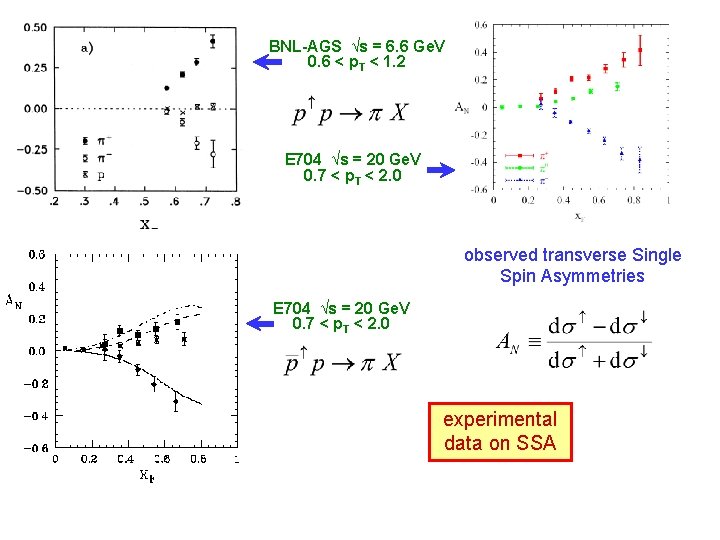
BNL-AGS √s = 6. 6 Ge. V 0. 6 < p. T < 1. 2 E 704 √s = 20 Ge. V 0. 7 < p. T < 2. 0 observed transverse Single Spin Asymmetries E 704 √s = 20 Ge. V 0. 7 < p. T < 2. 0 experimental data on SSA
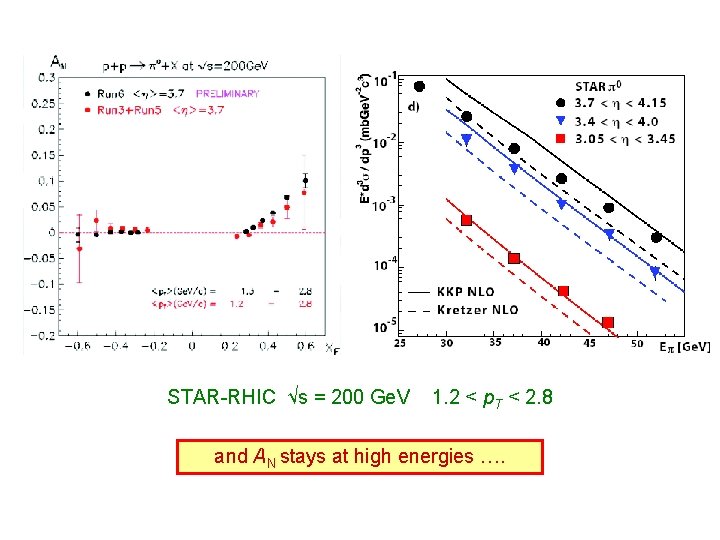
STAR-RHIC √s = 200 Ge. V 1. 2 < p. T < 2. 8 and AN stays at high energies ….
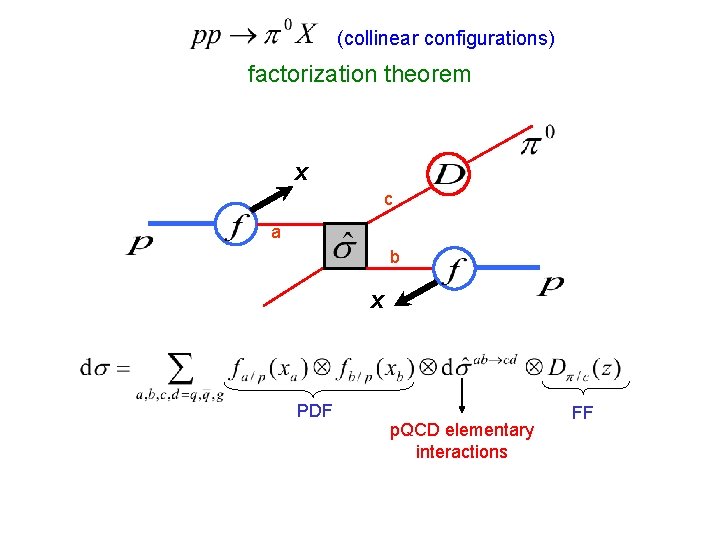
(collinear configurations) factorization theorem X c a b X PDF p. QCD elementary interactions FF
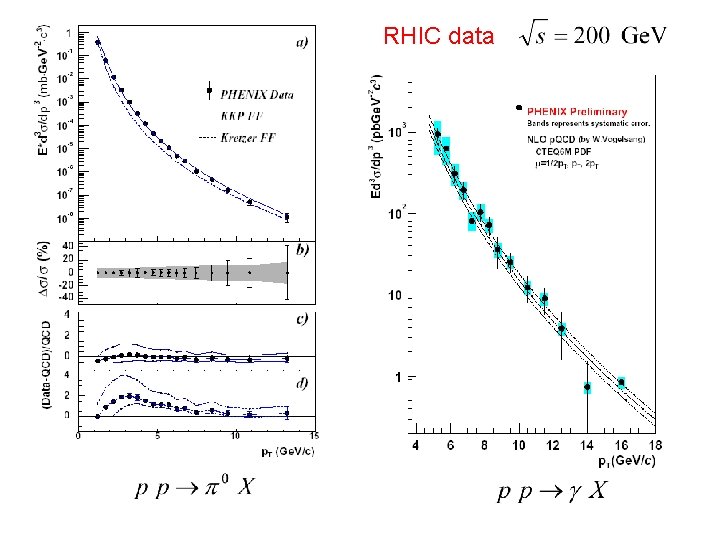
RHIC data
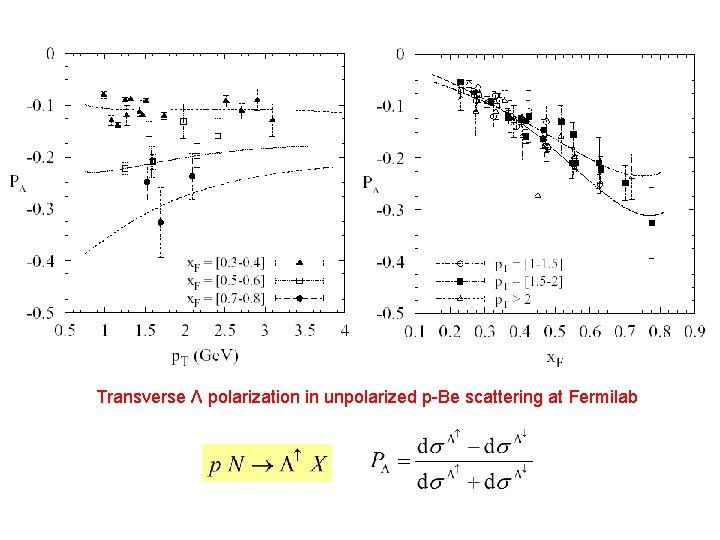
Transverse Λ polarization in unpolarized p-Be scattering at Fermilab
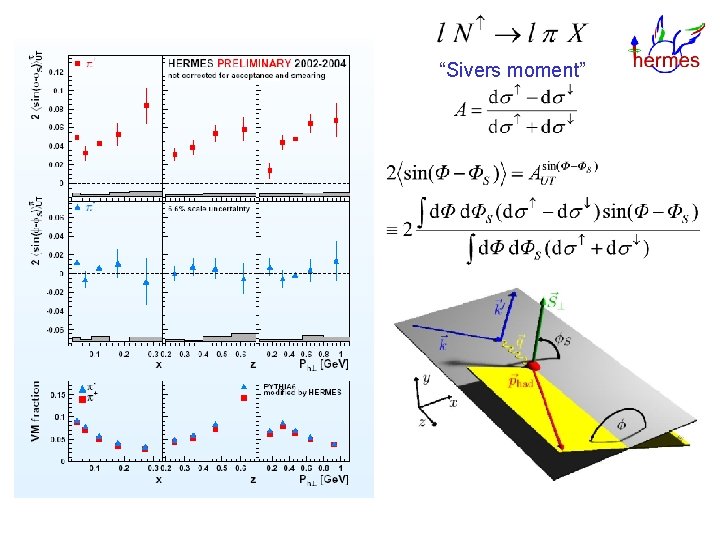
“Sivers moment”
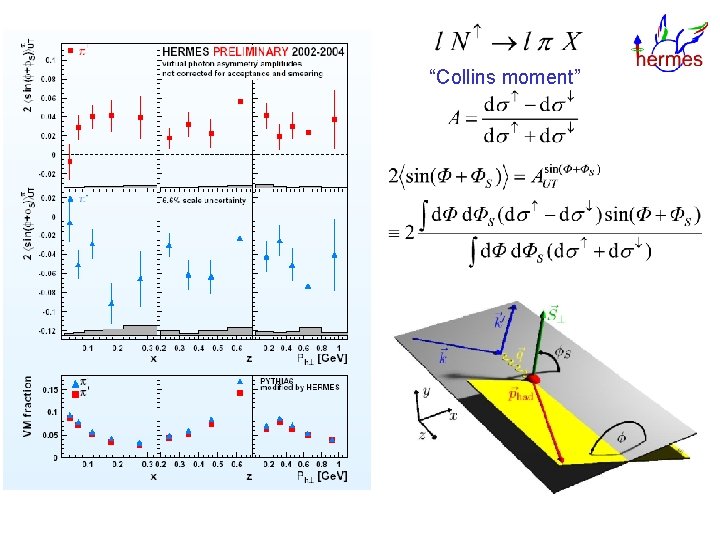
“Collins moment”
and now …. ? Polarization data has often been the graveyard of fashionable theories. If theorists had their way, they might just ban such measurements altogether out of self-protection. J. D. Bjorken St. Croix, 1987
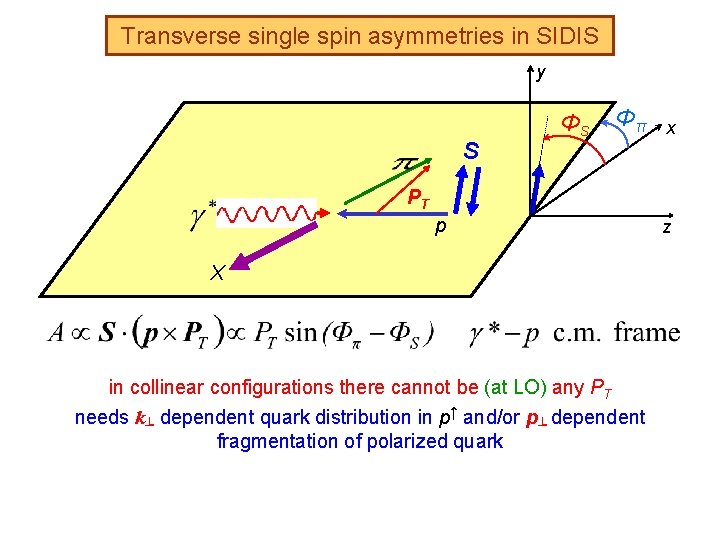
Transverse single spin asymmetries in SIDIS y S ΦS Φπ x PT p X in collinear configurations there cannot be (at LO) any PT needs k┴ dependent quark distribution in p↑ and/or p┴ dependent fragmentation of polarized quark z
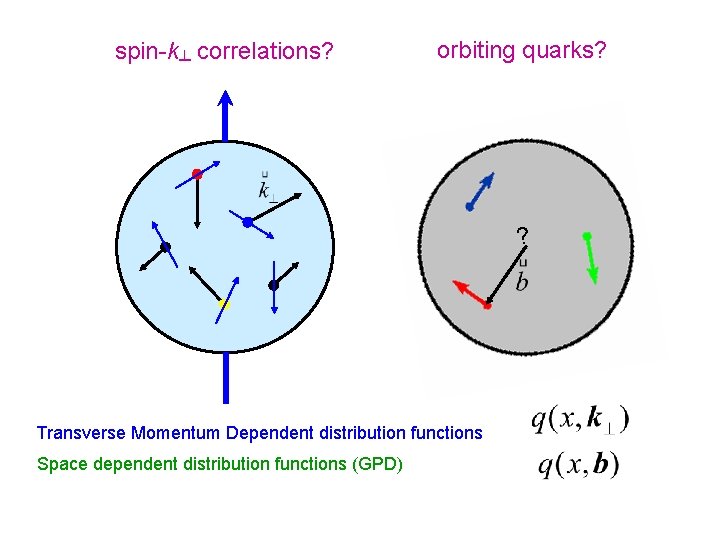
spin-k┴ correlations? orbiting quarks? ? Transverse Momentum Dependent distribution functions Space dependent distribution functions (GPD)
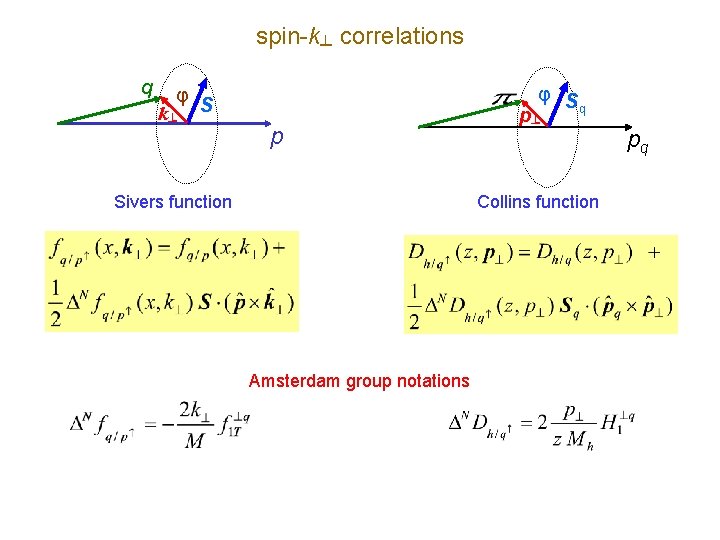
spin-k┴ correlations q φ k┴ φ S q S p Sivers function p┴ Collins function Amsterdam group notations pq
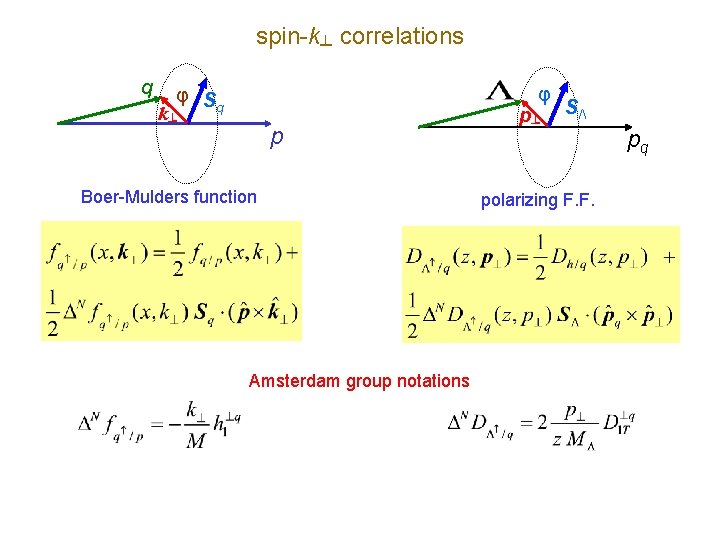
spin-k┴ correlations q φ φ S q k┴ p Boer-Mulders function Amsterdam group notations p┴ SΛ polarizing F. F. pq
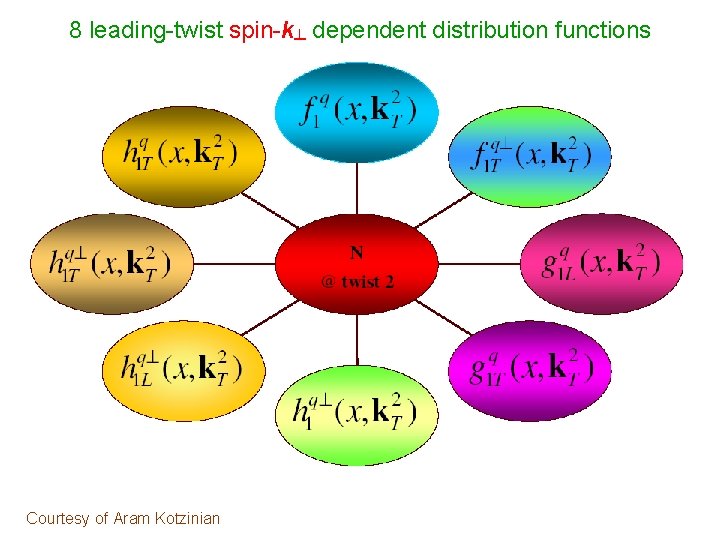
8 leading-twist spin-k┴ dependent distribution functions Courtesy of Aram Kotzinian
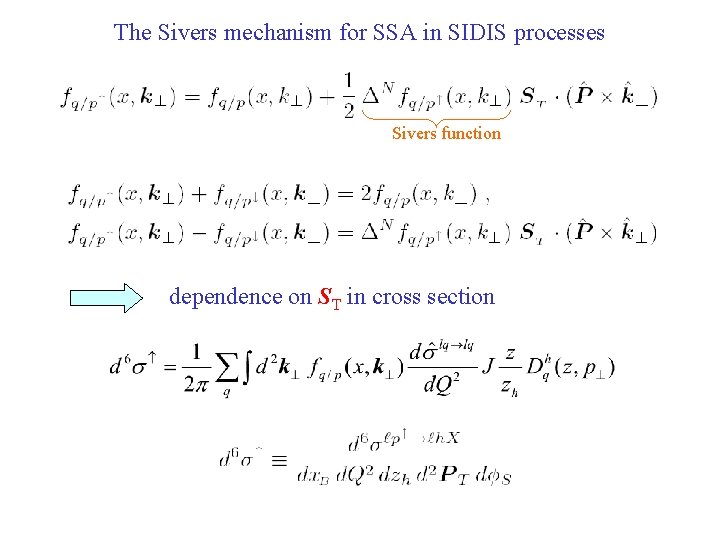
The Sivers mechanism for SSA in SIDIS processes Sivers function dependence on ST in cross section
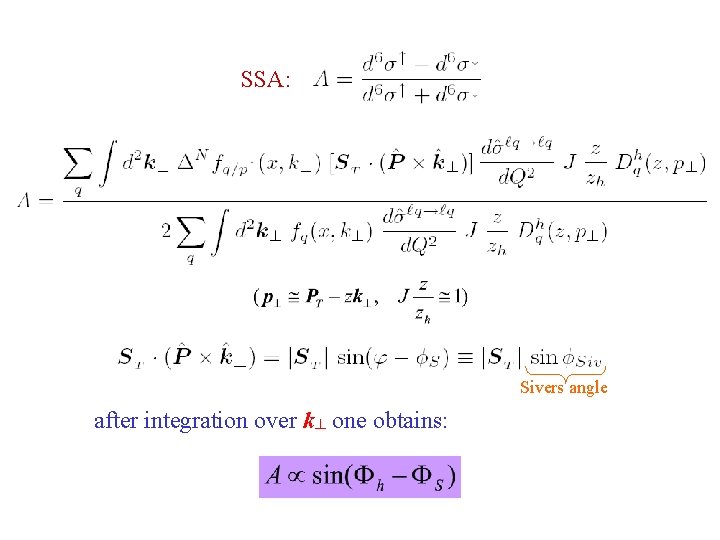
SSA: Sivers angle after integration over k┴ one obtains:
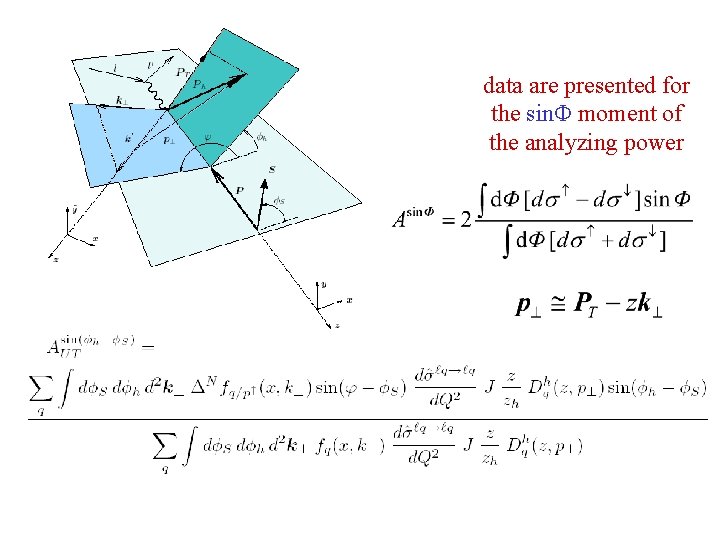
data are presented for the sinΦ moment of the analyzing power
Parameterization of the Sivers function q = u, d. The Sivers function for sea quarks and antiquarks is assumed to be zero.
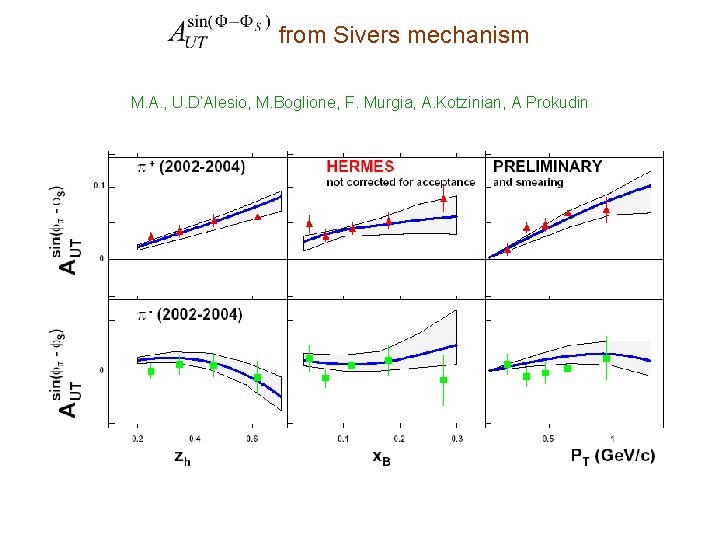
from Sivers mechanism M. A. , U. D’Alesio, M. Boglione, F. Murgia, A. Kotzinian, A Prokudin
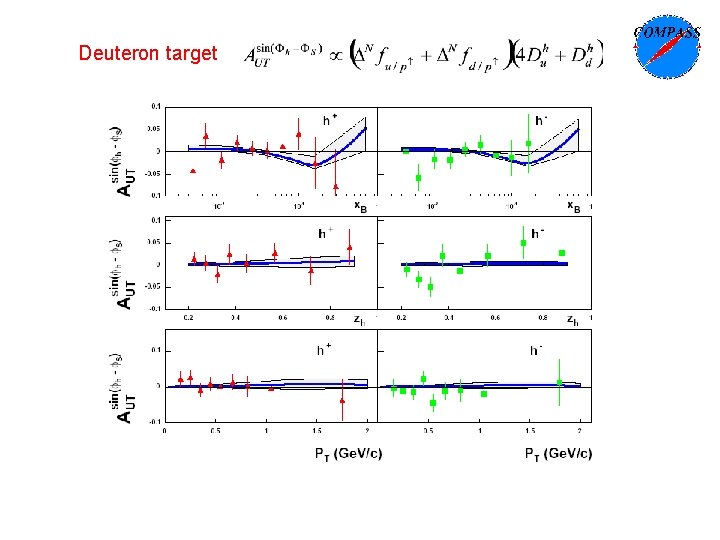
Deuteron target
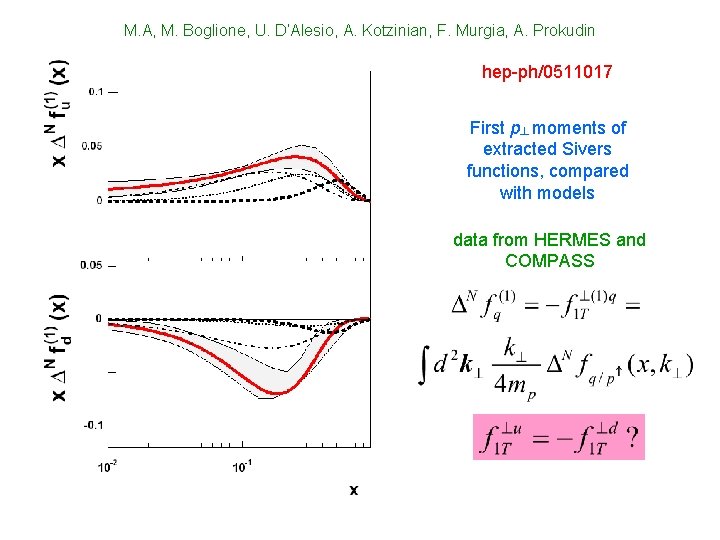
M. A, M. Boglione, U. D’Alesio, A. Kotzinian, F. Murgia, A. Prokudin hep-ph/0511017 First p┴ moments of extracted Sivers functions, compared with models data from HERMES and COMPASS
M. Anselmino, M. Boglione, J. C. Collins, U. D’Alesio, A. V. Efremov, K. Goeke, A. Kotzinian, S. Menze, A. Metz, F. Murgia, A. Prokudin, P. Schweitzer, W. Vogelsang, F. Yuan The first and 1/2 -transverse moments of the Sivers quark distribution functions. The fits were constrained mainly (or solely) by the preliminary HERMES data in the indicated x-range. The curves indicate the 1 -σ regions of the various parameterizations.
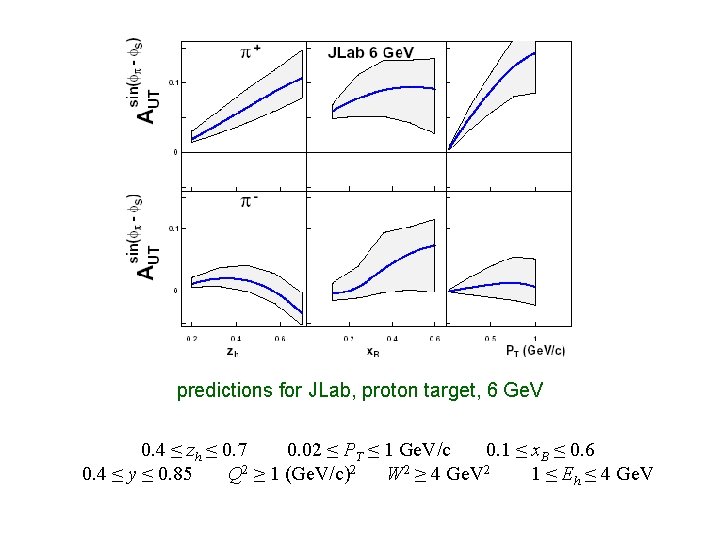
predictions for JLab, proton target, 6 Ge. V 0. 4 ≤ zh ≤ 0. 7 0. 02 ≤ PT ≤ 1 Ge. V/c 0. 1 ≤ x. B ≤ 0. 6 0. 4 ≤ y ≤ 0. 85 Q 2 ≥ 1 (Ge. V/c)2 W 2 ≥ 4 Ge. V 2 1 ≤ Eh ≤ 4 Ge. V
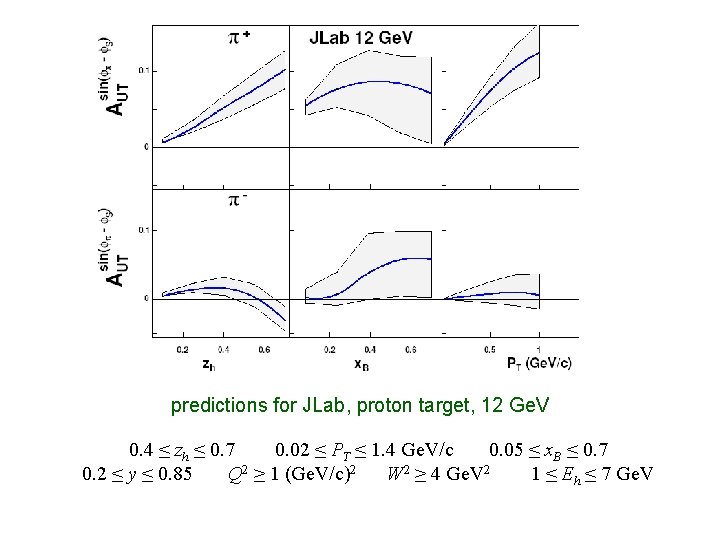
predictions for JLab, proton target, 12 Ge. V 0. 4 ≤ zh ≤ 0. 7 0. 02 ≤ PT ≤ 1. 4 Ge. V/c 0. 05 ≤ x. B ≤ 0. 7 0. 2 ≤ y ≤ 0. 85 Q 2 ≥ 1 (Ge. V/c)2 W 2 ≥ 4 Ge. V 2 1 ≤ Eh ≤ 7 Ge. V
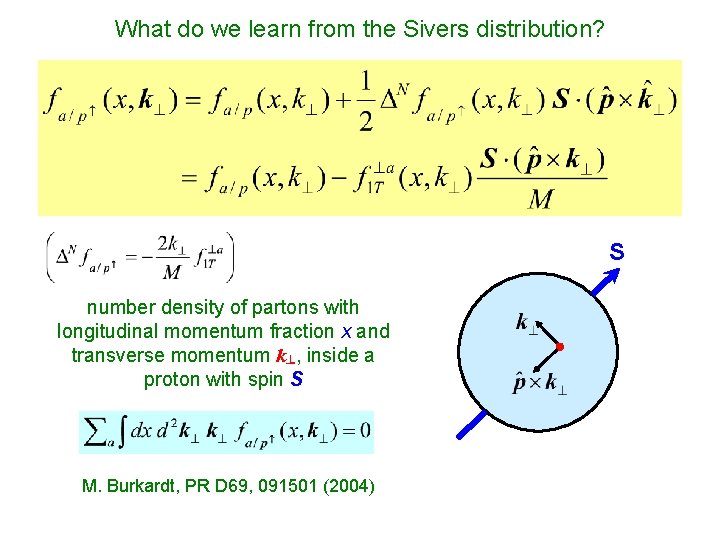
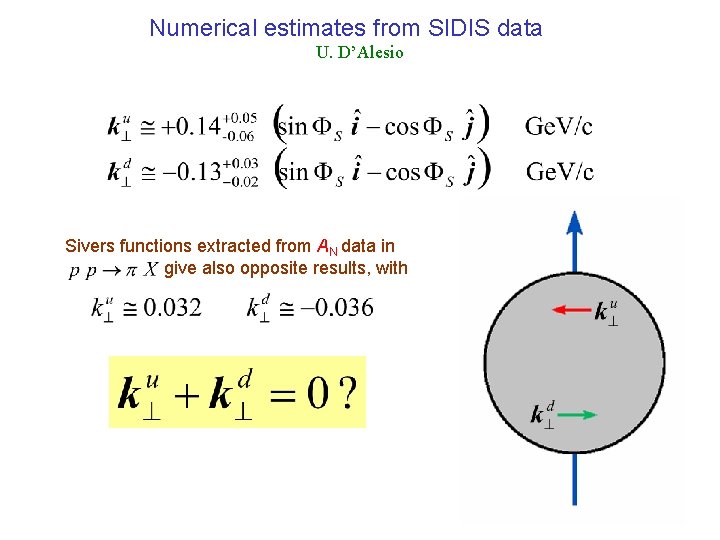
What do we learn from the Sivers distribution? S number density of partons with longitudinal momentum fraction x and transverse momentum k┴, inside a proton with spin S M. Burkardt, PR D 69, 091501 (2004)
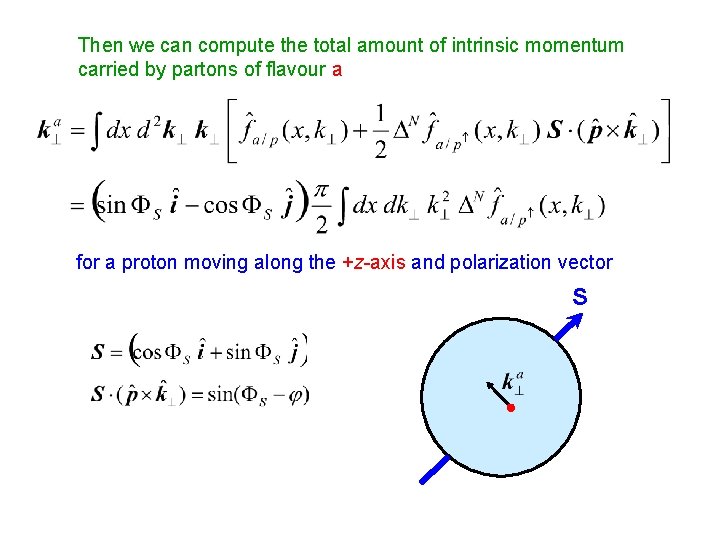
Then we can compute the total amount of intrinsic momentum carried by partons of flavour a for a proton moving along the +z-axis and polarization vector S
Numerical estimates from SIDIS data U. D’Alesio Sivers functions extracted from AN data in give also opposite results, with
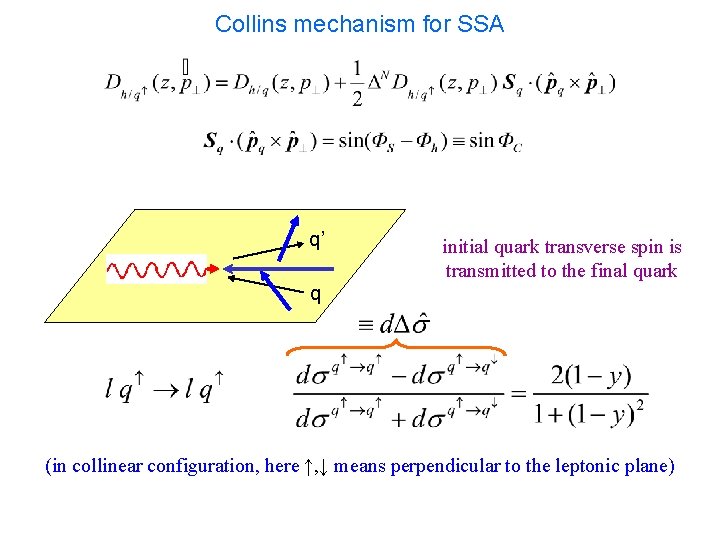
Collins mechanism for SSA q’ initial quark transverse spin is transmitted to the final quark q (in collinear configuration, here ↑, ↓ means perpendicular to the leptonic plane)
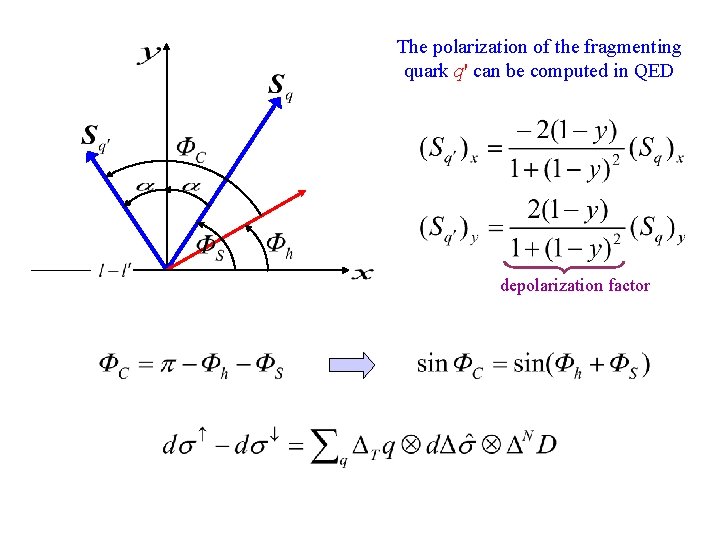
The polarization of the fragmenting quark q' can be computed in QED depolarization factor
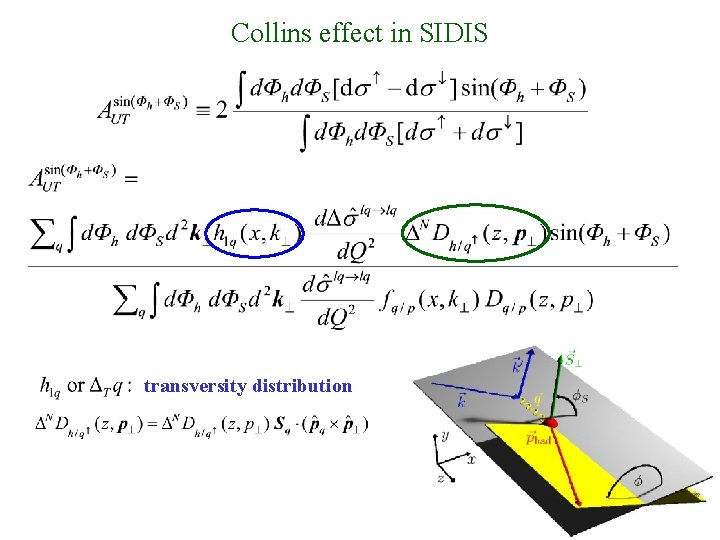
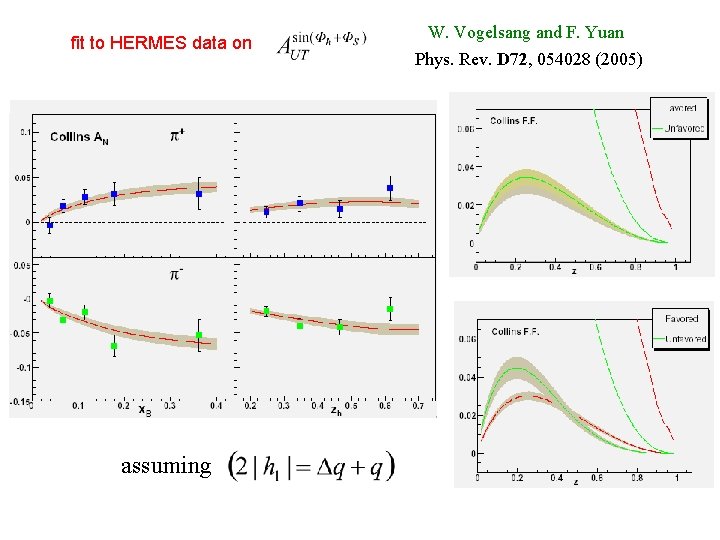
Collins effect in SIDIS transversity distribution
fit to HERMES data on assuming W. Vogelsang and F. Yuan Phys. Rev. D 72, 054028 (2005)
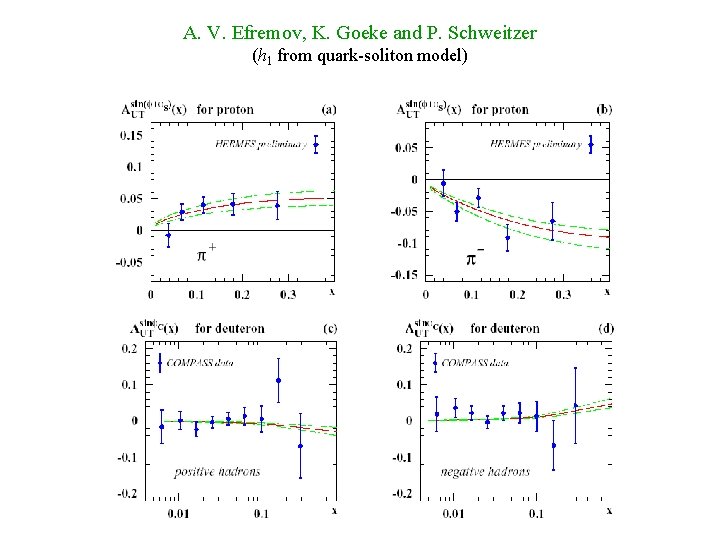
A. V. Efremov, K. Goeke and P. Schweitzer (h 1 from quark-soliton model)
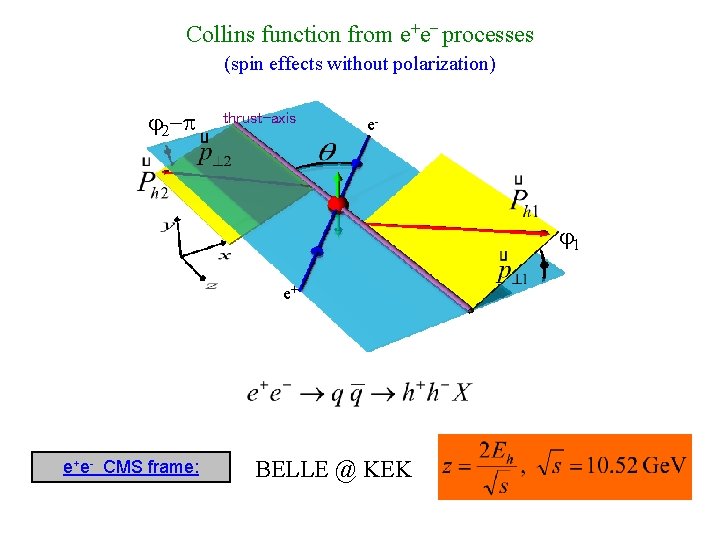
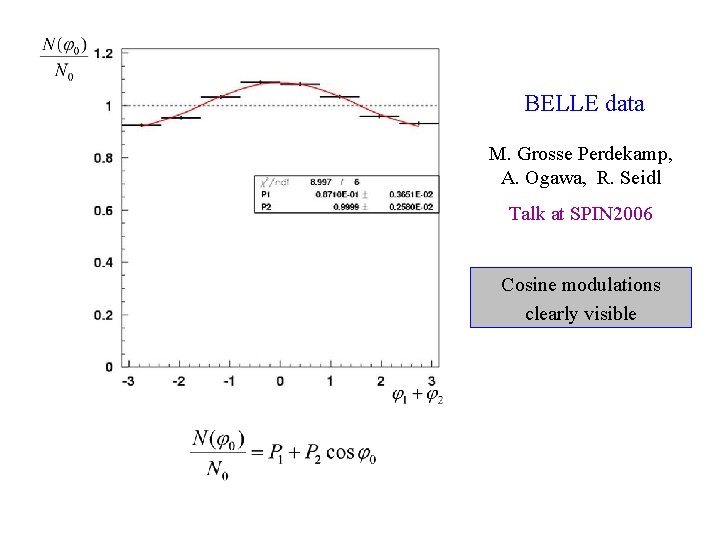
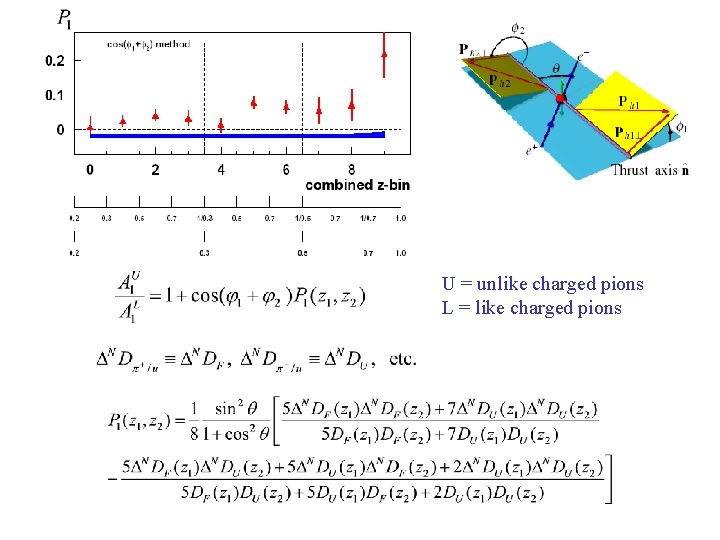
Collins function from e+e– processes (spin effects without polarization) j 2 -p thrust-axis e- j 1 e+ e+e- CMS frame: e+ BELLE @ KEK
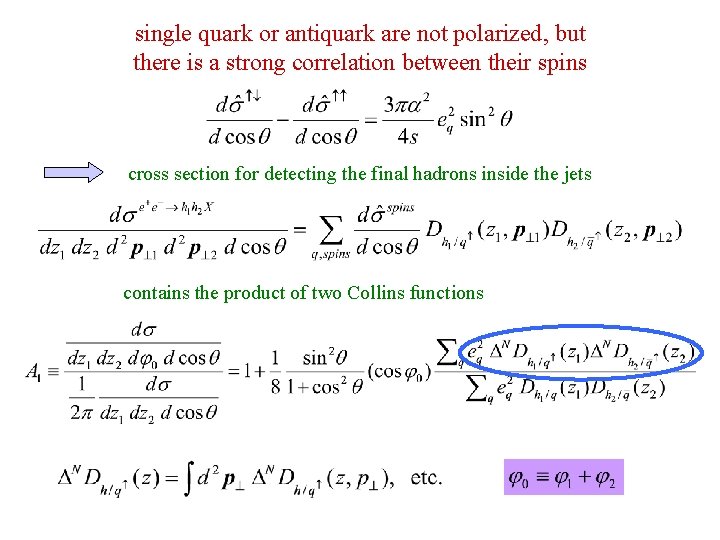
single quark or antiquark are not polarized, but there is a strong correlation between their spins cross section for detecting the final hadrons inside the jets contains the product of two Collins functions
BELLE data M. Grosse Perdekamp, A. Ogawa, R. Seidl Talk at SPIN 2006 Cosine modulations clearly visible
U = unlike charged pions L = like charged pions
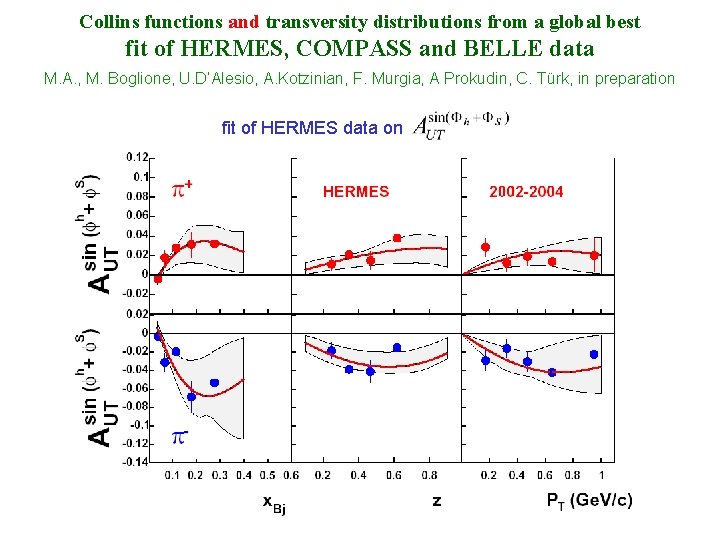
Collins functions and transversity distributions from a global best fit of HERMES, COMPASS and BELLE data M. A. , M. Boglione, U. D’Alesio, A. Kotzinian, F. Murgia, A Prokudin, C. Türk, in preparation fit of HERMES data on
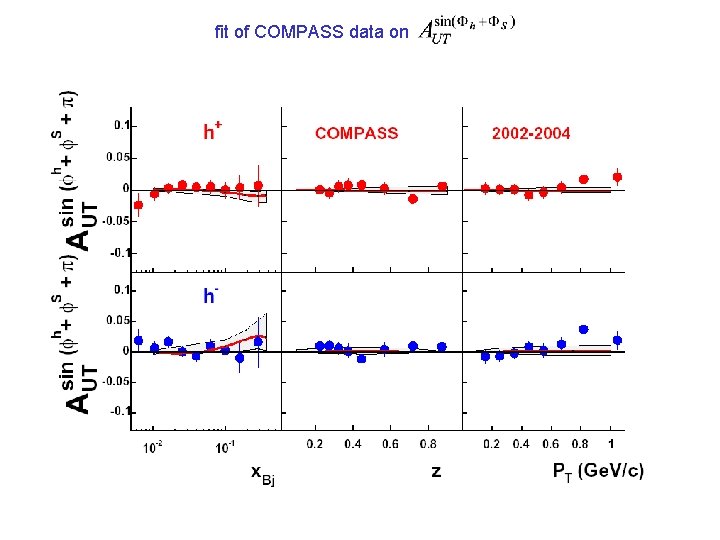
fit of COMPASS data on
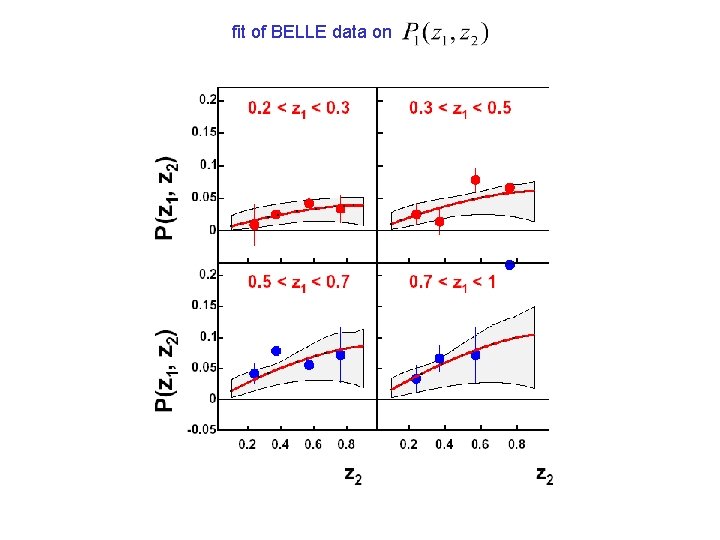
fit of BELLE data on
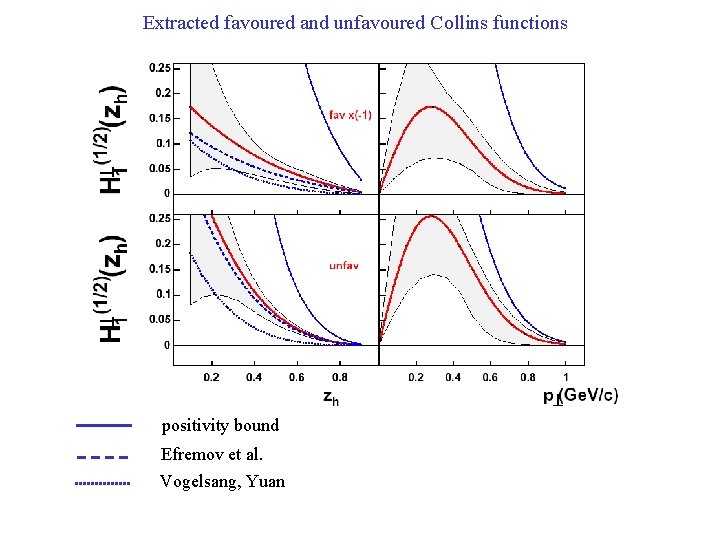
Extracted favoured and unfavoured Collins functions positivity bound Efremov et al. Vogelsang, Yuan
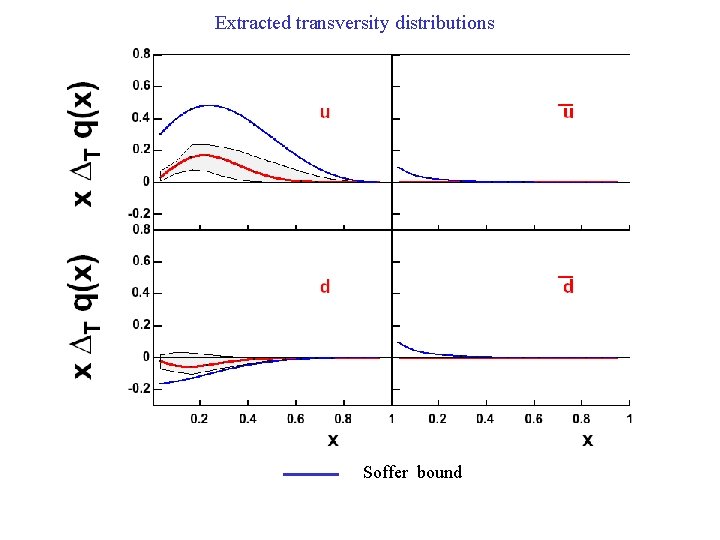
Extracted transversity distributions Soffer bound
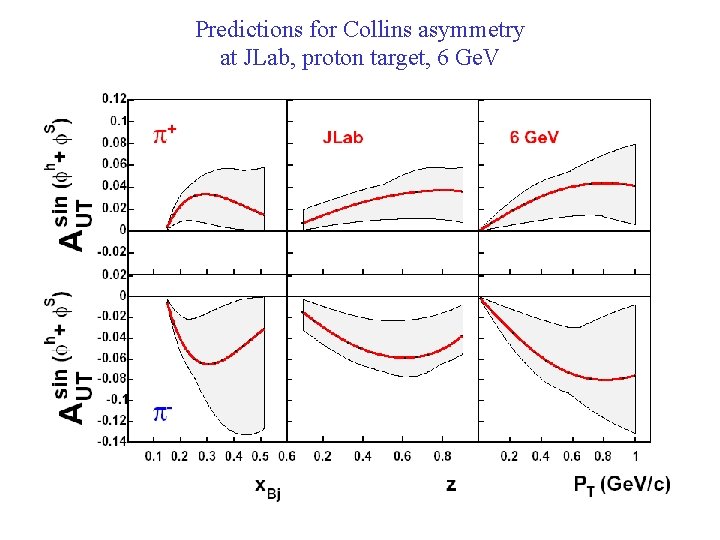
Predictions for Collins asymmetry at JLab, proton target, 6 Ge. V
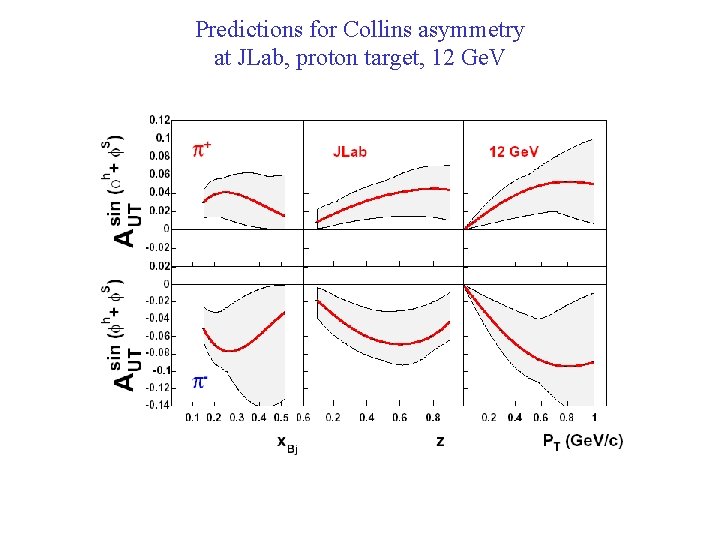
Predictions for Collins asymmetry at JLab, proton target, 12 Ge. V
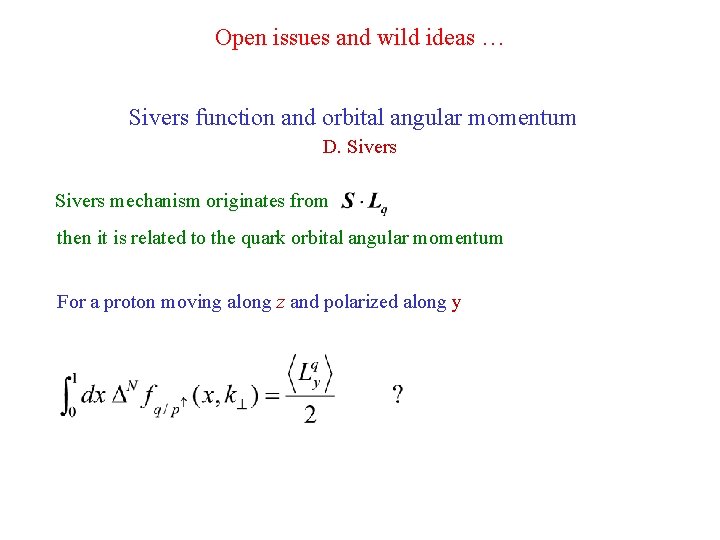
Open issues and wild ideas … Sivers function and orbital angular momentum D. Sivers mechanism originates from then it is related to the quark orbital angular momentum For a proton moving along z and polarized along y
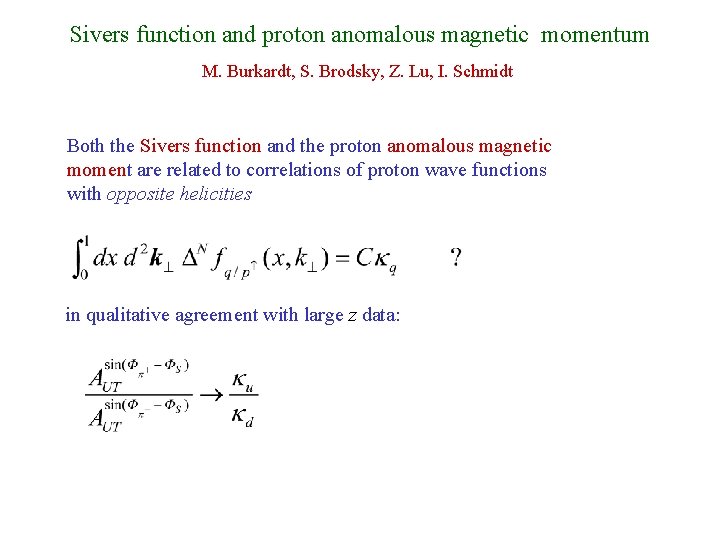
Sivers function and proton anomalous magnetic momentum M. Burkardt, S. Brodsky, Z. Lu, I. Schmidt Both the Sivers function and the proton anomalous magnetic moment are related to correlations of proton wave functions with opposite helicities in qualitative agreement with large z data:
Conclusions Towards the transverse spin and momentum structure of the nucleon via azimuthal and Ph. T dependence in SIDIS Information on quark intrinsic motion Spin-k┴ correlation from Sivers function Orbiting quarks? Extracting Collins function and accessing transversity Much more data needed …