
THE TRANSITION OF THE NOVICE ICP Mark Graham





- Slides: 29
THE TRANSITION OF THE NOVICE ICP Mark Graham BNRN
Objectives Ø Developmental Stages of the Infection Control Practitioner Ø Personal Transition as a Novice Infection Control Practitioner Ø Perspectives From Other Novice Infection Control Practitioners Across the Province Ø Resources to Help Ease the Transition Period for Novice ICP’s Ø Summary
Developmental Stages of the ICP Ø Novice: 0 -4 years’ experience (followed by passing the CIC exam) Ø Proficient: 4 -9 years’ experience Ø Advanced: 10+ years’ experience (APIC, 2017)
Personal Background Ø Graduated nursing school 2009 Ø Critical care / cardiac care background Ø Completed the Infection Control Course while working in Acute Care Ø Worked as an ICP since Fall 2015 Ø Long Term Care
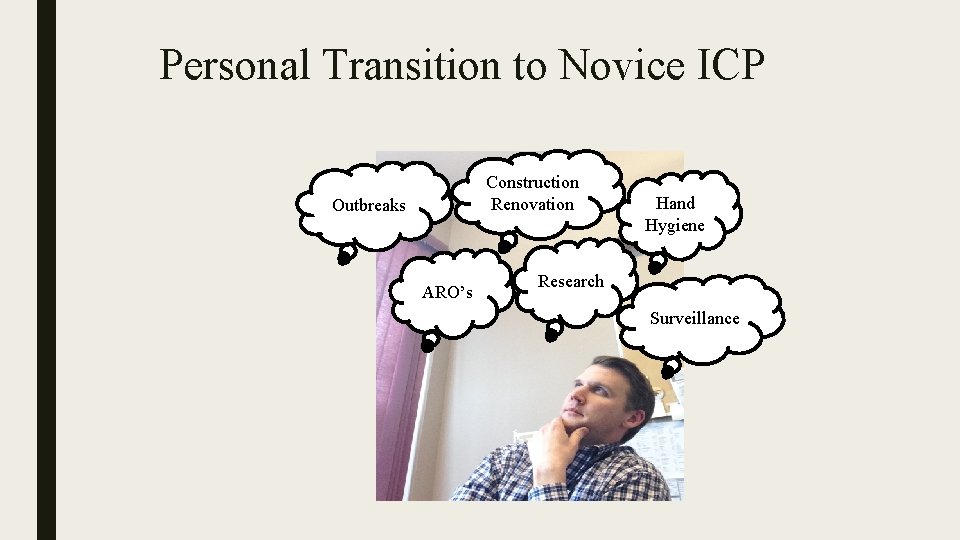
Personal Transition to Novice ICP Construction Renovation Outbreaks ARO’s Hand Hygiene Research Surveillance
Personal Transition Ø Ø Ø Overwhelmed Frustrated Incompetent Lack of knowledge Indecisive Unprepared Ø Where do I go from here? ?
Transition Ø Transition into a new role or position comes many different emotions and feelings. The transition shock for newly graduated nurses into professional work life can often encompass feelings of confusion, doubt, loss, and disorientation (Duchscher, 2008). Ø The initial transition stage of the Novice Infection Control Practitioner can meet many challenges as expectations to do surveillance, sit on committees, and countless other responsibilities can often contribute to resigning. Alarming number of new IP’s reach a breaking point in their first three to four years on the job and quit. (Bridges, 2015)
Personal Transition Ø Support Ø Positive reinforcement Ø Reassurance Ø Reasonable workload Ø Assistance always available Ø Allowed ICP to gain autonomy while providing assistance if needed
Perspectives from Novice Infection Control Practitioners
Results!!
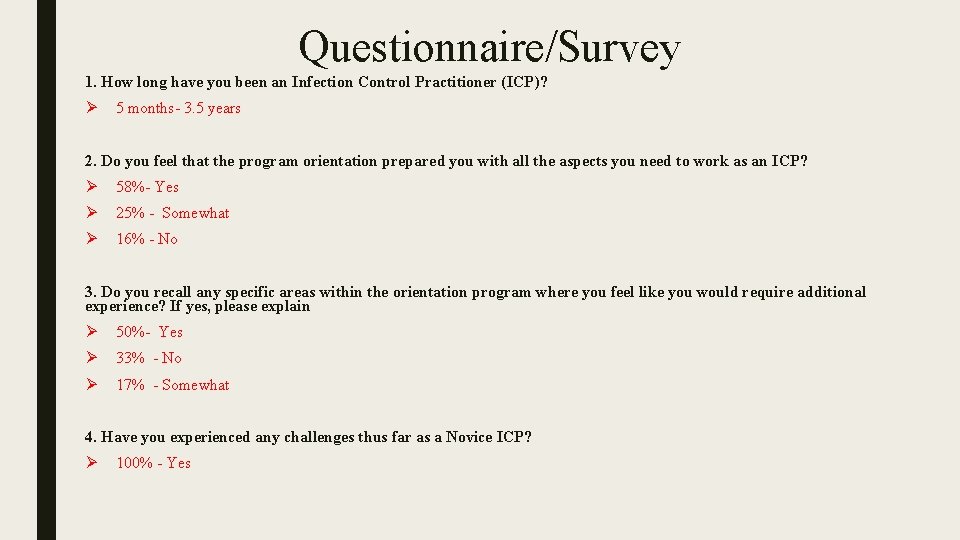
Questionnaire/Survey 1. How long have you been an Infection Control Practitioner (ICP)? Ø 5 months- 3. 5 years 2. Do you feel that the program orientation prepared you with all the aspects you need to work as an ICP? Ø 58%- Yes Ø 25% - Somewhat Ø 16% - No 3. Do you recall any specific areas within the orientation program where you feel like you would require additional experience? If yes, please explain Ø 50%- Yes Ø 33% - No Ø 17% - Somewhat 4. Have you experienced any challenges thus far as a Novice ICP? Ø 100% - Yes
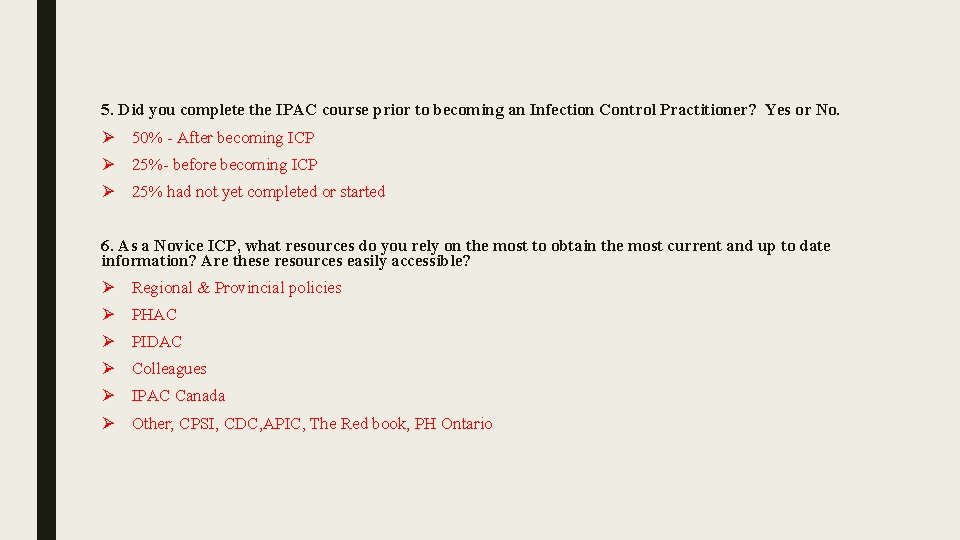
5. Did you complete the IPAC course prior to becoming an Infection Control Practitioner? Yes or No. Ø 50% - After becoming ICP Ø 25%- before becoming ICP Ø 25% had not yet completed or started 6. As a Novice ICP, what resources do you rely on the most to obtain the most current and up to date information? Are these resources easily accessible? Ø Regional & Provincial policies Ø PHAC Ø PIDAC Ø Colleagues Ø IPAC Canada Ø Other; CPSI, CDC, APIC, The Red book, PH Ontario
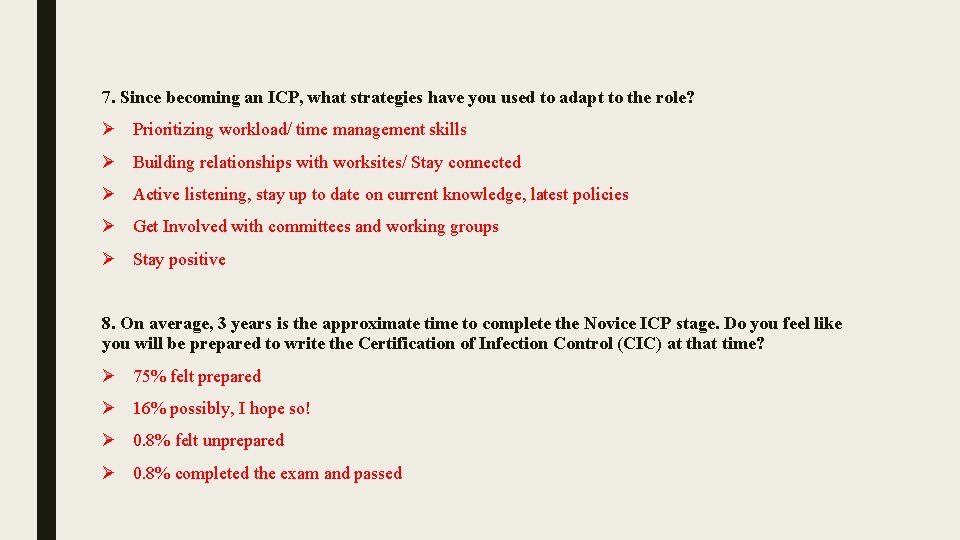
7. Since becoming an ICP, what strategies have you used to adapt to the role? Ø Prioritizing workload/ time management skills Ø Building relationships with worksites/ Stay connected Ø Active listening, stay up to date on current knowledge, latest policies Ø Get Involved with committees and working groups Ø Stay positive 8. On average, 3 years is the approximate time to complete the Novice ICP stage. Do you feel like you will be prepared to write the Certification of Infection Control (CIC) at that time? Ø 75% felt prepared Ø 16% possibly, I hope so! Ø 0. 8% felt unprepared Ø 0. 8% completed the exam and passed
9. Do you have any advice or recommendations to offer new ICP’s? Ø Ask a lot of questions and do not be afraid to ask for help Ø Take the time to investigate and think before you make decisions or recommendations Ø Don’t assume, have good working relationships with staff Ø Do not expect to be an expert at the beginning! 10. Do you have any recommendations or suggestions to offer Management that could help facilitate the transition into becoming an ICP? Suggestions: ü Ensure the ICP has an experienced mentor for guidance and direction ü Have patience; provide clear directions; be readily available ü Support education opportunities to grow and expand their knowledge Comments: ü Supportive ü Transition as a novice was smooth and acceptable time frame allotted ü Allowed novice to build autonomy in their skills but provided guidance as needed, ü Excellent orientation
Resources for Novice ICP’s Ø Core Competencies – IPAC Canada Ø APIC Competency Model Ø Competency Self-Assessment (APIC) Ø Mentorship Program –IPAC Canada Ø Orientation Program – PIC-Nl Ø Roadmap for the Novice Infection Preventionist (APIC)
Core Competencies Ø Provide the minimum knowledge, skills and attitudes required to practice safely and ethically as an ICP Ø Highlights that practitioners will have different needs of knowledge and skills Ø Reflect expectations of a competent ICP- not novice, not expert Ø Promote quality of IPAC practice by standardizing expectations Ø Guidance for practitioners with performance appraisal, professional development activities and education programs Ø Core Competencies Webinar - IPAC Canada Website
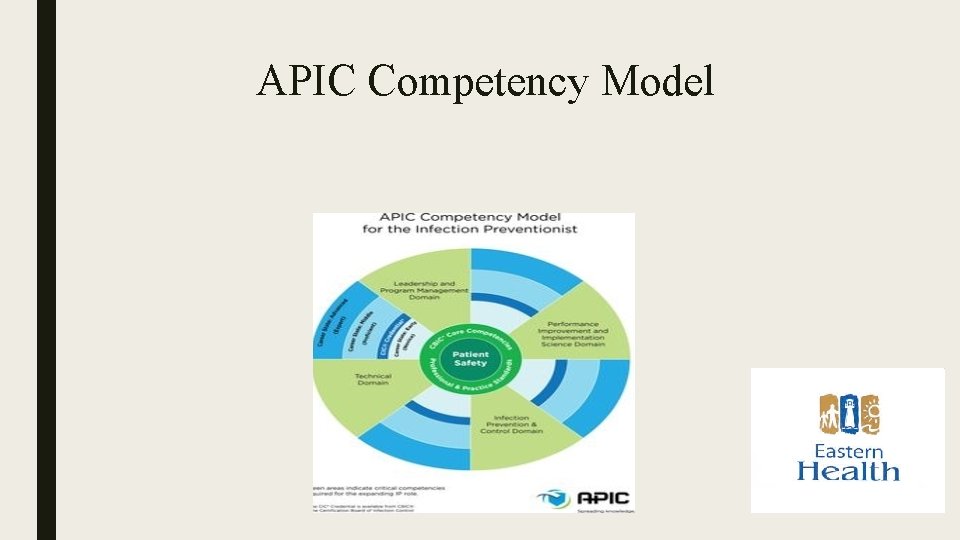
APIC Competency Model
APIC Competency Model Core Competencies CBIC Ø Identification of infectious disease processes Ø Surveillance and epidemiologic investigations Ø Preventing /controlling the transmission of infectious agents Ø Employee/ occupation health Ø Management and communication (leadership) Ø Education and research
APIC Competency Model Four Domains Ø Infection Prevention and control domain Ø Performance improvement and implementation science domain Ø Leadership and program management domain Ø Technical domain Ø Skills that will be developed over the course of the professional career Ø http: //www. ajicjournal. org/article/S 0196 -6553(12)00165 -4/fulltext
Self Assessment Tool- APIC Ø Necessary skill for life long learning ( Al-Kadri et al. , 2012) Ø Resource to help identify your areas of strength and learning needs (College of Nurses Ontario, 2017) Ø Outline areas of practice that need improvement Ø Enhance critical awareness, and reflection on learning Ø APIC self assessment tool Ø IPAC Canada currently in the process of formulating Ø http: //www. apic. org/Resource_/Tiny. Mce. File. Manager/Self-Assess_PS 1302 -SUMMER 2013 -FINAL. pdf
Mentorship Program ü Program designed to help ICP’s receive on one mentoring from expert ICP’s within Canada ü Expert advice in professional enhancement, networking, shared knowledge and experience and support ü Mentees will be paired up with suitable mentors that are expert in a particular field. surveillance and epidemiology, construction renovation, education and research. ü Training available for mentees and mentors ü http: //ipac-canada. org/mentorship-program. php i. e.
Orientation – (PIC- NL) (Provide a detailed four week schedule of daily activities for a new ICP) 10 modules included in Orientation are; 1) Orientation 2) Surveillance 3) RPAP 4) Microbiology 5) Hand Hygiene Module 6) Cleaning, disinfection and sterilization 7) Outbreak module 8) Communicable diseases 9) Occupational Health module 10) Construction and renovation
Roadmap for the Novice Infection Preventionist (APIC) Ø Outlines a descriptive roadmap for the infection control practitioner from day 1 to completing the certification exam Ø Provides a list of job specific knowledge, skills, and professional development goals Ø Similar to IPAC Canada orientation module Ø Good resource to review prior to writing the certification exam as it will provide expectations of certification skills and required knowledge
Summary Ø Discussed the importance of the transition period of the Novice Infection Control Practitioner Ø Opportunity to provide my own perspectives as a Novice ICP Ø Gained perspectives from other ICP’s within the Province Ø Outlined resources for Novice ICP’s to help facilitate the transition into an ICP
Questions - Comments - Concerns
References ■ Duchscher J. E. B. (2009) Transition shock: the initial stage of role adaptation for newly graduated Registered Nurses. Journal of Advanced Nursing 65(5), 1103 -1113. ■ Murphy D. M. , Hanchett M. , Olmsted R. N. , Farber M. R. , Lee T. B. , Hass J. P. , Streed S. S. (2012) Competency in infection prevention: A conceptual approach to guide current and future practice. American Journal of Infection Control 40(4): 296 -303. ■ Bridges B. , (2015) The Roadmap for the Novice Infection Preventionist. Prevention Strategist. Retrieved from http: //apic. org/Resource_/Tiny. Mce. File. Manager/Periodical_Images/The_novice_roadmap_PS 1501. pdf ■ Moralejo D. , Catt B. (2017, January 24) IPAC Canada Core Competencies for ICP’s [Webinar] Retrieved from http: //ipac-canada. org/ipac-canadapublications. php ■ Hanchett M. , (2013) Self Assessment to Advance IP Competency. Prevention Strategist. Retrieved from http: //www. apic. org/Resource_/Tiny. Mce. File. Manager/Self-Assess_PS 1302 -SUMMER-2013 -FINAL. pdf ■ Yetman et al. (2012) Orientation Program for Infection Control Practitioners. Retrieved from http: //www. health. gov. nl. ca/health/publichealth/cdc/icp_orientation_program_updated_july 30_2012. pdf ■ College of Nurses Ontario (2017) Self Assessment. Retrieved from http: //www. cno. org/en/myqa/self-assessment/ ■ Al-Kadri H. , Al-Moamary M. , Al-Takroni H. , Roberts C. , Vleuten C. (2012) Self- assessment and students strategies in a community of clinical practice: A qualitative study. Medical education online. Retrieved from https: //www. ncbi. nlm. nih. gov/pmc/articles/PMC 3282582/ ■ IPAC Canada (2017) Mentorship program Retrieved from http: //ipac-canada. org/mentorship-program. php ■ APIC (2016) Roadmap for the Novice Infection Preventionist. Retrieved from http: //apic. org/Professional-Practice/roadmap