
The trajectory simulation and optimization of ion source
- Slides: 1
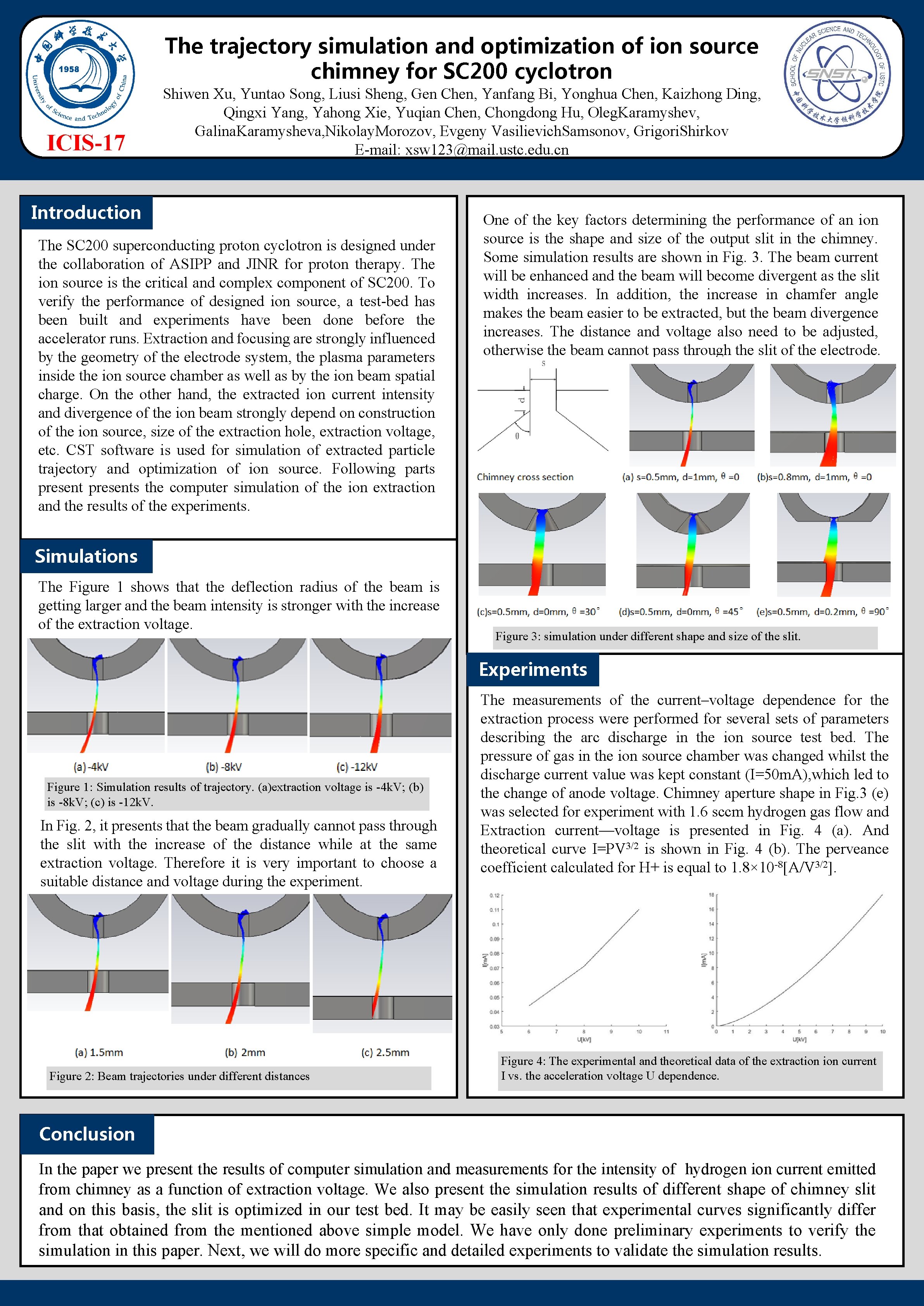
The trajectory simulation and optimization of ion source chimney for SC 200 cyclotron ICIS-17 Shiwen Xu, Yuntao Song, Liusi Sheng, Gen Chen, Yanfang Bi, Yonghua Chen, Kaizhong Ding, Qingxi Yang, Yahong Xie, Yuqian Chen, Chongdong Hu, Oleg. Karamyshev, Galina. Karamysheva, Nikolay. Morozov, Evgeny Vasilievich. Samsonov, Grigori. Shirkov E-mail: xsw 123@mail. ustc. edu. cn Introduction The SC 200 superconducting proton cyclotron is designed under the collaboration of ASIPP and JINR for proton therapy. The ion source is the critical and complex component of SC 200. To verify the performance of designed ion source, a test-bed has been built and experiments have been done before the accelerator runs. Extraction and focusing are strongly influenced by the geometry of the electrode system, the plasma parameters inside the ion source chamber as well as by the ion beam spatial charge. On the other hand, the extracted ion current intensity and divergence of the ion beam strongly depend on construction of the ion source, size of the extraction hole, extraction voltage, etc. CST software is used for simulation of extracted particle trajectory and optimization of ion source. Following parts presents the computer simulation of the ion extraction and the results of the experiments. One of the key factors determining the performance of an ion source is the shape and size of the output slit in the chimney. Some simulation results are shown in Fig. 3. The beam current will be enhanced and the beam will become divergent as the slit width increases. In addition, the increase in chamfer angle makes the beam easier to be extracted, but the beam divergence increases. The distance and voltage also need to be adjusted, otherwise the beam cannot pass through the slit of the electrode. (a) (b) Simulations The Figure 1 shows that the deflection radius of the beam is getting larger and the beam intensity is stronger with the increase of the extraction voltage. Figure 3: simulation under different shape and size of the slit. Experiments Figure 1: Simulation results of trajectory. (a)extraction voltage is -4 k. V; (b) is -8 k. V; (c) is -12 k. V. In Fig. 2, it presents that the beam gradually cannot pass through the slit with the increase of the distance while at the same extraction voltage. Therefore it is very important to choose a suitable distance and voltage during the experiment. Figure 2: Beam trajectories under different distances The measurements of the current–voltage dependence for the extraction process were performed for several sets of parameters describing the arc discharge in the ion source test bed. The pressure of gas in the ion source chamber was changed whilst the discharge current value was kept constant (I=50 m. A), which led to the change of anode voltage. Chimney aperture shape in Fig. 3 (e) was selected for experiment with 1. 6 sccm hydrogen gas flow and Extraction current—voltage is presented in Fig. 4 (a). And theoretical curve I=PV 3/2 is shown in Fig. 4 (b). The perveance coefficient calculated for H+ is equal to 1. 8× 10 -8[A/V 3/2]. Figure 4: The experimental and theoretical data of the extraction current I vs. the acceleration voltage U dependence. Conclusion In the paper we present the results of computer simulation and measurements for the intensity of hydrogen ion current emitted from chimney as a function of extraction voltage. We also present the simulation results of different shape of chimney slit and on this basis, the slit is optimized in our test bed. It may be easily seen that experimental curves significantly differ from that obtained from the mentioned above simple model. We have only done preliminary experiments to verify the simulation in this paper. Next, we will do more specific and detailed experiments to validate the simulation results.