
The Trait Approach Psychologists who support the trait
- Slides: 10
The Trait Approach Psychologists who support the trait approach believe that personality traits are inborn and unchanging. Many trait theorists believe that people can be measured according to five basic personality factors. Main features: Focus on cataloging traits Examining where traits come from Which traits are predominant Limitations: Pigeonholing people according to oversimplified
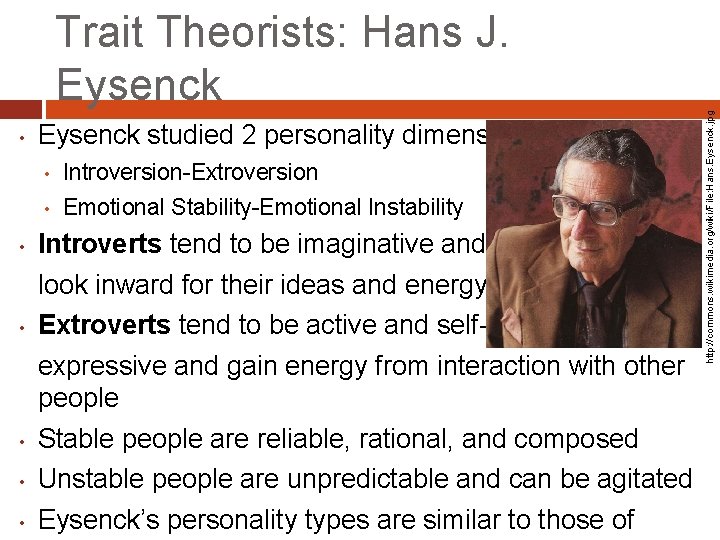
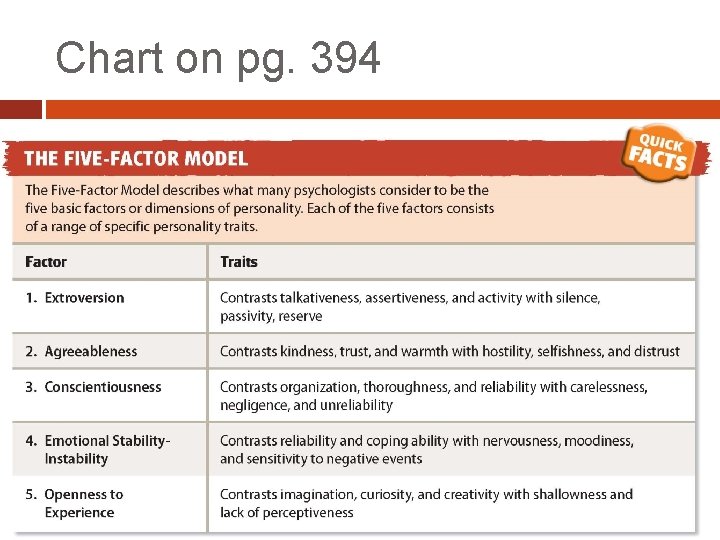
The Trait Approach Psychologists study personality to discover patterns of feelings, motives, and behavior that set people apart from one another. Trait theorists attempt to understand personality by focusing on traits, or those aspects of personality that remain stable. Psychologist Hans Eysenck used two basic dimensions of personality—introversion-extroversion and emotional stability-instability—to organize traits. The Five Factor Model identifies five basic personality factors: extroversion, agreeableness,
Basic Definitions Personality: the patterns of feelings, motives, and behavior that set people apart from one another. Trait: an aspect of personality that is considered to be reasonably stable.
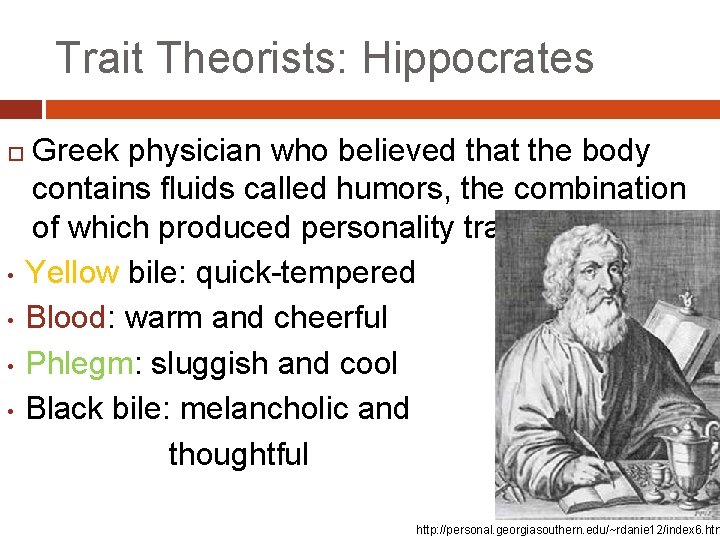
Trait Theorists: Hippocrates • • Greek physician who believed that the body contains fluids called humors, the combination of which produced personality traits. Yellow bile: quick-tempered Blood: warm and cheerful Phlegm: sluggish and cool Black bile: melancholic and thoughtful http: //personal. georgiasouthern. edu/~rdanie 12/index 6. htm
• • • Eysenck studied 2 personality dimensions: • Introversion-Extroversion • Emotional Stability-Emotional Instability Introverts tend to be imaginative and to look inward for their ideas and energy Extroverts tend to be active and selfexpressive and gain energy from interaction with other people Stable people are reliable, rational, and composed Unstable people are unpredictable and can be agitated Eysenck’s personality types are similar to those of http: //commons. wikimedia. org/wiki/File: Hans. Eysenck. jpg Trait Theorists: Hans J. Eysenck
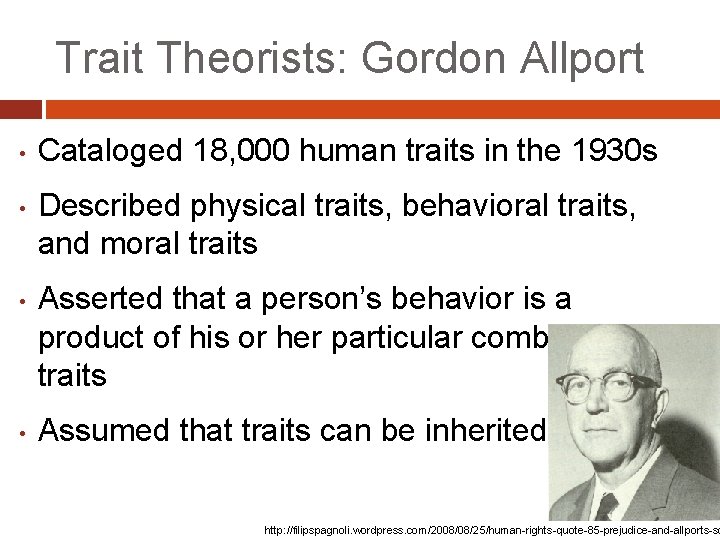
Trait Theorists: Gordon Allport • • Cataloged 18, 000 human traits in the 1930 s Described physical traits, behavioral traits, and moral traits Asserted that a person’s behavior is a product of his or her particular combination of traits Assumed that traits can be inherited http: //filipspagnoli. wordpress. com/2008/08/25/human-rights-quote-85 -prejudice-and-allports-sc
Chart on pg. 394
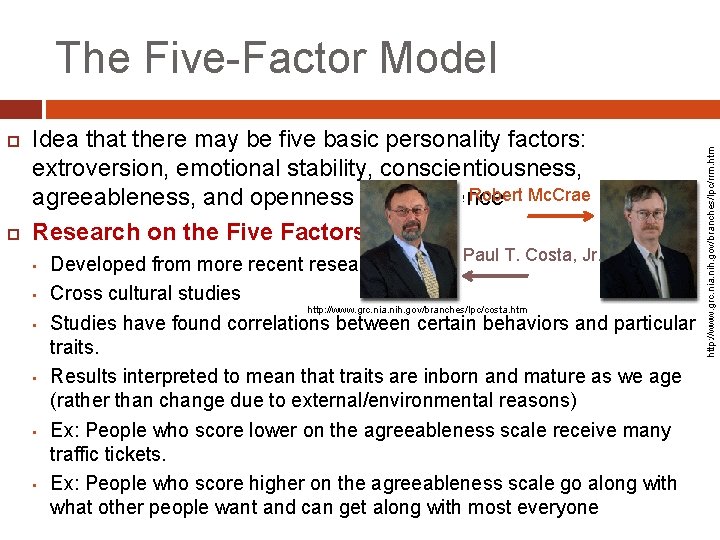
Idea that there may be five basic personality factors: extroversion, emotional stability, conscientiousness, Robert Mc. Crae agreeableness, and openness to experience Research on the Five Factors • • • Paul T. Costa, Jr. Developed from more recent research Cross cultural studies http: //www. grc. nia. nih. gov/branches/lpc/costa. htm Studies have found correlations between certain behaviors and particular traits. Results interpreted to mean that traits are inborn and mature as we age (rather than change due to external/environmental reasons) Ex: People who score lower on the agreeableness scale receive many traffic tickets. Ex: People who score higher on the agreeableness scale go along with what other people want and can get along with most everyone http: //www. grc. nia. nih. gov/branches/lpc/rrm. htm The Five-Factor Model
The Five-Factor Model Links to Disorders • Researchers are studying links between the five factors and the following disorders • • Anxiety Thinking you are ill when there is no medical basis for the belief Depression Suicide attempts Schizophrenia Personality disorders The Five-Factor Model helps psychologists to describe the above disorders. Psychologists still disagree about which factors are the most basic, but nearly all would agree that the “big five” are
Evaluation of the Trait Approach One shortcoming of the trait approach is its singular focus on describing traits. Efforts to link personality traits to biological factors have not been successful. This approach suggests that there are links between personalities, abilities, and interests. It provides no explanation of how personality develops.