
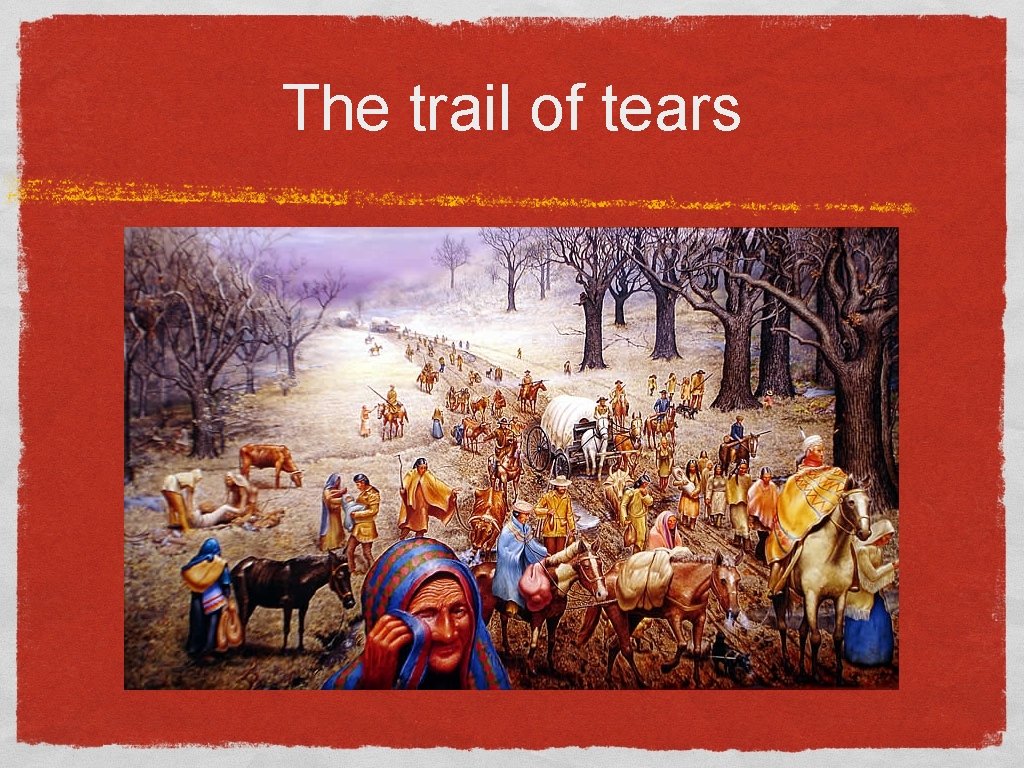
The trail of tears The Trail of Tears
- Slides: 12
The trail of tears
The Trail of Tears The Indian Removal Policy was enacted by Andrew Jackson and Congress in 1830. The Indians of the Southeast (Cherokees, Creeks, Choctaws, Chickasaws and Seminoles) were forced to leave their ancestral lands. Andrew Jackson stated that this was done to protect the Native Americans but in reality it was done for the benefit of American citizens who had a thirst for fertile lands. The lands occupied by the tribes was suitable for growing cotton and other crops.
Andrew Jackson on Indian Removal Such are the arrangements for the physical comfort and for the moral improvement of the Indians. The necessary measures for their political advancement and for their separation from our citizens have not been neglected. The pledge of the United States has been given by Congress that the country destined for the residence of this people shall be forever "secured and guaranteed to them. " A country west of Missouri and Arkansas has been assigned to them, into which the white settlements are not to be pushed. No political communities can be formed in that extensive region, except those which are established by the Indians themselves or by the Untied States for them and with their concurrence. A barrier has thus been raised for their protection against the encroachment of our citizens, and guarding the Indians as far as possible from those evils which have brought them to their present condition. Summary authority has been given by law to destroy all ardent spirits found in their country, without waiting the doubtful result and slow process of a legal seizure. I consider the absolute and unconditional interdiction of this article among these people as the first and great step in their melioration. Halfway measures will answer no purpose. These can not successfully contend against the cupidity of the seller and the overpowering appetite of the buyer. And the destructive effects of the traffic are marked in every page of the history of our Indian intercourse. . Exert from Jackson’s Seventh Annual Message to Congress
nearly thirty years, in relation to the removal of the Andrew Jackson on Indian Removal Indians beyond the white settlements is approaching to a happy consummation. Two important tribes have accepted the provision made for their removal at the last session of Congress, and it is believed that their example will induce the remaining tribes also to seek the same obvious advantages. The consequences of a speedy removal will be important to the United States, to individual states, and to the Indians themselves. The pecuniary advantages which it promises to the government are the least of its recommendations. It puts an end to all possible danger of collision between the authorities of the general and state governments on account of the Indians. It will place a dense and civilized population in large tracts of country now occupied by a few savage hunters. By opening the whole territory between Tennessee on the north and Louisiana on the south to the settlement of the whites it will incalculably strengthen the southwestern frontier and render the adjacent states strong enough to repel future invasions without remote aid. It will relieve the whole state of Mississippi and the western part of Alabama of
What brought about this policy? George Washington and Thomas Jefferson felt that the southeastern Native American states should be left alone. Jefferson believed that in time the tribes would begin to practice an agricultural based society. In this way, they would become “civilized” according to 19 th century American philosophy. Jackson thought otherwise. Andrew Jackson proposed military action against Native Americans in the southeast. This may have been influenced by his role in the Seminole Wars. Strong support from southerners assured the passage of the policy. Southern residents wanted access to the lands inhabited by the tribes. There was also a crisis in Georgia between Native Americans and the Georgian government. Jackson hoped that Indian Removal would eliminate any conflicts.
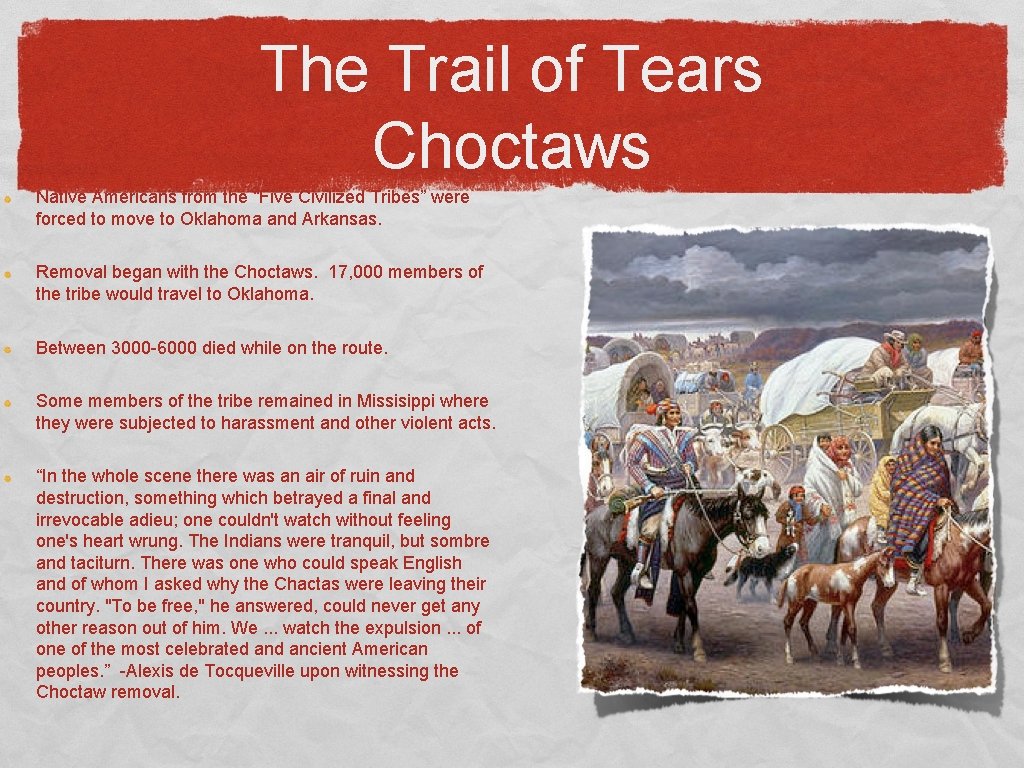
The Trail of Tears Choctaws Native Americans from the “Five Civilized Tribes” were forced to move to Oklahoma and Arkansas. Removal began with the Choctaws. 17, 000 members of the tribe would travel to Oklahoma. Between 3000 -6000 died while on the route. Some members of the tribe remained in Missisippi where they were subjected to harassment and other violent acts. “In the whole scene there was an air of ruin and destruction, something which betrayed a final and irrevocable adieu; one couldn't watch without feeling one's heart wrung. The Indians were tranquil, but sombre and taciturn. There was one who could speak English and of whom I asked why the Chactas were leaving their country. "To be free, " he answered, could never get any other reason out of him. We. . . watch the expulsion. . . of one of the most celebrated ancient American peoples. ” -Alexis de Tocqueville upon witnessing the Choctaw removal.
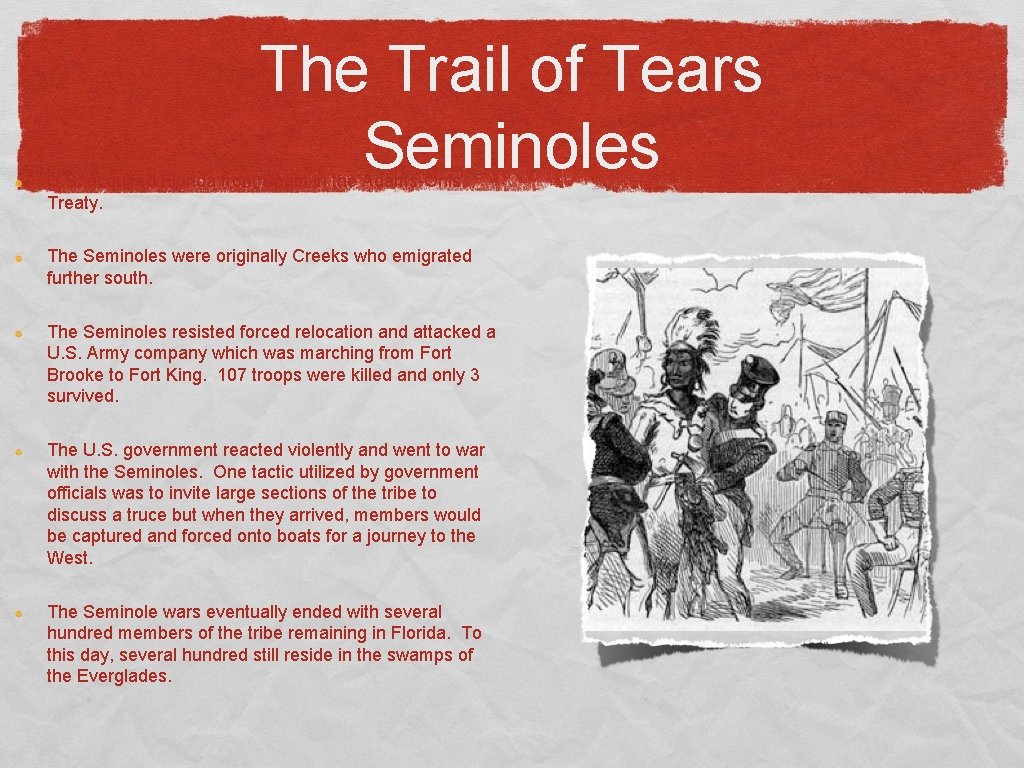
The Trail of Tears Seminoles U. S. acquired Florida from Spain in the Adams-Onis Treaty. The Seminoles were originally Creeks who emigrated further south. The Seminoles resisted forced relocation and attacked a U. S. Army company which was marching from Fort Brooke to Fort King. 107 troops were killed and only 3 survived. The U. S. government reacted violently and went to war with the Seminoles. One tactic utilized by government officials was to invite large sections of the tribe to discuss a truce but when they arrived, members would be captured and forced onto boats for a journey to the West. The Seminole wars eventually ended with several hundred members of the tribe remaining in Florida. To this day, several hundred still reside in the swamps of the Everglades.
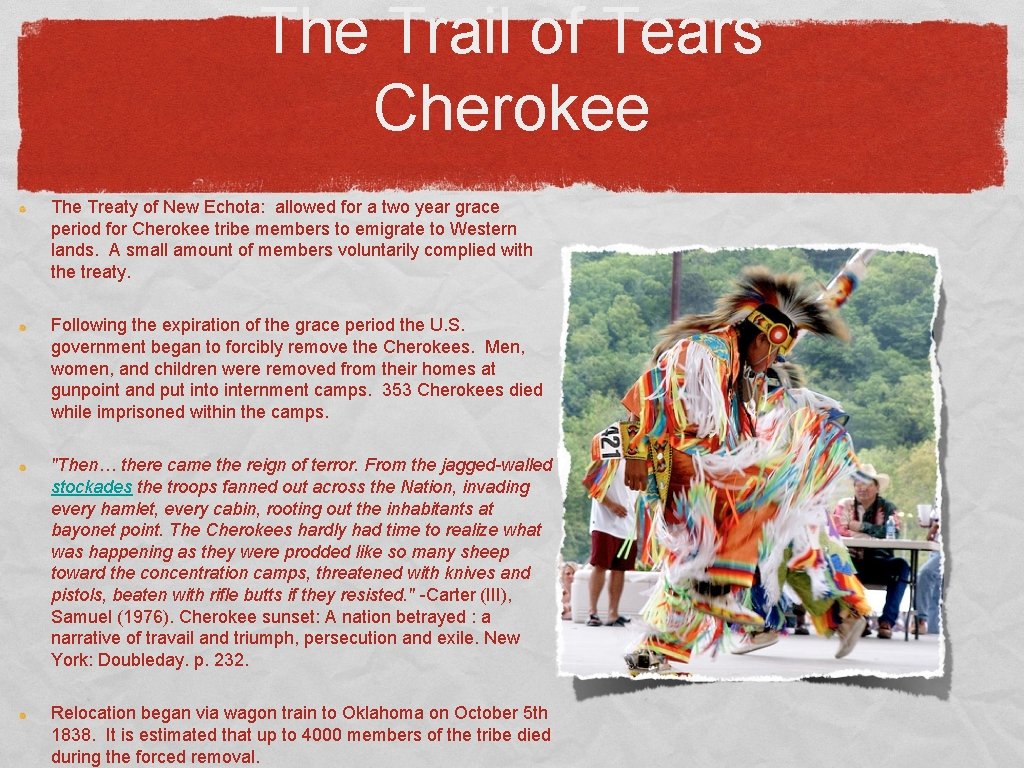
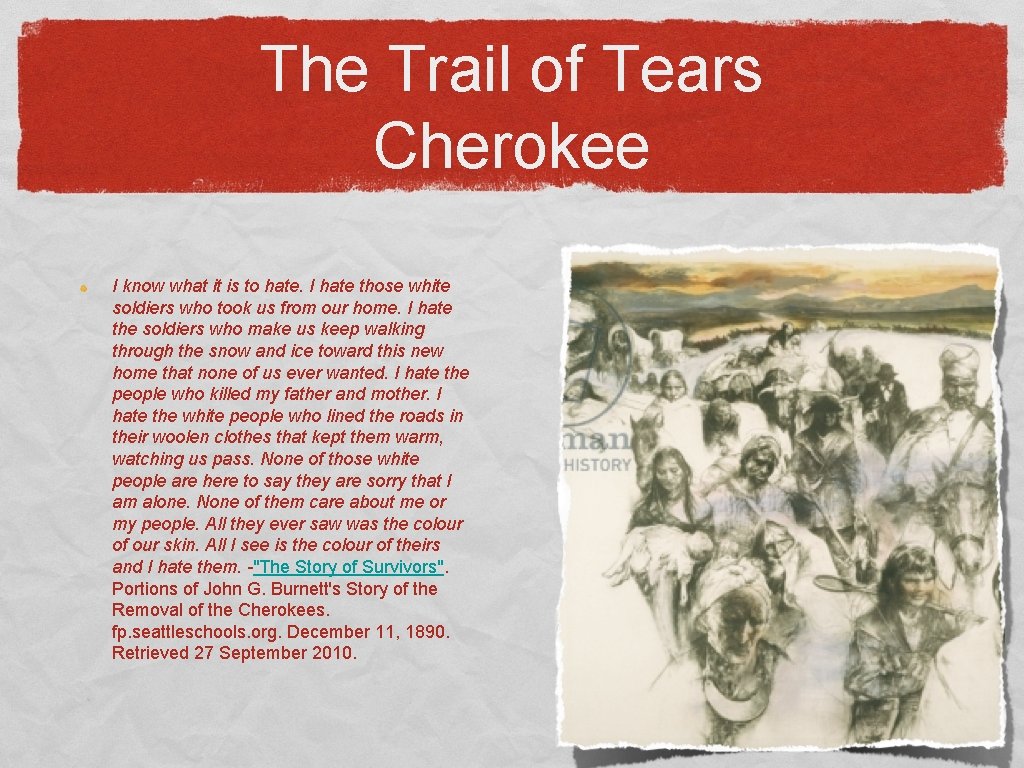
The Trail of Tears Cherokee The Treaty of New Echota: allowed for a two year grace period for Cherokee tribe members to emigrate to Western lands. A small amount of members voluntarily complied with the treaty. Following the expiration of the grace period the U. S. government began to forcibly remove the Cherokees. Men, women, and children were removed from their homes at gunpoint and put into internment camps. 353 Cherokees died while imprisoned within the camps. "Then… there came the reign of terror. From the jagged-walled stockades the troops fanned out across the Nation, invading every hamlet, every cabin, rooting out the inhabitants at bayonet point. The Cherokees hardly had time to realize what was happening as they were prodded like so many sheep toward the concentration camps, threatened with knives and pistols, beaten with rifle butts if they resisted. " -Carter (III), Samuel (1976). Cherokee sunset: A nation betrayed : a narrative of travail and triumph, persecution and exile. New York: Doubleday. p. 232. Relocation began via wagon train to Oklahoma on October 5 th 1838. It is estimated that up to 4000 members of the tribe died during the forced removal.
The Trail of Tears Cherokee I know what it is to hate. I hate those white soldiers who took us from our home. I hate the soldiers who make us keep walking through the snow and ice toward this new home that none of us ever wanted. I hate the people who killed my father and mother. I hate the white people who lined the roads in their woolen clothes that kept them warm, watching us pass. None of those white people are here to say they are sorry that I am alone. None of them care about me or my people. All they ever saw was the colour of our skin. All I see is the colour of theirs and I hate them. -"The Story of Survivors". Portions of John G. Burnett's Story of the Removal of the Cherokees. fp. seattleschools. org. December 11, 1890. Retrieved 27 September 2010.
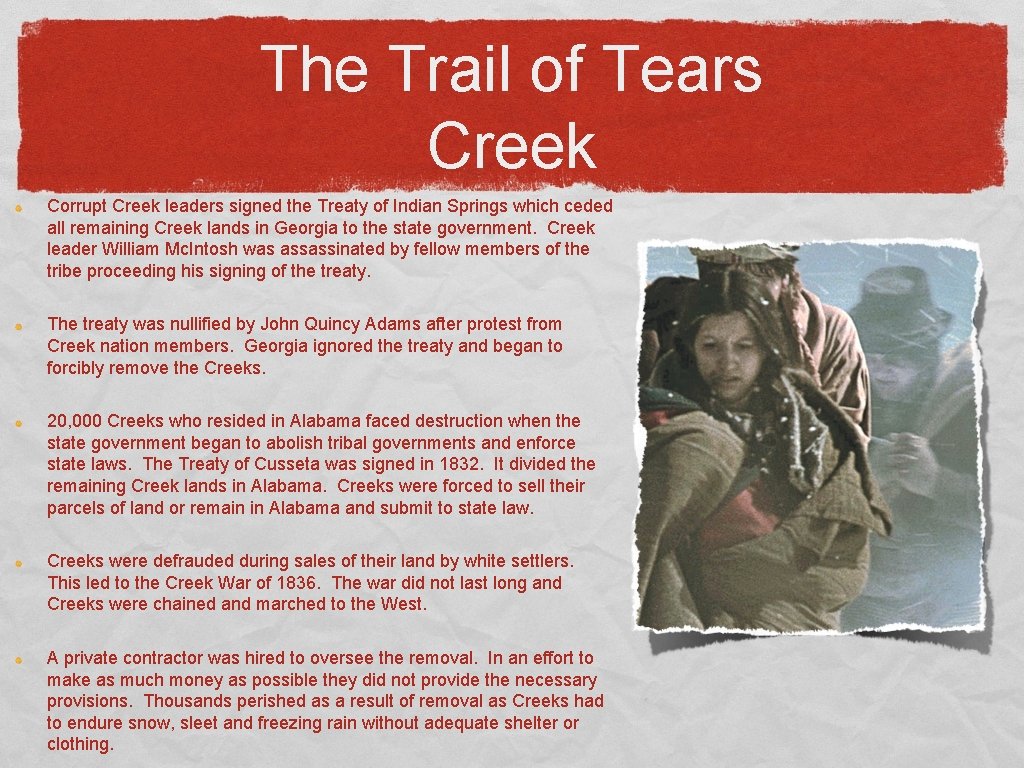
The Trail of Tears Creek Corrupt Creek leaders signed the Treaty of Indian Springs which ceded all remaining Creek lands in Georgia to the state government. Creek leader William Mc. Intosh was assassinated by fellow members of the tribe proceeding his signing of the treaty. The treaty was nullified by John Quincy Adams after protest from Creek nation members. Georgia ignored the treaty and began to forcibly remove the Creeks. 20, 000 Creeks who resided in Alabama faced destruction when the state government began to abolish tribal governments and enforce state laws. The Treaty of Cusseta was signed in 1832. It divided the remaining Creek lands in Alabama. Creeks were forced to sell their parcels of land or remain in Alabama and submit to state law. Creeks were defrauded during sales of their land by white settlers. This led to the Creek War of 1836. The war did not last long and Creeks were chained and marched to the West. A private contractor was hired to oversee the removal. In an effort to make as much money as possible they did not provide the necessary provisions. Thousands perished as a result of removal as Creeks had to endure snow, sleet and freezing rain without adequate shelter or clothing.
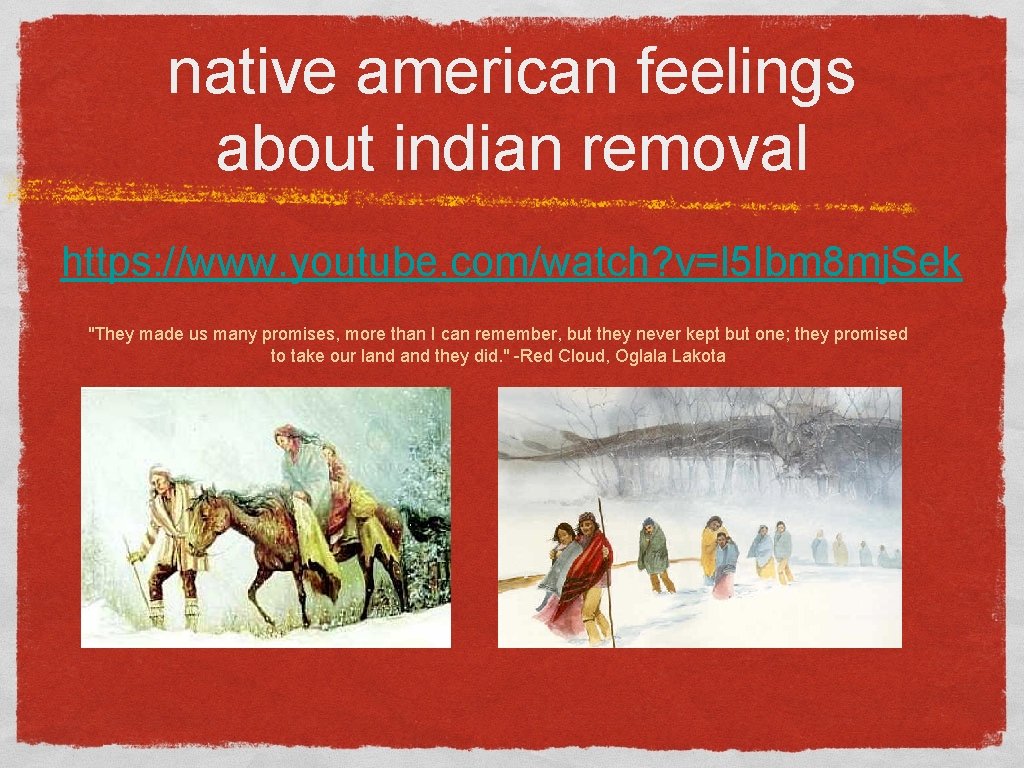
native american feelings about indian removal https: //www. youtube. com/watch? v=l 5 Ibm 8 mj. Sek "They made us many promises, more than I can remember, but they never kept but one; they promised to take our land they did. " -Red Cloud, Oglala Lakota
Discussion Quesitons What can Indian Removal/Trail of Tears be compared to? Has the U. S. government attitude towards Native Americans evolved or is it still the same? What can we, as citizens do to remember the tradgedies bestowed upon Native Americans?