
The Tragedy of Hamlet By William Shakespeare tragedy
The Tragedy of Hamlet By William Shakespeare
tragedy • Rise and fall of a noble man • Became deeper, more subtle, more flexible toward the end of the 16 th century • Depths of the human mind and spirit • Moral possibilities of human behavior • Men’s intertwining destinies
tragedy • Inspires fear and pity in the audience • Allows catharsis (purging of emotions) • Hero—an admirable character • Conflict—universal Is Hamlet’s tragic flaw his inability to take action without a great deal of forethought?
Ideal tragedy • Concerns career of a hero/great and admirable in both power and opportunity • Position affects many • Engaged in important events • Threat to security of community is removed only by death • Important choices /spin a web/cannot untangle circumstances

• Circumstances--bad luck, enemies, character flaw, supernatural • Hero realizes too late/no escape Hamlet is not the “ideal” tragedy.
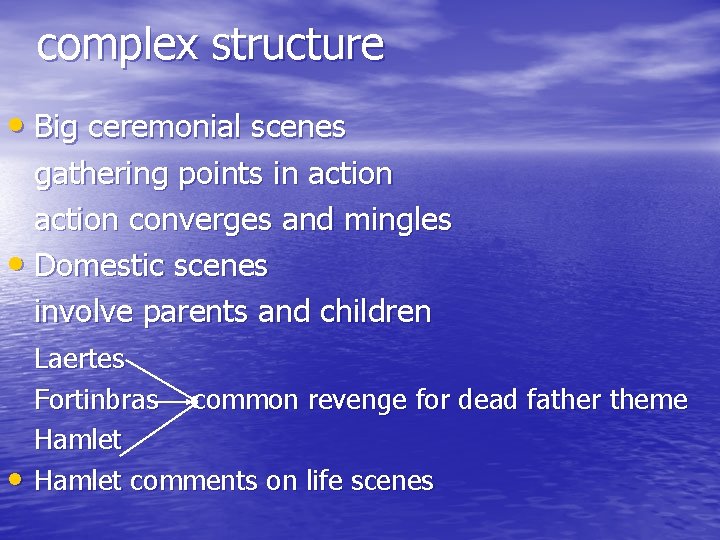
complex structure • Big ceremonial scenes gathering points in action converges and mingles • Domestic scenes involve parents and children • Laertes Fortinbras common revenge for dead father theme Hamlet comments on life scenes
Anachronism: something out of place historically • 7 th century/Whittenberg University 1502 • Often used to interest the audience
Verbal irony: double meaning Hamlet’s speeches/psychological state Situational irony: something different from what is expected Dramatic irony: some characters in the play know more than others so the reader knows more
Imagery: words creating mental images • Disease • Rot and decomposition • Overgrowing weeds • Harlot/makeup, flowers • Used to create emotional response in the play
Language: greater freedom than earlier plays • More rhythm • More prose
Setting: • Midnight(opening) • outside Elsinore in Denmark • Cold, bitter, dark evening(danger) • Inside Elsinore “too perfect” king’s court • Plain in Denmark(Scene 4, Act IV) • Churchyard cemetery(comic relief scene)

conflict • Protagonist Hamlet versus antagonist Claudius • Hamlet vs. self must resolve self doubts before he can defeat Claudius
Themes in Hamlet • Appearance vs. reality Looks can be deceptive evil can be concealed by the appearance of goodness
• Corruption difficult for a person to live and remain a good person in a world corrupted by evil need for revenge may be a harmful to the avenger as it is to the recipient of the revenge Claudius’ guilt—moral flaw of the court
• Mortality—all characters • Madness Hamlet’s behavior after the ghost pretense Ophelia’s true insanity
• Doubt Hamlet’s soliloquies decisiveness vs. cowardice
motifs in revenge tragedies • Insanity • Suicide • Soliloquies • Crimes/incest and adultery • Horrors of onstage murders and piles of dead bodies
- Slides: 17