
The Tradeoff between Energy Efficiency and User State
The Tradeoff between Energy Efficiency and User State Estimation Accuracy in Mobile Sensing Yi Wang, Bhaskar Krishnamachari, Qing Zhao, and Murali Annavaram Ming Hsieh Department of Electrical Engineering University of Southern California Department of Electrical and Computer Engineering University of California, Davis 1 Mobi. Case ‘ 09 October 26, 2009
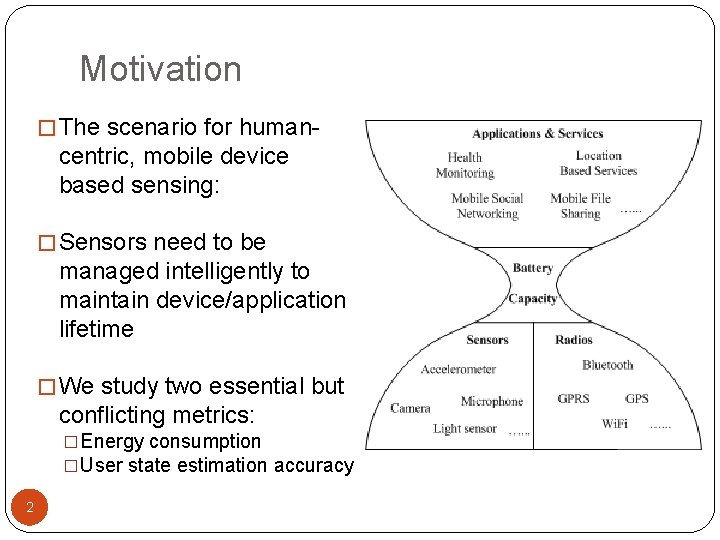
Motivation � The scenario for human- centric, mobile device based sensing: � Sensors need to be managed intelligently to maintain device/application lifetime � We study two essential but conflicting metrics: �Energy consumption �User state estimation accuracy 2
Outline � Problem modeling and assumptions � The stationary deterministic sensing policy � Estimation of user state for missing observations � Visualizing the tradeoff: energy vs. accuracy � Conclusion and Ongoing/future work 3
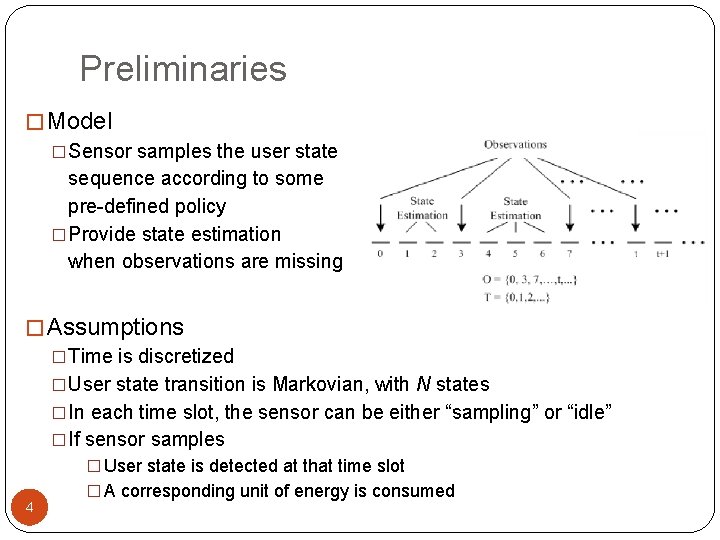
Preliminaries � Model �Sensor samples the user state sequence according to some pre-defined policy �Provide state estimation when observations are missing � Assumptions �Time is discretized �User state transition is Markovian, with N states �In each time slot, the sensor can be either “sampling” or “idle” �If sensor samples � User state is detected at that time slot 4 � A corresponding unit of energy is consumed
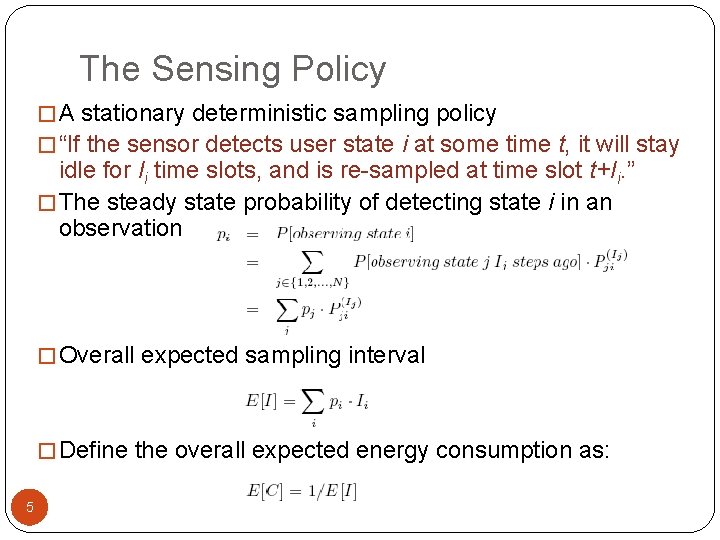
The Sensing Policy � A stationary deterministic sampling policy � “If the sensor detects user state i at some time t, it will stay idle for Ii time slots, and is re-sampled at time slot t+Ii. ” � The steady state probability of detecting state i in an observation � Overall expected sampling interval � Define the overall expected energy consumption as: 5
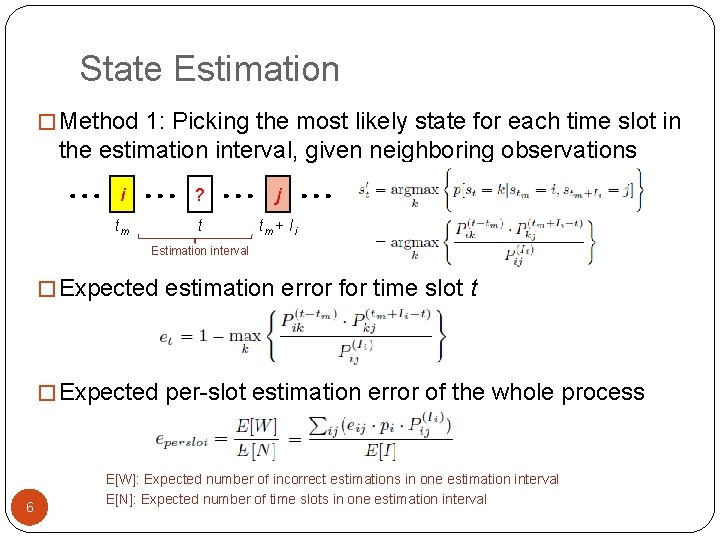
State Estimation � Method 1: Picking the most likely state for each time slot in the estimation interval, given neighboring observations i ? j tm t tm + Ii Estimation interval � Expected estimation error for time slot t � Expected per-slot estimation error of the whole process 6 E[W]: Expected number of incorrect estimations in one estimation interval E[N]: Expected number of time slots in one estimation interval
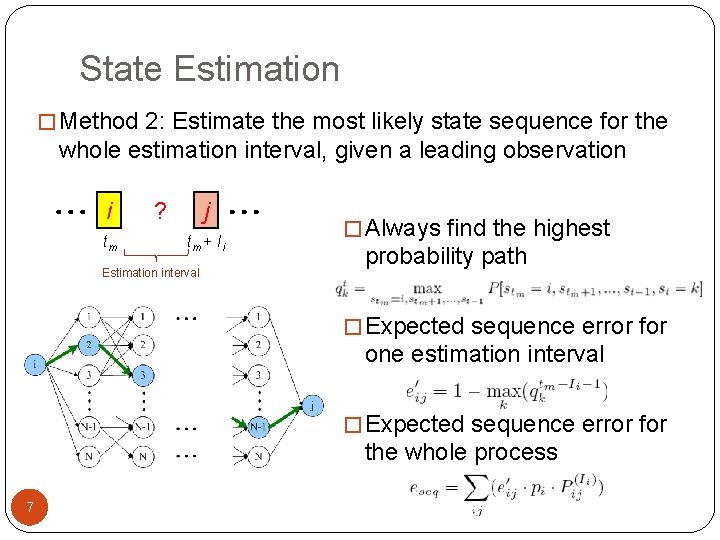
State Estimation � Method 2: Estimate the most likely state sequence for the whole estimation interval, given a leading observation i tm ? j tm + Ii Estimation interval � Always find the highest probability path � Expected sequence error for one estimation interval � Expected sequence error for the whole process 7

Case Study � Goal: Visualize the tradeoff between energy consumption and expected state estimation error �By varying Ii, the length of idle intervals � Test policy on two-state discrete time Markov chains �Different combinations of I 1 and I 2 are tested (1 ≤ I 1 ≤ 30, 1 ≤ I 2 ≤ 30) � Six Markov chain transition probability matrices are investigated: 0. 9 0. 1 0. 9 0. 5 0. 9 0. 1 0. 5 0. 1 0. 9 0. 5 0. 9 0. 1 8 � Analytical result vs. Simulation result �In simulation, user state data is generated based on Markov model �Policy is applied through the simulation process � 5000 time slots in each simulation run
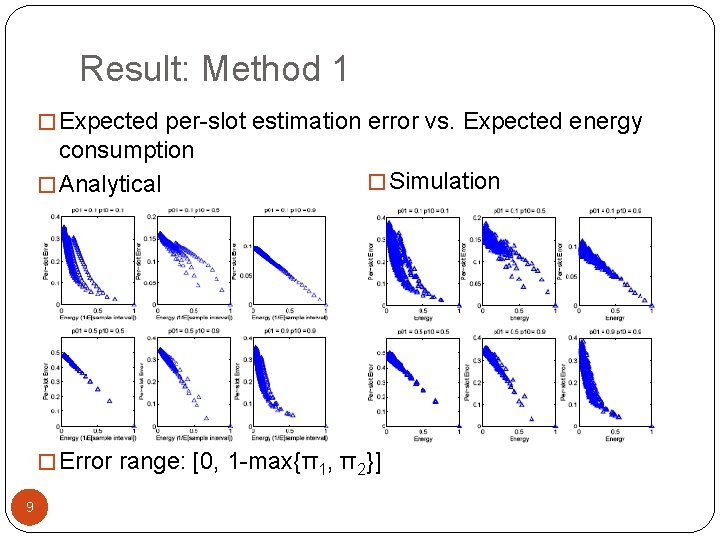
Result: Method 1 � Expected per-slot estimation error vs. Expected energy consumption � Analytical � Simulation � Error range: [0, 1 -max{π1, π2}] 9
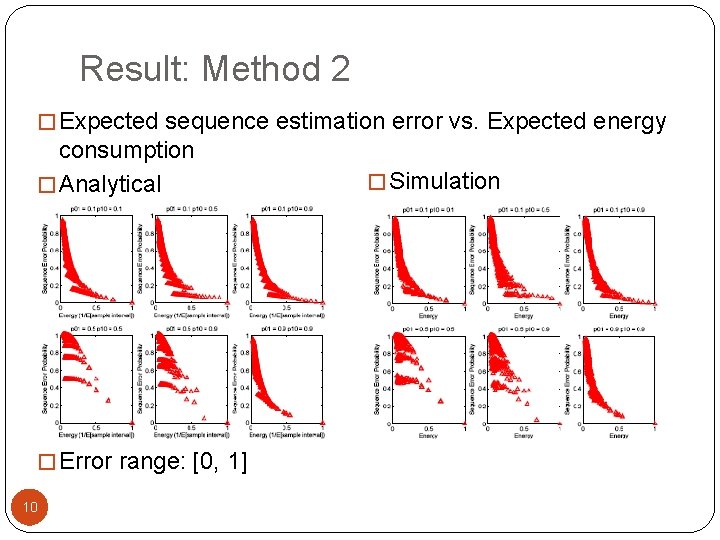
Result: Method 2 � Expected sequence estimation error vs. Expected energy consumption � Analytical � Error range: [0, 1] 10 � Simulation
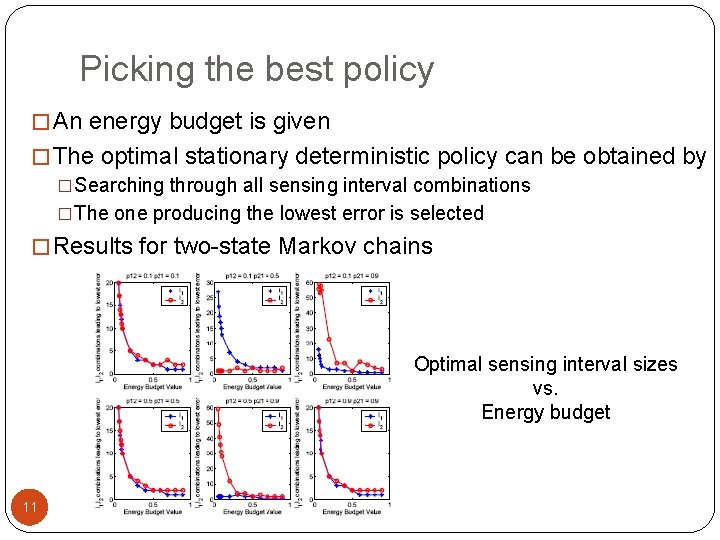
Picking the best policy � An energy budget is given � The optimal stationary deterministic policy can be obtained by �Searching through all sensing interval combinations �The one producing the lowest error is selected � Results for two-state Markov chains Optimal sensing interval sizes vs. Energy budget 11
Conclusion & Ongoing/Future Work � A stationary deterministic sensing policy � State estimation mechanisms � Energy efficiency vs. user state estimation accuracy � The optimal stationary deterministic policy can be obtained by exhaustively search � A more computationally efficient algorithm for optimal policy � Performance of sensing policy on real data trace 12

More research details available at http: //anrg. usc. edu Please email to wangyi@usc. edu
- Slides: 13