
The Tox Cast Chemical Universe and ACTo R

- Slides: 24
The Tox. Cast Chemical Universe and ACTo. R (Aggregated Computational Toxicology Resource) Presentation to EPA Chemical Prioritization Community of Practice October 23, 2008 This work was reviewed by EPA and approved for presentation but does not necessarily reflect official Agency policy. Mention of trade names or commercial products does not constitute endorsement or recommendation by EPA for use. Office of Research and Development National Center for Computational Toxicology
Outline • Defining the chemicals of interest for Tox. Cast –The Chemical Landscape Project • ACTo. R –A resource for aggregating data on these chemicals • Next Steps Office of Research and Development National Center for Computational Toxicology October 23, 2008 1
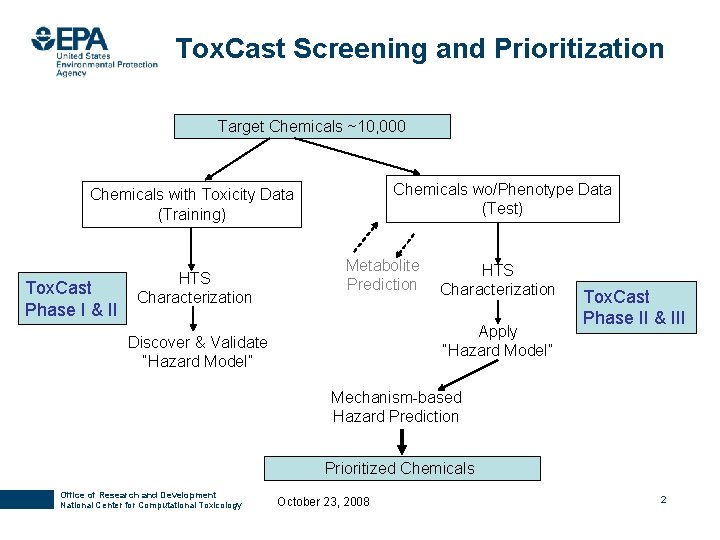
Tox. Cast Screening and Prioritization Target Chemicals ~10, 000 Chemicals wo/Phenotype Data (Test) Chemicals with Toxicity Data (Training) Tox. Cast Phase I & II HTS Characterization Metabolite Prediction HTS Characterization Apply “Hazard Model” Discover & Validate “Hazard Model” Tox. Cast Phase II & III Mechanism-based Hazard Prediction Prioritized Chemicals Office of Research and Development National Center for Computational Toxicology October 23, 2008 2
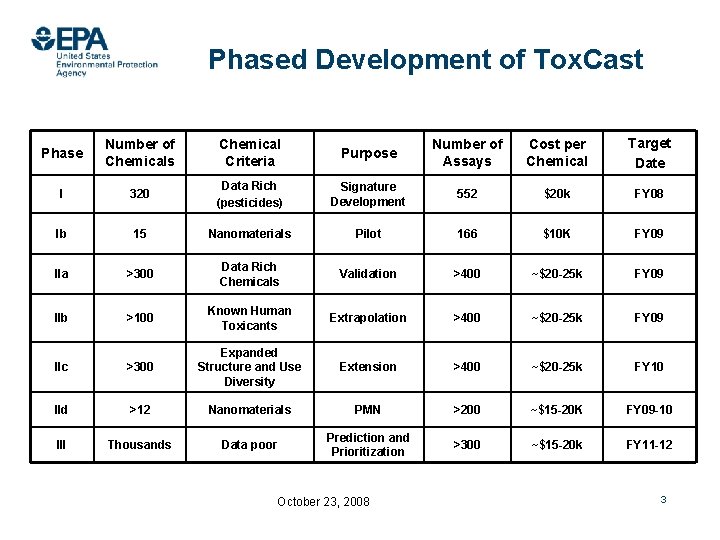
Phased Development of Tox. Cast Phase Number of Chemicals Chemical Criteria Purpose Number of Assays Cost per Chemical Target Date I 320 Data Rich (pesticides) Signature Development 552 $20 k FY 08 Ib 15 Nanomaterials Pilot 166 $10 K FY 09 IIa >300 Data Rich Chemicals Validation >400 ~$20 -25 k FY 09 IIb >100 Known Human Toxicants Extrapolation >400 ~$20 -25 k FY 09 IIc >300 Expanded Structure and Use Diversity Extension >400 ~$20 -25 k FY 10 IId >12 Nanomaterials PMN >200 ~$15 -20 K FY 09 -10 III Thousands Data poor Prediction and Prioritization >300 ~$15 -20 k FY 11 -12 Office of Research and Development National Center for Computational Toxicology October 23, 2008 3
The Chemical Landscape Project • What is the unique set of chemicals EPA is most concerned with? • Targets for the overall Tox. Cast Program • How much is know about these chemicals? • Where are the data gaps? • Collaboration across EPA –ORD, OPPT, OW, GLNPO, EDSP Office of Research and Development National Center for Computational Toxicology October 23, 2008 4
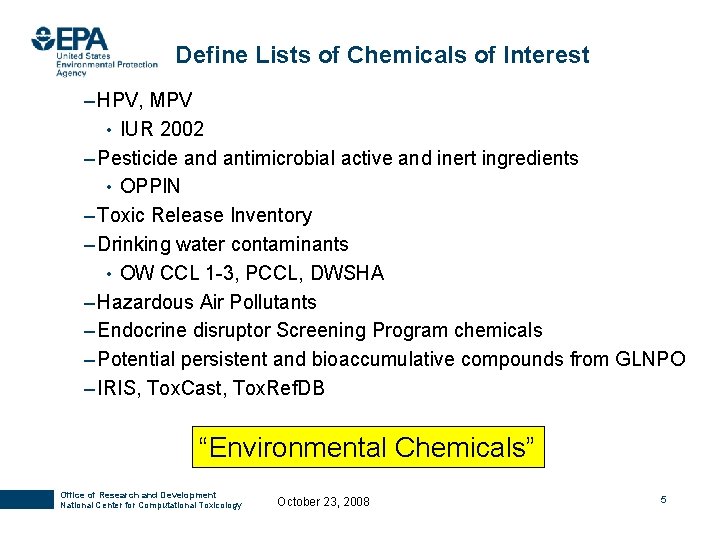
Define Lists of Chemicals of Interest – HPV, MPV • IUR 2002 – Pesticide and antimicrobial active and inert ingredients • OPPIN – Toxic Release Inventory – Drinking water contaminants • OW CCL 1 -3, PCCL, DWSHA – Hazardous Air Pollutants – Endocrine disruptor Screening Program chemicals – Potential persistent and bioaccumulative compounds from GLNPO – IRIS, Tox. Cast, Tox. Ref. DB “Environmental Chemicals” Office of Research and Development National Center for Computational Toxicology October 23, 2008 5
Types of Data Available • Identity –Names, synonyms –CAS registry numbers • Chemical structure • Biochemical assays • In Vivo Toxicology • Production volume • Regulations • Exposure Office of Research and Development National Center for Computational Toxicology October 23, 2008 6
Data Classes and Phenotypes • Type Classes • Phenotypes –Tabular –Summary calls –Descriptive –Links to web sites Office of Research and Development National Center for Computational Toxicology October 23, 2008 –General Hazard –Subchronic Toxicity –Carcinogenicity –Genotoxicity –Developmental Toxicity –Reproductive Toxicity –Dermal Toxicity –Neurotoxicity –Food Safety 7
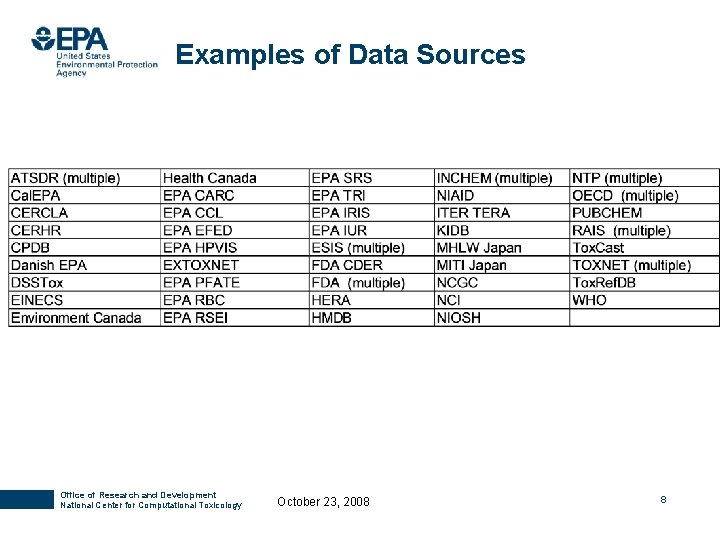
Examples of Data Sources Office of Research and Development National Center for Computational Toxicology October 23, 2008 8
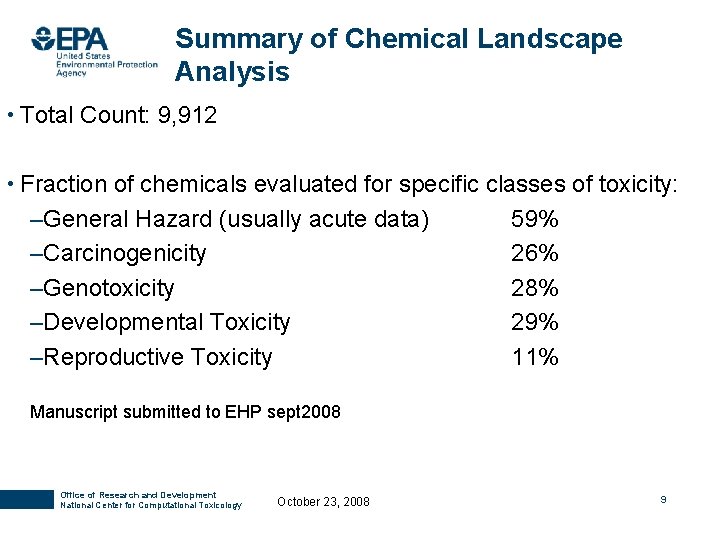
Summary of Chemical Landscape Analysis • Total Count: 9, 912 • Fraction of chemicals evaluated for specific classes of toxicity: –General Hazard (usually acute data) –Carcinogenicity –Genotoxicity –Developmental Toxicity –Reproductive Toxicity 59% 26% 28% 29% 11% Manuscript submitted to EHP sept 2008 Office of Research and Development National Center for Computational Toxicology October 23, 2008 9
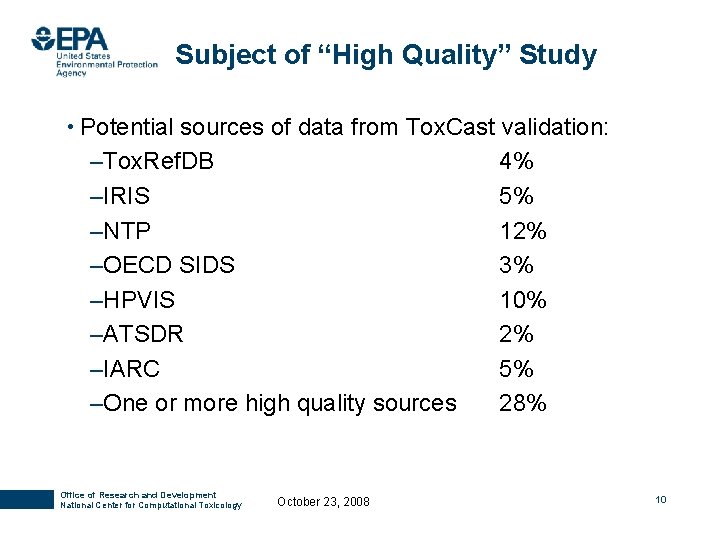
Subject of “High Quality” Study • Potential sources of data from Tox. Cast validation: –Tox. Ref. DB –IRIS –NTP –OECD SIDS –HPVIS –ATSDR –IARC –One or more high quality sources Office of Research and Development National Center for Computational Toxicology October 23, 2008 4% 5% 12% 3% 10% 2% 5% 28% 10
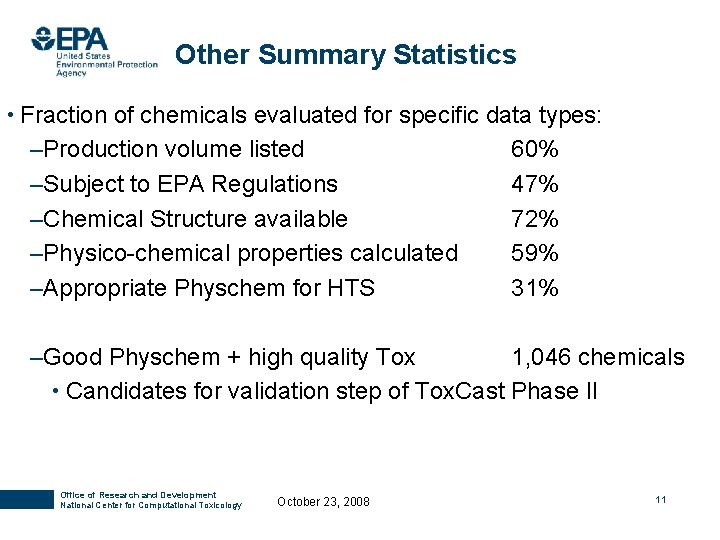
Other Summary Statistics • Fraction of chemicals evaluated for specific data types: –Production volume listed –Subject to EPA Regulations –Chemical Structure available –Physico-chemical properties calculated –Appropriate Physchem for HTS 60% 47% 72% 59% 31% –Good Physchem + high quality Tox 1, 046 chemicals • Candidates for validation step of Tox. Cast Phase II Office of Research and Development National Center for Computational Toxicology October 23, 2008 11
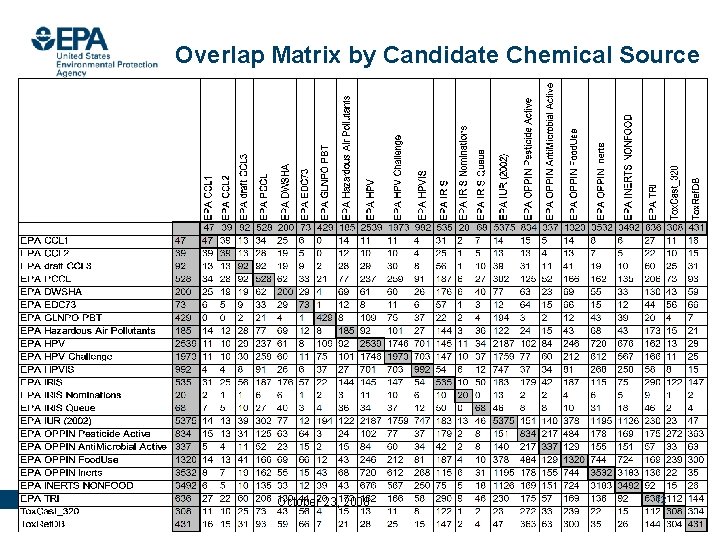
Overlap Matrix by Candidate Chemical Source Office of Research and Development National Center for Computational Toxicology October 23, 2008 12
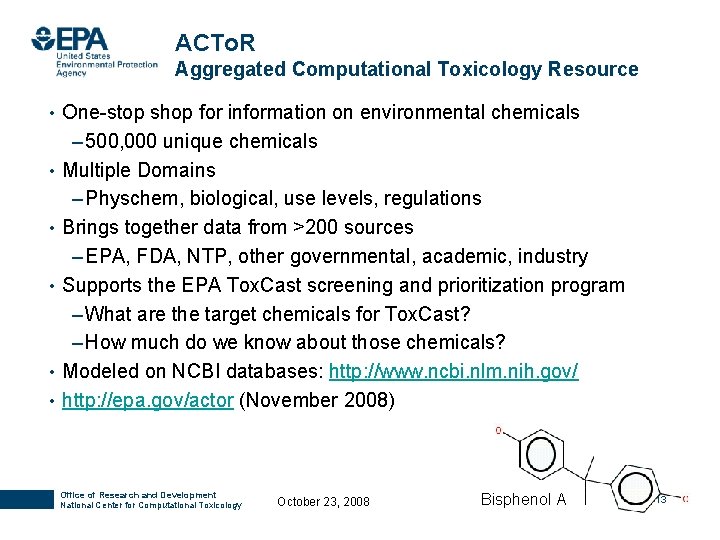
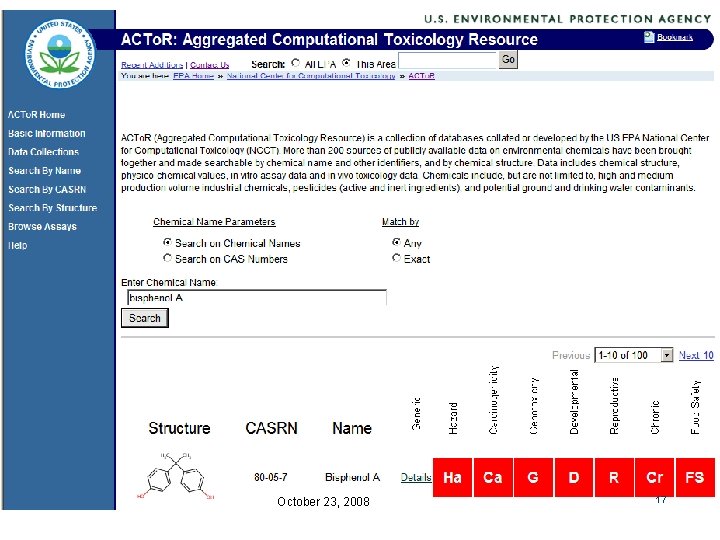
ACTo. R Aggregated Computational Toxicology Resource • One-stop shop for information on environmental chemicals • • • – 500, 000 unique chemicals Multiple Domains – Physchem, biological, use levels, regulations Brings together data from >200 sources – EPA, FDA, NTP, other governmental, academic, industry Supports the EPA Tox. Cast screening and prioritization program – What are the target chemicals for Tox. Cast? – How much do we know about those chemicals? Modeled on NCBI databases: http: //www. ncbi. nlm. nih. gov/ http: //epa. gov/actor (November 2008) Office of Research and Development National Center for Computational Toxicology October 23, 2008 Bisphenol A 13
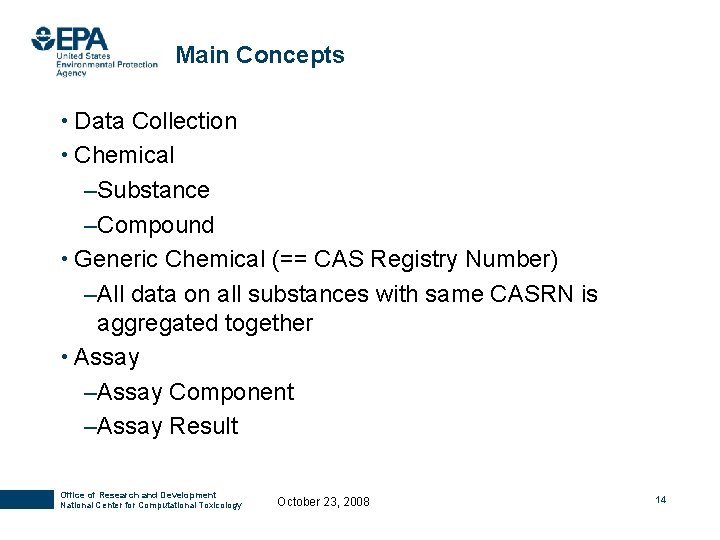
Main Concepts • Data Collection • Chemical –Substance –Compound • Generic Chemical (== CAS Registry Number) –All data on all substances with same CASRN is aggregated together • Assay –Assay Component –Assay Result Office of Research and Development National Center for Computational Toxicology October 23, 2008 14
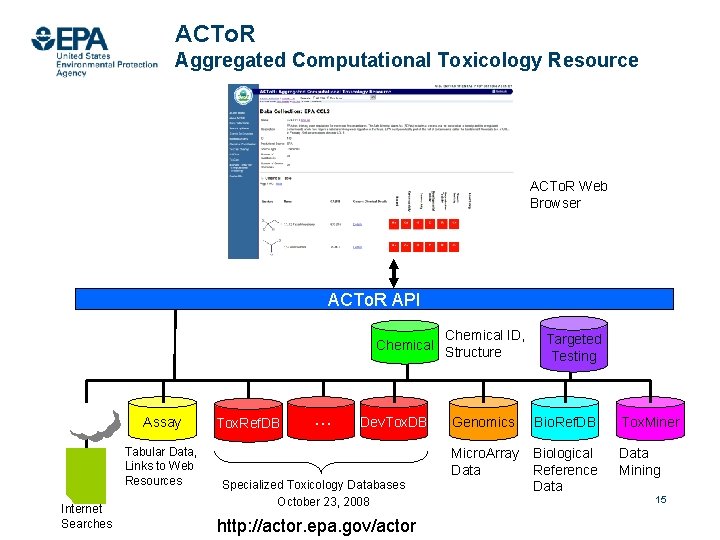
ACTo. R Aggregated Computational Toxicology Resource ACTo. R Web Browser ACTo. R API Chemical ID, Chemical Structure Assay Tabular Data, Links to Web Resources Tox. Ref. DB … Dev. Tox. DB Specialized Toxicology Databases October 23, 2008 Office of Research and Development National Center for Computational Toxicology Internet Searches http: //actor. epa. gov/actor Targeted Testing Genomics Bio. Ref. DB Tox. Miner Micro. Array Data Biological Reference Data Mining 15
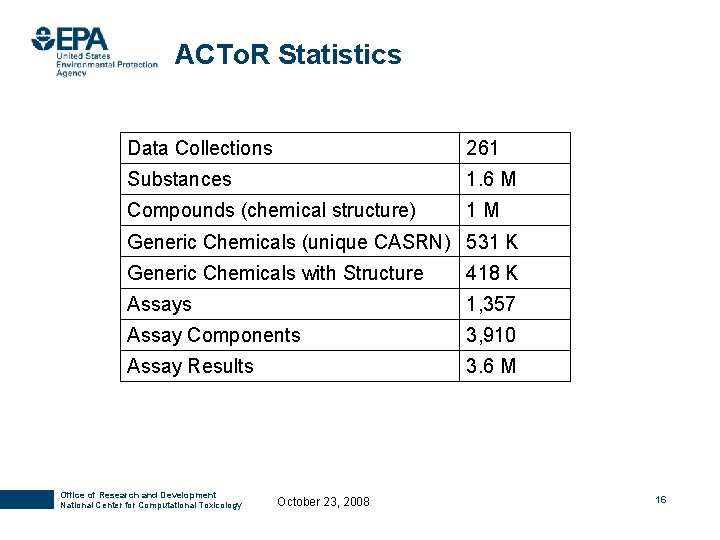
ACTo. R Statistics Data Collections 261 Substances 1. 6 M Compounds (chemical structure) 1 M Generic Chemicals (unique CASRN) 531 K Generic Chemicals with Structure 418 K Assays 1, 357 Assay Components 3, 910 Assay Results 3. 6 M Office of Research and Development National Center for Computational Toxicology October 23, 2008 16
Screen Shots Office of Research and Development National Center for Computational Toxicology October 23, 2008 17
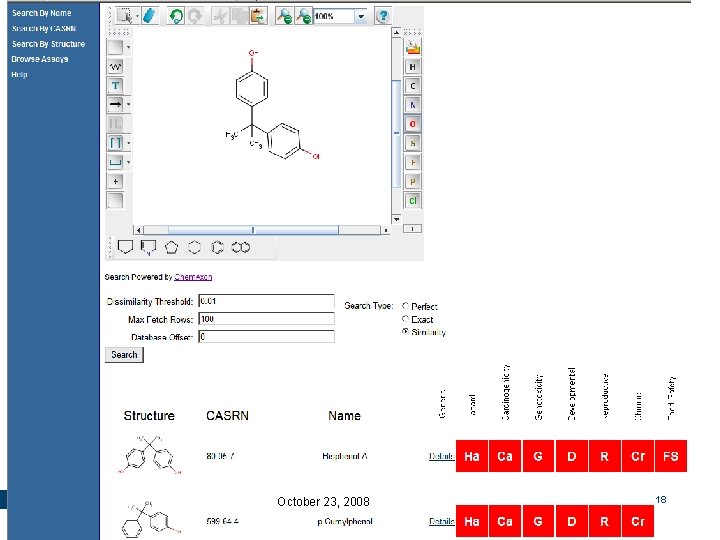
Office of Research and Development National Center for Computational Toxicology October 23, 2008 18
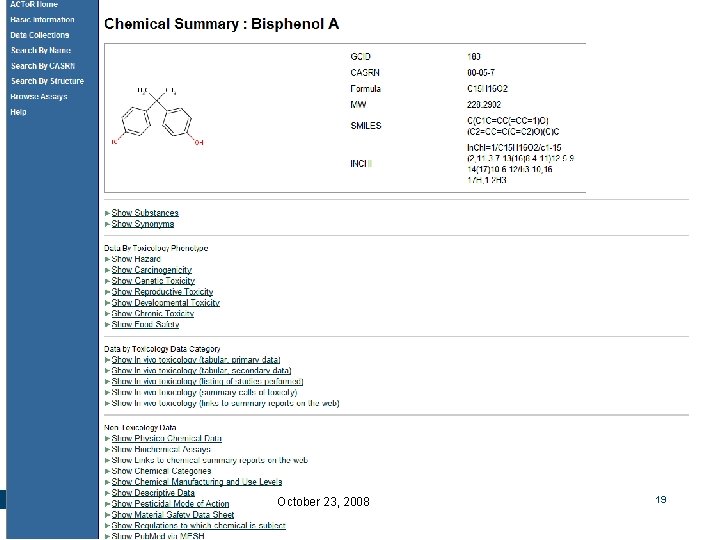
Office of Research and Development National Center for Computational Toxicology October 23, 2008 19
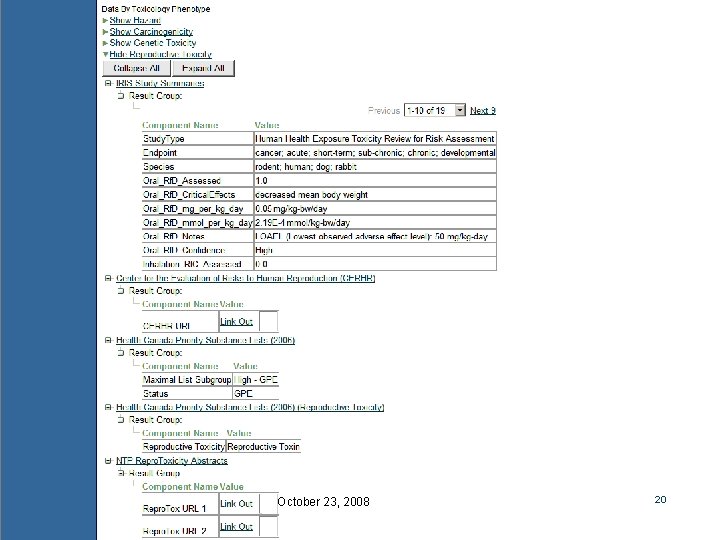
Office of Research and Development National Center for Computational Toxicology October 23, 2008 20
Landscape Next Steps • Goal is prioritization of Phase II, III Tox. Cast chemicals • List has expanded to include other Tox 21 nominations • Characterize chemicals along several axes –Single chemical vs. mixture –Amenable to HTS (DMSO solubility, volatility are issues) –Toxicity already characterized or not –Known safe or known toxic –Is exposure potential known or calculable? • Cluster chemicals –Structural classes –Physico-chemical properties Office of Research and Development National Center for Computational Toxicology October 23, 2008 21
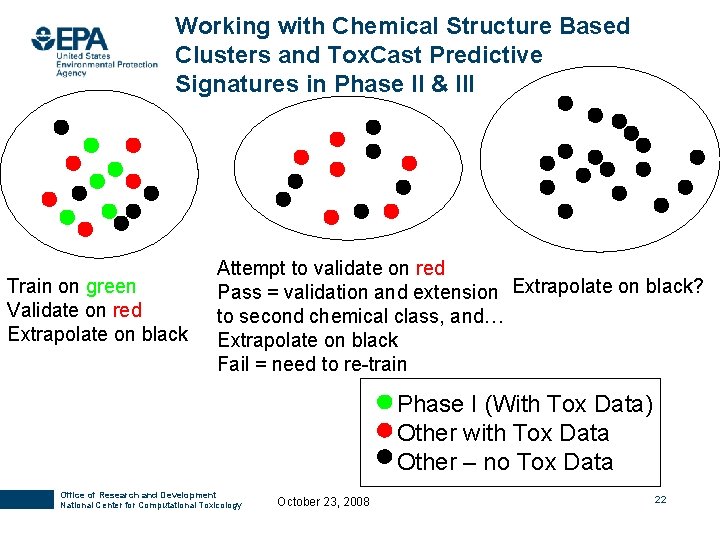
Working with Chemical Structure Based Clusters and Tox. Cast Predictive Signatures in Phase II & III Train on green Validate on red Extrapolate on black Attempt to validate on red Pass = validation and extension Extrapolate on black? to second chemical class, and… Extrapolate on black Fail = need to re-train Phase I (With Tox Data) Other with Tox Data Other – no Tox Data Office of Research and Development National Center for Computational Toxicology October 23, 2008 22
Summary • The universe of chemicals to be examined by Tox. Cast has been defined – 10 K – 12 K –About 25% have characterized toxicity –Chemical structure, toxicology and other information is being used to prioritize chemicals for Phase II • ACTo. R is a new resource for finding information on environmental chemicals –Publicly available soon –Pulling in data or links to all publicly available data sources on these chemicals Office of Research and Development National Center for Computational Toxicology October 23, 2008 23