
The TORCH PMT A close packing long life
- Slides: 24
The TORCH PMT: A close packing, long life MCP-PMT for Cherenkov applications with a novel high granularity multi-anode James Milnes 1 TIPP 2017, Beijing, China, May 22 - 26 2017 page 1 www. photek. co. uk
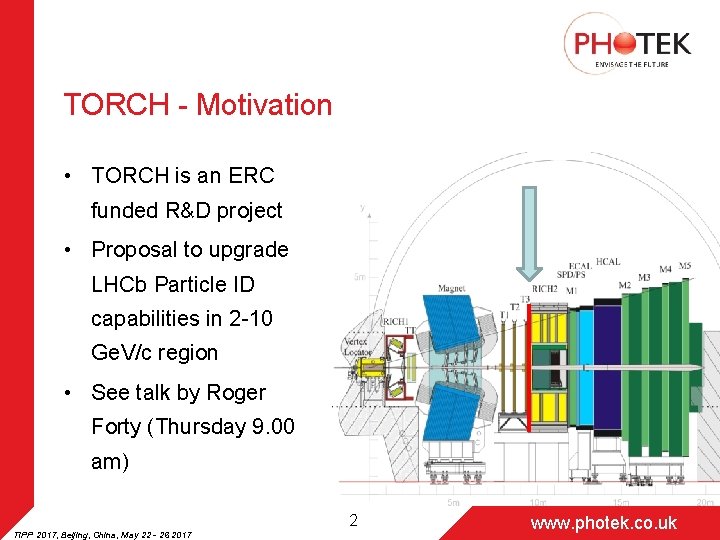
TORCH - Motivation • TORCH is an ERC funded R&D project • Proposal to upgrade LHCb Particle ID capabilities in 2 -10 Ge. V/c region • See talk by Roger Forty (Thursday 9. 00 am) 2 TIPP 2017, Beijing, China, May 22 - 26 2017 www. photek. co. uk
The TORCH PMT • In November 2012 Photek started the development of the TORCH (Timing Of internally Reflected CHerenkov photons) PMT • A collaboration with CERN and the Universities of Oxford and Bristol for the LHCb upgrade due around 2023 • Technical aims: – A lifetime of 5 C/cm 2 of accumulated anode charge or better – A multi-anode readout of 8 x 128 pixels • Fine pitch resolution target = 0. 12 mm – Close packing on two apposing sides with a fill factor of 88% or better • 53 mm working width within a 60 mm envelope 3 TIPP 2017, Beijing, China, May 22 - 26 2017 www. photek. co. uk
MCP-PMT Lifetime • Standard MCP detectors suffer from sensitivity loss after prolonged exposure: – An MCP has a very large surface area – Prolonged electron bombardment of this surface releases material that is ionised – These ions are drawn back to the photocathode and reduce sensitivity • Solution is now well known: • Conformal coating of Al 2 O 3 or Mg. O through Atomic Layer Deposition • Extensive study by Albert Lehmann 4 TIPP 2017, Beijing, China, May 22 - 26 2017 www. photek. co. uk
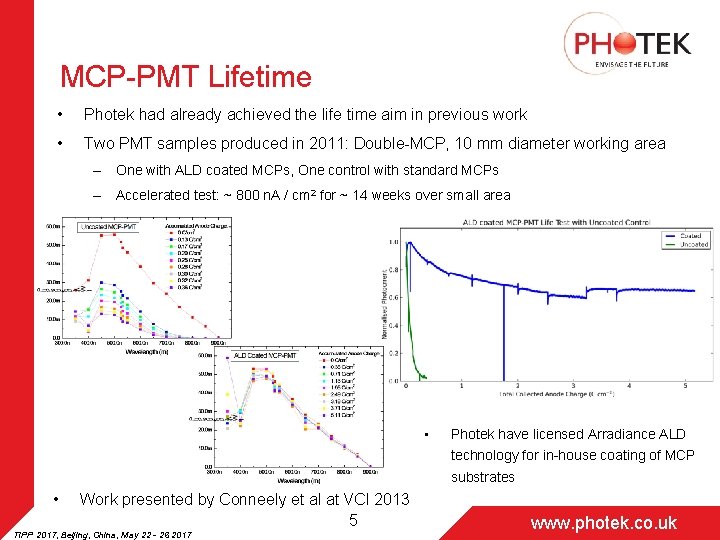
MCP-PMT Lifetime • Photek had already achieved the life time aim in previous work • Two PMT samples produced in 2011: Double-MCP, 10 mm diameter working area – One with ALD coated MCPs, One control with standard MCPs – Accelerated test: ~ 800 n. A / cm 2 for ~ 14 weeks over small area • Photek have licensed Arradiance ALD technology for in-house coating of MCP substrates • Work presented by Conneely et al at VCI 2013 5 TIPP 2017, Beijing, China, May 22 - 26 2017 www. photek. co. uk
High granularity multi-anode • For the TORCH project, how do we obtain position resolution beyond the pitch of the pads? – Proposed idea of charge sharing: – Deliberately spread the charge footprint – Charge is shared over multiple pads – Charge is measured on each pad – needs charge measuring front-end – Simple algorithm calculates the interpolated position – Reduces channel count – crucial factor! • Cannot share over too many pads without compromising the occupancy level – Important in a tube designed for high count rates – Ideally share over 2 – 3 pads 6 TIPP 2017, Beijing, China, May 22 - 26 2017 www. photek. co. uk
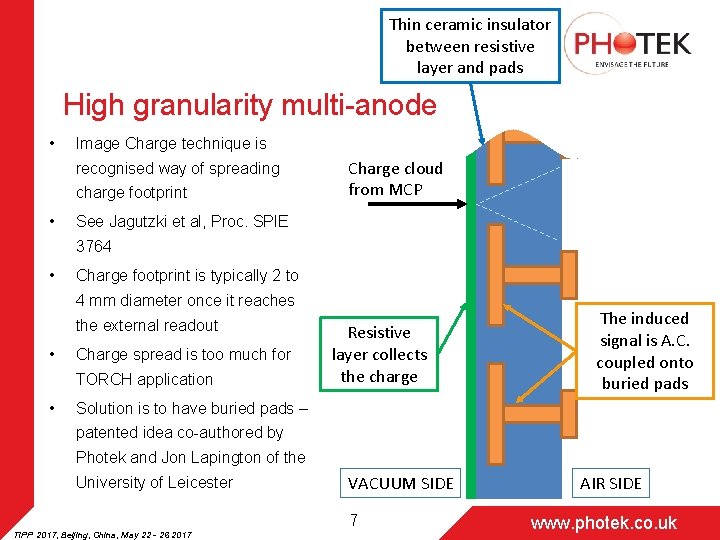
Thin ceramic insulator between resistive layer and pads High granularity multi-anode • Image Charge technique is recognised way of spreading charge footprint • Charge cloud from MCP See Jagutzki et al, Proc. SPIE 3764 • Charge footprint is typically 2 to 4 mm diameter once it reaches the external readout • Charge spread is too much for TORCH application • Resistive layer collects the charge The induced signal is A. C. coupled onto buried pads Solution is to have buried pads – patented idea co-authored by Photek and Jon Lapington of the University of Leicester VACUUM SIDE 7 TIPP 2017, Beijing, China, May 22 - 26 2017 AIR SIDE www. photek. co. uk
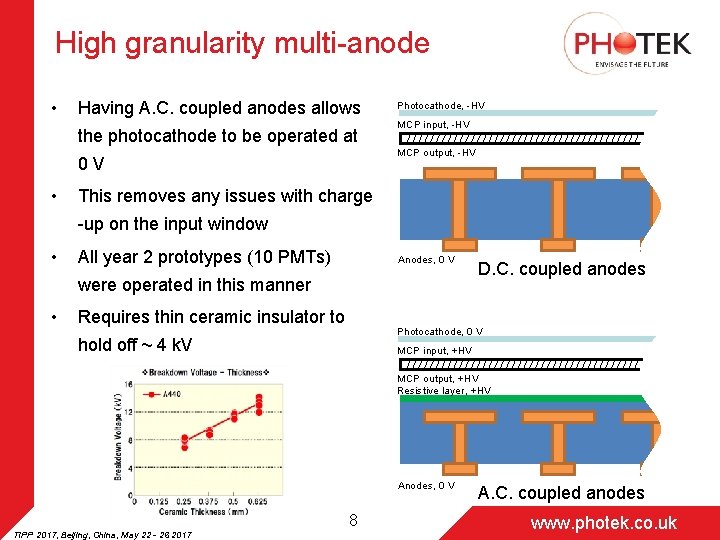
High granularity multi-anode • Having A. C. coupled anodes allows the photocathode to be operated at MCP input, -HV MCP output, -HV 0 V • Photocathode, -HV This removes any issues with charge -up on the input window • All year 2 prototypes (10 PMTs) Anodes, 0 V were operated in this manner • Requires thin ceramic insulator to hold off ~ 4 k. V D. C. coupled anodes Photocathode, 0 V MCP input, +HV MCP output, +HV Resistive layer, +HV Anodes, 0 V 8 TIPP 2017, Beijing, China, May 22 - 26 2017 A. C. coupled anodes www. photek. co. uk
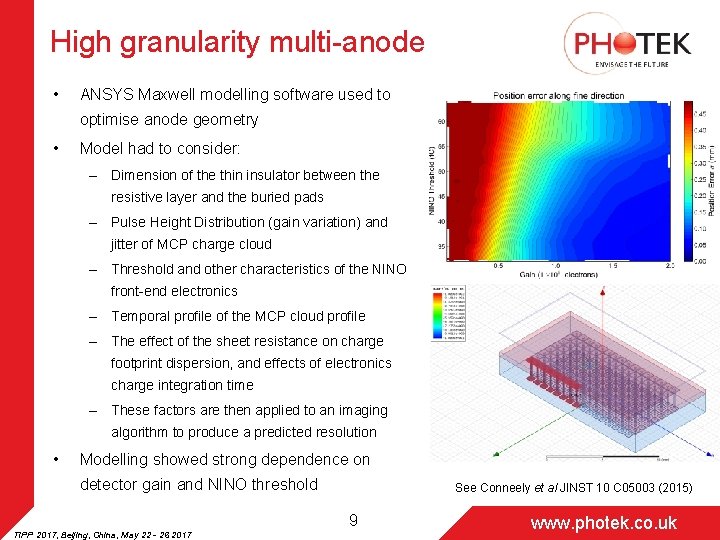
High granularity multi-anode • ANSYS Maxwell modelling software used to optimise anode geometry • Model had to consider: – Dimension of the thin insulator between the resistive layer and the buried pads – Pulse Height Distribution (gain variation) and jitter of MCP charge cloud – Threshold and other characteristics of the NINO front-end electronics – Temporal profile of the MCP cloud profile – The effect of the sheet resistance on charge footprint dispersion, and effects of electronics charge integration time – These factors are then applied to an imaging algorithm to produce a predicted resolution • Modelling showed strong dependence on detector gain and NINO threshold See Conneely et al JINST 10 C 05003 (2015) 9 TIPP 2017, Beijing, China, May 22 - 26 2017 www. photek. co. uk
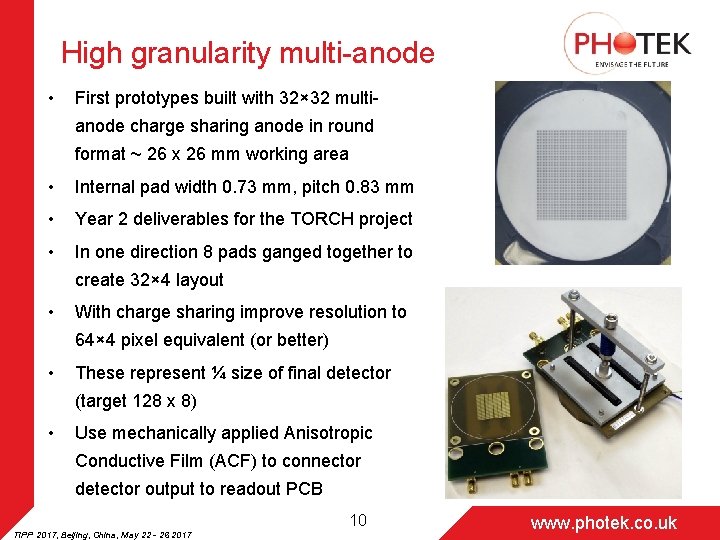
High granularity multi-anode • First prototypes built with 32× 32 multianode charge sharing anode in round format ~ 26 x 26 mm working area • Internal pad width 0. 73 mm, pitch 0. 83 mm • Year 2 deliverables for the TORCH project • In one direction 8 pads ganged together to create 32× 4 layout • With charge sharing improve resolution to 64× 4 pixel equivalent (or better) • These represent ¼ size of final detector (target 128 x 8) • Use mechanically applied Anisotropic Conductive Film (ACF) to connector detector output to readout PCB 10 TIPP 2017, Beijing, China, May 22 - 26 2017 www. photek. co. uk
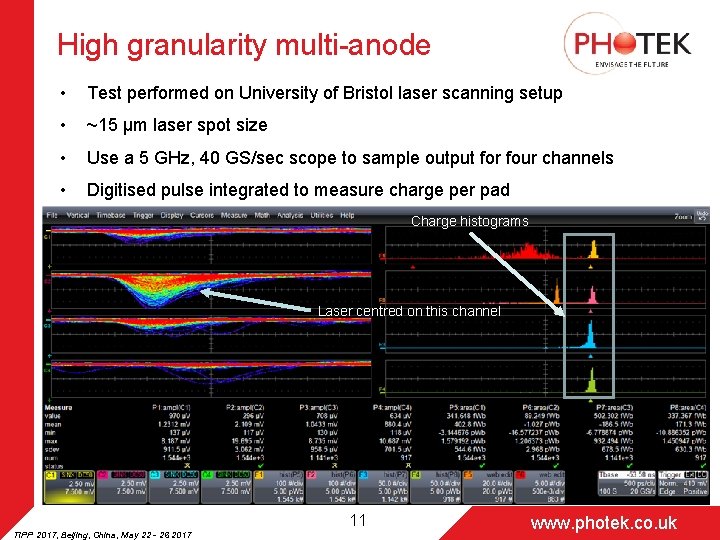
High granularity multi-anode • Test performed on University of Bristol laser scanning setup • ~15 µm laser spot size • Use a 5 GHz, 40 GS/sec scope to sample output for four channels • Digitised pulse integrated to measure charge per pad Charge histograms Laser centred on this channel 11 TIPP 2017, Beijing, China, May 22 - 26 2017 www. photek. co. uk
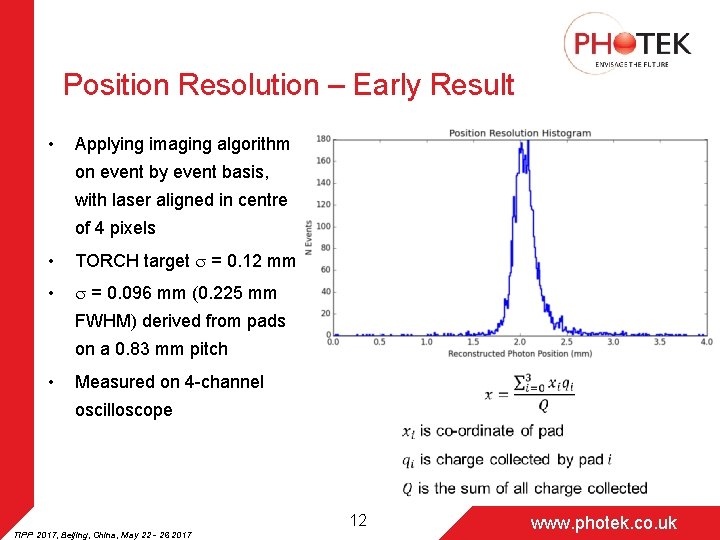
Position Resolution – Early Result • Applying imaging algorithm on event by event basis, with laser aligned in centre of 4 pixels • TORCH target = 0. 12 mm • = 0. 096 mm (0. 225 mm FWHM) derived from pads on a 0. 83 mm pitch • Measured on 4 -channel oscilloscope 12 TIPP 2017, Beijing, China, May 22 - 26 2017 www. photek. co. uk
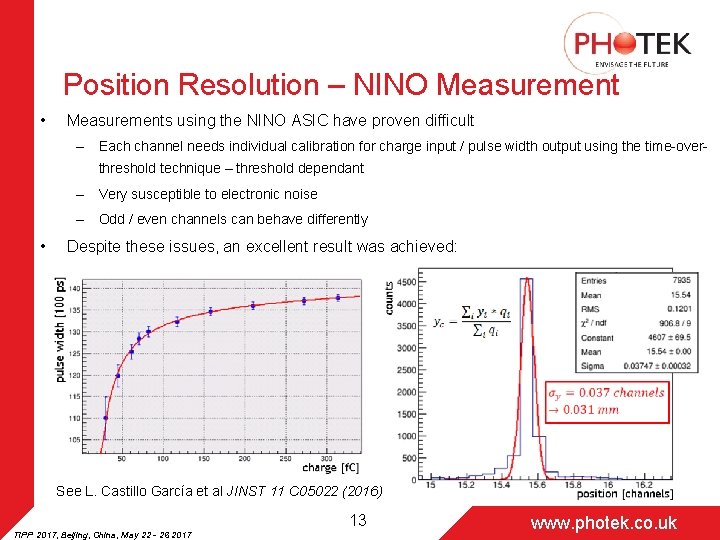
Position Resolution – NINO Measurement • Measurements using the NINO ASIC have proven difficult – Each channel needs individual calibration for charge input / pulse width output using the time-overthreshold technique – threshold dependant – Very susceptible to electronic noise – Odd / even channels can behave differently • Despite these issues, an excellent result was achieved: See L. Castillo García et al JINST 11 C 05022 (2016) 13 TIPP 2017, Beijing, China, May 22 - 26 2017 www. photek. co. uk
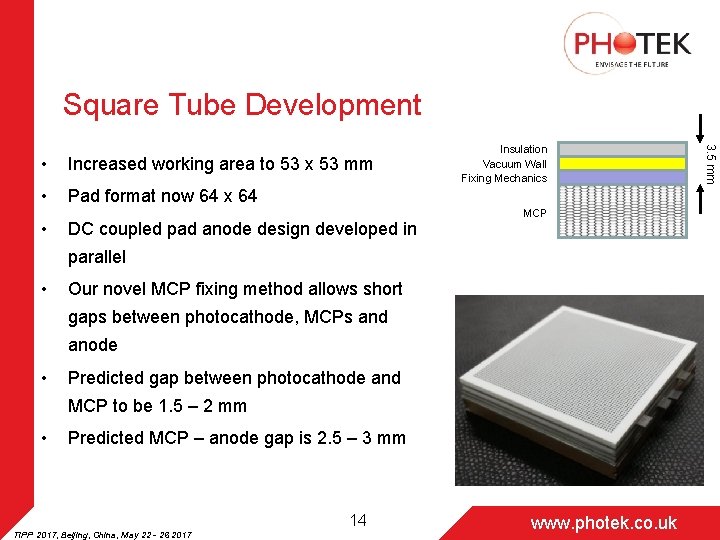
Square Tube Development Increased working area to 53 x 53 mm • Pad format now 64 x 64 • DC coupled pad anode design developed in MCP parallel • Our novel MCP fixing method allows short gaps between photocathode, MCPs and anode • Predicted gap between photocathode and MCP to be 1. 5 – 2 mm • Predicted MCP – anode gap is 2. 5 – 3 mm 14 TIPP 2017, Beijing, China, May 22 - 26 2017 www. photek. co. uk 3. 5 mm • Insulation Vacuum Wall Fixing Mechanics
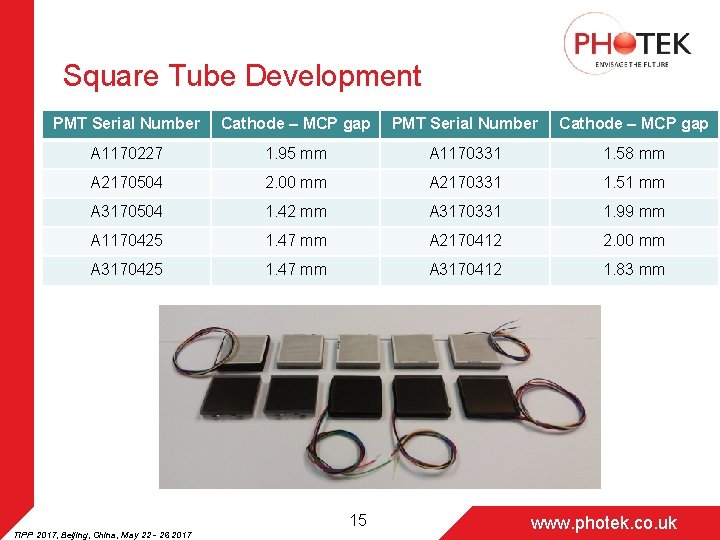
Square Tube Development PMT Serial Number Cathode – MCP gap A 1170227 1. 95 mm A 1170331 1. 58 mm A 2170504 2. 00 mm A 2170331 1. 51 mm A 3170504 1. 42 mm A 3170331 1. 99 mm A 1170425 1. 47 mm A 2170412 2. 00 mm A 3170425 1. 47 mm A 3170412 1. 83 mm 15 TIPP 2017, Beijing, China, May 22 - 26 2017 www. photek. co. uk
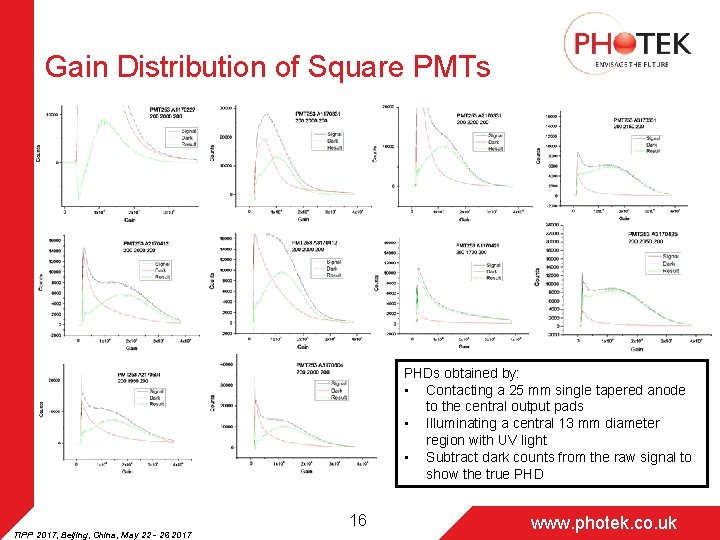
Gain Distribution of Square PMTs PHDs obtained by: • Contacting a 25 mm single tapered anode to the central output pads • Illuminating a central 13 mm diameter region with UV light • Subtract dark counts from the raw signal to show the true PHD 16 TIPP 2017, Beijing, China, May 22 - 26 2017 www. photek. co. uk
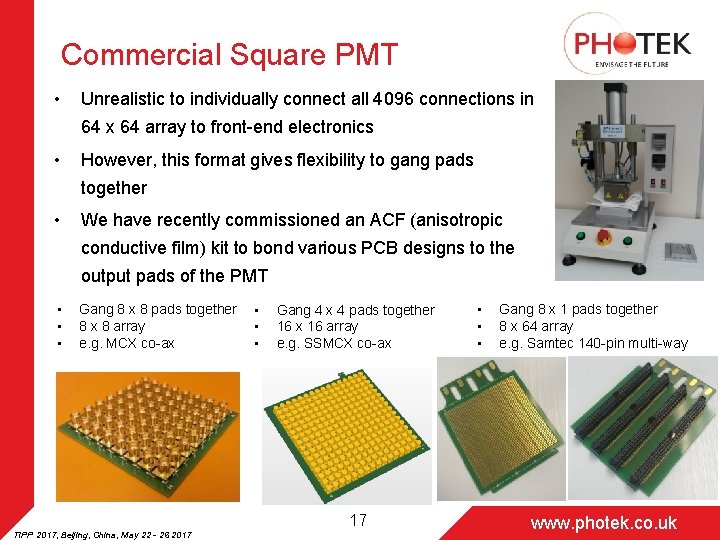
Commercial Square PMT • Unrealistic to individually connect all 4096 connections in 64 x 64 array to front-end electronics • However, this format gives flexibility to gang pads together • We have recently commissioned an ACF (anisotropic conductive film) kit to bond various PCB designs to the output pads of the PMT • • • Gang 8 x 8 pads together 8 x 8 array e. g. MCX co-ax • • • Gang 4 x 4 pads together 16 x 16 array e. g. SSMCX co-ax 17 TIPP 2017, Beijing, China, May 22 - 26 2017 • • • Gang 8 x 1 pads together 8 x 64 array e. g. Samtec 140 -pin multi-way www. photek. co. uk
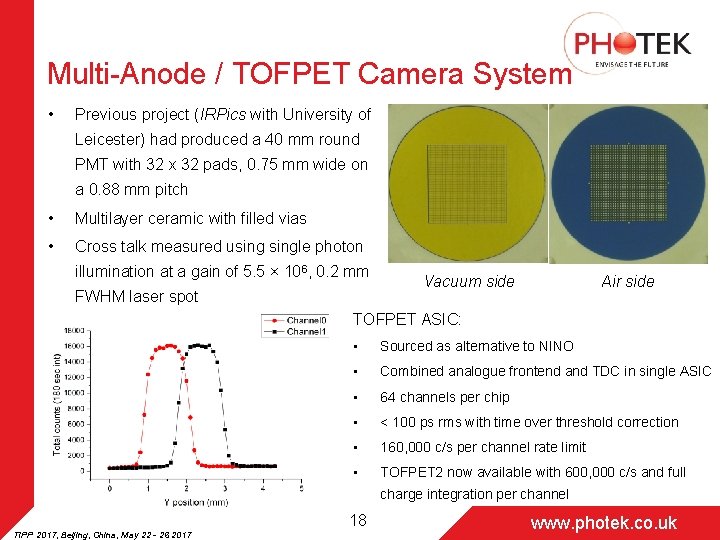
Multi-Anode / TOFPET Camera System • Previous project (IRPics with University of Leicester) had produced a 40 mm round PMT with 32 x 32 pads, 0. 75 mm wide on a 0. 88 mm pitch • Multilayer ceramic with filled vias • Cross talk measured usingle photon illumination at a gain of 5. 5 × 10⁶, 0. 2 mm FWHM laser spot Air side Vacuum side TOFPET ASIC: • Sourced as alternative to NINO • Combined analogue frontend and TDC in single ASIC • 64 channels per chip • < 100 ps rms with time over threshold correction • 160, 000 c/s per channel rate limit • TOFPET 2 now available with 600, 000 c/s and full charge integration per channel 18 TIPP 2017, Beijing, China, May 22 - 26 2017 www. photek. co. uk
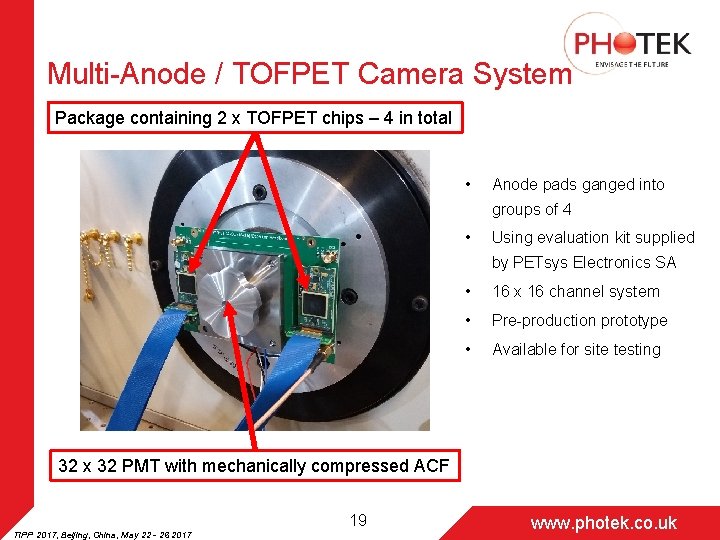
Multi-Anode / TOFPET Camera System Package containing 2 x TOFPET chips – 4 in total • Anode pads ganged into groups of 4 • Using evaluation kit supplied by PETsys Electronics SA • 16 x 16 channel system • Pre-production prototype • Available for site testing 32 x 32 PMT with mechanically compressed ACF 19 TIPP 2017, Beijing, China, May 22 - 26 2017 www. photek. co. uk
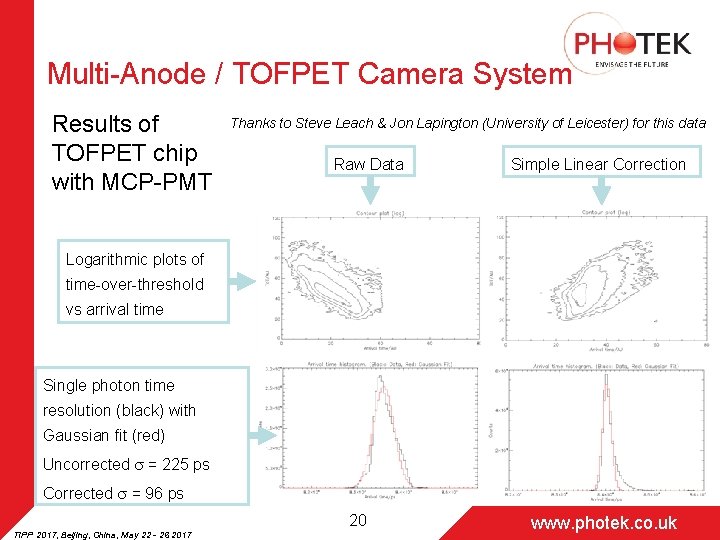
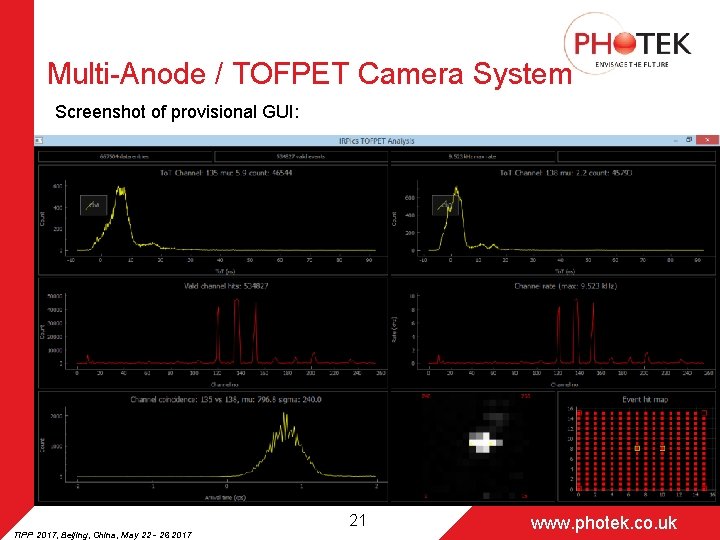
Multi-Anode / TOFPET Camera System Results of TOFPET chip with MCP-PMT Thanks to Steve Leach & Jon Lapington (University of Leicester) for this data Raw Data Simple Linear Correction Logarithmic plots of time-over-threshold vs arrival time Single photon time resolution (black) with Gaussian fit (red) Uncorrected = 225 ps Corrected = 96 ps 20 TIPP 2017, Beijing, China, May 22 - 26 2017 www. photek. co. uk
Multi-Anode / TOFPET Camera System Screenshot of provisional GUI: 21 TIPP 2017, Beijing, China, May 22 - 26 2017 www. photek. co. uk
Summary • TORCH PMT developed at Photek • Currently packaging final ten PMTs for delivery to CERN – Long lifetime – 64 x 64 multi-anode readout – < 0. 1 mm achieved in fine pitch direction through charge sharing algorithm and patented A. C. coupled anode design – Square format dimension targets achieved – Also produced direct coupled anode version • Multi-Anode / TOFPET prototype camera produced – Current format is 16 x 16, could be expanded – < 100 ps time resolution with To. T correction 22 TIPP 2017, Beijing, China, May 22 - 26 2017 www. photek. co. uk
With thanks to… The members of the TORCH collaboration at the University of Bristol, CERN and the University of Oxford The TORCH project is funded by an ERC Advanced Grant under the Seventh Framework Programme (FP 7), code ERC-2011 -ADG proposal 299175. 23 TIPP 2017, Beijing, China, May 22 - 26 2017 www. photek. co. uk
Thank you for listening 24 TIPP 2017, Beijing, China, May 22 - 26 2017 www. photek. co. uk