
The Tools of Astronomy How astronomers study space
![Wave basics Draw a wave with 4 cycles per second: [ ] Draw a](https://slidetodoc.com/presentation_image_h2/49d8d1bba56c1be9edeb727db926f8e0/image-4.jpg "Wave basics Draw a wave with 4 cycles per second: [ ] Draw a")
- Slides: 11
The Tools of Astronomy How astronomers study space
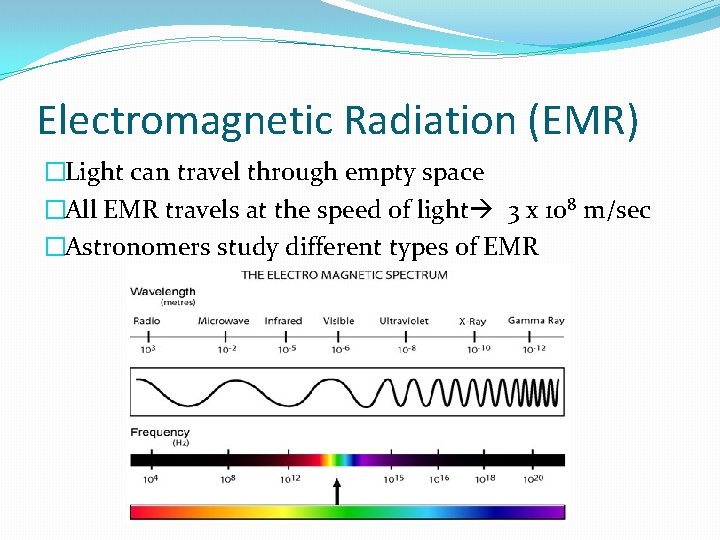
Electromagnetic Radiation (EMR) �Light can travel through empty space �All EMR travels at the speed of light 3 x 10⁸ m/sec �Astronomers study different types of EMR
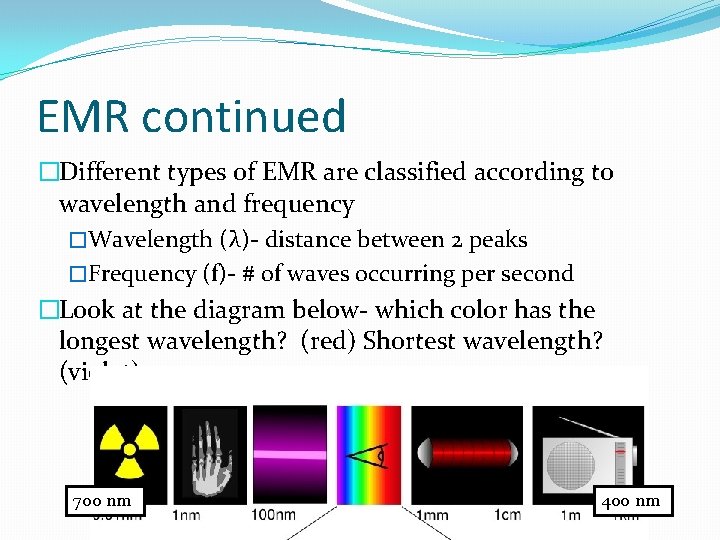
EMR continued �Different types of EMR are classified according to wavelength and frequency �Wavelength (λ)- distance between 2 peaks �Frequency (f)- # of waves occurring per second �Look at the diagram below- which color has the longest wavelength? (red) Shortest wavelength? (violet) 700 nm 400 nm
Wave basics Draw a wave with 4 cycles per second: [ ] Draw a wave with 10 cycles per second: [ ] Which wave has the shorter wavelength? Which wave has the longer wavelength?
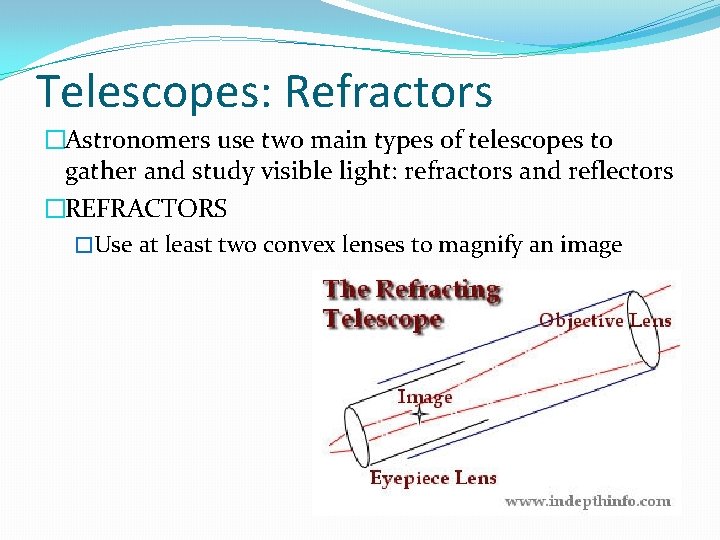
Telescopes: Refractors �Astronomers use two main types of telescopes to gather and study visible light: refractors and reflectors �REFRACTORS �Use at least two convex lenses to magnify an image
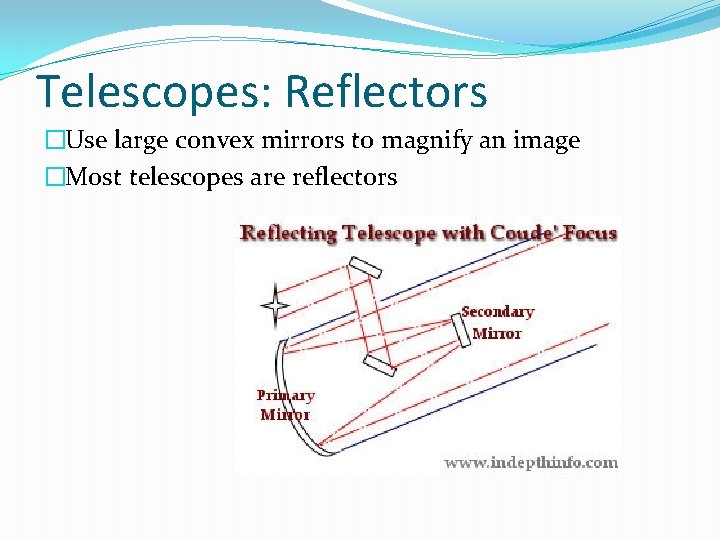
Telescopes: Reflectors �Use large convex mirrors to magnify an image �Most telescopes are reflectors
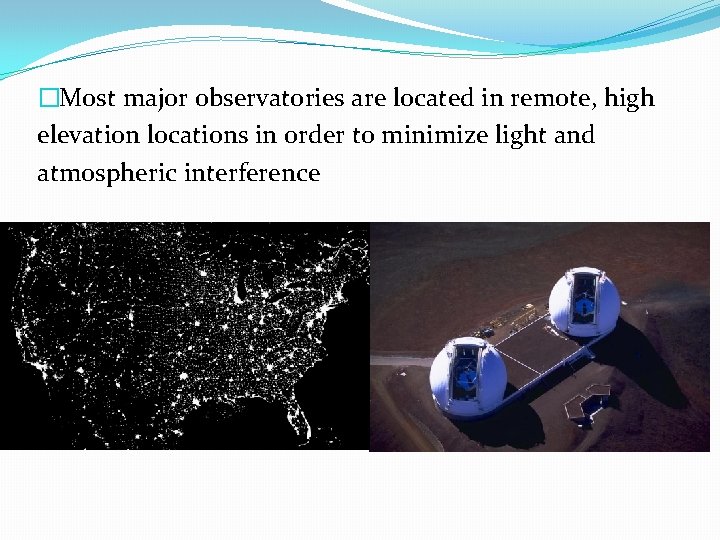
�Most major observatories are located in remote, high elevation locations in order to minimize light and atmospheric interference
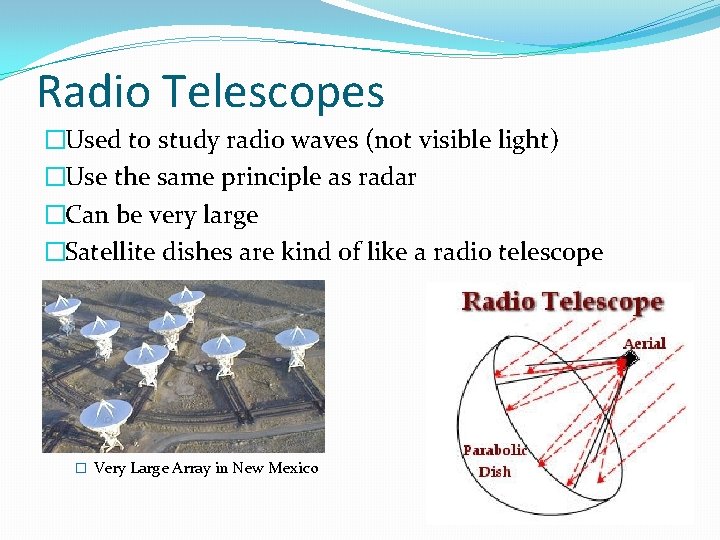
Radio Telescopes �Used to study radio waves (not visible light) �Use the same principle as radar �Can be very large �Satellite dishes are kind of like a radio telescope � Very Large Array in New Mexico
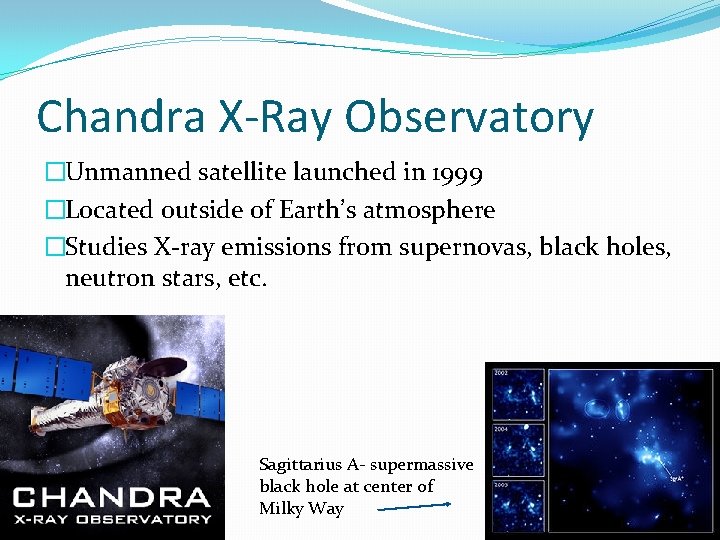
Chandra X-Ray Observatory �Unmanned satellite launched in 1999 �Located outside of Earth’s atmosphere �Studies X-ray emissions from supernovas, black holes, neutron stars, etc. Sagittarius A- supermassive black hole at center of Milky Way
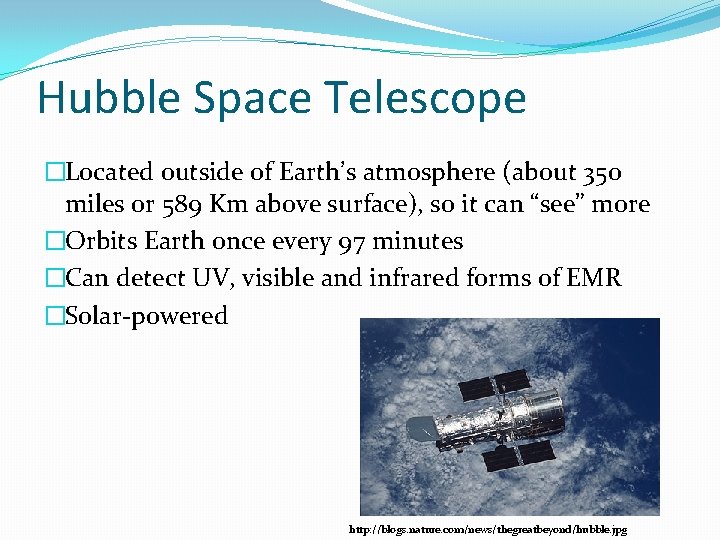
Hubble Space Telescope �Located outside of Earth’s atmosphere (about 350 miles or 589 Km above surface), so it can “see” more �Orbits Earth once every 97 minutes �Can detect UV, visible and infrared forms of EMR �Solar-powered http: //blogs. nature. com/news/thegreatbeyond/hubble. jpg
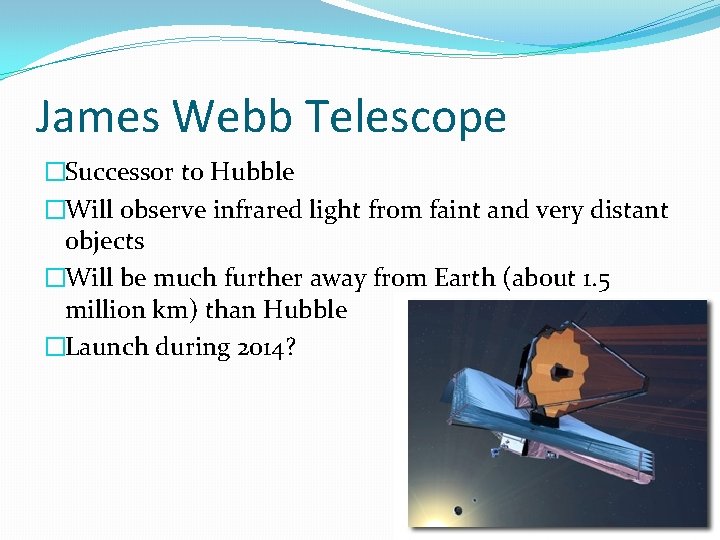
James Webb Telescope �Successor to Hubble �Will observe infrared light from faint and very distant objects �Will be much further away from Earth (about 1. 5 million km) than Hubble �Launch during 2014?