
The Titanic A Royal Mail Ship Rotary Club
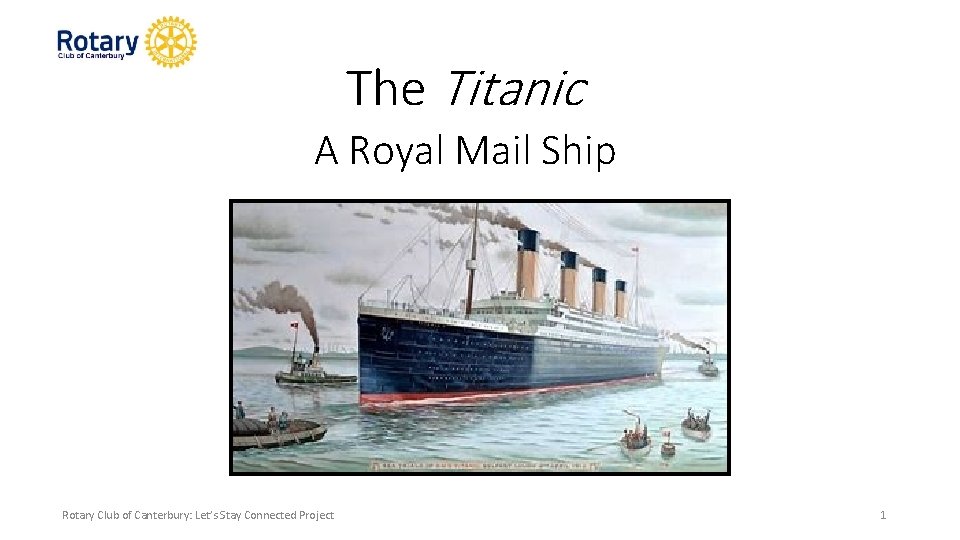
The Titanic A Royal Mail Ship Rotary Club of Canterbury: Let’s Stay Connected Project 1
Hello! My name is Rosemary and I live in Melbourne Victoria, Australia. I am a member of the Rotary Club of Canterbury. I have been lucky to travel to places that were significant to the Titanic. I wrote this book about the Titanic to share my travels with you. I hope you enjoy the story of my Titanic experience as much as I enjoyed writing it. Rosemary Rotary Club of Canterbury: Let’s Stay Connected Project 2
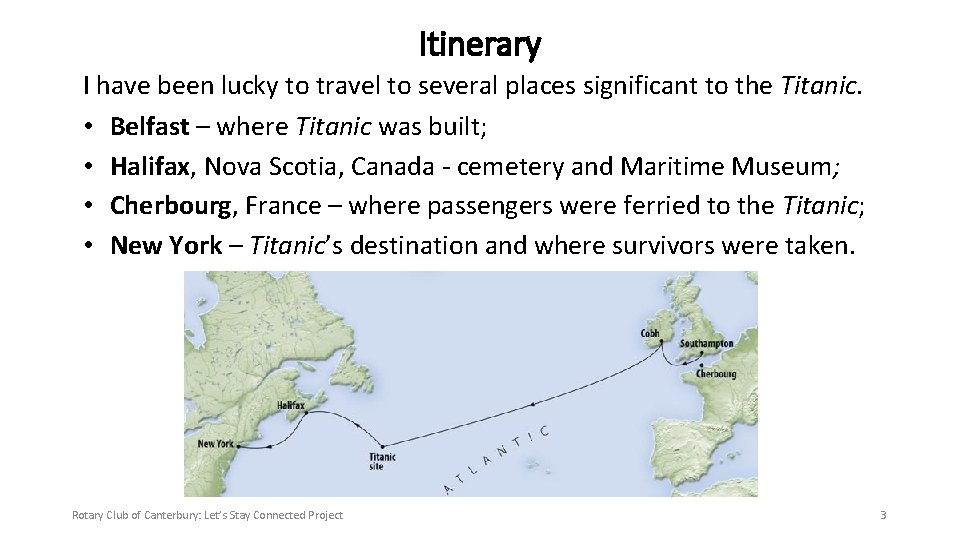
Itinerary I have been lucky to travel to several places significant to the Titanic. • Belfast – where Titanic was built; • Halifax, Nova Scotia, Canada - cemetery and Maritime Museum; • Cherbourg, France – where passengers were ferried to the Titanic; • New York – Titanic’s destination and where survivors were taken. Rotary Club of Canterbury: Let’s Stay Connected Project 3
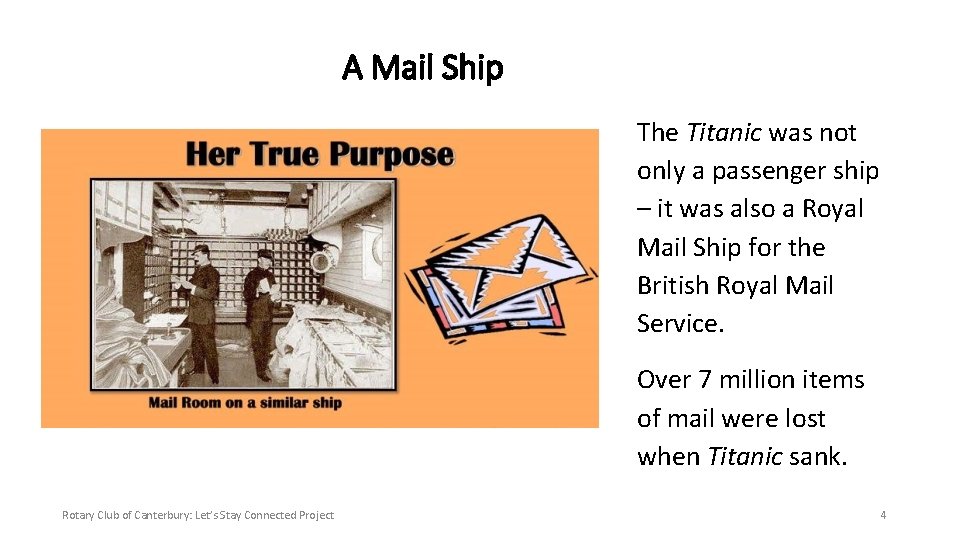
A Mail Ship The Titanic was not only a passenger ship – it was also a Royal Mail Ship for the British Royal Mail Service. Over 7 million items of mail were lost when Titanic sank. Rotary Club of Canterbury: Let’s Stay Connected Project 4
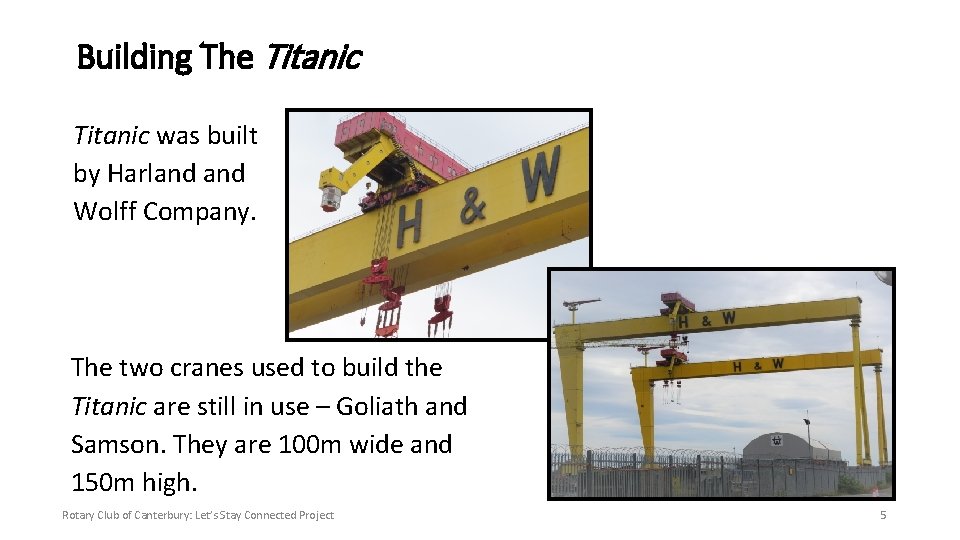
Building The Titanic was built by Harland Wolff Company. The two cranes used to build the Titanic are still in use – Goliath and Samson. They are 100 m wide and 150 m high. Rotary Club of Canterbury: Let’s Stay Connected Project 5
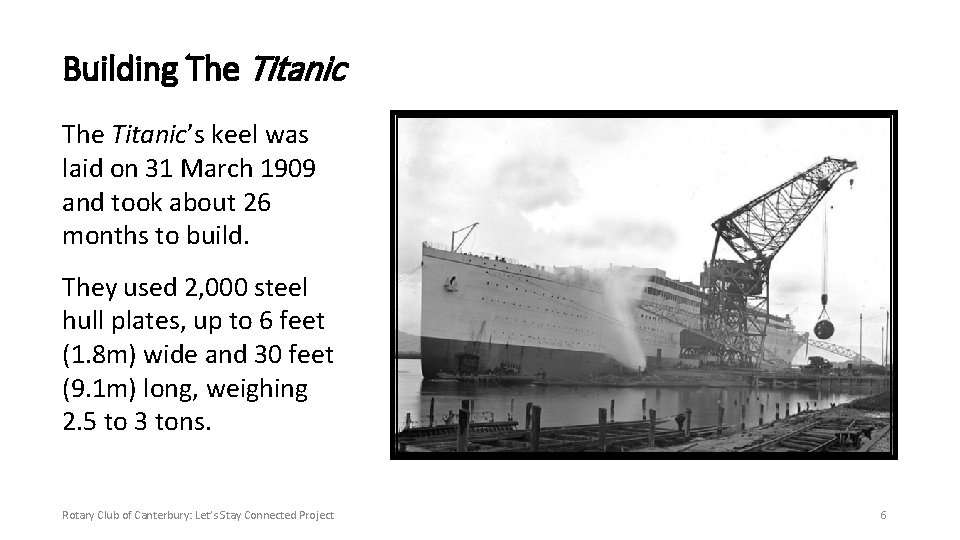
Building The Titanic’s keel was laid on 31 March 1909 and took about 26 months to build. They used 2, 000 steel hull plates, up to 6 feet (1. 8 m) wide and 30 feet (9. 1 m) long, weighing 2. 5 to 3 tons. Rotary Club of Canterbury: Let’s Stay Connected Project 6
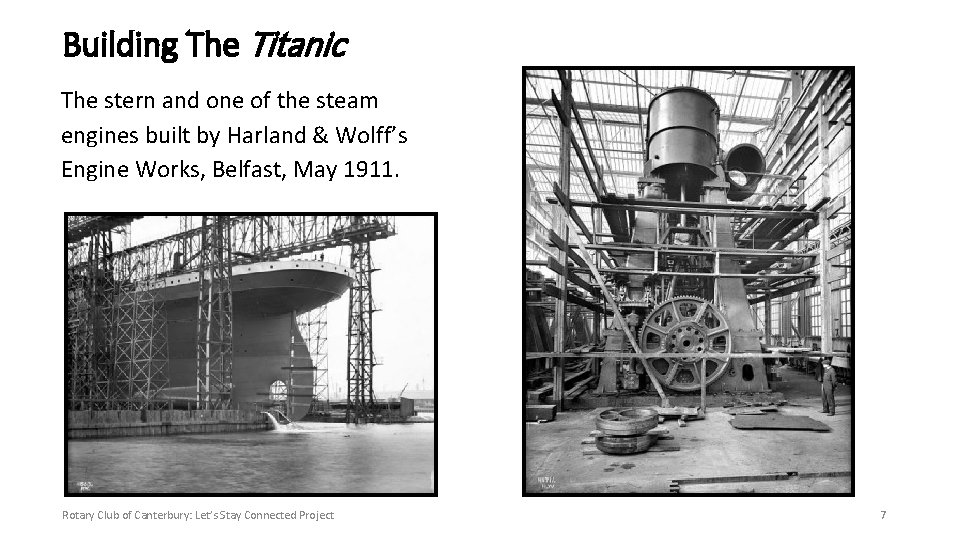
Building The Titanic The stern and one of the steam engines built by Harland & Wolff’s Engine Works, Belfast, May 1911. Rotary Club of Canterbury: Let’s Stay Connected Project 7

Rudder Facts Height of Titanic’s rudder – 78 feet 8 inches (23. 8 m). Weight of rudder – 100 tons Span of central propeller – 17 feet (5. 2 m). Span of each outer propeller – 23 feet 6 inches (7 m). Rotary Club of Canterbury: Let’s Stay Connected Project 8
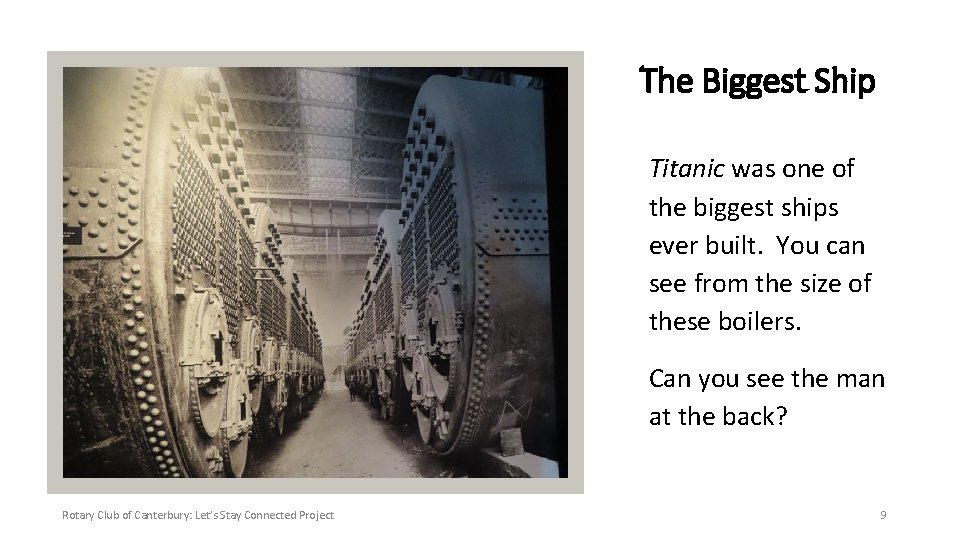
The Biggest Ship Titanic was one of the biggest ships ever built. You can see from the size of these boilers. Can you see the man at the back? Rotary Club of Canterbury: Let’s Stay Connected Project 9
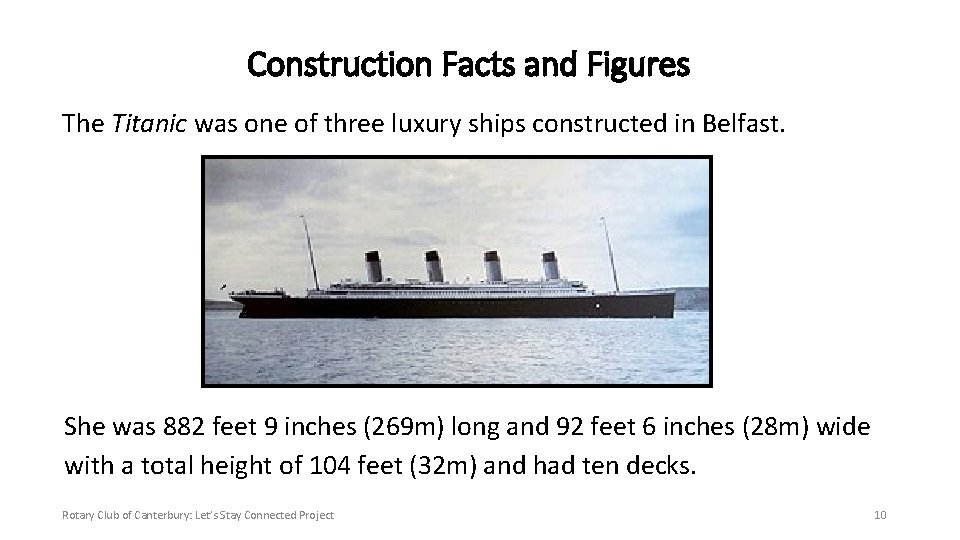
Construction Facts and Figures The Titanic was one of three luxury ships constructed in Belfast. She was 882 feet 9 inches (269 m) long and 92 feet 6 inches (28 m) wide with a total height of 104 feet (32 m) and had ten decks. Rotary Club of Canterbury: Let’s Stay Connected Project 10
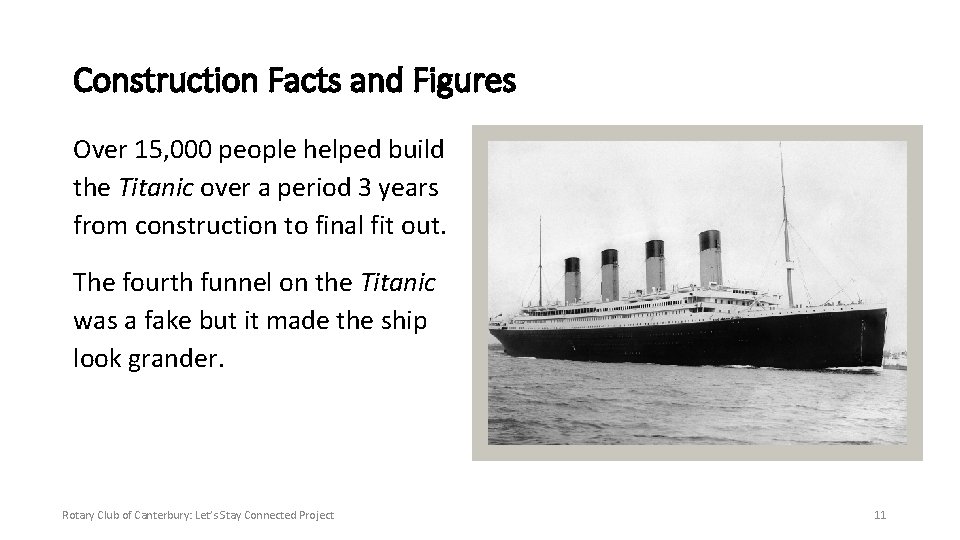
Construction Facts and Figures Over 15, 000 people helped build the Titanic over a period 3 years from construction to final fit out. The fourth funnel on the Titanic was a fake but it made the ship look grander. Rotary Club of Canterbury: Let’s Stay Connected Project 11
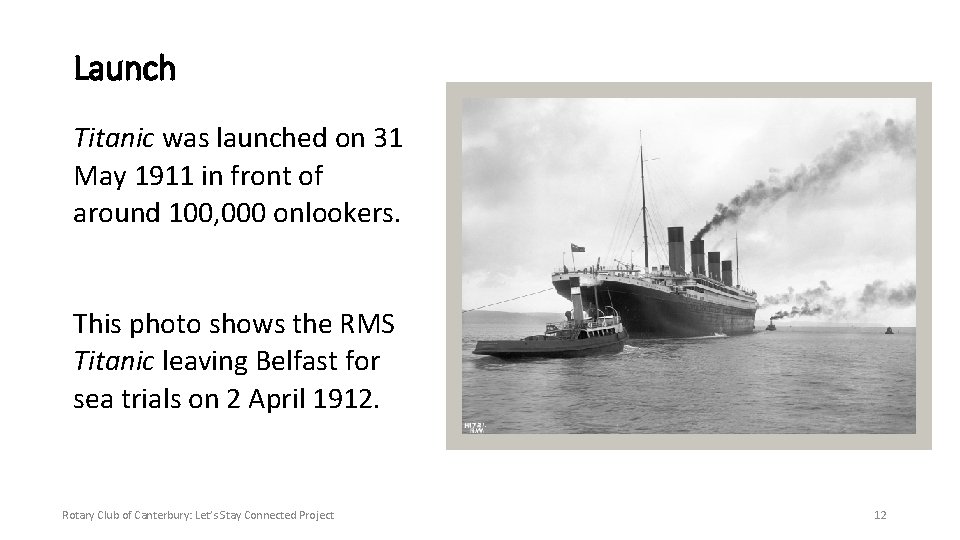
Launch Titanic was launched on 31 May 1911 in front of around 100, 000 onlookers. This photo shows the RMS Titanic leaving Belfast for sea trials on 2 April 1912. Rotary Club of Canterbury: Let’s Stay Connected Project 12
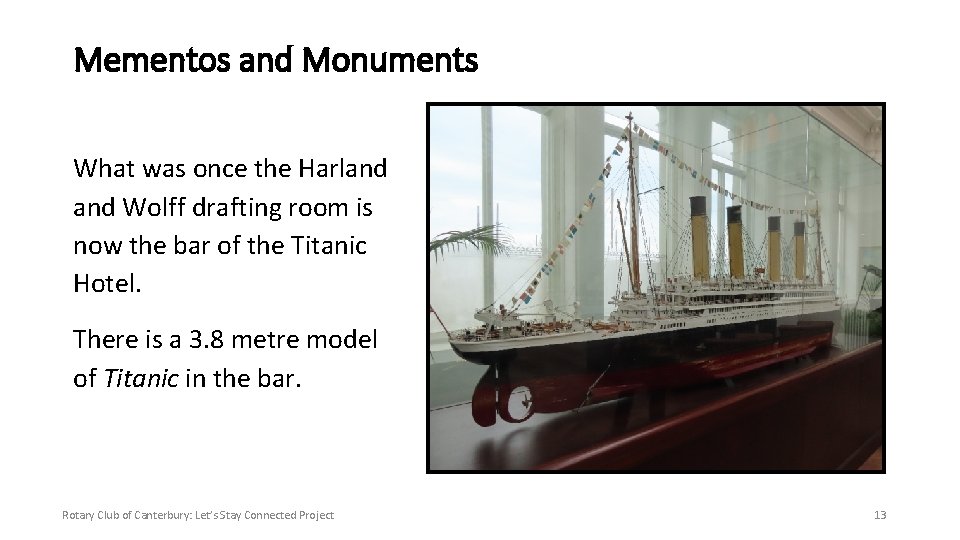
Mementos and Monuments What was once the Harland Wolff drafting room is now the bar of the Titanic Hotel. There is a 3. 8 metre model of Titanic in the bar. Rotary Club of Canterbury: Let’s Stay Connected Project 13
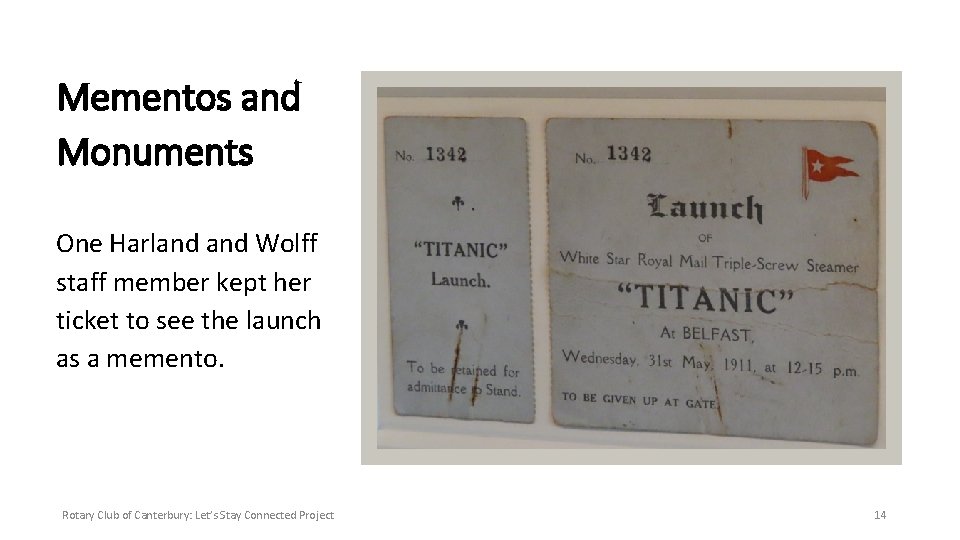
Mementos and Monuments One Harland Wolff staff member kept her ticket to see the launch as a memento. Rotary Club of Canterbury: Let’s Stay Connected Project 14
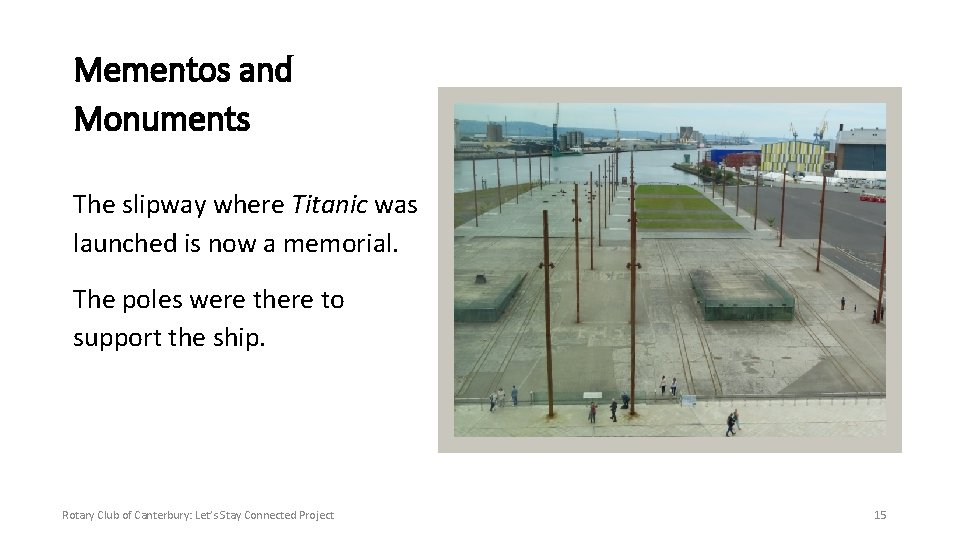
Mementos and Monuments The slipway where Titanic was launched is now a memorial. The poles were there to support the ship. Rotary Club of Canterbury: Let’s Stay Connected Project 15

Facts on the Crew The Titanic had 908 crew members, of whom only 23 were women. The youngest crew members were only 14 years old. First Officer William Murdoch and Captain Edward Smith Rotary Club of Canterbury: Let’s Stay Connected Project 16

Maiden Voyage Titanic left for her maiden voyage on 10 April 1912. She was to go to New York, via Southampton, Cherbourg (France), and Queenstown (Ireland). Rotary Club of Canterbury: Let’s Stay Connected Project 17
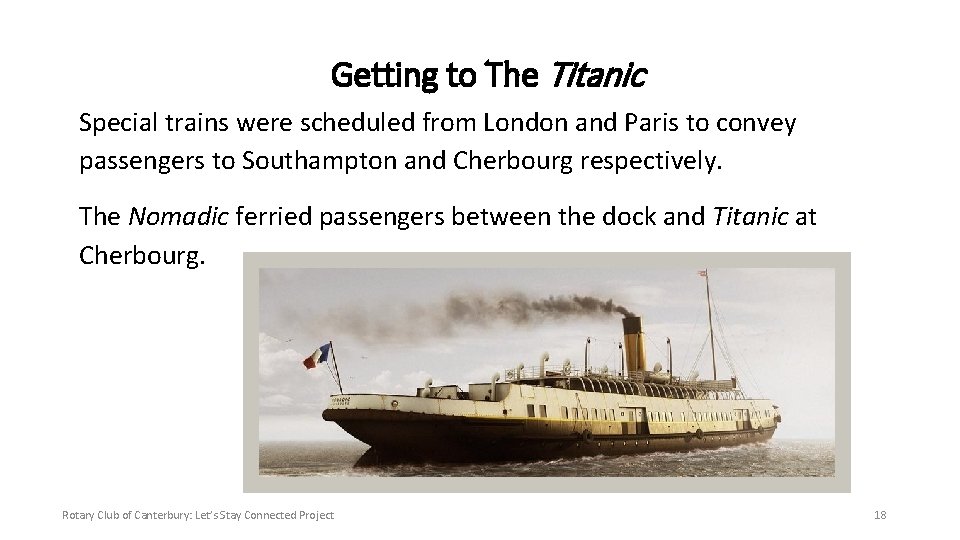
Getting to The Titanic Special trains were scheduled from London and Paris to convey passengers to Southampton and Cherbourg respectively. The Nomadic ferried passengers between the dock and Titanic at Cherbourg. Rotary Club of Canterbury: Let’s Stay Connected Project 18

Passenger Facts When the Titanic left Queenstown, there were 1325 passengers aboard, 112 of whom were children. Rotary Club of Canterbury: Let’s Stay Connected Project 19
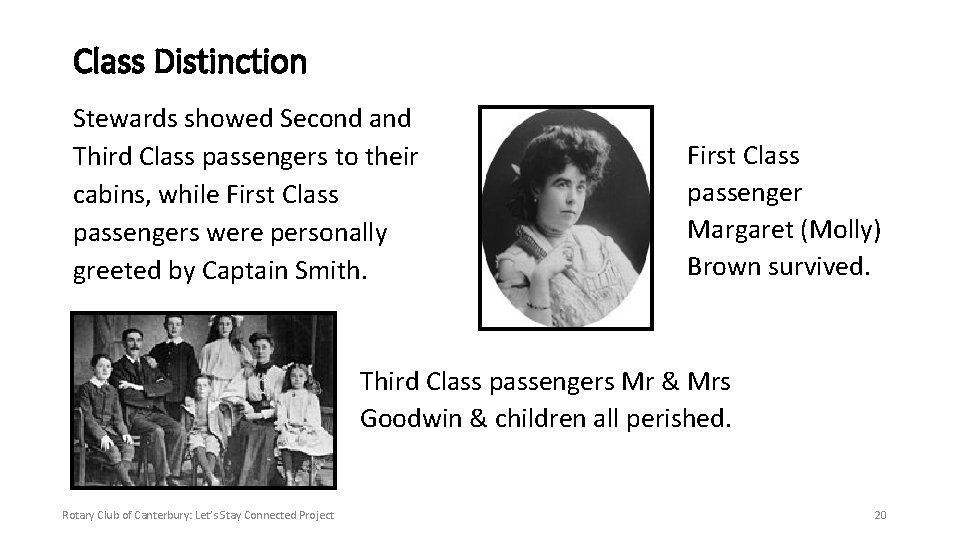
Class Distinction Stewards showed Second and Third Class passengers to their cabins, while First Class passengers were personally greeted by Captain Smith. First Class passenger Margaret (Molly) Brown survived. Third Class passengers Mr & Mrs Goodwin & children all perished. Rotary Club of Canterbury: Let’s Stay Connected Project 20
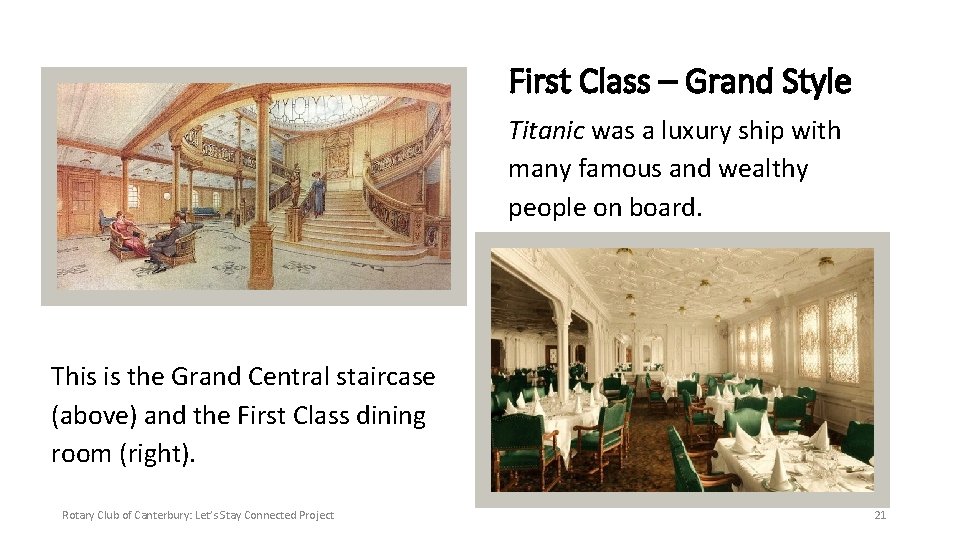
First Class – Grand Style Titanic was a luxury ship with many famous and wealthy people on board. This is the Grand Central staircase (above) and the First Class dining room (right). Rotary Club of Canterbury: Let’s Stay Connected Project 21
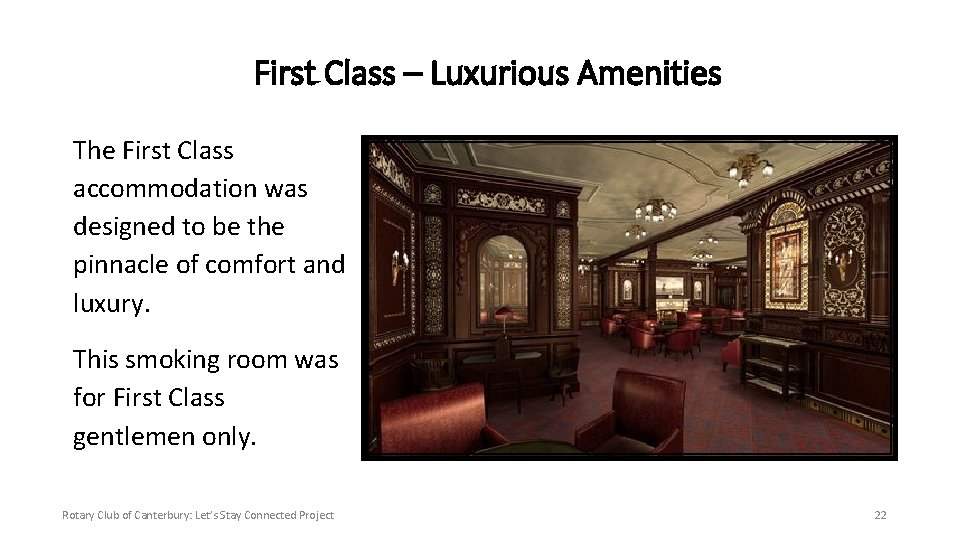
First Class – Luxurious Amenities The First Class accommodation was designed to be the pinnacle of comfort and luxury. This smoking room was for First Class gentlemen only. Rotary Club of Canterbury: Let’s Stay Connected Project 22
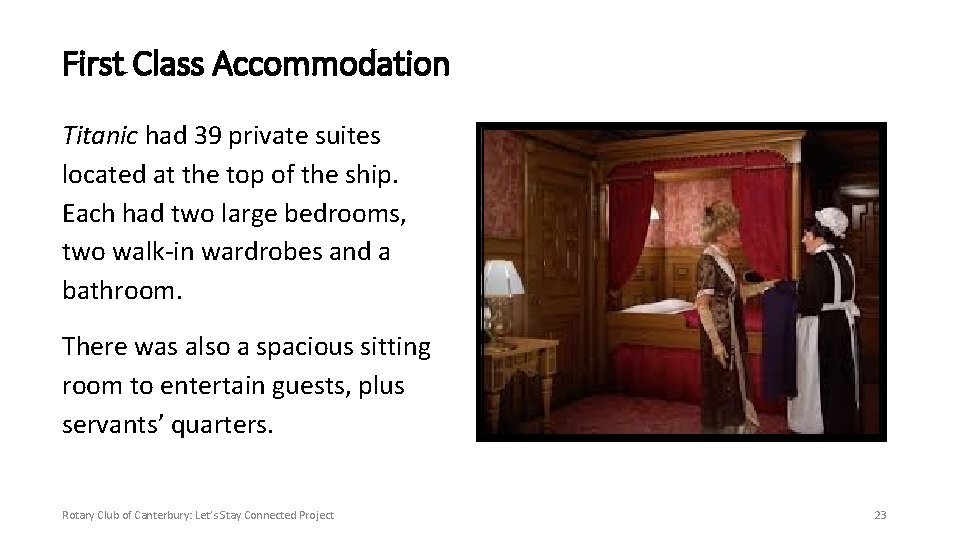
First Class Accommodation Titanic had 39 private suites located at the top of the ship. Each had two large bedrooms, two walk-in wardrobes and a bathroom. There was also a spacious sitting room to entertain guests, plus servants’ quarters. Rotary Club of Canterbury: Let’s Stay Connected Project 23
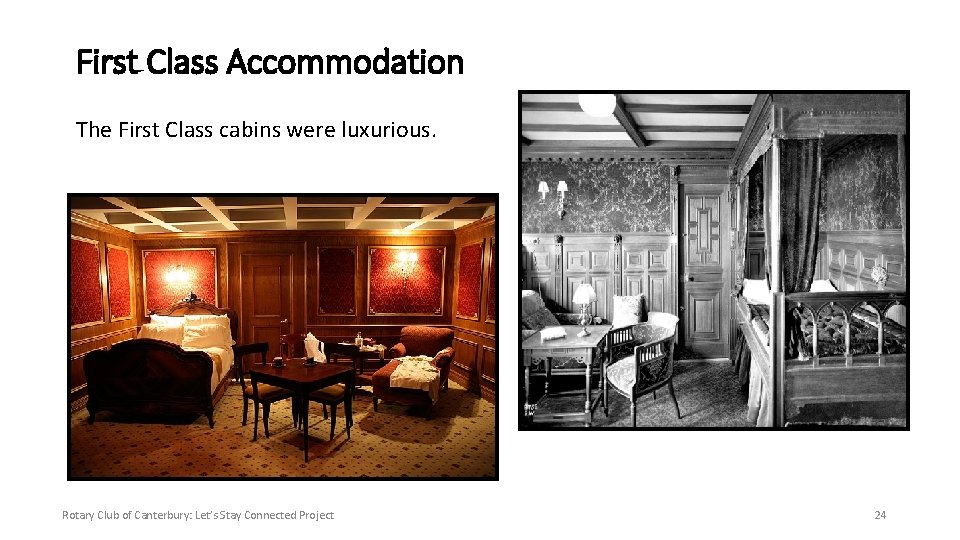
First Class Accommodation The First Class cabins were luxurious. Rotary Club of Canterbury: Let’s Stay Connected Project 24
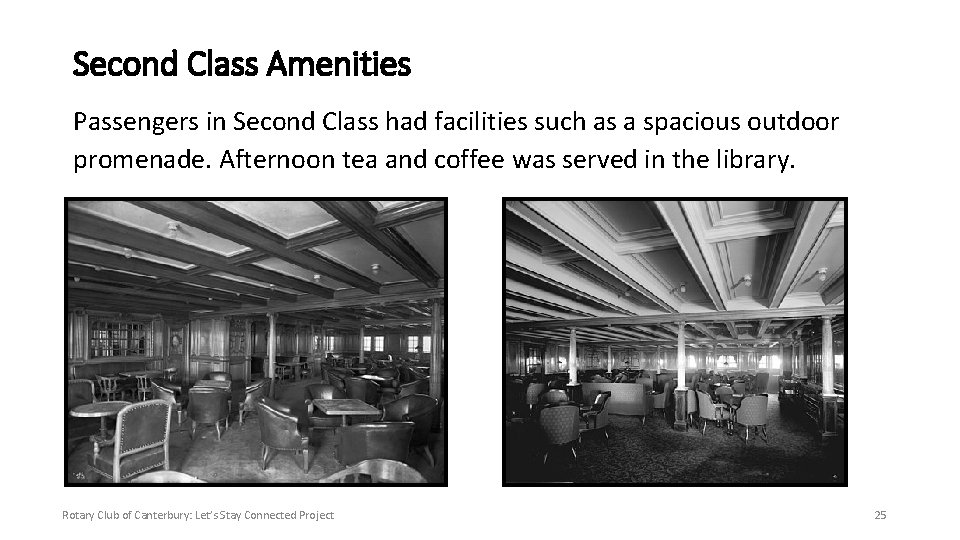
Second Class Amenities Passengers in Second Class had facilities such as a spacious outdoor promenade. Afternoon tea and coffee was served in the library. Rotary Club of Canterbury: Let’s Stay Connected Project 25

Second Class Accommodation Most of the Second Class accommodation on Titanic consisted of cabins with bunk-beds. These cabins had sinks and mirrors and the bed linen was changed every day. Rotary Club of Canterbury: Let’s Stay Connected Project 26
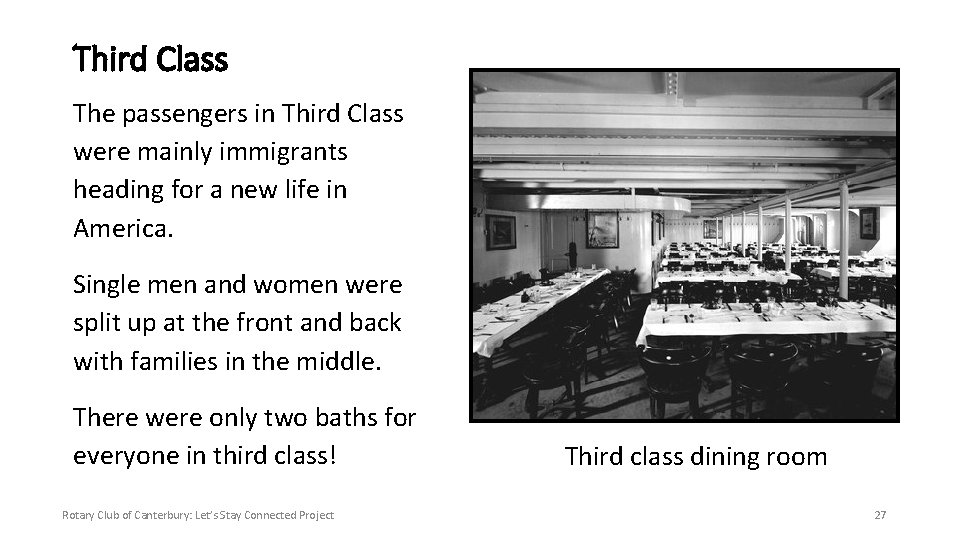
Third Class The passengers in Third Class were mainly immigrants heading for a new life in America. Single men and women were split up at the front and back with families in the middle. There were only two baths for everyone in third class! Rotary Club of Canterbury: Let’s Stay Connected Project Third class dining room 27
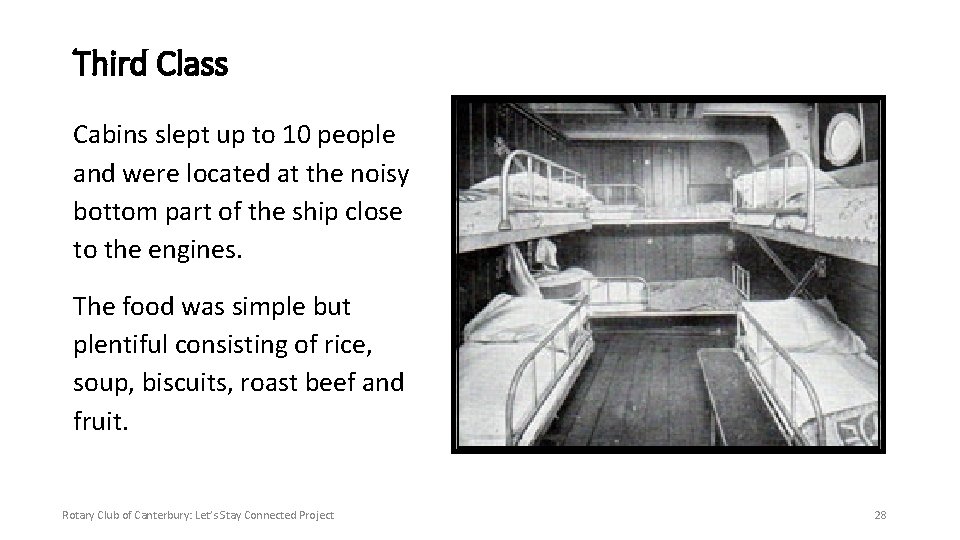
Third Class Cabins slept up to 10 people and were located at the noisy bottom part of the ship close to the engines. The food was simple but plentiful consisting of rice, soup, biscuits, roast beef and fruit. Rotary Club of Canterbury: Let’s Stay Connected Project 28
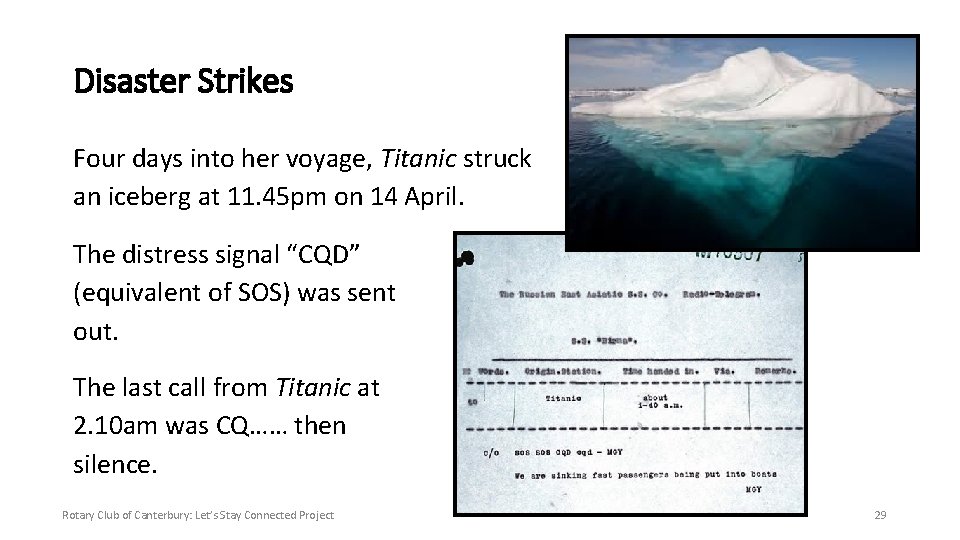
Disaster Strikes Four days into her voyage, Titanic struck an iceberg at 11. 45 pm on 14 April. The distress signal “CQD” (equivalent of SOS) was sent out. The last call from Titanic at 2. 10 am was CQ…… then silence. Rotary Club of Canterbury: Let’s Stay Connected Project 29
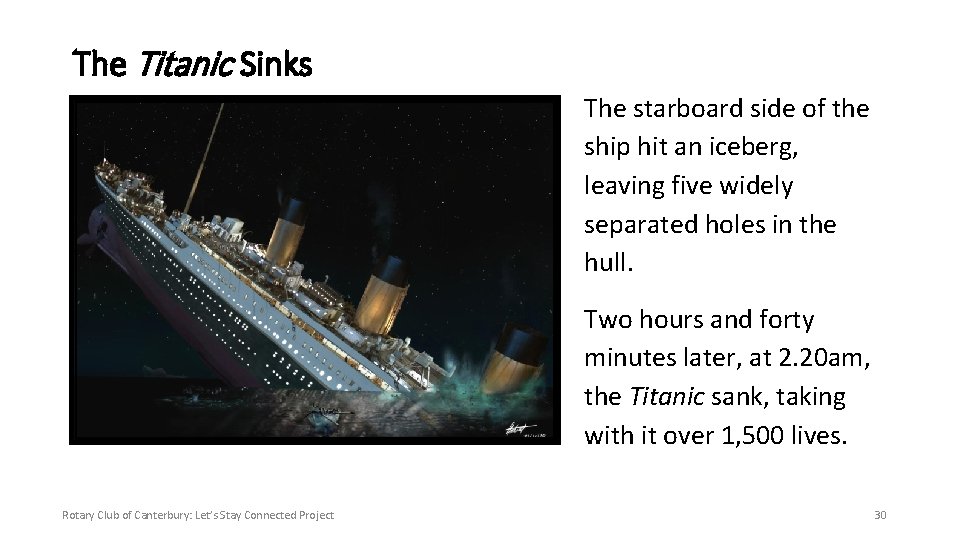
The Titanic Sinks The starboard side of the ship hit an iceberg, leaving five widely separated holes in the hull. Two hours and forty minutes later, at 2. 20 am, the Titanic sank, taking with it over 1, 500 lives. Rotary Club of Canterbury: Let’s Stay Connected Project 30
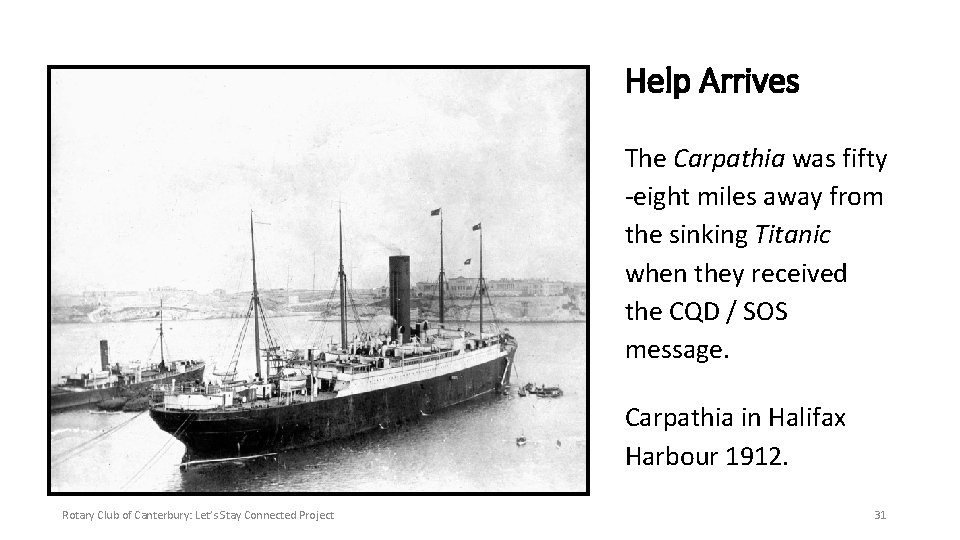
Help Arrives The Carpathia was fifty -eight miles away from the sinking Titanic when they received the CQD / SOS message. Carpathia in Halifax Harbour 1912. Rotary Club of Canterbury: Let’s Stay Connected Project 31
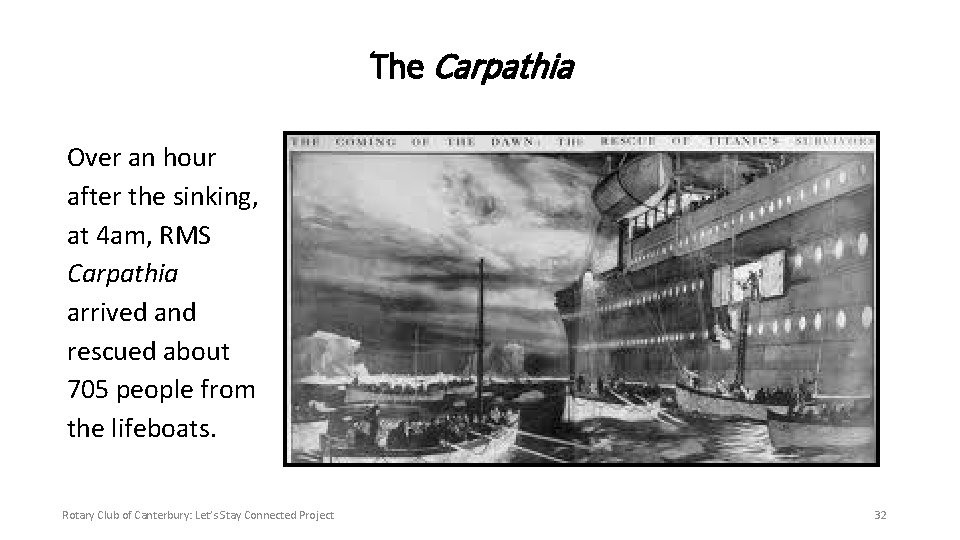
The Carpathia Over an hour after the sinking, at 4 am, RMS Carpathia arrived and rescued about 705 people from the lifeboats. Rotary Club of Canterbury: Let’s Stay Connected Project 32
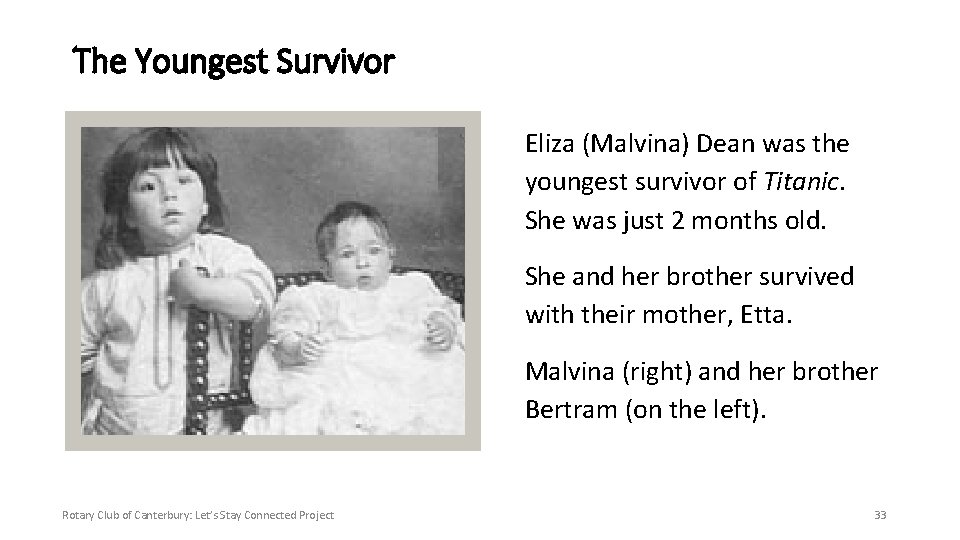
The Youngest Survivor Eliza (Malvina) Dean was the youngest survivor of Titanic. She was just 2 months old. She and her brother survived with their mother, Etta. Malvina (right) and her brother Bertram (on the left). Rotary Club of Canterbury: Let’s Stay Connected Project 33
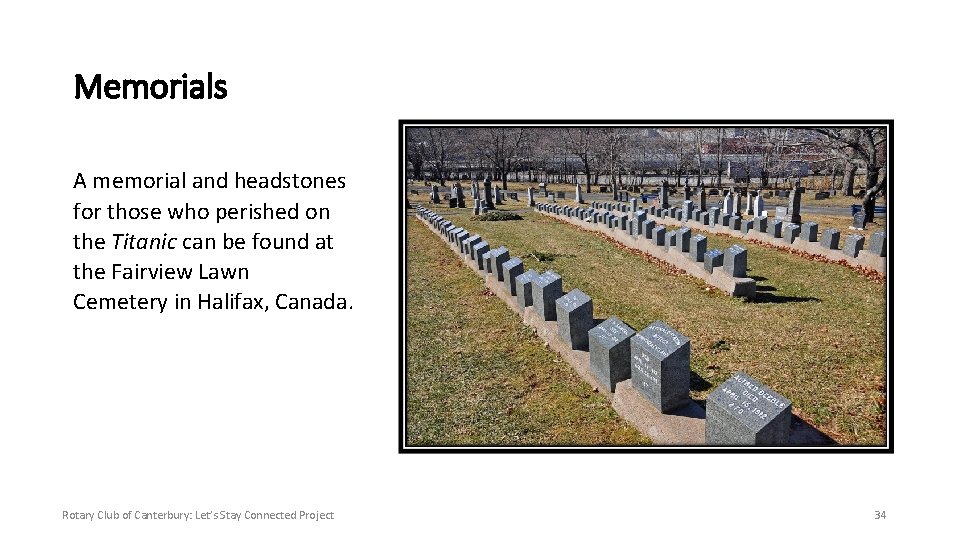
Memorials A memorial and headstones for those who perished on the Titanic can be found at the Fairview Lawn Cemetery in Halifax, Canada. Rotary Club of Canterbury: Let’s Stay Connected Project 34
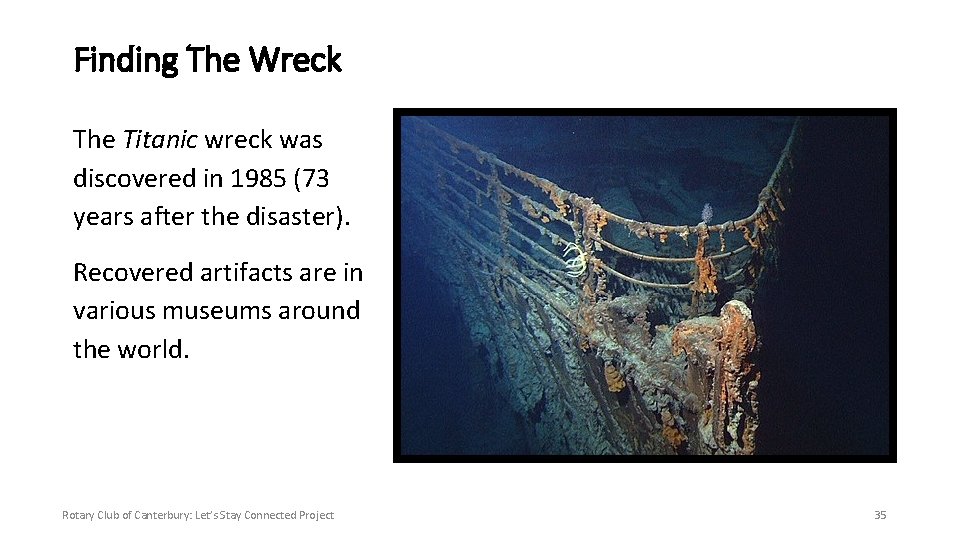
Finding The Wreck The Titanic wreck was discovered in 1985 (73 years after the disaster). Recovered artifacts are in various museums around the world. Rotary Club of Canterbury: Let’s Stay Connected Project 35
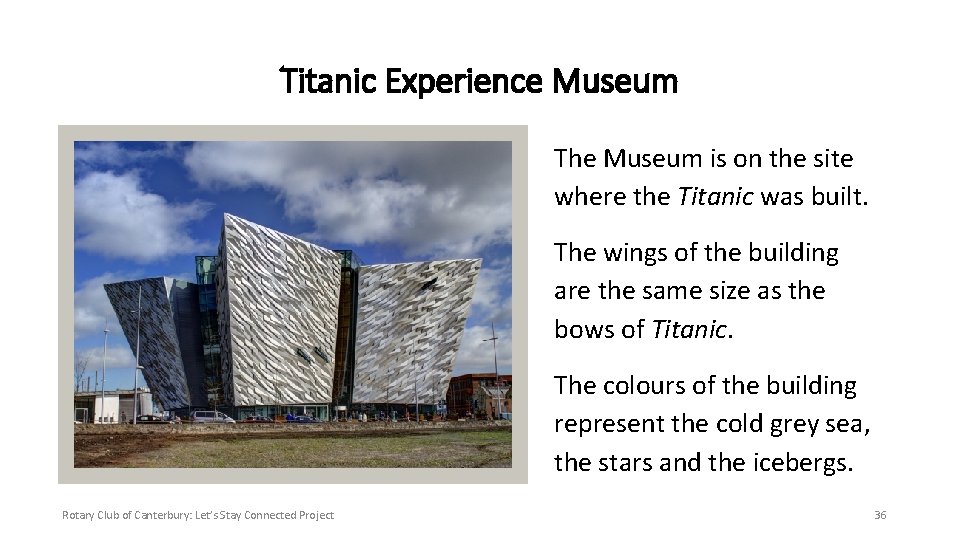
Titanic Experience Museum The Museum is on the site where the Titanic was built. The wings of the building are the same size as the bows of Titanic. The colours of the building represent the cold grey sea, the stars and the icebergs. Rotary Club of Canterbury: Let’s Stay Connected Project 36
I hope you enjoyed my version of the Titanic experience as much as I have in putting it together. Rosemary Waghorne September 2020 Rotary Club of Canterbury: Let’s Stay Connected Project 37
The Rotary Club of Canterbury “Let’s Stay Connected Project” has been developed as a response to an identified need within the Aged Care sector. At times when it’s difficult to connect in person with family and friends, the Rotary Club of Canterbury has pleasure in offering you this booklet, designed to promote conversation, recollection and engagement for those who are in isolation and without their usual social activities. The booklets have been designed for people in an aged care residence, village or at home to read by themselves, or to have a family or staff member share the booklet with them. You can download this and other booklets from the Rotary Club of Canterbury website (www. canterburyrotary. org). Source references for this book are held at the Rotary Club of Canterbury. Contact president@caterburyrotary. org for further details. Material in this book was reproduced in accordance with Section 113 F of the Copyright Act (1968). Rotary Club of Canterbury: Let’s Stay Connected Project 38
- Slides: 38