
The tiling algorithm Learning in feedforward layered networks





- Slides: 29
The tiling algorithm “Learning in feedforward layered networks: the tiling algorithm” writed by Marc Mézard and Jean-Pierre Nadal 1
Outline n Introduction n The tiling algorithm n Simulations n Concluding remarks 2
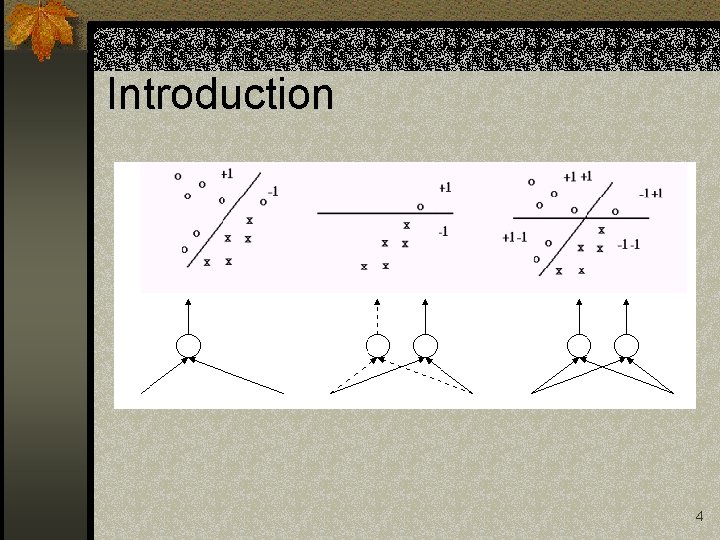
Introduction n The feedforward layered system n The drawbacks of back propagation n The structure of the network has to be guessed. n The error is not guaranteed to converge to an absolute minimum with zero error. n Units are added like tiles whenever they are needed. 3
Introduction 4
The tiling algorithm n Basic notions and notation n Theorem for convergence n Generation the master unit n Building the ancillary units: divide and conquer 5
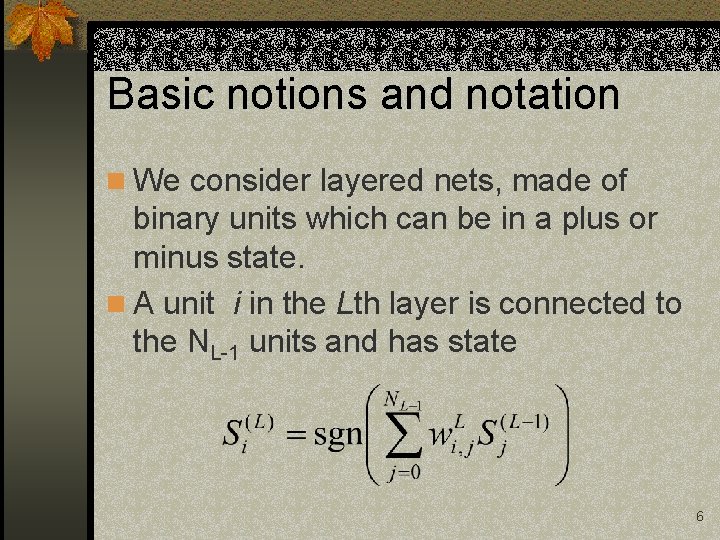
Basic notions and notation n We consider layered nets, made of binary units which can be in a plus or minus state. n A unit i in the Lth layer is connected to the NL-1 units and has state 6
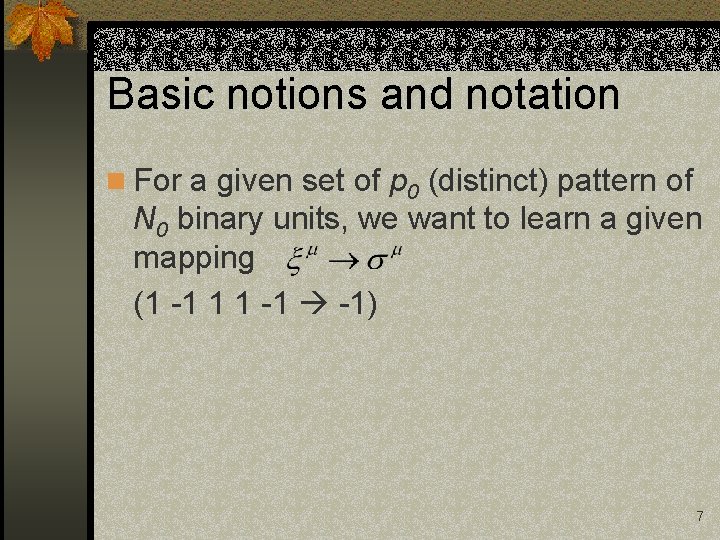
Basic notions and notation n For a given set of p 0 (distinct) pattern of N 0 binary units, we want to learn a given mapping (1 -1 1 1 -1 -1) 7
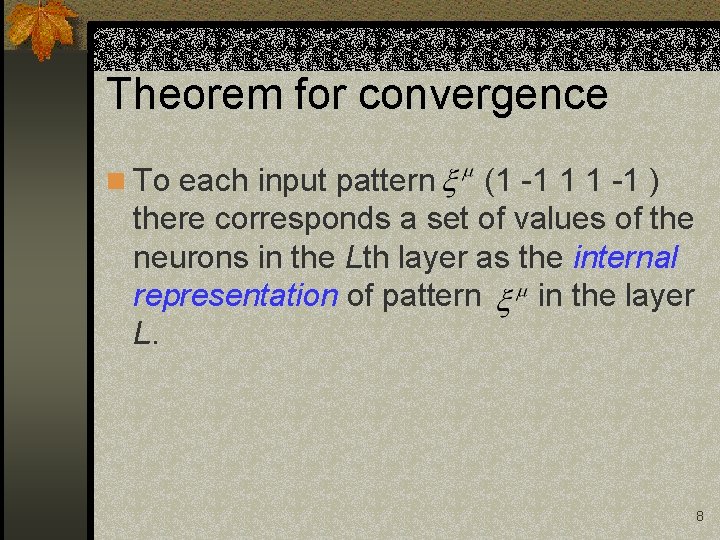
Theorem for convergence n To each input pattern (1 -1 1 1 -1 ) there corresponds a set of values of the neurons in the Lth layer as the internal representation of pattern in the layer L. 8
Theorem for convergence n We say that two patterns belong to the same class (for the layer L) if they have the same internal representation, which we call the prototype of the class. n The problem becomes to map these prototypes onto the desired output. 9
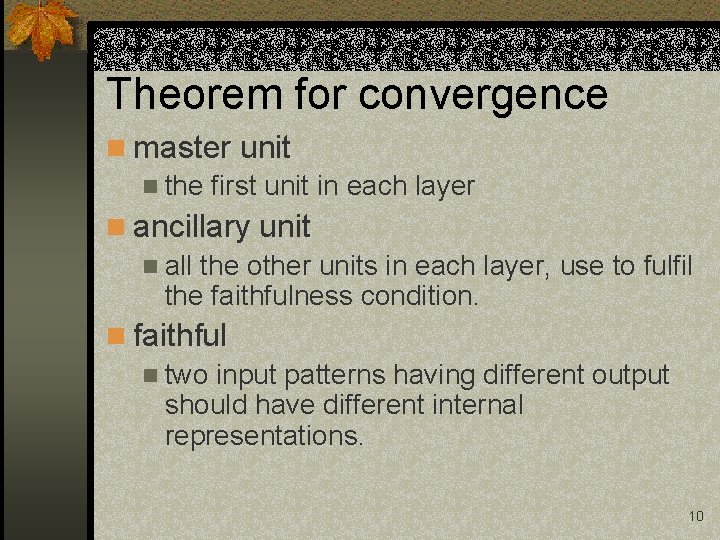
Theorem for convergence n master unit n the first unit in each layer n ancillary unit n all the other units in each layer, use to fulfil the faithfulness condition. n faithful n two input patterns having different output should have different internal representations. 10
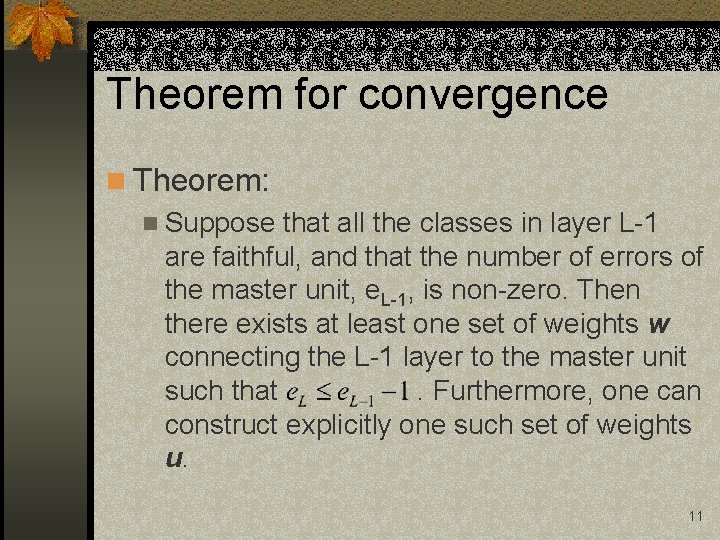
Theorem for convergence n Theorem: n Suppose that all the classes in layer L-1 are faithful, and that the number of errors of the master unit, e. L-1, is non-zero. Then there exists at least one set of weights w connecting the L-1 layer to the master unit such that. Furthermore, one can construct explicitly one such set of weights u. 11
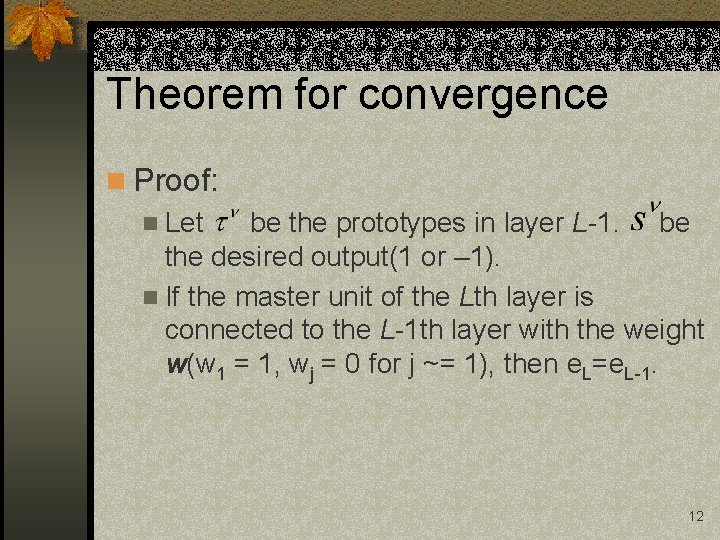
Theorem for convergence n Proof: n Let be the prototypes in layer L-1. be the desired output(1 or – 1). n If the master unit of the Lth layer is connected to the L-1 th layer with the weight w(w 1 = 1, wj = 0 for j ~= 1), then e. L=e. L-1. 12
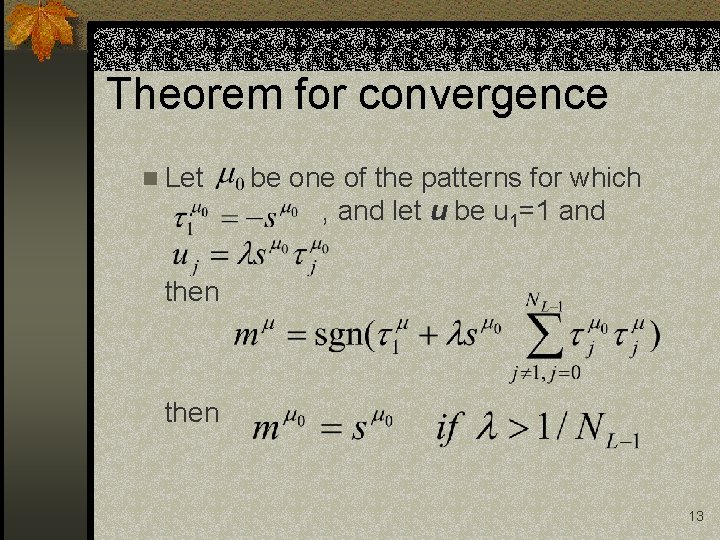
Theorem for convergence n Let be one of the patterns for which , and let u be u 1=1 and then 13
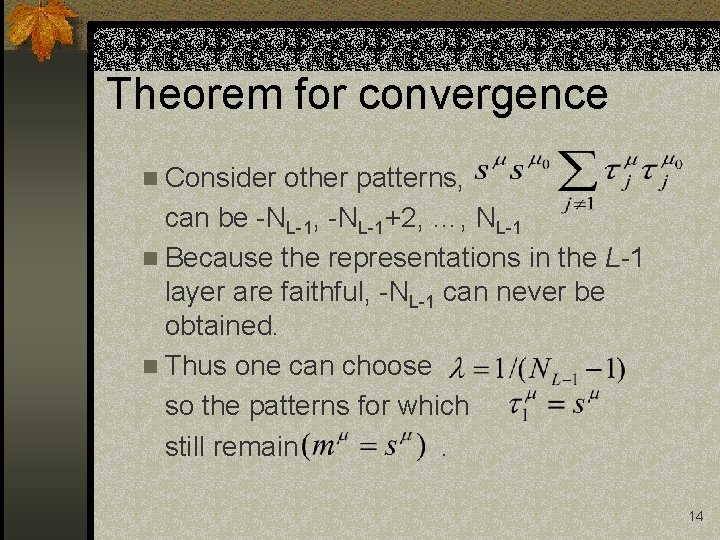
Theorem for convergence n Consider other patterns, can be -NL-1, -NL-1+2, …, NL-1 n Because the representations in the L-1 layer are faithful, -NL-1 can never be obtained. n Thus one can choose so the patterns for which still remain. 14
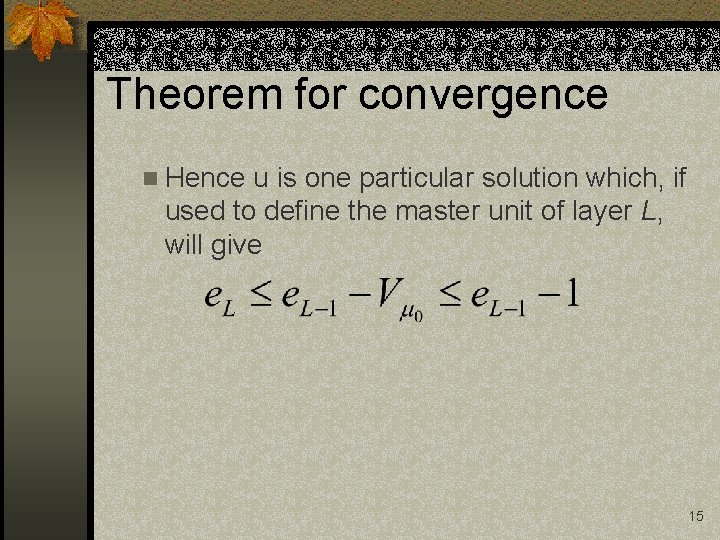
Theorem for convergence n Hence u is one particular solution which, if used to define the master unit of layer L, will give 15
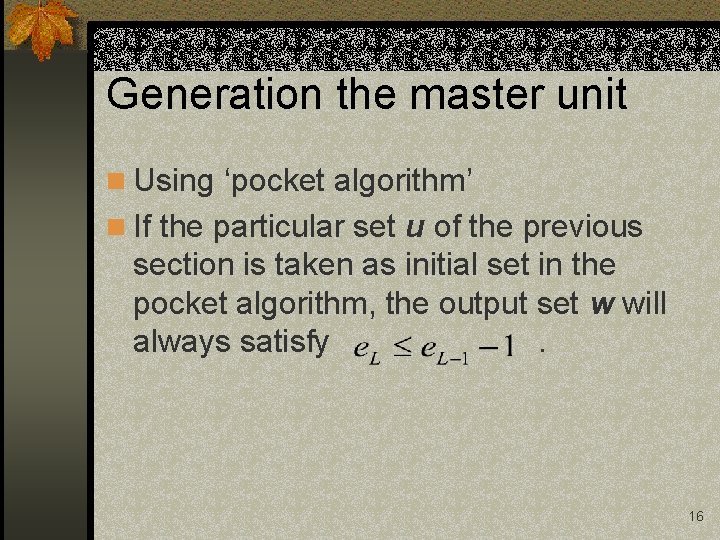
Generation the master unit n Using ‘pocket algorithm’ n If the particular set u of the previous section is taken as initial set in the pocket algorithm, the output set w will always satisfy. 16
Building the ancillary units n The master unit is not equal to the desired output unit means that at least one of the two classes is unfaithful. n We pick one unfaithful class and add a new unit to learn the mapping for the patterns μ belonging to this class only. n Repeat above process until all classes are faithful. 17
Simulations n Exhaustive learning (use the full set of the 2 N patterns) n Parity task n Random Boolean function n Generalization n Quality of convergence n Comments 18
Parity task n In the parity task for N 0 Boolean units the output should be 1 of the number of units in state +1 is even, and – 1 otherwise. 19
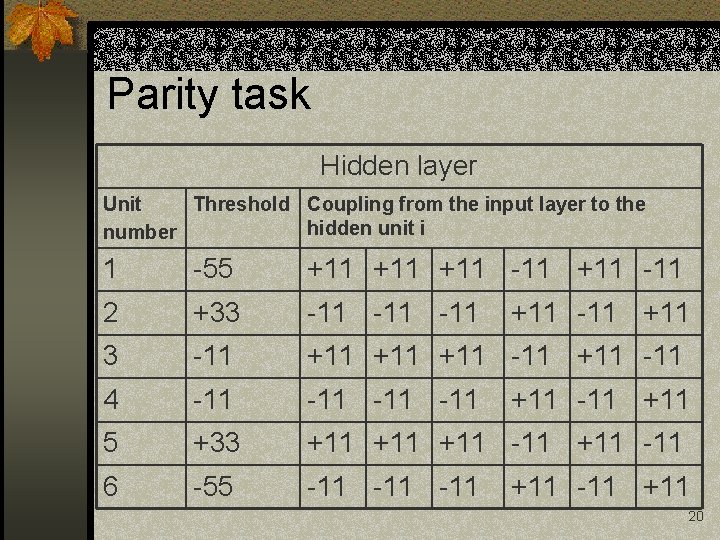
Parity task Hidden layer Unit Threshold Coupling from the input layer to the hidden unit i number 1 -55 +11 +11 -11 2 +33 -11 -11 3 -11 +11 +11 -11 4 -11 -11 5 +33 +11 +11 -11 6 -55 -11 -11 +11 +11 -11 +11 20
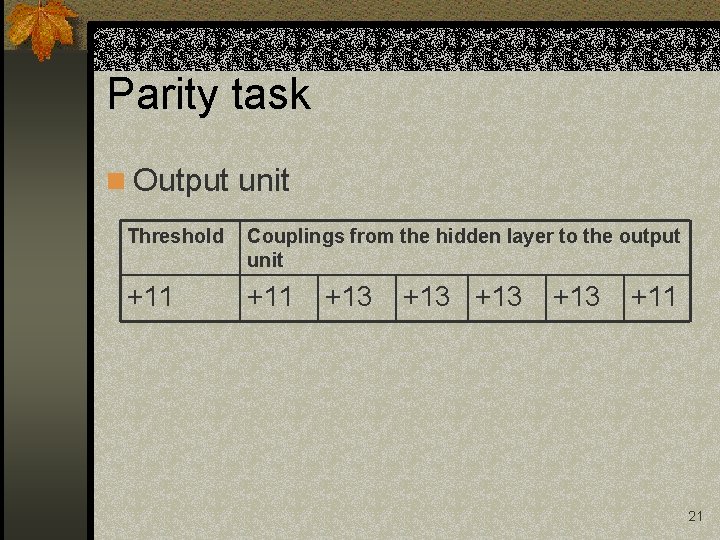
Parity task n Output unit Threshold Couplings from the hidden layer to the output unit +11 +13 +13 +11 21
Random Boolean function n A random Boolean function is obtained by drawing at random the output (± 1 with equal probability) for each input configuration. n The numbers of layers and of hidden units increase rapidly with N 0. 22
Generalization n The number of training patterns is smaller than 2 N. n The N 0 input neurons are organized in a one-dimensional chain, and the problem is to find out whether the number of domain walls is greater or smaller than three. 23
Generalization n domain wall n The presence of two neighboring neurons pointing in opposite directions n When the average of domain walls are three in training patterns, the problem is harder than other numbers. 24
See figure 1 in page 2199 Learning in feedforward layered networks: the tiling algorithm 25
Quality of convergence n To quantify the quality of convergence one might think of at least two parameters. n e. L n p. L : the number of distinct internal representations in each layer L. 26
See figure 2 in page 2200 Learning in feedforward layered networks: the tiling algorithm 27
Comments n There is a lot of freedom in the choice of the unfaithful classes to be learnt. n How to choose the maximum number of iterations which are allowed before one decides hat the perceptron algorithm has not converged? 28
Concluding remarks n presented a new strategy for building a feedforward layered network n Identified some possible roles of the hidden units: the master units and the ancillary units n continuous inputs and binary outputs n conflicting data n more than one output units 29