
The ThreeBody Problem Context Motivation and History Periodic
The Three-Body Problem
Context • Motivation and History • Periodic solutions to the three-body problem • The restricted three-body problem • Runge-Kutta method • Numerical simulation

Motivations and History
Motivations and History People who formulated the problem and made great contributions: • • Newton Kepler Euler Poincaré
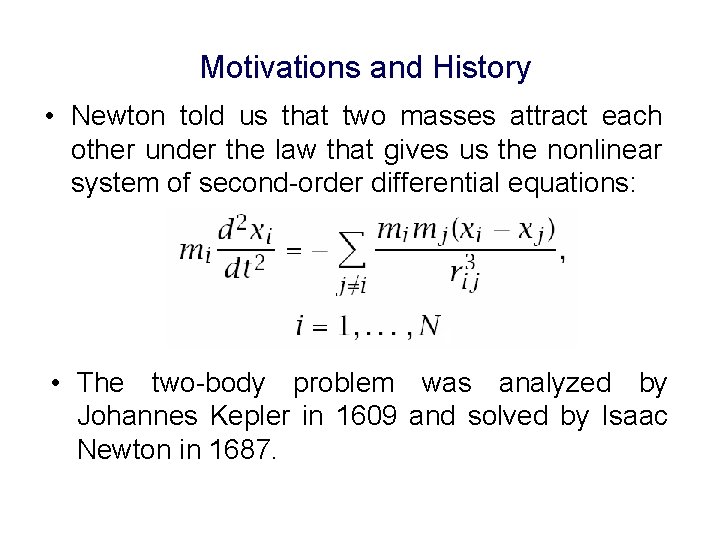
Motivations and History • Newton told us that two masses attract each other under the law that gives us the nonlinear system of second-order differential equations: • The two-body problem was analyzed by Johannes Kepler in 1609 and solved by Isaac Newton in 1687.
Motivations and History • There are many systems we would like to calculate. • For instance a flight of a spacecraft from the Earth to Moon, or flight path of a meteorite. • So we need to solve few bodies problem of interactions.
Motivations and History • In the mid-1890 s Henri Poincaré showed that there could be no such quantities analytic in positions, velocities and mass ratios for N>2.
Motivations and History • In 1912 Karl Sundman found an infinite series that could in principle be summed to give the solution - but which converges exceptionally slowly. • Henri Poincaré identified very dependence on initial conditions. sensitive • And developed topology to provide a simpler overall description.

Periodic Solutions
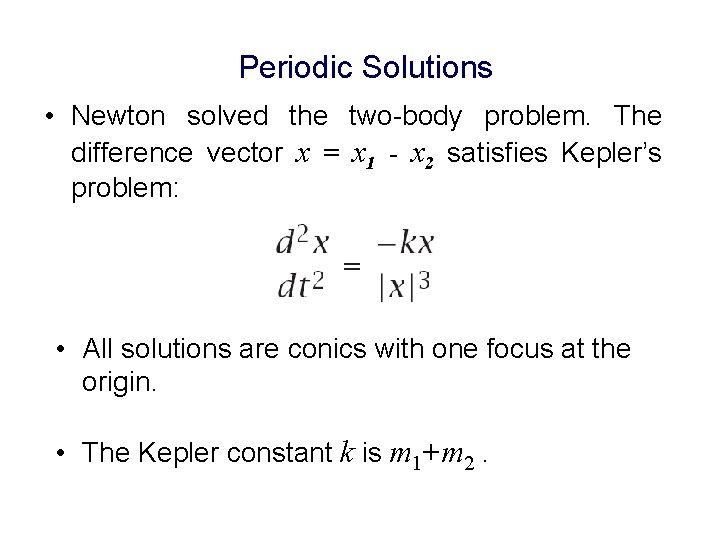
Periodic Solutions • Newton solved the two-body problem. The difference vector x = x 1 - x 2 satisfies Kepler’s problem: • All solutions are conics with one focus at the origin. • The Kepler constant k is m 1+m 2.
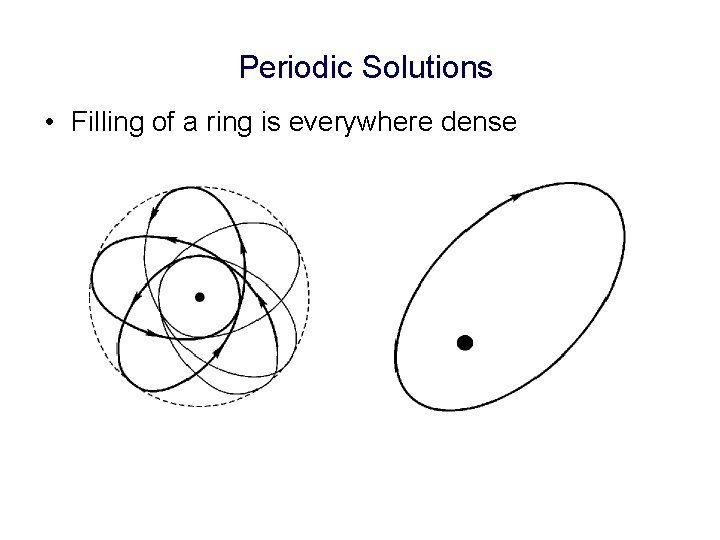
Periodic Solutions • Filling of a ring is everywhere dense

Periodic Solutions • The simplest periodic solutions for the threebody problem were discovered by Euler [1765] and by Lagrange [1772]. • Built out of Keplerian ellipses, they are the only explicit solutions.
Periodic Solutions • The Lagrange solutions are xi (t) = λ(t)xi 0, λ(t) C is any solution to the planar Kepler problem. • To form the Lagrange solution, start by placing the three masses at the vertices x 10, x 20, x 30 of an equilateral triangle whose center of mass m 1 x 10+m 2 x 20+m 3 x 30 is the origin.
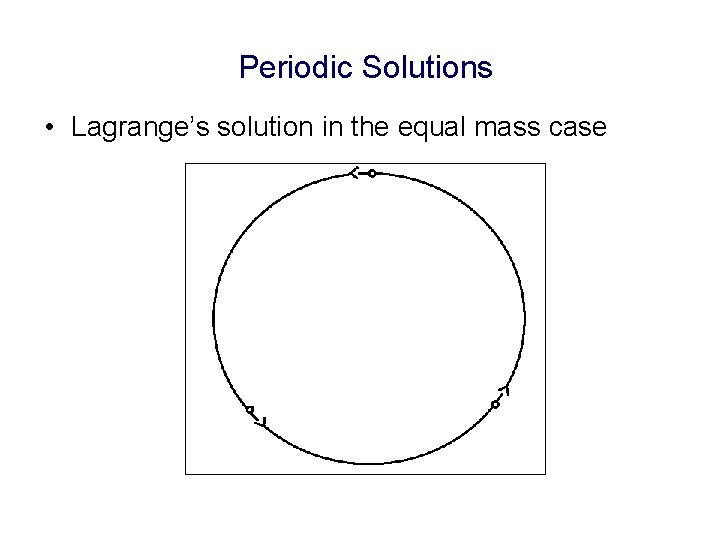
Periodic Solutions • Lagrange’s solution in the equal mass case
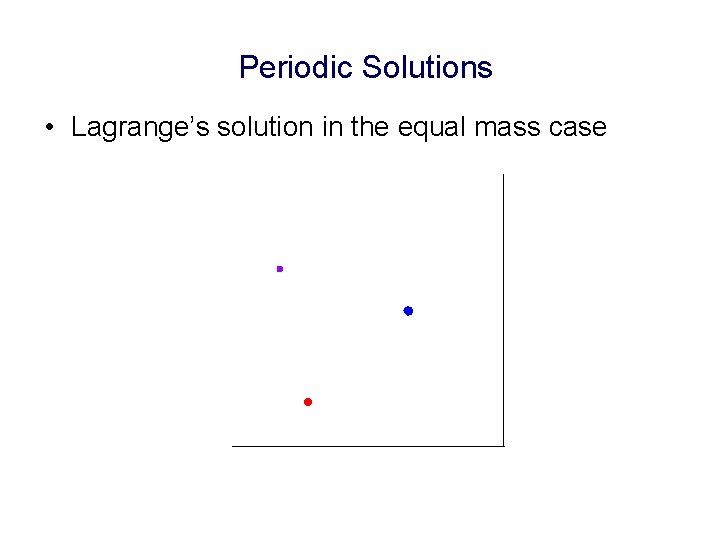
Periodic Solutions • Lagrange’s solution in the equal mass case
Periodic Solutions • The Euler solutions are xi (t) = λ(t)xi 0, λ(t) C is any solution to the planar Kepler problem. • To form the Euler solution, start by placing the three masses on the same line with their positions xi 0 such that the ratios rij=rik of their distances are the roots of a certain polynomial whose coefficients depend on the masses.
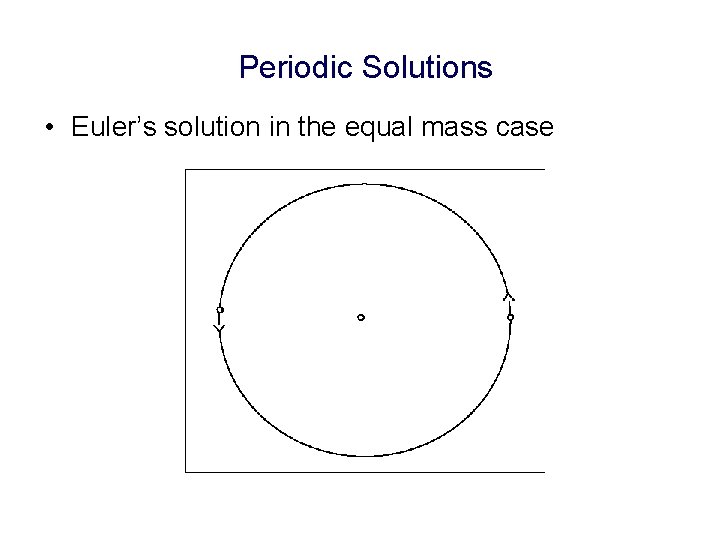
Periodic Solutions • Euler’s solution in the equal mass case
Periodic Solutions • Most important to astronomy are Hill’s periodic solutions, also called tight binaries. • These model the earth-moon-sun system. Two masses are close to each other while third remains far away.
Periodic Solutions • New periodic solution “figure eight”. • The eight was discovered numerically by Chris Moore [1993]. • A. Chenciner and R. Montgomery [2001] rediscovered it and proved its existence.
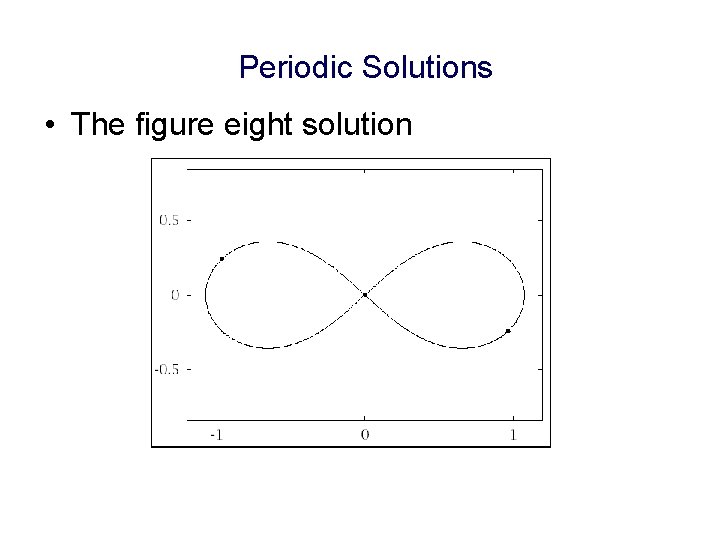
Periodic Solutions • The figure eight solution
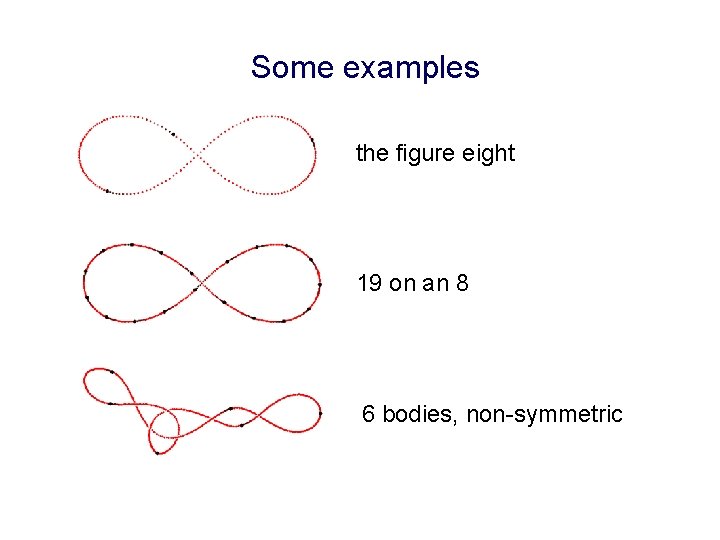
Some examples the figure eight 19 on an 8 6 bodies, non-symmetric
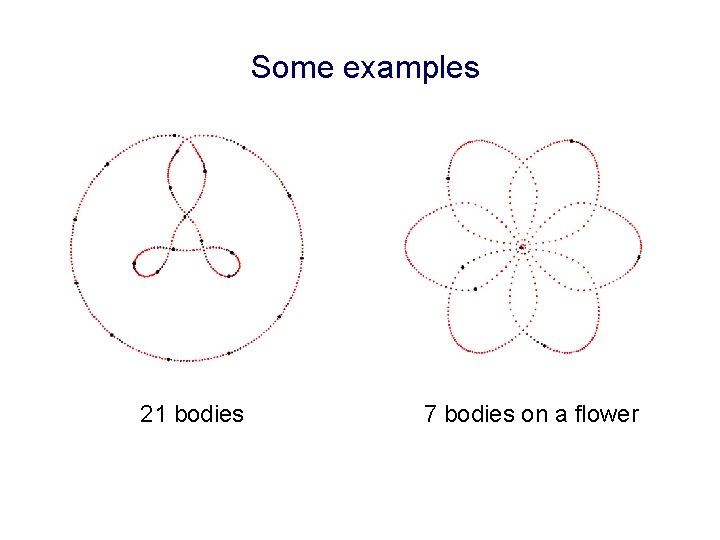
Some examples 21 bodies 7 bodies on a flower
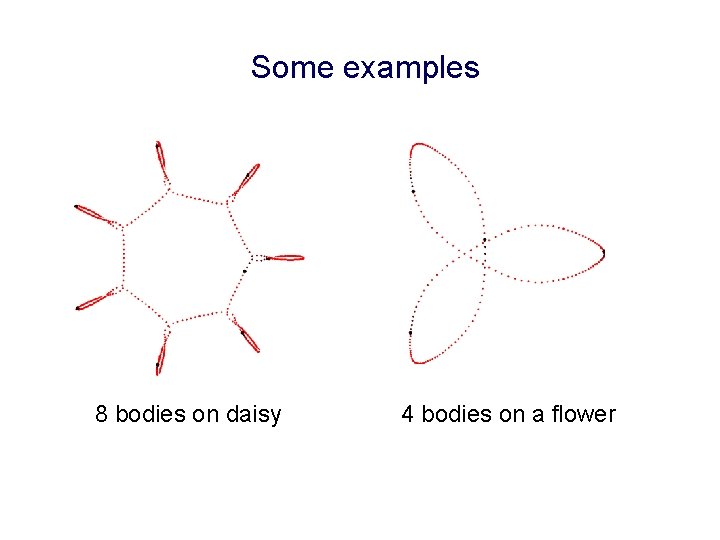
Some examples 8 bodies on daisy 4 bodies on a flower
The restricted three-body problem.
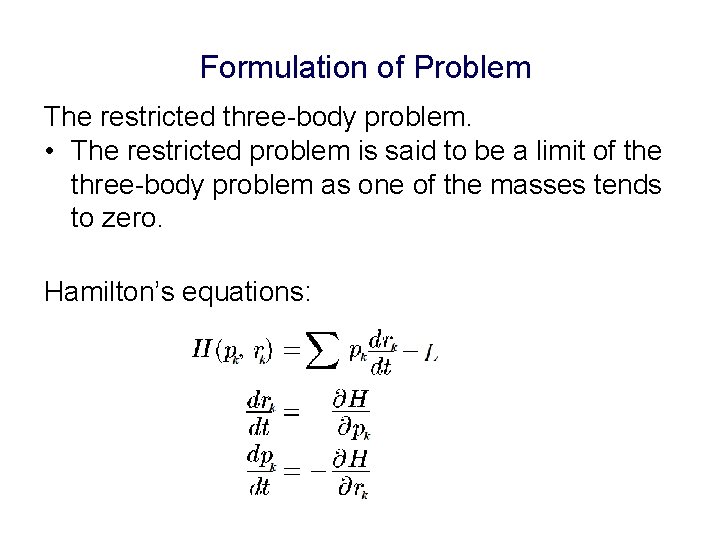
Formulation of Problem The restricted three-body problem. • The restricted problem is said to be a limit of the three-body problem as one of the masses tends to zero. Hamilton’s equations:
Runge-Kutta Method
Runge-Kutta Method Abstract: First developed by the German mathematicians C. D. T. Runge and M. W. Kutta in the latter half of the nineteenth century. It is based on difference schemes.
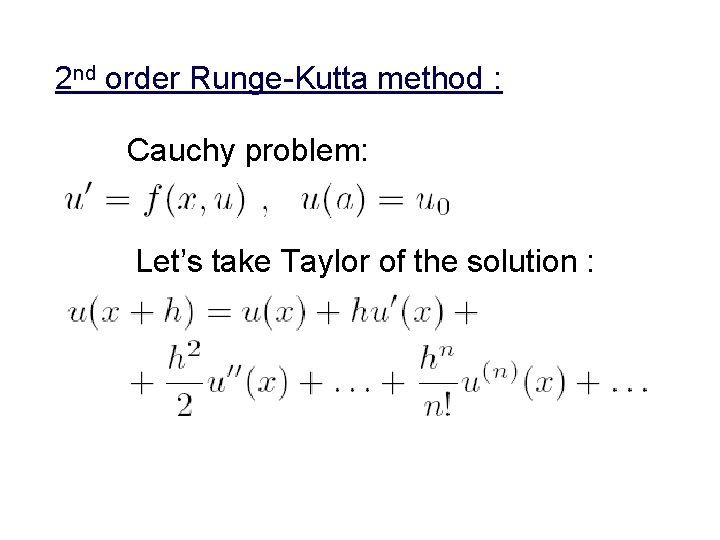
2 nd order Runge-Kutta method : Cauchy problem: Let’s take Taylor of the solution :
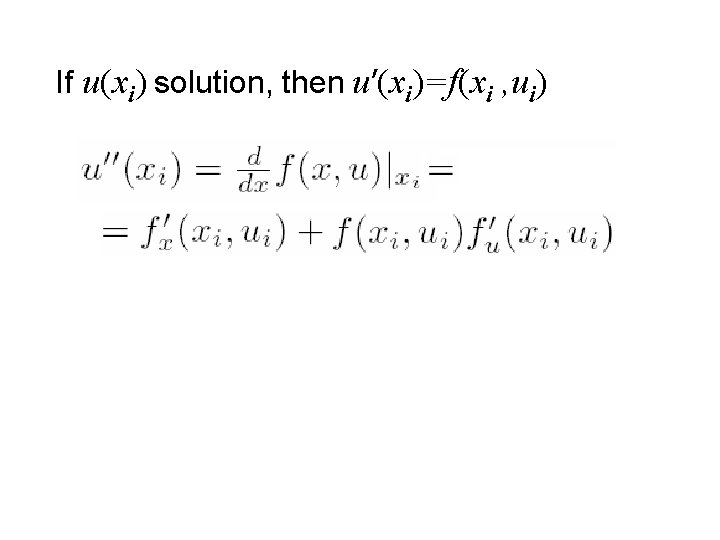
If u(xi) solution, then u’(xi)=f(xi , ui)
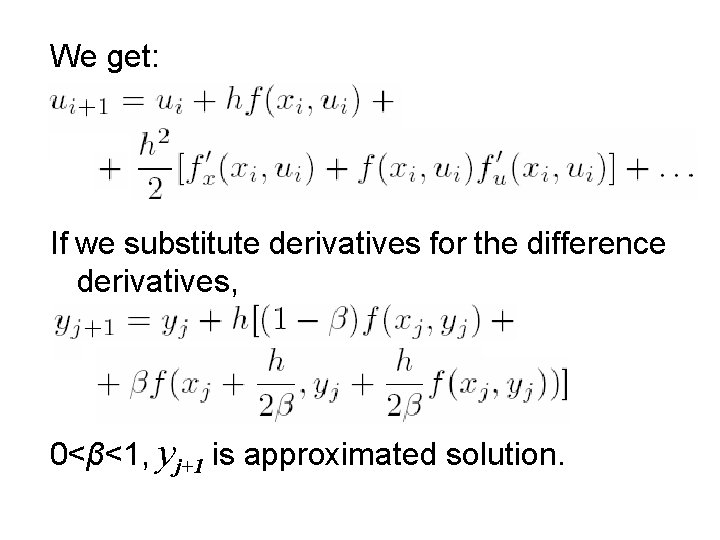
We get: If we substitute derivatives for the difference derivatives, 0<β<1, yj+1 is approximated solution.
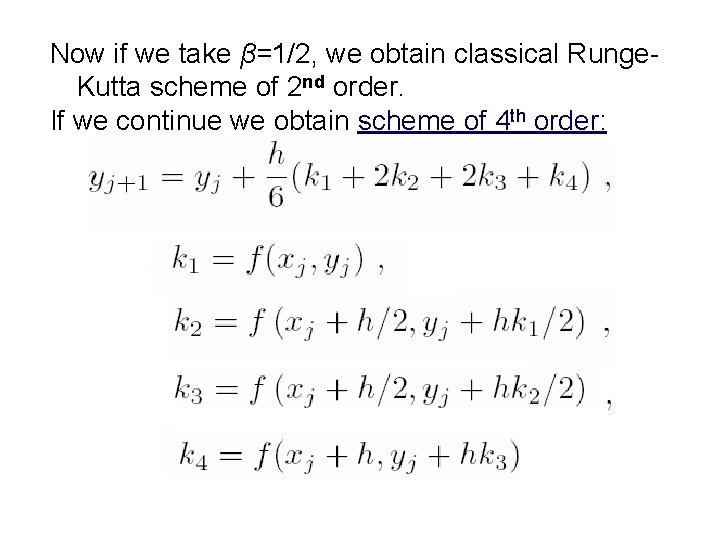
Now if we take β=1/2, we obtain classical Runge. Kutta scheme of 2 nd order. If we continue we obtain scheme of 4 th order:
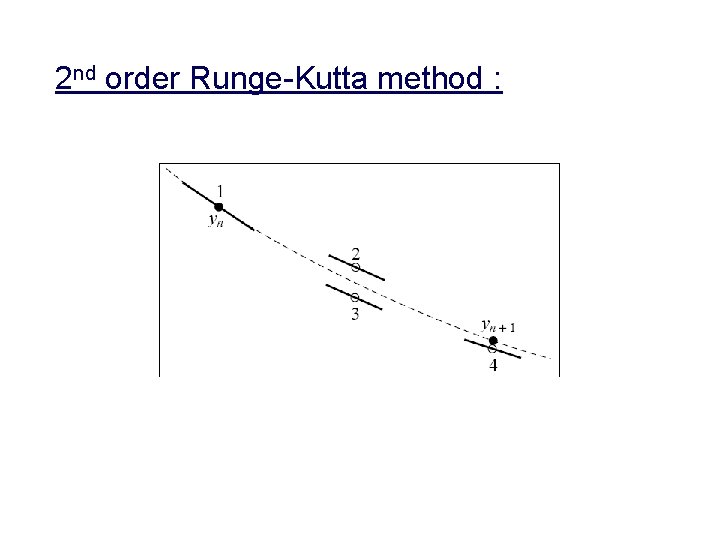
2 nd order Runge-Kutta method :
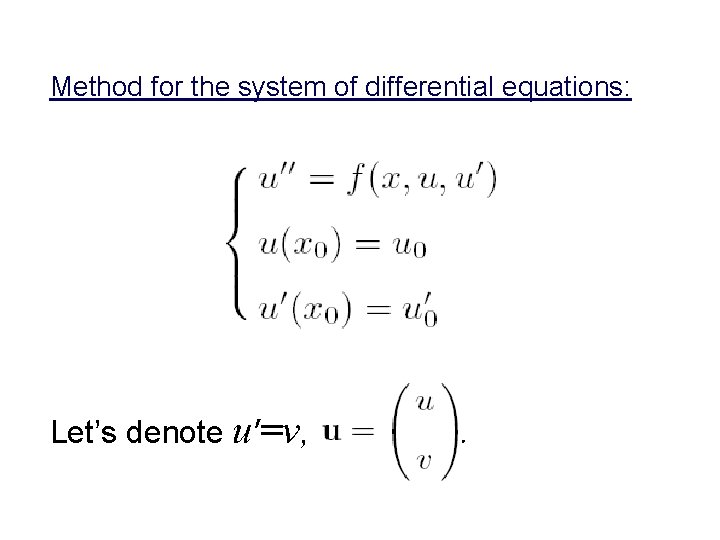
Method for the system of differential equations: Let’s denote u’=v, .

The system takes on form:
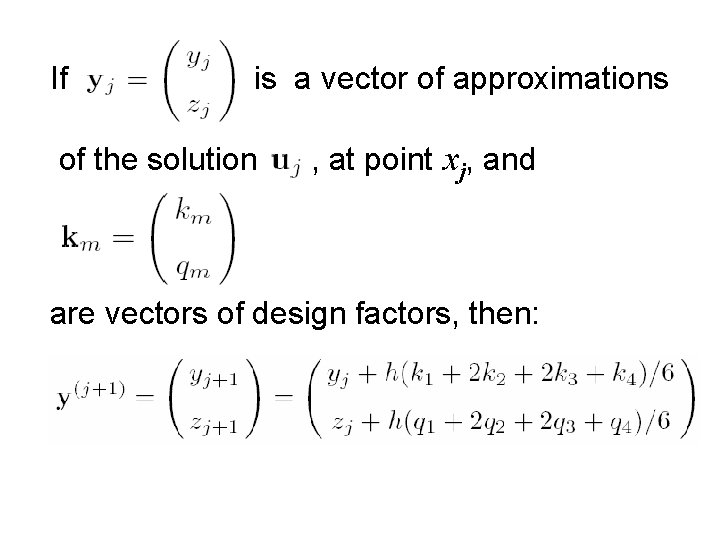
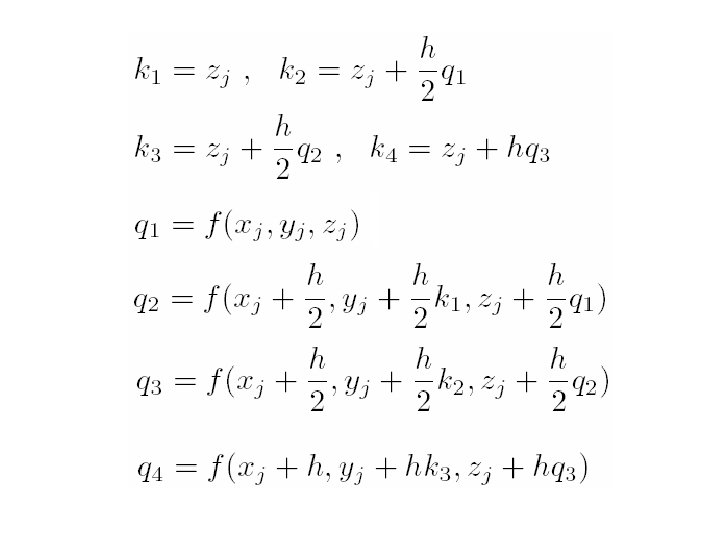
If is a vector of approximations of the solution , at point xj, and are vectors of design factors, then:
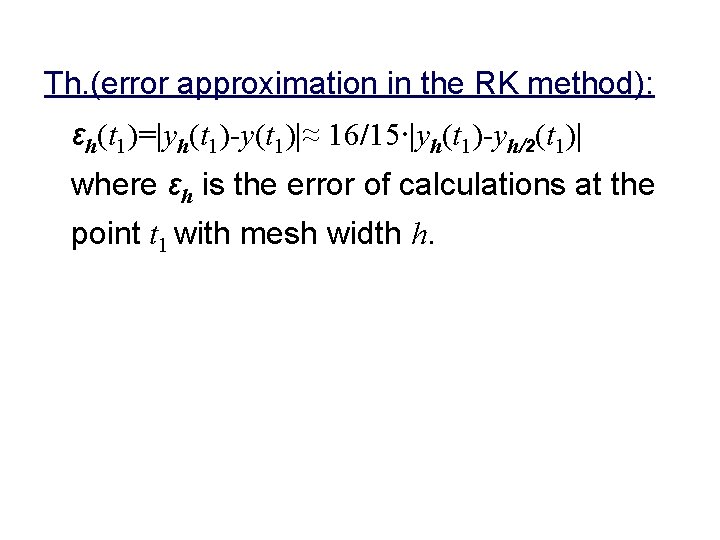
Th. (error approximation in the RK method): εh(t 1)=|yh(t 1)-y(t 1)|≈ 16/15∙|yh(t 1)-yh/2(t 1)| where εh is the error of calculations at the point t 1 with mesh width h.
Numerical simulation
Numerical simulation is based on: • 4 th order Runge-Kutta method • Adaptive stepsize control for Runge. Kutta Program is developed in Delphi.
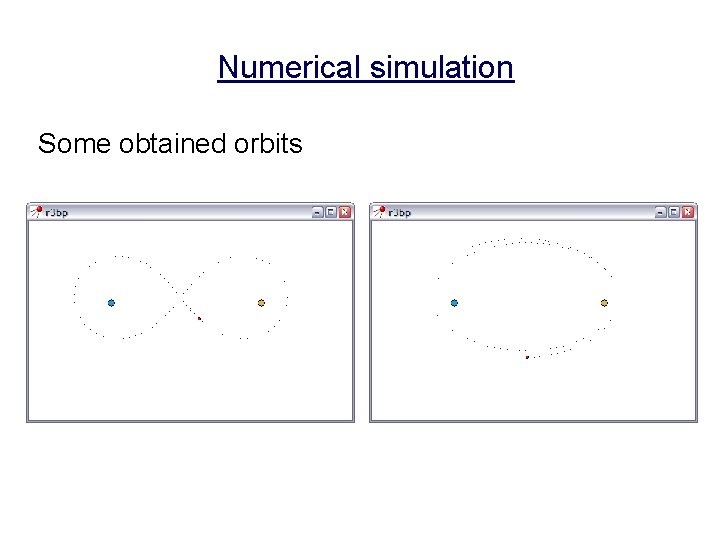
Numerical simulation Some obtained orbits
References • “A New Solution to the Three-Body Problem”, R. Montgomery • “Numerical methods”, E. Shmidt. • “Lekcii po nebesnoj mehanike”, V. M. Alekseev. • “Chislennie Metodi”, V. A. Buslov, S. L. Yakovlev. • “From the restricted to the full three-body problem”, Kenneth R. , Meyer and Dieter S. Schmidt. • http: //www. cse. ucsc. edu/~charlie/3 body/, Charlie Mc. Dowell.
- Slides: 41