
The Three Modes Mrs BatesAronson Intermediate English 091
The Three Modes Mrs. Bates-Aronson Intermediate English 091 Lesson 6
What is a mode? • Modes, also called patterns of development, are ways in which we organize and write our papers. There are several methods we can use depending on what we want to write and how we want to write it. The three we focus on are • Illustration • Description • Narration
Organization: How we put together our papers • Each essay you write has a specific organizational pattern. There are three main patterns. • Spatial: by order of location (used primarily with description) • Chronological: by order of events (used primarily with narration) • Emphatic: by order of importance (used primarily with illustration)
What is Illustration? • Illustration is providing support for your topic sentence or thesis statement by giving specific examples or details. • Your job with illustration is to explain something. • For every statement you make, you need an example to show what it means or how it applies. • The organization for an illustration essay is usually emphatic.
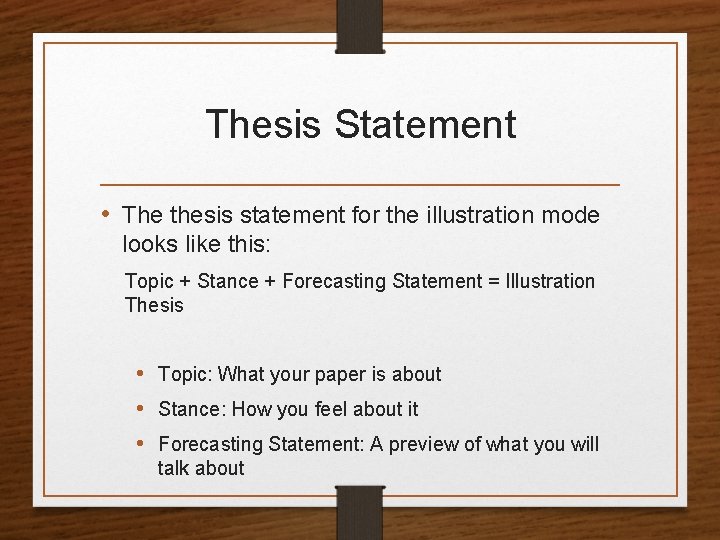
Thesis Statement • The thesis statement for the illustration mode looks like this: Topic + Stance + Forecasting Statement = Illustration Thesis • Topic: What your paper is about • Stance: How you feel about it • Forecasting Statement: A preview of what you will talk about
Remember • It is not enough to make a statement. You always have to BACK IT UP. • The more specific your examples, the more knowledgeable you are. It is very important to establish your CREDIBILITY.
Example • The first day of school was frustrating. • Topic Sentence • My sociology course was canceled. Then, I could not find the biology lab. Furthermore, the lines at the bookstore were so long that I went home without buying my textbooks, and I have English homework to do. • Example
What are the parts we have to have? • Opening Hook—the attention grabbing sentence • Thesis Statement with Forecasting—what the essay is about • 3 Main Points—the topic sentences for supporting paragraphs along with developing supporting points • Conclusion—a reminder of what the essay was about • Closing Hook—the attention releasing
How to Develop Illustration • • • Consider your purpose and audience. Use as many types of examples as you can Use things your audience can relate to Mention facts and events Include anecdotes (stories) Use ONLY examples that fit
What is Description? • Description essays allow writers to get creative! For description, you want to paint a picture of something for your reader using words. Utilize every tool in your disposal to create imagery. • Thesis statements for description look like this: Topic + Dominant Impression = Description Thesis • The organization of a description essay is usually spatial; however, it is possible to be organized in another way, like by senses.
Creating Description: Sensory Details • The 5 senses help to make your description more concrete. • Touch • Taste • Sight • Smell • Sound • Sensory details can add physical sensations to what you are describing, painting a better picture for your reader.
Creating Description: Active Verbs • Actions are strong! Using active verbs (having the subject perform something instead of being performed on—which is passive), makes your paper that much stronger. Passive Example: The puppy was scared by the lightning. (The lighting is doing the acting. The puppy is reacting. ) Active Example: The puppy whimpered and whined under the couch during the thunderstorm. (Isn’t this better? See the puppy actually doing something? Doing things is exciting! You can picture it better. )
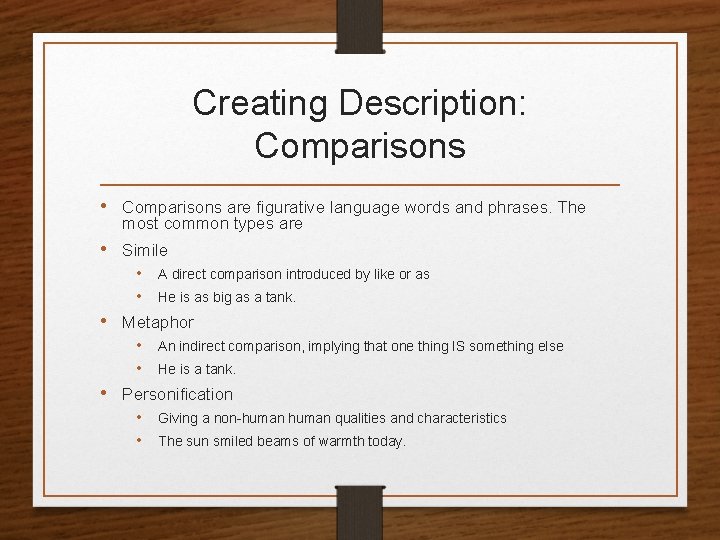
Creating Description: Comparisons • Comparisons are figurative language words and phrases. The most common types are • Simile • • A direct comparison introduced by like or as He is as big as a tank. • Metaphor • • An indirect comparison, implying that one thing IS something else He is a tank. • Personification • • Giving a non-human qualities and characteristics The sun smiled beams of warmth today.
Diction • Diction means “word choice. ” You remember this from the previous lesson. • Every word you chose conveys a specific meaning. So be careful that you use the word you intend and that it fits your dominant impression.
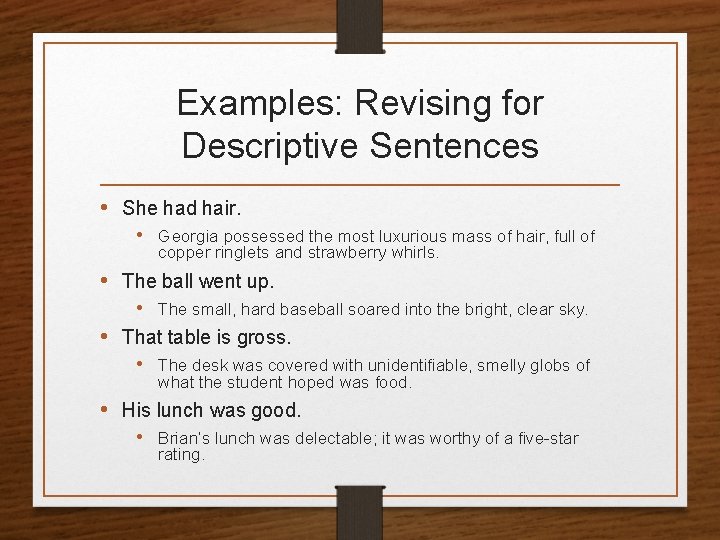
Examples: Revising for Descriptive Sentences • She had hair. • Georgia possessed the most luxurious mass of hair, full of copper ringlets and strawberry whirls. • The ball went up. • The small, hard baseball soared into the bright, clear sky. • That table is gross. • The desk was covered with unidentifiable, smelly globs of what the student hoped was food. • His lunch was good. • Brian’s lunch was delectable; it was worthy of a five-star rating.
Dominant impression • All of these details determine the DOMINANT IMPRESSION of your piece. • Dominant Impression: the “feeling” the writer wishes to convey • Ex: ecstatic, terrible, disgusting, etc. • The tone of the piece is very important. It is created by the words you choose. Your words give the object (person, place) a meaning original to you.
What is Narration? • When a writer uses the narrative mode, he or she is creating a story. • The story needs to have a beginning, middle, and end, and it must have a point. • The thesis statement for a narrative looks like this: Experience + Lesson Learned = Narrative Thesis
Examples of Thesis Statements • Narrative thesis statements can come in two types. • Explicit—has both the event and the lesson stated. • A diving experience (event) showed me the strength to overcome my claustrophobia (lesson). • Implicit—does not state in one sentence; the writer provides enough details so that the reader understands what the significance of the event was.
Organization of a Narrative • Narratives are told in Chronological (time order) order, with few exceptions. • Flashbacks are glimpses of the past that might help explain what is happening in the present. • Foreshadowing are hints of the future that warn the reader what is coming.
How does a narrative work? • A narrative must have a few things to be considered a narrative. • Characters: who is the story about? Who is performing the actions? • Setting: where and when does the story take place? • Plot: what is happening in the story? • Conflict and Resolution: what is the problem and how is it fixed? • Dominant Impression/Tone: what is the overall feeling of the story? • Theme: what is the meaning of this story?
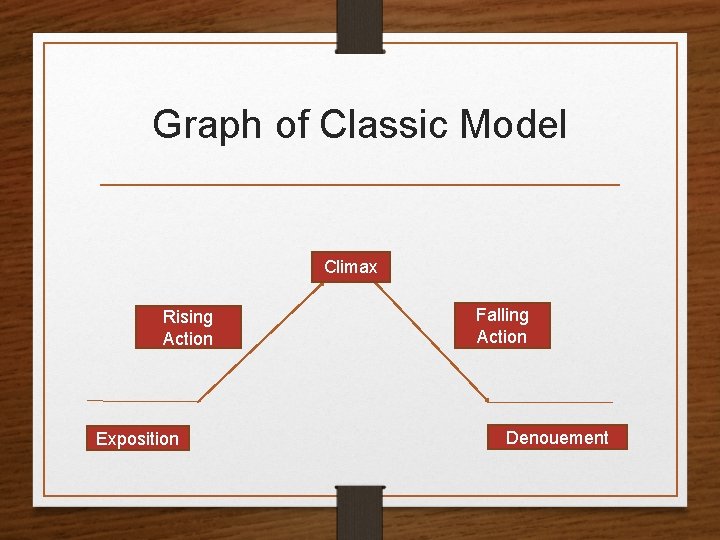
Graph of Classic Model Climax Rising Action Exposition Falling Action Denouement
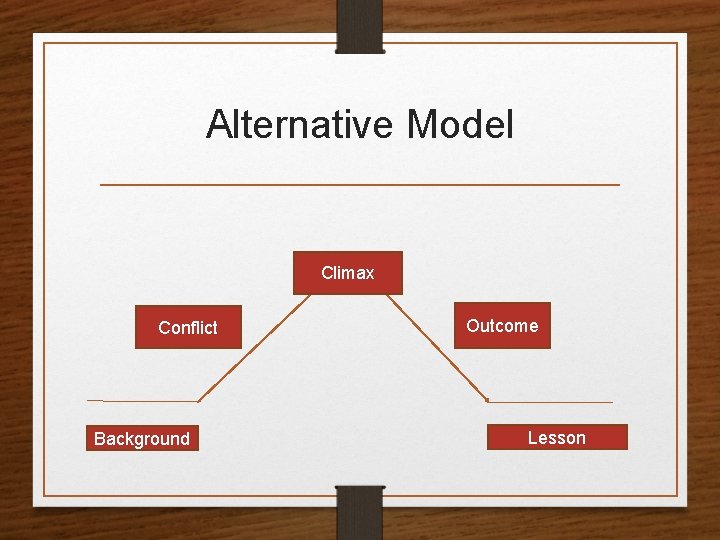
Alternative Model Climax Conflict Background Outcome Lesson
Creating Narration: How to Use Dialogue • Dialogue can be an important part of a narrative. • It adds characterization and helps provide more detail about the character. • It should mirror everyday language and be natural, not forced. • It uses quotation marks to indicate what is said. • Remember to start a new paragraph when a character speaks and be clear on who is talking. • Dialogue is a useful tool to assist with narratives, but it is not absolutely required.
- Slides: 23