
The Three Hallmarks of Superconductivity Zero Resistance Complete
- Slides: 7
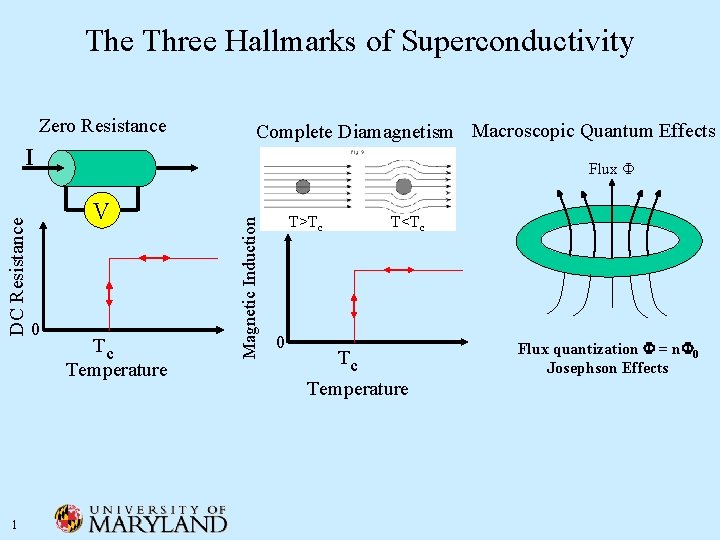
The Three Hallmarks of Superconductivity Zero Resistance Complete Diamagnetism Macroscopic Quantum Effects 1 Flux F V 0 Tc Temperature Magnetic Induction DC Resistance I T>Tc 0 T<Tc Tc Temperature Flux quantization F = n. F 0 Josephson Effects
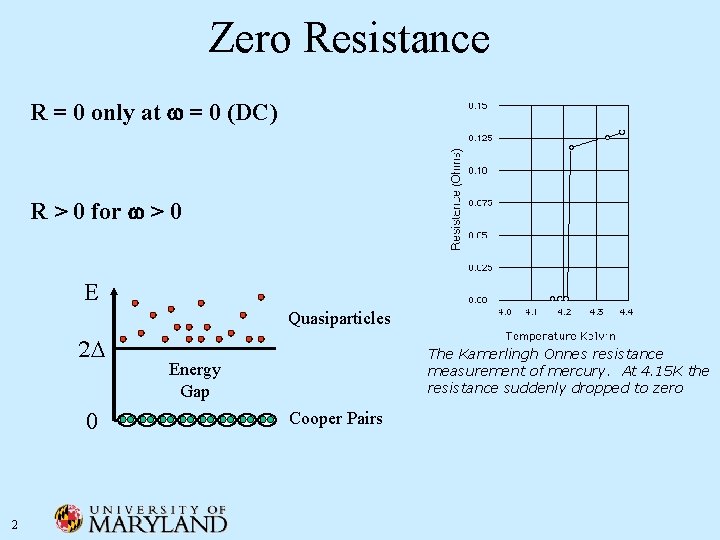
Zero Resistance R = 0 only at w = 0 (DC) R > 0 for w > 0 E Quasiparticles 2 D 0 2 The Kamerlingh Onnes resistance measurement of mercury. At 4. 15 K the resistance suddenly dropped to zero Energy Gap Cooper Pairs
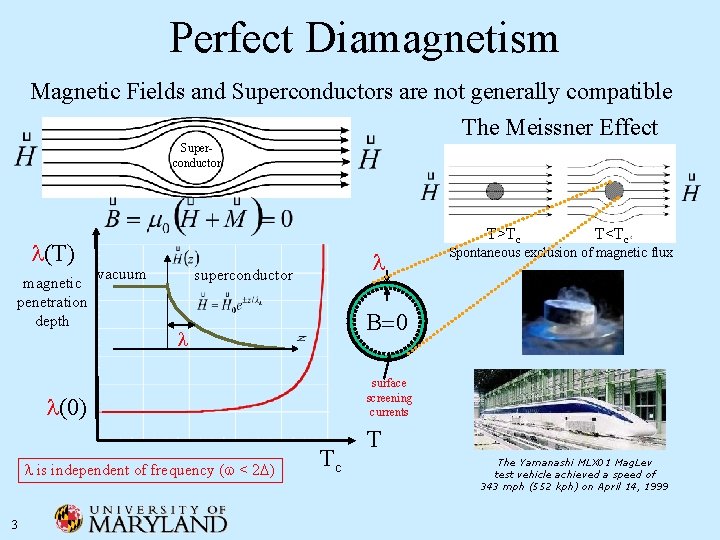
Perfect Diamagnetism Magnetic Fields and Superconductors are not generally compatible The Meissner Effect Superconductor l(T) magnetic penetration depth T>Tc vacuum l superconductor surface screening currents l(0) 3 Spontaneous exclusion of magnetic flux B=0 l l is independent of frequency (w < 2 D) T<Tc Tc T The Yamanashi MLX 01 Mag. Lev test vehicle achieved a speed of 343 mph (552 kph) on April 14, 1999
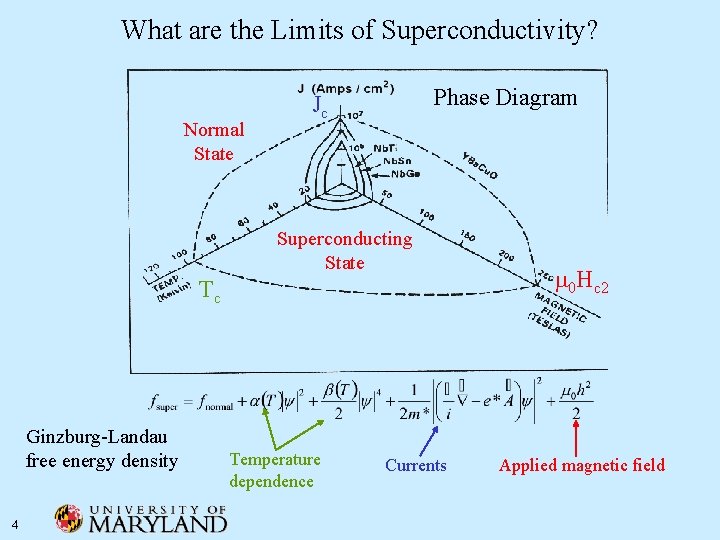
What are the Limits of Superconductivity? Normal State Phase Diagram Jc Superconducting State Tc Ginzburg-Landau free energy density 4 Temperature dependence Currents m 0 Hc 2 Applied magnetic field
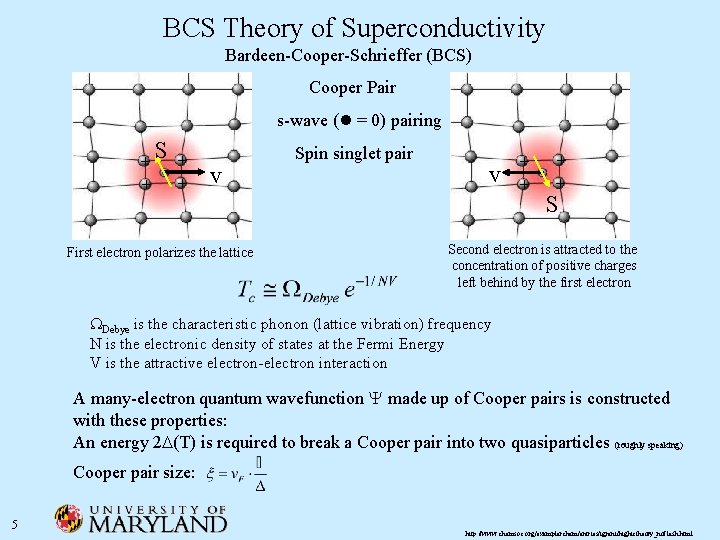
BCS Theory of Superconductivity Bardeen-Cooper-Schrieffer (BCS) Cooper Pair s-wave ( = 0) pairing + + S + + v First electron polarizes the lattice Spin singlet pair v + + S Second electron is attracted to the concentration of positive charges left behind by the first electron WDebye is the characteristic phonon (lattice vibration) frequency N is the electronic density of states at the Fermi Energy V is the attractive electron-electron interaction A many-electron quantum wavefunction Y made up of Cooper pairs is constructed with these properties: An energy 2 D(T) is required to break a Cooper pair into two quasiparticles (roughly speaking) Cooper pair size: 5 http: //www. chemsoc. org/exemplarchem/entries/igrant/hightctheory_noflash. html
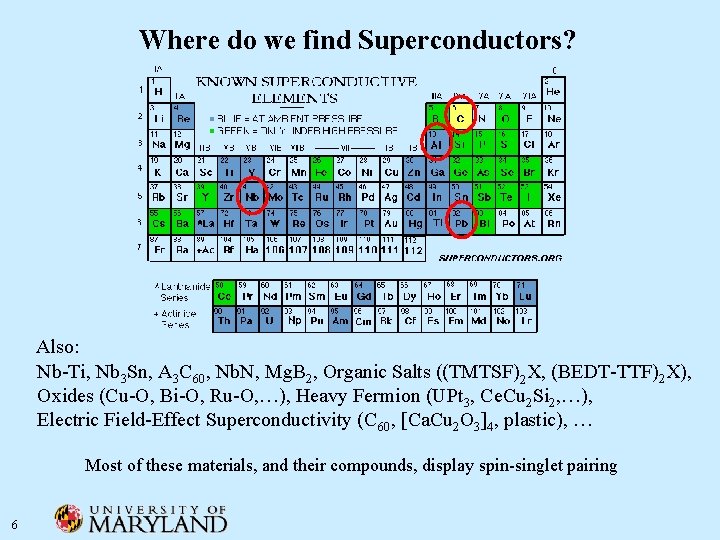
Where do we find Superconductors? Also: Nb-Ti, Nb 3 Sn, A 3 C 60, Nb. N, Mg. B 2, Organic Salts ((TMTSF)2 X, (BEDT-TTF)2 X), Oxides (Cu-O, Bi-O, Ru-O, …), Heavy Fermion (UPt 3, Ce. Cu 2 Si 2, …), Electric Field-Effect Superconductivity (C 60, [Ca. Cu 2 O 3]4, plastic), … Most of these materials, and their compounds, display spin-singlet pairing 6
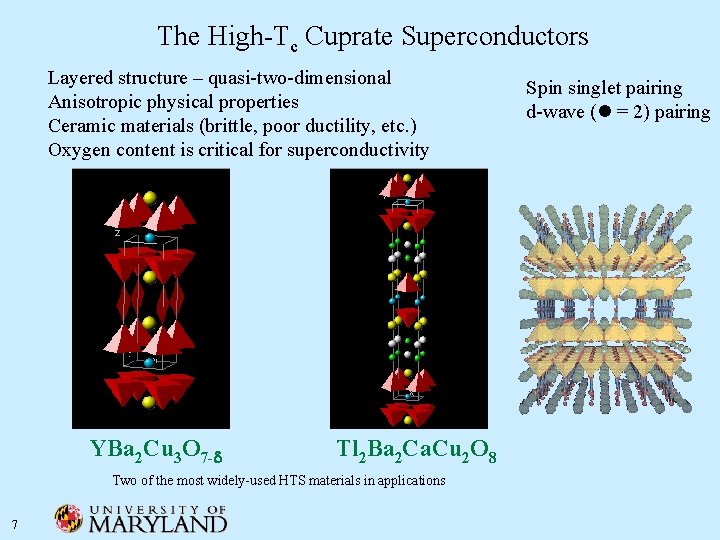
The High-Tc Cuprate Superconductors Layered structure – quasi-two-dimensional Anisotropic physical properties Ceramic materials (brittle, poor ductility, etc. ) Oxygen content is critical for superconductivity YBa 2 Cu 3 O 7 -d Tl 2 Ba 2 Ca. Cu 2 O 8 Two of the most widely-used HTS materials in applications 7 Spin singlet pairing d-wave ( = 2) pairing