
The Thorax Axial Appendicular Skeleton Mammary Glands Surface
- Slides: 33
The Thorax Axial & Appendicular Skeleton Mammary Glands Surface Anatomy Medical ppt http: //hastaneciyiz. blogspot. com
Axial vs. Appendicular Skeleton w Axial Skeleton n n Skull = Cranium + Facial bones Vertebrae Ribs Sternum w Appendicular Skeleton n n Bones of upper/lower limbs Limb Girdles Page 14
The Bony Thorax w Sternum n Manubrium, Body (Gladiolus), Xiphoid Process w Ribs n n 7 True Ribs 5 False Ribs w Clavicle w Scapula w Vertebrae n Cervical, Thoracic, Lumbar, Sacral (Sacrum), Coccygeal (Coccyx) Pg 14
Projections and Depressions w Site of muscle and ligament attachments n n Spine Process w Help form joints n n Head Facet w Allow BV, nerves, and muscles to pass n n Notch Fossa Pg 624
Thoracic Cage w Borders: n n n Thoracic vertebrae posteriorly Ribs laterally Sternum and costal cartilages anteriorly w Forms protective cage around heart, lungs, and other organs w Composed of: n n n Sternum Ribs Vertebrae
The Sternum (Composed of fused sternebrae) w Manubrium n n Jugular (sternal) notch Articulation with rib #1 & 2 Clavicular Articular facets Sternal Angle – 2 nd rib w Body (Gladiolus) n n Articulates w/ribs 2 -7 Xiphosternal joint w Xiphoid process n n Cartilage-calcifies thru time Partial attachment of many muscles Pg 120
The Ribs w Usually, 12 pairs n n n 7 True ribs-direct attachment to sternum 5 False ribs-indirect or no attachment to sternum Floating ribs-make up 2 of 5 False ribs, no ventral attachment w Typical Ribs n Ribs # 2 -9 w Atypical Ribs n Ribs #1, 10, 11, 12 w Reinforce thoracic cage Pg 120
Rib Anatomy w Typical Ribs n n n Head Neck Tubercle Angle Shaft Subcostal Groove Pg 121
Rib Anatomy w Atypical Ribs n n n #1 -short, flat (S-I), wide, Supports Subclavian vessels #1, 10 -12 articulate with only = # vertebra #11, 12 don’t articulate with transverse processes, or anteriorly at all Pg 121
Typical Rib Articulation w Dorsal (P) Attachment Thoracic Vertebrae w Head of Rib 2 costal facets Superior costal facet § Inferior costal facet of vertebra above it § Intervertebral disc § w Tubercle of Rib Transverse Costal Facet w e. g. Rib #4 articulates with Superior Costal Facet and Transverse Costal Facet of T 4 & Inferior Costal Facet of T 3 w Ventral (A) Attachment to Sternum n Via costal cartilage
Pectoral Girdle w Attaches upper extremity to axial skeleton w Holds upper extremity away from skeleton for mobility Pg 623, 624, 646
Intercostal Muscles w External Intercostals n n n O: Inferior border of rib above I: Superior border of rib below Fibers run OBLIQUE (down and forward) Aid in Inspiration (lift ribcage, increase dimensions) w Internal Intercostals n n n O: Superior border of rib below I: Inferior border of rib above Fibers run at RIGHT ANGLES to external intercostals Aid in forced expiration (depress ribcage, decrease dimensions) w Innermost Intercostals, Subcostals, Transversus thoracis n n Attachments similar to Internal Intercostals, Attach ribs Small, variable, function unclear
Neurovascular Bundle of Intercostal Muscles w VAN (vein, artery, nerve) n n n Intercostal vein Intercostal artery Intercostal nerve w Sit in Subcostal Groove w Between Internal Intercostal and Innermost intercostal layer Pg 128
Vertebral Column w Humans’ made of 26 bones n n n Cervical 7 Thoracic 12 Lumbar 5 Sacrum (5 fused sacral vertebrae) Coccyx (4 fused coccygeal vertebrae) w Extends from skull to pelvis w Supports body, muscle attachment w Vertebral Canal n n Created by vertebral foramen Contains + protects spinal cord w Intervertebral foramina Pg 45, 18
Cervical Vertebrae (7) w w w w **Transverse Foramen ** Superior Articular Facets face superoposteriorly Inferior Articular Facets face inferoanteriorly Allows wide range of motion Spinous process fairly short, bifid (except for C 7) Vertebral Foramen is Triangular Body is wider laterally than in A-P direction Pg 31
Atypical Cervical Vertebrae w C 1 – Atlas n n n No body No Spinous Process Superior Articular facets are kidney shaped w C 2 – Axis n n Odontoid Process = Dens Other features typical Pg 32
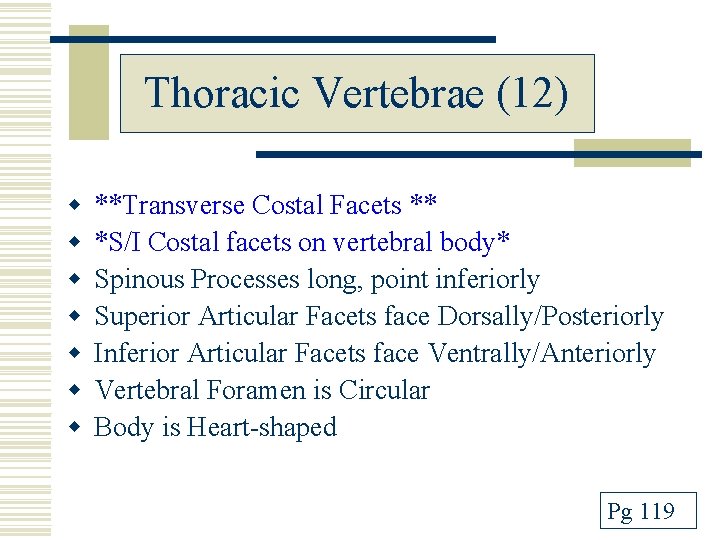
Thoracic Vertebrae (12) w w w w **Transverse Costal Facets ** *S/I Costal facets on vertebral body* Spinous Processes long, point inferiorly Superior Articular Facets face Dorsally/Posteriorly Inferior Articular Facets face Ventrally/Anteriorly Vertebral Foramen is Circular Body is Heart-shaped Pg 119
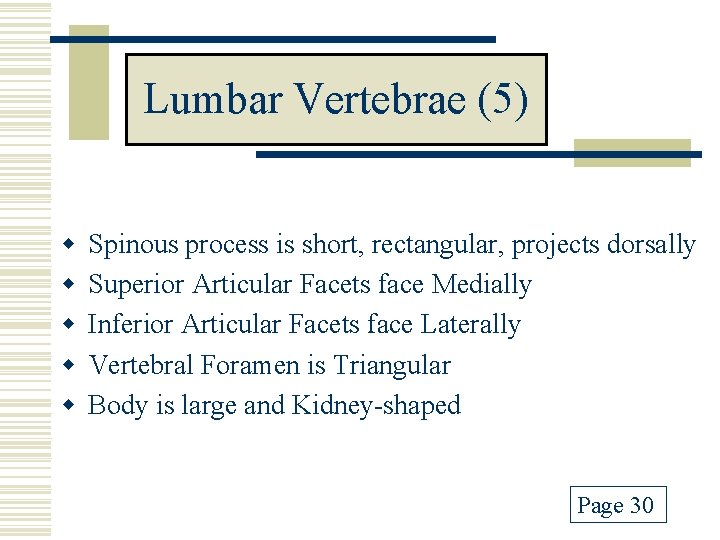
Lumbar Vertebrae (5) w w w Spinous process is short, rectangular, projects dorsally Superior Articular Facets face Medially Inferior Articular Facets face Laterally Vertebral Foramen is Triangular Body is large and Kidney-shaped Page 30
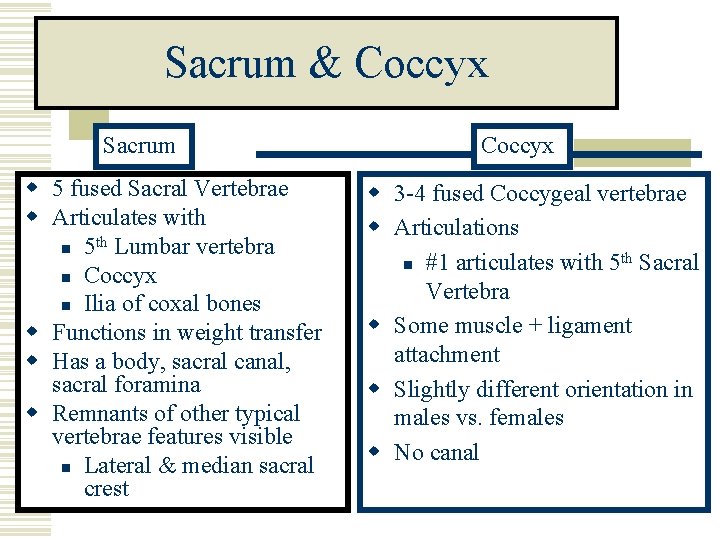
Sacrum & Coccyx Sacrum w 5 fused Sacral Vertebrae w Articulates with th n 5 Lumbar vertebra n Coccyx n Ilia of coxal bones w Functions in weight transfer w Has a body, sacral canal, sacral foramina w Remnants of other typical vertebrae features visible n Lateral & median sacral crest Coccyx w 3 -4 fused Coccygeal vertebrae w Articulations th n #1 articulates with 5 Sacral Vertebra w Some muscle + ligament attachment w Slightly different orientation in males vs. females w No canal
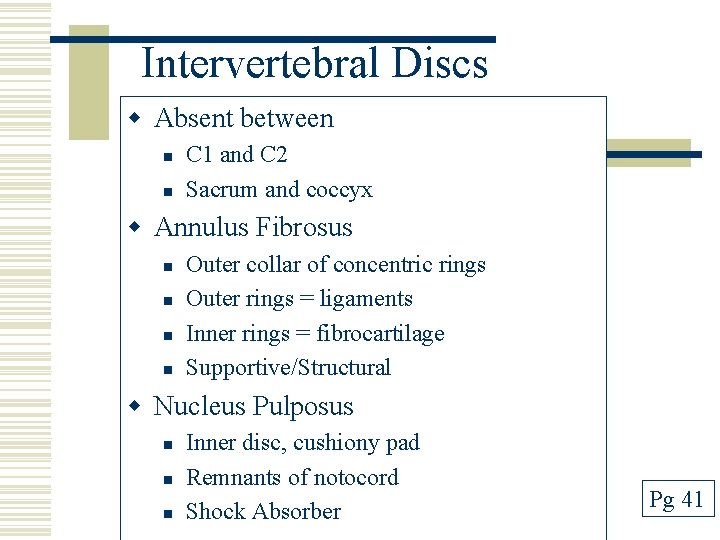
Intervertebral Discs w Absent between n n C 1 and C 2 Sacrum and coccyx w Annulus Fibrosus n n Outer collar of concentric rings Outer rings = ligaments Inner rings = fibrocartilage Supportive/Structural w Nucleus Pulposus n n n Inner disc, cushiony pad Remnants of notocord Shock Absorber Pg 41
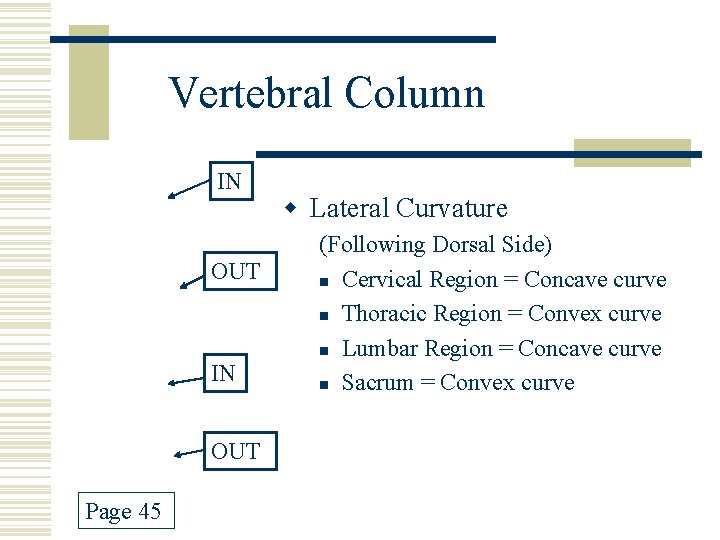
Vertebral Column IN OUT Page 45 w Lateral Curvature (Following Dorsal Side) n Cervical Region = Concave curve n Thoracic Region = Convex curve n Lumbar Region = Concave curve n Sacrum = Convex curve
Abnormal Curves w Scoliosis-abnormal lateral curve of more than 10° n “twisted disease” w Kyphosis-exaggerated thoracic curve n “humped disease” w Lordosis-accentuated lumbar curve n “bent-backward disease” www. nlm. nih. gov
Ligaments of Vertebral Column w Anterior Longitudinal Ligaments (neck – sacrum) n n n Run vertically on anterior surface of vertebral bodies + intervertebral discs Wide, strong Prevents hyperextension w Posterior Longitudinal Ligaments (neck – sacrum) n n n Run vertically on posterior surface of intervertebral discs only Narrow, weak Prevents hyperflexion w Ligamentum Flavum (contains elastic connective tissue) n n Attaches lamina of vertebrae (one on right, one on left) Very strong Pg 44
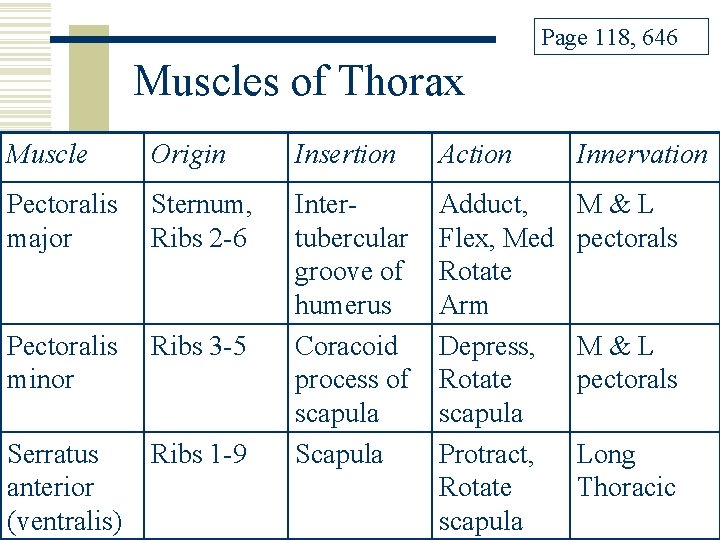
Page 118, 646 Muscles of Thorax Muscle Origin Insertion Action Innervation Pectoralis major Sternum, Ribs 2 -6 Ribs 3 -5 Serratus anterior (ventralis) Ribs 1 -9 Adduct, Flex, Med Rotate Arm Depress, Rotate scapula Protract, Rotate scapula M&L pectorals Pectoralis minor Intertubercular groove of humerus Coracoid process of scapula Scapula M&L pectorals Long Thoracic
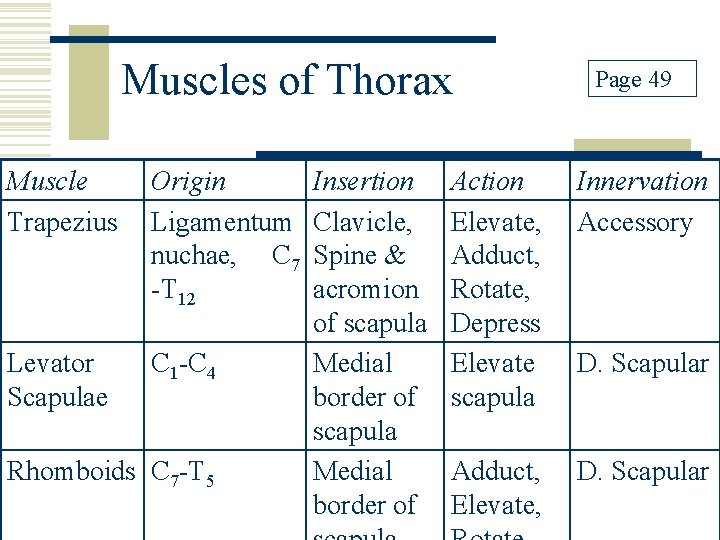
Muscles of Thorax Muscle Trapezius Origin Ligamentum nuchae, C 7 -T 12 Levator Scapulae C 1 -C 4 Rhomboids C 7 -T 5 Insertion Clavicle, Spine & acromion of scapula Medial border of Page 49 Action Elevate, Adduct, Rotate, Depress Elevate scapula Innervation Accessory Adduct, Elevate, D. Scapular
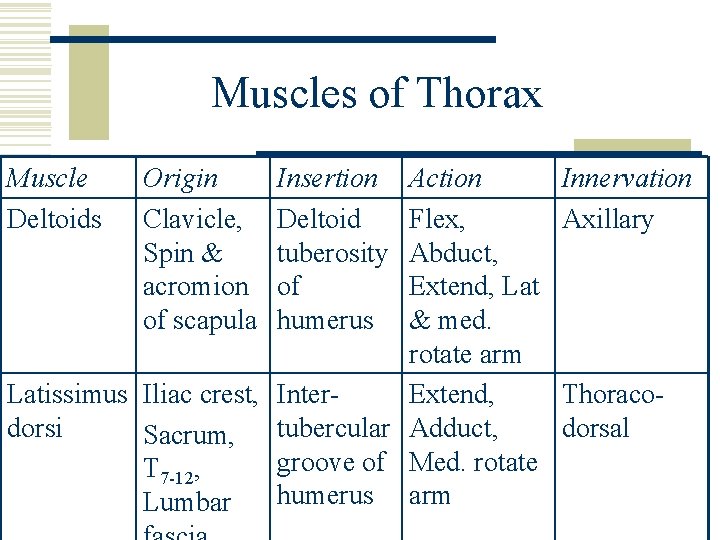
Muscles of Thorax Muscle Deltoids Origin Clavicle, Spin & acromion of scapula Insertion Deltoid tuberosity of humerus Action Flex, Abduct, Extend, Lat & med. rotate arm Latissimus Iliac crest, Inter. Extend, dorsi Sacrum, tubercular Adduct, groove of Med. rotate T 7 -12, humerus arm Lumbar Innervation Axillary Thoracodorsal
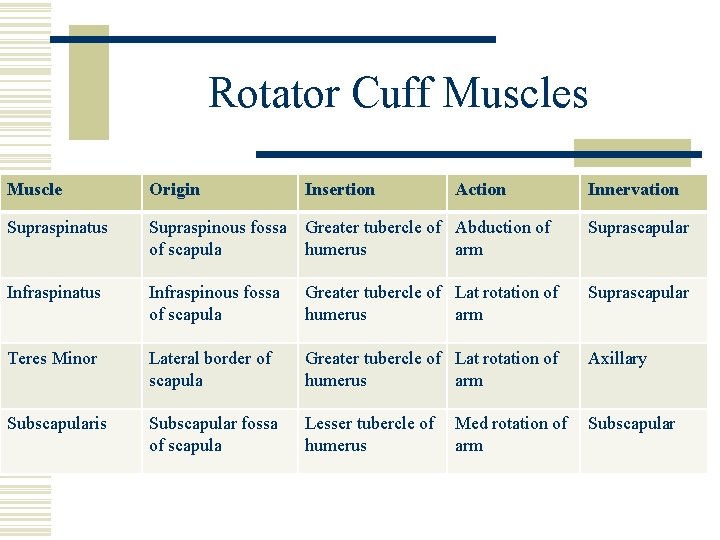
Rotator Cuff Muscles Muscle Origin Insertion Action Supraspinatus Supraspinous fossa of scapula Greater tubercle of Abduction of humerus arm Suprascapular Infraspinatus Infraspinous fossa of scapula Greater tubercle of Lat rotation of humerus arm Suprascapular Teres Minor Lateral border of scapula Greater tubercle of Lat rotation of humerus arm Axillary Subscapularis Subscapular fossa of scapula Lesser tubercle of humerus Subscapular Med rotation of arm Innervation
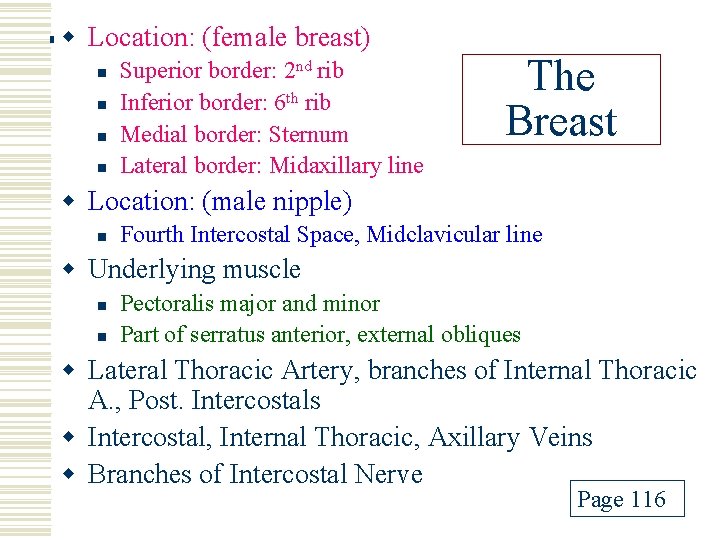
w Location: (female breast) n n Superior border: 2 nd rib Inferior border: 6 th rib Medial border: Sternum Lateral border: Midaxillary line The Breast w Location: (male nipple) n Fourth Intercostal Space, Midclavicular line w Underlying muscle n n Pectoralis major and minor Part of serratus anterior, external obliques w Lateral Thoracic Artery, branches of Internal Thoracic A. , Post. Intercostals w Intercostal, Internal Thoracic, Axillary Veins w Branches of Intercostal Nerve Page 116
Mammary Glands w w w Lactiferous (modified sweat) Glands Breast made of 15 -25 lobes (each a compound alveolar gland) Lobes made of lobules (= clusters of acini/alveoli) Acini/Alveoli lined w/milk-secreting simple epithelial cells Lactiferous Ducts of lobes open at nipple Areola-ring of pigmented skin around nipple n Sebaceous gland produce sebum during nursing w Lobes separated by adipose tissue and suspended by connective tissue = Suspensory Ligaments of the Breasts
Surface Anatomy Use the next 3 slides and follow the book to palpate (feel) the features listed
Anterior Surface of Thorax w Palpate the following n n n Sternum (3 parts) Jugular notch Sternal Angle (= 2 nd rib) Clavicle Costal margin Xiphosternal joint w Midclavicular Line w Midaxillary Line Page 201
Posterior Surface of Thorax w Palpate the following n n Spinous Process of C 7 Scapula (ribs 2 -7) Scapular spine l Acromion Process l Inferior Angle of Spine l Inferior Border l Page 90
Locating Internal Structures w Pleural Cavities n n n Inferior margin = adjacent to T 12 in Posterior Midline To Rib 10 at Midaxillary line To Rib 8 at Midclavicular line To Xiphosternal joint medially Lungs posterior border is 2 ribs superior to pleural cavity (rib 8) w Heart n Deep to xiphisternal angle Medical ppt Page 206 http: //hastaneciyiz. blogspot. com