
The ThirtyTwo Crystal Classes Pt 1 Dr Stephen
- Slides: 38
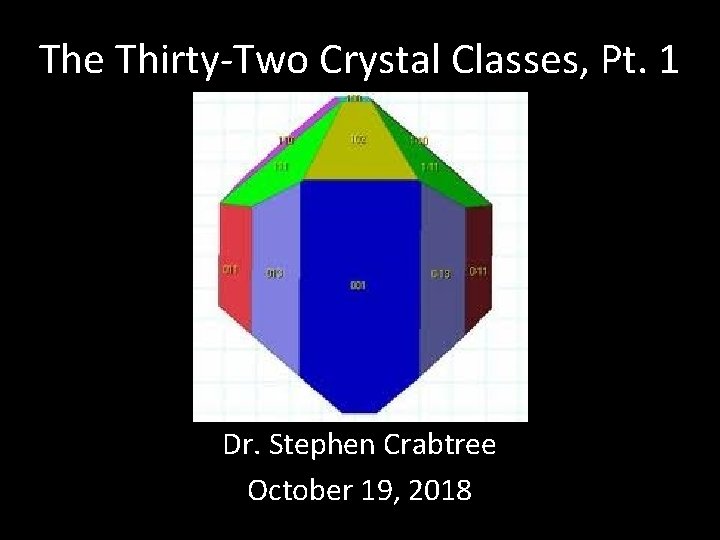
The Thirty-Two Crystal Classes, Pt. 1 Dr. Stephen Crabtree October 19, 2018
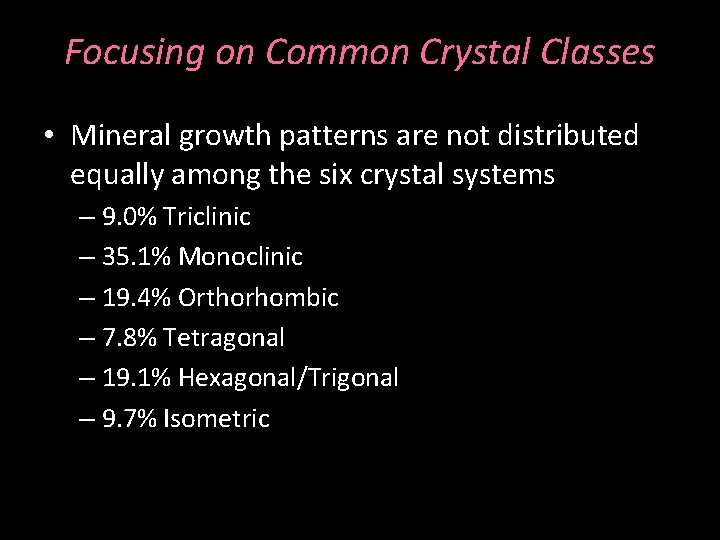
Focusing on Common Crystal Classes • Mineral growth patterns are not distributed equally among the six crystal systems – 9. 0% Triclinic – 35. 1% Monoclinic – 19. 4% Orthorhombic – 7. 8% Tetragonal – 19. 1% Hexagonal/Trigonal – 9. 7% Isometric
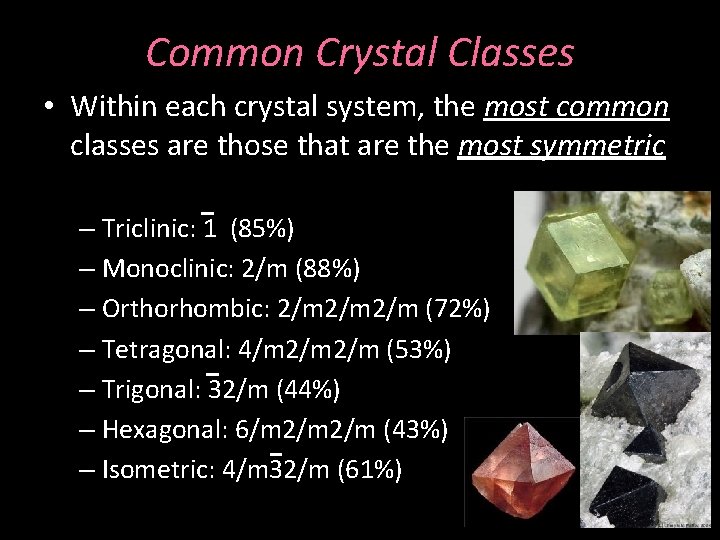
Common Crystal Classes • Within each crystal system, the most common classes are those that are the most symmetric – Triclinic: 1 (85%) – Monoclinic: 2/m (88%) – Orthorhombic: 2/m 2/m (72%) – Tetragonal: 4/m 2/m (53%) – Trigonal: 32/m (44%) – Hexagonal: 6/m 2/m (43%) – Isometric: 4/m 32/m (61%)
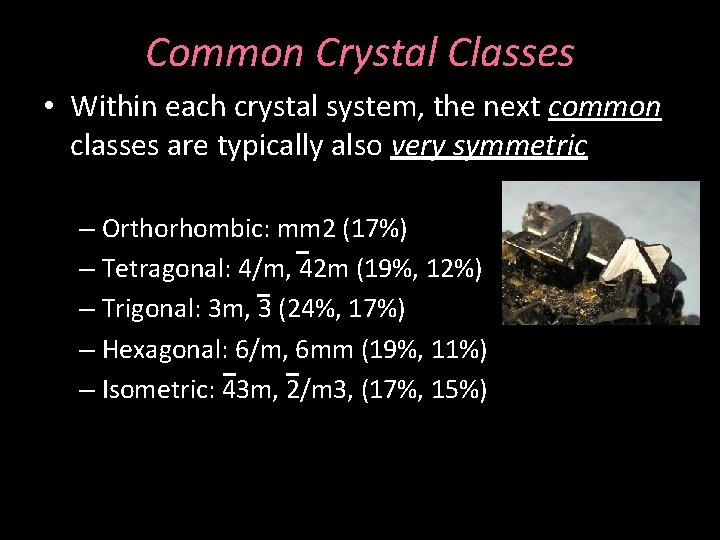
Common Crystal Classes • Within each crystal system, the next common classes are typically also very symmetric – Orthorhombic: mm 2 (17%) – Tetragonal: 4/m, 42 m (19%, 12%) – Trigonal: 3 m, 3 (24%, 17%) – Hexagonal: 6/m, 6 mm (19%, 11%) – Isometric: 43 m, 2/m 3, (17%, 15%)
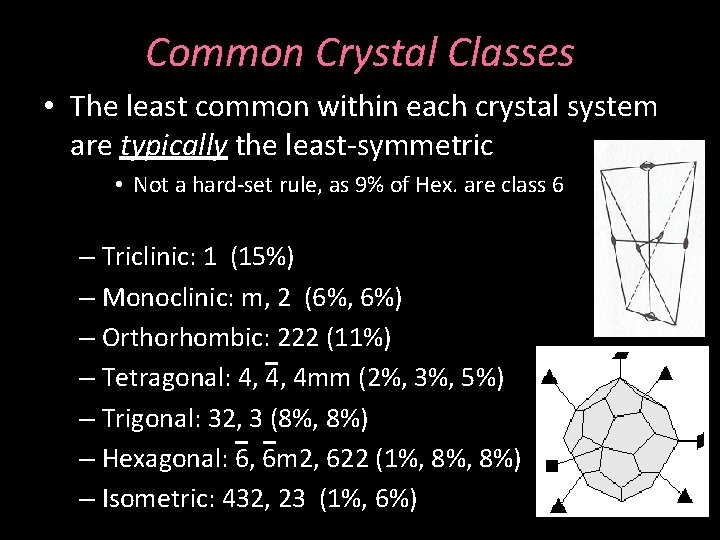
Common Crystal Classes • The least common within each crystal system are typically the least-symmetric • Not a hard-set rule, as 9% of Hex. are class 6 – Triclinic: 1 (15%) – Monoclinic: m, 2 (6%, 6%) – Orthorhombic: 222 (11%) – Tetragonal: 4, 4, 4 mm (2%, 3%, 5%) – Trigonal: 32, 3 (8%, 8%) – Hexagonal: 6, 6 m 2, 622 (1%, 8%) – Isometric: 432, 23 (1%, 6%)
Focusing on Common Crystal Classes • Each point-group has a “general form” with a face that intersects all of the principal axes at different lengths – Miller index of face: {hkl} where h ≠ k ≠ l ≠ 0 – A repeating face, not parallel to any axis, producing the simplest form expressing the symmetry, whether a closed or open form – “General form” tends to have more faces than other forms within the same crystal class
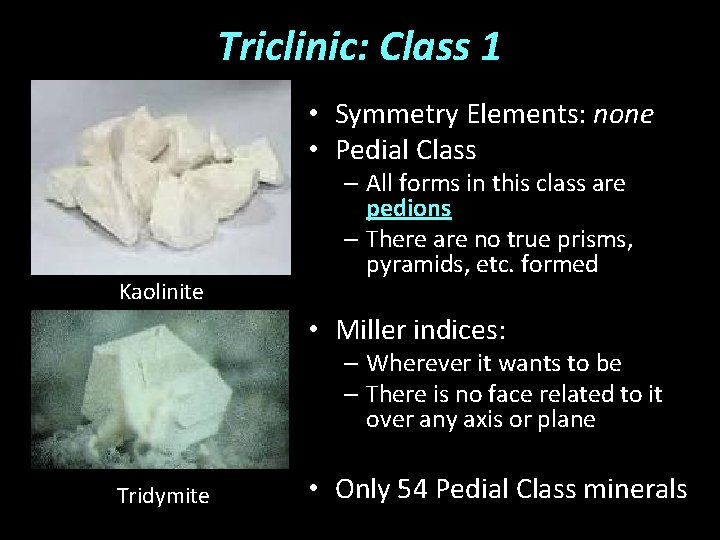
Triclinic: Class 1 • Symmetry Elements: none • Pedial Class Kaolinite – All forms in this class are pedions – There are no true prisms, pyramids, etc. formed • Miller indices: – Wherever it wants to be – There is no face related to it over any axis or plane Tridymite • Only 54 Pedial Class minerals
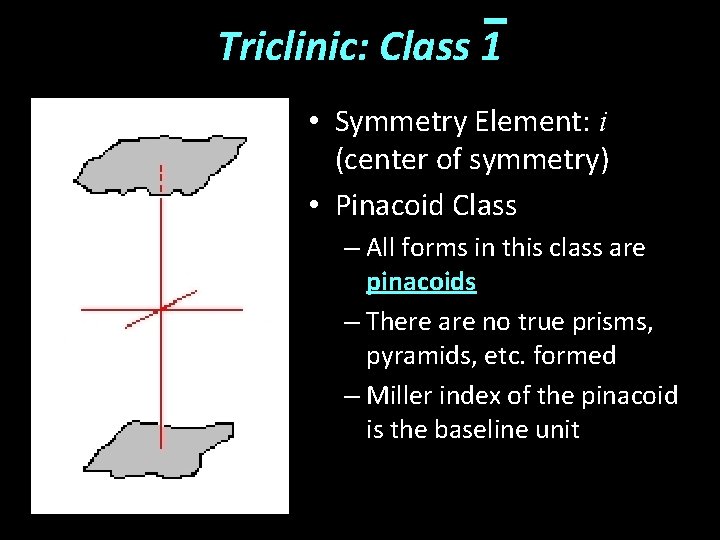
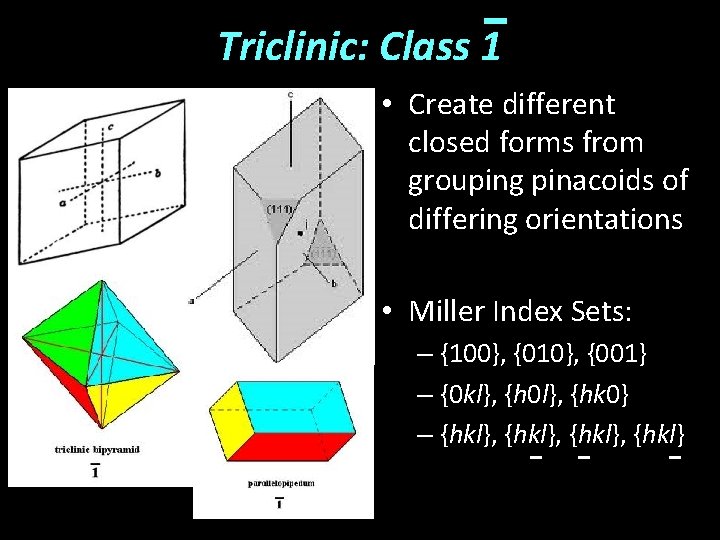
Triclinic: Class 1 • Symmetry Element: i (center of symmetry) • Pinacoid Class – All forms in this class are pinacoids – There are no true prisms, pyramids, etc. formed – Miller index of the pinacoid is the baseline unit
Triclinic: Class 1 • Create different closed forms from grouping pinacoids of differing orientations • Miller Index Sets: – {100}, {010}, {001} – {0 kl}, {h 0 l}, {hk 0} – {hkl}, {hkl}
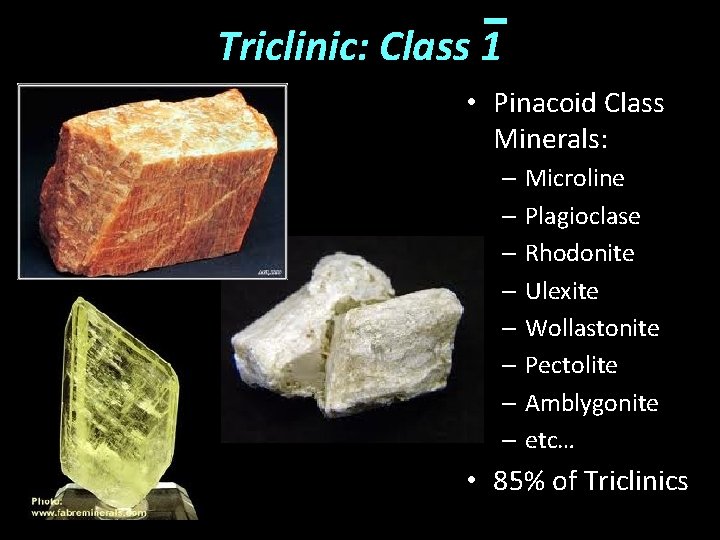
Triclinic: Class 1 • Pinacoid Class Minerals: – Microline – Plagioclase – Rhodonite – Ulexite – Wollastonite – Pectolite – Amblygonite – etc… • 85% of Triclinics
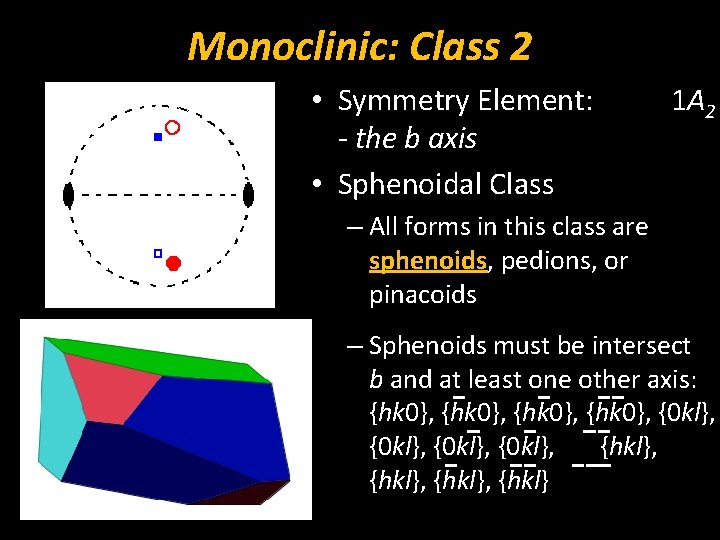
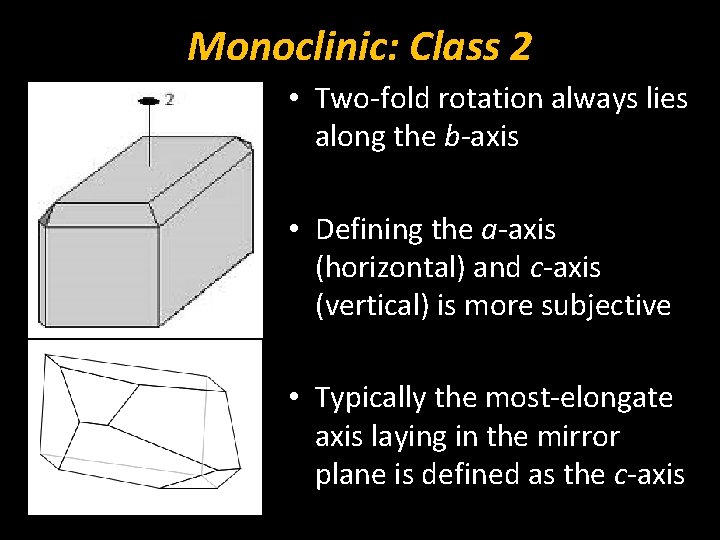
Monoclinic: Class 2 • Symmetry Element: - the b axis • Sphenoidal Class 1 A 2 – All forms in this class are sphenoids, pedions, or pinacoids – Sphenoids must be intersect b and at least one other axis: {hk 0}, {0 kl}, {hkl}, {hkl}
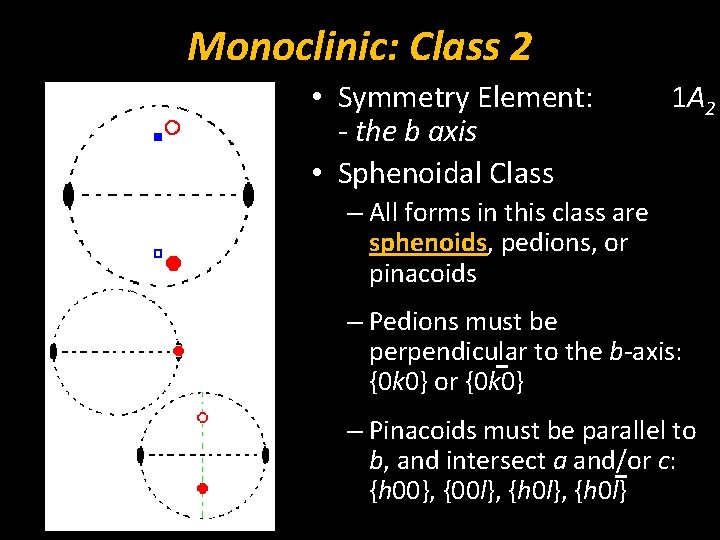
Monoclinic: Class 2 • Symmetry Element: - the b axis • Sphenoidal Class 1 A 2 – All forms in this class are sphenoids, pedions, or pinacoids – Pedions must be perpendicular to the b-axis: {0 k 0} or {0 k 0} – Pinacoids must be parallel to b, and intersect a and/or c: {h 00}, {00 l}, {h 0 l}
Monoclinic: Class 2 • Two-fold rotation always lies along the b-axis • Defining the a-axis (horizontal) and c-axis (vertical) is more subjective • Typically the most-elongate axis laying in the mirror plane is defined as the c-axis
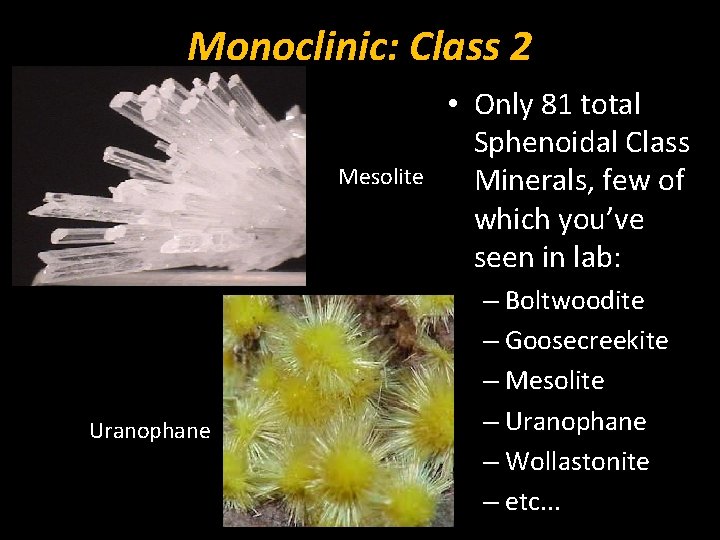
Monoclinic: Class 2 Mesolite Uranophane • Only 81 total Sphenoidal Class Minerals, few of which you’ve seen in lab: – Boltwoodite – Goosecreekite – Mesolite – Uranophane – Wollastonite – etc. . .
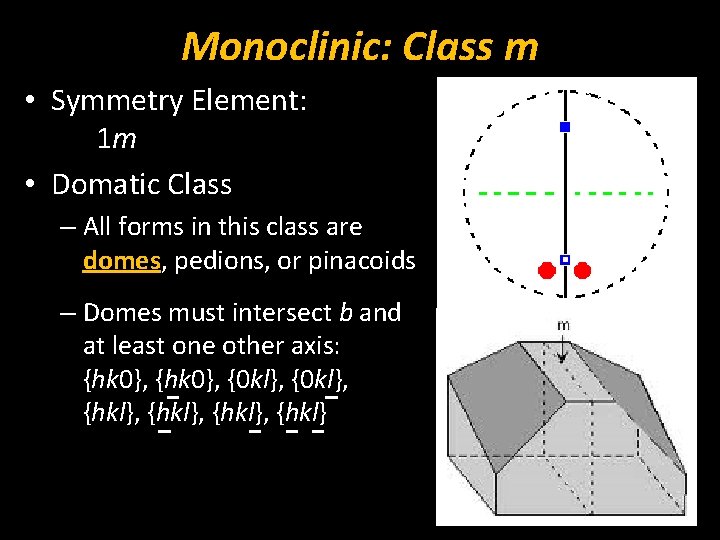
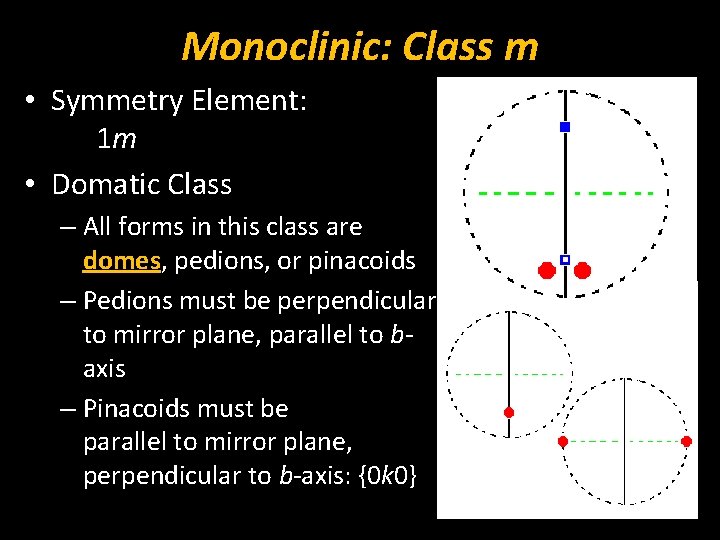
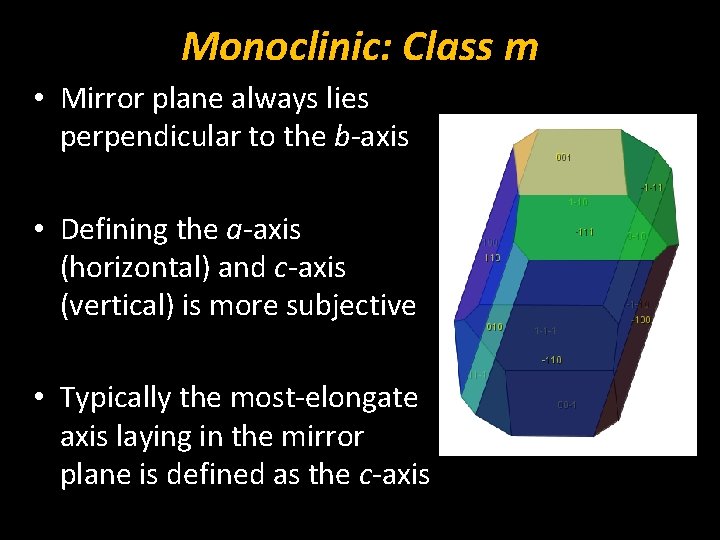
Monoclinic: Class m • Symmetry Element: 1 m • Domatic Class – All forms in this class are domes, pedions, or pinacoids – Domes must intersect b and at least one other axis: {hk 0}, {0 kl}, {hkl}, {hkl}
Monoclinic: Class m • Symmetry Element: 1 m • Domatic Class – All forms in this class are domes, pedions, or pinacoids – Pedions must be perpendicular to mirror plane, parallel to baxis – Pinacoids must be parallel to mirror plane, perpendicular to b-axis: {0 k 0}
Monoclinic: Class m • Mirror plane always lies perpendicular to the b-axis • Defining the a-axis (horizontal) and c-axis (vertical) is more subjective • Typically the most-elongate axis laying in the mirror plane is defined as the c-axis
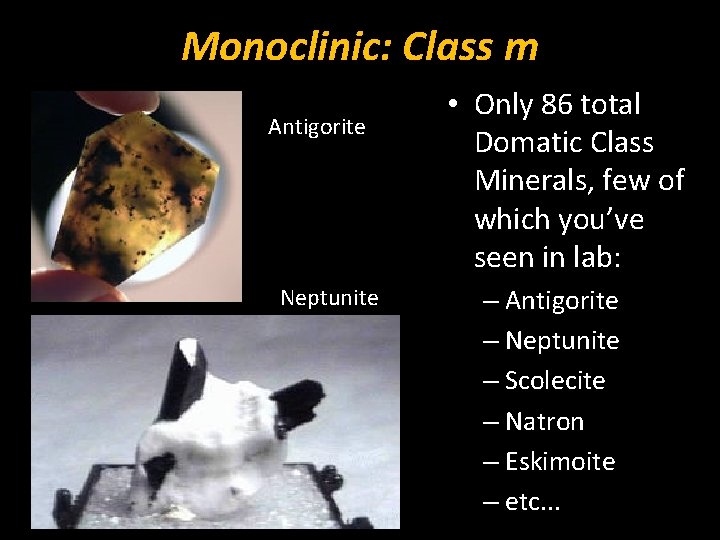
Monoclinic: Class m Antigorite Neptunite • Only 86 total Domatic Class Minerals, few of which you’ve seen in lab: – Antigorite – Neptunite – Scolecite – Natron – Eskimoite – etc. . .
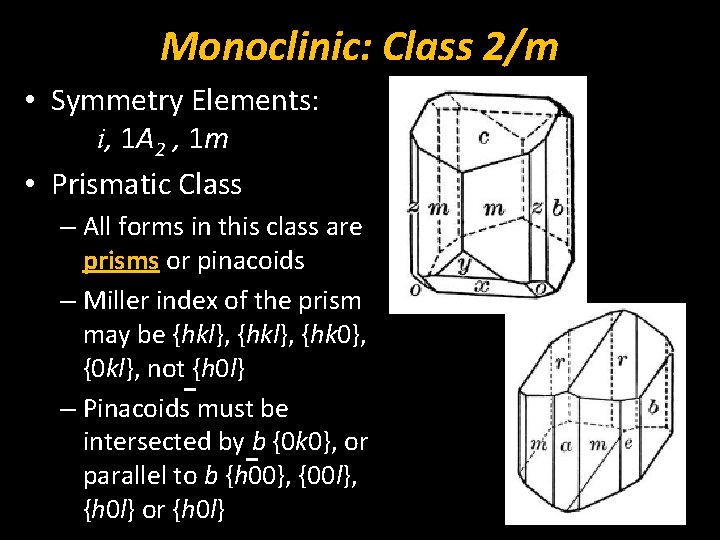
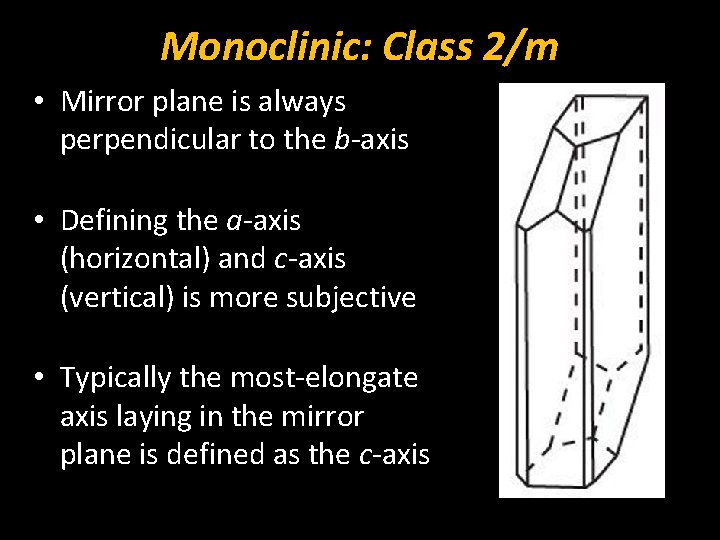
Monoclinic: Class 2/m • Symmetry Elements: i, 1 A 2 , 1 m • Prismatic Class – All forms in this class are prisms or pinacoids – Miller index of the prism may be {hkl}, {hk 0}, {0 kl}, not {h 0 l} – Pinacoids must be intersected by b {0 k 0}, or parallel to b {h 00}, {00 l}, {h 0 l} or {h 0 l}
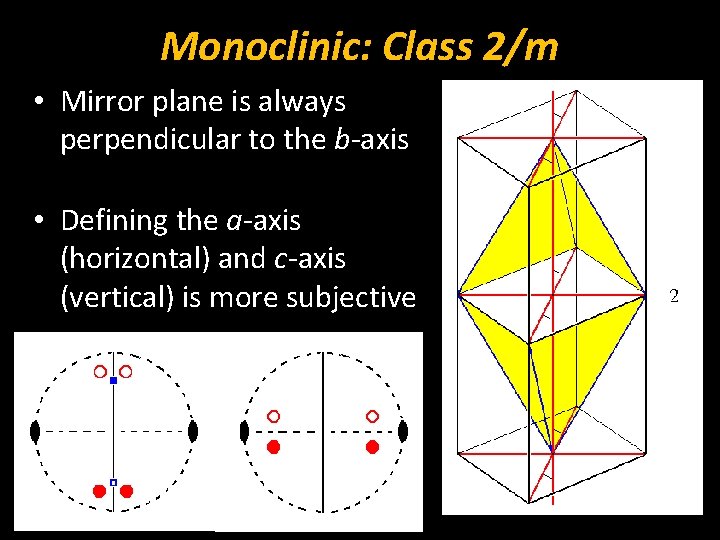
Monoclinic: Class 2/m • Mirror plane is always perpendicular to the b-axis • Defining the a-axis (horizontal) and c-axis (vertical) is more subjective
Monoclinic: Class 2/m • Mirror plane is always perpendicular to the b-axis • Defining the a-axis (horizontal) and c-axis (vertical) is more subjective • Typically the most-elongate axis laying in the mirror plane is defined as the c-axis
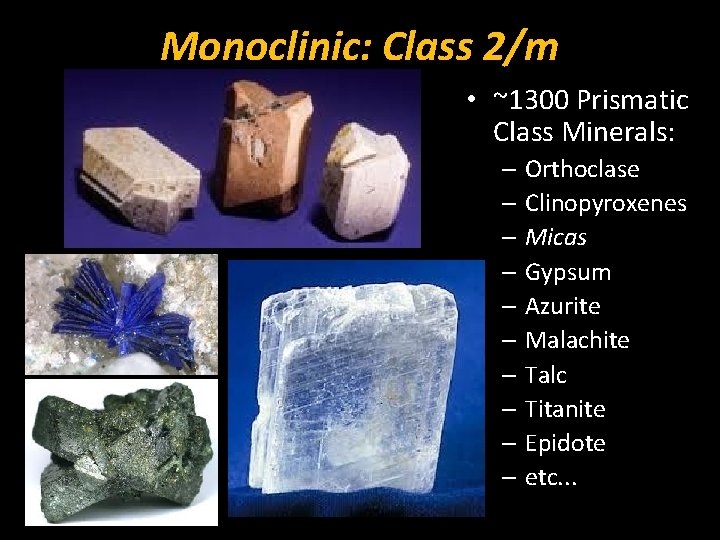
Monoclinic: Class 2/m • ~1300 Prismatic Class Minerals: – Orthoclase – Clinopyroxenes – Micas – Gypsum – Azurite – Malachite – Talc – Titanite – Epidote – etc. . .
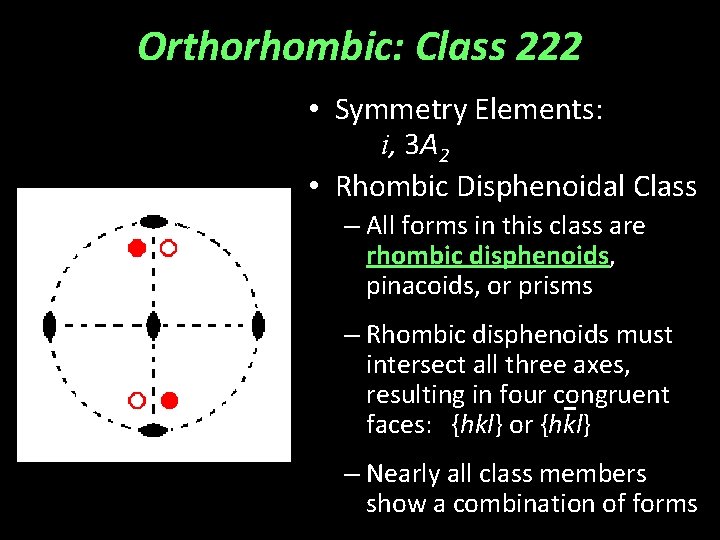
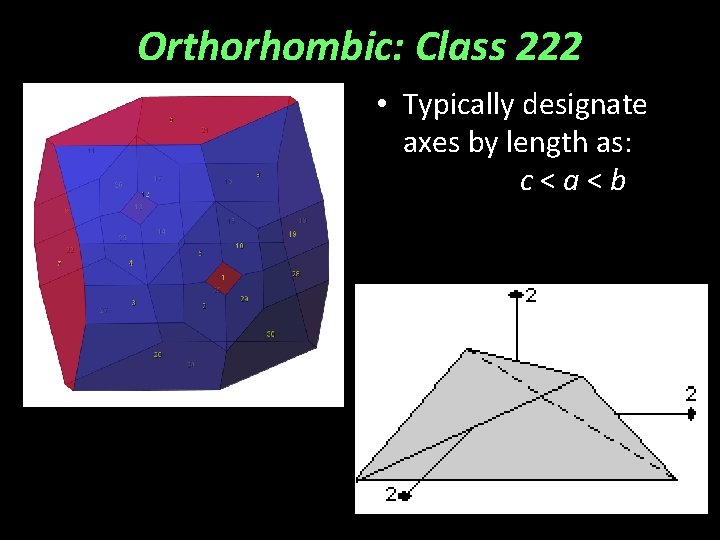
Orthorhombic: Class 222 • Symmetry Elements: i, 3 A 2 • Rhombic Disphenoidal Class – All forms in this class are rhombic disphenoids, pinacoids, or prisms – Rhombic disphenoids must intersect all three axes, resulting in four congruent faces: {hkl} or {hkl} – Nearly all class members show a combination of forms
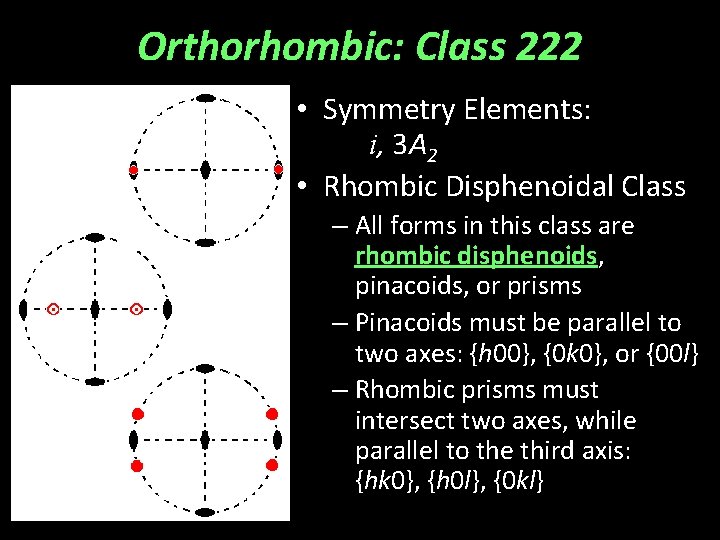
Orthorhombic: Class 222 • Symmetry Elements: i, 3 A 2 • Rhombic Disphenoidal Class – All forms in this class are rhombic disphenoids, pinacoids, or prisms – Pinacoids must be parallel to two axes: {h 00}, {0 k 0}, or {00 l} – Rhombic prisms must intersect two axes, while parallel to the third axis: {hk 0}, {h 0 l}, {0 kl}
Orthorhombic: Class 222 • Typically designate axes by length as: c<a<b
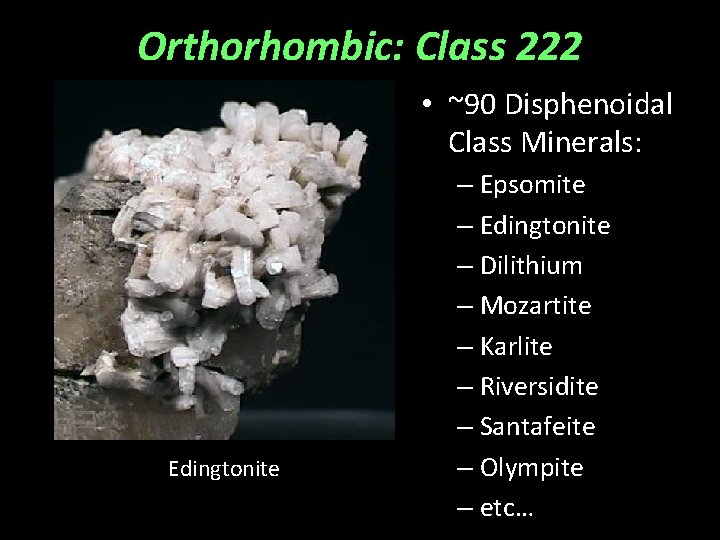
Orthorhombic: Class 222 • ~90 Disphenoidal Class Minerals: Edingtonite – Epsomite – Edingtonite – Dilithium – Mozartite – Karlite – Riversidite – Santafeite – Olympite – etc…
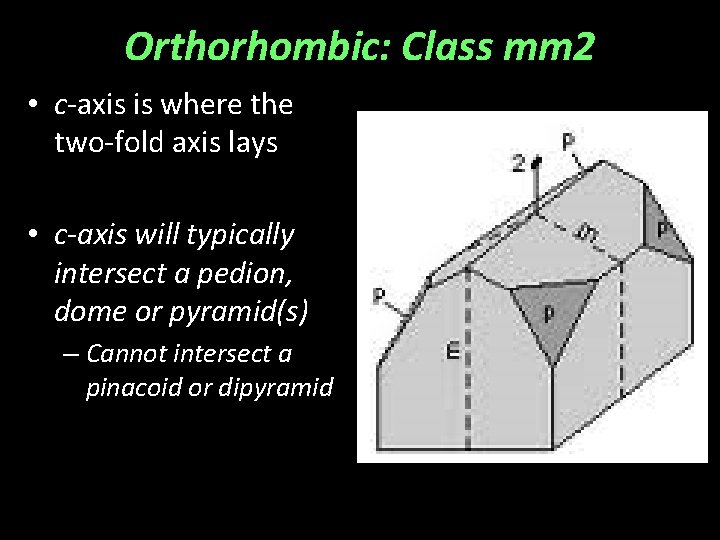
Orthorhombic: Class mm 2 • c-axis is where the two-fold axis lays • c-axis will typically intersect a pedion, dome or pyramid(s) – Cannot intersect a pinacoid or dipyramid
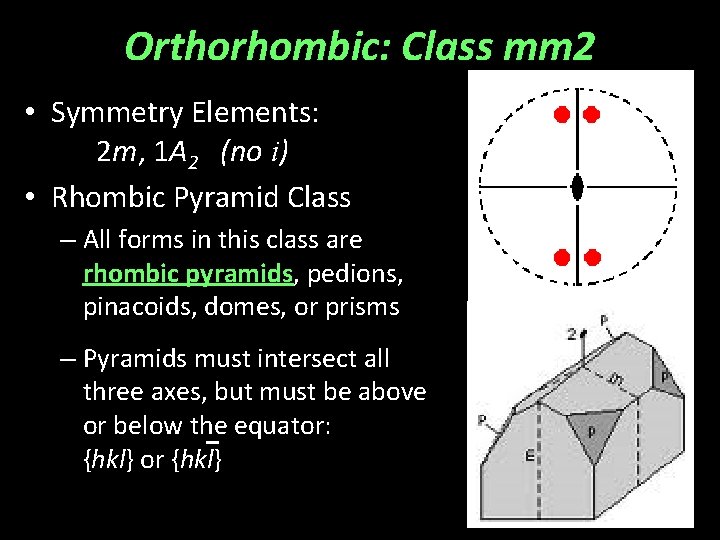
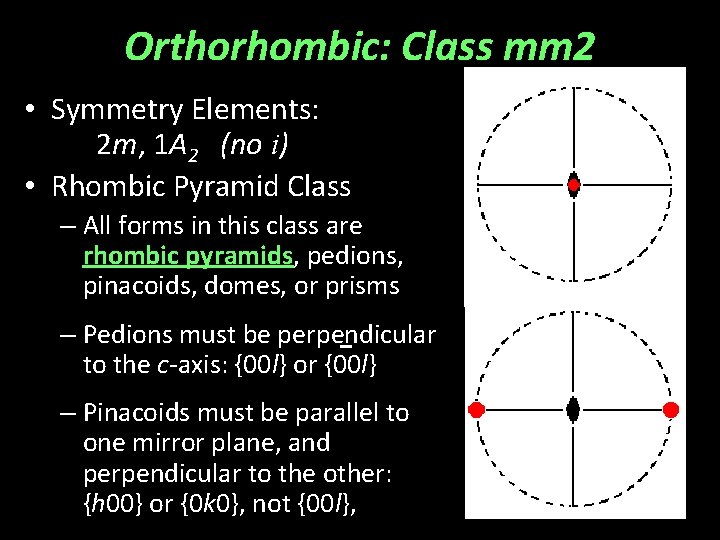
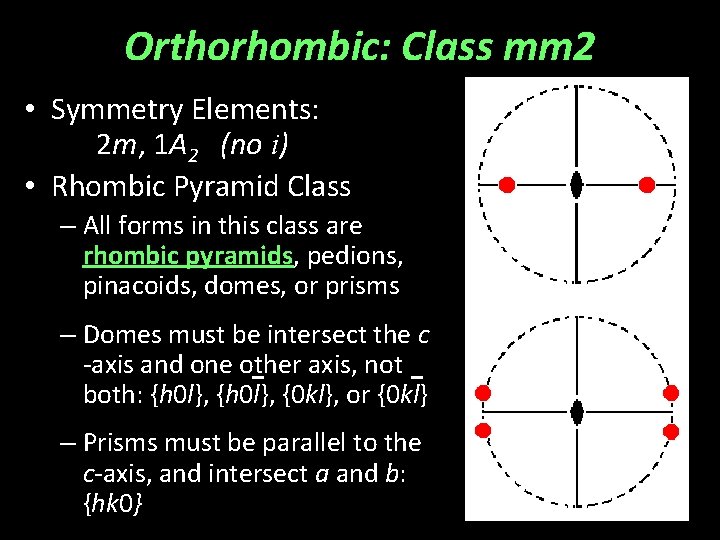
Orthorhombic: Class mm 2 • Symmetry Elements: 2 m, 1 A 2 (no i) • Rhombic Pyramid Class – All forms in this class are rhombic pyramids, pedions, pinacoids, domes, or prisms – Pyramids must intersect all three axes, but must be above or below the equator: {hkl} or {hkl}
Orthorhombic: Class mm 2 • Symmetry Elements: 2 m, 1 A 2 (no i) • Rhombic Pyramid Class – All forms in this class are rhombic pyramids, pedions, pinacoids, domes, or prisms – Pedions must be perpendicular to the c-axis: {00 l} or {00 l} – Pinacoids must be parallel to one mirror plane, and perpendicular to the other: {h 00} or {0 k 0}, not {00 l},
Orthorhombic: Class mm 2 • Symmetry Elements: 2 m, 1 A 2 (no i) • Rhombic Pyramid Class – All forms in this class are rhombic pyramids, pedions, pinacoids, domes, or prisms – Domes must be intersect the c -axis and one other axis, not both: {h 0 l}, {0 kl}, or {0 kl} – Prisms must be parallel to the c-axis, and intersect a and b: {hk 0}
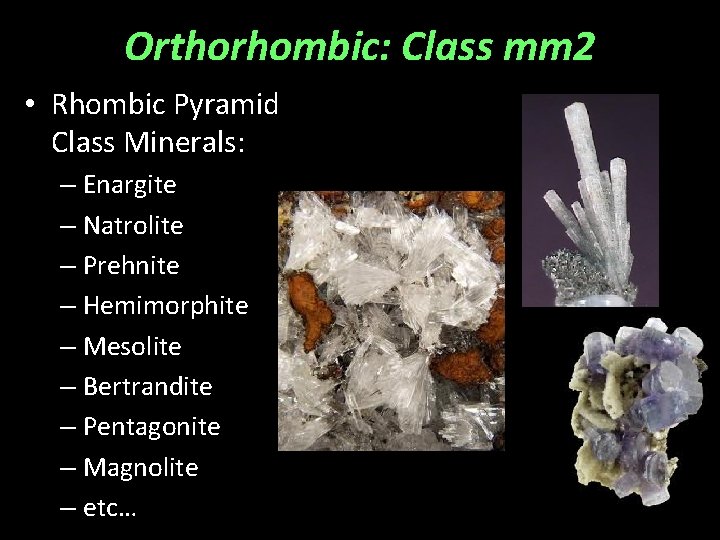
Orthorhombic: Class mm 2 • Rhombic Pyramid Class Minerals: – Enargite – Natrolite – Prehnite – Hemimorphite – Mesolite – Bertrandite – Pentagonite – Magnolite – etc…
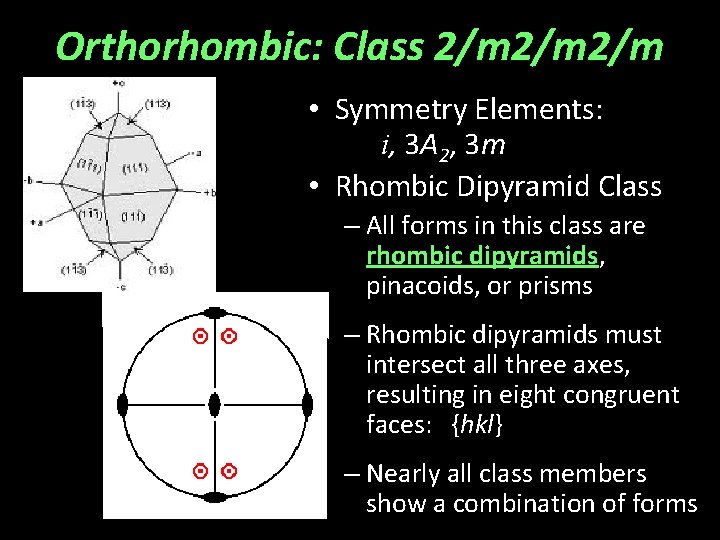
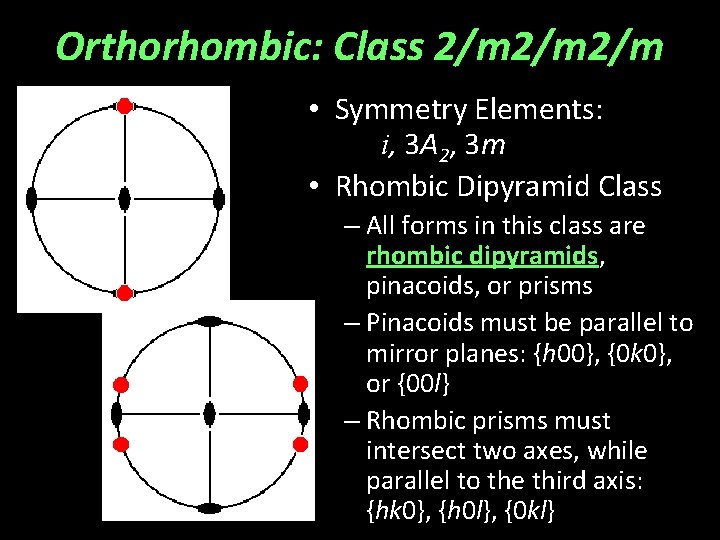
Orthorhombic: Class 2/m 2/m • Symmetry Elements: i, 3 A 2, 3 m • Rhombic Dipyramid Class – All forms in this class are rhombic dipyramids, pinacoids, or prisms – Rhombic dipyramids must intersect all three axes, resulting in eight congruent faces: {hkl} – Nearly all class members show a combination of forms
Orthorhombic: Class 2/m 2/m • Symmetry Elements: i, 3 A 2, 3 m • Rhombic Dipyramid Class – All forms in this class are rhombic dipyramids, pinacoids, or prisms – Pinacoids must be parallel to mirror planes: {h 00}, {0 k 0}, or {00 l} – Rhombic prisms must intersect two axes, while parallel to the third axis: {hk 0}, {h 0 l}, {0 kl}
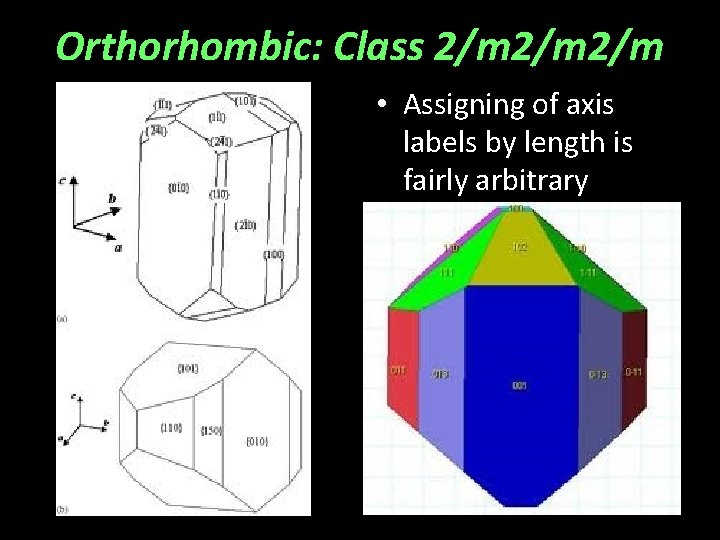
Orthorhombic: Class 2/m 2/m • Assigning of axis labels by length is fairly arbitrary
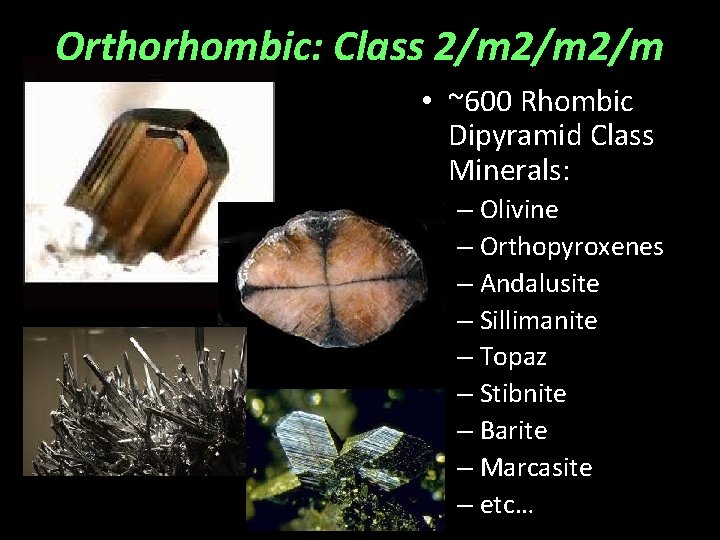
Orthorhombic: Class 2/m 2/m • ~600 Rhombic Dipyramid Class Minerals: – Olivine – Orthopyroxenes – Andalusite – Sillimanite – Topaz – Stibnite – Barite – Marcasite – etc…
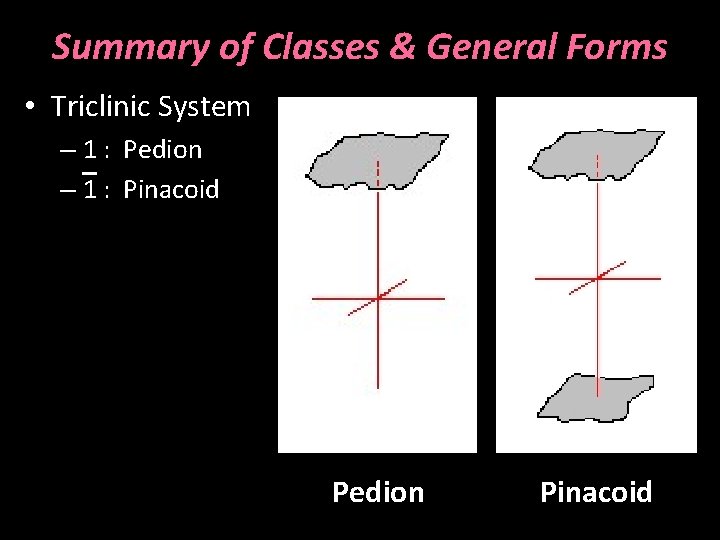
Summary of Classes & General Forms • Triclinic System – 1 : Pedion – 1 : Pinacoid Pedion Pinacoid
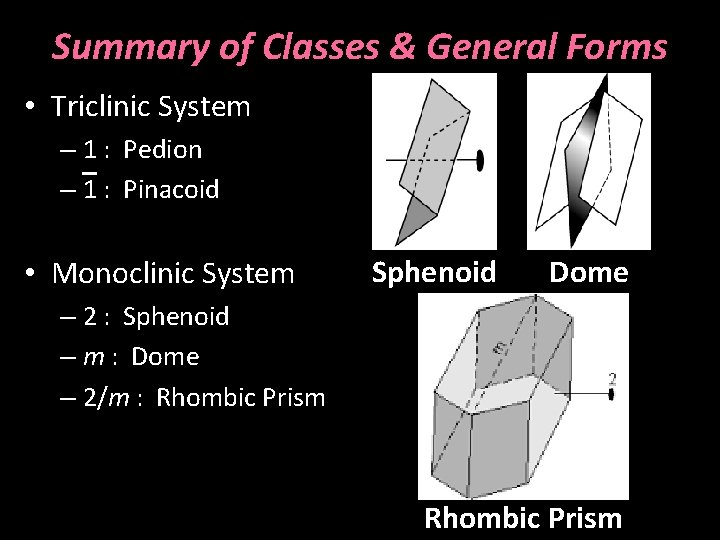
Summary of Classes & General Forms • Triclinic System – 1 : Pedion – 1 : Pinacoid • Monoclinic System Sphenoid Dome – 2 : Sphenoid – m : Dome – 2/m : Rhombic Prism
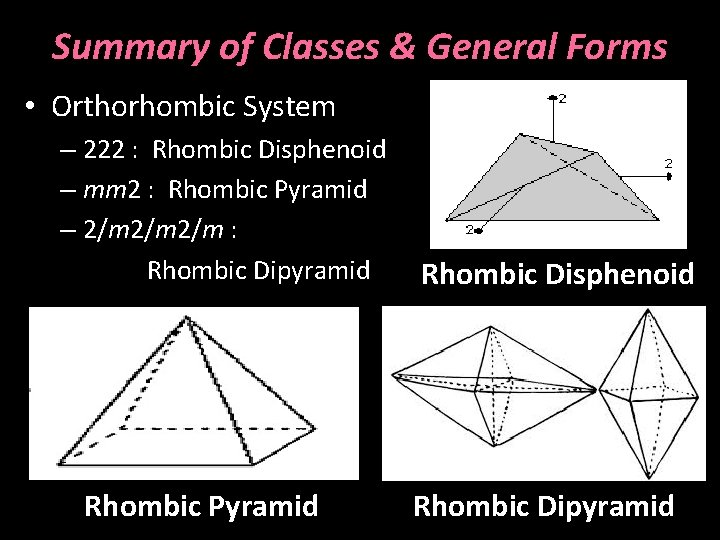
Summary of Classes & General Forms • Orthorhombic System – 222 : Rhombic Disphenoid – mm 2 : Rhombic Pyramid – 2/m 2/m : Rhombic Dipyramid Rhombic Pyramid Rhombic Disphenoid Rhombic Dipyramid