
The ThirtyMeter Telescope Project Design and Development Phase
- Slides: 37
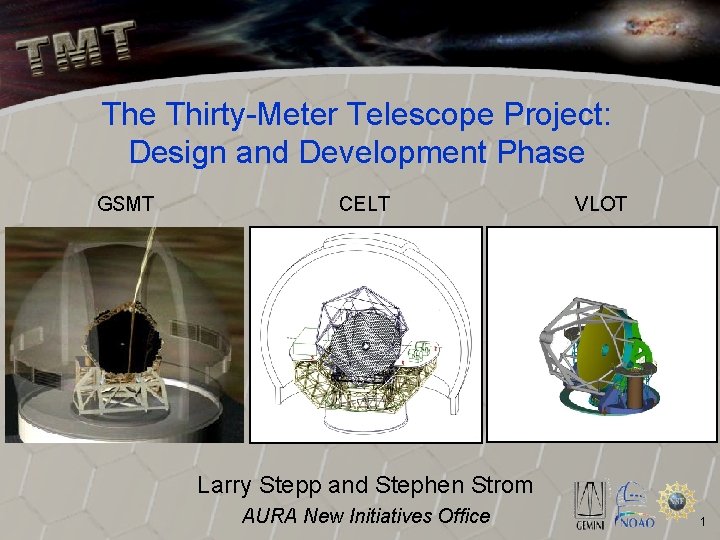
The Thirty-Meter Telescope Project: Design and Development Phase GSMT CELT VLOT Larry Stepp and Stephen Strom AURA New Initiatives Office 1
Outline • The TMT Partnership • The next step: TMT Design and Development Phase • Conceptual design process • Technology development activities • Site testing program • Conclusions 2
Goals of TMT Partnership • Combine the strengths of public and private observatories to create a 30 -m diffraction-limited telescope – Contemporary with JWST/ALMA – Following the recommendation of the AASC decadal review • Public access through peer review • Involve the community in defining observatory goals • Work with other ELT programs to maximize community benefit from available development funds 3
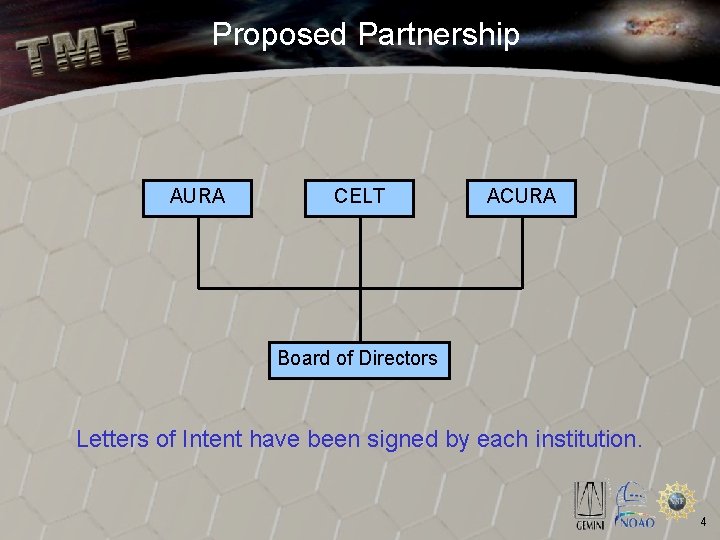
Proposed Partnership AURA CELT ACURA Board of Directors Letters of Intent have been signed by each institution. 4
Project Will Be Fully Integrated • Strong project scientist who helps guide all engineering decisions • Strong project manager responsible for performance, budget and schedule – Budget and schedule contingency controlled by project manager • Emphasis on systems engineering • Design-to-life-cycle-cost approach • Formal, rigorous design reviews • A product-oriented WBS – Reflected in organization of the project team 5
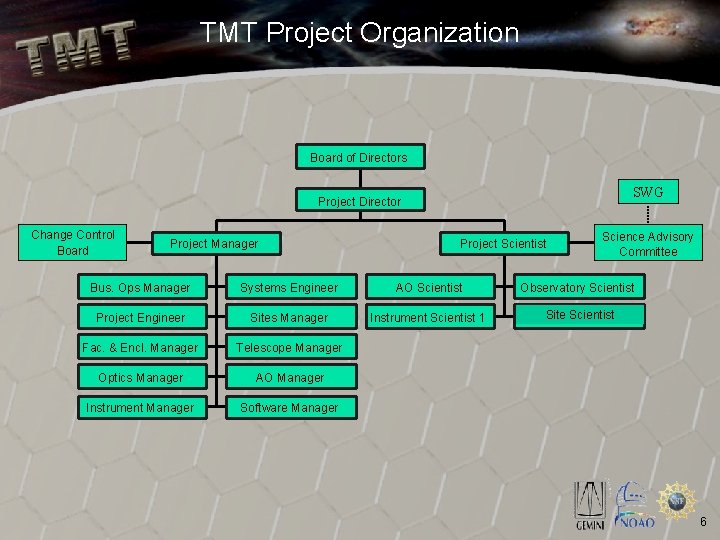
TMT Project Organization Board of Directors SWG Project Director Change Control Board Project Manager Project Scientist Science Advisory Committee Bus. Ops Manager Systems Engineer AO Scientist Observatory Scientist Project Engineer Sites Manager Instrument Scientist 1 Site Scientist Instrument Scientist 2 Fac. & Encl. Manager Telescope Manager Optics Manager AO Manager Instrument Manager Software Manager 6
The next step: TMT Design and Development Phase 7
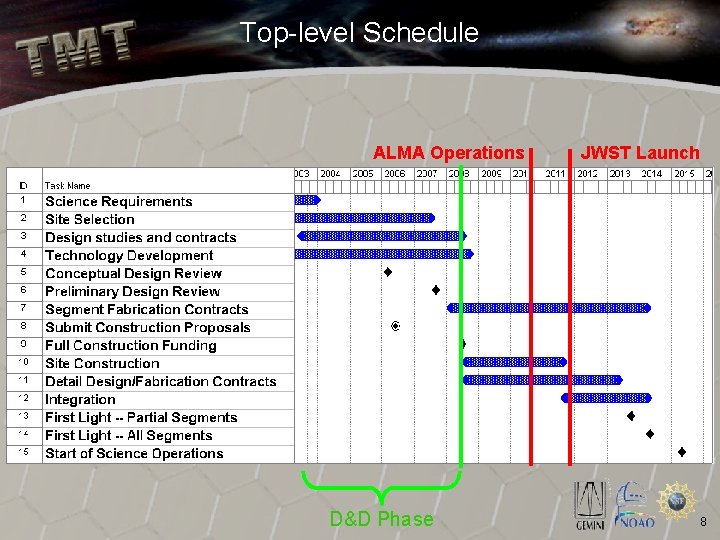
Top-level Schedule ALMA Operations D&D Phase JWST Launch 8
Conceptual Design Process: System Architecture Issues 9
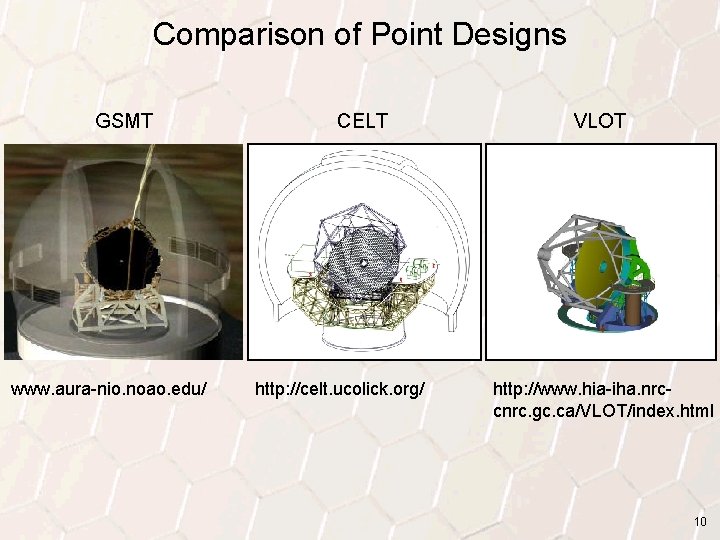
Comparison of Point Designs GSMT www. aura-nio. noao. edu/ CELT http: //celt. ucolick. org/ VLOT http: //www. hia-iha. nrccnrc. gc. ca/VLOT/index. html 10
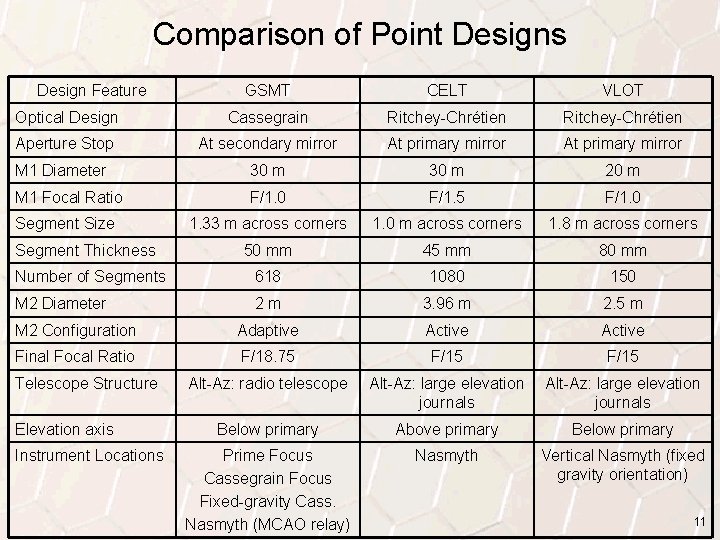
Comparison of Point Designs Design Feature GSMT CELT VLOT Optical Design Cassegrain Ritchey-Chrétien Aperture Stop At secondary mirror At primary mirror M 1 Diameter 30 m 20 m M 1 Focal Ratio F/1. 0 F/1. 5 F/1. 0 Segment Size 1. 33 m across corners 1. 0 m across corners 1. 8 m across corners 50 mm 45 mm 80 mm Number of Segments 618 1080 150 M 2 Diameter 2 m 3. 96 m 2. 5 m M 2 Configuration Adaptive Active Final Focal Ratio F/18. 75 F/15 Alt-Az: radio telescope Alt-Az: large elevation journals Below primary Above primary Below primary Prime Focus Cassegrain Focus Fixed-gravity Cass. Nasmyth (MCAO relay) Nasmyth Vertical Nasmyth (fixed gravity orientation) Segment Thickness Telescope Structure Elevation axis Instrument Locations 11
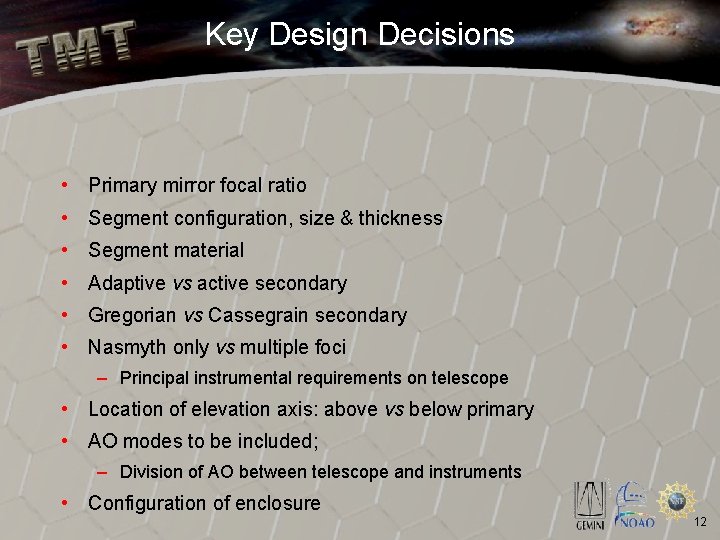
Key Design Decisions • Primary mirror focal ratio • Segment configuration, size & thickness • Segment material • Adaptive vs active secondary • Gregorian vs Cassegrain secondary • Nasmyth only vs multiple foci – Principal instrumental requirements on telescope • Location of elevation axis: above vs below primary • AO modes to be included; – Division of AO between telescope and instruments • Configuration of enclosure 12
Conceptual Design Process • Design trade studies consider performance, cost & risk – Performance evaluated by simulations and integrated modeling – Operations modeling used to consider effect of observing modes on scientific output and cost – Costs evaluated by parametric cost estimating – Science return evaluated using observing scenarios and quantitative figures of merit • Trade studies performed by project team with help from consultants and industry • Instrument conceptual designs developed by competing teams from observatories, universities or industry 13
Technology Development Activities 14
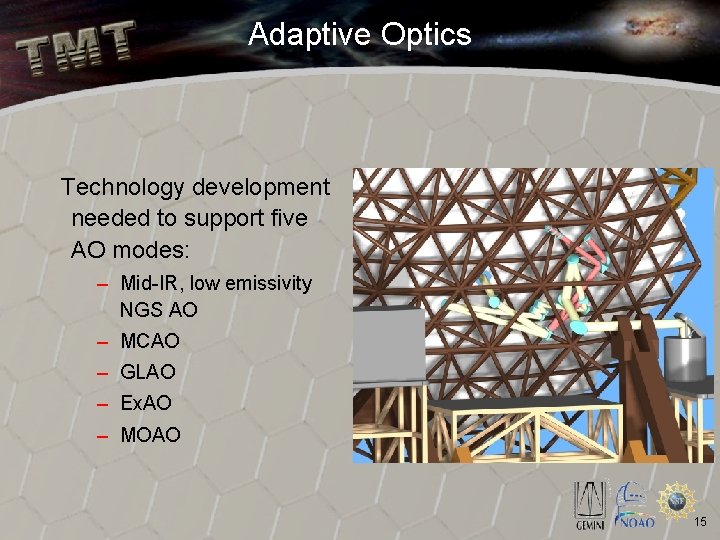
Adaptive Optics Technology development needed to support five AO modes: – Mid-IR, low emissivity NGS AO – MCAO – GLAO – Ex. AO – MOAO 15
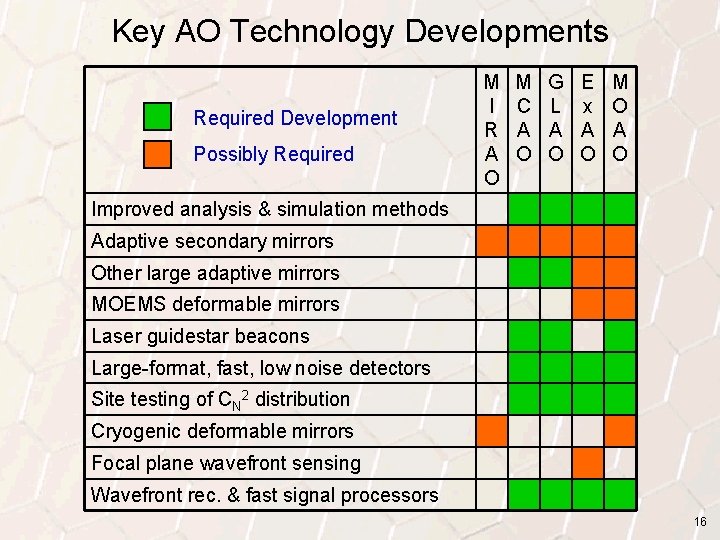
Key AO Technology Developments Required Development Possibly Required M I R A O M C A O G L A O E x A O M O A O Improved analysis & simulation methods Adaptive secondary mirrors Other large adaptive mirrors MOEMS deformable mirrors Laser guidestar beacons Large-format, fast, low noise detectors Site testing of CN 2 distribution Cryogenic deformable mirrors Focal plane wavefront sensing Wavefront rec. & fast signal processors 16
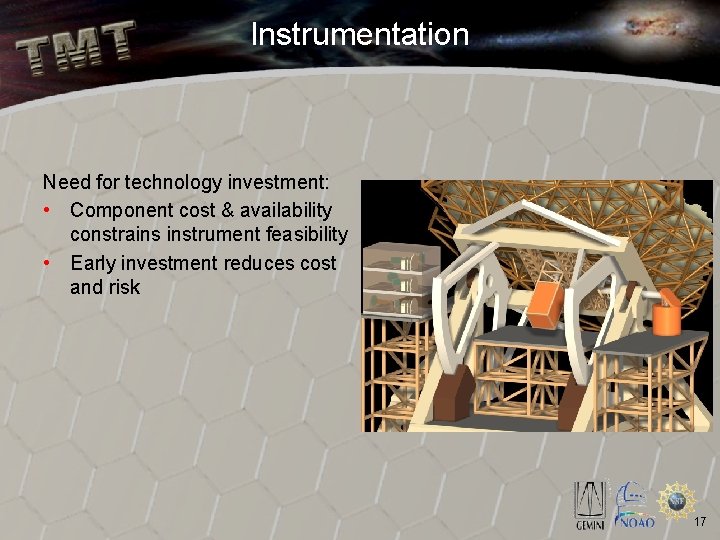
Instrumentation Need for technology investment: • Component cost & availability constrains instrument feasibility • Early investment reduces cost and risk 17
Instruments Under Consideration • Wide-field optical spectrograph • Million-element IFU spectrograph • High resolution optical spectrograph • GLAO-fed near-IR MOS/IFU • MCAO-fed near-IR imager • MCAO-fed deployable IFU spectrograph • Extreme AO coronagraph • Near-IR Echelle spectrograph • Mid-IR imager/low resolution spectrograph 18
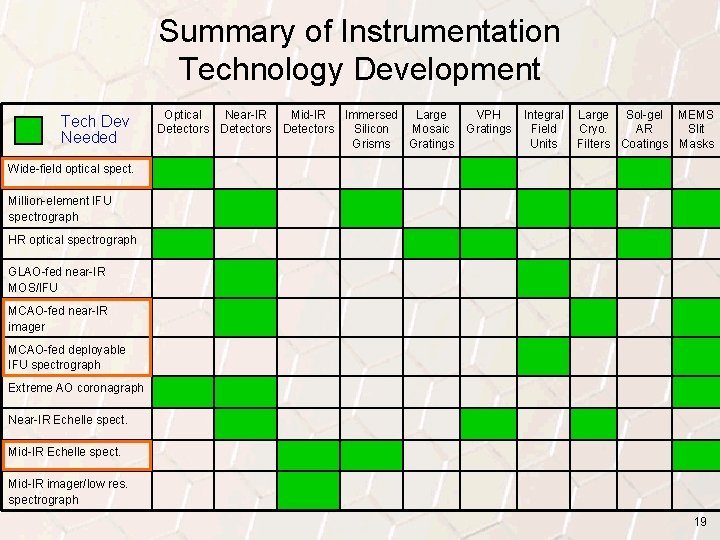
Summary of Instrumentation Technology Development Tech Dev Needed Optical Near-IR Mid-IR Immersed Large Detectors Silicon Mosaic Grisms Gratings VPH Gratings Integral Field Units Large Sol-gel MEMS Cryo. AR Slit Filters Coatings Masks Wide-field optical spect. Million-element IFU spectrograph HR optical spectrograph GLAO-fed near-IR MOS/IFU MCAO-fed near-IR imager MCAO-fed deployable IFU spectrograph Extreme AO coronagraph Near-IR Echelle spect. Mid-IR imager/low res. spectrograph 19
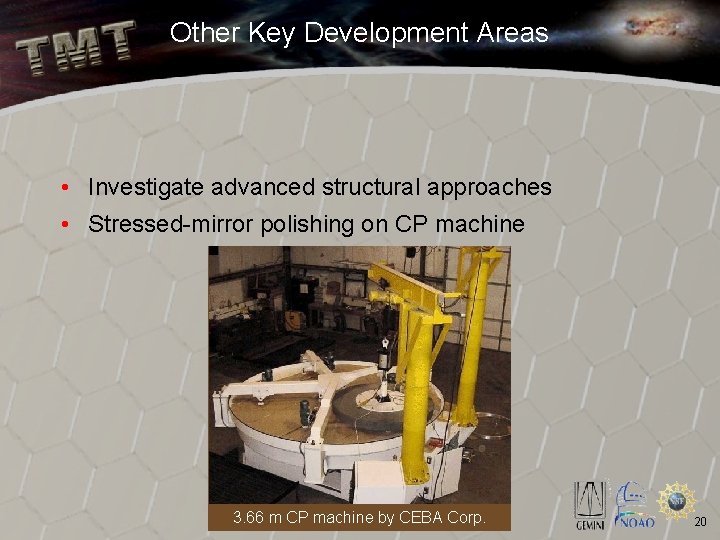
Other Key Development Areas • Investigate advanced structural approaches • Stressed-mirror polishing on CP machine 3. 66 m CP machine by CEBA Corp. 20
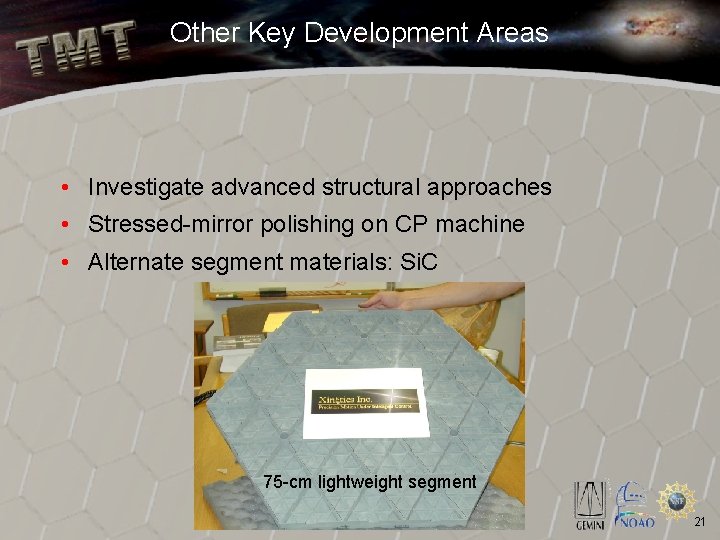
Other Key Development Areas • Investigate advanced structural approaches • Stressed-mirror polishing on CP machine • Alternate segment materials: Si. C 75 -cm lightweight segment 21
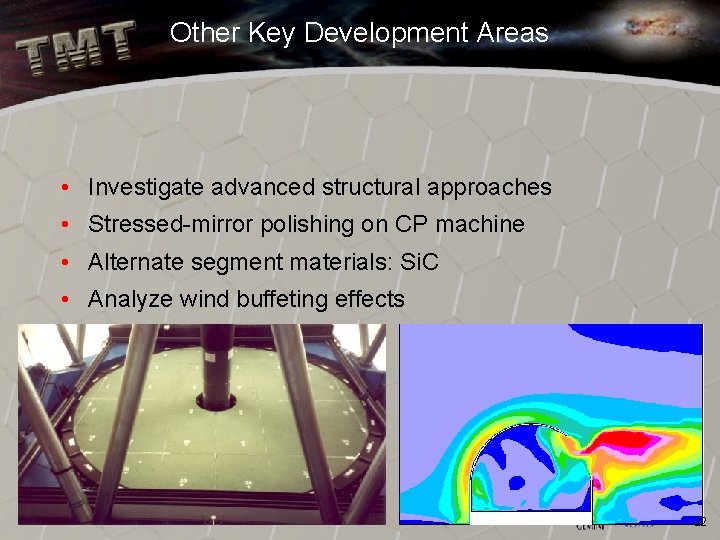
Other Key Development Areas • Investigate advanced structural approaches • Stressed-mirror polishing on CP machine • Alternate segment materials: Si. C • Analyze wind buffeting effects 22
Other Key Development Areas • Investigate advanced structural approaches • Stressed-mirror polishing on CP machine • Alternate segment materials: Si. C • Analyze wind buffeting effects • Develop integrated modeling tools • High-performance durable coatings • Software architecture • Operations modeling 23
Site Evaluation 24
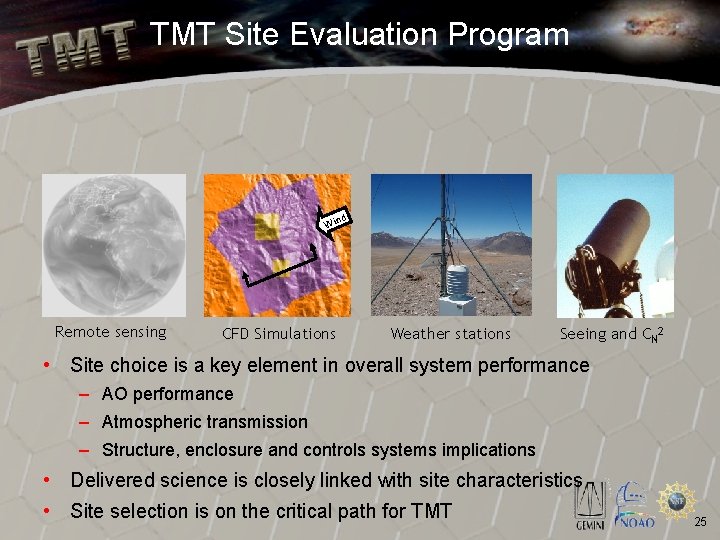
TMT Site Evaluation Program d Win Remote sensing CFD Simulations Weather stations Seeing and CN 2 • Site choice is a key element in overall system performance – AO performance – Atmospheric transmission – Structure, enclosure and controls systems implications • Delivered science is closely linked with site characteristics • Site selection is on the critical path for TMT 25
Key Requirements • Uniform evaluation information + data for multiple sites – Cloud cover – Precipitable water vapor – Long-term weather patterns – Wind flow and turbulence modeling – In situ measurements of temperature; wind – Ground-layer and upper atmospheric turbulence measurements – Seismicity and geotechnical characteristics – Light pollution; demographic and ownership issues • These data are essential to inform a site choice for any ELT 26
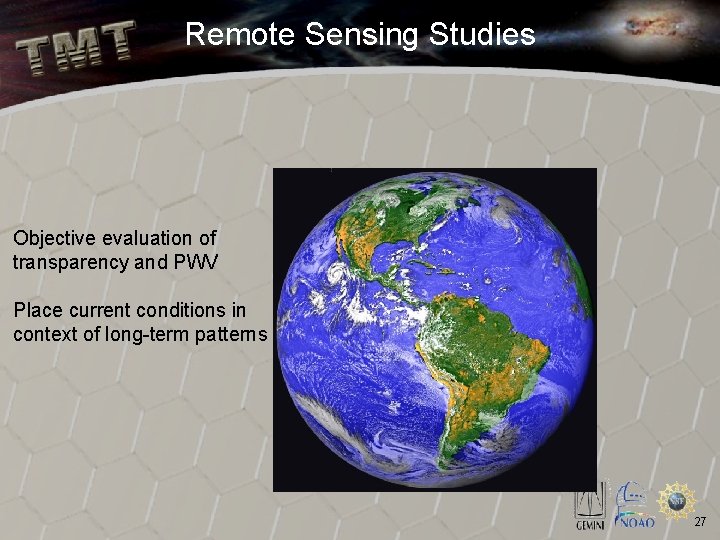
Remote Sensing Studies Objective evaluation of transparency and PWV Place current conditions in context of long-term patterns 27
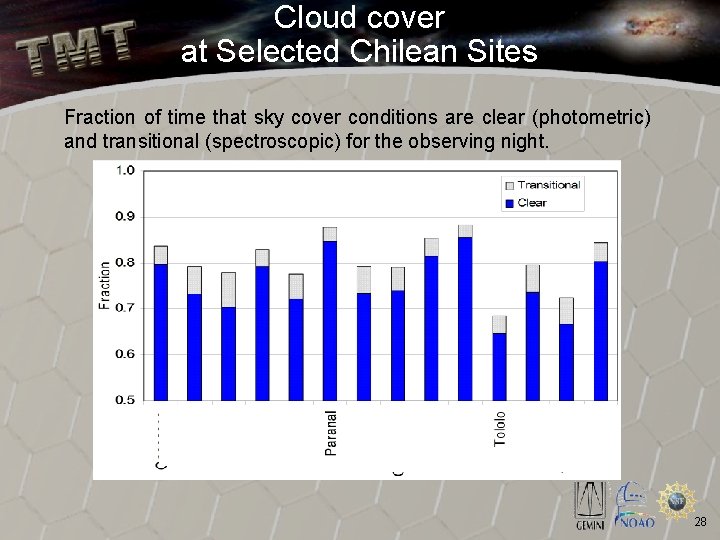
Cloud cover at Selected Chilean Sites Fraction of time that sky cover conditions are clear (photometric) and transitional (spectroscopic) for the observing night. 28
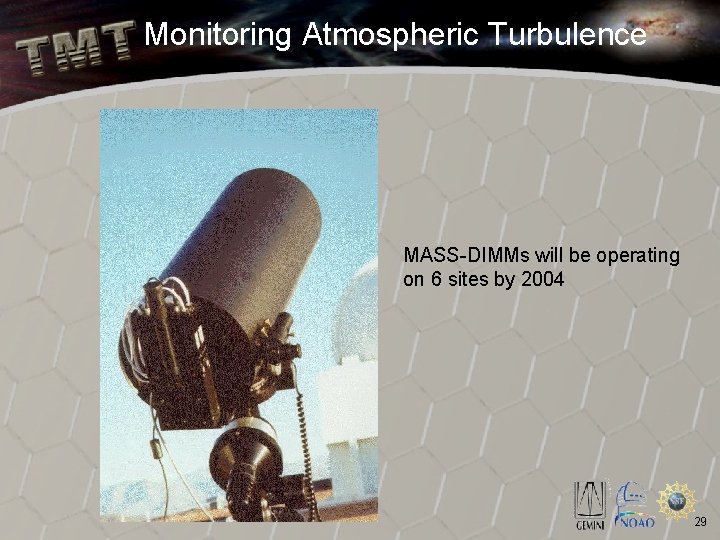
Monitoring Atmospheric Turbulence MASS-DIMMs will be operating on 6 sites by 2004 29
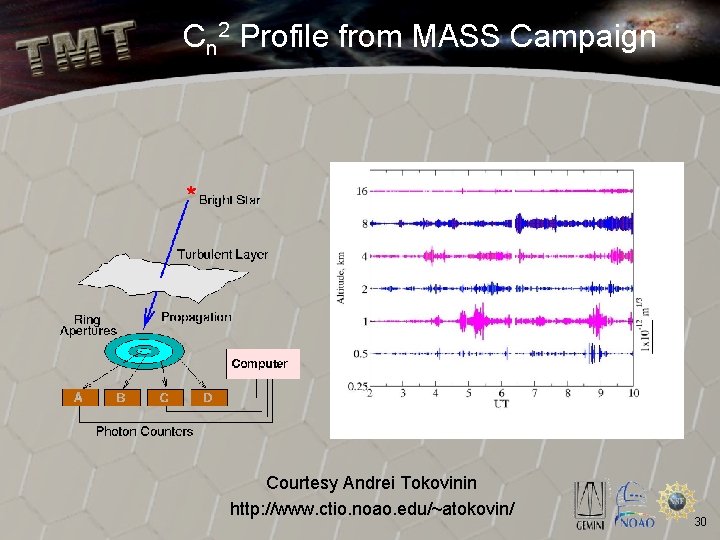
Cn 2 Profile from MASS Campaign Courtesy Andrei Tokovinin http: //www. ctio. noao. edu/~atokovin/ 30
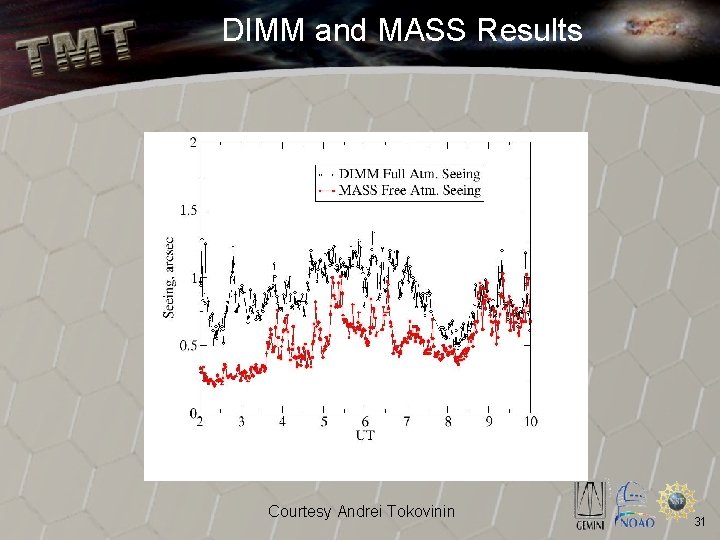
DIMM and MASS Results Courtesy Andrei Tokovinin 31
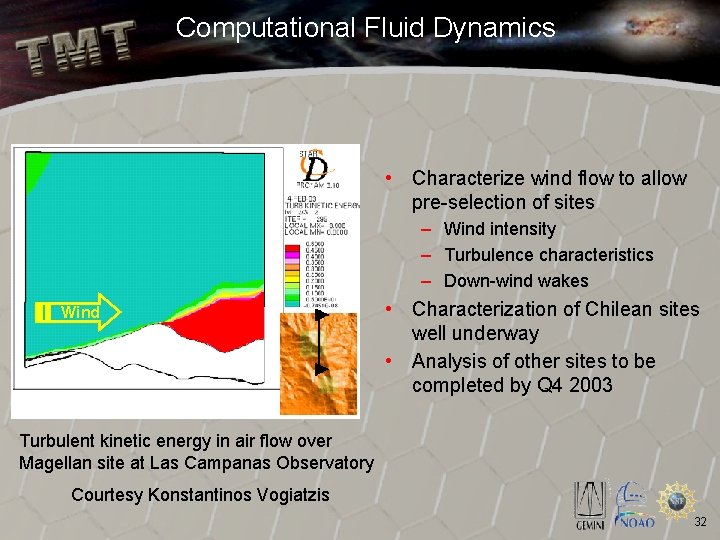
Computational Fluid Dynamics • Characterize wind flow to allow pre-selection of sites – Wind intensity – Turbulence characteristics – Down-wind wakes Wind • Characterization of Chilean sites well underway • Analysis of other sites to be completed by Q 4 2003 Turbulent kinetic energy in air flow over Magellan site at Las Campanas Observatory Courtesy Konstantinos Vogiatzis 32
Other TMT-Related Papers in this Workshop Richard Dekany, Exo-Earth Study with CELT René Doyon, Detecting and Characterizing Exo-planets using Multi-Color Detector Arrays Jerry Nelson et al, California Extremely Large Telescope Dennis Crabtree, An Overview of the Canadian VLOT Project Jeremy Mould, GSMT George Angeli, Robert Upton, Brooke Gregory, Brent Ellerbroek and Anna Segurson, Active Optics for a Giant Segmented Mirror Telescope Scott Roberts, John Pazder, Nathan Loewen, Joeleff Fitzsimmons, and Raymond Yu, Integrated Modeling of the Canadian Very Large Optical Telescope Konstantinos Vogiatzis and David S. De. Young, Numerical Simulations of Flow in Extremely Large Telescope Enclosures Joeleff Fitzsimmons, Glen Herriot, Laurent Jolissaint, John Pazder, Scott Roberts, Mahmoud Mamou, and Kevin Cooper, Aerodynamic Modeling of the Canadian Very Large Optical Telescope 33
Other TMT-Related Papers in this Workshop Gary Chanan, Issues in Segment Alignment for Extremely Large Telescopes Don Gavel, Sodium Laser Guidestar Adaptive Optics: Lessons Learned Laurent Jolissaint, Jeffrey A. Stoesz, and Jean-Pierre Veran, Wide Field Adaptive Optics for Large Optical Telescopes: Upper Bound on Performance Brent Ellerbroek, Wavefront Reconstruction Algorithms and Simulation Results for Multi-Conjugate Adaptive Optics on Giant Telescopes Andrei Tokovinin, Sensing and Compensation of Ground-layer Turbulence at ELTs Mark Chun, Site Characterization at Mauna Kea for an ELT Konstantinos Vogiatzis and David S. De. Young, Site Characterization through the Use of Computational Fluid Dynamics John Pazder, Laurent Jolissaint, Scott Roberts, and Malcolm Smith, The Optical Modeling Tools for the Canadian Very Large Optical Telescope Integrated Model Laurent Jolissaint and Jean-Pierre Veran, PAOLA, an Analytic Code for Fast and Accurate Astronomical Adaptive Optics Performance Studies 34
Current Status of TMT Project • Proposals submitted to a private foundation & CFI; AURA proposal to NSF ready to submit • Interim Board of Directors meeting monthly • Science Advisory Committee meeting monthly – Developing Science Requirements Document • Interim Steering Group meeting monthly, telecons weekly • Advertisements placed for Project Manager – Send resumes to: TMT Search Committee c/o Stacey Scoville California Institute of Technology 1200 East California Boulevard Mail Code 206 -31 Pasadena, CA 91125, USA 35
Key Activities for Immediate Start We are initiating long-lead-time activities that will drive the conceptual design choices over the next 30 months: – – – – Site testing Develop stressed-mirror polishing techniques Develop lightweight Si. C mirror blanks Model dynamic disturbances caused by wind Develop large adaptive mirrors Initiate AO development strategy Develop durable coatings Investigate designs for seeing-limited instruments to understand their impact on the telescope design 36
Conclusions • We are launching the TMT D&D Phase • Goal is to have Co. DR in 30 months – – Evaluate design options and costs Develop needed technology Evaluate potential sites Select optimal design, define associated cost • TMT goal is to have first light with all segments in 2014 37