
The ThirtyFirst AAAI Conference on Artificial Intelligence San


- Slides: 18
The Thirty-First AAAI Conference on Artificial Intelligence San Francisco, California, USA. February 4– 9, 2017 Coupling Implicit and Explicit Knowledge for Customer Volume Prediction Jingyuan Wang, Yating Lin, Junjie Wu, Zhong Wang and Zhang Xiong Beihang University, Beijing, China
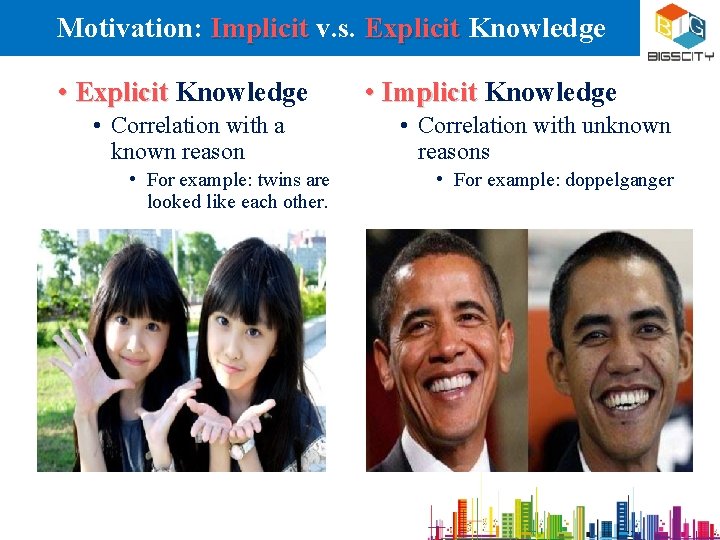
Motivation: Implicit v. s. Explicit Knowledge • Correlation with a known reason • For example: twins are looked like each other. • Implicit Knowledge • Correlation with unknown reasons • For example: doppelganger
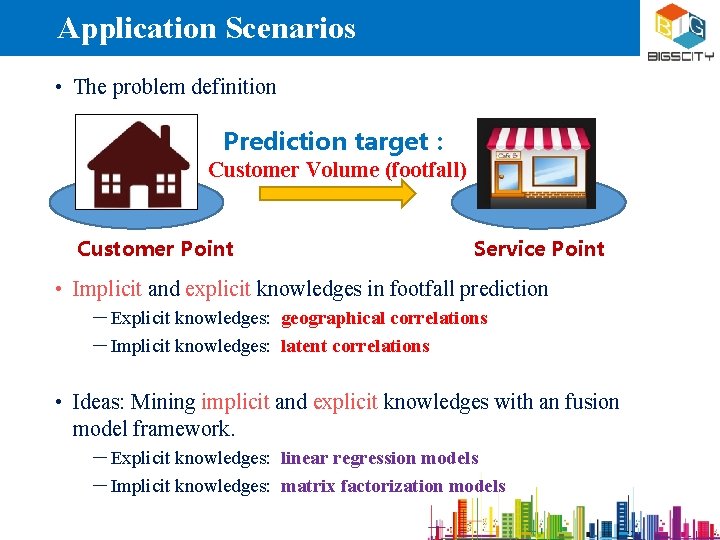
Application Scenarios • The problem definition Prediction target: Customer Volume (footfall) Customer Point Service Point • Implicit and explicit knowledges in footfall prediction ―Explicit knowledges: geographical correlations ―Implicit knowledges: latent correlations • Ideas: Mining implicit and explicit knowledges with an fusion model framework. ―Explicit knowledges: linear regression models ―Implicit knowledges: matrix factorization models
Related Works • Footfall prediction • Geo-spotting (Karamshuk et al. 2013) • Optimized location selection (Li et al. 2015) • Real estate appraisal (Fu et al. 2014 a; 2014 b) • Service requirements mining (Xu et al. 2016) • Limitation: • Most of these approaches are based on explicit geographic contexts. • Few methods have the ability to exploit implicit correlations in data. • Implicit correlations mining • PHF-MF Model (Cui et al. 2011 b; 2011 a) • Geo-MF Model (Lian et al. 2014) • CLAR model (Zheng et al. 2010 a) • UCLAF model (Zheng et al. 2010 b; 2012) • Limitation: • Most of these works treat implicit correlations as the most important knowledge. • Uses explicit information as their regulations.
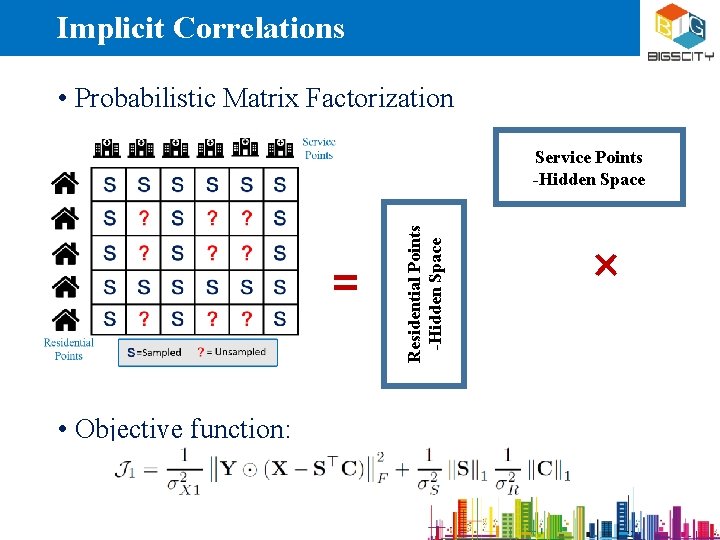
Implicit Correlations • Probabilistic Matrix Factorization = • Objective function: Residential Points -Hidden Space Service Points -Hidden Space ×
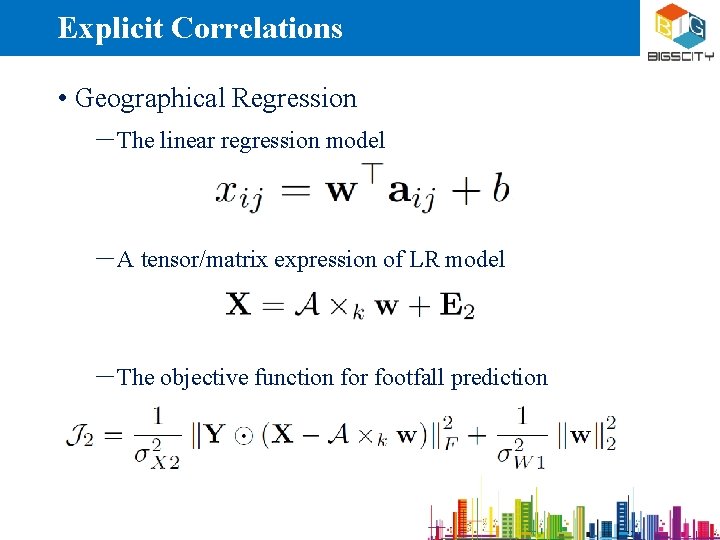
Explicit Correlations • Geographical Regression ―The linear regression model ―A tensor/matrix expression of LR model ―The objective function for footfall prediction
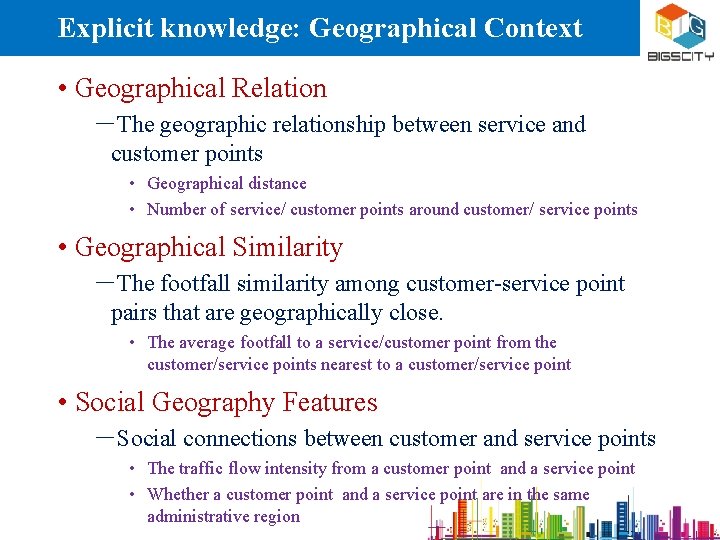
Explicit knowledge: Geographical Context • Geographical Relation ―The geographic relationship between service and customer points • Geographical distance • Number of service/ customer points around customer/ service points • Geographical Similarity ―The footfall similarity among customer-service point pairs that are geographically close. • The average footfall to a service/customer point from the customer/service points nearest to a customer/service point • Social Geography Features ―Social connections between customer and service points • The traffic flow intensity from a customer point and a service point • Whether a customer point and a service point are in the same administrative region
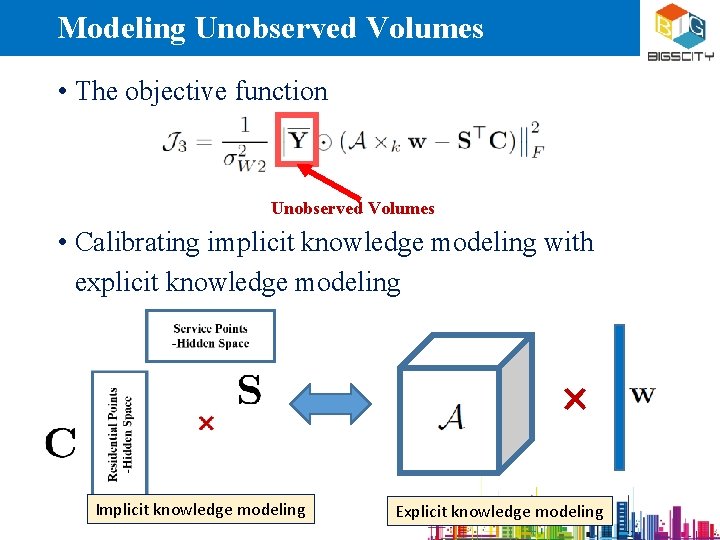
Modeling Unobserved Volumes • The objective function Unobserved Volumes • Calibrating implicit knowledge modeling with explicit knowledge modeling × Implicit knowledge modeling Explicit knowledge modeling
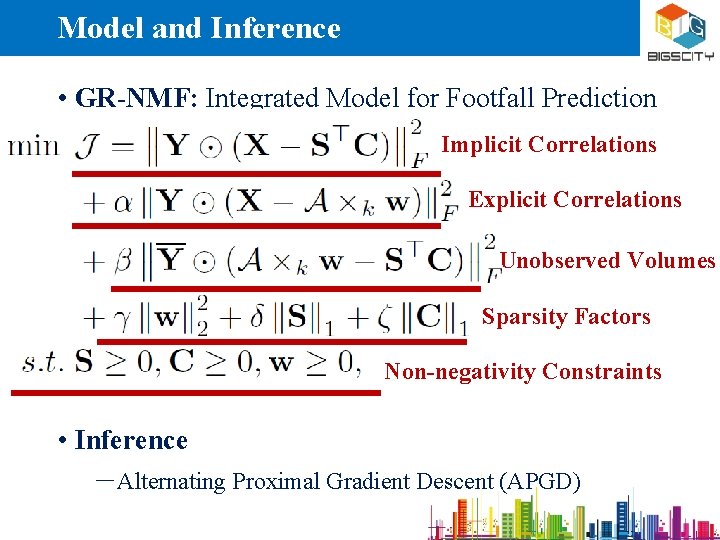
Model and Inference • GR-NMF: Integrated Model for Footfall Prediction Implicit Correlations Explicit Correlations Unobserved Volumes Sparsity Factors Non-negativity Constraints • Inference ―Alternating Proximal Gradient Descent (APGD)
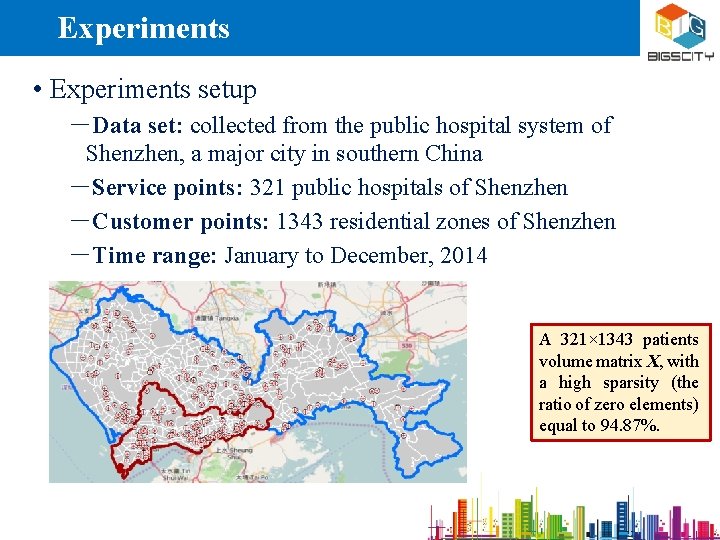
Experiments • Experiments setup ―Data set: collected from the public hospital system of Shenzhen, a major city in southern China ―Service points: 321 public hospitals of Shenzhen ―Customer points: 1343 residential zones of Shenzhen ―Time range: January to December, 2014 A 321× 1343 patients volume matrix X, with a high sparsity (the ratio of zero elements) equal to 94. 87%.
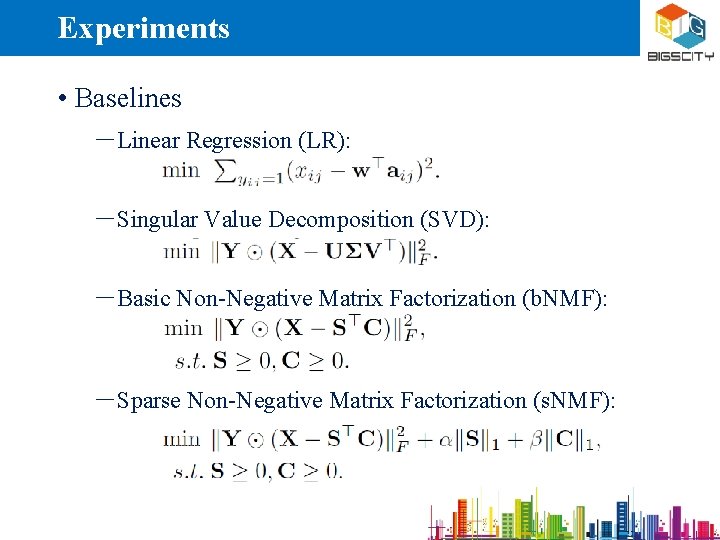
Experiments • Baselines ―Linear Regression (LR): ―Singular Value Decomposition (SVD): ―Basic Non-Negative Matrix Factorization (b. NMF): ―Sparse Non-Negative Matrix Factorization (s. NMF):
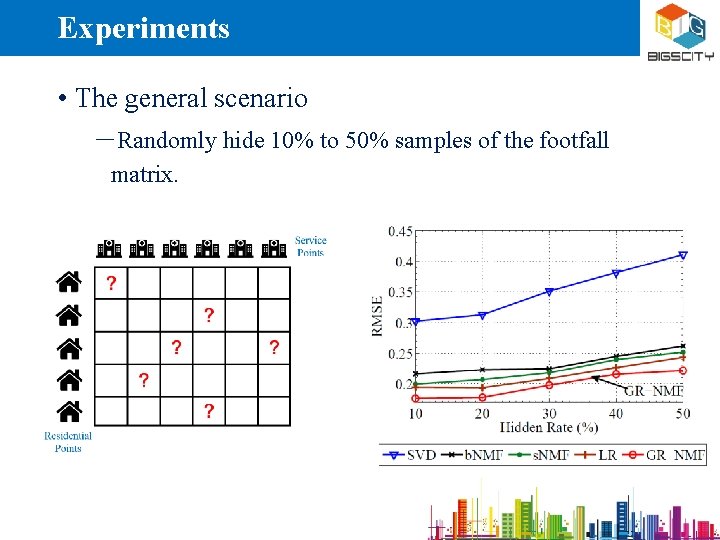
Experiments • The general scenario ―Randomly hide 10% to 50% samples of the footfall matrix.
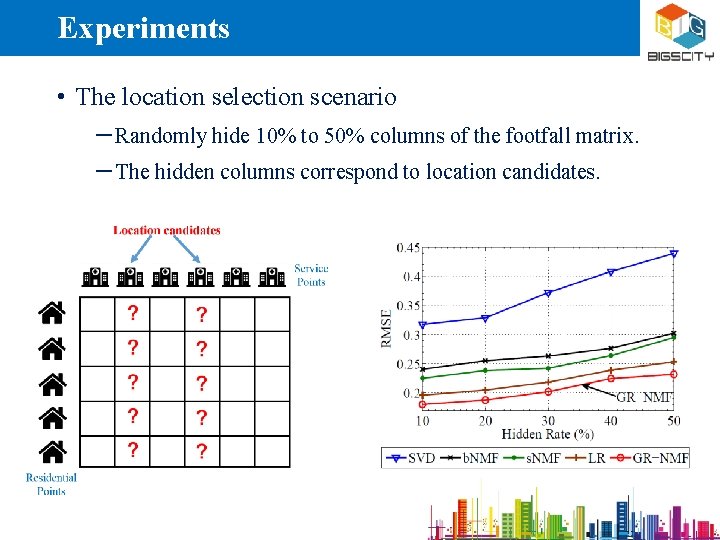
Experiments • The location selection scenario ―Randomly hide 10% to 50% columns of the footfall matrix. ―The hidden columns correspond to location candidates.
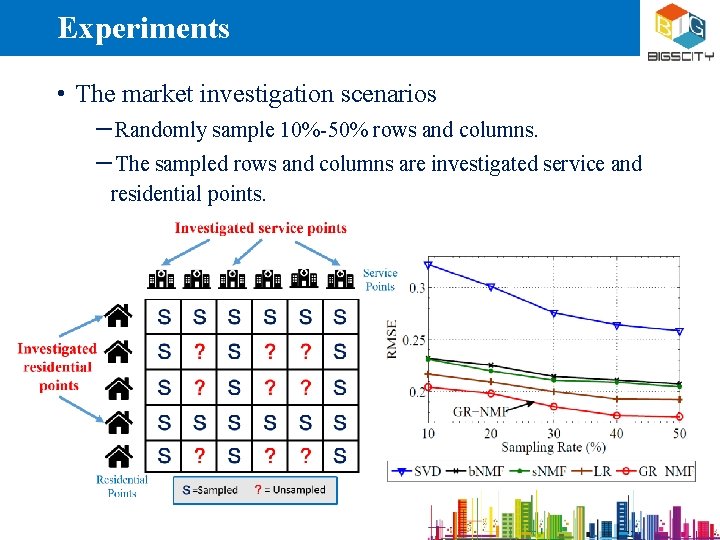
Experiments • The market investigation scenarios ―Randomly sample 10%-50% rows and columns. ―The sampled rows and columns are investigated service and residential points.
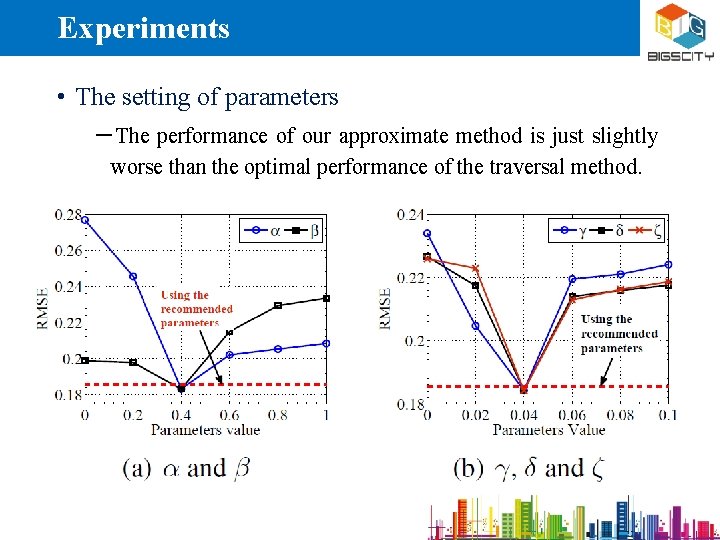
Experiments • The setting of parameters ―The performance of our approximate method is just slightly worse than the optimal performance of the traversal method.
Conclusions • The model proposed by this study have following contributions: ―GR-NMF is able to jointly model implicit knowledge hidden inside customer volumes and explicit knowledge expressed as geographical relations. ―GR-NMF has a unified probabilistic interpretation, which makes the model theoretically solid. ―Extensive experiments are conducted on a real-life outpatient dataset obtained from the Shenzhen city of China. ―The results show that GR-NMF outperforms competitive baselines consistently in various application scenarios with different sampling rates.
THANK YOU! Email: jywang@buaa. edu. cn Webpage: http: //www. bigscity. com/
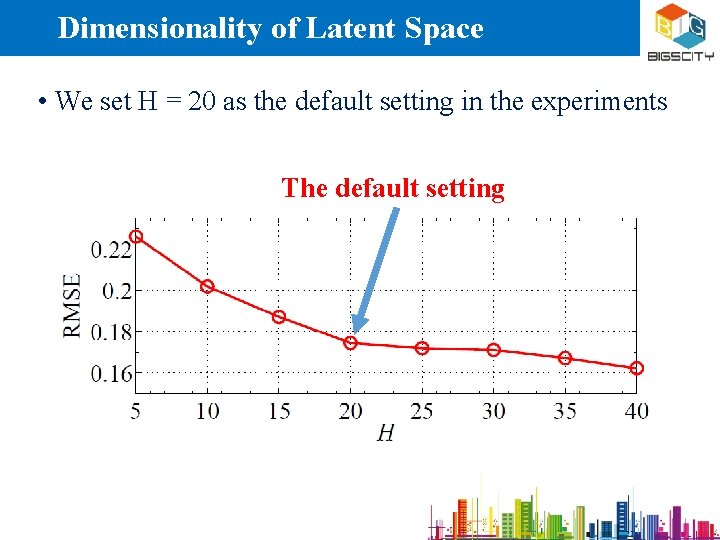
Dimensionality of Latent Space • We set H = 20 as the default setting in the experiments The default setting