
The THIRA and SPR Nolan Fry NCEM Planning
- Slides: 26
The THIRA and SPR Nolan Fry NCEM Planning and Homeland Security March 22, 2016 North Carolina Emergency Management
Keys to THIRA/SPR 1. Results driven by participants 2. THIRA is not based on your current capabilities 3. SPR results reflective of actual capability levels North Carolina Emergency Management
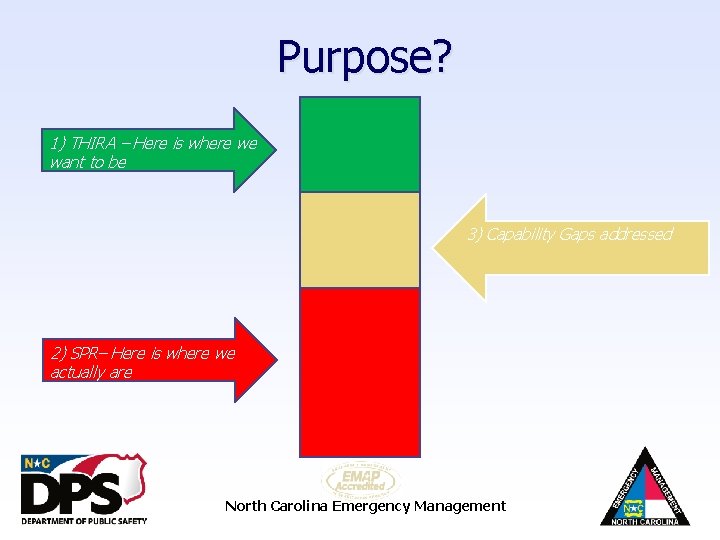
Purpose? 1) THIRA – Here is where we want to be 3) Capability Gaps addressed 2) SPR– Here is where we actually are North Carolina Emergency Management
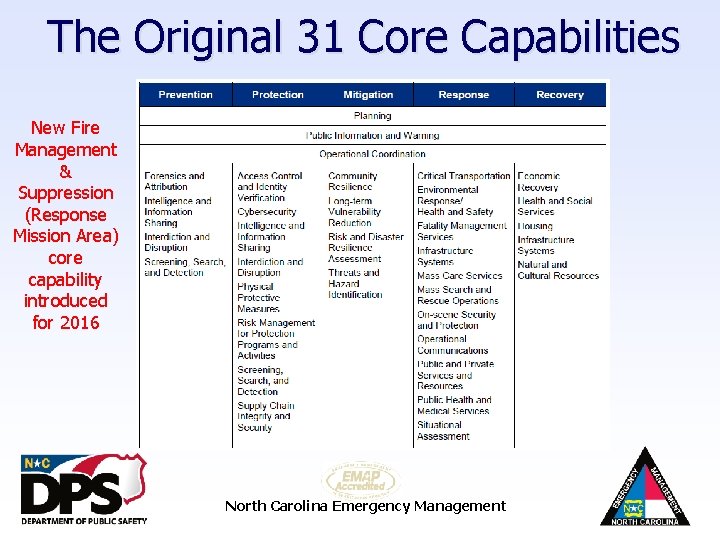
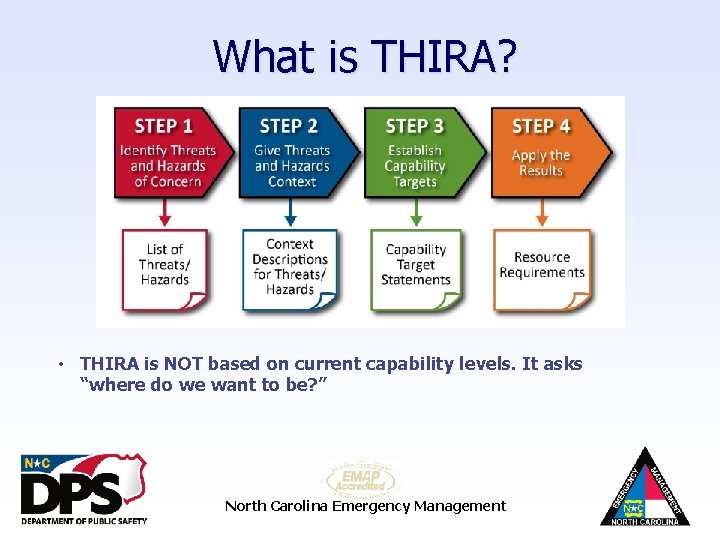
What is THIRA? • Threat Hazard Identification and Risk Assessment (THIRA) • A four-step process required by Presidential Policy Directive 8 (PPD-8) for states and UASIs • Fulfills the first two stages of the National Preparedness System (NPS) by examining the 32 core capabilities outlined by the National Preparedness Goal (NPG) North Carolina Emergency Management
The Original 31 Core Capabilities New Fire Management & Suppression (Response Mission Area) core capability introduced for 2016 North Carolina Emergency Management
What is THIRA? • THIRA is NOT based on current capability levels. It asks “where do we want to be? ” North Carolina Emergency Management
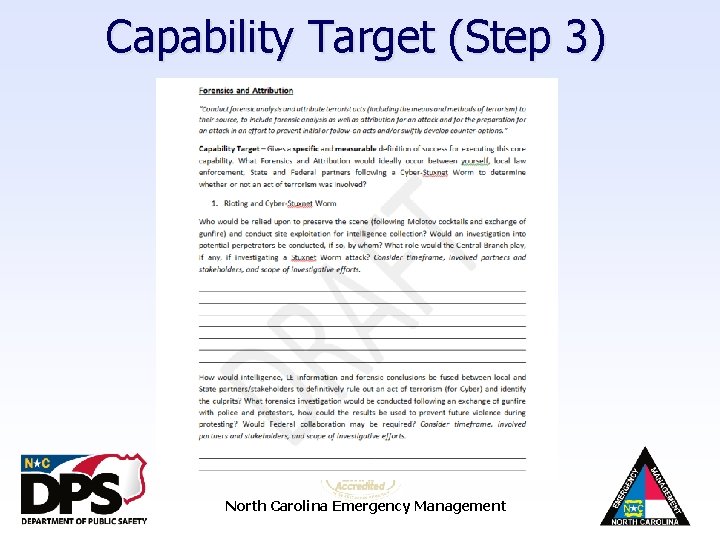
Capability Target (Step 3) North Carolina Emergency Management
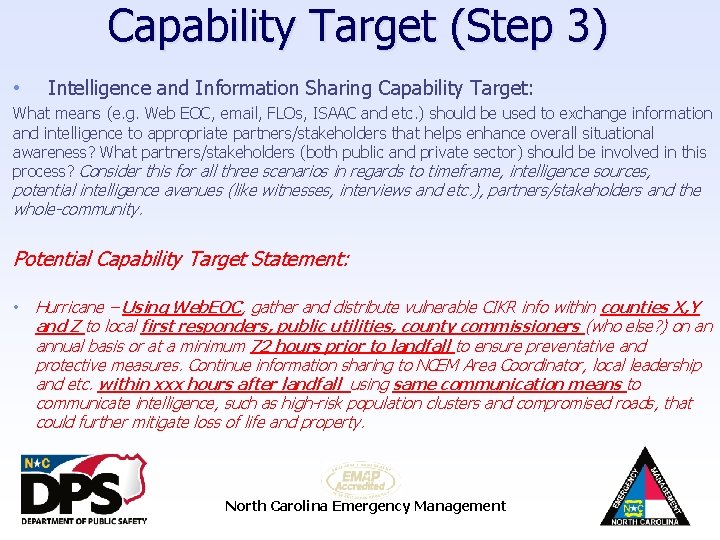
Capability Target (Step 3) • Intelligence and Information Sharing Capability Target: What means (e. g. Web EOC, email, FLOs, ISAAC and etc. ) should be used to exchange information and intelligence to appropriate partners/stakeholders that helps enhance overall situational awareness? What partners/stakeholders (both public and private sector) should be involved in this process? Consider this for all three scenarios in regards to timeframe, intelligence sources, potential intelligence avenues (like witnesses, interviews and etc. ), partners/stakeholders and the whole-community. Potential Capability Target Statement: • Hurricane – Using Web. EOC, gather and distribute vulnerable CIKR info within counties X, Y and Z to local first responders, public utilities, county commissioners (who else? ) on an annual basis or at a minimum 72 hours prior to landfall to ensure preventative and protective measures. Continue information sharing to NCEM Area Coordinator, local leadership and etc. within xxx hours after landfall using same communication means to communicate intelligence, such as high-risk population clusters and compromised roads, that could further mitigate loss of life and property. North Carolina Emergency Management
What is the SPR? • State Preparedness Report (SPR) • Required by the 2006 Post Katrina Emergency Management Reform Act (PKEMRA) • Uses the THIRA Capability Targets to self assess the State’s current capabilities through gap analysis North Carolina Emergency Management
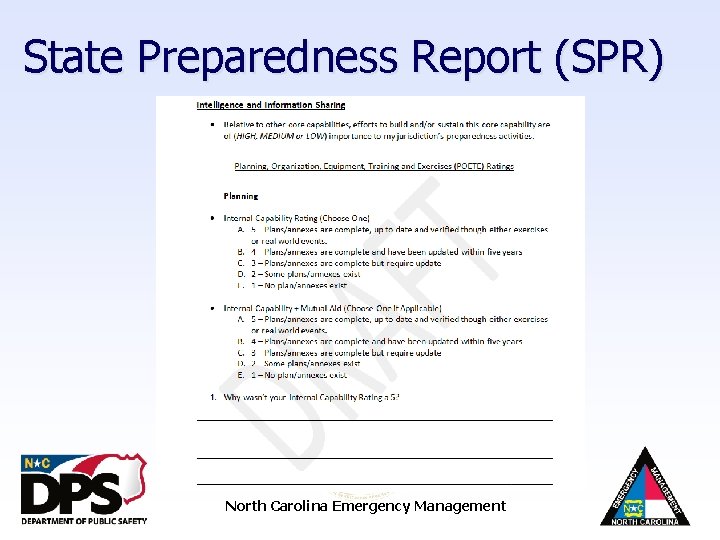
State Preparedness Report (SPR) • Each Core Capability examined through Planning, Organization, Equipment, Training and Exercise (POETE) • Each sector of POETE will give • • 1) An Internal Rating (1 -5) 2) Internal Rating + Mutual Aid Rating 3) Gap Description (why am I not a 5? ) 4) Recent Advances (what am I doing that is bringing us closer to a 5? ) North Carolina Emergency Management
State Preparedness Report (SPR) North Carolina Emergency Management
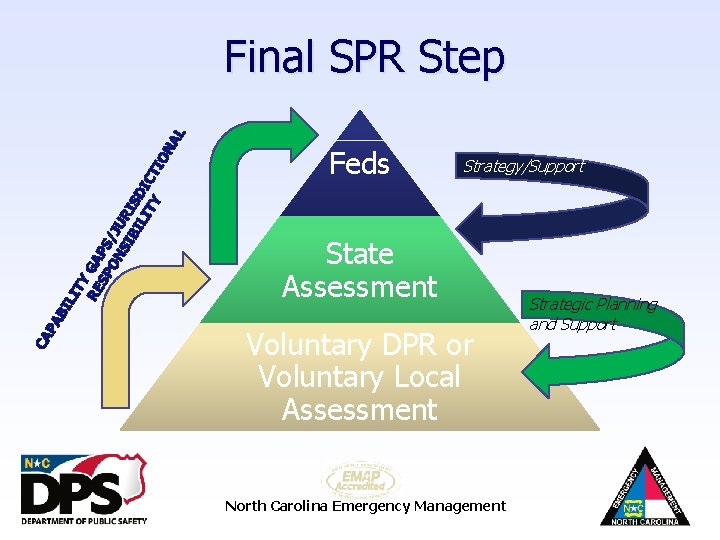
Final SPR Step Feds Strategy/Support State Assessment Voluntary DPR or Voluntary Local Assessment North Carolina Emergency Management Strategic Planning and Support
History • 2012 – Inaugural THIRA for states and UASIs SPR now informed by THIRA capability targets • 2012 results rarely used to inform plans and strategies North Carolina Emergency Management
History • 2013 • • • Resource estimation requirement introduced Five Mission Area workgroups meet during two -day workshop to update 2013 THIRA/SPR Per FEMA/DHS guidance, the results are used for development of HSGP IJs North Carolina Emergency Management
History • 2014 • • • No changes to guidance Individual meetings for each of the 31 core capabilities (CC) scheduled with SERC, SERT and other SMEs to provide concentrated and focused updates Two additional scenarios incorporated (Winter Storm and Tornado Outbreak) North Carolina Emergency Management
History • 2014 • • • Inaugural regional THIRA/Branch Preparedness Report (BPR) pilot with CBO and associated counties Customized and tailored for CBO and locals Incorporated the National Planning Frameworks critical tasks to pilot capability target templates and customized questionnaire worksheets North Carolina Emergency Management
The CBO County Experience • “Great opportunity to discuss issues (scenarios) that are for the most part ‘universal’ to each county regarding possible affects that they would have on individual counties. ” North Carolina Emergency Management
The CBO County Experience • “If utilized correctly, THIRA could allow state and locals to plan…to meet true capability gaps in our programs. ” North Carolina Emergency Management
History • 2014 • • State and CBO SPR/BPR capability gap results, coupled with NCEM Sr. Staff input, used to inform HSA’s selection of State Homeland Security priorities (15 core capabilities) Means by which NC SHSS is updated and subsequent guidance for prospective HSGP applicants North Carolina Emergency Management
2015 THIRA/SPR Update Process • SERC, SERT, NCEM Field Staff and other state partners involved • 50, 000 ft. strategic perspective • Developed custom worksheets (available upon request) to guide participants and facilitate remote participation • • • Applied NPF critical tasks Lessons learned Keeps thought process focused North Carolina Emergency Management
State Strengths and Areas for Improvement • Capability gaps are not failures, they are realities! • Need to develop active shooter/terrorism scenario for 2016 THIRA/SPR update North Carolina Emergency Management
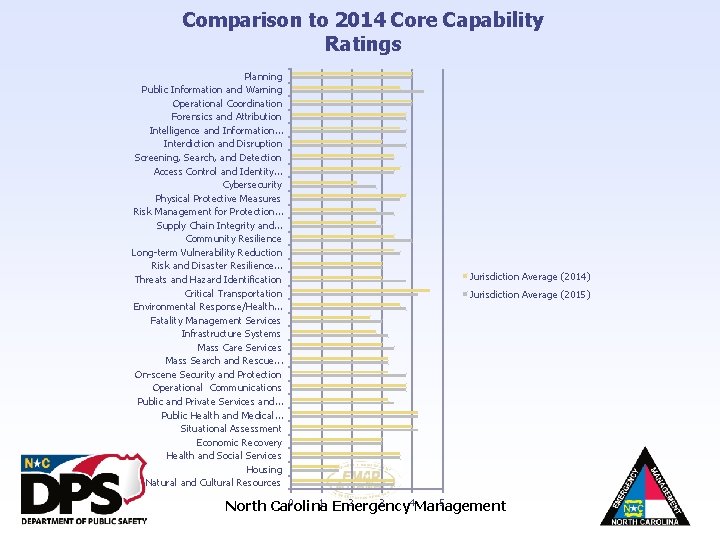
Comparison to 2014 Core Capability Ratings Planning Public Information and Warning Operational Coordination Forensics and Attribution Intelligence and Information. . . Interdiction and Disruption Screening, Search, and Detection Access Control and Identity. . . Cybersecurity Physical Protective Measures Risk Management for Protection. . . Supply Chain Integrity and. . . Community Resilience Long-term Vulnerability Reduction Risk and Disaster Resilience. . . Threats and Hazard Identification Critical Transportation Environmental Response/Health. . . Fatality Management Services Infrastructure Systems Mass Care Services Mass Search and Rescue. . . On-scene Security and Protection Operational Communications Public and Private Services and. . . Public Health and Medical. . . Situational Assessment Economic Recovery Health and Social Services Housing Natural and Cultural Resources Jurisdiction Average (2014) Jurisdiction Average (2015) 0 1 2 3 4 5 North Carolina Emergency Management
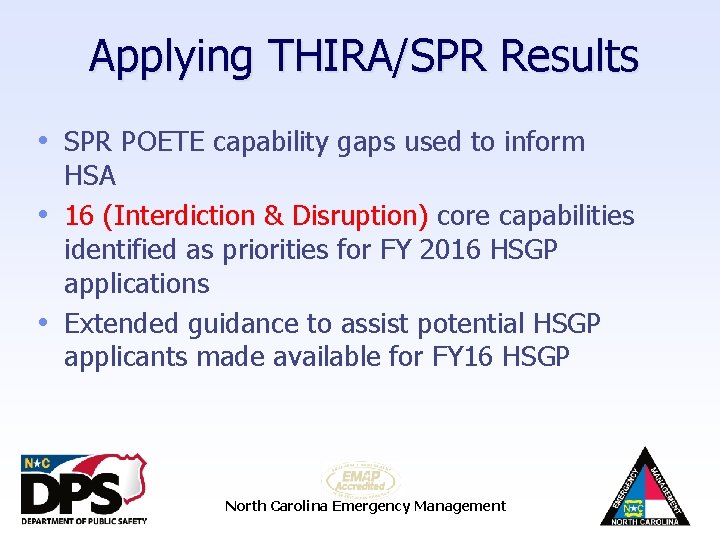
Applying THIRA/SPR Results • SPR POETE capability gaps used to inform HSA • 16 (Interdiction & Disruption) core capabilities identified as priorities for FY 2016 HSGP applications • Extended guidance to assist potential HSGP applicants made available for FY 16 HSGP North Carolina Emergency Management
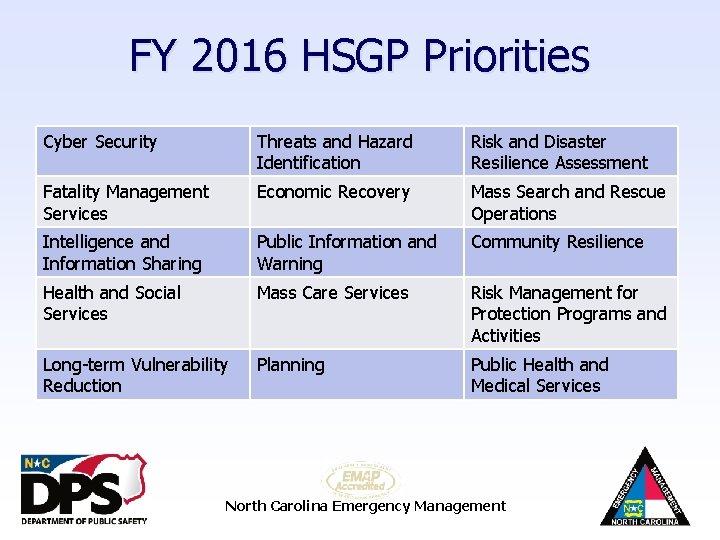
FY 2016 HSGP Priorities Cyber Security Threats and Hazard Identification Risk and Disaster Resilience Assessment Fatality Management Services Economic Recovery Mass Search and Rescue Operations Intelligence and Information Sharing Public Information and Warning Community Resilience Health and Social Services Mass Care Services Risk Management for Protection Programs and Activities Long-term Vulnerability Reduction Planning Public Health and Medical Services North Carolina Emergency Management
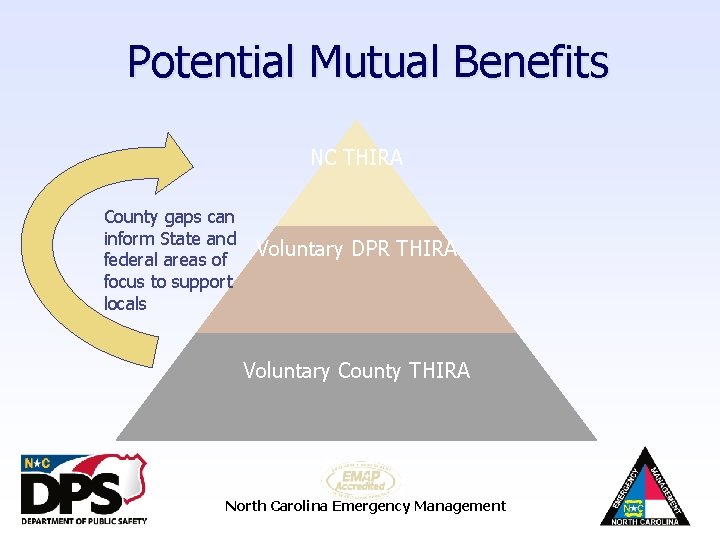
Potential Mutual Benefits NC THIRA County gaps can inform State and federal areas of focus to support locals Voluntary DPR THIRA Voluntary County THIRA North Carolina Emergency Management
Questions? Nolan. Fry@ncdps. gov (919) 825 -2268 Strategic Planning Branch Supervisor (ACTING) North Carolina Emergency Management