
The thing is as a film director youre





- Slides: 29
“The thing is, as a film director, you’re essentially alone: You have to tell a story primarily through pictures, and only you know the film you see in your head. ” – Mike Nichols, Director
Cultural Change � The Bay of Pigs Invasion 1960 – a failed CIA military action to kill Fidel Castro � The Cuban Missile Crisis – 1962 � The Assassination of JFK November 22, 1963 � The Zapruder Film – WARNING: GRAPHIC � The Civil Rights Act signed into law July 2, 1964 � The escalation of American involvement in the Vietnam Conflict � Guess Who’s Coming to Dinner (1967) � The Assassination of Martin Luther King, Jr. – April 4, 1968 � The Assassination of Robert F. Kennedy – June 6, 1968
The Studios � The studios were struggling to survive � Many studios had to sell their back lots to try to keep afloat �Some sold props - Vanity Fair article about Ruby Slippers “ 40 Acres” Studio
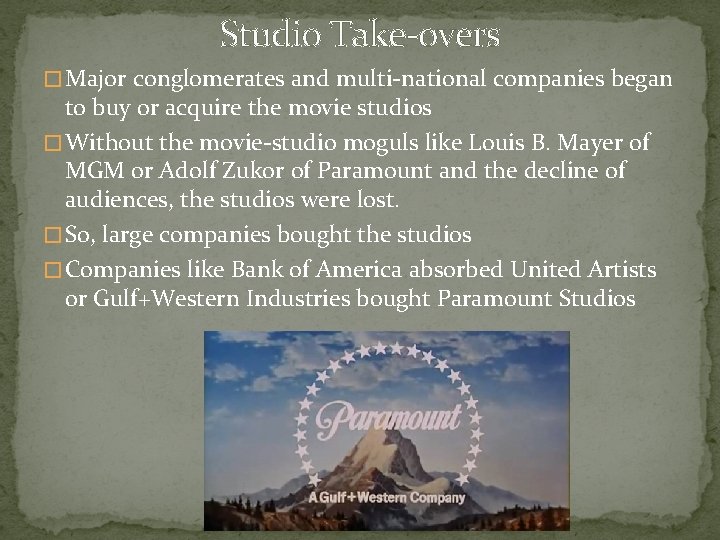
Studio Take-overs � Major conglomerates and multi-national companies began to buy or acquire the movie studios � Without the movie-studio moguls like Louis B. Mayer of MGM or Adolf Zukor of Paramount and the decline of audiences, the studios were lost. � So, large companies bought the studios � Companies like Bank of America absorbed United Artists or Gulf+Western Industries bought Paramount Studios
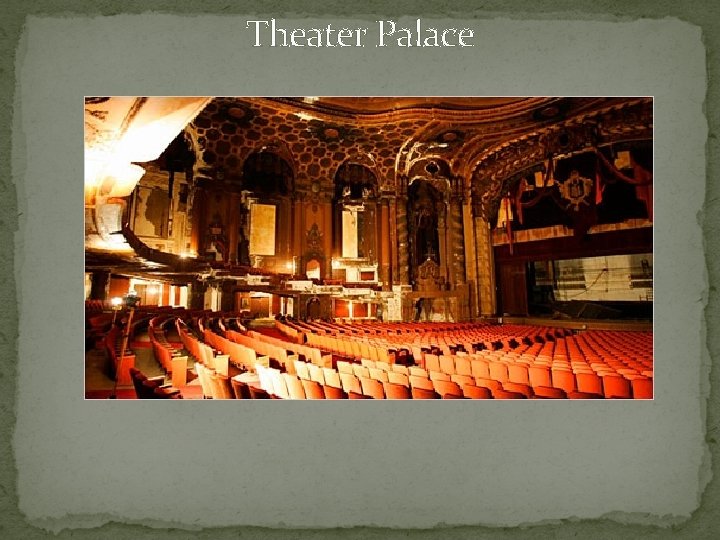
The Birth of The Multiplex � As audiences left the city to the suburbs, theaters followed �Stanley Durwood – the Father of the multiplex built the first side-by-side screens in a mall in Kansas City �A multiplex has more than one screen showing films �Replaced theater palaces of old
Theater Palace
Multiplex Screen
Films of Note – Early 1960 s � Alfred Hitchcock’s Psycho (1960) � West Side Story (1961) � In order to offset costs, many studios became distributors foreign made films (mostly from Britain) � Lawrence of Arabia (1962)– Dir. David Lean
The End of Historical Epics � Two of the last big EPIC films (coincidentally shot in Britain and Italy) were El Cid and Spartacus � The failure of Cleopatra (1963) starring Elizabeth Taylor and Richard Burton almost bankrupted 20 th Century Fox
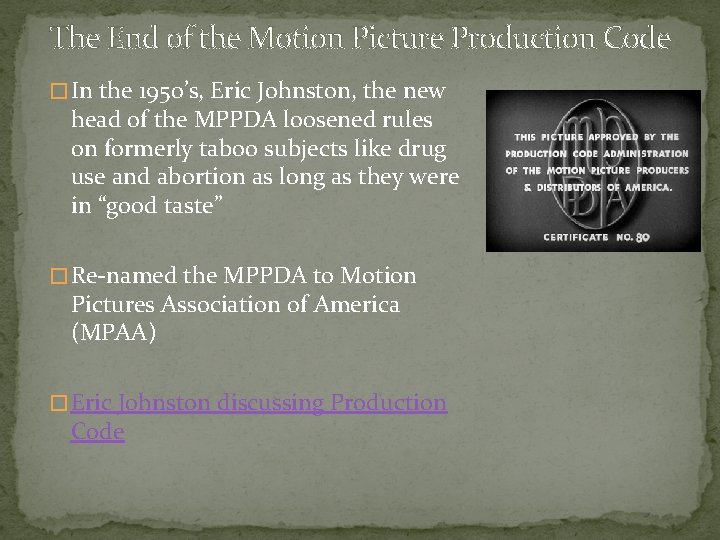
The End of the Motion Picture Production Code � In the 1950’s, Eric Johnston, the new head of the MPPDA loosened rules on formerly taboo subjects like drug use and abortion as long as they were in “good taste” � Re-named the MPPDA to Motion Pictures Association of America (MPAA) � Eric Johnston discussing Production Code
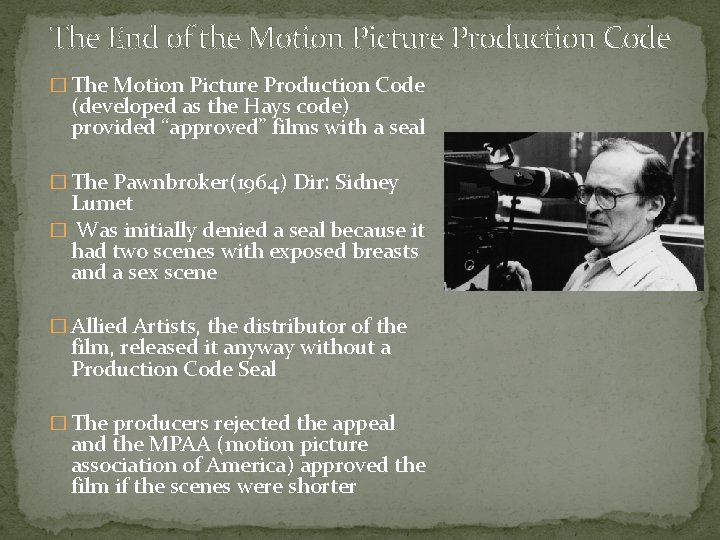
The End of the Motion Picture Production Code � The Motion Picture Production Code (developed as the Hays code) provided “approved” films with a seal � The Pawnbroker(1964) Dir: Sidney Lumet � Was initially denied a seal because it had two scenes with exposed breasts and a sex scene � Allied Artists, the distributor of the film, released it anyway without a Production Code Seal � The producers rejected the appeal and the MPAA (motion picture association of America) approved the film if the scenes were shorter
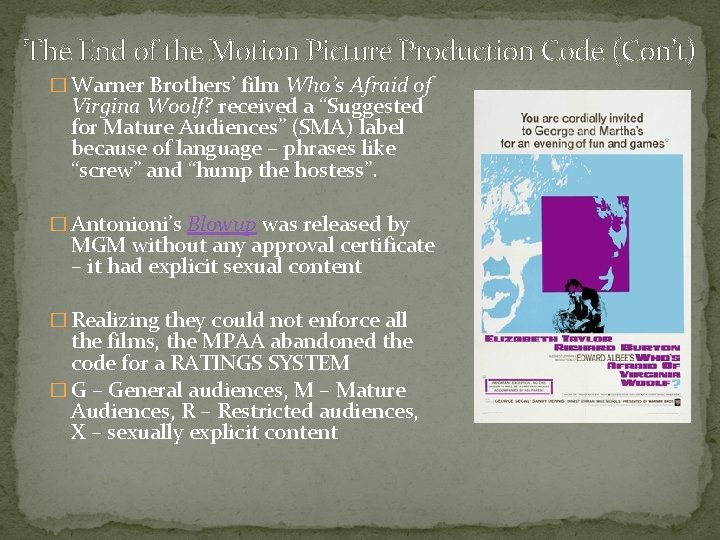
The End of the Motion Picture Production Code (Con’t) � Warner Brothers’ film Who’s Afraid of Virgina Woolf? received a “Suggested for Mature Audiences” (SMA) label because of language – phrases like “screw” and “hump the hostess”. � Antonioni’s Blowup was released by MGM without any approval certificate – it had explicit sexual content � Realizing they could not enforce all the films, the MPAA abandoned the code for a RATINGS SYSTEM � G – General audiences, M – Mature Audiences, R – Restricted audiences, X – sexually explicit content
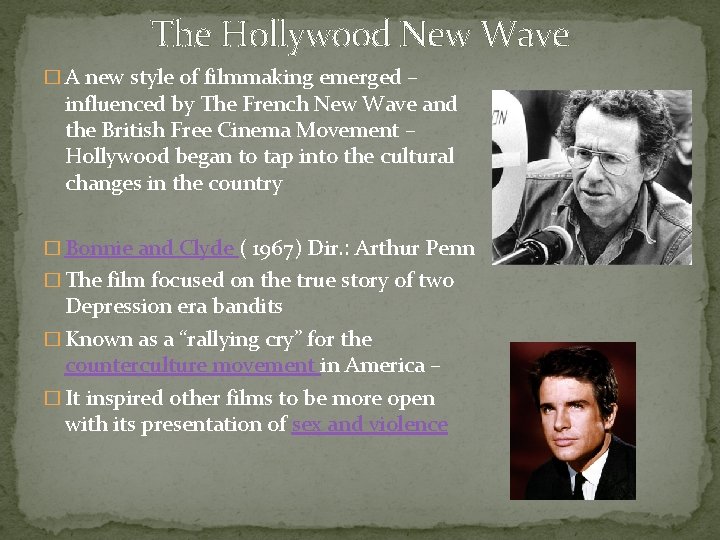
The Hollywood New Wave � A new style of filmmaking emerged – influenced by The French New Wave and the British Free Cinema Movement – Hollywood began to tap into the cultural changes in the country � Bonnie and Clyde ( 1967) Dir. : Arthur Penn � The film focused on the true story of two Depression era bandits � Known as a “rallying cry” for the counterculture movement in America – � It inspired other films to be more open with its presentation of sex and violence
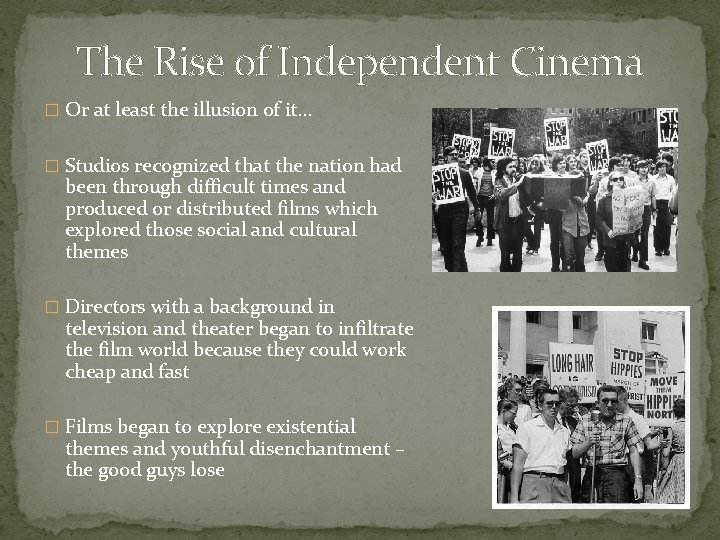
The Rise of Independent Cinema � Or at least the illusion of it… � Studios recognized that the nation had been through difficult times and produced or distributed films which explored those social and cultural themes � Directors with a background in television and theater began to infiltrate the film world because they could work cheap and fast � Films began to explore existential themes and youthful disenchantment – the good guys lose
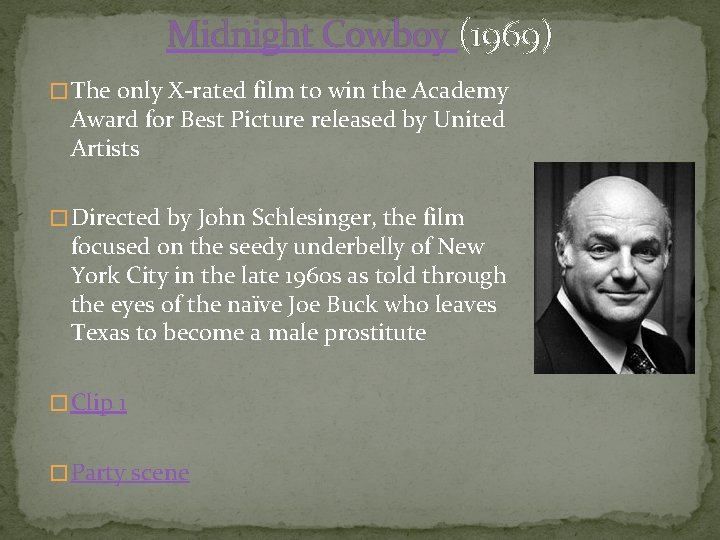
Midnight Cowboy (1969) � The only X-rated film to win the Academy Award for Best Picture released by United Artists � Directed by John Schlesinger, the film focused on the seedy underbelly of New York City in the late 1960 s as told through the eyes of the naïve Joe Buck who leaves Texas to become a male prostitute � Clip 1 � Party scene
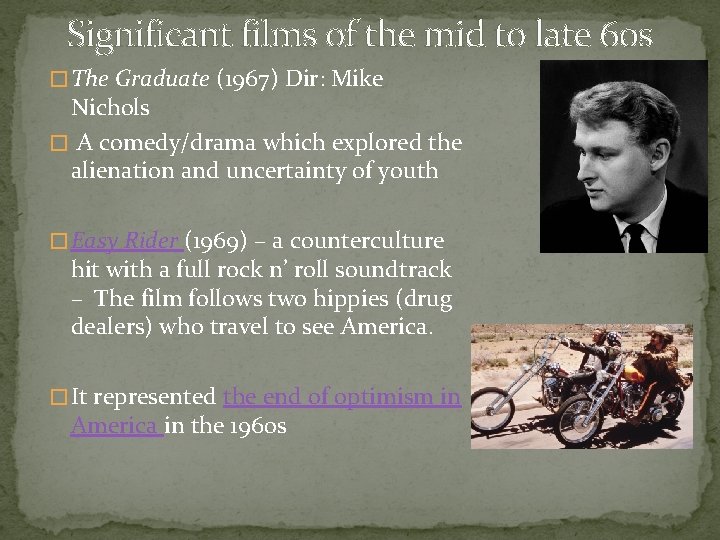
Significant films of the mid to late 60 s � The Graduate (1967) Dir: Mike Nichols � A comedy/drama which explored the alienation and uncertainty of youth � Easy Rider (1969) – a counterculture hit with a full rock n’ roll soundtrack – The film follows two hippies (drug dealers) who travel to see America. � It represented the end of optimism in America in the 1960 s
American Documentaries � With a renewed focus on trying to be “real”, documentaries grew in popularity in America � Primary (1960) was the touchstone project which introduced the hand-held, sync-sound and “it is happening right now” documentary tradition � Woodstock (1970) – a documentary following the three day music concert / festival with famous performances from Janis Joplin and Jimi Hendrix � Gimme Shelter (1970) – A concert film following the Rolling Stones – marred by the filming of the deadly stabbing of Meredith Hunter
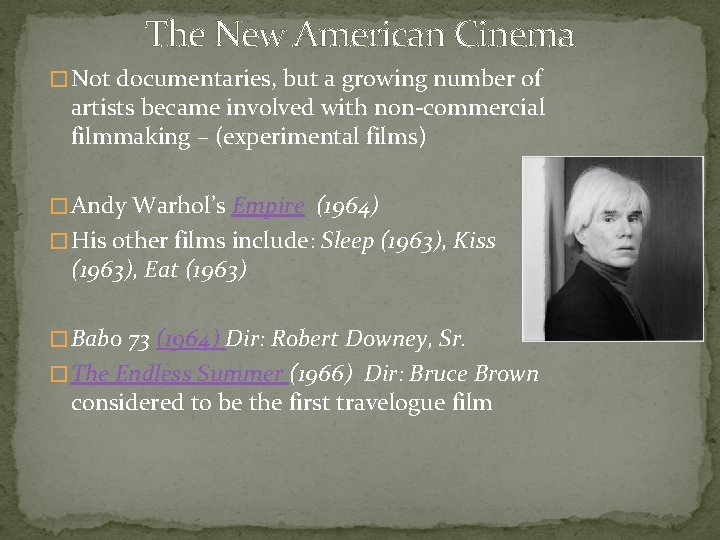
The New American Cinema � Not documentaries, but a growing number of artists became involved with non-commercial filmmaking – (experimental films) � Andy Warhol’s Empire (1964) � His other films include: Sleep (1963), Kiss (1963), Eat (1963) � Babo 73 (1964) Dir: Robert Downey, Sr. � The Endless Summer (1966) Dir: Bruce Brown considered to be the first travelogue film
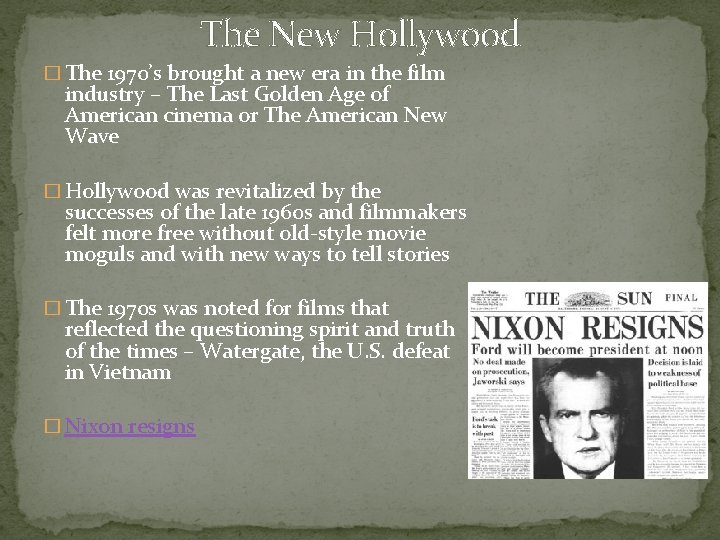
The New Hollywood � The 1970’s brought a new era in the film industry – The Last Golden Age of American cinema or The American New Wave � Hollywood was revitalized by the successes of the late 1960 s and filmmakers felt more free without old-style movie moguls and with new ways to tell stories � The 1970 s was noted for films that reflected the questioning spirit and truth of the times – Watergate, the U. S. defeat in Vietnam � Nixon resigns
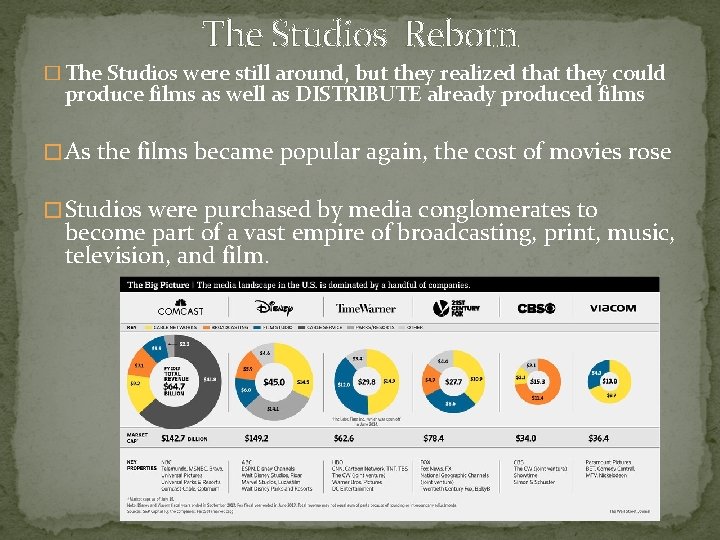
The Studios Reborn � The Studios were still around, but they realized that they could produce films as well as DISTRIBUTE already produced films � As the films became popular again, the cost of movies rose � Studios were purchased by media conglomerates to become part of a vast empire of broadcasting, print, music, television, and film.
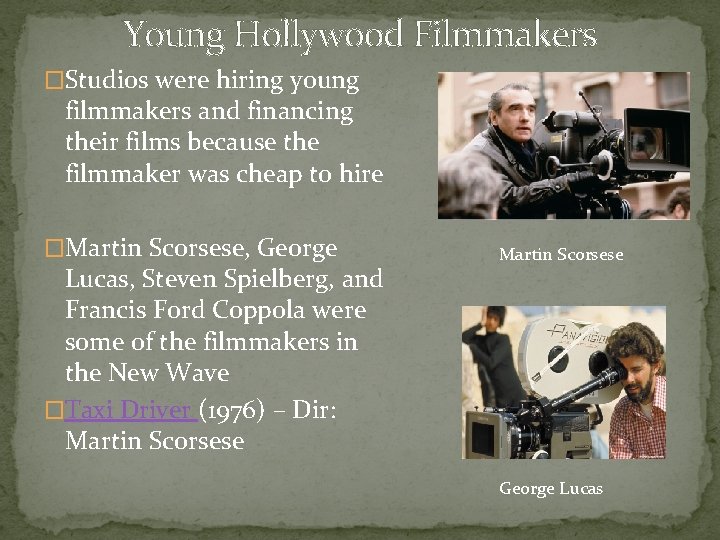
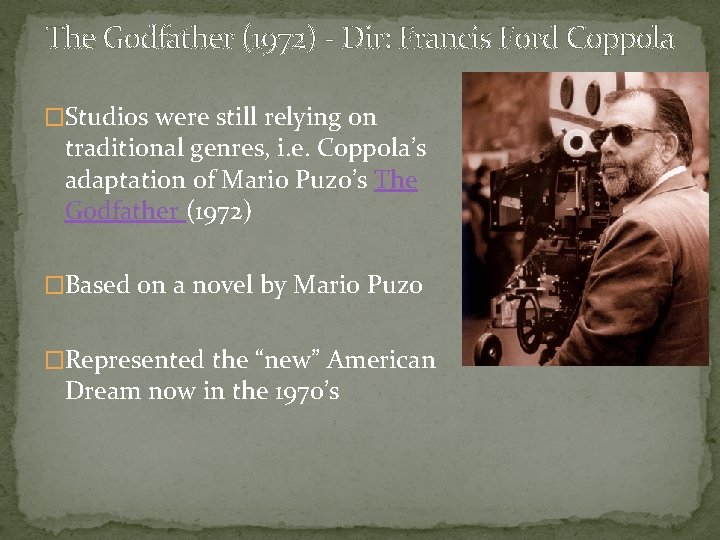
Young Hollywood Filmmakers �Studios were hiring young filmmakers and financing their films because the filmmaker was cheap to hire �Martin Scorsese, George Lucas, Steven Spielberg, and Francis Ford Coppola were some of the filmmakers in the New Wave �Taxi Driver (1976) – Dir: Martin Scorsese George Lucas
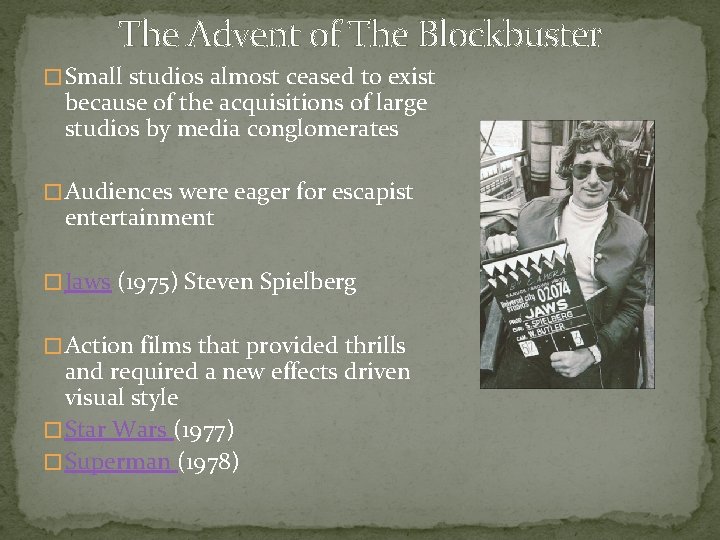
The Godfather (1972) - Dir: Francis Ford Coppola �Studios were still relying on traditional genres, i. e. Coppola’s adaptation of Mario Puzo’s The Godfather (1972) �Based on a novel by Mario Puzo �Represented the “new” American Dream now in the 1970’s
The Advent of The Blockbuster � Small studios almost ceased to exist because of the acquisitions of large studios by media conglomerates � Audiences were eager for escapist entertainment � Jaws (1975) Steven Spielberg � Action films that provided thrills and required a new effects driven visual style � Star Wars (1977) � Superman (1978)
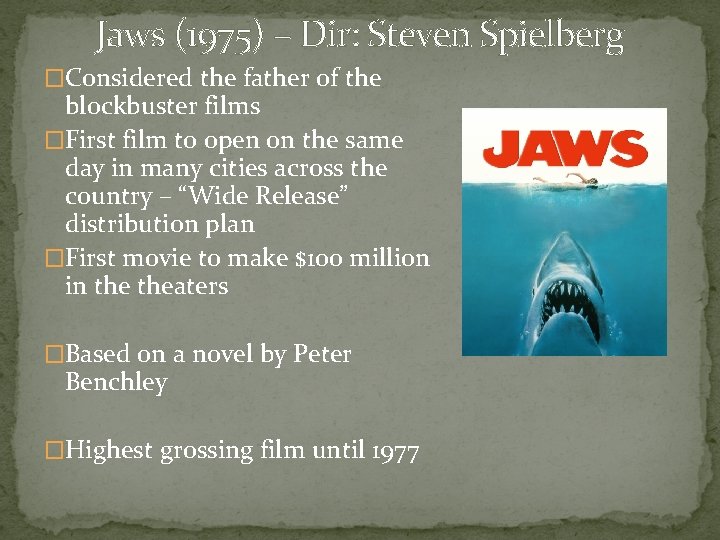
Jaws (1975) – Dir: Steven Spielberg �Considered the father of the blockbuster films �First film to open on the same day in many cities across the country – “Wide Release” distribution plan �First movie to make $100 million in theaters �Based on a novel by Peter Benchley �Highest grossing film until 1977
Genre Films Reborn � The new rating system allowed filmmakers to stretch the boundaries of what is acceptable � Films began to offer more violent visions � Films offered more “urban” cowboys taking the law into their own hands � Dirty Harry (1971) � The Poseidon Adventure (1972) – Disaster Movies � Dog Day Afternoon (1975) by Sidney Lumet
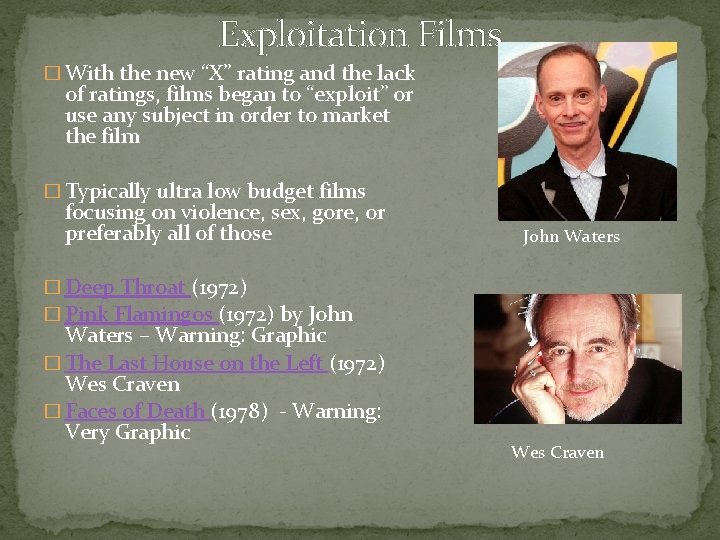
Exploitation Films � With the new “X” rating and the lack of ratings, films began to “exploit” or use any subject in order to market the film � Typically ultra low budget films focusing on violence, sex, gore, or preferably all of those John Waters � Deep Throat (1972) � Pink Flamingos (1972) by John Waters – Warning: Graphic � The Last House on the Left (1972) Wes Craven � Faces of Death (1978) - Warning: Very Graphic Wes Craven
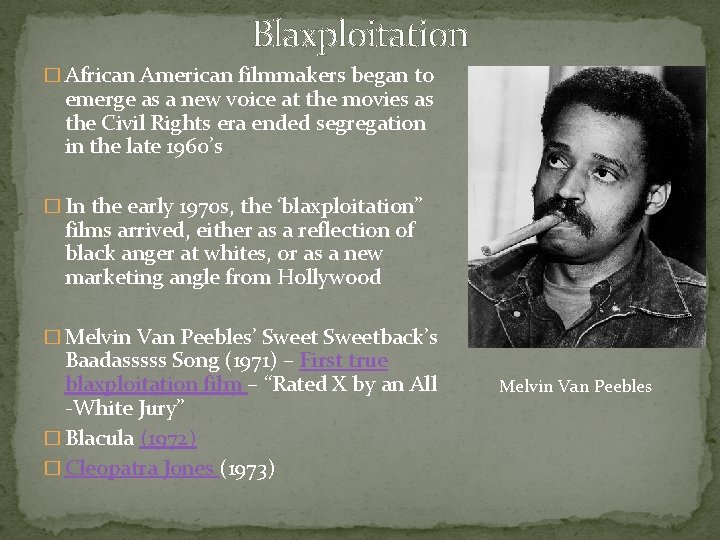
Blaxploitation � African American filmmakers began to emerge as a new voice at the movies as the Civil Rights era ended segregation in the late 1960’s � In the early 1970 s, the ‘blaxploitation” films arrived, either as a reflection of black anger at whites, or as a new marketing angle from Hollywood � Melvin Van Peebles’ Sweetback’s Baadasssss Song (1971) – First true blaxploitation film – “Rated X by an All -White Jury” � Blacula (1972) � Cleopatra Jones (1973) Melvin Van Peebles
Home Box Office (HBO) � Cable service began � Using satellite technology – HBO transmitted its first cable television programming for subscribers (September 30 - October 1, 1975 – Muhammed Ali and Joe Frazier boxing match – Thrilla in Manila) � First subscription based pay channel � Ancillary markets – Non-theatrical exhibition of films, like cable, home video, etc.
Home Videos � 1975 – Sony introduces Betamax video format and the VCR (video cassette recorder) � 1976 – JVC introduces VHS (Video Home System) – � Beta was a technically better format, but was very expensive � VHS was cheaper, but poorer quality � Sony finally stopped making Betamax in 2015